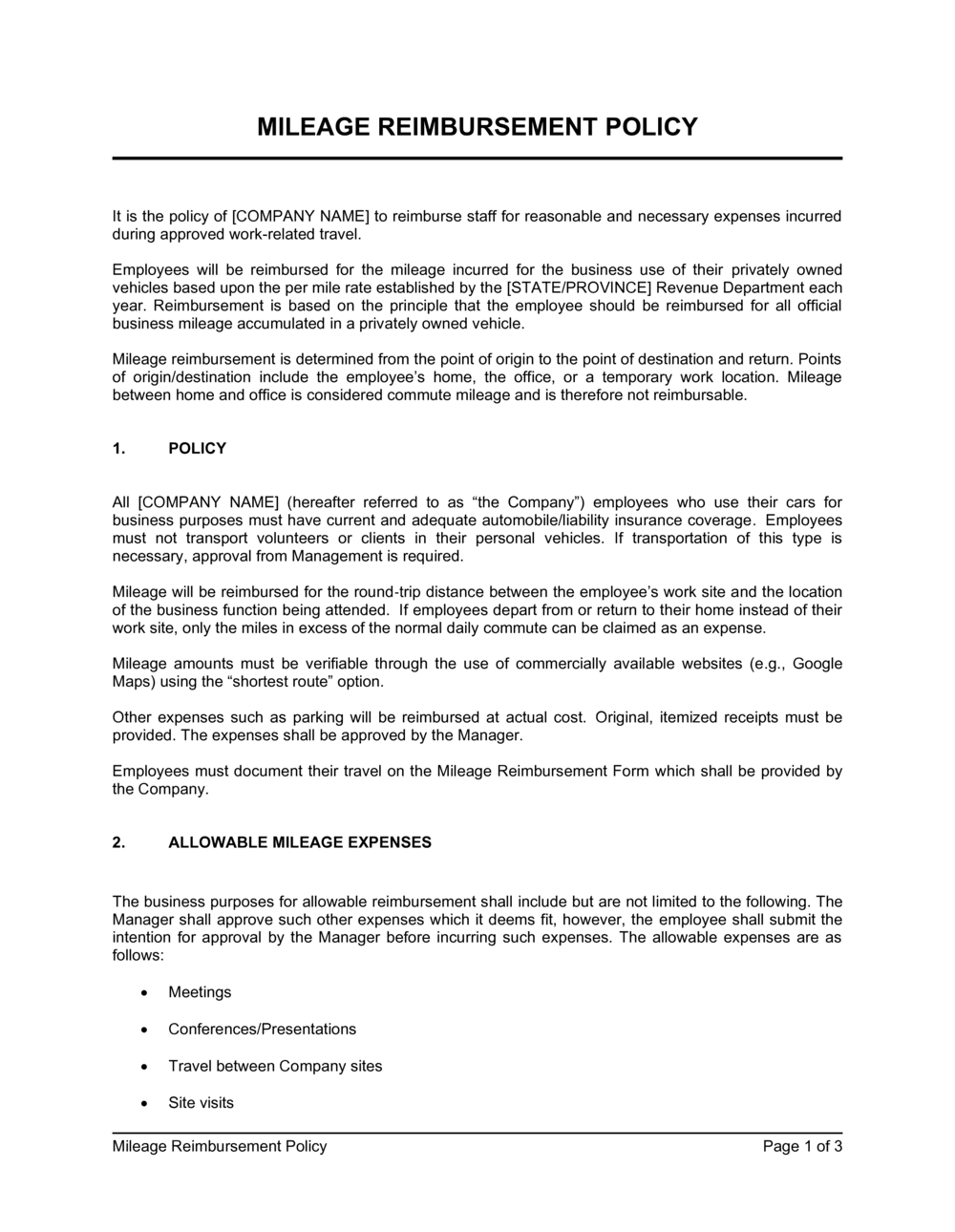
Mileage Reimbursement Policy Template

Free Word download β€’ Edit online β€’ Save & share with Drive β€’ Export to PDF

3 pagesβ€’20–25 min to fillβ€’Difficulty: Standard
Learn more ↓
FreeMileage Reimbursement Policy Template

At a glance

What it is
A Mileage Reimbursement Policy is an internal business document that defines how employees are compensated for using their personal vehicles for work-related travel. This free Word download provides a structured, editable template you can tailor to your reimbursement rate, eligible trip types, tracking requirements, and approval workflow, then export as PDF for employee distribution.
When you need it
Use it when employees regularly drive personal vehicles for client visits, inter-office travel, or field work and you need a consistent, auditable standard for processing and approving mileage claims. It is also required when aligning reimbursements to IRS standard mileage rates for tax purposes.
What's inside
Policy scope and eligible employees, reimbursement rate and IRS alignment, covered and excluded trip types, mileage log requirements, submission and approval workflow, payment timing, and consequences for non-compliance.

What is a Mileage Reimbursement Policy?

A Mileage Reimbursement Policy is an internal business document that establishes the rules, rates, and procedures for compensating employees who use their personal vehicles for approved work-related driving. It specifies the per-mile reimbursement rate β€” typically aligned to the IRS standard mileage rate β€” defines which trips qualify, mandates the mileage log format required for substantiation, and outlines the submission, approval, and payment workflow. Beyond operational consistency, a properly structured policy qualifies reimbursements as non-taxable under an IRS accountable plan, eliminating payroll tax liability for the company and the employee alike.

Why You Need This Document

Without a written mileage reimbursement policy, inconsistent reimbursements are inevitable β€” one manager approves commute miles while another denies legitimate client visits, creating both inequity and legal exposure. In California, Illinois, and Massachusetts, employers are legally required to reimburse employees for necessary business expenses, including driving; the absence of a written policy makes compliance impossible to demonstrate. For tax purposes, reimbursements processed without a documented accountable plan become taxable wages, triggering unnecessary income tax for employees and payroll tax for the company. A clear written policy, distributed and acknowledged before claims are submitted, closes all three gaps at once β€” and this template gives you a ready-to-publish starting point that covers every required component in under an hour.

Which variant fits your situation?

If your situation is…Use this template
Reimbursing employees at the IRS standard mileage rateMileage Reimbursement Policy (Standard Rate)
Providing a flat monthly car allowance instead of per-mile trackingCar Allowance Policy
Tracking all employee business expenses including mileageEmployee Expense Reimbursement Policy
Logging individual trips for reimbursement submissionMileage Log / Mileage Tracking Form
Reimbursing employees for a broader range of travel costsTravel and Expense Policy
Reimbursing contractors or freelancers for client-site travelIndependent Contractor Expense Policy
Governing company-owned vehicle use alongside personal vehicle reimbursementCompany Vehicle Use Policy

Common mistakes to avoid

❌ Not excluding commute miles in writing

Why it matters: Employees who misunderstand the IRS rule will submit home-to-office miles. Reimbursing them without a written exclusion creates taxable income for employees and payroll tax exposure for the company.

Fix: Add a dedicated section that explicitly states commute miles are ineligible and includes a worked example clarifying what counts when an employee drives from home directly to a client site.

❌ Setting no submission deadline

Why it matters: Without a cutoff, employees batch months of mileage into a single year-end submission, creating a cash-flow surprise, a reconciliation headache, and records that are impossible to verify months after the fact.

Fix: Establish a hard monthly deadline β€” typically the 5th to 10th of the month for prior-month travel β€” and state that late submissions beyond 30 days will not be reimbursed.

❌ Accepting logs with no documented business purpose

Why it matters: The IRS requires substantiation of the business purpose for every trip. A log that lists only miles and dates fails this standard, disallowing the deduction and exposing the company in an audit.

Fix: Require employees to record a brief but specific business purpose for each trip β€” 'client site visit β€” Acme Corp quarterly review' β€” and reject submissions that list only origin and destination.

❌ Failing to update the reimbursement rate when the IRS rate changes

Why it matters: If the company rate falls below the IRS standard rate, employees bear an uncompensated cost for business driving. If it exceeds the rate, the excess is taxable income β€” both outcomes create compliance and morale problems.

Fix: Assign a named policy owner who is responsible for reviewing the IRS rate announcement (typically issued in January) and updating the policy before the new rate takes effect.

The 9 key sections, explained

Policy purpose and scope

Reimbursement rate

Eligible and ineligible trips

Mileage log requirements

Submission process and deadlines

Approval workflow

Payment timing

Non-compliance and policy violations

Policy review and amendment

How to fill it out

  1. 1

    Set the policy scope and eligible employees

    Identify which job roles or departments are covered β€” typically field staff, sales representatives, and anyone whose role requires driving to external locations. Exclude roles that never travel for work.

    πŸ’‘ Attach an appendix listing covered job titles rather than writing 'all employees' β€” this prevents inappropriate claims and simplifies future updates when roles change.

  2. 2

    Enter the reimbursement rate and review schedule

    State the per-mile rate and whether it tracks the IRS standard rate automatically or requires a manual annual update. Add the calendar date by which the rate is reviewed each year.

    πŸ’‘ Setting the rate equal to the IRS standard rate simplifies tax treatment β€” reimbursements at or below the IRS rate are non-taxable under an accountable plan.

  3. 3

    Define eligible and excluded trip types

    List at least four examples of covered trips and explicitly exclude the daily home-to-office commute, personal errands, and any travel not pre-approved by a manager.

    πŸ’‘ Add a worked example: 'Driving from the office to a client site and back qualifies; driving from home directly to a client site means only the miles exceeding the normal commute qualify.'

  4. 4

    Specify mileage log requirements

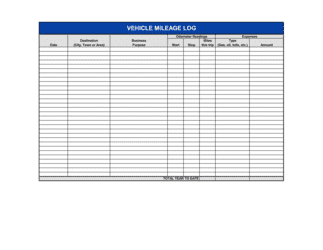
    List every data point a valid log entry must contain: date, origin, destination, business purpose, odometer readings, and total miles. Name the approved submission format β€” app, spreadsheet template, or paper form.

    πŸ’‘ Link to or embed your mileage log template directly in the policy so employees have no excuse for submitting incomplete records.

  5. 5

    Set submission deadlines and the approval workflow

    Enter the monthly submission cutoff date, the manager approval deadline, any secondary approval threshold, and the escalation path for disputes.

    πŸ’‘ A 30-day submission window with a hard cutoff is the most common and auditor-friendly configuration β€” it aligns with typical monthly close cycles.

  6. 6

    Document payment timing and method

    State which payroll cycle processes approved claims, whether reimbursement appears as a separate line item or is bundled with wages, and how it is designated on pay stubs.

    πŸ’‘ Labeling the payment 'mileage reimbursement β€” non-taxable' on the pay stub prevents employee confusion and simplifies year-end payroll reconciliation.

  7. 7

    Add the non-compliance and audit clause

    Include explicit language on consequences for false claims, the company's audit rights, and the documentation retention period (minimum three years for IRS purposes).

    πŸ’‘ Requiring employees to sign an acknowledgment when they receive the policy creates a record that they understood the consequences β€” useful in any disciplinary proceeding.

  8. 8

    Assign policy ownership and publish

    Name the department or role responsible for maintaining the policy, set the annual review date, and distribute to all covered employees via email or your HR system with a read-receipt or acknowledgment.

    πŸ’‘ Store the signed acknowledgments alongside the policy version they reference β€” version-controlling the document (v1.0, v1.1) makes audit responses straightforward.

Frequently asked questions

What is a mileage reimbursement policy?

A mileage reimbursement policy is an internal company document that defines the rules for compensating employees who use personal vehicles for work-related driving. It specifies the per-mile reimbursement rate, which trips qualify, what documentation employees must provide, and how claims are submitted and approved. A written policy protects the company from inconsistent reimbursements, IRS audit exposure, and disputes with employees over what qualifies.

What is the IRS standard mileage rate for 2024?

The IRS standard mileage rate for business driving is 67 cents per mile for 2024, up from 65.5 cents in 2023. This rate is updated annually β€” and occasionally mid-year during periods of high fuel cost volatility. Employers who reimburse at or below the IRS rate under an accountable plan do not need to include reimbursements in employee wages, making them non-taxable for both parties.

Are mileage reimbursements taxable?

Mileage reimbursements are non-taxable when made under an IRS accountable plan β€” meaning the policy requires a documented business purpose, timely substantiation through a mileage log, and the rate does not exceed the IRS standard rate. If any of these conditions are not met, reimbursements become taxable wages subject to income tax and payroll withholding. A well-written mileage reimbursement policy is the foundation of a compliant accountable plan.

Can I reimburse employees at a rate higher than the IRS standard rate?

Yes β€” employers can set a reimbursement rate higher than the IRS standard rate, but the amount exceeding the IRS rate is treated as taxable income for the employee and must be included in wages subject to withholding and payroll taxes. Most employers set their rate at or below the IRS standard to keep reimbursements non-taxable. Some employers use the FAVR method for high-mileage employees to account for local fuel and insurance cost variations.

Do commute miles qualify for mileage reimbursement?

No. Under IRS rules, miles driven between an employee's home and their regular primary work location are personal commute miles and do not qualify as deductible business expenses. This exclusion should be stated explicitly in the policy. An exception applies when an employee drives from home directly to a client site that is not their regular work location β€” in that case, only the miles that exceed the employee's normal commute distance may qualify.

What records does an employee need to keep for mileage reimbursement?

The IRS requires a contemporaneous mileage log documenting the date of each trip, the origin and destination, the business purpose, and the total miles driven. Odometer readings at the start and end of the trip provide the strongest substantiation. Digital mileage tracking apps that automatically record GPS routes satisfy these requirements and reduce administrative burden. Records should be retained for at least three years to cover the standard IRS audit window.

Is a mileage reimbursement policy legally required?

No federal law mandates a written mileage reimbursement policy. However, several states β€” including California, Illinois, and Massachusetts β€” require employers to reimburse employees for necessary business expenses, which includes business driving. Even where not legally required, a written policy prevents disputes, ensures consistent treatment across employees, and establishes the accountable plan structure needed for favorable tax treatment.

What is the difference between a mileage reimbursement policy and a car allowance policy?

A mileage reimbursement policy pays employees a per-mile rate only for miles actually driven for business, supported by a mileage log. A car allowance policy pays a flat monthly amount regardless of actual miles driven. Car allowances are simpler to administer but are always taxable wages unless paired with mileage substantiation. For employees with variable driving levels, per-mile reimbursement is more accurate and typically more tax-efficient.

How often should a mileage reimbursement policy be updated?

The policy should be reviewed at minimum once per year when the IRS announces its standard mileage rate, typically in January. It should also be reviewed mid-year if the IRS issues an emergency rate adjustment β€” as it did in 2022 β€” and whenever the company changes its expense management systems, approval workflows, or covered employee groups. Assign a named policy owner to ensure updates happen on schedule.

How this compares to alternatives

vs Car Allowance Policy

A car allowance policy pays a fixed monthly amount regardless of actual miles driven β€” simpler to administer but always taxable as wages without mileage substantiation. A mileage reimbursement policy pays only for miles actually driven with a log, keeping reimbursements non-taxable under an accountable plan. Use per-mile reimbursement when driving levels vary significantly across employees.

vs Travel and Expense Policy

A travel and expense policy covers the full range of business travel costs β€” flights, hotels, meals, ground transportation, and mileage. A mileage reimbursement policy is a narrower document focused exclusively on personal vehicle use. Companies often maintain both, with the mileage policy embedded as a section of the broader travel policy or published as a standalone document for driving-heavy roles.

vs Employee Expense Reimbursement Policy

An employee expense reimbursement policy covers all out-of-pocket business expenses β€” supplies, software, client entertainment, and travel. Mileage is typically one line item within it. A standalone mileage reimbursement policy is appropriate when driving is frequent enough to warrant dedicated tracking procedures, approval workflows, and IRS-specific documentation requirements.

vs Company Vehicle Use Policy

A company vehicle use policy governs employer-owned vehicles β€” who may drive them, for what purposes, insurance obligations, and personal use rules. A mileage reimbursement policy applies exclusively to employee-owned personal vehicles used for business. Companies with mixed fleets often maintain both documents, ensuring each vehicle type has its own governing rules and tax treatment.

Industry-specific considerations

Construction and trades

Field crews and project managers drive between job sites daily β€” high mileage volume makes a structured log and monthly submission cutoff essential for cost control.

Healthcare

Home health aides, visiting nurses, and medical sales reps drive extensively between patient locations and facilities, requiring precise per-trip documentation for Medicare cost-reporting compliance.

Professional services

Consultants and auditors billing travel costs to client engagements need mileage records that map to specific client matter codes for accurate client invoicing and expense recovery.

Retail and distribution

District managers and merchandisers cover multiple store locations per day, making a standardized log format and clear inter-store versus commute distinction critical to accurate reimbursement.

Template vs pro β€” what fits your needs?

PathBest forCostTime
Use the templateSmall and mid-sized businesses establishing a mileage policy for the first timeFree30–60 minutes
Template + professional reviewCompanies in California, Illinois, or Massachusetts where state expense reimbursement laws impose additional obligations$200–$500 for an HR advisor or employment attorney review1–3 days
Custom draftedEnterprises with multi-state workforces, unionized employees, or complex FAVR reimbursement programs$500–$2,000 for a custom HR policy package1–2 weeks

Glossary

IRS Standard Mileage Rate
The per-mile reimbursement rate set annually by the IRS that employers can use to calculate deductible business driving costs β€” 67 cents per mile for 2024.
Eligible Business Miles
Miles driven for a work-related purpose β€” such as client visits, inter-office travel, or approved errands β€” that qualify for reimbursement under the policy.
Commute Miles
Miles driven between an employee's home and their primary work location, which are explicitly excluded from business mileage reimbursement under IRS rules.
Mileage Log
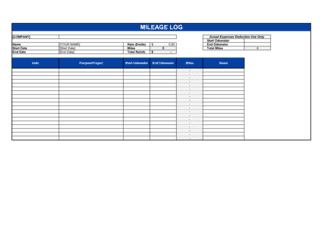
A written or digital record documenting each business trip's date, destination, business purpose, starting odometer reading, and total miles driven.
FAVR (Fixed and Variable Rate)
An IRS-compliant reimbursement method that combines a fixed monthly amount for vehicle ownership costs with a per-mile variable rate for fuel and wear.
Accountable Plan
An IRS-defined expense reimbursement arrangement requiring a business purpose, substantiation of expenses, and return of excess payments β€” qualifying reimbursements as non-taxable.
Non-Accountable Plan
A reimbursement arrangement that does not meet IRS accountable plan rules, making all reimbursements taxable wages subject to income tax and payroll withholding.
Odometer Reading
The vehicle's total mileage shown on the dashboard at the start and end of a trip, used to verify the distance claimed on a mileage log.
Reimbursement Rate
The dollar amount per mile the employer pays, which may equal the IRS standard rate or a higher or lower rate set by company policy.
Expense Substantiation
The documentation required to support a reimbursement claim β€” typically a mileage log with date, destination, purpose, and miles for each trip.

Part of your Business Operating System

This document is one of 3,000+ business & legal templates included in Business in a Box.

  • Fill-in-the-blanks β€” ready in minutes
  • 100% customizable Word document
  • Compatible with all office suites
  • Export to PDF and share electronically

Create your document in 3 simple steps.

From template to signed document β€” all inside one Business Operating System.
1
Download or open template

Access over 3,000+ business and legal templates for any business task, project or initiative.

2
Edit and fill in the blanks with AI

Customize your ready-made business document template and save it in the cloud.

3
Save, Share, Send, Sign

Share your files and folders with your team. Create a space of seamless collaboration.

Save time, save money, and create top-quality documents.

β˜…β˜…β˜…β˜…β˜…

"Fantastic value! I'm not sure how I'd do without it. It's worth its weight in gold and paid back for itself many times."

Managing Director Β· Mall Farm
Robert Whalley
Managing Director, Mall Farm Proprietary Limited
β˜…β˜…β˜…β˜…β˜…

"I have been using Business in a Box for years. It has been the most useful source of templates I have encountered. I recommend it to anyone."

Business Owner Β· 4+ years
Dr Michael John Freestone
Business Owner
β˜…β˜…β˜…β˜…β˜…

"It has been a life saver so many times I have lost count. Business in a Box has saved me so much time and as you know, time is money."

Owner Β· Upstate Web
David G. Moore Jr.
Owner, Upstate Web

Run your business with a system β€” not scattered tools

Stop downloading documents. Start operating with clarity. Business in a Box gives you the Business Operating System used by over 250,000 companies worldwide to structure, run, and grow their business.

Start freeΒ Β·Β No credit card required