Fleet Management Policy Template

Free Word download β€’ Edit online β€’ Save & share with Drive β€’ Export to PDF

3 pagesβ€’20–25 min to fillβ€’Difficulty: Standard
Learn more ↓
FreeFleet Management Policy Template

At a glance

What it is
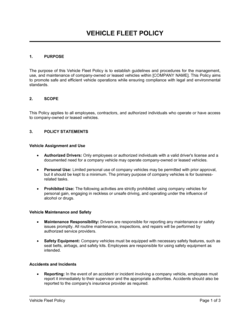
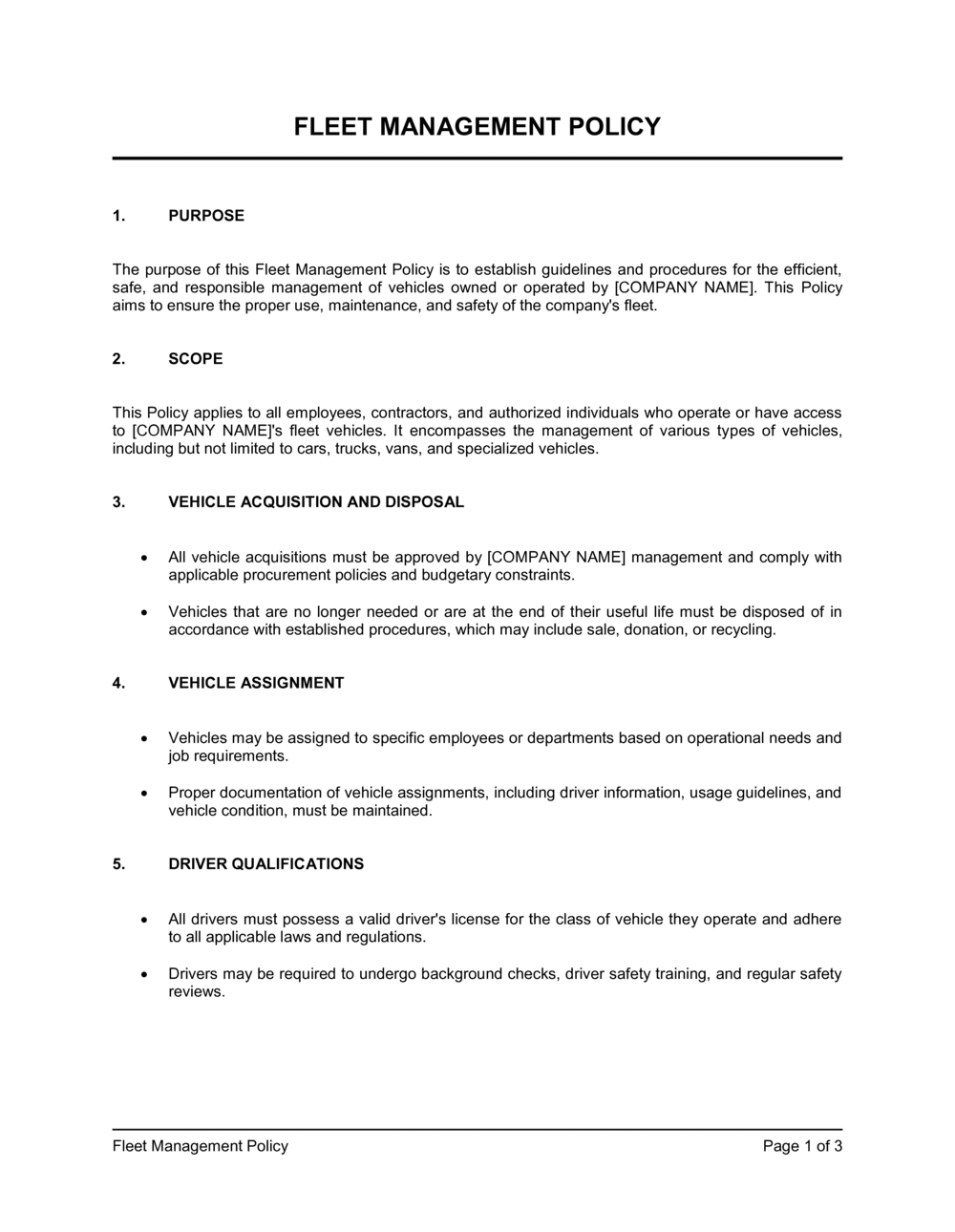
A Fleet Management Policy is an internal operational document that sets the rules governing how company-owned or leased vehicles are assigned, used, maintained, fueled, and returned. This free Word download gives you a structured, editable template you can adapt to your fleet size and industry, then distribute to drivers and managers as a binding company standard.
When you need it
Use it when your organization operates two or more vehicles for business purposes and needs consistent rules for driver eligibility, personal-use restrictions, maintenance scheduling, fuel reimbursement, and incident reporting. It is also required by most commercial auto insurers as a condition of coverage.
What's inside
Vehicle assignment and eligibility criteria, authorized-use and personal-use rules, driver licensing and background-check requirements, preventive maintenance schedules, fuel and expense procedures, accident and incident reporting protocols, traffic violation accountability, and vehicle return and disposal procedures.

What is a Fleet Management Policy?

A Fleet Management Policy is an internal operational document that establishes the rules, responsibilities, and procedures governing every aspect of a company's vehicle fleet β€” from driver eligibility and vehicle assignment through maintenance, fuel, incident reporting, and end-of-assignment return. It creates a single, authoritative reference for employees who drive company vehicles, managers who oversee the fleet, and administrators who track costs and compliance. Rather than leaving vehicle-use expectations to informal norms or scattered emails, a fleet management policy puts every standard in writing so they can be consistently applied and, when necessary, enforced.

Why You Need This Document

Without a written fleet management policy, organizations face compounding exposure on three fronts simultaneously. First, liability: in an accident involving a company vehicle, the absence of documented driver eligibility standards and conduct rules is routinely cited by plaintiffs' attorneys as evidence of negligent entrustment β€” a theory that can produce damage awards far exceeding the vehicle's insured value. Second, cost: untracked personal use, unaudited fuel cards, and deferred maintenance quietly inflate fleet operating costs with no policy basis to address them. Third, compliance: commercial auto insurers typically require documented fleet procedures as a condition of coverage, and FMCSA-regulated fleets face civil penalties for missing driver qualification records. This template gives you a structured, immediately editable starting point β€” covering all ten core policy areas β€” so you can close these gaps in hours rather than weeks.

Which variant fits your situation?

If your situation is…Use this template
Policy covering only passenger cars assigned to individual employeesCompany Vehicle Use Policy
Policy for a delivery fleet with daily route driversFleet Management Policy (Logistics)
Policy governing heavy commercial vehicles and CDL driversCommercial Fleet Safety Policy
Policy for a pool fleet shared by multiple departmentsMotor Pool Vehicle Policy
Policy for employees who use personal vehicles for company businessPersonal Vehicle Use and Reimbursement Policy
Policy specific to electric vehicle fleet operations and chargingEV Fleet Management Policy
Policy for a nonprofit or government fleet with public-asset controlsGovernment Fleet Vehicle Policy

Common mistakes to avoid

❌ No recurring MVR screening

Why it matters: A driver with a clean record at hire can accumulate serious violations within 12 months. Without annual re-screening, the organization may unknowingly assign vehicles to high-risk drivers β€” creating negligent entrustment exposure in accident litigation.

Fix: Schedule MVR pulls annually for all authorized drivers and immediately upon any reported accident. Automate the process through your insurer or a third-party MVR service.

❌ Permitting personal use without taxable benefit documentation

Why it matters: In the US, personal use of a company vehicle is a reportable fringe benefit under IRS rules. Failing to track and report it results in payroll tax underpayment and potential penalties during an IRS audit.

Fix: Require monthly personal-mileage logs from any driver with approved personal use. Work with your payroll provider to calculate and include the benefit on each affected employee's W-2.

❌ Installing telematics without disclosing it in writing

Why it matters: Undisclosed GPS monitoring has triggered employee grievances, arbitration claims, and regulatory complaints β€” particularly in California and the EU, where privacy expectations for workers are higher.

Fix: Include a telematics disclosure section in the policy, specify exactly what data is collected, who can access it, and for how long. Have drivers acknowledge this section separately at signing.

❌ No vehicle condition inspection at return

Why it matters: Without a documented pre-return inspection, damage found after a vehicle is reassigned cannot be attributed to the previous driver β€” leaving the company with unrecoverable repair costs and no basis for disciplinary action.

Fix: Add a standardized condition checklist to the vehicle return procedure and require both the driver and a fleet administrator to sign it before the keys are accepted.

The 10 key sections, explained

Purpose and scope

Driver eligibility and authorization

Vehicle assignment and personal use

Driver conduct and safety rules

Preventive maintenance and inspections

Fuel, expenses, and fuel cards

Accident, incident, and damage reporting

Traffic violations and fines

Telematics and monitoring

Vehicle return and end-of-assignment procedures

How to fill it out

  1. 1

    Define your fleet and covered vehicles

    List the vehicle categories covered β€” owned, leased, rental, and pool vehicles. Decide whether personal vehicles used on company business are in scope, and state this explicitly in the purpose and scope section.

    πŸ’‘ If you reimburse employees for personal vehicle use under a mileage program, handle that in a separate addendum to keep this policy focused on company-owned assets.

  2. 2

    Set driver eligibility criteria

    Specify the minimum license class, minimum driver age, MVR screening threshold (e.g., no more than 2 moving violations in 36 months), and any mandatory training. Decide how often MVRs will be re-checked β€” annually is standard.

    πŸ’‘ Pull current MVR screening thresholds from your commercial auto insurer β€” many policies void coverage if you knowingly assign a vehicle to a driver who exceeds their maximum violation count.

  3. 3

    Decide on personal-use rules

    Determine whether personal use is prohibited entirely, permitted with pre-approval, or permitted within defined limits (e.g., commuting only). If personal use is allowed, document how the taxable benefit will be calculated and reported.

    πŸ’‘ Zero personal use is the simplest policy to administer β€” if you allow it, build a monthly personal-mileage log process before you launch the policy.

  4. 4

    Fill in the maintenance schedule thresholds

    Enter the oil-change interval (typically every 5,000–7,500 miles for modern engines), tire rotation frequency, and annual inspection requirements. Assign clear responsibility to either the driver or a fleet administrator.

    πŸ’‘ Link the maintenance schedule to your telematics data if available β€” automated mileage alerts are more reliable than driver-initiated scheduling.

  5. 5

    Configure fuel card and expense rules

    Specify the fuel card issuer, permitted fuel types, receipt submission deadline, and the reconciliation process. Name the person responsible for monthly card audits.

    πŸ’‘ Set a per-transaction alert threshold on your fuel card portal β€” any single transaction above 120% of the vehicle's tank capacity warrants review.

  6. 6

    Define accident reporting timelines

    Enter the notification window (2 hours is standard), the incident report completion deadline (24 hours), and the escalation chain. Attach the incident report form as Appendix B.

    πŸ’‘ Pre-populate the incident form with insurer contact details, claim reporting phone numbers, and the policy number so drivers have everything they need in a stressful moment.

  7. 7

    Set the violation escalation ladder

    Specify the number of violations that trigger re-training, the number that trigger a suspension of driving privileges, and whether any single offense β€” DUI, reckless driving β€” results in automatic revocation.

    πŸ’‘ Align the escalation ladder with your disciplinary policy so you can cross-reference both documents without contradicting the HR process.

  8. 8

    Obtain acknowledgment signatures and distribute

    Add an acknowledgment page at the end of the document requiring each authorized driver to sign and date that they have read and understood the policy. Retain signed copies in the employee's personnel file.

    πŸ’‘ Re-obtain signatures any time the policy is materially updated β€” a signed copy of an outdated policy does not cover you for a rule the driver was never shown.

Frequently asked questions

What is a fleet management policy?

A fleet management policy is an internal company document that defines the rules governing how employees may use, maintain, fuel, and return company-owned or leased vehicles. It sets driver eligibility standards, behavioral conduct requirements, maintenance responsibilities, accident reporting procedures, and the consequences of violations. Most commercial auto insurers require a documented fleet policy as a condition of coverage.

Who needs a fleet management policy?

Any organization that owns, leases, or regularly rents two or more vehicles for business use should have a formal fleet management policy. This includes delivery and logistics companies, construction firms, healthcare providers with mobile staff, field service organizations, and any business that assigns cars to sales or executive employees. Even a small fleet of two to five vehicles creates enough liability exposure to warrant a written policy.

What should a fleet management policy include?

At minimum, a complete fleet policy covers: vehicle and driver scope, driver eligibility and MVR screening requirements, authorized and personal-use rules, driver conduct and safety standards, preventive maintenance responsibilities, fuel card procedures, accident and incident reporting timelines, traffic violation accountability, telematics disclosure if applicable, and vehicle return procedures. Most policies also include a driver acknowledgment signature page and appendices for the pre-trip inspection checklist and incident report form.

Is a fleet management policy legally required?

No single federal law in the US mandates a written fleet policy, but several factors make one effectively essential. Commercial auto insurers typically require one as a policy condition. FMCSA regulations require documented driver qualification and hours-of-service procedures for commercial motor vehicles. OSHA's General Duty Clause requires employers to provide a safe work environment, which includes safe vehicle operation standards. In the absence of a written policy, courts and regulators use the lack of documentation as evidence of negligence.

Can employees use company vehicles for personal errands?

Personal use is permissible only if the company's fleet policy explicitly allows it and the employee has received written approval. Even when permitted, personal use of a company vehicle is a taxable fringe benefit under IRS rules and must be reported on the employee's W-2. Many organizations restrict personal use to commuting only, or prohibit it entirely to simplify tax administration and reduce insurance exposure.

How often should driver records be checked?

Annual MVR checks for all authorized drivers are the industry standard and are required by many commercial auto insurance policies. In addition to annual reviews, an MVR should be pulled immediately after any reported accident, whenever a driver discloses a new violation, and upon rehire after a break in service. Higher-risk roles β€” delivery drivers, CDL operators β€” warrant semi-annual screening.

What should happen when an employee with a company vehicle leaves the company?

The policy should require the departing employee to return the vehicle, all keys, fuel cards, and access devices on or before their last day. A condition inspection should be completed and signed by both parties before the keys are accepted. Any outstanding fuel card charges or unreported incidents should be reconciled before final payroll processing. Failure to document the return condition leaves the company unable to attribute damage discovered during the next assignment.

Does a fleet policy cover rental cars?

It depends on how the policy is scoped. Some organizations include company-rented vehicles in the same policy as owned and leased fleet assets β€” particularly if employees rent vehicles frequently for travel. Others handle rental vehicles through a separate travel and expense policy. Whichever approach you take, the policy should state clearly whether rental vehicles are covered, and whether employees may decline or accept rental insurance at the counter.

What are the consequences of not having a fleet management policy?

Without a written policy, the organization has no documented basis for disciplining drivers who misuse vehicles, no standard for what a properly maintained vehicle looks like, and no procedure to point to when an insurer investigates a claim. In litigation following an accident, the absence of a fleet policy is frequently used by plaintiffs' attorneys to argue negligent entrustment or negligent supervision β€” both of which can result in punitive damages beyond the vehicle's insured value.

How this compares to alternatives

vs Vehicle Use Policy

A vehicle use policy focuses narrowly on who may drive company vehicles and under what conditions. A fleet management policy is broader β€” it adds maintenance scheduling, fuel card procedures, telematics disclosure, incident reporting, and end-of-life disposal rules. Use a vehicle use policy for small organizations with one or two cars; use a fleet management policy when you have three or more vehicles and a dedicated fleet function.

vs Driver Safety Policy

A driver safety policy concentrates on behavioral standards β€” seatbelt use, phone restrictions, speed limits, and substance rules. A fleet management policy incorporates all of those standards and extends them to asset management, cost control, and administrative procedures. Most organizations embed driver safety rules as a section within the fleet management policy rather than maintaining two separate documents.

vs Travel and Expense Policy

A travel and expense policy governs all forms of business travel β€” flights, hotels, meals, and ground transportation β€” including mileage reimbursement for personal vehicles. A fleet management policy governs only company-owned or leased vehicles. The two documents can coexist: the fleet policy covers the company fleet; the travel policy covers rental cars and personal vehicle reimbursement during business trips.

vs Employee Handbook

An employee handbook summarizes all company policies in one reference document, typically with brief paragraphs on each topic. A fleet management policy is a standalone document that provides the full procedural depth β€” checklists, forms, and escalation procedures β€” that a handbook summary cannot. The handbook should reference the fleet policy and direct employees to the full document for operating details.

Industry-specific considerations

Logistics and distribution

High-volume driver rosters, daily pre-trip inspection requirements, FMCSA hours-of-service integration, and route-based telematics monitoring.

Construction and field services

Tool and equipment transport rules, jobsite access restrictions, load securement standards, and heavy-vehicle maintenance intervals.

Healthcare and home services

HIPAA-compliant patient visit records tied to vehicle logs, lone-worker safety check-in procedures, and after-hours vehicle use rules for on-call staff.

Sales and professional services

Individual vehicle assignments tied to compensation plans, mileage and fuel reimbursement integration, and personal-use taxable benefit tracking for executive car allowances.

Template vs pro β€” what fits your needs?

PathBest forCostTime
Use the templateOrganizations with 2–25 vehicles that need a documented policy for insurance, HR, and driver accountability purposesFree2–4 hours to customize and distribute
Template + professional reviewFleets with CDL drivers, FMCSA-regulated operations, or multi-state compliance requirements$300–$800 for a compliance consultant or employment attorney review3–5 business days
Custom draftedLarge fleets (100+ vehicles), heavily regulated industries, or organizations integrating policy with telematics and HR platforms$1,500–$5,000+ for a fleet management consultant or specialized counsel2–4 weeks

Glossary

Fleet Vehicle
Any vehicle owned, leased, or rented by the organization and assigned for business use by employees.
Authorized Driver
An employee or contractor who has been formally approved to operate a company vehicle after meeting licensing, background-check, and training requirements.
Motor Vehicle Record (MVR)
An official report from a state or provincial licensing authority listing a driver's license status, violations, suspensions, and accidents.
Preventive Maintenance Schedule
A calendar- or mileage-based plan specifying when each vehicle receives oil changes, tire rotations, brake inspections, and other routine services.
Telematics
GPS and onboard diagnostic technology that tracks vehicle location, speed, idle time, hard braking, and fuel consumption in real time.
Personal Use
Any use of a company vehicle outside of authorized business purposes, including commuting, personal errands, or use by non-employees.
Incident Report
A standardized form completed by the driver within a defined timeframe after any accident, collision, or vehicle damage event.
Total Cost of Ownership (TCO)
The full lifecycle cost of a vehicle including purchase price, insurance, fuel, maintenance, repairs, and depreciation.
CDL (Commercial Driver's License)
A specialized license required to operate vehicles above a defined weight threshold, regulated federally in the US by the FMCSA.
Pool Vehicle
A shared company vehicle not assigned to a specific employee, available for reservation by eligible staff on an as-needed basis.

Part of your Business Operating System

This document is one of 3,000+ business & legal templates included in Business in a Box.

  • Fill-in-the-blanks β€” ready in minutes
  • 100% customizable Word document
  • Compatible with all office suites
  • Export to PDF and share electronically

Create your document in 3 simple steps.

From template to signed document β€” all inside one Business Operating System.
1
Download or open template

Access over 3,000+ business and legal templates for any business task, project or initiative.

2
Edit and fill in the blanks with AI

Customize your ready-made business document template and save it in the cloud.

3
Save, Share, Send, Sign

Share your files and folders with your team. Create a space of seamless collaboration.

Save time, save money, and create top-quality documents.

β˜…β˜…β˜…β˜…β˜…

"Fantastic value! I'm not sure how I'd do without it. It's worth its weight in gold and paid back for itself many times."

Managing Director Β· Mall Farm
Robert Whalley
Managing Director, Mall Farm Proprietary Limited
β˜…β˜…β˜…β˜…β˜…

"I have been using Business in a Box for years. It has been the most useful source of templates I have encountered. I recommend it to anyone."

Business Owner Β· 4+ years
Dr Michael John Freestone
Business Owner
β˜…β˜…β˜…β˜…β˜…

"It has been a life saver so many times I have lost count. Business in a Box has saved me so much time and as you know, time is money."

Owner Β· Upstate Web
David G. Moore Jr.
Owner, Upstate Web

Run your business with a system β€” not scattered tools

Stop downloading documents. Start operating with clarity. Business in a Box gives you the Business Operating System used by over 250,000 companies worldwide to structure, run, and grow their business.

Start freeΒ Β·Β No credit card required