Vehicle Maintenance Log Template

Free Word download β€’ Edit online β€’ Save & share with Drive β€’ Export to PDF

1 pageβ€’15–25 min to fillβ€’Difficulty: Standard
Learn more ↓
FreeVehicle Maintenance Log Template

At a glance

What it is
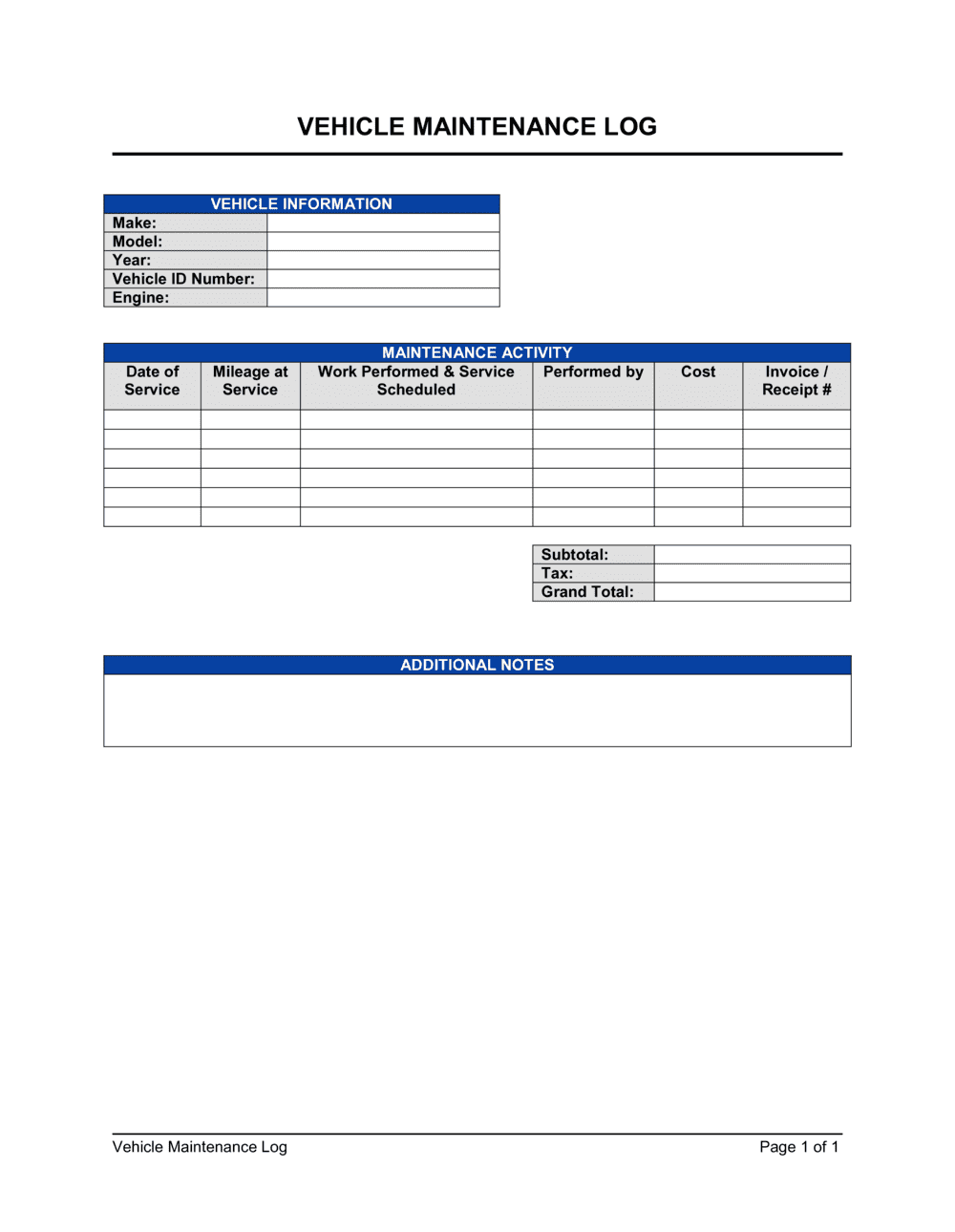
A Vehicle Maintenance Log is a structured record-keeping form used to document every service event, repair, inspection, and parts replacement performed on a vehicle over its operational life. This free Word download gives you a print-ready log you can edit online and customize for any vehicle type β€” car, truck, van, or heavy equipment.
When you need it
Use it whenever a vehicle receives service β€” oil changes, tire rotations, brake replacements, safety inspections, or unscheduled repairs β€” to maintain a complete, date-stamped history. Fleet operators, small business owners, and individual drivers rely on it to schedule preventive maintenance and prove service history at resale or insurance claim time.
What's inside
Vehicle identification details, date and odometer reading at each service event, type of service performed, parts replaced, labor and parts costs, service provider information, and next scheduled maintenance date. A notes field captures additional observations or warranty references.

What is a Vehicle Maintenance Log?

A Vehicle Maintenance Log is a structured record-keeping form used to document every service event performed on a vehicle throughout its operational life β€” oil changes, tire rotations, brake replacements, fluid services, inspections, and unscheduled repairs. Each entry captures the date, odometer reading, description of work performed, parts replaced, service provider, and cost, creating a complete chronological history tied to a specific vehicle by VIN and license plate. Businesses and fleet operators use it to schedule preventive maintenance, track total cost of ownership, and satisfy tax and compliance documentation requirements.

Why You Need This Document

Without a maintenance log, missed service intervals go undetected until a breakdown occurs β€” often at the worst possible time. For business vehicles, the IRS and CRA require contemporaneous records to substantiate maintenance expense deductions, and a log filled in after the fact rarely holds up to scrutiny. Fleet operators without documented service histories face higher insurance premiums, reduced vehicle resale values, and exposure during DOT or transport authority audits. A complete, accurate log also protects you in warranty disputes: without a written record showing that manufacturer-specified service intervals were followed, warranty claims are routinely denied. This template gives you a print-ready, editable form that takes under five minutes per entry to complete and builds a service history that pays for itself many times over.

Which variant fits your situation?

If your situation is…Use this template
Managing service records for multiple company vehiclesFleet Maintenance Log
Tracking daily pre-trip and post-trip driver inspectionsDriver Vehicle Inspection Report
Logging equipment and machinery maintenance on a job siteEquipment Maintenance Log
Recording fuel consumption and mileage alongside maintenanceVehicle Mileage and Fuel Log
Documenting a single repair event with parts and labor detailVehicle Repair Order
Scheduling and tracking upcoming preventive maintenance tasksPreventive Maintenance Schedule
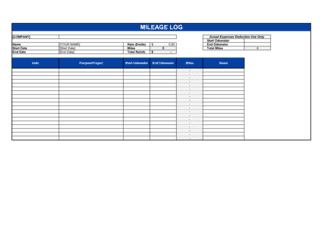
Tracking business vehicle use for CRA or IRS mileage deductionsMileage Log

Common mistakes to avoid

❌ Skipping entries for minor services

Why it matters: Omitting small services like tire rotations or air filter changes creates gaps in the odometer sequence that make the log look incomplete to buyers, auditors, and warranty administrators.

Fix: Log every service event regardless of cost or complexity β€” a complete, unbroken record is worth more than a selective one.

❌ Recording estimated rather than actual odometer readings

Why it matters: Estimated mileage errors compound across entries and can push scheduled maintenance past its safe interval without anyone realizing it.

Fix: Always read the odometer directly from the dashboard at the time of service and enter the exact figure.

❌ Maintaining one shared log for multiple vehicles

Why it matters: Mixed-vehicle logs create confusion when diagnosing recurring issues, complicate tax reporting for business vehicles, and reduce resale documentation value.

Fix: Keep a separate log for each vehicle, identified by VIN and license plate at the top of each form.

❌ Not recording parts numbers or supplier information

Why it matters: Without part numbers, confirming whether a warranty-covered component was installed β€” or tracing a recalled part β€” requires time-consuming manual research that may not succeed.

Fix: Copy part numbers directly from the invoice or packaging into the log entry at the time of service.

The 9 key fields, explained

Vehicle Identification

Date of Service

Odometer Reading

Type of Service Performed

Parts Replaced

Service Provider

Cost Breakdown

Next Scheduled Maintenance

Notes and Observations

How to fill it out

  1. 1

    Enter the vehicle identification details once

    Fill in make, model, year, license plate, and VIN at the top of the log. These fields apply to every entry and only need to be completed once per vehicle.

    πŸ’‘ Keep a photo of the VIN plate on your phone so you can complete this field accurately even when the vehicle is not in front of you.

  2. 2

    Record the date and odometer reading at every service event

    Read the odometer directly from the dashboard at the time of service and record it alongside the date. Calculate miles since the last service by subtracting the previous odometer entry.

    πŸ’‘ Set a phone reminder to log the odometer immediately after service β€” trying to recall it a week later introduces errors.

  3. 3

    Describe the service type in specific terms

    Write out the full service performed rather than a category alone. Include oil specification, filter brand, fluid type, or brake pad grade where relevant.

    πŸ’‘ Copy the exact language from the shop invoice into this field β€” it ensures the log matches official service records and saves time if a warranty dispute arises.

  4. 4

    List every part replaced with its part number

    Enter each replaced component, the OEM or aftermarket part number, and the supplier. If multiple parts were replaced in one visit, add a row for each.

    πŸ’‘ Retain the physical receipt and staple or scan it alongside the log entry β€” part receipts are primary evidence for warranty claims.

  5. 5

    Record service provider details and the work order number

    Enter the shop name, address, phone number, and the work order number from their invoice. For in-house work, record the technician's name.

    πŸ’‘ Cross-reference the work order number on your invoice filing system so you can pull the full invoice quickly from just the log entry.

  6. 6

    Enter the cost breakdown by labor and parts

    Split the invoice total into labor, parts, and tax. Add a running cumulative total column if tracking total cost of ownership across the vehicle's life.

    πŸ’‘ When cumulative maintenance costs on a vehicle approach 50% of its current market value, the log data gives you an objective basis to evaluate replacement.

  7. 7

    Set the next maintenance date or mileage

    Before closing the entry, calculate and enter when the next service is due β€” either a calendar date or an odometer milestone, whichever comes first.

    πŸ’‘ Use the manufacturer's service schedule (usually found in the owner's manual or the shop's service recommendation) rather than estimating.

Frequently asked questions

What is a vehicle maintenance log?

A vehicle maintenance log is a structured form used to record every service event performed on a vehicle β€” oil changes, tire rotations, brake replacements, inspections, and unscheduled repairs β€” along with the date, odometer reading, parts used, cost, and service provider. It creates a complete chronological service history that supports preventive maintenance scheduling, warranty claims, and resale documentation.

Why should businesses keep a vehicle maintenance log?

Businesses use vehicle maintenance logs to schedule preventive service before costly breakdowns occur, satisfy IRS or CRA requirements for business vehicle deductions, support insurance and warranty claims with documented evidence, and establish resale value with a complete service history. Fleet operators also use logs to identify vehicles that are becoming uneconomical to maintain relative to their current value.

Is a vehicle maintenance log required by law?

No single law mandates a maintenance log for private vehicles in most jurisdictions, but certain industries β€” commercial trucking under FMCSA regulations, DOT-regulated carriers, and some government fleet programs β€” require documented maintenance records. For tax purposes, the IRS and CRA require contemporaneous mileage and expense records to support business vehicle deductions, and a maintenance log contributes to that documentation.

How often should I update a vehicle maintenance log?

Update the log immediately after every service event, regardless of how minor. Waiting to batch-enter multiple services increases the risk of missing odometer readings, misremembering part details, or losing receipts. The most accurate logs are completed the same day as the service.

What is the difference between a vehicle maintenance log and a mileage log?

A mileage log records each trip β€” date, destination, purpose, and miles driven β€” primarily to support tax deduction claims for business vehicle use. A maintenance log records service events β€” what was done, when, at what mileage, by whom, and at what cost. The two documents serve different purposes and should be maintained separately, though both are typically required for full business vehicle compliance.

Can I use one log for an entire fleet?

No β€” each vehicle should have its own dedicated log, identified by VIN and license plate. A single combined log for multiple vehicles creates gaps in each vehicle's individual service history, complicates tax reporting, and reduces the document's value as resale evidence or in a warranty dispute.

How long should I keep vehicle maintenance records?

Keep records for as long as you own the vehicle plus at least three years after sale β€” longer if the vehicle was used for business and the maintenance costs were claimed as tax deductions, in which case the standard IRS or CRA audit window (typically 3–6 years) applies. For commercial fleets under DOT regulation, minimum retention periods are defined by the applicable federal or provincial regulation.

Does a vehicle maintenance log affect resale value?

Yes β€” a complete, unbroken maintenance log is one of the most reliable signals of vehicle condition available to a buyer. Used-vehicle buyers and dealers routinely pay a premium for vehicles with documented service histories, and some fleet remarketing programs require a maintenance log to qualify for certified pre-owned status.

How this compares to alternatives

vs Mileage Log

A mileage log tracks individual trips β€” date, destination, business purpose, and miles β€” to support IRS or CRA vehicle deduction claims. A maintenance log records service events, not trips. Both are required for full business vehicle compliance, but they capture different information and serve different purposes.

vs Driver Vehicle Inspection Report

A driver vehicle inspection report (DVIR) documents a driver's pre-trip and post-trip safety checks β€” brakes, lights, tires, and fluid levels β€” typically completed daily. A maintenance log records the actual service work performed by a technician, not driver observations. DVIRs trigger maintenance log entries; they do not replace them.

vs Equipment Maintenance Log

An equipment maintenance log tracks service events for fixed or mobile machinery β€” generators, compressors, forklifts β€” rather than road vehicles. The fields are similar, but equipment logs often track operating hours instead of odometer miles and reference manufacturer maintenance schedules specific to industrial equipment.

vs Vehicle Repair Order

A repair order is a single-event document issued by a shop that authorizes and details one specific repair β€” labor, parts, and cost. A maintenance log is a running cumulative record of all service events across the vehicle's life. Repair orders are typically filed as supporting documents behind the corresponding maintenance log entry.

Industry-specific considerations

Transportation and logistics

DOT-regulated carriers use maintenance logs to satisfy federal inspection requirements and demonstrate compliance during roadside audits.

Construction and trades

Contractors log work truck and equipment vehicle maintenance to prevent job-site downtime and support equipment depreciation claims.

Property management

Property managers track maintenance vans and service vehicles across multiple sites, using logs to allocate costs to individual properties.

Healthcare and field services

Mobile healthcare and field-service organizations maintain logs to ensure regulatory compliance and minimize service interruptions caused by vehicle failure.

Template vs pro β€” what fits your needs?

PathBest forCostTime
Use the templateIndividual vehicle owners, small businesses, and fleet operators tracking standard maintenanceFree5 minutes per entry
Template + professional reviewBusinesses adding fleet-specific fields, cost allocation codes, or integration with a maintenance management system$50–$200 (operations consultant or admin setup)2–4 hours
Custom draftedDOT-regulated carriers or large fleets requiring compliance-specific formats tied to FMCSA or provincial transport regulations$500–$2,000 (compliance consultant or fleet management software setup)1–2 weeks

Glossary

Odometer Reading
The total distance shown on the vehicle's odometer at the time of a service event, used to determine when the next service interval falls due.
Service Interval
A manufacturer-specified mileage or time threshold β€” such as every 5,000 miles or every 6 months β€” after which a particular maintenance task must be performed.
Preventive Maintenance
Scheduled servicing carried out before a failure occurs, such as oil changes, filter replacements, and tire rotations, to extend vehicle life and prevent costly breakdowns.
Work Order Number
A unique identifier assigned by a shop or fleet manager to each repair or service event, used to cross-reference invoices, parts receipts, and warranty records.
VIN (Vehicle Identification Number)
A 17-character alphanumeric code unique to each vehicle, used to look up recall history, warranty coverage, and service records.
Parts Replacement Record
A log entry that captures the specific part replaced, its part number, the supplier, and the cost β€” supporting warranty claims and resale documentation.
Corrective Maintenance
Repair work performed in response to a failure or malfunction, as opposed to scheduled preventive maintenance.
Fleet Management
The administration of a company's vehicle assets, including acquisition, maintenance scheduling, compliance, and eventual disposal or resale.
Total Cost of Ownership (TCO)
The full cost of operating a vehicle over its lifetime, including purchase price, fuel, insurance, and all maintenance and repair expenses.

Part of your Business Operating System

This document is one of 3,000+ business & legal templates included in Business in a Box.

  • Fill-in-the-blanks β€” ready in minutes
  • 100% customizable Word document
  • Compatible with all office suites
  • Export to PDF and share electronically

Create your document in 3 simple steps.

From template to signed document β€” all inside one Business Operating System.
1
Download or open template

Access over 3,000+ business and legal templates for any business task, project or initiative.

2
Edit and fill in the blanks with AI

Customize your ready-made business document template and save it in the cloud.

3
Save, Share, Send, Sign

Share your files and folders with your team. Create a space of seamless collaboration.

Save time, save money, and create top-quality documents.

β˜…β˜…β˜…β˜…β˜…

"Fantastic value! I'm not sure how I'd do without it. It's worth its weight in gold and paid back for itself many times."

Managing Director Β· Mall Farm
Robert Whalley
Managing Director, Mall Farm Proprietary Limited
β˜…β˜…β˜…β˜…β˜…

"I have been using Business in a Box for years. It has been the most useful source of templates I have encountered. I recommend it to anyone."

Business Owner Β· 4+ years
Dr Michael John Freestone
Business Owner
β˜…β˜…β˜…β˜…β˜…

"It has been a life saver so many times I have lost count. Business in a Box has saved me so much time and as you know, time is money."

Owner Β· Upstate Web
David G. Moore Jr.
Owner, Upstate Web

Run your business with a system β€” not scattered tools

Stop downloading documents. Start operating with clarity. Business in a Box gives you the Business Operating System used by over 250,000 companies worldwide to structure, run, and grow their business.

Start freeΒ Β·Β No credit card required