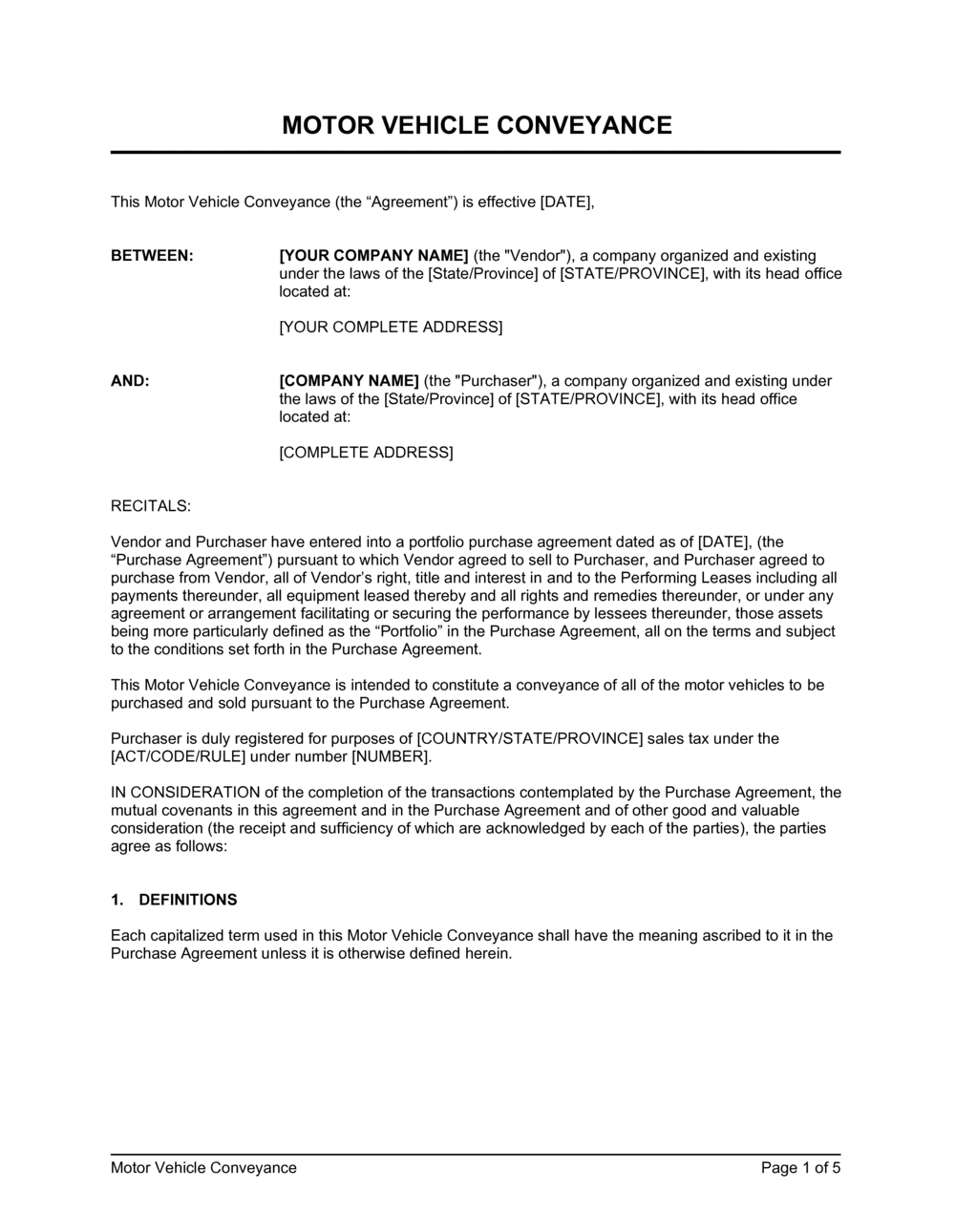
Motor Vehicle Conveyance Template

Free Word download β€’ Edit online β€’ Save & share with Drive β€’ Export to PDF

5 pagesβ€’25–35 min to fillβ€’Difficulty: Complexβ€’Signature requiredβ€’Legal review recommended
Learn more ↓
FreeMotor Vehicle Conveyance Template

At a glance

What it is
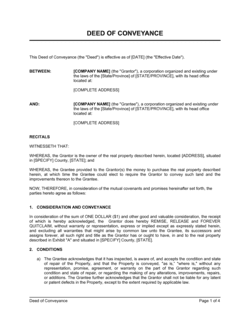
A Motor Vehicle Conveyance is a legally binding document that formally transfers ownership of a motor vehicle from a seller to a buyer. This free Word download captures the vehicle's identifying details, agreed purchase price, condition disclosures, title status, and mutual release of liability β€” and can be edited online and exported as PDF for signing and submission to a motor vehicle authority.
When you need it
Use it whenever a vehicle changes hands through a private sale, fleet disposal, business asset transfer, or gift β€” any transaction where a government title transfer will follow and both parties need a written record of the agreed terms before the registration is updated.
What's inside
Party identification, full vehicle description (VIN, make, model, year, odometer), purchase price and payment terms, title and lien status, condition and warranty disclosures, as-is acknowledgment, release of liability, and governing law with signature blocks for both parties.

What is a Motor Vehicle Conveyance?

A Motor Vehicle Conveyance is a legally binding document that formally transfers ownership of a motor vehicle from a seller to a buyer. It records the vehicle's identifying details β€” including the VIN, make, model, year, and odometer reading β€” alongside the agreed purchase price, title and lien status, condition disclosures, and a mutual release of liability. Unlike an informal handshake or a text message confirming a price, a properly executed conveyance creates an enforceable written record of every term the parties agreed to at the time of sale, and it supports the government title transfer that officially registers the buyer as the new legal owner with the relevant motor vehicle authority.

Why You Need This Document

Without a written conveyance, both seller and buyer are exposed to disputes that a simple document would have prevented. A seller who transfers a vehicle without a signed release of liability remains the registered owner on record β€” liable for parking tickets, tolls, and even accident claims generated by the new owner until the DMV is formally notified. A buyer who accepts a vehicle without a written record of the agreed price and condition has no documentary basis to challenge the seller if undisclosed defects surface or if title cannot be cleanly transferred. For businesses disposing of fleet vehicles, the absence of a paper trail creates accounting and tax compliance gaps that auditors will flag. This template gives both parties a complete, jurisdiction-aware starting point: it covers federally mandated odometer disclosure, title warranty, lien status, and as-is acknowledgment in a single document β€” reducing the time and cost of a standard vehicle transfer to under 20 minutes.

Which variant fits your situation?

If your situation is…Use this template
Straightforward private-party sale between individualsMotor Vehicle Conveyance
Selling a vehicle that still carries a lender's lienVehicle Bill of Sale with Lien Release
Gifting a vehicle to a family member with no monetary exchangeVehicle Gift Transfer Letter
Selling a commercial truck or heavy equipmentCommercial Vehicle Sale Agreement
Transferring multiple fleet vehicles in a single business transactionBulk Asset Purchase Agreement
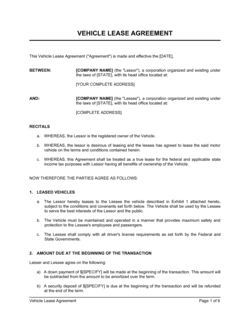
Leasing a vehicle instead of transferring ownership outrightVehicle Lease Agreement
Transferring a vehicle as part of a broader business asset saleAsset Purchase Agreement

Common mistakes to avoid

❌ Name mismatch between conveyance and title certificate

Why it matters: If the seller's name on the conveyance differs from the name printed on the certificate of title, the DMV will reject the transfer and the buyer cannot re-register the vehicle.

Fix: Copy the seller's name character-for-character from the current title certificate before drafting the conveyance, including middle initials and any suffixes.

❌ Skipping the odometer disclosure on a qualifying vehicle

Why it matters: Federal law in the US requires odometer disclosure on most vehicles under 10 years old; omitting it exposes the seller to a civil penalty of up to $10,000 per violation under 49 U.S.C. Β§ 32709.

Fix: Include a dedicated odometer disclosure clause and have the seller initial it separately to confirm they read and understood the certification.

❌ Failing to file the notice of transfer with the DMV

Why it matters: Until the seller notifies the motor vehicle authority of the sale, they remain the registered owner on record β€” liable for tolls, parking violations, and potentially accidents caused by the new owner.

Fix: File the state or provincial notice-of-transfer form on the day of signing. Many jurisdictions now allow online filing within 24 hours of the sale.

❌ Concealing a salvage or rebuilt title history

Why it matters: Selling a vehicle with a salvage or rebuilt title without disclosure is actionable fraud in every US state and Canadian province, entitling the buyer to rescission and damages even if an as-is clause was signed.

Fix: Run a NMVTIS or equivalent title check before listing the vehicle, disclose any salvage or rebuilt branding explicitly in the condition section, and retain the report with the executed conveyance.

❌ Signing without confirming lien discharge

Why it matters: A buyer who receives a conveyance for a vehicle with an undischarged lien acquires the lien along with the vehicle β€” the lender can repossess the car even from a bona fide purchaser in some jurisdictions.

Fix: Demand a written lien-release letter from the lienholder and attach it to the conveyance before signing; if the loan payoff is happening simultaneously, use a three-party closing with the funds disbursed directly to the lender.

❌ Understating the purchase price to reduce sales tax

Why it matters: Tax authorities in every jurisdiction cross-check reported sale prices against market value databases and can assess back tax, penalties, and interest on both parties β€” and the fraud voids the transaction's legal protections.

Fix: Record the actual agreed purchase price. If the vehicle is a gift, note the gift relationship explicitly and use a $0 or nominal consideration clause where the jurisdiction permits gift transfers.

The 10 key clauses, explained

Parties and identification

In plain language: Names the seller and buyer as legal individuals or entities, including their addresses and government ID or business registration numbers where required.

Sample language
This Motor Vehicle Conveyance is entered into on [DATE] between [SELLER FULL LEGAL NAME], residing at [SELLER ADDRESS] ('Seller'), and [BUYER FULL LEGAL NAME], residing at [BUYER ADDRESS] ('Buyer').

Common mistake: Using nicknames or trade names instead of legal names β€” if the seller's name doesn't match the name on the certificate of title, the DMV will reject the transfer.

Vehicle description and VIN

In plain language: Identifies the vehicle precisely using its VIN, year, make, model, body style, color, and license plate number so there is no ambiguity about which asset is being transferred.

Sample language
The vehicle being conveyed is a [YEAR] [MAKE] [MODEL] [BODY STYLE], [COLOR], bearing Vehicle Identification Number [VIN], License Plate [PLATE NUMBER], registered in [STATE/PROVINCE].

Common mistake: Transcribing the VIN incorrectly β€” a single character error means the conveyance does not match the title document and the entire transfer must be redone.

Odometer disclosure

In plain language: States the vehicle's mileage at the time of transfer, certifies whether the reading is accurate, and flags any odometer discrepancy known to the seller.

Sample language
Seller certifies that the odometer reading at the time of transfer is [MILEAGE] miles and, to the best of Seller's knowledge, reflects the actual mileage of the vehicle. [OR: The odometer reading reflects mileage in excess of the odometer's mechanical limits / is not the actual mileage β€” WARNING: ODOMETER DISCREPANCY.]

Common mistake: Omitting the odometer disclosure on vehicles under 10 years old in the US β€” federal law under the Motor Vehicle Information and Cost Savings Act requires it, and omission exposes the seller to federal fraud liability.

Purchase price and payment terms

In plain language: States the agreed total price, the form of payment, and when payment is due relative to the transfer of possession and title.

Sample language
Buyer agrees to pay Seller the sum of $[AMOUNT] ([WRITTEN AMOUNT] Dollars) as full consideration for the vehicle. Payment shall be made by [CASH / CERTIFIED CHECK / BANK TRANSFER] on or before [DATE / at time of signing].

Common mistake: Understating the purchase price to reduce sales tax β€” this constitutes tax fraud in every jurisdiction and voids any warranty of the transaction's legitimacy.

Title and lien status

In plain language: Seller warrants that they hold clear title to the vehicle, that it is free from liens and encumbrances, and commits to delivering the signed title certificate to the buyer at closing.

Sample language
Seller warrants that Seller is the lawful owner of the vehicle, holds clear title free and clear of all liens and encumbrances except as disclosed herein, and shall deliver the signed certificate of title to Buyer no later than [DATE / time of signing].

Common mistake: Signing the conveyance without first confirming the lien has been fully discharged β€” if a lender's name still appears on the title, the buyer cannot re-register the vehicle until the lien release is obtained separately.

Condition disclosure and as-is acknowledgment

In plain language: Describes the vehicle's known condition, lists any known defects, and β€” if no warranty is offered β€” states clearly that the buyer accepts the vehicle as-is with no seller warranty.

Sample language
The vehicle is sold AS-IS, WHERE-IS, with all faults. Seller makes no representations or warranties, express or implied, regarding the condition, fitness for purpose, or merchantability of the vehicle. Known defects: [LIST OR 'None known to Seller'].

Common mistake: Failing to list known defects before an as-is clause β€” courts in many jurisdictions hold that a seller cannot disclaim liability for defects they knew about and actively concealed.

Release of liability

In plain language: States the exact date and time the seller's responsibility for the vehicle ends β€” including responsibility for tolls, parking tickets, accidents, and insurance β€” and may reference submission of a notice-of-transfer form to the DMV.

Sample language
As of [DATE] at [TIME], Seller is released from all liability arising from the use, operation, or ownership of the vehicle. Seller shall submit a Notice of Transfer to [DMV / MOTOR VEHICLE AUTHORITY] within [X] business days of signing.

Common mistake: Not filing the DMV notice-of-transfer after signing β€” the seller remains registered as the owner until the authority is notified, leaving them exposed to traffic violations and liability claims generated by the new owner.

Representations and warranties

In plain language: Seller's formal statements that they have the legal authority to sell the vehicle, it has not been reported stolen, it has not been declared a total loss (salvage), and all disclosures are accurate.

Sample language
Seller represents and warrants that: (a) Seller has full legal authority to convey the vehicle; (b) the vehicle has not been reported stolen; (c) the vehicle has not been declared a total loss or issued a salvage or rebuilt title; and (d) all statements in this document are true and complete to Seller's knowledge.

Common mistake: Omitting the salvage title disclosure β€” selling a rebuilt or salvage-titled vehicle without disclosure exposes the seller to fraud claims and rescission demands, even if the buyer could have checked the vehicle history independently.

Governing law and dispute resolution

In plain language: Specifies which jurisdiction's law governs the agreement and how disputes will be resolved β€” typically the state or province where the vehicle is registered or the transaction takes place.

Sample language
This Agreement shall be governed by the laws of [STATE / PROVINCE]. Any dispute arising under this Agreement shall be resolved in the courts of [COUNTY / JURISDICTION], and the parties consent to personal jurisdiction therein.

Common mistake: Choosing a governing law that differs from the state or province where the title is registered β€” the titling authority applies its own jurisdiction's rules regardless of what the contract specifies.

Signatures and date

In plain language: Both parties sign and date the document, confirming mutual agreement; some jurisdictions require a witness or notary signature on the conveyance itself or on the accompanying title certificate.

Sample language
IN WITNESS WHEREOF, the parties have executed this Motor Vehicle Conveyance as of the date first written above. Seller: ___________________________ Date: _________ [SELLER NAME] Buyer: ___________________________ Date: _________ [BUYER NAME] Witness (if required): _____________ Date: _________

Common mistake: Both parties signing on different dates without noting the effective transfer date β€” the signature date controls when liability and ownership shift, and a gap between seller and buyer signatures creates ambiguity about when exactly ownership transferred.

How to fill it out

  1. 1

    Enter both parties' full legal names and addresses

    Use the seller's name exactly as it appears on the current certificate of title, and the buyer's name as they want it to appear on the new title. Include full mailing addresses for both.

    πŸ’‘ If the title shows a deceased owner's name or a former married name, do not attempt to correct it on the conveyance β€” that requires a separate probate or name-change process before the transfer.

  2. 2

    Record the VIN, year, make, model, and odometer reading

    Copy the VIN character-by-character from the vehicle's dashboard plate or door jamb sticker, not from memory or a previous document. Record the odometer reading on the day of signing.

    πŸ’‘ Photograph the VIN plate and odometer display immediately before signing β€” this single step resolves the majority of post-sale VIN and mileage disputes.

  3. 3

    State the purchase price and payment method

    Enter the actual agreed price in both numerals and written words. Specify whether payment is cash, certified check, or bank transfer, and note whether it has already been received or is due at a specific time.

    πŸ’‘ For amounts over $10,000, a bank transfer with a transaction reference number creates a cleaner audit trail than cash and avoids federal cash-reporting complications.

  4. 4

    Verify and disclose the title and lien status

    Check the physical title certificate for any lender name in the lienholder field. If a lien exists, obtain a signed lien-release letter from the lender before or simultaneously with the conveyance signing.

    πŸ’‘ Run a VIN history report (CARFAX, AutoCheck, or the NMVTIS database) and attach it to the conveyance β€” this protects both parties and documents that neither concealed known title issues.

  5. 5

    Complete the condition disclosure and as-is clause

    List every known defect β€” mechanical, cosmetic, or title-related β€” in the condition section. If no warranty is intended, confirm the as-is language is present and that the buyer has initialed it.

    πŸ’‘ Even a brief written list ('check-engine light present, A/C inoperable') is better than a blank defects field β€” disclosed defects cannot form the basis of a later fraud claim.

  6. 6

    Set the transfer date and time for the release of liability

    Enter the exact date and time ownership transfers. Both parties should sign on that same date where possible. Note any DMV notice-of-transfer filing obligation for your state or province.

    πŸ’‘ If you are selling in a jurisdiction that allows online DMV liability release (California, Florida, and many others), complete it the same day you sign β€” before you hand over the keys.

  7. 7

    Sign, witness, and notarize as required

    Both parties sign and date the document. Check your jurisdiction's requirements β€” some states (Louisiana, Montana, West Virginia) require notarization on the conveyance itself; others only on the title certificate.

    πŸ’‘ Keep a fully executed copy (original or certified copy) in your records for a minimum of five years β€” long enough to cover the statute of limitations for most vehicle-related claims.

  8. 8

    Submit the title and conveyance to the motor vehicle authority

    The buyer takes the signed title certificate and this conveyance document to the DMV or equivalent authority to complete re-registration. The seller files the notice of transfer simultaneously.

    πŸ’‘ Many jurisdictions impose a deadline of 10–30 days for title transfer after sale β€” exceeding it triggers late fees assessed against the buyer.

Frequently asked questions

What is a motor vehicle conveyance?

A motor vehicle conveyance is a written legal document that formally transfers ownership of a vehicle from a seller to a buyer. It records the vehicle's identifying details, agreed purchase price, condition, title status, and mutual release of liability. Unlike an informal receipt, a properly executed conveyance creates an enforceable record of the transaction and supports the government title transfer that registers the buyer as the new legal owner.

Is a motor vehicle conveyance the same as a bill of sale?

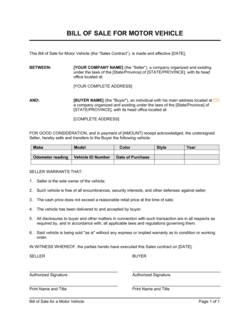
The terms are often used interchangeably, but a conveyance typically carries more formal legal language than a simple bill of sale. A bill of sale records the fact of the transaction; a conveyance explicitly transfers the property right (title) from one party to another and includes representations and warranties, condition disclosures, and a release of liability. In jurisdictions that treat the two as equivalent, either document satisfies the DMV's requirement for proof of purchase.

Do I need a motor vehicle conveyance if I'm using the state's official bill-of-sale form?

Some states and provinces provide an official bill-of-sale or transfer form that satisfies their DMV requirements on its own. However, official forms are typically brief and do not include condition disclosures, warranty representations, or dispute resolution clauses. Using a comprehensive conveyance document alongside the official form gives both parties a more complete legal record β€” particularly useful if a dispute arises after the transaction is complete.

What happens if the seller still owes money on the vehicle?

An outstanding loan creates a lien on the title, and the vehicle cannot be conveyed with clear title until the lien is discharged. The seller must pay off the loan β€” often from the sale proceeds at closing β€” and obtain a lien-release letter from the lender before or simultaneously with the conveyance signing. Attempting to sell a liened vehicle without disclosing the encumbrance exposes the seller to fraud liability.

Does a motor vehicle conveyance need to be notarized?

Notarization requirements vary by jurisdiction. In most US states, the conveyance document itself does not require notarization β€” but the certificate of title does in certain states, including Louisiana, Montana, Nebraska, New Hampshire, and West Virginia. In Canada, the UK, and the EU, notarization is generally not required for private vehicle sales. Check your specific jurisdiction's motor vehicle authority requirements before signing.

Can I sell a vehicle as-is and disclaim all warranties?

Yes, a seller can disclaim all implied warranties of merchantability and fitness through a clearly worded as-is clause, and this is standard in most private-party vehicle sales. However, an as-is clause does not protect a seller who actively conceals a known defect. In most jurisdictions, deliberate non-disclosure of material defects β€” such as flood damage, odometer tampering, or a salvage title β€” constitutes fraud and overrides the as-is provision.

What is an odometer disclosure and when is it required?

An odometer disclosure is a signed statement from the seller certifying the vehicle's mileage at the time of sale. In the United States, federal law requires odometer disclosure on all motor vehicles under 10 model years old (with limited exceptions for heavy trucks and non-road vehicles). The disclosure must appear on the title certificate or a separate form and, if falsified, carries civil penalties of up to $10,000 per violation and potential criminal liability.

How long should I keep a copy of the motor vehicle conveyance?

Both buyer and seller should retain a fully executed copy for a minimum of five years after the transaction. This covers the statute of limitations for most vehicle-related civil claims in the US and Canada. The buyer may need it to resolve title disputes, prove purchase price for tax purposes, or support an insurance claim. The seller may need it to defend against traffic violations or liability claims arising after the transfer date.

Does a motor vehicle conveyance cover commercial vehicles and trailers?

The same document structure applies to commercial vehicles, trailers, and motorcycles, but certain vehicle classes β€” particularly heavy commercial trucks, semi-trailers, and specialty equipment β€” may be subject to additional disclosure requirements, DOT registration considerations, or state-specific transfer forms. For fleet or commercial transactions, it is advisable to have the conveyance reviewed by a lawyer familiar with commercial vehicle regulations in the relevant jurisdiction.

How this compares to alternatives

vs Vehicle Lease Agreement

A lease agreement transfers possession and use of a vehicle for a fixed term in exchange for periodic payments, while ownership remains with the lessor. A motor vehicle conveyance permanently transfers title and ownership to the buyer in a single transaction. Use a conveyance when the goal is outright sale; use a lease when the owner wants to retain the asset and collect recurring income.

vs Asset Purchase Agreement

An asset purchase agreement covers the sale of multiple business assets β€” equipment, inventory, IP, and goodwill β€” in a single transaction, often including vehicles as one line item. A motor vehicle conveyance is a standalone document focused solely on one vehicle transfer. When a vehicle is the only asset changing hands, a conveyance is the appropriate document; when it is part of a broader business sale, an asset purchase agreement governs the transaction.

vs General Bill of Sale

A general bill of sale records the transfer of any personal property β€” furniture, equipment, or goods β€” and is not specific to motor vehicles. A motor vehicle conveyance includes vehicle-specific requirements such as VIN, odometer disclosure, title warranty, lien status, and DMV notice provisions that a generic bill of sale omits. Using a general bill of sale for a vehicle transfer may leave the seller exposed on federally mandated odometer disclosure and title warranty obligations.

vs Quitclaim Deed

A quitclaim deed transfers whatever interest the grantor holds in real property β€” with no warranty of title β€” and is not used for vehicle transfers. A motor vehicle conveyance is the vehicle equivalent, but unlike a quitclaim deed it typically includes affirmative title warranties from the seller. Confusing the two is most common in estate situations where both real property and vehicles are being transferred simultaneously.

Industry-specific considerations

Automotive and dealerships

Wholesale dealer-to-dealer transfers and auction sales require a conveyance that references the dealer license number and complies with state dealer-specific title transfer rules.

Transportation and logistics

Fleet disposals involving multiple commercial vehicles benefit from a conveyance that references DOT numbers, GVWR classifications, and any federal safety compliance certifications being transferred with the asset.

Construction and trades

Contractors transferring work trucks or specialty vehicles between business entities need the conveyance to reference equipment-specific identifiers and align with the company's asset-disposal policy.

Professional services and corporate

Businesses conveying company cars to employees or successor entities must document the transaction for accounting purposes, including the fair-market-value determination required for employee benefit or capital-gains tax reporting.

Jurisdictional notes

United States

Title transfer requirements are set by each state's DMV. Federal law (49 U.S.C. Β§ 32705) mandates odometer disclosure on vehicles under 10 model years old. Notarization of the title certificate is required in approximately 11 states, including Louisiana and West Virginia. Sales tax is assessed on the purchase price at the state and sometimes county level β€” rates range from 0% (Oregon, Montana) to over 10% in some California counties.

Canada

Vehicle ownership transfers are administered provincially; the process differs between Ontario, British Columbia, Quebec, and other provinces. Ontario requires a Used Vehicle Information Package (UVIP) from the seller before closing. Quebec requires all transaction documents to be in French for private sellers. HST or PST applies to private sales in most provinces, assessed on the greater of the declared price or the Canadian Black Book retail value.

United Kingdom

The UK does not use a title certificate system β€” ownership is evidenced by the V5C logbook (Registration Certificate) issued by the DVLA. The seller must notify the DVLA of the sale online or by post on the day of transfer. A written conveyance or bill of sale is not legally required but is strongly recommended as evidence of the agreed terms, particularly for vehicles sold with outstanding finance under a hire-purchase agreement.

European Union

EU member states each maintain their own vehicle registration and ownership transfer systems, and there is no unified EU-level vehicle title regime. In most member states, the buyer must re-register the vehicle within 30 days of purchase. VAT treatment of private vehicle sales varies β€” in Germany and France, private sellers are generally exempt from VAT, while dealers must charge it. Cross-border EU vehicle transfers require customs and technical compliance documentation, particularly for vehicles not already type-approved in the destination country.

Template vs lawyer β€” what fits your deal?

PathBest forCostTime
Use the templateStandard private-party vehicle sales between individuals in a single jurisdiction with clear titleFree15–20 minutes
Template + legal reviewBusiness fleet disposals, cross-state transactions, vehicles with prior liens, or transfers involving estates$150–$400 for a lawyer or notary review1–2 business days
Custom draftedHigh-value commercial vehicles, fleet portfolio disposals, multi-jurisdiction transactions, or title disputes$500–$2,000+3–7 business days

Glossary

Conveyance
The legal act of transferring ownership or title of property from one party to another, documented in writing.
VIN (Vehicle Identification Number)
A unique 17-character alphanumeric code assigned to every motor vehicle that identifies its manufacturer, specifications, and production sequence.
Title
The government-issued certificate that establishes legal ownership of a motor vehicle and must be transferred to the buyer at the time of sale.
Odometer Disclosure
A federally required statement (in the US) in which the seller certifies the vehicle's mileage at the time of sale to prevent odometer fraud.
Lien
A legal claim held by a lender against a vehicle used as collateral for a loan; the lien must be released before clean title can transfer to a buyer.
As-Is Sale
A transaction in which the buyer accepts the vehicle in its current condition with no warranty from the seller β€” all risk of undisclosed defects passes to the buyer.
Release of Liability
A clause β€” and often a separate government form β€” that notifies the DMV or equivalent authority that the seller is no longer responsible for the vehicle after the transfer date.
Bill of Sale
A written record of a sale transaction that documents the price, parties, and item transferred; in vehicle transactions, it serves as evidence of purchase until the title is formally re-registered.
Encumbrance
Any claim, lien, or charge against a vehicle's title β€” such as an unpaid loan or tax judgment β€” that limits the seller's ability to convey clear title.
Warranty of Title
A seller's representation that they have the legal right to sell the vehicle and that it is free from undisclosed liens or encumbrances.
Notarization
Authentication of a signature by a licensed notary public; required for vehicle title transfers in certain US states even when not required on the conveyance document itself.

Part of your Business Operating System

This document is one of 3,000+ business & legal templates included in Business in a Box.

  • Fill-in-the-blanks β€” ready in minutes
  • 100% customizable Word document
  • Compatible with all office suites
  • Export to PDF and share electronically

Create your document in 3 simple steps.

From template to signed document β€” all inside one Business Operating System.
1
Download or open template

Access over 3,000+ business and legal templates for any business task, project or initiative.

2
Edit and fill in the blanks with AI

Customize your ready-made business document template and save it in the cloud.

3
Save, Share, Send, Sign

Share your files and folders with your team. Create a space of seamless collaboration.

Save time, save money, and create top-quality documents.

β˜…β˜…β˜…β˜…β˜…

"Fantastic value! I'm not sure how I'd do without it. It's worth its weight in gold and paid back for itself many times."

Managing Director Β· Mall Farm
Robert Whalley
Managing Director, Mall Farm Proprietary Limited
β˜…β˜…β˜…β˜…β˜…

"I have been using Business in a Box for years. It has been the most useful source of templates I have encountered. I recommend it to anyone."

Business Owner Β· 4+ years
Dr Michael John Freestone
Business Owner
β˜…β˜…β˜…β˜…β˜…

"It has been a life saver so many times I have lost count. Business in a Box has saved me so much time and as you know, time is money."

Owner Β· Upstate Web
David G. Moore Jr.
Owner, Upstate Web

Run your business with a system β€” not scattered tools

Stop downloading documents. Start operating with clarity. Business in a Box gives you the Business Operating System used by over 250,000 companies worldwide to structure, run, and grow their business.

Start freeΒ Β·Β No credit card required