Company Vehicle Policy Template

Free Word download β€’ Edit online β€’ Save & share with Drive β€’ Export to PDF

4 pagesβ€’20–30 min to fillβ€’Difficulty: Standard
Learn more ↓
FreeCompany Vehicle Policy Template

At a glance

What it is
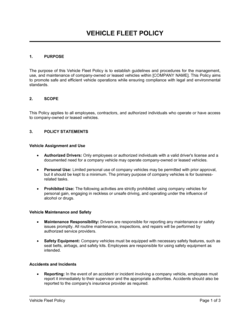
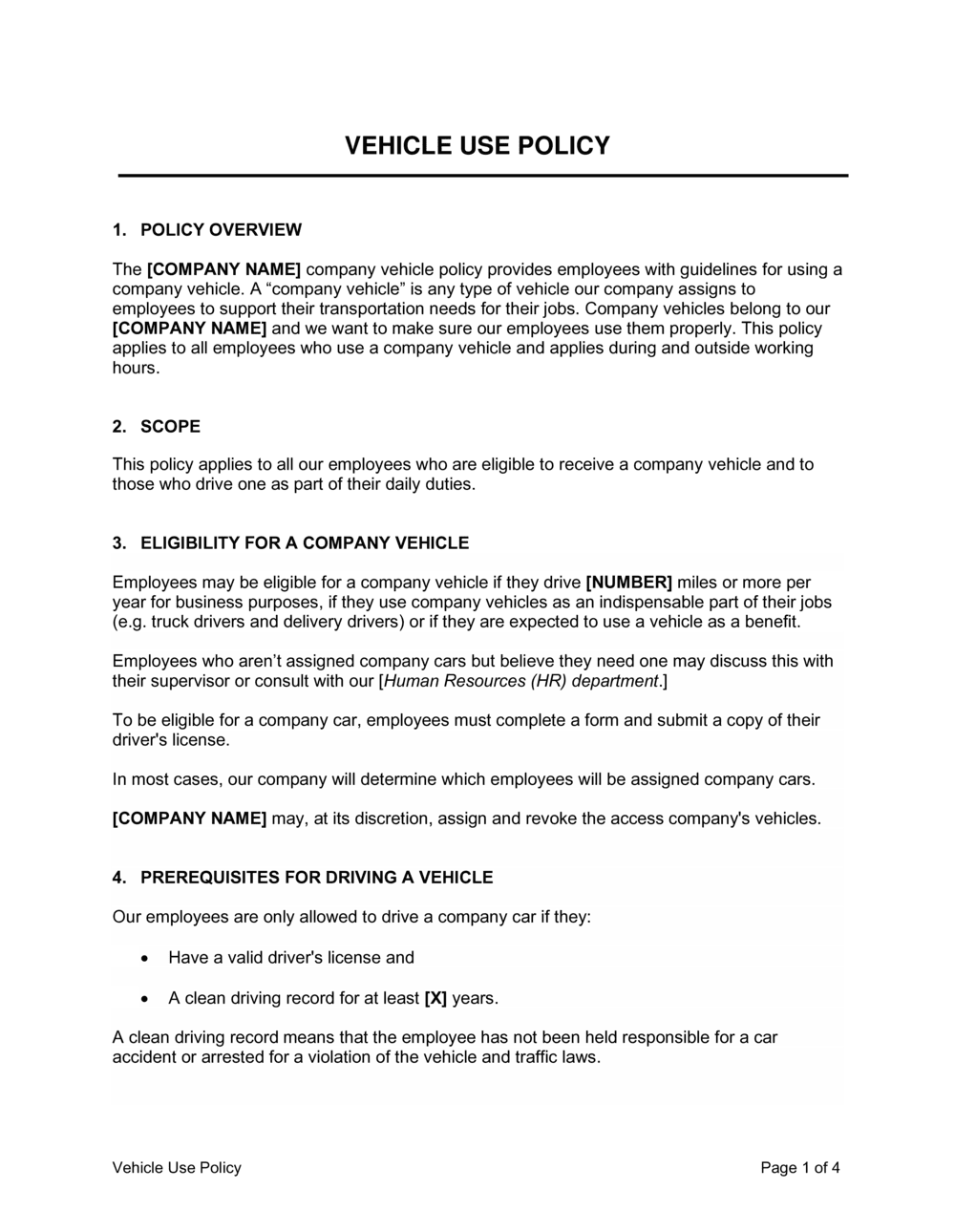
A Company Vehicle Policy is an HR and operations document that sets the rules for how employees may use company-owned or company-paid vehicles. This free Word download covers eligibility criteria, permitted and prohibited use, fuel and maintenance responsibilities, accident reporting, traffic violations, GPS monitoring, and the tax implications of personal use β€” all in a single editable template you can customize and distribute to your workforce in under an hour.
When you need it
Use it when your business owns, leases, or reimburses employees for vehicles β€” or when a recent incident (accident, misuse, or audit) reveals that informal vehicle arrangements need to be formalized in writing.
What's inside
Eligibility and authorization requirements, permitted and prohibited use rules, fuel and maintenance responsibilities, accident and incident reporting procedures, traffic violation accountability, GPS and telematics monitoring disclosures, personal-use rules and tax implications, and employee acknowledgment and signature block.

What is a Company Vehicle Policy?

A Company Vehicle Policy is an HR and operations document that establishes the rules governing how employees may use vehicles owned, leased, or funded by the company. It defines who is eligible to drive, what constitutes permitted and prohibited use, how fuel and maintenance responsibilities are allocated, what steps drivers must follow after an accident, how traffic violations are handled, and whether personal use is allowed and under what conditions. Because company vehicles create both financial liability and tax obligations, the policy also addresses GPS monitoring disclosures and the IRS-mandated treatment of personal-use mileage as imputed income.

Why You Need This Document

Operating a company vehicle without a written policy exposes your business on multiple fronts simultaneously. Without defined eligibility standards and annual MVR checks, a driver with a suspended license or multiple DUIs may remain authorized β€” and when an accident happens, your liability is amplified by your failure to screen. Without mileage logs and a documented imputed-income method, the IRS can assess payroll tax penalties on the entire value of personal use, not just the portion you underreported. Without a GPS monitoring disclosure, deploying telematics can trigger privacy complaints or labor grievances. And without clear accident reporting procedures, critical documentation deteriorates in the hours after an incident, complicating insurer cooperation and liability defense. This template closes all of those gaps in a single document your employees can read, acknowledge, and reference the moment they take the keys.

Which variant fits your situation?

If your situation is…Use this template
Company owns a fleet of vehicles assigned to specific employeesCompany Vehicle Policy
Employees use personal vehicles for business travel and are reimbursedVehicle Expense Reimbursement Policy
Employees rent vehicles for business tripsTravel and Expense Policy
Documenting a specific vehicle loan to an employeeVehicle Loan Agreement
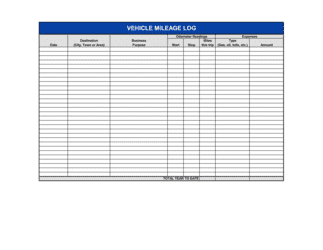
Tracking mileage for reimbursement or tax deduction purposesMileage Log Template
Governing all employee travel including vehicles, flights, and hotelsEmployee Travel Policy
Establishing general HR rules of which vehicle policy is one componentEmployee Handbook

Common mistakes to avoid

❌ No annual MVR check after initial hire

Why it matters: A driver's record can accumulate DUIs, suspensions, or multiple violations between hire and the next audit. Liability for an accident involving a driver with a known-bad record falls heavily on the employer.

Fix: Schedule MVR checks annually for all authorized drivers and revoke access immediately when the driving record falls below the policy threshold.

❌ Allowing personal use without mileage logs

Why it matters: Without documented personal-mile records, the company cannot calculate imputed income accurately, creating payroll tax underpayment exposure and IRS audit risk for both the employer and the employee.

Fix: Require monthly mileage logs for all drivers with personal-use privileges and tie log submission to continued vehicle access.

❌ Installing GPS without a written monitoring disclosure

Why it matters: Several US states, Canadian provinces, and EU member states require employers to notify employees before monitoring their location, even in company vehicles. Non-disclosure creates legal exposure and employee-relations problems.

Fix: Add a GPS monitoring disclosure clause to the policy and have each driver sign it before the device is activated in their assigned vehicle.

❌ Omitting a handheld phone prohibition

Why it matters: Accidents caused by distracted driving while using a company vehicle expose the employer to vicarious liability. Without an explicit ban in writing, plaintiffs' attorneys argue the company implicitly condoned the behavior.

Fix: Add a specific prohibition on handheld phone use while operating any company vehicle, and cross-reference it in the prohibited-use and disciplinary-consequence sections.

❌ No geographic restriction on vehicle use

Why it matters: Without a defined operating area, employees drive company vehicles across state lines or internationally, triggering different insurance coverage requirements, tax nexus issues, and liability exposure the company's policy may not cover.

Fix: Define the approved operating area explicitly β€” e.g., continental US or a named state list β€” and require prior written approval for any use outside that boundary.

❌ Using a flat estimate instead of an IRS-approved method for imputed income

Why it matters: Flat estimates that understate personal-use value result in payroll tax underpayments. The IRS has assessed penalties against employers who could not demonstrate use of an approved calculation method.

Fix: Choose either the Annual Lease Value method or the cents-per-mile method, document the choice in the policy, and apply it consistently for all drivers each tax year.

The 9 key sections, explained

Purpose and scope

Eligibility and authorization

Permitted and prohibited use

Personal use rules

Fuel, maintenance, and care responsibilities

Accident and incident reporting

Traffic violations and fines

GPS monitoring and telematics

Tax implications of personal use

How to fill it out

  1. 1

    Define the scope and vehicle types covered

    Insert your company name and specify whether the policy covers owned vehicles, leased vehicles, vehicle allowances, or all three. This determines which employees are subject to the policy from the outset.

    πŸ’‘ List your specific vehicle categories β€” sedans, vans, pickup trucks β€” if maintenance schedules or use restrictions differ by type.

  2. 2

    Set eligibility criteria and the MVR review schedule

    Enter the minimum age, license type, and maximum number of violations for eligibility. Specify how often driving records will be reviewed β€” annually is the standard for most fleets.

    πŸ’‘ Build the MVR check into your annual HR calendar alongside performance reviews so it doesn't get skipped.

  3. 3

    Spell out permitted and prohibited uses

    Check each permitted-use item against your actual business needs β€” commuting, client visits, field work β€” and add any industry-specific restrictions. Confirm the prohibited-use list includes handheld phone use and substance impairment explicitly.

    πŸ’‘ If you operate in multiple states or countries, add a geographic boundary clause to the prohibited-use section.

  4. 4

    Decide on personal-use allowance and mileage logging

    Choose whether personal use is permitted, limited, or prohibited. If permitted, set the monthly mileage limit and the logging method β€” a paper logbook, a fleet app, or a spreadsheet β€” and enter the submission deadline.

    πŸ’‘ Using a fleet management app (e.g., Samsara, Fleetio) automates mileage separation and dramatically reduces imputed-income calculation errors.

  5. 5

    Complete the accident reporting workflow

    Insert the name and contact number of your fleet or HR contact, the reporting deadline (2 hours is standard), and attach or reference your incident report form as an appendix.

    πŸ’‘ Include a laminated quick-reference card in the glove box of each vehicle summarizing the four steps employees must take at an accident scene.

  6. 6

    Set the traffic violation threshold and consequences

    Enter the number of violations or demerit points that trigger a review, and the number that result in suspension of vehicle privileges. Connect these thresholds to your existing progressive discipline framework.

    πŸ’‘ A two-violation warning and three-violation suspension is a widely used benchmark that courts have found reasonable in employment disputes.

  7. 7

    Add GPS monitoring disclosure language

    Confirm whether your vehicles are equipped with GPS or telematics. If yes, insert the disclosure language as written and have employees sign the acknowledgment. If not currently monitored, keep the clause as a placeholder for future use.

    πŸ’‘ Check your jurisdiction's employee monitoring notice requirements before deployment β€” some states and EU countries require advance written notice.

  8. 8

    Distribute and collect signed acknowledgments

    Send the finalized policy to all authorized drivers and collect a signed acknowledgment from each. File signed copies in employee HR records and send a reminder annually when the policy is reviewed.

    πŸ’‘ Treat the acknowledgment signature as a condition of continued vehicle access β€” employees who decline to sign are not authorized to drive until the issue is resolved.

Frequently asked questions

What is a company vehicle policy?

A company vehicle policy is an HR and operations document that governs how employees may use company-owned, leased, or allowance-funded vehicles. It covers who is eligible to drive, what counts as permitted use, how fuel and maintenance are handled, what to do after an accident, and the tax treatment of any personal use. It protects the company from liability and gives employees clear behavioral expectations in writing.

Who should be required to sign the company vehicle policy?

Every employee authorized to operate a company vehicle β€” whether assigned a dedicated car, sharing a pool vehicle, or driving occasionally for business errands β€” should sign an acknowledgment before their first drive. Some companies also require re-acknowledgment annually when the policy is reviewed and updated. Signed copies should be filed in each employee's HR record.

Is personal use of a company vehicle taxable?

Yes, in most jurisdictions personal use of a company vehicle is a taxable fringe benefit. In the United States, the IRS requires employers to calculate and report the fair market value of personal use as imputed income on the employee's W-2, using an approved method such as the Annual Lease Value or the cents-per-mile method. Accurate monthly mileage logs are essential for calculating this correctly.

Can a company monitor employees through GPS in a company vehicle?

Generally yes, but with important caveats. In the US, employers have broad rights to monitor company-owned vehicles. However, several states and countries require advance written notice to employees before activating GPS tracking. The safest approach is to include a clear monitoring disclosure in the vehicle policy itself and obtain a signed acknowledgment from each driver before deployment.

What should an employee do immediately after an accident in a company vehicle?

The policy should require drivers to: ensure safety and call emergency services if anyone is injured; exchange information with other parties; notify the designated company contact within a defined window (2 hours is standard); and complete a written incident report within 24 hours. A quick-reference card kept in the vehicle's glove box helps drivers follow these steps under stress.

Who pays for traffic fines incurred in a company vehicle?

The employee is personally responsible for all fines, penalties, and court costs resulting from traffic violations, regardless of whether they were in a company vehicle at the time. The policy should state this explicitly and connect repeated violations to a defined disciplinary process β€” typically a warning at the second violation and suspension of vehicle privileges at the third within a 12-month period.

How often should a company vehicle policy be reviewed?

At minimum, review it annually β€” ideally tied to your fleet renewal cycle or fiscal year start. Trigger an out-of-cycle review when tax regulations change (IRS mileage rates are updated annually), when your fleet size or composition changes significantly, when a serious accident reveals a policy gap, or when you deploy new telematics technology that requires updated disclosure language.

Do I need a lawyer to create a company vehicle policy?

For most small and mid-sized businesses with a straightforward domestic fleet, a well-structured template is sufficient. Consider involving an employment attorney when your fleet operates across multiple states with different monitoring laws, when you have union employees whose contracts may govern vehicle-use terms, or when a previous accident or labor dispute exposed specific legal vulnerabilities you need to address by name.

What is the difference between a company vehicle policy and a mileage reimbursement policy?

A company vehicle policy governs the use of vehicles the company owns, leases, or funds directly β€” the company bears the asset cost and liability. A mileage reimbursement policy governs employees who drive their own personal vehicles for business purposes and are compensated at a set cents-per-mile rate. An employee who drives a company-provided car needs the first policy; an employee who uses their own car needs the second. Some companies need both.

How this compares to alternatives

vs Employee Travel Policy

An employee travel policy covers all business travel expenses β€” flights, hotels, meals, and ground transportation β€” at a high level. A company vehicle policy is a dedicated, operationally detailed document focused entirely on the use, maintenance, and liability associated with company-provided vehicles. Organizations with a fleet need both: the travel policy for trip approvals and expense reimbursement, the vehicle policy for day-to-day fleet governance.

vs Mileage Reimbursement Form

A mileage reimbursement form is a transactional record employees complete to claim payment for using their personal vehicle on business. A company vehicle policy governs company-owned assets and does not involve reimbursement. Employees who drive personal cars need the form; employees who drive company cars need the policy. Both documents address business driving but serve entirely different populations.

vs Employee Handbook

An employee handbook is an umbrella HR document covering all workplace policies β€” conduct, leave, benefits, and sometimes a brief vehicle section. A standalone company vehicle policy provides the operational depth β€” accident procedures, maintenance schedules, GPS disclosures, and imputed income rules β€” that a handbook summary cannot. Use the handbook to reference the vehicle policy; use the vehicle policy to govern it.

vs Vehicle Loan Agreement

A vehicle loan agreement is a bilateral legal document between the company and a specific employee governing the terms of lending a single vehicle, including return conditions and liability allocation. A company vehicle policy is a workforce-wide HR policy that sets behavioral and operational standards for all authorized drivers. Both may be needed simultaneously: the policy sets the rules; the loan agreement documents the specific asset assignment.

Industry-specific considerations

Field Services and Utilities

Large vehicle fleets with rotating drivers require strict scheduling, preventive maintenance tracking, and GPS monitoring for dispatching and liability documentation.

Construction and Trades

Vehicles often carry tools and equipment, requiring additional policies on cargo security, load limits, and towing authorization alongside standard use rules.

Professional Services

Company cars are frequently a compensation benefit for senior staff, making personal-use rules, imputed income calculation, and graded eligibility tiers especially important.

Logistics and Distribution

DOT hours-of-service compliance, commercial driver's license requirements, and drug and alcohol testing rules must be incorporated alongside or referenced from the vehicle policy.

Template vs pro β€” what fits your needs?

PathBest forCostTime
Use the templateSmall and mid-sized businesses with a domestic fleet and standard employee vehicle arrangementsFree1–2 hours to customize and distribute
Template + professional reviewCompanies with GPS monitoring programs, multi-state fleets, or union employees whose agreements may intersect with vehicle terms$300–$800 for an employment attorney or HR consultant review3–5 business days
Custom draftedLarge fleets, companies operating across multiple countries, or industries subject to DOT or other regulatory requirements$1,500–$4,000+ for a custom policy drafted by an employment attorney2–4 weeks

Glossary

Authorized Driver
An employee who has met the company's eligibility criteria β€” valid license, clean driving record, and approved status β€” to operate a company vehicle.
Personal Use
Any use of a company vehicle for non-business purposes, such as commuting, errands, or leisure travel, which may trigger taxable imputed income.
Imputed Income
The dollar value of personal vehicle use that the IRS and most tax authorities treat as employee compensation, subject to income and payroll taxes.
Fleet Vehicle
A vehicle owned or leased by the company and assigned to one or more employees for business purposes.
Telematics / GPS Monitoring
Technology installed in a vehicle to track location, speed, mileage, and driving behavior in real time.
MVR (Motor Vehicle Record)
An official driving history report from a state or provincial licensing authority showing license status, violations, and accidents.
Preventive Maintenance Schedule
A manufacturer- or fleet-manager-defined timetable for oil changes, tire rotations, inspections, and other upkeep tasks to preserve vehicle condition.
Commute Exclusion Rule
An IRS provision allowing employers to exclude from income the value of commuting in a company vehicle under specific conditions, including a written commuting policy.
Annual Lease Value (ALV)
An IRS table-based method for calculating the fair market value of company vehicle personal use for imputed income reporting purposes.
At-Fault Accident
A collision or incident in which the driver is determined to bear primary or partial responsibility, which may trigger disciplinary action under the policy.

Part of your Business Operating System

This document is one of 3,000+ business & legal templates included in Business in a Box.

  • Fill-in-the-blanks β€” ready in minutes
  • 100% customizable Word document
  • Compatible with all office suites
  • Export to PDF and share electronically

Create your document in 3 simple steps.

From template to signed document β€” all inside one Business Operating System.
1
Download or open template

Access over 3,000+ business and legal templates for any business task, project or initiative.

2
Edit and fill in the blanks with AI

Customize your ready-made business document template and save it in the cloud.

3
Save, Share, Send, Sign

Share your files and folders with your team. Create a space of seamless collaboration.

Save time, save money, and create top-quality documents.

β˜…β˜…β˜…β˜…β˜…

"Fantastic value! I'm not sure how I'd do without it. It's worth its weight in gold and paid back for itself many times."

Managing Director Β· Mall Farm
Robert Whalley
Managing Director, Mall Farm Proprietary Limited
β˜…β˜…β˜…β˜…β˜…

"I have been using Business in a Box for years. It has been the most useful source of templates I have encountered. I recommend it to anyone."

Business Owner Β· 4+ years
Dr Michael John Freestone
Business Owner
β˜…β˜…β˜…β˜…β˜…

"It has been a life saver so many times I have lost count. Business in a Box has saved me so much time and as you know, time is money."

Owner Β· Upstate Web
David G. Moore Jr.
Owner, Upstate Web

Run your business with a system β€” not scattered tools

Stop downloading documents. Start operating with clarity. Business in a Box gives you the Business Operating System used by over 250,000 companies worldwide to structure, run, and grow their business.

Start freeΒ Β·Β No credit card required