Travel and Expense Policy Template

Free Word download β€’ Edit online β€’ Save & share with Drive β€’ Export to PDF

3 pagesβ€’20–25 min to fillβ€’Difficulty: Standard
Learn more ↓
FreeTravel and Expense Policy Template

At a glance

What it is
A Travel and Expense Policy is a formal operational document that defines the rules employees must follow when spending company money on travel, meals, accommodation, and other business-related expenses. This free Word download gives you a structured, editable template you can tailor to your company's spending limits and approval workflows, then export as PDF for distribution to your team.
When you need it
Use it when onboarding employees who will travel or incur business expenses, when inconsistent reimbursement requests are creating accounting friction, or when your finance team needs a written standard to enforce during audits and year-end reporting.
What's inside
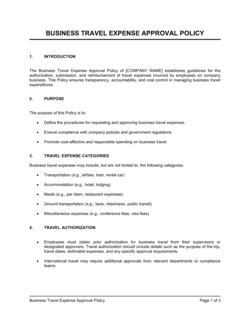
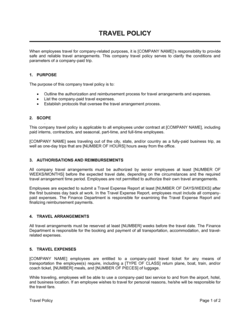
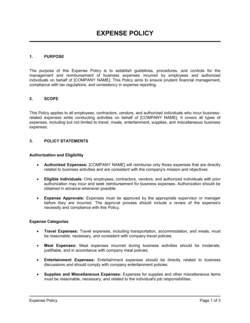
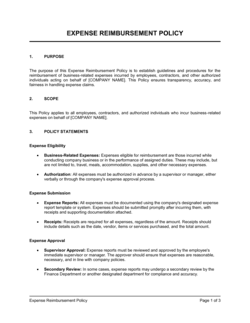
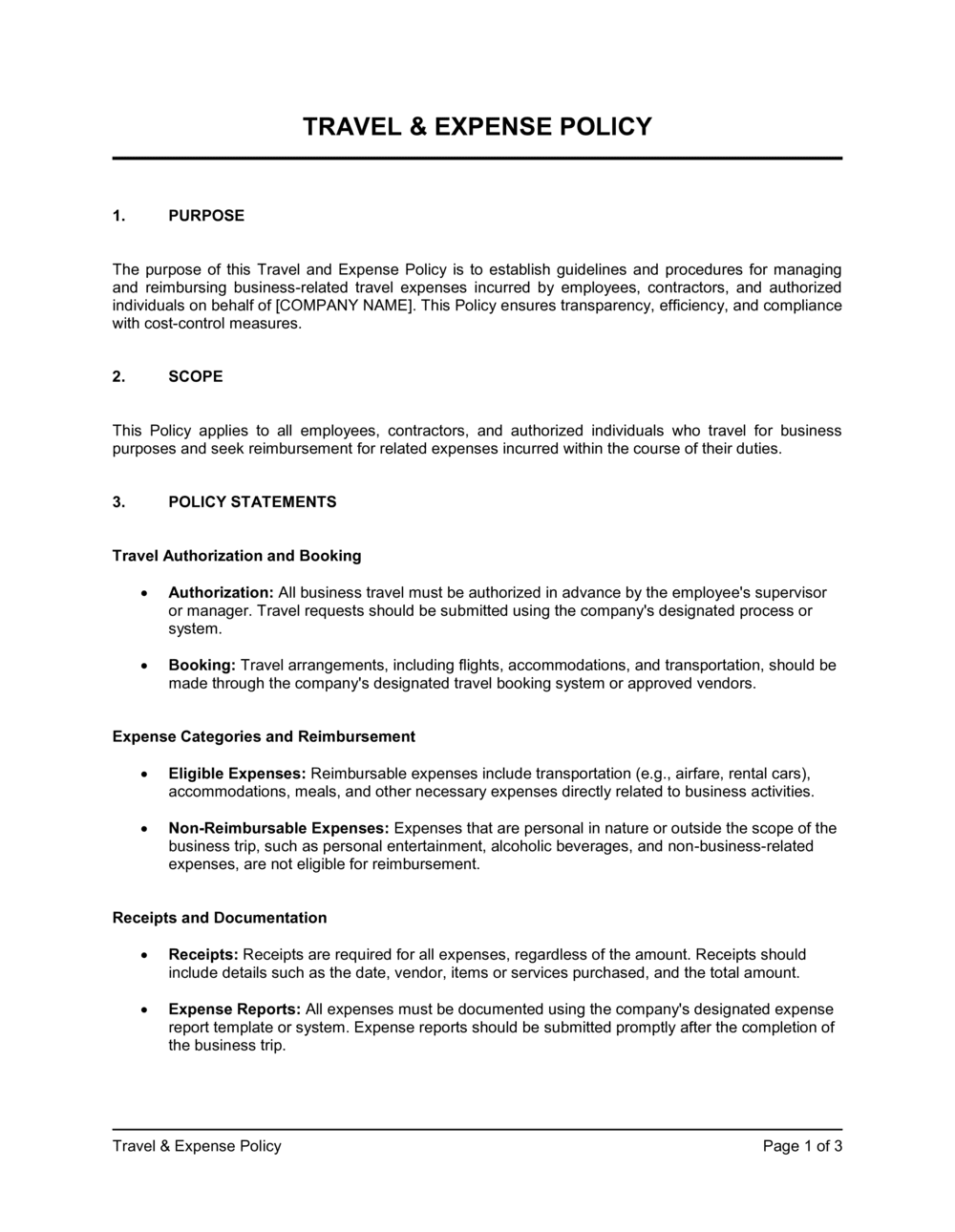
Purpose and scope, booking and pre-approval requirements, spending limits by category (flights, hotels, meals, ground transport), receipt and documentation requirements, reimbursement submission timelines, prohibited expenses, and policy violation consequences.

What is a Travel and Expense Policy?

A Travel and Expense Policy is a formal operational document that defines the rules, spending limits, and approval workflows governing how employees spend company money on business travel, meals, accommodation, and related costs. It specifies which expenses are reimbursable and which are not, sets category-by-category dollar caps, describes the documentation employees must submit, and establishes consequences for violations. Unlike an informal agreement or a line in the employee handbook, a standalone T&E policy provides the operational detail finance teams need to enforce consistent treatment across every employee and every trip.

Why You Need This Document

Without a written travel and expense policy, every ambiguous expense claim becomes a negotiation β€” between the employee and their manager, or between the manager and finance β€” consuming time and generating inconsistent outcomes that damage team trust. Employees who don't know the rules either under-claim legitimate costs or over-claim personal ones; neither is good for the business. From a tax perspective, the IRS and CRA require substantiated records to support expense deductions, and a policy is the foundation of that substantiation trail. Companies that grow past a handful of employees without a written T&E policy routinely discover the cost at year-end: reconciliation errors, audit exposure, and backdated disputes over expenses already spent. This template gives you a complete, editable starting point that closes those gaps in two to four hours rather than weeks.

Which variant fits your situation?

If your situation is…Use this template
Setting limits for a sales team with frequent overnight travelTravel And Expense Policy (Sales Edition)
Managing a remote workforce with home-office and internet expense claimsRemote Work Expense Policy
Reimbursing individual employee expense submissionsEmployee Expense Report
Tracking and forecasting total T&E spend across the organizationBusiness Budget Template
Creating a per-diem table for domestic and international travelPer Diem Policy
Documenting corporate card issuance and usage rulesCorporate Credit Card Policy
Summarizing monthly department spending for management reviewMonthly Expense Report

Common mistakes to avoid

❌ Using a single hotel rate limit for all cities

Why it matters: A $150/night cap that works in suburban markets forces employees in New York, London, or San Francisco to request exceptions on every trip, creating administrative overhead and frustration.

Fix: Define at least two market tiers β€” standard and high-cost β€” with separate rate limits. Name the high-cost cities explicitly so there is no ambiguity about which rate applies.

❌ No guidance on alcohol reimbursement

Why it matters: Employees expense alcohol inconsistently β€” some claim it freely, others avoid it entirely. Both outcomes create accounting noise and potential tax issues if alcohol is not properly categorized.

Fix: State explicitly when alcohol is reimbursable (client entertainment only, itemized separately) and when it is not (solo travel, personal meals), and require it to be listed as a distinct line item on receipts.

❌ Skipping the prohibited expenses list

Why it matters: Without a named list, every ambiguous expense becomes a negotiation between the employee and their manager, consuming management time and creating inconsistent treatment across teams.

Fix: Compile a specific prohibited expense list by reviewing a full year of expense disputes. Include personal entertainment, fines, companion travel, and non-approved upgrades at minimum.

❌ No submission deadline for expense reports

Why it matters: Employees submitting expenses 90 days after travel creates accrual errors, closes-period adjustments, and makes it harder to detect fraudulent claims before records are stale.

Fix: Set a hard deadline β€” 30 calendar days from the date of travel or expense is a widely used standard β€” and state the consequence for late submission (reimbursement at manager discretion only).

The 10 key sections, explained

Purpose and scope

Booking and pre-approval requirements

Airfare standards

Lodging limits

Meals and per diem

Ground transportation and mileage

Receipt and documentation requirements

Prohibited expenses

Approval and reimbursement workflow

Policy violations and consequences

How to fill it out

  1. 1

    Define the policy scope and effective date

    Specify exactly which employees, engagement types (full-time, contractor, part-time), and expense categories the policy covers. Enter the effective date and version number for change-tracking.

    πŸ’‘ Assign a policy owner β€” typically the CFO or Finance Manager β€” so employees know who to contact with questions and who is responsible for annual updates.

  2. 2

    Set spending limits by category

    Enter dollar caps for each major expense category: nightly hotel rate by market tier, daily meal limits per meal or as a flat per diem, airfare class rules, and mileage rate. Use current IRS standard mileage rates for vehicle reimbursement.

    πŸ’‘ Research average hotel and meal costs in the cities your team visits most often before setting limits β€” limits that force constant exception requests slow down everyone.

  3. 3

    Define the pre-approval workflow

    State which expenses require approval before they are incurred, who approves them (direct manager, VP, finance), and the channel (email, expense platform, form). Set a response time so employees aren't left waiting.

    πŸ’‘ Require pre-approval only for expenses above a meaningful threshold β€” $500 for travel is a common floor β€” to avoid creating a bottleneck on small, routine purchases.

  4. 4

    List prohibited expenses explicitly

    Write out every specific category the company will not reimburse. Review a year's worth of disputed expense claims with your finance team to identify the categories that generate the most friction.

    πŸ’‘ A prohibited expense list also protects managers from awkward one-on-one conversations β€” they can point to the policy rather than making a personal judgment call.

  5. 5

    Document receipt and submission requirements

    State the minimum receipt threshold, acceptable formats (digital scan, original paper, credit card statement), and the deadline for submitting expense reports after travel ends.

    πŸ’‘ 30 calendar days from the travel date is the standard submission window β€” align it to your monthly close cycle so finance can accrue expenses accurately.

  6. 6

    Describe the reimbursement timeline and payment method

    Specify how long approved expense reports take to process, what payment method is used (ACH, payroll, check), and who in finance employees contact if a reimbursement is late.

    πŸ’‘ Publishing a processing SLA β€” e.g., 'approved reports are paid within 15 business days' β€” reduces follow-up emails to finance and sets clear employee expectations.

  7. 7

    State policy violation consequences

    Include a graduated consequences section covering honest mistakes, repeated violations, and intentional fraud. Reference the company's broader disciplinary policy for serious cases.

    πŸ’‘ Have HR review this section before finalizing β€” language around termination and fraud referral should align with your existing disciplinary procedures.

  8. 8

    Distribute and obtain employee acknowledgment

    Share the final policy via your HRIS or email, and collect a signed acknowledgment form from each employee confirming they have read and understood the policy.

    πŸ’‘ Attach the acknowledgment requirement to new-hire onboarding so every employee signs before they incur their first expense β€” not after a dispute arises.

Frequently asked questions

What is a travel and expense policy?

A travel and expense policy is a formal document that defines the rules employees must follow when spending company money on business travel, meals, accommodation, and related costs. It sets spending limits by category, describes the approval and reimbursement process, lists prohibited expenses, and specifies what documentation employees must submit to be reimbursed. It is both a financial control and a guide that protects employees from ambiguity about what they are allowed to spend.

What should a travel and expense policy include?

A complete policy covers scope and effective date, pre-approval requirements, airfare and lodging limits, meal per diems or daily caps, ground transportation and mileage rates, a prohibited expense list, receipt and documentation requirements, the reimbursement submission timeline, and consequences for policy violations. Missing any of these sections creates gaps that employees fill with their own judgment β€” usually more generously than the company intended.

How do I set hotel and meal spending limits?

Research actual average rates in the cities your employees visit most frequently before setting limits. Use government per-diem tables (GSA for the US, Treasury Board for Canada) as a benchmark for meals and incidentals. For hotels, set at least two tiers β€” standard markets and named high-cost cities β€” so that limits are realistic in each context without defaulting to the most expensive market as the global standard.

Is a travel and expense policy legally required?

No jurisdiction mandates a formal written T&E policy for private employers. However, the IRS and CRA require businesses to substantiate deducted expenses with records showing amount, date, place, business purpose, and the employee who incurred them. A written policy is the most reliable way to ensure employees maintain the documentation required to support those deductions during a tax audit.

How often should a travel and expense policy be updated?

Review the policy at minimum once a year, typically aligned to your fiscal year start. Trigger an off-cycle update whenever the IRS adjusts the standard mileage rate, when the company adopts a new expense platform, when a significant change in travel volume occurs, or when a pattern of policy disputes signals that a category needs clearer rules.

What is the difference between a per diem and an expense reimbursement?

A per diem is a fixed daily allowance paid without requiring itemized receipts β€” the employee keeps any amount not spent. An expense reimbursement pays the actual amount spent, supported by receipts, up to a defined cap. Per diems reduce administrative overhead and are easier for employees to plan around; reimbursements are more precise but require more documentation. Many companies use per diems for meals and incidentals and actual-cost reimbursement for lodging and airfare.

Can employees book travel outside the company's preferred booking tool?

Most policies require employees to use a preferred booking tool or travel management company for flights and hotels, primarily to capture negotiated rates and maintain a complete travel record. Exceptions for lower fares found outside the tool are typically permitted if the employee can document a meaningful cost saving β€” usually defined as more than $[50–$100] below the tool's best available rate β€” with manager approval.

What happens if an employee submits an expense that violates the policy?

The standard workflow is to deny the specific expense, notify the employee in writing with the policy reference, and ask them to resubmit a corrected report if applicable. Repeated violations should trigger a documented conversation with the employee's manager. Submitting falsified receipts or inflated amounts constitutes expense fraud and should be escalated to HR and, in serious cases, legal counsel or law enforcement.

Should employees acknowledge the travel and expense policy in writing?

Yes. A signed acknowledgment β€” collected during onboarding and when the policy is materially updated β€” confirms the employee received, read, and understood the rules. It also removes the 'I didn't know' defense in a dispute or disciplinary proceeding. Most companies collect this acknowledgment through their HRIS alongside the employee handbook and code of conduct.

How this compares to alternatives

vs Employee Expense Report

A travel and expense policy sets the rules employees must follow when spending company money. An expense report is the transactional form an employee submits to claim reimbursement under those rules. The policy without the report has no submission mechanism; the report without the policy has no rules to enforce. Both documents are needed for a functioning expense management process.

vs Employee Handbook

An employee handbook is a broad operational document covering all HR policies β€” conduct, leave, benefits, and more. A travel and expense policy is a focused financial controls document with spending limits, approval workflows, and prohibited expense lists detailed enough to guide daily decisions. The T&E policy is typically included in or referenced by the handbook, but its operational depth lives in a standalone document.

vs Business Budget Template

A business budget sets total T&E spending targets at the organizational or department level for a planning period. A travel and expense policy governs how individual employees spend within those targets on a transaction-by-transaction basis. The budget answers 'how much are we allocating to travel this year'; the policy answers 'how each employee must spend and document within that allocation.'

vs Corporate Credit Card Policy

A corporate credit card policy governs the issuance, use, and reconciliation of company-issued payment cards. A travel and expense policy covers all business spending β€” whether on a corporate card, personal card, or cash. Companies with a corporate card program typically maintain both documents: the card policy handles card-specific controls, while the T&E policy sets the underlying spending rules that apply regardless of payment method.

Industry-specific considerations

Professional Services

Client billable vs. non-billable expense tracking is critical β€” the policy must distinguish between expenses charged back to clients and those absorbed internally.

Technology / SaaS

Remote and distributed teams require explicit guidance on home-office expenses, co-working space reimbursement, and international travel for offsites and conferences.

Manufacturing

Procurement and operations staff travel to supplier sites frequently β€” mileage reimbursement, rental car rules, and per-diem rates for extended field assignments need clear definition.

Financial Services

Regulatory and audit requirements demand tighter documentation standards and stricter entertainment expense controls, including client gift limits aligned to anti-bribery regulations.

Template vs pro β€” what fits your needs?

PathBest forCostTime
Use the templateSmall and mid-sized businesses creating or formalizing a T&E policy for the first timeFree2–4 hours
Template + professional reviewCompanies with corporate cards, multi-country operations, or client-billable expense requirements$200–$500 for a finance or HR consultant review1–3 days
Custom draftedEnterprises with regulated industries, complex approval hierarchies, or integration with an ERP or expense management platform$1,000–$3,000+1–3 weeks

Glossary

Per Diem
A fixed daily allowance paid to an employee to cover meals, incidentals, or lodging while traveling on company business, without requiring itemized receipts.
Pre-Approval
Written authorization from a manager or finance team obtained before an expense is incurred, required for expenses above a defined threshold.
Reimbursable Expense
A legitimate business cost paid out-of-pocket by an employee that the company agrees to repay upon proper submission and approval.
Non-Reimbursable Expense
A personal or prohibited cost β€” such as alcohol on solo travel, personal entertainment, or fines β€” that the company explicitly will not repay.
Spend Limit
The maximum dollar amount an employee is permitted to spend in a given category β€” such as $200 per night for hotels β€” without additional approval.
Expense Report
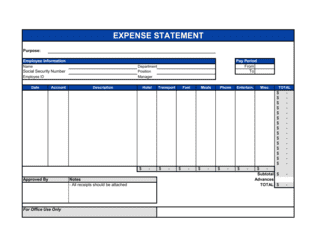
The standardized form an employee submits to claim reimbursement, listing each expense with date, amount, business purpose, and receipt attachment.
Corporate Card
A payment card issued to an employee by the company, with charges billed directly to the company account and reconciled against expense reports.
Audit Trail
The documented chain of receipts, approvals, and expense reports that allows finance or auditors to verify that spending was authorized and appropriate.
Substantiation
The IRS and CRA requirement that business expenses be supported by records showing amount, date, place, business purpose, and the employee who incurred them.
T&E (Travel and Entertainment)
The accounting category covering all employee travel, lodging, meals, and client entertainment costs incurred in the course of business.

Part of your Business Operating System

This document is one of 3,000+ business & legal templates included in Business in a Box.

  • Fill-in-the-blanks β€” ready in minutes
  • 100% customizable Word document
  • Compatible with all office suites
  • Export to PDF and share electronically

Create your document in 3 simple steps.

From template to signed document β€” all inside one Business Operating System.
1
Download or open template

Access over 3,000+ business and legal templates for any business task, project or initiative.

2
Edit and fill in the blanks with AI

Customize your ready-made business document template and save it in the cloud.

3
Save, Share, Send, Sign

Share your files and folders with your team. Create a space of seamless collaboration.

Save time, save money, and create top-quality documents.

β˜…β˜…β˜…β˜…β˜…

"Fantastic value! I'm not sure how I'd do without it. It's worth its weight in gold and paid back for itself many times."

Managing Director Β· Mall Farm
Robert Whalley
Managing Director, Mall Farm Proprietary Limited
β˜…β˜…β˜…β˜…β˜…

"I have been using Business in a Box for years. It has been the most useful source of templates I have encountered. I recommend it to anyone."

Business Owner Β· 4+ years
Dr Michael John Freestone
Business Owner
β˜…β˜…β˜…β˜…β˜…

"It has been a life saver so many times I have lost count. Business in a Box has saved me so much time and as you know, time is money."

Owner Β· Upstate Web
David G. Moore Jr.
Owner, Upstate Web

Run your business with a system β€” not scattered tools

Stop downloading documents. Start operating with clarity. Business in a Box gives you the Business Operating System used by over 250,000 companies worldwide to structure, run, and grow their business.

Start freeΒ Β·Β No credit card required