Travel Policy Template

Free Word download β€’ Edit online β€’ Save & share with Drive β€’ Export to PDF

2 pagesβ€’20–30 min to fillβ€’Difficulty: Standard
Learn more ↓
FreeTravel Policy Template

At a glance

What it is
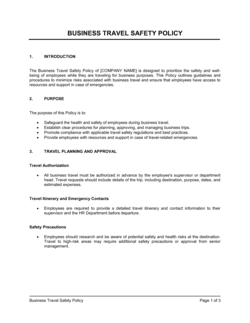
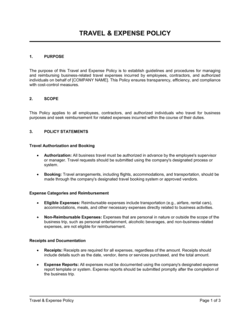
A Travel Policy is a formal internal document that sets the rules, limits, and procedures governing business travel for employees. This free Word download gives you a structured, editable template you can tailor to your organization's budget and approval workflows, then distribute as a PDF or link from your employee handbook.
When you need it
Use it when employees regularly travel for client meetings, conferences, or site visits, and you need consistent rules for booking, spending, and reimbursement. It is also essential before rolling out a corporate travel management platform or expense reporting system.
What's inside
Scope and eligibility, booking procedures and preferred vendors, per diem and expense category limits, approval workflows, reimbursement submission requirements, non-reimbursable expenses, duty-of-care provisions, and policy compliance and consequences.

What is a Travel Policy?

A Travel Policy is a formal internal document that defines the rules, spending limits, booking procedures, and reimbursement processes that apply whenever employees travel on company business. It specifies which booking channels to use, what class of air travel is permitted, how much the company will reimburse for hotels and meals, who must approve a trip before it is booked, and what expenses the company will not pay under any circumstances. By setting these rules in writing, the policy removes ambiguity from hundreds of individual travel decisions each year and gives finance teams a consistent, auditable standard against which to process expense claims.

Why You Need This Document

Without a written travel policy, travel spend is governed entirely by individual judgment β€” and individual judgment varies widely. One employee books business class on a two-hour domestic flight; another stays at a budget property and submits a receipt for the minibar. Finance teams spend hours adjudicating claims that should take minutes, and the company loses tax deductions because meal expenses lack the documented business purpose that regulators require. A clear, distributed travel policy closes those gaps before they cost money. It also protects the company legally: duty-of-care obligations are hard to demonstrate without a documented framework, and corporate card programs are far easier to manage when employees have acknowledged written rules. This template gives you a professionally structured starting point you can customize to your budget, approval structure, and vendor relationships in a few hours β€” not days.

Which variant fits your situation?

If your situation is…Use this template
Covering all employee travel and expense categories in one documentTravel Policy
Detailing how employees submit and get reimbursed for individual expensesExpense Reimbursement Policy
Tracking actual costs incurred on a specific tripBusiness Travel Expense Report
Requesting advance approval and budget for an upcoming tripTravel Request Form
Managing per diem rates by city or country for international travelPer Diem Policy
Covering broader spending rules beyond travel, including office and entertainmentExpense Management Policy
Providing safety and security protocols for employees traveling to high-risk regionsDuty of Care Travel Policy

Common mistakes to avoid

❌ Setting a single hotel rate cap regardless of location

Why it matters: A flat cap that works in mid-tier cities forces employees into substandard or unsafe accommodation in major metros, creating both a duty-of-care gap and staff friction.

Fix: Tier your hotel caps by city β€” at minimum, distinguish Tier 1 metros (New York, London, San Francisco) from all other domestic destinations.

❌ Omitting a non-reimbursable expense list

Why it matters: Without a specific exclusion list, employees interpret 'personal expenses' broadly, and finance teams spend disproportionate time adjudicating borderline claims.

Fix: Publish a named list of at least eight commonly claimed personal expenses β€” minibar, in-flight entertainment, traffic tickets, companion travel β€” and update it annually based on actual disputes.

❌ No backup approver in the approval workflow

Why it matters: When the designated approver is on leave or traveling themselves, employees either delay critical bookings or bypass approval entirely to meet deadlines.

Fix: Assign a documented backup approver for each approval tier and communicate substitution procedures clearly in the policy.

❌ Allowing per diem and actuals reimbursement simultaneously

Why it matters: Employees claim whichever method yields a higher payout on any given day, making meal expense totals unpredictable and hard to audit.

Fix: Choose one method β€” per diem or actuals β€” as the default for each expense category and state it explicitly. Per diem for meals, actuals for accommodation, is a common and defensible split.

❌ Publishing the policy without a stated review date

Why it matters: Hotel and airfare rates, IRS mileage rates, and per diem benchmarks change annually. A policy that is two or more years out of date creates gaps between what the policy says and what is commercially reasonable.

Fix: Add a review date of no more than 12 months from the effective date and assign a named owner β€” typically the Finance or HR director β€” responsible for the annual update.

❌ Not specifying the business purpose requirement for meals and entertainment

Why it matters: Tax authorities in the US, UK, and Canada require documented business purpose for meals and entertainment deductions. Missing documentation exposes the company to disallowed deductions in an audit.

Fix: Require employees to record the business purpose and names of all attendees on every meal or entertainment expense over a defined threshold β€” $25 is the most common trigger.

The 10 key sections, explained

Purpose and scope

Booking procedures and preferred vendors

Air travel standards

Hotel and accommodation standards

Meals and per diem

Ground transportation and car rental

Approval workflow and pre-trip authorization

Expense submission and reimbursement

Non-reimbursable expenses

Policy compliance and consequences

How to fill it out

  1. 1

    Set the effective date and define scope

    Insert the policy effective date and list every employee category it covers β€” full-time, part-time, contractors, and interns if applicable. Specify whether it covers only domestic travel, only international, or both.

    πŸ’‘ State explicitly that this policy supersedes any prior travel guidance β€” this closes loopholes where employees cite older, more permissive informal rules.

  2. 2

    Identify your booking channel and preferred vendors

    Enter the name of your corporate booking tool or travel management company, the required advance booking window, and your preferred airlines, hotel chains, and car rental providers. If you have negotiated rates, reference the vendor schedule.

    πŸ’‘ If you do not yet have a TMC or preferred vendor program, name the booking platform (e.g., Concur, TripActions, Navan) even if it is self-service β€” having a single channel simplifies policy enforcement significantly.

  3. 3

    Set air travel class and duration thresholds

    Define economy as the default, then specify the flight duration and employee level at which business class is permitted. Add rules for upgrades, seat selection fees, and what to do when preferred fares are unavailable.

    πŸ’‘ Align your business-class threshold with actual flight routes your team uses most β€” a blanket 6-hour rule may not fit a company whose longest common route is 4 hours.

  4. 4

    Define hotel rate limits by city tier

    Group the cities your employees travel to most into two or three tiers and assign a nightly rate cap to each. Include taxes and fees in the cap to avoid disputes about what counts toward the limit.

    πŸ’‘ Check current average daily rates on your booking platform before setting limits β€” caps set two or three years ago are often unrealistic given current hotel pricing.

  5. 5

    Establish meal and per diem rules

    Choose between a flat per diem approach (no receipts required up to the daily cap) or an actuals-with-receipts approach. Set separate caps for breakfast, lunch, and dinner. State explicitly that alcohol is not reimbursable unless part of an approved client entertainment event.

    πŸ’‘ Using IRS GSA per diem rates as your baseline for domestic US travel saves time and aligns with what is already considered reasonable for tax purposes.

  6. 6

    Map the approval workflow with dollar thresholds

    Define at least two approval tiers based on total estimated trip cost and destination type. Assign a backup approver for each tier so travel is not blocked when primary approvers are unavailable.

    πŸ’‘ Keep the approval chain to no more than two levels for trips under $5,000 β€” longer chains slow travel planning and lead to employees booking first and seeking approval retroactively.

  7. 7

    Build the non-reimbursable expense list

    Draft a specific, itemized list of excluded expenses rather than a catch-all phrase. Include minibar charges, personal entertainment, traffic fines, companion travel, and late-change fees caused by personal itinerary adjustments.

    πŸ’‘ Share a draft of this list with your finance team before publishing β€” they will identify the items that generate the most frequent disputes and help you close those gaps.

  8. 8

    Define the compliance and consequences section

    State who approves exceptions, how violations are documented, and what repeated non-compliance may lead to. Link to the relevant section of your employee handbook or disciplinary policy.

    πŸ’‘ Name a specific role (e.g., 'Director of Finance') rather than a department for exception approvals β€” employees need to know exactly who to contact so exceptions do not get informally granted at lower levels.

Frequently asked questions

What is a corporate travel policy?

A corporate travel policy is a formal internal document that establishes the rules, spending limits, booking procedures, and reimbursement processes for employee business travel. It tells employees how to book flights and hotels, what the company will and will not pay for, who must approve travel requests, and how to submit expenses for reimbursement. A written policy protects the company from uncontrolled spend and gives employees clear, fair guidelines to follow.

What should a travel policy include?

A complete travel policy covers scope and eligibility, booking procedures and preferred vendors, air travel and hotel standards, per diem or meal limits, ground transportation rules, approval workflow with dollar thresholds, expense submission deadlines, a non-reimbursable expense list, duty-of-care provisions, and compliance consequences. Policies that omit even one of these sections tend to generate the most reimbursement disputes and audit issues.

How do I set hotel rate limits in a travel policy?

The most practical approach is to tier your rate limits by city. Designate Tier 1 cities β€” typically major metros like New York, San Francisco, London, or Sydney β€” with a higher cap, and apply a lower cap to all other domestic destinations. Set a separate cap for international travel by region. Check current average daily rates on your booking platform before setting limits, and review them annually β€” hotel rates shift significantly year to year.

Should a travel policy use per diems or actual receipts for meals?

Per diem rates are simpler to administer and require no receipts up to the daily cap, which reduces both employee burden and finance team processing time. Actual reimbursement with receipts gives more precision but adds administrative overhead and creates more disputes. Most mid-size companies use per diem for meals and incidentals and require actuals for hotels and flights. Whichever method you choose, state it unambiguously and do not allow both simultaneously for the same expense category.

Do I need employees to sign the travel policy?

Most companies distribute the travel policy as part of the employee handbook and obtain a general handbook acknowledgment signature rather than a separate signature on the policy itself. For employees who travel frequently or hold corporate travel cards, a specific acknowledgment β€” either a countersignature or a confirmed read receipt in your HR system β€” provides clearer evidence of notice if a dispute arises. Check with your HR advisor to align this with your broader policy acknowledgment process.

How often should a travel policy be updated?

Review your travel policy at least once per year, typically aligned to your fiscal year or budget cycle. Key triggers for an out-of-cycle update include changes to IRS standard mileage rates (published annually in January), significant shifts in average hotel or airfare rates, the adoption of a new travel management platform, or a pattern of disputes suggesting a coverage gap. Assign a named owner β€” Finance or HR director β€” and record a review date in the document itself.

What expenses are typically non-reimbursable under a travel policy?

The most commonly excluded items are minibar charges, in-flight entertainment, traffic and parking violations, personal companion travel, travel insurance purchased outside the company plan, seat upgrades beyond policy class, and any costs from itinerary changes made for personal reasons. Publishing an explicit named list β€” rather than a vague reference to 'personal expenses' β€” significantly reduces the volume of reimbursement disputes finance teams must handle.

What is duty of care in the context of a travel policy?

Duty of care is the employer's legal and ethical obligation to take reasonable steps to protect employees traveling on company business. In a travel policy, this typically means requiring employees to register their itinerary in a tracking system, providing access to a 24-hour emergency assistance line, specifying approval requirements for high-risk destinations, and outlining evacuation or incident procedures. Duty of care gaps create direct liability exposure if an employee is injured or detained while traveling on company-sanctioned business.

Can a travel policy help reduce business travel costs?

Yes β€” consistently enforced advance booking windows alone typically reduce average airfare costs by 15–25% compared to last-minute bookings. Required use of preferred vendors and negotiated hotel rates compounds those savings. The policy also reduces the cost of reimbursing personal or non-business expenses that slip through without clear exclusion rules. Companies with a documented, enforced travel policy typically spend 10–20% less per trip than those managing travel informally.

How this compares to alternatives

vs Expense Reimbursement Policy

An expense reimbursement policy covers all employee out-of-pocket business costs β€” office supplies, client meals, software subscriptions β€” not just travel. A travel policy focuses specifically on booking, accommodation, transportation, and per diem during trips. Large organizations maintain both; smaller companies often combine them into a single travel and expense policy.

vs Travel Expense Report

A travel expense report is a per-trip form an employee completes after returning, itemizing actual costs incurred and attaching receipts for reimbursement. A travel policy is the standing document that tells employees what they are allowed to spend and how to submit that report. The policy governs; the report executes against it.

vs Employee Handbook

An employee handbook is a comprehensive reference covering all HR policies β€” conduct, leave, benefits, and more. A travel policy is typically one section within the handbook or a standalone annexure for organizations where travel is frequent and complex enough to warrant its own document. Standalone travel policies allow faster updates without republishing the full handbook.

vs Per Diem Policy

A per diem policy is a narrow, rate-focused document that specifies daily allowances for meals and incidentals by city or country. A travel policy encompasses per diem rates as one section but also covers booking procedures, approval workflows, hotel limits, ground transportation, and compliance rules. Use a standalone per diem policy when you need a quick reference sheet employees can carry on trips.

Industry-specific considerations

Professional Services

Client-site travel is frequent and billable, requiring clear rules on which costs pass through to clients versus stay in overhead, and documentation standards for billing support.

Technology / SaaS

Conference and trade show travel dominates the calendar, making multi-trip approval workflows and group booking procedures especially important alongside per-employee annual travel budgets.

Construction and Engineering

Project-site travel often involves extended stays, vehicle rentals, and per diem for remote locations, requiring tiered daily rates and clear rules on long-term accommodation versus hotel stays.

Healthcare

Compliance with anti-kickback and sunshine act requirements means travel funded by or involving pharmaceutical or device vendors must be documented separately and disclosed appropriately.

Retail / E-commerce

Buyer and merchandising teams travel to trade shows and supplier visits internationally, making currency expense handling, international per diem rates, and visa cost reimbursement key policy elements.

Manufacturing

Plant visits, supplier audits, and equipment installation trips involve heavy equipment transport logistics and extended project stays, requiring specific rules on freight costs and long-stay accommodation limits.

Template vs pro β€” what fits your needs?

PathBest forCostTime
Use the templateSmall to mid-size businesses establishing or standardizing travel rules for the first timeFree2–4 hours to customize and distribute
Template + professional reviewCompanies with corporate travel cards, duty-of-care obligations for high-risk destinations, or 50+ traveling employees$300–$800 for an HR advisor or finance consultant review3–5 business days
Custom draftedMultinationals with cross-border payroll, regulated industries (healthcare, financial services), or companies implementing an enterprise TMC platform$1,500–$5,000 for a specialized HR or travel management consultant2–4 weeks

Glossary

Per Diem
A fixed daily allowance covering meals and incidental expenses while traveling, eliminating the need for itemized receipts for those categories.
Reimbursable Expense
A business cost paid out-of-pocket by an employee that the company agrees to repay upon submission of a valid receipt and expense claim.
Preferred Vendor
A supplier β€” airline, hotel chain, or car rental company β€” with whom the company has a negotiated rate or program that employees are required or encouraged to use.
Duty of Care
The legal and ethical obligation an employer has to take reasonable steps to protect the health, safety, and security of employees traveling on company business.
Expense Report
A document submitted by an employee itemizing travel and business expenses incurred during a trip, with receipts attached, for reimbursement or reconciliation against a corporate card.
Approval Threshold
A spending or trip cost level at which a specific tier of management approval is required before booking or expense submission proceeds.
Corporate Travel Card
A company-issued payment card used exclusively for business travel expenses, allowing direct billing to the company and simplifying reconciliation.
Booking Window
The minimum number of days in advance that flights or hotels must be booked to qualify for reimbursement at the standard rate β€” typically 14 or 21 days for domestic travel.
Non-Reimbursable Expense
A personal or policy-excluded cost β€” such as minibar charges, in-flight entertainment, or spouse travel β€” that the company explicitly will not repay.
Travel Management Company (TMC)
A third-party agency contracted by a business to manage employee travel bookings, enforce policy compliance, and consolidate reporting.

Part of your Business Operating System

This document is one of 3,000+ business & legal templates included in Business in a Box.

  • Fill-in-the-blanks β€” ready in minutes
  • 100% customizable Word document
  • Compatible with all office suites
  • Export to PDF and share electronically

Create your document in 3 simple steps.

From template to signed document β€” all inside one Business Operating System.
1
Download or open template

Access over 3,000+ business and legal templates for any business task, project or initiative.

2
Edit and fill in the blanks with AI

Customize your ready-made business document template and save it in the cloud.

3
Save, Share, Send, Sign

Share your files and folders with your team. Create a space of seamless collaboration.

Save time, save money, and create top-quality documents.

β˜…β˜…β˜…β˜…β˜…

"Fantastic value! I'm not sure how I'd do without it. It's worth its weight in gold and paid back for itself many times."

Managing Director Β· Mall Farm
Robert Whalley
Managing Director, Mall Farm Proprietary Limited
β˜…β˜…β˜…β˜…β˜…

"I have been using Business in a Box for years. It has been the most useful source of templates I have encountered. I recommend it to anyone."

Business Owner Β· 4+ years
Dr Michael John Freestone
Business Owner
β˜…β˜…β˜…β˜…β˜…

"It has been a life saver so many times I have lost count. Business in a Box has saved me so much time and as you know, time is money."

Owner Β· Upstate Web
David G. Moore Jr.
Owner, Upstate Web

Run your business with a system β€” not scattered tools

Stop downloading documents. Start operating with clarity. Business in a Box gives you the Business Operating System used by over 250,000 companies worldwide to structure, run, and grow their business.

Free Forever PlanΒ Β·Β No credit card required