Billing Policy Template

Free Word download β€’ Edit online β€’ Save & share with Drive β€’ Export to PDF

4 pagesβ€’20–30 min to fillβ€’Difficulty: Standard
Learn more ↓
FreeBilling Policy Template

At a glance

What it is
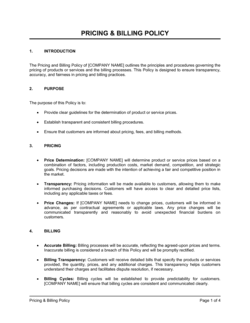
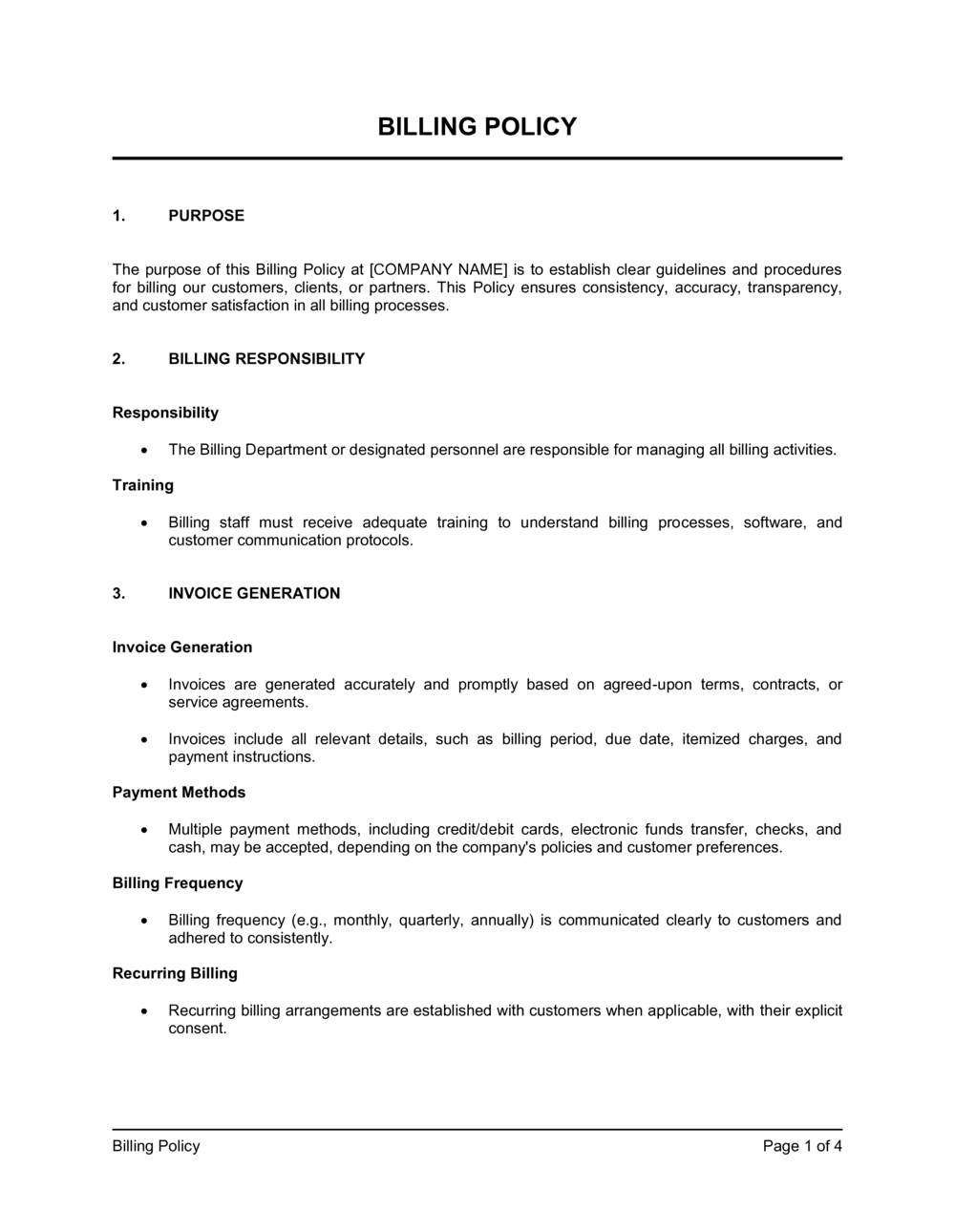
A Billing Policy is an internal operational document that defines exactly how your business invoices customers, what payment terms apply, when late fees are triggered, and how overdue accounts are escalated to collections. This free Word download gives you a structured, editable starting point you can customize to your business and share with staff, clients, and finance teams in minutes.
When you need it
Use it when onboarding new clients, standardizing invoicing across a growing team, reducing payment disputes, or setting consistent expectations before work begins. It is especially critical when you bill recurring clients, offer credit terms, or have multiple staff issuing invoices.
What's inside
Invoicing procedures and timing, accepted payment methods, payment terms and due dates, late payment fees and grace periods, dispute resolution steps, collections escalation procedures, and refund or credit policies.

What is a Billing Policy?

A Billing Policy is an internal operational document that defines the rules and procedures governing how a business issues invoices, collects payment, handles disputes, and escalates overdue accounts. It establishes consistent standards across the entire accounts receivable lifecycle β€” from the moment a service is delivered or a product ships, to the point at which outstanding balances are fully resolved. A well-written billing policy removes ambiguity for staff who handle invoicing and sets clear expectations for clients before a payment dispute ever arises.

Why You Need This Document

Without a written billing policy, every late payment becomes a judgment call, every dispute starts from scratch, and every overdue account follows a different path β€” or no path at all. The consequences are concrete: invoices sent late train clients to pay late, missing invoice fields stall corporate AP cycles, and undisclosed late fees trigger chargebacks and relationship damage. Businesses without a billing policy consistently carry higher days sales outstanding (DSO) than those with one, because the delays that inflate DSO are almost always procedural rather than intentional. A documented billing policy closes those gaps, gives your finance team a defensible standard to enforce, and signals to clients that your business operates with the same professionalism it expects from them. This template gives you a complete, editable starting point in minutes.

Which variant fits your situation?

If your situation is…Use this template
Service business with project-based billing and milestone invoicesBilling Policy (Service Business)
Subscription or SaaS product with automated recurring chargesSubscription Billing Policy
Medical or healthcare practice billing patients and insurersMedical Billing Policy
Retail or e-commerce business billing wholesale buyersCredit and Collections Policy
Professional services firm billing by the hour with retainersRetainer Billing Policy
Nonprofit or government contractor billing against grants or contractsGrant Billing and Reimbursement Policy
Freelancer needing a short client-facing payment terms documentPayment Terms Agreement

Common mistakes to avoid

❌ No defined invoice timing

Why it matters: Invoicing 30 days after delivery is equivalent to extending 60-day credit on a Net 30 contract β€” it doubles your cash cycle with no corresponding benefit.

Fix: Set a maximum number of business days between triggering event and invoice issuance and assign a named role responsible for meeting that deadline.

❌ Late fees not disclosed before billing

Why it matters: Applying a late fee a client was not told about triggers disputes, damages the relationship, and may be unenforceable in jurisdictions that require prior disclosure.

Fix: Include the late fee rate and grace period in the policy, on every invoice, and in your standard client agreement before work begins.

❌ No dispute resolution window

Why it matters: Without a defined dispute deadline β€” such as 15 days from invoice date β€” clients can contest invoices months later, forcing you to reconstruct records and re-examine completed work.

Fix: Set a written dispute window in the policy, reference it on every invoice, and log disputes by date so you can enforce the deadline when needed.

❌ Collections escalation with no intermediate steps

Why it matters: Jumping from an unpaid invoice directly to service suspension or legal referral bypasses a written reminder that may resolve the issue and creates client relations risk if the delay was a processing error.

Fix: Build at least two reminder touchpoints β€” at 30 days and 45 days overdue β€” before escalating to service suspension or collections referral.

❌ Refunds handled on a case-by-case basis

Why it matters: Ad hoc refund decisions create inconsistent treatment across clients and set informal precedents that staff and clients both cite in future disputes.

Fix: Write explicit eligibility criteria for refunds β€” overpayment, billing error, cancellation within a defined window β€” and assign approval authority to a specific role.

❌ Billing records stored only in email

Why it matters: Invoice history in email threads becomes inaccessible when staff leave or accounts are archived, leaving no audit trail for disputes, tax reviews, or litigation.

Fix: Require all billing records to be entered into a centralized accounting system or document management platform within 24 hours of issuance or receipt.

The 9 key sections, explained

Purpose and scope

Invoicing procedures and timing

Invoice content requirements

Payment terms and accepted methods

Late payment fees and grace periods

Billing disputes and resolution process

Collections escalation procedure

Refund and credit policy

Record retention and audit trail

How to fill it out

  1. 1

    Define the scope and assign ownership

    Enter your company name, the customer types the policy covers, and the department or role responsible for billing. Narrow scope prevents confusion about when the policy applies.

    πŸ’‘ If different business units bill differently β€” e.g., a product division vs. a services division β€” note those distinctions in the scope section rather than creating separate policies.

  2. 2

    Set your invoicing timing and authorized senders

    Decide when invoices go out β€” on delivery, at the end of each month, or at project milestones β€” and enter the number of business days allowed between triggering event and invoice issuance.

    πŸ’‘ A 48-hour invoicing rule from project completion is achievable for most teams and cuts average days-to-payment by 4–6 days.

  3. 3

    Specify required invoice fields

    List every field that must appear on invoices your business sends. Include any client-specific requirements you have encountered β€” PO numbers, cost center codes, or tax registration numbers.

    πŸ’‘ Build a checklist from this section and attach it to your invoice template so finance staff verify compliance before sending.

  4. 4

    Enter payment terms and accepted methods

    Choose your standard payment period (Net 15, Net 30, or Net 60), list every accepted payment method, and add early-payment discount terms if you offer them.

    πŸ’‘ Net 30 is the most widely expected B2B standard. Shortening to Net 15 for new clients before credit is established can significantly reduce first-invoice risk.

  5. 5

    Set the late fee rate and grace period

    Enter the grace period in business days and the monthly late fee percentage. 1–1.5% per month is standard across most industries. Confirm the rate is permissible in the client's jurisdiction before applying it.

    πŸ’‘ Disclose the late fee in the policy, on your invoices, and in your client contract so there is no basis for dispute when it is first applied.

  6. 6

    Document the dispute and collections process

    Write the dispute submission email or form, set the investigation and response timeline, and define the escalation steps with day-count triggers for each stage.

    πŸ’‘ A written dispute process also functions as a collections defense β€” if a client claims they disputed an invoice, you have a documented process to check whether they followed it.

  7. 7

    Complete the refund and records sections

    State eligible refund conditions, processing timeline, and the retention period for all billing records. Cross-reference the accounting system or document management platform where records are stored.

    πŸ’‘ Match your retention period to the longest applicable statute of limitations in your jurisdiction β€” typically 6–7 years for financial records in the US and Canada.

Frequently asked questions

What is a billing policy?

A billing policy is an internal business document that defines how a company invoices its customers, what payment terms apply, when late fees are charged, and how overdue accounts are escalated. It creates a consistent, documented standard for the accounts receivable process so staff, clients, and finance teams all operate from the same expectations. A written billing policy also reduces disputes, supports audits, and protects cash flow.

What should a billing policy include?

A complete billing policy covers invoicing timing and authorized senders, required invoice content, standard payment terms and accepted methods, late payment fees and grace periods, a dispute resolution process, collections escalation steps, refund and credit criteria, and record retention requirements. Leaving out any of these creates operational gaps that typically surface as cash flow problems or client disputes.

How is a billing policy different from payment terms?

Payment terms β€” such as Net 30 or Net 60 β€” are a single clause specifying when payment is due. A billing policy is a comprehensive document that covers the entire billing lifecycle, including how invoices are prepared and sent, what happens when payment is late, how disputes are handled, and how records are retained. Payment terms are typically included as one section within the billing policy.

Do I need to share my billing policy with clients?

The sections that affect clients directly β€” payment terms, accepted methods, late fees, and dispute procedures β€” should be communicated before work begins and referenced on every invoice. The internal procedural sections, such as staff authorization and record retention, are typically kept internal. Many businesses include a one-page summary of client-facing terms in their service agreements or onboarding documents.

How much should I charge for late payment fees?

A monthly rate of 1–1.5% on the overdue balance is standard across most B2B industries, equivalent to 12–18% annually. Some jurisdictions cap the maximum allowable rate, so confirm the ceiling for your client's location before applying it. Always disclose the rate in your billing policy, on your invoices, and in your client contract β€” undisclosed late fees are frequently disputed and may be unenforceable.

What is a billing dispute resolution process?

A billing dispute resolution process defines how a client formally contests an invoice β€” typically in writing within a set number of days of the invoice date β€” and how the business investigates and responds. A defined process sets a deadline for disputes, prevents months-old contested invoices from surfacing unexpectedly, and provides documentation that protects both parties if the dispute escalates.

How long should billing records be retained?

In the US, the IRS generally recommends retaining financial records for at least 3 years, but the statute of limitations for tax assessment can extend to 6–7 years in certain circumstances. In Canada, the CRA requires 6 years from the end of the tax year the records relate to. A safe default across most jurisdictions is 7 years for all invoices, payment receipts, and related correspondence.

When should I escalate an overdue account to collections?

Most businesses send a first written reminder at 30 days past due, a second notice at 45 days, and consider collections referral at 60–90 days. Before escalating, confirm the invoice was received, verify there is no unresolved dispute, and attempt a direct call to accounts payable. Document every contact attempt β€” this record is essential if the debt is later disputed or referred to a collections attorney.

Can a billing policy help reduce days sales outstanding (DSO)?

Yes β€” businesses with a written billing policy consistently report lower DSO than those without one, because the policy eliminates the most common delay drivers: invoices sent late, missing required fields, undisclosed late fees, and no clear escalation path. Setting a 48-hour invoicing rule, stating Net 30 terms explicitly, and applying late fees consistently after a grace period are the three changes most likely to shorten your collection cycle.

How this compares to alternatives

vs Payment Terms Agreement

A payment terms agreement is a client-facing contract clause or document that records the agreed payment period, methods, and late-fee rate for a specific engagement. A billing policy is an internal operational document that governs the entire invoicing and collections lifecycle across all clients. The payment terms agreement communicates obligations to one client; the billing policy defines how the business manages all of them.

vs Invoice Template

An invoice template is the formatted document sent to clients to request payment. A billing policy is the governing document that determines when invoices are issued, what they must contain, what happens when they go unpaid, and how disputes are resolved. The policy drives what goes into the invoice; the invoice template is the output.

vs Credit and Collections Policy

A credit and collections policy focuses specifically on evaluating client creditworthiness, setting credit limits, and recovering overdue debt. A billing policy covers the full invoicing lifecycle from issuance through payment, with collections escalation as one section rather than the primary focus. Businesses that extend significant trade credit typically need both documents.

vs Accounts Receivable Procedures Manual

An accounts receivable procedures manual is a detailed step-by-step operational guide for AR staff β€” including system entry instructions, reconciliation workflows, and exception handling. A billing policy is the higher-level governance document that defines the rules those procedures implement. The policy states what must happen; the procedures manual explains how staff execute it.

Industry-specific considerations

Professional Services

Milestone billing, retainer drawdown schedules, and hourly rate reconciliation require explicit procedures for when and how invoices are generated against tracked time.

SaaS / Technology

Subscription billing policies must address failed payment retries, dunning sequences, proration on upgrades or downgrades, and service suspension timelines.

Healthcare

Medical billing policies must cover insurance claim submission windows, patient balance billing procedures, and HIPAA-compliant record retention alongside standard AR practices.

Construction and Trades

Progress billing tied to project milestones, lien rights that depend on timely invoice delivery, and retainage release procedures all require explicit policy coverage.

Retail / Wholesale

Trade credit terms, volume discount schedules, and return authorization procedures intersect directly with billing policy to determine what gets invoiced, credited, or adjusted.

Marketing and Creative Agencies

Third-party expense pass-through billing, deposit invoices before campaign spend, and client approval requirements before final invoices are issued add complexity requiring documented procedures.

Template vs pro β€” what fits your needs?

PathBest forCostTime
Use the templateSmall businesses, freelancers, and growing teams standardizing billing for the first timeFree1–2 hours to customize and finalize
Template + professional reviewBusinesses extending credit terms, billing in regulated industries, or operating across multiple jurisdictions$200–$500 for an accountant or finance consultant review2–5 business days
Custom draftedEnterprise businesses, healthcare organizations, or companies with complex billing systems requiring integration with AR automation platforms$1,000–$3,000+ for a finance operations consultant or policy writer1–3 weeks

Glossary

Net 30 / Net 60
Payment terms stating the full invoice amount is due 30 or 60 calendar days after the invoice date.
Grace Period
A defined number of days after the due date during which a late fee is not yet charged, giving the payer time to resolve processing delays.
Late Payment Fee
A charge applied to overdue invoices, typically expressed as a flat fee or a monthly percentage of the outstanding balance.
Accounts Receivable (AR)
Money owed to the business by customers for goods or services already delivered but not yet paid for.
Collections Escalation
The process of formally pursuing an overdue account β€” through reminder notices, suspension of service, or referral to a third-party collections agency.
Disputed Invoice
An invoice the customer contests in whole or in part, triggering a formal review process before payment or adjustment is made.
Credit Terms
The agreed conditions under which a business extends payment credit to a customer β€” including payment period, credit limit, and any discount for early payment.
Retainer
An advance payment made by a client before work begins, held and drawn down as services are delivered and invoiced against.
Aging Report
An accounts receivable report that groups outstanding invoices by how long they have been unpaid β€” typically 0–30, 31–60, 61–90, and 90+ days.
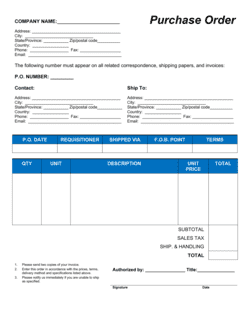
Purchase Order (PO) Number
A reference number issued by the buyer's purchasing system, required on the invoice by many corporate clients to authorize payment.

Part of your Business Operating System

This document is one of 3,000+ business & legal templates included in Business in a Box.

  • Fill-in-the-blanks β€” ready in minutes
  • 100% customizable Word document
  • Compatible with all office suites
  • Export to PDF and share electronically

Create your document in 3 simple steps.

From template to signed document β€” all inside one Business Operating System.
1
Download or open template

Access over 3,000+ business and legal templates for any business task, project or initiative.

2
Edit and fill in the blanks with AI

Customize your ready-made business document template and save it in the cloud.

3
Save, Share, Send, Sign

Share your files and folders with your team. Create a space of seamless collaboration.

Save time, save money, and create top-quality documents.

β˜…β˜…β˜…β˜…β˜…

"Fantastic value! I'm not sure how I'd do without it. It's worth its weight in gold and paid back for itself many times."

Managing Director Β· Mall Farm
Robert Whalley
Managing Director, Mall Farm Proprietary Limited
β˜…β˜…β˜…β˜…β˜…

"I have been using Business in a Box for years. It has been the most useful source of templates I have encountered. I recommend it to anyone."

Business Owner Β· 4+ years
Dr Michael John Freestone
Business Owner
β˜…β˜…β˜…β˜…β˜…

"It has been a life saver so many times I have lost count. Business in a Box has saved me so much time and as you know, time is money."

Owner Β· Upstate Web
David G. Moore Jr.
Owner, Upstate Web

Run your business with a system β€” not scattered tools

Stop downloading documents. Start operating with clarity. Business in a Box gives you the Business Operating System used by over 250,000 companies worldwide to structure, run, and grow their business.

Start freeΒ Β·Β No credit card required