Expense Reimbursement Policy Template

Free Word download β€’ Edit online β€’ Save & share with Drive β€’ Export to PDF

3 pagesβ€’20–30 min to fillβ€’Difficulty: Standard
Learn more ↓
FreeExpense Reimbursement Policy Template

At a glance

What it is
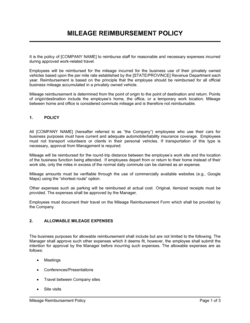
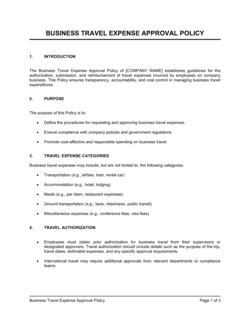
An Expense Reimbursement Policy is a formal internal document that defines which employee-paid business expenses the company will reimburse, sets spending limits by category, establishes the approval workflow, and specifies submission deadlines and documentation requirements. This free Word download gives you a structured, ready-to-customize starting point you can edit online and distribute to your team as a PDF or handbook insert.
When you need it
Use it when onboarding employees who incur business expenses, when scaling past the point where ad-hoc approvals are manageable, or when auditors or investors ask for documented internal financial controls.
What's inside
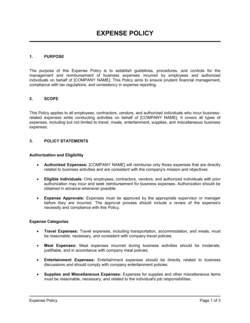
Scope and eligibility rules, eligible and ineligible expense categories with per-category spending limits, receipt and documentation requirements, the step-by-step approval and reimbursement workflow, submission deadlines, consequences for non-compliance, and an employee acknowledgment section.

What is an Expense Reimbursement Policy?

An Expense Reimbursement Policy is a formal internal document that establishes the rules governing how employees are repaid for business expenses they pay out of pocket. It defines which expense categories the company covers, sets spending limits by category, requires specific documentation for each expense type, maps the approval workflow from submission to payment, and states the consequences for non-compliance. Beyond internal consistency, the policy serves a critical tax function: it is the primary evidence that the company operates an IRS-compliant accountable plan, which is what keeps employee reimbursements out of taxable income.

Why You Need This Document

Without a written expense reimbursement policy, every expense claim becomes a negotiation. Finance teams apply inconsistent standards, managers approve expenses they lack the authority to approve, and employees submit costs months after they were incurred β€” distorting monthly close cycles and creating IRS substantiation problems. The downstream costs are concrete: reimbursements made without a documented accountable plan may be treated as taxable wages, triggering payroll tax liability for the company and unexpected tax bills for employees. A clearly written policy eliminates these risks, gives finance a documented basis to deny non-compliant claims, and signals to auditors and investors that the company has functional financial controls in place. This template gives you a complete, customizable starting point that covers every required element β€” from per-category limits to employee acknowledgment β€” so you can go from no policy to a distributed, signed document in under two hours.

Which variant fits your situation?

If your situation is…Use this template
Policy for a workforce that travels frequently for client workTravel and Expense Policy
Simple one-page reimbursement rules for a small teamEmployee Expense Reimbursement Policy (Simple)
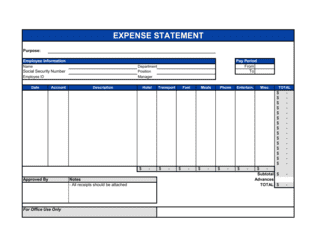
Capturing and submitting individual expense claimsExpense Report
Reimbursing employees for remote work home-office costsRemote Work Expense Policy
Policy governing corporate credit card usage and reconciliationCorporate Credit Card Policy
Per diem rates for employee travel meals and lodgingPer Diem Policy
Tracking and categorizing business expenses for tax purposesBusiness Expense Tracker

Common mistakes to avoid

❌ No per-category spending limits

Why it matters: Without explicit limits, employees interpret 'reasonable' differently β€” a $400 team dinner is reasonable to one person and excessive to another, and finance has no documented basis to deny it.

Fix: Set a dollar limit for every eligible category, including a per-person cap for group meals and a nightly hotel cap by city tier.

❌ Skipping a submission deadline

Why it matters: Late expense submissions create accounting close problems, distort monthly P&L, and can violate IRS accountable-plan rules if submitted more than 60 days after the expense date.

Fix: State a specific deadline β€” 30 calendar days is standard β€” and include an exception process requiring CFO sign-off for late submissions.

❌ Accepting credit card statements instead of itemized receipts

Why it matters: A statement shows the merchant and amount but not what was purchased or for what business purpose, which fails IRS substantiation requirements for meals and entertainment.

Fix: Require itemized receipts for all meal and entertainment expenses, plus a written note of the business purpose and names of attendees.

❌ Treating all approvals as post-hoc

Why it matters: Without pre-approval requirements for large or unusual expenses, the company learns about a $5,000 conference registration after the employee has already paid and cannot redirect or decline the spend.

Fix: Require written pre-approval for international travel, any single expense above a defined threshold, and all client entertainment above the per-person limit.

❌ Vague non-compliance language

Why it matters: Language like 'may be subject to review' signals that violations carry no real consequences, which invites policy abuse and makes enforcement actions harder to defend.

Fix: State explicitly that non-compliant expenses will be denied, employees may be required to repay reimbursed amounts, and intentional fraud will result in termination and potential prosecution.

❌ Never updating spending limits

Why it matters: A hotel limit set at $150/night in 2019 is unworkable in most cities today, forcing constant exception requests that undermine the policy and burden approvers.

Fix: Schedule an annual policy review tied to the fiscal year budget process and update all dollar limits to reflect current market rates.

The 10 key sections, explained

Purpose and scope

Eligible expense categories

Non-reimbursable expenses

Spending limits and thresholds

Receipt and documentation requirements

Pre-approval requirements

Submission process and deadlines

Approval workflow and payment timeline

Non-compliance and consequences

Employee acknowledgment

How to fill it out

  1. 1

    Enter company name and effective date

    Replace all [COMPANY NAME] placeholders with your registered business name and set the policy's effective date. This establishes which version applies to any given expense claim.

    πŸ’‘ Include a revision history table at the back β€” even a simple 'Version 1.0, May 2026' β€” so future updates can be tracked without ambiguity.

  2. 2

    Define the scope of covered employees

    Specify whether the policy applies to full-time employees only, or also to part-time, contract, and temporary workers. List any roles or departments with separate expense arrangements.

    πŸ’‘ If contractors bill expenses through invoices rather than expense reports, state this explicitly to avoid double-submission confusion.

  3. 3

    Set spending limits for each category

    Fill in dollar amounts for each eligible expense category β€” meals, lodging, mileage, airfare, entertainment. Use current IRS standard mileage rates and your actual city-tier hotel averages as anchors.

    πŸ’‘ Check GSA per diem tables for the cities your employees travel to most frequently β€” these rates are defensible benchmarks if a limit is ever questioned.

  4. 4

    List non-reimbursable items specifically

    Add at least eight to ten concrete examples of expenses the company will not cover. Pull from your most common employee queries or past disputes to make the list practical.

    πŸ’‘ Include a catch-all clause after the specific list: 'and any other expense not directly related to a documented business purpose' to cover edge cases.

  5. 5

    Map the pre-approval and approval workflow

    Name the actual roles β€” not individuals β€” responsible for each approval step (e.g., 'direct manager,' 'VP Finance,' 'CFO'). Set turnaround time commitments at each stage.

    πŸ’‘ Using roles instead of names means the policy stays valid when people change jobs or leave the company.

  6. 6

    Set the submission deadline

    Enter a specific number of calendar days after the expense date within which reports must be submitted. Thirty days is the most common standard; 60 days is the outer limit for IRS accountable-plan compliance.

    πŸ’‘ A 30-day deadline aligns with monthly accounting close cycles and makes month-end accruals easier to estimate.

  7. 7

    Specify the payment method and timeline

    State whether reimbursements are paid via payroll, separate ACH transfer, or check, and how many business days after final approval the employee can expect payment.

    πŸ’‘ Processing through payroll is simplest administratively but delays payment to the next payroll cycle β€” consider a mid-cycle ACH option for large reimbursements.

  8. 8

    Collect signed employee acknowledgments

    Distribute the policy to all in-scope employees, collect signed acknowledgment forms, and store them in each employee's personnel file or your HRIS.

    πŸ’‘ Re-collect signatures whenever the policy is updated β€” a signature on a prior version does not constitute agreement to new spending limits.

Frequently asked questions

What is an expense reimbursement policy?

An expense reimbursement policy is an internal company document that defines which business expenses employees can be repaid for, how much the company will reimburse per category, what documentation is required, and how the approval and payment process works. It creates consistent rules across the organization, reduces disputes, and ensures the company meets IRS accountable-plan requirements so reimbursements remain non-taxable to employees.

What should an expense reimbursement policy include?

A complete policy covers: scope of covered employees, eligible and non-reimbursable expense categories with specific dollar limits, receipt and documentation requirements, pre-approval rules for large or unusual expenses, submission deadlines, the step-by-step approval workflow, payment method and timeline, consequences for non-compliance, and an employee acknowledgment section. Missing any of these creates gaps that result in disputes, late submissions, or tax problems.

Does an expense reimbursement policy need to be in writing?

No law in most jurisdictions requires a written expense policy, but operating without one is a significant practical and tax risk. The IRS requires businesses to maintain an accountable plan β€” documented business purpose, adequate receipts, and timely submission β€” to exclude reimbursements from employee income. A written policy is the primary evidence that an accountable plan exists and is being followed.

What is the IRS accountable plan rule?

An accountable plan is an IRS-compliant reimbursement arrangement that requires three conditions: the expense must have a business connection, the employee must provide adequate documentation (receipt plus business purpose) within a reasonable time, and any advance in excess of actual expenses must be returned. When all three are met, reimbursements are not included in the employee's taxable income. A policy that omits submission deadlines or receipt requirements risks failing this test.

What is a reasonable hotel spending limit for a travel expense policy?

Most companies set hotel limits by city tier rather than a single national rate. A common approach uses GSA per diem lodging rates as the baseline β€” typically $100–$130/night for secondary cities and $200–$350/night for high-cost cities like New York, San Francisco, or Boston. Review and update limits annually, as rates shift materially with market conditions.

Should meals be reimbursed at actual cost or on a per diem basis?

Both approaches are valid. Per diems simplify administration β€” employees receive a fixed daily allowance and need not submit meal receipts β€” and are fully compliant with IRS rules when set at or below GSA per diem rates. Actual-cost reimbursement with itemized receipts gives the company more control but creates higher administrative overhead. Many companies use per diems for multi-day trips and actual-cost rules for single-meal client entertainment where the business purpose must be documented.

How long do employees have to submit expense reports?

Thirty calendar days after the expense date is the most common standard and aligns with monthly accounting close cycles. The IRS considers submission within 60 days of the expense date to be reasonable for accountable plan purposes β€” beyond 60 days, reimbursements may need to be treated as taxable income. State your deadline explicitly in the policy and include an exception process for late submissions.

Do employees need to sign the expense reimbursement policy?

A signed acknowledgment is strongly recommended. It confirms the employee received and understood the rules, which is essential if the company later needs to deny a claim, seek repayment of a non-compliant reimbursement, or take disciplinary action. Store signed acknowledgments in each employee's personnel file and re-collect signatures whenever the policy is materially updated.

How is an expense reimbursement policy different from an expense report?

The policy is the governing document that sets the rules β€” what is reimbursable, how much, and how the process works. An expense report is the form or digital submission an individual employee uses to claim a specific set of expenses under those rules. The policy applies to everyone permanently; the expense report is a transaction-level document submitted each time an employee incurs reimbursable costs.

How this compares to alternatives

vs Expense Report

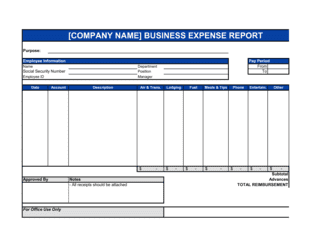
An expense report is the transaction-level form an employee submits to claim specific costs incurred during a period. An expense reimbursement policy is the governing document that sets the rules the expense report must comply with. You need both β€” the policy defines what is allowed; the report is how employees request it.

vs Travel Policy

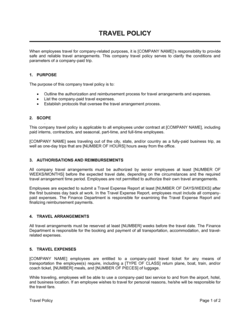
A travel policy focuses exclusively on business travel β€” booking requirements, approved vendors, class of service, and trip approval thresholds. An expense reimbursement policy is broader, covering travel alongside meals, equipment, entertainment, and remote-work costs. Companies with frequent travel often maintain both, with the travel policy setting travel-specific rules and the expense policy governing everything else.

vs Employee Handbook

An employee handbook is a comprehensive reference covering all HR policies β€” conduct, benefits, leave, and general expectations. An expense reimbursement policy is a standalone financial controls document with specific dollar limits, workflow steps, and tax compliance requirements that warrant their own dedicated document rather than a brief handbook section.

vs Corporate Credit Card Policy

A corporate credit card policy governs expenses charged directly to company-issued cards β€” card limits, approved categories, reconciliation deadlines, and consequences for misuse. An expense reimbursement policy covers out-of-pocket employee spending that is repaid after the fact. Companies with both card and cash reimbursement programs need both policies, with clear rules on which payment method applies to which expense type.

Industry-specific considerations

Professional Services

Client entertainment limits and meal documentation are critical because frequent client-facing meals are standard and IRS scrutiny of entertainment deductions is high.

Technology / SaaS

Remote-work stipends, home-office equipment, and software subscription reimbursements require explicit category definitions that traditional travel-focused policies omit.

Construction and Trades

Per diem rates for extended job-site deployments, tool and equipment purchases, and fuel reimbursement for personal vehicles are the most frequently disputed categories.

Healthcare

Conference and continuing-education reimbursements are common and often require pre-approval, with limits set separately from general travel to manage CME budgets.

Retail and Hospitality

Uniform and workwear reimbursements, staff meals, and multi-site travel for area managers are the primary categories, often governed by hourly-worker-specific rules.

Financial Services

Regulatory compliance training costs and client entertainment are subject to additional scrutiny under FINRA and FCA rules, requiring enhanced documentation beyond standard policy requirements.

Template vs pro β€” what fits your needs?

PathBest forCostTime
Use the templateSmall to mid-sized businesses establishing a first written expense policyFree1–2 hours to customize and distribute
Template + professional reviewCompanies with complex multi-jurisdiction operations, frequent international travel, or corporate card programs$200–$600 for an HR consultant or accountant review2–5 business days
Custom draftedEnterprises with regulated expense categories (FINRA, FCA, healthcare anti-kickback), union workforces, or ERP-integrated approval workflows$1,000–$3,500+2–4 weeks

Glossary

Reimbursable Expense
A business-related cost paid out of pocket by an employee that the company has agreed to repay according to the terms of this policy.
Per Diem
A fixed daily allowance paid to employees for meals and incidental expenses while traveling on company business, eliminating the need for individual meal receipts.
Approval Workflow
The defined chain of people β€” typically the direct manager and a finance approver β€” who must review and authorize an expense claim before reimbursement is processed.
Spend Limit
The maximum amount the company will reimburse for a specific expense category per transaction, per day, or per trip.
Itemized Receipt
A receipt that shows the individual line items of a purchase, not just the total β€” required for meals and entertainment to confirm the business nature of each charge.
Non-Reimbursable Expense
A cost the company explicitly will not repay, such as personal entertainment, traffic fines, or upgrades beyond the company's approved travel class.
Expense Report
The form or digital submission an employee uses to list, categorize, and attach receipts for expenses incurred, which then enters the approval workflow.
Substantiation
The documentation required by the IRS (and equivalent tax authorities) to support a business expense deduction β€” typically a receipt plus a business purpose statement.
Advance
A cash or card payment issued to an employee before a trip or event to cover anticipated business expenses, which must be reconciled against actual receipts afterward.
Accountable Plan
An IRS-compliant reimbursement arrangement in which employees must have a business connection for expenses, submit adequate documentation, and return any excess advance β€” making reimbursements non-taxable to the employee.

Part of your Business Operating System

This document is one of 3,000+ business & legal templates included in Business in a Box.

  • Fill-in-the-blanks β€” ready in minutes
  • 100% customizable Word document
  • Compatible with all office suites
  • Export to PDF and share electronically

Create your document in 3 simple steps.

From template to signed document β€” all inside one Business Operating System.
1
Download or open template

Access over 3,000+ business and legal templates for any business task, project or initiative.

2
Edit and fill in the blanks with AI

Customize your ready-made business document template and save it in the cloud.

3
Save, Share, Send, Sign

Share your files and folders with your team. Create a space of seamless collaboration.

Save time, save money, and create top-quality documents.

β˜…β˜…β˜…β˜…β˜…

"Fantastic value! I'm not sure how I'd do without it. It's worth its weight in gold and paid back for itself many times."

Managing Director Β· Mall Farm
Robert Whalley
Managing Director, Mall Farm Proprietary Limited
β˜…β˜…β˜…β˜…β˜…

"I have been using Business in a Box for years. It has been the most useful source of templates I have encountered. I recommend it to anyone."

Business Owner Β· 4+ years
Dr Michael John Freestone
Business Owner
β˜…β˜…β˜…β˜…β˜…

"It has been a life saver so many times I have lost count. Business in a Box has saved me so much time and as you know, time is money."

Owner Β· Upstate Web
David G. Moore Jr.
Owner, Upstate Web

Run your business with a system β€” not scattered tools

Stop downloading documents. Start operating with clarity. Business in a Box gives you the Business Operating System used by over 250,000 companies worldwide to structure, run, and grow their business.

Start freeΒ Β·Β No credit card required