Attendance Policy Template

Free Word download β€’ Edit online β€’ Save & share with Drive β€’ Export to PDF

3 pagesβ€’20–25 min to fillβ€’Difficulty: Standard
Learn more ↓
FreeAttendance Policy Template

At a glance

What it is
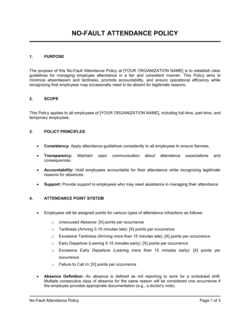
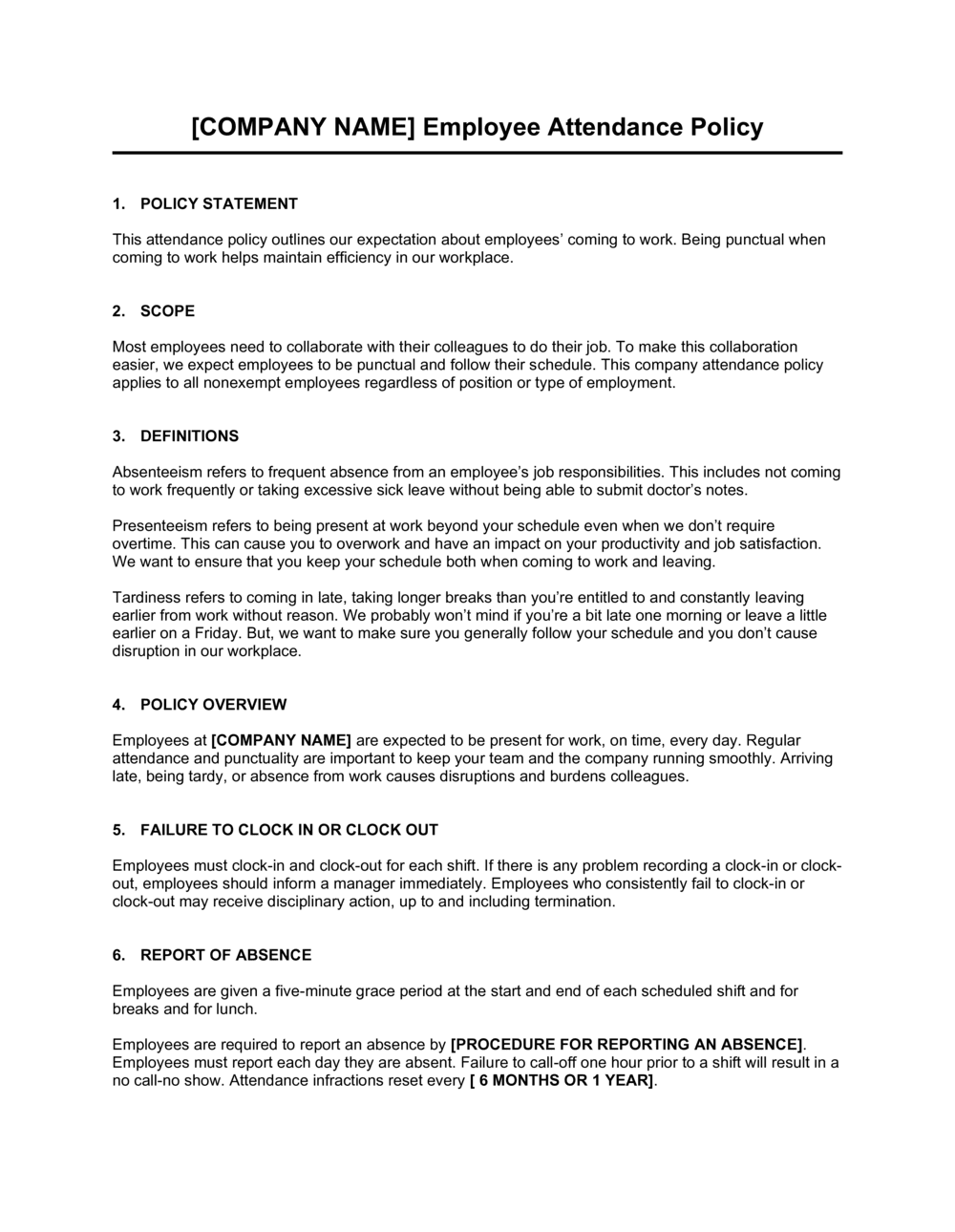
An Attendance Policy is a formal workplace document that defines an employer's expectations for employee punctuality and presence, the procedures for reporting absences, and the disciplinary consequences for violations. This free Word download gives you a structured, editable starting point you can tailor to your workforce and export as PDF for distribution or inclusion in your employee handbook.
When you need it
Use it when onboarding your first employees, when absenteeism is affecting operations or morale, or when you need to standardize how managers across multiple locations handle tardiness and call-outs.
What's inside
Policy purpose and scope, definitions of absence and tardiness, call-out notification procedures, an absence tracking or point system, approved leave categories, disciplinary progression steps, and manager responsibilities.

What is an Attendance Policy?

An Attendance Policy is a formal workplace document that sets an employer's expectations for employee punctuality and presence, defines the categories of excused and unexcused absence, establishes the procedure employees must follow to report a missed shift or late arrival, and specifies the progressive disciplinary steps that follow repeated violations. Unlike informal expectations passed verbally between managers and employees, a written attendance policy ensures every team lead, HR professional, and worker operates from the same written standard β€” reducing disputes, supporting consistent discipline, and creating the documentation trail needed if a termination is ever challenged.

Why You Need This Document

Without a written attendance policy, every manager enforces attendance by feel β€” one tolerates three absences before a conversation, another issues a warning after one. That inconsistency creates real legal risk: employees who are disciplined more quickly than peers in comparable situations have a credible basis for a discrimination or unfair-treatment complaint. Absenteeism without a clear tracking method also goes unaddressed until it reaches a crisis point, by which time terminating the employee without a documented escalation trail is procedurally difficult. A formal attendance policy eliminates all of these gaps: it gives employees clear notice of the rules before any discipline occurs, gives managers a consistent framework to apply uniformly, and gives HR the documented evidence base to defend a termination if it is ever challenged. This template gets you from blank page to a distributed, acknowledged policy in under two hours.

Which variant fits your situation?

If your situation is…Use this template
Hourly or shift-based workforce where coverage is time-criticalShift Attendance Policy
Remote or hybrid workforce with flexible hoursRemote Work Attendance Policy
Tracking individual absence history for progressive disciplineEmployee Attendance Record
Managing chronic absenteeism with a formal points systemAttendance Points System Policy
Policy covering scheduled time-off requests and approvalsLeave of Absence Policy
Comprehensive employee rules document that includes attendanceEmployee Handbook
Written warning for an employee who has violated the policyEmployee Warning Letter

Common mistakes to avoid

❌ Undefined or vague tardiness threshold

Why it matters: Without a specific cutoff β€” such as '5 minutes after scheduled start time' β€” managers set their own informal standards, creating inconsistency that exposes the company to discrimination claims.

Fix: State the exact number of minutes that constitutes tardiness and apply it uniformly across all teams and shifts.

❌ Calendar-year reset for attendance points

Why it matters: An employee who accumulates seven points between October and December starts fresh in January, meaning a pattern of chronic absenteeism resets before discipline is complete.

Fix: Switch to a rolling 12-month window so any given day looks back 365 days β€” the deterrent effect is continuous and consistent.

❌ No signed acknowledgement collected at distribution

Why it matters: When an employee is terminated for attendance and disputes the discharge, the absence of a signed acknowledgement is the most common procedural gap that weakens the employer's case.

Fix: Require a signed or digitally confirmed acknowledgement at onboarding and each time the policy is materially revised, and file it in the personnel record.

❌ No call-out channel or deadline specified

Why it matters: Employees who notify a coworker by text an hour after their shift starts claim they followed policy β€” and without a written procedure, that claim is hard to rebut.

Fix: Specify the exact communication channel, recipient, and deadline for call-outs, and state explicitly which channels do not constitute valid notification.

❌ Disciplinary steps not initiated within a defined timeframe

Why it matters: Managers who delay initiating a disciplinary step for weeks after a threshold is crossed undermine the policy's credibility and create a record of inconsistent enforcement.

Fix: State a specific deadline β€” for example, 'within five business days of crossing a threshold' β€” and hold managers accountable for initiating steps on time.

❌ Failing to exclude legally protected leave from point accumulation

Why it matters: Counting FMLA, ADA-accommodated, or state-mandated sick leave absences toward attendance points exposes the employer to retaliation or interference claims under federal or state law.

Fix: List every legally protected leave type explicitly in the excused-absence section and train managers to flag potential FMLA or accommodation situations before logging them as unexcused.

The 8 key sections, explained

Purpose and Scope

Definitions

Call-Out Notification Procedure

Absence Tracking and Points System

Approved Leave Categories

Disciplinary Progression

Manager Responsibilities

Employee Acknowledgement

How to fill it out

  1. 1

    Define the scope and covered employee groups

    Identify which employment types, locations, and departments the policy covers. If remote and on-site workers have different expectations, create separate scope paragraphs or separate policies.

    πŸ’‘ State the effective date and version number in the header so employees and managers always know which version is current.

  2. 2

    Set precise definitions for each absence category

    Write specific, numeric definitions for tardiness, early departure, unexcused absence, excused absence, and no-call no-show. Ambiguous definitions are the most common source of manager-employee disputes.

    πŸ’‘ Run draft definitions past two or three front-line managers before finalizing β€” they will quickly identify edge cases that need clarification.

  3. 3

    Document the call-out procedure with a specific deadline

    State the required notification channel (phone call, HR portal, text), the recipient (direct supervisor, department head, or HR), and the deadline β€” for example, at least one hour before the scheduled start time.

    πŸ’‘ Require a phone call rather than a text for unplanned same-day absences β€” it reduces ambiguous or unread notifications.

  4. 4

    Choose a tracking method and set point thresholds

    Decide whether you will use a simple absence count, a weighted points system, or your HR software's built-in tracking. Set point values for each absence type and the thresholds that trigger each disciplinary step.

    πŸ’‘ Use a rolling 12-month window rather than a calendar year to prevent a December-to-January reset from erasing an employee's full year of violations.

  5. 5

    List excused leave categories with cross-references

    Enumerate every leave type that will not count against the employee's attendance record. Cross-reference your PTO policy, FMLA policy, bereavement policy, and any state or local mandated-leave laws.

    πŸ’‘ Consult your state labor department's website to confirm all legally protected leave types in your jurisdiction before finalizing this section.

  6. 6

    Draft the disciplinary progression with specific point triggers

    Map each disciplinary step to a specific point threshold or occurrence count, name the action required (written warning, suspension, PIP), and specify the timeframe for initiating each step.

    πŸ’‘ Add a no-call no-show carve-out that allows immediate progression to Step 2 or Step 3 β€” this is standard practice and withstands legal scrutiny when documented.

  7. 7

    Assign manager responsibilities with deadlines

    Write a dedicated section stating what managers must do β€” log events in the HR system within 24 hours, conduct return-to-work check-ins, escalate to HR at defined thresholds β€” and in what timeframe.

    πŸ’‘ Brief all people managers on the policy before it goes live; unenforced policies create more legal risk than no policy at all.

  8. 8

    Collect signed employee acknowledgements

    Distribute the policy at onboarding and whenever it is materially updated. Collect a signed acknowledgement form from every employee and file it in the personnel record.

    πŸ’‘ If you use an HRIS, configure the acknowledgement as a required digital task so you have a timestamped audit trail without chasing paper signatures.

Frequently asked questions

What is an attendance policy?

An attendance policy is a written workplace document that defines an employer's expectations for employee punctuality and presence, the procedure employees must follow to report an absence or late arrival, and the disciplinary consequences for repeated violations. It ensures every manager applies the same standard and gives employees clear notice of the rules before any discipline occurs.

What should an employee attendance policy include?

At minimum, an attendance policy should include the policy's scope and covered employee groups, precise definitions of tardiness and the different absence types, the call-out notification procedure, a method for tracking attendance events, a list of excused leave categories, a progressive disciplinary process tied to specific thresholds, manager responsibilities, and an employee acknowledgement section.

Can an employer count FMLA absences toward attendance points?

No. In the United States, counting FMLA-qualifying absences toward an attendance point total or disciplinary process constitutes interference with FMLA rights and exposes the employer to a retaliation claim. Absences covered by FMLA, ADA accommodations, or equivalent state-mandated leave must be excluded from the attendance tracking system. Consult an employment attorney if your workforce includes employees who take frequent intermittent leave.

What is a no-call no-show policy?

A no-call no-show provision defines what happens when an employee misses a shift without contacting a supervisor by the required deadline. Most policies treat a no-call no-show as the most serious attendance violation and allow the employer to skip directly to a higher disciplinary step β€” commonly Step 2 or Step 3 β€” rather than starting at the beginning of the progressive discipline ladder. Three consecutive no-call no-shows is frequently treated as a voluntary resignation.

Should an attendance policy use a calendar year or a rolling 12-month window?

A rolling 12-month window is strongly preferred over a calendar-year reset. With a calendar-year approach, an employee who accumulates violations through November resets to zero in January β€” eliminating any deterrent effect. A rolling window means any given date looks back 365 days, so the policy's consequences remain active regardless of when in the year violations occur.

How do I handle attendance for remote or hybrid employees?

Remote and hybrid attendance policies focus on availability and responsiveness during core hours rather than physical presence. Define the core hours employees must be reachable, the expected response time for messages and calls, how scheduled remote workdays are tracked in the HR system, and the procedure for reporting when a remote employee is unexpectedly unavailable. Apply the same progressive discipline steps used for on-site employees so the standard is consistent.

Do I need a separate attendance policy if I already have an employee handbook?

If your employee handbook includes a detailed attendance section with specific procedures, point thresholds, and disciplinary steps, a separate standalone policy may be redundant. However, many companies keep a standalone attendance policy that the handbook references β€” this makes it easier to update attendance rules without re-issuing the entire handbook. Either approach is valid as long as the rules are clear, consistent, and acknowledged in writing by every employee.

What is a reasonable number of absences before discipline begins?

There is no universal standard, but a common benchmark in shift-based industries is three unexcused absences in a rolling 12-month period before a written warning is issued. Office environments often use four to six occurrences before formal action. The right threshold depends on your operational impact tolerance and the prevailing norms in your industry. Document your rationale so you can demonstrate the threshold is applied consistently and is not discriminatory.

How often should an attendance policy be reviewed and updated?

Review the policy annually β€” ideally at the start of the fiscal year β€” and whenever there is a material change in employment law, a shift in your workforce model (for example, moving to hybrid work), or evidence that the current thresholds are being gamed or are inconsistently enforced. Distribute and re-acknowledge the updated policy every time a substantive change is made.

How this compares to alternatives

vs Employee Handbook

An employee handbook is a comprehensive document covering all workplace policies β€” code of conduct, benefits, safety, leave, and more. An attendance policy is a single-topic document that can stand alone or be embedded as a chapter in the handbook. Use the standalone template when you need to update attendance rules without reissuing the full handbook, or when managers need a one-page reference document for daily use.

vs Leave of Absence Policy

A leave of absence policy governs planned, approved time off β€” FMLA, parental leave, medical leave, and personal leave. An attendance policy governs unplanned absences and tardiness, and defines the disciplinary consequences for them. The two documents work in tandem: the attendance policy should explicitly cross-reference approved leave types so managers know which absences to exempt from the points system.

vs Employee Warning Letter

An attendance policy is the governing rule document; an employee warning letter is the output document generated when an employee violates it. The warning letter references the attendance policy by name and version to establish that the employee had clear prior notice. You need both: the policy to set the standard and the letter to document that a specific violation occurred and was formally addressed.

vs Performance Improvement Plan

A performance improvement plan (PIP) addresses broader performance deficiencies β€” output quality, skill gaps, missed targets β€” over a defined remediation period. An attendance policy handles the narrower issue of presence and punctuality through a points-based or occurrence-based escalation. Some employers initiate a PIP as the final step before termination in severe attendance cases, but the two documents serve distinct purposes and should not be conflated.

Industry-specific considerations

Manufacturing

Shift coverage is time-critical β€” a single unplanned absence on a production line can halt output, so points systems with low thresholds and rapid disciplinary escalation are standard.

Retail / Hospitality

High turnover and hourly scheduling make consistent call-out procedures essential; many operators use a three-strike no-call no-show rule as a de facto voluntary-resignation clause.

Healthcare

Patient safety depends on fully staffed shifts, so attendance policies often require two-hour advance notice and carry automatic Step 2 discipline for no-call no-shows; FMLA and ADA carve-outs require careful documentation.

Professional Services

Policies focus on availability during client-facing core hours and response-time standards rather than physical presence, with hybrid and remote arrangements requiring explicit definitions of 'present and available.'

Template vs pro β€” what fits your needs?

PathBest forCostTime
Use the templateSmall businesses and HR teams standardizing attendance rules for the first timeFree1–2 hours to complete and distribute
Template + professional reviewCompanies with 50+ employees, unionized workforces, or operations in states with strict paid-sick-leave laws$200–$500 for an HR consultant or employment attorney review2–5 business days
Custom draftedMulti-state employers, heavily regulated industries such as healthcare, or workforces covered by collective bargaining agreements$500–$2,000+1–2 weeks

Glossary

Unexcused Absence
A missed workday for which the employee did not provide advance notice or an accepted reason, as defined by the employer's policy.
Excused Absence
A missed workday that the employer has approved in advance or accepted as valid after the fact, such as a documented medical appointment or bereavement.
Tardiness
Arriving at the workplace or logging in after the scheduled start time, typically defined as any arrival more than a set number of minutes late β€” commonly 5 or 10 minutes.
No-Call No-Show
A situation where an employee fails to report to work and does not notify a supervisor by the required deadline β€” typically treated as the most serious category of attendance violation.
Attendance Points System
A tracking method that assigns a numeric value to each absence or tardiness event; employees who accumulate points above a threshold trigger automatic disciplinary steps.
Progressive Discipline
A formal disciplinary process that escalates in severity β€” verbal warning, written warning, final warning, suspension, termination β€” with each repeated violation.
Call-Out Procedure
The specific steps an employee must follow to notify their supervisor when they will be absent or late, including the required lead time and accepted communication channels.
Intermittent Leave
Approved time off taken in separate blocks rather than all at once β€” common for chronic medical conditions covered by FMLA or equivalent legislation.
FMLA
The US Family and Medical Leave Act, which entitles eligible employees at covered employers to up to 12 weeks of unpaid, job-protected leave per year for qualifying medical or family reasons.
Attendance Record
A written or system-based log maintained by HR or a direct manager that tracks each employee's absences, late arrivals, and early departures over a defined period.

Part of your Business Operating System

This document is one of 3,000+ business & legal templates included in Business in a Box.

  • Fill-in-the-blanks β€” ready in minutes
  • 100% customizable Word document
  • Compatible with all office suites
  • Export to PDF and share electronically

Create your document in 3 simple steps.

From template to signed document β€” all inside one Business Operating System.
1
Download or open template

Access over 3,000+ business and legal templates for any business task, project or initiative.

2
Edit and fill in the blanks with AI

Customize your ready-made business document template and save it in the cloud.

3
Save, Share, Send, Sign

Share your files and folders with your team. Create a space of seamless collaboration.

Save time, save money, and create top-quality documents.

β˜…β˜…β˜…β˜…β˜…

"Fantastic value! I'm not sure how I'd do without it. It's worth its weight in gold and paid back for itself many times."

Managing Director Β· Mall Farm
Robert Whalley
Managing Director, Mall Farm Proprietary Limited
β˜…β˜…β˜…β˜…β˜…

"I have been using Business in a Box for years. It has been the most useful source of templates I have encountered. I recommend it to anyone."

Business Owner Β· 4+ years
Dr Michael John Freestone
Business Owner
β˜…β˜…β˜…β˜…β˜…

"It has been a life saver so many times I have lost count. Business in a Box has saved me so much time and as you know, time is money."

Owner Β· Upstate Web
David G. Moore Jr.
Owner, Upstate Web

Run your business with a system β€” not scattered tools

Stop downloading documents. Start operating with clarity. Business in a Box gives you the Business Operating System used by over 250,000 companies worldwide to structure, run, and grow their business.

Start freeΒ Β·Β No credit card required