Branding Policy Template

Free Word download β€’ Edit online β€’ Save & share with Drive β€’ Export to PDF

3 pagesβ€’20–25 min to fillβ€’Difficulty: Standard
Learn more ↓
FreeBranding Policy Template

At a glance

What it is
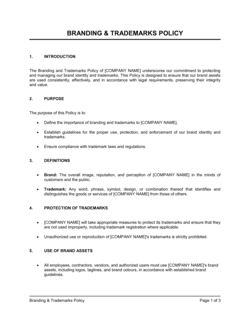
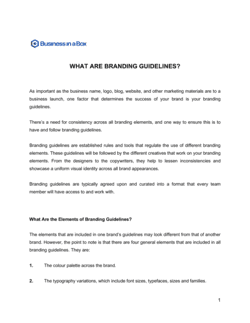
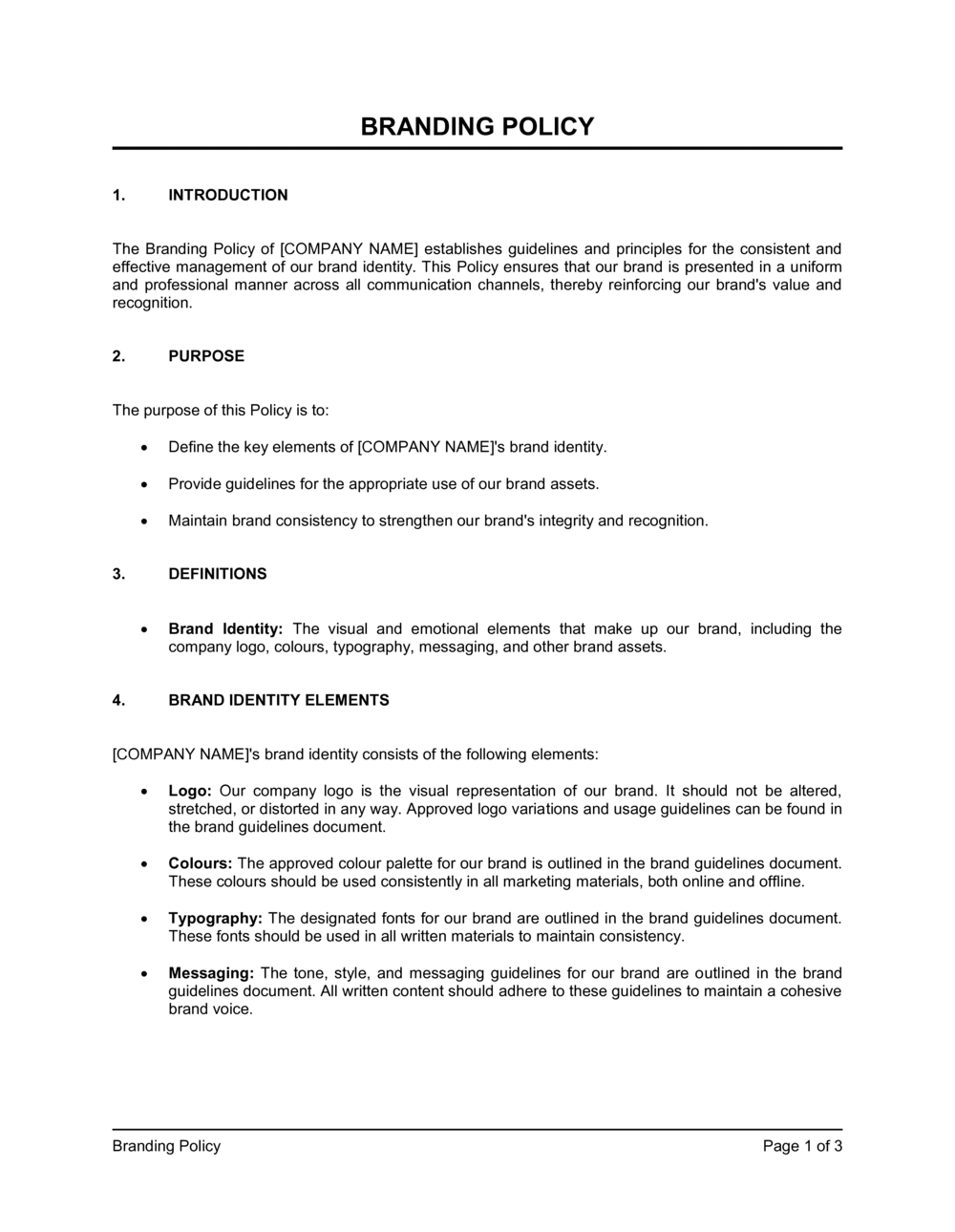
A Branding Policy is an internal governance document that defines the rules for how a company's visual identity, tone of voice, and brand assets are used across all channels and by all stakeholders. This free Word download gives you a structured, editable starting point covering logos, color palettes, typography, imagery, and messaging guidelines you can tailor and distribute to your team, agencies, and partners.
When you need it
Use it when onboarding a new agency or vendor who will produce content on your behalf, when inconsistent branding across departments or channels has become a visible problem, or when scaling a team that needs a single authoritative reference for how the brand should look and sound.
What's inside
Brand purpose and positioning statement, logo usage rules and clear-space requirements, primary and secondary color palettes with hex and CMYK codes, typography hierarchy, imagery and iconography standards, tone of voice guidelines, co-branding and partner usage rules, and a policy enforcement section defining who approves exceptions.

What is a Branding Policy?

A Branding Policy is an internal governance document that establishes the authoritative rules for how a company's visual identity, tone of voice, and brand assets are applied β€” consistently and correctly β€” across every channel, team, and third-party relationship. It goes beyond a design reference by adding named ownership, an exception approval process, and a scheduled review cadence, transforming brand standards from informal guidelines into an enforceable organizational policy. The document typically covers logo usage, color palettes with print and digital specifications, typography hierarchy, imagery standards, messaging guidelines, digital application rules, co-branding requirements, and the governance mechanism that keeps all of the above current.

Why You Need This Document

Without a documented branding policy, inconsistency compounds silently: a vendor uses the wrong logo variant, a new hire writes in a tone that contradicts established messaging, a franchisee prints signage in an unapproved color because no one told them the CMYK values. Each individual deviation seems minor; the cumulative effect is a brand that looks and sounds different depending on who produced the material β€” eroding the recognition and trust that brand equity is built on. A formal policy gives every team member, agency, and partner a single source of truth, eliminates the recurring back-and-forth of correcting off-brand work after production, and protects the investment your organization has made in its visual and verbal identity. This template gives you the structure to get that policy written and distributed in hours rather than weeks.

Which variant fits your situation?

If your situation is…Use this template
A short, visual reference card for day-to-day team useBrand Style Guide
Governing how a partner or reseller may display your brandCo-Branding Agreement
Controlling how franchisees apply brand standards at the location levelFranchise Operations Manual
Documenting tone, messaging, and editorial standards for content teamsContent Marketing Strategy
Setting social media brand conduct rules for employeesSocial Media Policy
Defining the overall marketing direction and budget allocationMarketing Plan
Establishing a new brand identity from scratch with a creative agencyCreative Brief

Common mistakes to avoid

❌ Defining tone of voice with adjectives only

Why it matters: Terms like 'friendly, professional, and innovative' mean different things to different writers. Without example sentences, the guidance does not change behavior.

Fix: Pair every trait with a before/after rewrite so writers can see the difference between on-brand and off-brand copy in a concrete sentence.

❌ Specifying digital color values only

Why it matters: Hex and RGB codes cannot be directly matched by print vendors. Materials produced without CMYK and Pantone values routinely print with noticeably different colors than the digital brand.

Fix: Record hex, RGB, CMYK, and Pantone values for every brand color and verify print values with a physical proof before finalizing the policy.

❌ Publishing the policy with no named owner

Why it matters: Without a responsible person, exception requests go unanswered, the policy goes unreviewed, and teams treat it as advisory rather than authoritative.

Fix: Name a specific role β€” not a team or committee β€” as brand owner, and include their contact method and response time commitment for exception requests.

❌ Leaving logo variants undefined

Why it matters: When only the primary logo is documented, teams improvise reversed, tinted, or resized versions to fit dark backgrounds or small spaces, producing executions no one approved.

Fix: Document every sanctioned logo variant with the specific contexts in which each is used, and explicitly prohibit all treatments not covered by the policy.

❌ Treating the branding policy as a one-time deliverable

Why it matters: Brand assets evolve β€” new product lines, rebrands, platform format changes. A policy with no review cadence becomes outdated and is quietly abandoned by teams.

Fix: Assign an annual review date, version the document (v1.0, v1.1), and log all changes so stakeholders know which version is current.

❌ No imagery or photography guidance

Why it matters: Without defined photography style and prohibited image types, teams pull from different stock libraries and produce materials with visually inconsistent moods that dilute brand recognition.

Fix: Add an imagery section with three to five descriptive criteria for approved photography style and at least two explicit prohibited image types.

The 9 key sections, explained

Brand purpose and positioning

Logo usage rules

Color palette

Typography hierarchy

Imagery and iconography standards

Tone of voice and messaging guidelines

Digital and social media brand application

Co-branding and partner usage rules

Policy governance and exception process

How to fill it out

  1. 1

    Document the brand purpose and positioning statement

    Write a one-sentence mission and a positioning statement using the format: for [audience], we are the [category] that [differentiator] because [proof point]. This anchors every subsequent section.

    πŸ’‘ If leadership cannot agree on a single positioning statement, resolve that alignment before completing the rest of the policy β€” a contested brand foundation produces inconsistent guidelines.

  2. 2

    Catalog all existing logo files and define each variant's use case

    Gather every current logo file and classify them: primary, reversed, monochrome, and icon-only. For each variant, specify the backgrounds it may appear on and the minimum size.

    πŸ’‘ If your logo archive is scattered across email threads and shared drives, completing this step will also produce a clean, consolidated asset library β€” a permanent operational improvement.

  3. 3

    Enter all color values across every output format

    For each brand color, record the hex, RGB, CMYK, and Pantone values. Confirm print values by requesting a physical press proof from your printer before finalizing CMYK codes.

    πŸ’‘ Use Adobe Color or Pantone's digital library to cross-check digital-to-print conversion accuracy before committing values to the policy.

  4. 4

    Define the typography hierarchy with specific weights and sizes

    List the approved font for each text level β€” heading, subheading, body, caption β€” with weight (Regular, Bold, Semibold), size in both points and pixels, and line spacing.

    πŸ’‘ Include a system font fallback for each branded typeface so web developers have a compliant option when the licensed font cannot load.

  5. 5

    Write the tone of voice section with before/after examples

    Identify three to five character traits that describe the brand's verbal personality. For each trait, provide one example of an on-brand sentence and one off-brand version of the same sentence.

    πŸ’‘ Pull real examples from existing approved copy β€” a customer email, a social post, a product page β€” to ground the guidelines in content your team already recognizes as correct.

  6. 6

    Add digital application specifications for social and email

    Specify exact pixel dimensions for profile images, cover photos, and post templates on each platform your brand uses. Write out the standard email signature format with font, size, and approved fields.

    πŸ’‘ Platform image dimension requirements change frequently β€” note the date of each specification and assign someone to check and update dimensions quarterly.

  7. 7

    Set co-branding rules and name the approval contact

    Write the minimum logo size ratio, required separation distance, and the name or role of the person who must approve co-branded materials before production.

    πŸ’‘ If your business regularly co-brands with a handful of known partners, create a pre-approved template for each to reduce approval turnaround time.

  8. 8

    Assign a policy owner, version number, and next review date

    Add a document control block with the brand owner's name and role, the current version number (e.g., v1.0), the effective date, and the scheduled review date β€” typically 12 months out.

    πŸ’‘ Set a calendar reminder for the review date the same day you publish the policy, or it will be overlooked until an inconsistency problem surfaces.

Frequently asked questions

What is a branding policy?

A branding policy is an internal governance document that defines the rules for how a company's visual identity, verbal tone, and brand assets are applied across all materials and channels. It covers logo usage, color palettes, typography, imagery, tone of voice, and co-branding rules, giving employees, agencies, and partners a single authoritative reference for how the brand should look and sound.

What is the difference between a branding policy and brand guidelines?

Brand guidelines (also called a brand style guide) are typically a visual reference document β€” often a designed PDF β€” focused on the look and feel of the brand. A branding policy is a governance document that adds rules, ownership, an exception process, and a review cadence. Both serve consistency, but the policy carries the weight of an internal rule that employees are expected to follow, while guidelines are primarily a creative reference.

Who should be responsible for enforcing a branding policy?

A named brand owner β€” typically a marketing director, brand manager, or head of communications β€” should be accountable for the policy. This person approves exceptions, conducts the annual review, and is the escalation point when teams produce off-brand materials. Distributing responsibility across a committee without a single accountable owner consistently results in the policy losing authority within 12 months.

How often should a branding policy be reviewed?

An annual review aligned to the fiscal or calendar year is the standard cadence for stable brands. Trigger an unscheduled review whenever the company rebrands, launches a significant new product line, acquires another company, or adds a major new channel. Each version should carry a version number and effective date so teams always know which document is current.

Do small businesses need a branding policy?

A small business with fewer than ten people and a single marketing owner can often operate with a condensed brand style guide rather than a full governance policy. A formal branding policy becomes necessary when the team grows beyond one person producing content, when external agencies or freelancers are engaged, or when franchisees and licensed partners are using the brand without direct oversight.

Should a branding policy cover social media?

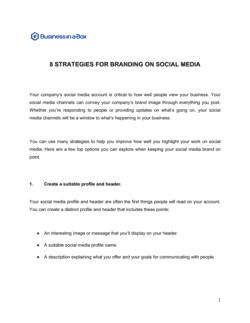
Yes. Social media brand application β€” profile image dimensions, approved post templates, employee social conduct β€” should be included in the branding policy or referenced from it. If social media conduct rules are extensive, a separate Social Media Policy can cover employee behavior in detail while the branding policy handles the visual and verbal brand standards that apply to the company's owned accounts.

What should a branding policy include for third-party or co-branded use?

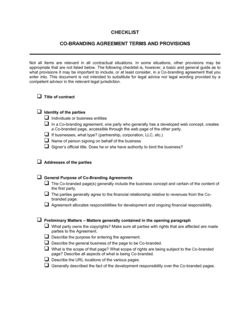
The co-branding section should specify the minimum size ratio of your logo relative to the partner's logo, the required separation distance between the two marks, approved background treatments, and the name and contact method of the person who must approve all co-branded materials before production. Pre-approved templates for recurring partner types reduce approval delays without compromising brand control.

How is a branding policy different from a marketing plan?

A marketing plan defines strategy, channels, budget allocation, and campaign objectives β€” it answers what the brand will do and where. A branding policy defines standards β€” it answers how the brand must look and sound in everything it produces. The two documents complement each other: the marketing plan drives activity; the branding policy ensures that activity is consistent and recognizable.

Can I use a branding policy template, or does it need to be custom?

A well-structured template covers 70–80% of what most organizations need and provides the section structure, governance framework, and placeholder language that would otherwise take a brand manager several days to draft from scratch. Customization is required for the specific logo files, color values, typography choices, and tone of voice that are unique to your brand. For complex multi-brand organizations or franchise systems, supplementing the template with a professional brand audit is worthwhile.

How this compares to alternatives

vs Brand Style Guide

A brand style guide is a visual reference document β€” typically a designed PDF β€” focused on showing what the brand looks like. A branding policy is a governance document that adds rules, a named owner, an exception process, and a review schedule. Use a style guide as the creative companion to a policy, not as a substitute for one.

vs Marketing Plan

A marketing plan defines strategy, channels, campaigns, and budget allocation β€” it answers what the brand will do. A branding policy defines standards β€” it answers how every output must look and sound. Both are necessary; one without the other produces either inconsistent activity or well-branded inaction.

vs Social Media Policy

A social media policy governs employee conduct and content posting behavior on personal and company accounts. A branding policy governs the visual and verbal standards applied to the brand's owned channels. A branding policy sets the rules for how social content must look; a social media policy sets the rules for who can post it and under what conditions.

vs Content Marketing Strategy

A content marketing strategy defines the topics, formats, publishing cadence, and distribution channels for content production. A branding policy provides the tone of voice, visual standards, and messaging hierarchy that content must adhere to. The strategy drives content creation; the branding policy ensures every piece of content is recognizably on brand.

Industry-specific considerations

Retail and e-commerce

Consistent product photography standards, packaging color specifications, and seasonal campaign template rules across physical and digital storefronts.

Franchise and licensing

Franchisee compliance with logo placement, approved signage vendors, and co-branding restrictions are legally and commercially critical to brand equity protection.

Professional services

Pitch deck templates, proposal covers, and email signature standards ensure the firm presents a unified identity across dozens of individual client relationships.

SaaS and technology

Product UI patterns, in-app icon libraries, and developer documentation styling must align with the external brand to avoid a fractured user experience across touchpoints.

Healthcare and medtech

Regulated communication channels require branded materials to meet both visual standards and compliance review, making a documented approval workflow inside the policy essential.

Nonprofit and education

Grant applications, donor communications, and event materials are often produced by volunteers who rely entirely on clear, accessible brand guidance to represent the organization correctly.

Template vs pro β€” what fits your needs?

PathBest forCostTime
Use the templateSmall to mid-size businesses formalizing brand standards for an internal team or agencyFree4–8 hours to complete
Template + professional reviewGrowing companies engaging multiple agencies, launching a rebrand, or onboarding franchise partners$500–$2,000 for a brand strategist or marketing consultant review1–2 weeks
Custom draftedEnterprise brands, multi-brand portfolios, or franchise systems requiring legally referenced brand standards$3,000–$15,000 for a full brand audit and custom policy4–8 weeks

Glossary

Brand Identity
The collection of visual and verbal elements β€” logo, colors, typography, tone β€” that distinguishes a company and signals its values to audiences.
Primary Logo
The main, fully featured version of a brand's logo mark, used as the default in most contexts unless a specific variant is prescribed.
Clear Space
The minimum area of empty space that must surround a logo on all sides to prevent visual crowding or interference from other elements.
Color Palette
The defined set of brand colors expressed in hex (digital), RGB (screen), CMYK (print), and Pantone (physical production) codes.
Typography Hierarchy
The defined order of typefaces and sizes used for headings, subheadings, body copy, and captions across brand communications.
Tone of Voice
The consistent personality and style with which a brand communicates β€” such as direct and plain-spoken, or warm and conversational β€” regardless of channel.
Brand Mark
A standalone graphical symbol associated with the brand, used without the company name when recognition is already established.
Co-Branding
The presentation of two or more brand identities together on shared materials, campaigns, or products β€” subject to specific sizing and placement rules.
Brand Equity
The commercial value a brand adds to a product or service beyond its functional attributes, built through consistent and recognizable presentation over time.
Usage Restriction
An explicit prohibition against specific treatments of brand assets β€” such as rotating the logo, changing its colors, or placing it on conflicting backgrounds.

Part of your Business Operating System

This document is one of 3,000+ business & legal templates included in Business in a Box.

  • Fill-in-the-blanks β€” ready in minutes
  • 100% customizable Word document
  • Compatible with all office suites
  • Export to PDF and share electronically

Create your document in 3 simple steps.

From template to signed document β€” all inside one Business Operating System.
1
Download or open template

Access over 3,000+ business and legal templates for any business task, project or initiative.

2
Edit and fill in the blanks with AI

Customize your ready-made business document template and save it in the cloud.

3
Save, Share, Send, Sign

Share your files and folders with your team. Create a space of seamless collaboration.

Save time, save money, and create top-quality documents.

β˜…β˜…β˜…β˜…β˜…

"Fantastic value! I'm not sure how I'd do without it. It's worth its weight in gold and paid back for itself many times."

Managing Director Β· Mall Farm
Robert Whalley
Managing Director, Mall Farm Proprietary Limited
β˜…β˜…β˜…β˜…β˜…

"I have been using Business in a Box for years. It has been the most useful source of templates I have encountered. I recommend it to anyone."

Business Owner Β· 4+ years
Dr Michael John Freestone
Business Owner
β˜…β˜…β˜…β˜…β˜…

"It has been a life saver so many times I have lost count. Business in a Box has saved me so much time and as you know, time is money."

Owner Β· Upstate Web
David G. Moore Jr.
Owner, Upstate Web

Run your business with a system β€” not scattered tools

Stop downloading documents. Start operating with clarity. Business in a Box gives you the Business Operating System used by over 250,000 companies worldwide to structure, run, and grow their business.

Start freeΒ Β·Β No credit card required