Surveillance Officer Job Description Template

Free Word download • Edit online • Save & share with Drive • Export to PDF

2 pages20–30 min to fillDifficulty: StandardSignature requiredLegal review recommended
Learn more ↓
FreeSurveillance Officer Job Description Template

At a glance

What it is
A Surveillance Officer Job Description is a formal employment document that defines the role, responsibilities, required qualifications, reporting structure, and legal compliance obligations of a surveillance officer position within an organization. This free Word download is fully editable online and can be exported as PDF, giving employers a structured, legally defensible baseline for hiring, performance management, and regulatory compliance in security-sensitive environments.
When you need it
Use it when posting a new surveillance officer vacancy, onboarding a new hire into a monitoring or loss-prevention role, or updating an existing position description to reflect changes in technology, scope, or applicable privacy regulations. It is also required when operating in regulated industries — such as gaming, finance, or healthcare — where documented role definitions are subject to regulatory review.
What's inside
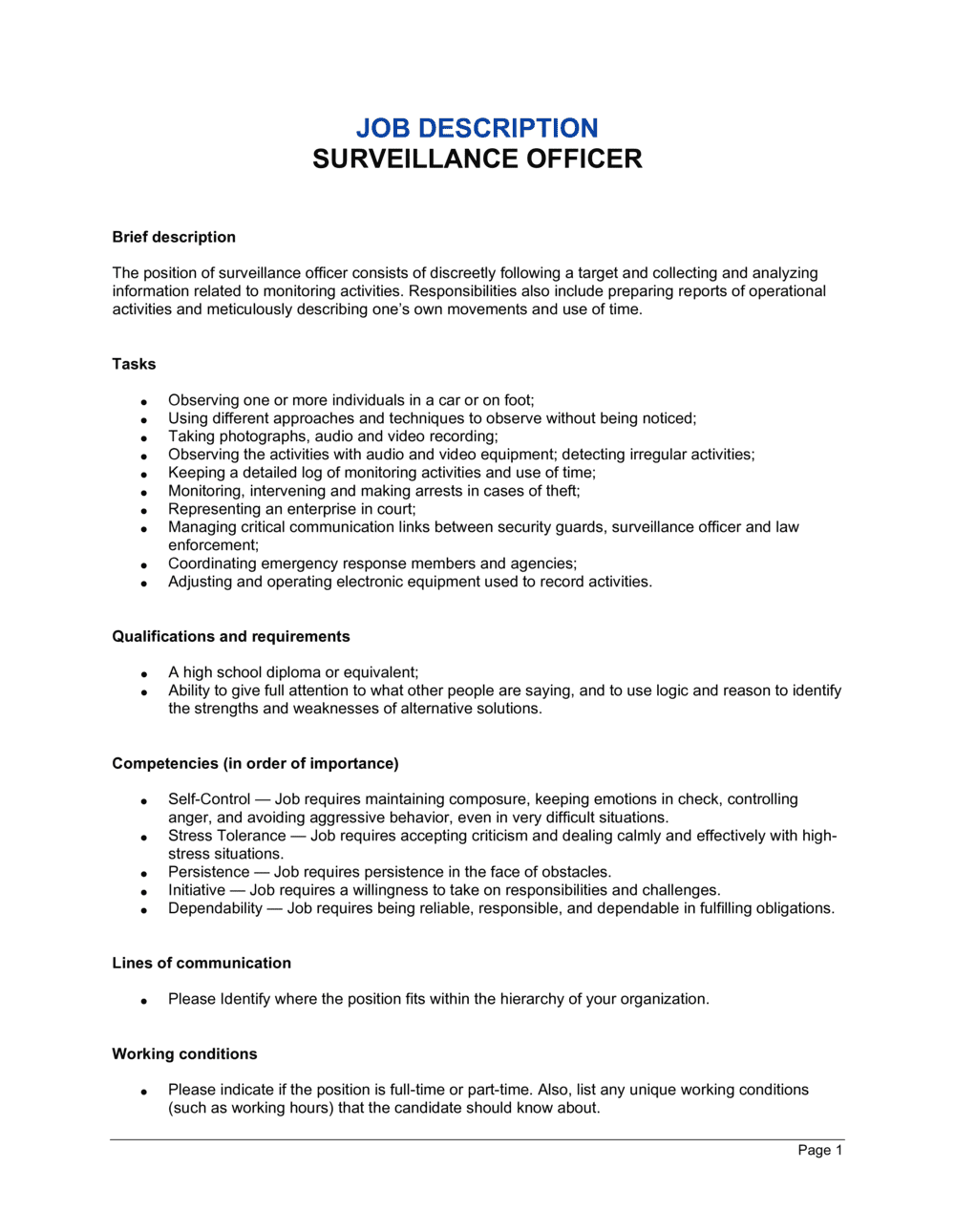
The template covers the position summary, core duties and responsibilities, required and preferred qualifications, physical and technical requirements, reporting relationships, licensing and certification conditions, and compliance obligations under applicable privacy and employment laws. A signature block confirms both parties have reviewed and agreed to the defined scope of the role.

What is a Surveillance Officer Job Description?

A Surveillance Officer Job Description is a formal employment document that defines the scope, duties, qualifications, reporting structure, and legal compliance obligations of a surveillance officer position within an organization. It establishes what the officer is expected to monitor, how incidents must be documented and escalated, which systems they are authorized to operate, and what data-handling and confidentiality standards govern their conduct. Unlike a general job posting, a properly drafted surveillance officer job description functions as a binding reference document that supports performance management, disciplinary proceedings, licensing compliance, and regulatory audits — particularly in gaming, healthcare, financial services, and corporate security environments.

Why You Need This Document

Operating a surveillance function without a documented, signed job description creates compounding risk across three dimensions. First, without defined escalation protocols and data-handling obligations, officers exercise unsupervised discretion — and when their decisions are later challenged in litigation or a regulatory review, the absence of written standards leaves the employer without a defensible policy basis. Second, in regulated industries such as gaming and healthcare, surveillance staffing documentation is not optional: gaming commissions and healthcare accreditation bodies review job descriptions during compliance inspections, and gaps in scope or licensing requirements can trigger fines or licence suspensions. Third, in jurisdictions governed by GDPR, UK GDPR, PIPEDA, or CCPA, a surveillance role that processes personal data without documented handling obligations exposes the employer to data protection enforcement action. This template gives you a structured, jurisdiction-aware starting point that closes all three gaps — covering core duties, licensing conditions, confidentiality obligations, and a signature block that confirms both parties understand the role before day one.

Which variant fits your situation?

If your situation is…Use this template
Hiring a surveillance officer for a licensed gaming facilityCasino Surveillance Officer Job Description
Defining a retail loss-prevention monitoring roleLoss Prevention Officer Job Description
Hiring a corporate CCTV and access-control monitoring officerSecurity Officer Job Description
Engaging a surveillance professional as an independent contractorIndependent Contractor Agreement
Formalizing the full employment relationship with a signed surveillance officerEmployment Contract
Onboarding a surveillance officer who will handle sensitive dataNon-Disclosure Agreement
Documenting surveillance officer performance expectations post-hireEmployee Performance Review

Common mistakes to avoid

❌ Omitting the escalation chain for incidents

Why it matters: Without a documented escalation protocol, officers exercise unsupervised discretion on when to contact law enforcement or management. Inconsistent responses create liability exposure and complicate post-incident legal proceedings.

Fix: Define specific escalation steps with time thresholds — identify who must be notified, in what order, and within how many minutes of an observed incident.

❌ Listing qualifications that cannot be justified as job-related

Why it matters: Blanket requirements — such as a clean criminal record for all offences regardless of type — have been found to disproportionately screen out protected classes without a documented business necessity, exposing employers to EEOC or human rights complaints.

Fix: Tie each qualification to a specific job duty and document the nexus in writing before posting. For criminal history screening, follow EEOC guidance on individualized assessment.

❌ No specific confidentiality obligation in the job description

Why it matters: A general reference to 'company policy' does not create an enforceable confidentiality duty. Officers who share footage or incident data can argue they were unaware of a binding obligation.

Fix: State the confidentiality requirement explicitly in the job description and back it up with a signed NDA or confidentiality clause in the employment agreement.

❌ Describing the job description itself as a contract of employment

Why it matters: Language implying guaranteed employment duration or that duties will 'not change without consent' can override an at-will clause, creating enforceable implied-contract claims that courts have upheld in multiple US jurisdictions.

Fix: Include a clear disclaimer: 'This job description does not constitute a contract of employment and may be modified by the employer at any time with reasonable notice.'

❌ Failing to specify shift and availability requirements

Why it matters: Vague shift language — 'rotating shifts as required' — creates scheduling disputes and potential violations of predictive scheduling ordinances in cities including San Francisco, Seattle, and Chicago.

Fix: State the specific shift pattern, the minimum notice period for schedule changes, and any on-call obligations in measurable terms.

❌ Not confirming licence validity as a condition of hire

Why it matters: If a surveillance officer begins work without a valid security or CCTV operator licence in a jurisdiction that requires one, the employer may be operating in breach of licensing statutes and subject to fines or loss of its own operating licence.

Fix: State explicitly that a valid licence must be held on the first day of employment and that continued employment is conditional on maintaining valid licensing at all times.

The 10 key clauses, explained

Position Title and Summary

In plain language: Identifies the formal job title, department, and a 3–5 sentence overview of the role's primary purpose within the organization.

Sample language
Position Title: Surveillance Officer | Department: Security and Loss Prevention | Reports To: [SURVEILLANCE MANAGER / DIRECTOR OF SECURITY]. The Surveillance Officer is responsible for monitoring [FACILITY TYPE] via CCTV and electronic access systems to detect, document, and report unauthorized activity, policy violations, and safety incidents.

Common mistake: Using a vague title like 'Security Monitor' that does not align with licensing terminology in regulated jurisdictions — this can invalidate licensing compliance and create classification disputes.

Core Duties and Responsibilities

In plain language: Lists the specific tasks the officer is expected to perform on a regular basis, including monitoring, reporting, equipment operation, and inter-departmental coordination.

Sample language
Monitor [NUMBER] CCTV cameras and access-control systems across [FACILITY NAME] on a [SHIFT SCHEDULE] basis. Document all suspicious activity, policy violations, and incidents in the incident reporting system within [X] minutes of observation. Coordinate with [DEPARTMENT] and law enforcement when escalation is required.

Common mistake: Listing duties so broadly — 'perform all security-related tasks as needed' — that the role has no defined scope, making performance management and overtime exemption classifications legally difficult.

Required Qualifications and Experience

In plain language: States the minimum education, prior experience, and any mandatory certifications or licences the candidate must hold at the time of hire.

Sample language
Minimum [X] years of experience in security, surveillance, or law enforcement. [High school diploma / Associate's degree] required. Valid [STATE / JURISDICTION] security guard licence required prior to first day. CPR/First Aid certification preferred.

Common mistake: Setting qualification thresholds that screen out protected classes without a documented business necessity — courts have found blanket criminal background exclusions unlawful under EEOC guidelines when not tied to specific job duties.

Technical and Physical Requirements

In plain language: Describes the equipment the officer must operate, the physical demands of the role (e.g., prolonged sitting, lifting), and any vision or fitness standards required.

Sample language
Proficiency with [CCTV PLATFORM, e.g., Avigilon, Genetec] required. Must be able to sit for extended periods (up to [X] hours per shift) and respond physically to on-site incidents. Corrected visual acuity of at least [20/40] in both eyes required for CCTV monitoring duties.

Common mistake: Listing physical requirements without confirming they are essential functions under the ADA (US) or equivalent disability legislation — unsubstantiated requirements expose the employer to accommodation claims.

Reporting Structure and Escalation Protocol

In plain language: Defines who the surveillance officer reports to, which departments they coordinate with, and the specific escalation path when an incident requires action beyond the officer's direct authority.

Sample language
The Surveillance Officer reports directly to the [SURVEILLANCE SUPERVISOR / SHIFT MANAGER]. Incidents requiring immediate intervention must be escalated to [DESIGNATED CONTACT] within [X] minutes. All footage flagged for legal or regulatory review must be reported to [LEGAL / COMPLIANCE DEPARTMENT] before any external disclosure.

Common mistake: Omitting a clear escalation chain, leaving officers to exercise unsupervised discretion on when to contact law enforcement — this creates liability exposure if an officer acts or fails to act inconsistently with company policy.

Confidentiality and Data-Handling Obligations

In plain language: Requires the officer to maintain strict confidentiality over surveillance footage, incident records, and any personally identifiable information captured during monitoring.

Sample language
The Surveillance Officer shall not disclose, copy, or transmit surveillance footage, incident records, or personally identifiable information captured in the course of monitoring to any unauthorized party. All data shall be handled in accordance with [COMPANY DATA PROTECTION POLICY] and applicable privacy laws including [GDPR / CCPA / PIPEDA] as applicable.

Common mistake: Treating confidentiality as a general policy reference rather than a specific contractual obligation — vague confidentiality language in a job description does not create an enforceable duty without a separate signed NDA or employment agreement.

Licensing, Certification, and Regulatory Compliance

In plain language: States all licences, certifications, or regulatory clearances the officer must hold or obtain, and the consequence of failing to maintain them.

Sample language
The Surveillance Officer must hold a valid [STATE / PROVINCIAL / NATIONAL] security guard or CCTV operator licence at all times during employment. Failure to renew or maintain required licensing constitutes grounds for suspension or termination. In gaming environments, the officer must comply with all directives issued by [GAMING COMMISSION NAME].

Common mistake: Not specifying who bears the cost of licence renewal — if the employer fails to reimburse and the officer lets the licence lapse, the employer may be operating with an unlicensed employee in a regulated role.

Workplace Conduct and Use of Surveillance Systems

In plain language: Sets out the officer's obligations to use monitoring equipment lawfully, within defined policy parameters, and only for authorized purposes.

Sample language
Surveillance systems must be used solely for authorized security and loss-prevention purposes. Personal monitoring of employees outside the scope of an authorized investigation is strictly prohibited. The officer must not use, copy, or retain footage for any personal purpose. Misuse of surveillance equipment will result in immediate disciplinary action up to and including termination.

Common mistake: No prohibition on unauthorized personal use of surveillance access — without explicit language, officers who misuse CCTV access for personal purposes create serious privacy tort exposure for the employer.

Shift Requirements and Availability

In plain language: Documents the expected shift schedule, including overnight, weekend, and holiday availability, and any on-call obligations.

Sample language
This position requires availability for [DAY / EVENING / OVERNIGHT / ROTATING] shifts, including weekends and statutory holidays. On-call availability of [X] hours' notice may be required during periods of elevated security risk or staff shortages.

Common mistake: Describing shift requirements vaguely — 'shift work as required' — without specifying rotation patterns. This creates scheduling disputes, overtime miscalculations, and predictive scheduling law violations in jurisdictions like California, New York City, and Seattle.

Signature and Acknowledgment Block

In plain language: Confirms that both the employer representative and the employee have read, understood, and agreed to the terms of the job description.

Sample language
By signing below, the Employee acknowledges receipt and understanding of this Job Description and agrees to perform the duties and meet the standards described herein. This document does not constitute a contract of employment. [EMPLOYEE NAME] ________________ Date: _______ | [EMPLOYER REPRESENTATIVE] ________________ Title: _______ Date: _______

Common mistake: Including language that implies the job description is itself an employment contract — this can override an at-will clause in a separate employment agreement and create implied promises of continued employment.

How to fill it out

  1. 1

    Enter the position title and organizational details

    Fill in the exact job title that matches your licensing and payroll records, the department name, and the direct supervisor's title. Confirm the title aligns with any regulatory terminology required by your jurisdiction's security licensing body.

    💡 In gaming environments, use the exact role title specified by your gaming commission's surveillance staffing standards — deviations can trigger compliance findings.

  2. 2

    Define core duties with specific, measurable language

    List each primary responsibility as a concrete action — monitor, document, escalate, test, calibrate — with a frequency or standard attached where possible. Avoid catch-all language like 'other duties as assigned' without listing the essential functions first.

    💡 US employers should identify which duties are 'essential functions' under the ADA at this stage — this determination governs reasonable accommodation obligations later.

  3. 3

    Set qualification thresholds tied to job requirements

    List only qualifications that are demonstrably necessary for the role. For each requirement — degree, licence, years of experience — document why it is necessary so you can defend it if challenged as discriminatory in screening.

    💡 Run your qualification requirements past HR or legal counsel before posting if you operate in multiple US states or Canadian provinces — minimum licensing ages and experience thresholds vary.

  4. 4

    Specify technical and physical requirements as essential functions

    List the specific CCTV platforms and access-control systems the officer must operate, and document physical demands — sitting duration, lifting weight, visual acuity — only if they are genuinely required by the role.

    💡 For each physical requirement, note whether it is essential or marginal. Only essential functions need to be performed without accommodation under US ADA and Canadian human rights statutes.

  5. 5

    Document the reporting structure and escalation chain

    Name the supervisor title (not a personal name), identify which departments the officer coordinates with, and write out the specific escalation steps for incidents requiring intervention, legal review, or law enforcement contact.

    💡 Build escalation timelines into this section — 'within 15 minutes of observation' is enforceable; 'promptly' is not.

  6. 6

    Insert confidentiality and data-handling obligations

    Reference your organization's data protection policy by name, list applicable privacy laws (GDPR, CCPA, PIPEDA), and state the consequence of unauthorized disclosure. If the role handles biometric data or audio recordings, add explicit handling instructions.

    💡 For EU or UK employees, confirm that the confidentiality clause aligns with your GDPR or UK GDPR Article 88 employment data processing policy — job descriptions referencing surveillance can constitute notice of data processing activities.

  7. 7

    Add licensing and regulatory compliance requirements

    Enter every licence, certification, and regulatory clearance required — including the issuing body and renewal cadence — and state who bears renewal costs. For gaming roles, reference the specific gaming commission directives that govern the position.

    💡 Specify that the offer of employment is conditional on the candidate holding a valid licence on their first day — not just applying for one.

  8. 8

    Execute the signature block before the first day

    Have both the employer representative and the new hire sign the job description before or on day one. File the signed original in the employee's personnel record and provide a countersigned copy to the employee.

    💡 Include a disclaimer that the job description is not an employment contract and does not guarantee a specific duration of employment — this protects at-will status in US jurisdictions.

Frequently asked questions

What is a surveillance officer job description?

A surveillance officer job description is a formal document that defines the duties, qualifications, reporting structure, technical requirements, and compliance obligations of a surveillance officer role within an organization. It serves as both a hiring tool and a legally defensible record of what the employer expects the officer to do, which equipment they must operate, and which laws and internal policies govern their conduct. In regulated industries such as gaming, healthcare, and financial services, a documented job description is often required for regulatory compliance audits.

What should a surveillance officer job description include?

At minimum, it should include a position summary, a list of core duties and responsibilities, required and preferred qualifications, technical and physical requirements, the reporting structure and escalation protocol, confidentiality and data-handling obligations, licensing and certification requirements, shift expectations, and a signature block. Missing any of these sections creates gaps that complicate performance management, disciplinary actions, and regulatory inspections.

Is a surveillance officer job description legally binding?

A signed job description creates enforceable expectations regarding role scope and conduct obligations — including confidentiality and compliance duties — but does not typically constitute an employment contract in at-will jurisdictions. To make the confidentiality and data-handling obligations fully enforceable, pair the job description with a signed employment agreement or NDA. Always include a disclaimer stating the document is not a contract of employment.

Does a surveillance officer need a licence?

In most jurisdictions, yes. In the US, most states require a security guard or surveillance agent licence issued by a state licensing authority, with requirements varying from training hours to background checks. In the UK, anyone operating CCTV in a public-facing role requires an SIA CCTV operator licence. In Canada, provincial licensing requirements apply. Gaming surveillance officers typically face additional gaming commission certification requirements on top of standard security licensing.

What is the difference between a surveillance officer and a security guard?

A security guard typically performs physical access control, patrols, and on-site deterrence. A surveillance officer is primarily responsible for monitoring via CCTV and electronic systems, documenting observations, and reporting to security management — often without direct physical intervention authority. In practice, many organizations combine elements of both roles, but regulatory licensing categories distinguish between them in jurisdictions including the UK and several US states.

How does GDPR affect a surveillance officer's job description?

Under GDPR and UK GDPR, surveillance officers who operate CCTV systems that capture footage of identifiable individuals are involved in personal data processing. The job description should reference the organization's GDPR-compliant data protection policy, restrict footage access to authorized purposes, and prohibit unauthorized retention or disclosure. In the EU, the employer should also confirm that the job description aligns with its Article 88 employment data processing policy and any applicable works council consultation requirements.

Can I use this template for casino surveillance officers?

Yes, with additions. Gaming surveillance roles require specific references to gaming commission directives, mandatory reporting obligations for detected cheating or fraud, and in some jurisdictions specific equipment certification requirements. Customize the licensing clause to reference the applicable gaming authority — such as the Nevada Gaming Control Board, the UK Gambling Commission, or the Alcohol and Gaming Commission of Ontario — and confirm that all surveillance staffing ratios meet the commission's minimum standards.

What physical requirements can be included in a surveillance officer job description?

Physical requirements are permissible if they are genuinely essential to performing the job. Common requirements for surveillance roles include the ability to sit for extended shifts, corrected visual acuity sufficient for CCTV monitoring, and the physical capacity to respond to on-site incidents. Under the US ADA, the UK Equality Act 2010, and Canadian human rights statutes, employers must provide reasonable accommodation for qualified individuals with disabilities unless doing so would cause undue hardship. Document why each physical requirement is essential before listing it.

Should the job description include a non-compete clause?

Typically no — non-compete restrictions belong in a separate employment agreement or standalone non-compete contract, not in a job description. Job descriptions define role scope and conduct standards. Non-compete and non-solicitation obligations require separate consideration and execution to be enforceable in most jurisdictions. Reference the employment agreement for these restrictions and ensure both documents are signed before day one.

How this compares to alternatives

vs Security Officer Job Description

A security officer job description focuses on physical access control, on-site patrol, and deterrence — roles that involve direct interaction with people and property. A surveillance officer job description is specific to CCTV monitoring, electronic systems operation, and incident documentation. Use the surveillance officer version when the primary function is remote monitoring rather than physical presence; use the security officer version when patrol and physical access management are the core duties.

vs Loss Prevention Officer Job Description

A loss prevention officer description covers both physical floor presence and basic monitoring duties aimed at reducing retail shrinkage. A surveillance officer description is more technically focused — CCTV systems, access control platforms, data-handling obligations — and is used in environments beyond retail, including gaming, healthcare, and corporate campuses. Where the role blends both functions, combine elements from both templates.

vs Employment Contract

A job description defines role scope, duties, and conduct standards but does not govern the full employment relationship. An employment contract adds compensation terms, IP assignment, confidentiality obligations, non-compete restrictions, termination provisions, and severance. Both documents should be signed before day one — the job description establishes what the officer does; the employment contract establishes the enforceable terms of the relationship.

vs Non-Disclosure Agreement

A job description references confidentiality obligations but does not by itself create an independently enforceable duty of confidentiality. A standalone NDA creates a separate, signed obligation covering surveillance footage, incident records, and security procedures. For roles where footage misuse could cause significant harm — gaming fraud investigations, healthcare, or financial services — a separate NDA is recommended in addition to the job description.

Industry-specific considerations

Gaming and Casinos

Gaming commission licensing requirements mandate documented surveillance staffing standards, specific equipment certifications, and mandatory fraud-reporting protocols that must be reflected in the job description.

Retail and Loss Prevention

Retail surveillance roles focus on shoplifting detection, employee theft monitoring, and CCTV coverage of high-shrink areas, with escalation protocols tied to loss-prevention investigators rather than law enforcement.

Healthcare

Healthcare surveillance officers must comply with HIPAA in the US and equivalent patient privacy statutes elsewhere, restricting footage access to non-clinical areas and requiring specific data-handling procedures for any recording involving patient spaces.

Financial Services

Banks and financial institutions use surveillance officers to monitor trading floors, vault areas, and ATM networks, with chain-of-custody and incident-reporting requirements tied to anti-money-laundering and fraud compliance frameworks.

Jurisdictional notes

United States

Most states require a security guard or private patrol operator licence for surveillance officers, with training hour minimums ranging from 8 hours (Texas) to 40 hours (New York) before assignment. The ADA requires that physical requirements listed in job descriptions be limited to essential functions, with individualized accommodation assessments. EEOC guidance restricts blanket criminal background screening — each disqualifying criterion must be tied to a specific job-related business necessity. California's CCPA imposes additional data-handling obligations on employers whose surveillance systems capture consumer or employee personal data.

Canada

Provincial security guard licensing is mandatory in all provinces, with requirements governed by statutes such as Ontario's Private Security and Investigative Services Act and BC's Security Services Act. Job descriptions must comply with provincial human rights codes, which prohibit physical or qualification requirements that are not bona fide occupational requirements. PIPEDA and provincial privacy statutes (notably Quebec's Law 25) govern the collection and retention of surveillance footage involving employees. Quebec employers must provide the job description in French for provincially regulated roles.

United Kingdom

Surveillance officers who operate CCTV in a public-facing environment must hold a valid SIA CCTV (Public Space Surveillance) licence, renewed every three years. The UK GDPR and Data Protection Act 2018 impose strict obligations on the processing of surveillance footage, including a documented legitimate interest assessment and data retention limits. The Surveillance Camera Code of Practice, overseen by the Surveillance Camera Commissioner, applies to public authorities and many private operators. The Equality Act 2010 requires that physical and qualification requirements be justified as proportionate means of achieving a legitimate aim.

European Union

GDPR Article 88 permits member states to apply specific rules for employment data processing, and surveillance footage of employees constitutes personal data requiring a documented legal basis — typically legitimate interest or a statutory obligation. Job descriptions for surveillance roles should reference the employer's data protection impact assessment (DPIA) where applicable. In Germany, France, and the Netherlands, works council consultation may be required before deploying or modifying a CCTV monitoring program, and the job description may need to reflect agreed operational limits. Post-employment non-competes typically require financial compensation to be enforceable and should be placed in a separate agreement, not the job description.

Template vs lawyer — what fits your deal?

PathBest forCostTime
Use the templateStandard surveillance officer hires in unregulated or lightly regulated environments where the core duties and qualifications are well-definedFree20–30 minutes
Template + legal reviewSurveillance roles in regulated industries (gaming, healthcare, financial services) or where jurisdiction-specific licensing and privacy law compliance is critical$300–$6001–3 days
Custom draftedMulti-jurisdiction surveillance programs, gaming commission compliance requirements, or organizations subject to union agreements governing surveillance staffing$1,000–$3,000+1–2 weeks

Glossary

Surveillance Officer
A security professional responsible for monitoring premises, personnel, or transactions via CCTV, access control systems, or direct observation to detect and document suspicious activity.
CCTV (Closed-Circuit Television)
A private video monitoring system in which camera feeds are transmitted to a defined set of monitors, used for real-time surveillance and incident recording.
Chain of Custody
A documented process tracking how evidence — such as surveillance footage — is collected, stored, transferred, and accessed to ensure its integrity for legal proceedings.
Incident Report
A formal written record of a security event observed during surveillance, including date, time, location, individuals involved, and actions taken.
Gaming Commission
A government regulatory body that oversees licensed gambling operations and requires documented compliance with surveillance staffing and operational standards.
BSIA (British Security Industry Association)
The UK trade association representing the private security industry, which publishes standards and guidance relevant to surveillance officer roles and licensing.
SIA Licence (Security Industry Authority)
A mandatory UK licence required for individuals working in designated security roles, including CCTV operation in public areas, issued by the Security Industry Authority.
Loss Prevention
Organizational practices and personnel dedicated to reducing theft, fraud, and shrinkage through monitoring, deterrence, and investigation.
At-Will Employment
An employment arrangement in most US states where either the employer or employee may end the relationship at any time for any lawful reason, unless a contract specifies otherwise.
GDPR (General Data Protection Regulation)
EU law governing the processing of personal data, including video surveillance footage, that imposes strict obligations on organizations that collect or store such data.
Position Summary
A brief paragraph at the opening of a job description that captures the primary purpose of the role, where it sits in the organization, and the type of environment the officer will work in.

Part of your Business Operating System

This document is one of 3,000+ business & legal templates included in Business in a Box.

  • Fill-in-the-blanks — ready in minutes
  • 100% customizable Word document
  • Compatible with all office suites
  • Export to PDF and share electronically

Create your document in 3 simple steps.

From template to signed document — all inside one Business Operating System.
1
Download or open template

Access over 3,000+ business and legal templates for any business task, project or initiative.

2
Edit and fill in the blanks with AI

Customize your ready-made business document template and save it in the cloud.

3
Save, Share, Send, Sign

Share your files and folders with your team. Create a space of seamless collaboration.

Save time, save money, and create top-quality documents.

★★★★★

"Fantastic value! I'm not sure how I'd do without it. It's worth its weight in gold and paid back for itself many times."

Managing Director · Mall Farm
Robert Whalley
Managing Director, Mall Farm Proprietary Limited
★★★★★

"I have been using Business in a Box for years. It has been the most useful source of templates I have encountered. I recommend it to anyone."

Business Owner · 4+ years
Dr Michael John Freestone
Business Owner
★★★★★

"It has been a life saver so many times I have lost count. Business in a Box has saved me so much time and as you know, time is money."

Owner · Upstate Web
David G. Moore Jr.
Owner, Upstate Web

Run your business with a system — not scattered tools

Stop downloading documents. Start operating with clarity. Business in a Box gives you the Business Operating System used by over 250,000 companies worldwide to structure, run, and grow their business.

Start free · No credit card required