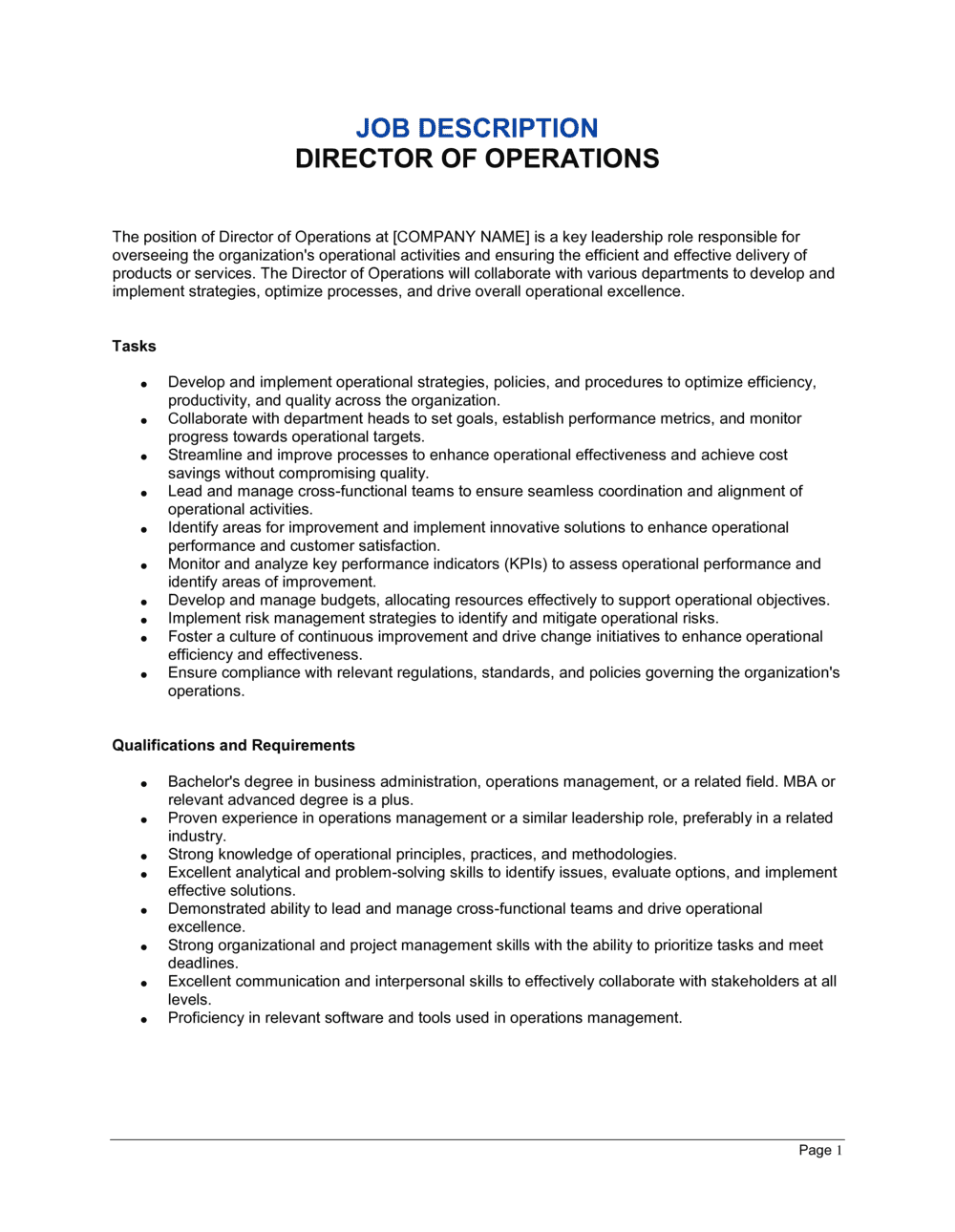
Director Of Operations Job Description Template

Free Word download • Edit online • Save & share with Drive • Export to PDF

2 pages20–30 min to fillDifficulty: StandardSignature requiredLegal review recommended
Learn more ↓
FreeDirector Of Operations Job Description Template

At a glance

What it is
A Director of Operations Job Description is a formal document that defines the scope, responsibilities, qualifications, reporting structure, and compensation expectations for a senior operational leadership role. This free Word download gives you a structured, legally defensible starting point you can edit online and export as PDF to use in recruitment, employment contracts, and performance management.
When you need it
Use it when hiring or promoting a Director of Operations, restructuring your leadership team, or formalizing accountability for an existing role to support performance reviews, compensation decisions, or employment agreements.
What's inside
Role summary, key duties and responsibilities, reporting relationships, required and preferred qualifications, compensation and benefits overview, KPIs and performance expectations, and employment classification details.

What is a Director of Operations Job Description?

A Director of Operations Job Description is a formal document that defines the scope, duties, qualifications, reporting relationships, performance expectations, and compensation terms for one of the most consequential operational leadership roles in a business. It establishes — in writing — what the Director is accountable for, who they report to, how their success will be measured, and what qualifications the organization requires before extending an offer. Unlike an informal role summary passed between executives, a properly structured job description creates a documented, legally defensible basis for every hiring decision, compensation offer, and performance management action tied to this position.

Job descriptions at the Director level carry more legal weight than many employers realize. The duties listed determine whether the role qualifies as exempt from overtime under the FLSA and equivalent provincial and national wage-and-hour laws. The qualifications set the baseline against which all applicants are screened — making inconsistent application a source of disparate-impact liability. The salary band, once documented, anchors pay-equity analysis. And the signed acknowledgment block converts the document from a recruitment artifact into an evidentiary record that HR and legal teams rely on when performance or termination disputes arise.

Why You Need This Document

Hiring a Director of Operations without a comprehensive, signed job description exposes your organization on multiple fronts simultaneously. Without clearly documented duties, the incoming Director may interpret their authority and scope differently from the CEO — a misalignment that surfaces in resource allocation conflicts, budget disputes, and organizational friction within the first 90 days. Without measurable KPIs embedded in the description, performance management becomes subjective, and terminating a Director for underperformance without documented expectations is a litigation risk in every major jurisdiction.

Compensation disputes are equally preventable. Publishing a documented salary band rather than an ad-hoc offer creates a defensible pay-equity record — particularly important as pay transparency laws expand across US states, Canadian provinces, and EU member states. The EEO statement and neutral language requirements are not formalities; EEOC charges and human rights complaints frequently cite job postings as evidence of discriminatory intent when protected-class language appears in required qualifications. This template gives you a structured, legally reviewed starting point that closes each of these gaps — so the first conversation you have with your new Director is about strategy, not scope.

Which variant fits your situation?

If your situation is…Use this template
Hiring a VP-level operations leader with P&L ownership and board reportingVP of Operations Job Description
Defining responsibilities for a COO with enterprise-wide authorityChief Operating Officer Job Description
Hiring an operations manager below director levelOperations Manager Job Description
Formalizing the hire with a binding employment agreementExecutive Employment Agreement
Documenting operations processes the director will ownStandard Operating Procedure Template
Setting measurable performance targets tied to the roleEmployee Performance Review Template
Hiring a project-based operations lead on a contract basisIndependent Contractor Agreement

Common mistakes to avoid

❌ Combining preferred and required qualifications in one list

Why it matters: Screening out candidates who lack a 'preferred' credential becomes legally indistinguishable from requiring it — exposing the employer to adverse impact claims if the credential correlates with a protected class.

Fix: Use two clearly labeled sections — 'Required Qualifications' and 'Preferred Qualifications' — and train recruiters to screen only on the required list at the initial stage.

❌ Omitting measurable KPIs from the description

Why it matters: Without documented performance expectations, terminating a Director of Operations for poor performance becomes difficult to defend — a subjective 'not a good fit' rationale invites discrimination claims.

Fix: Include 3–5 specific, measurable KPIs in the job description and reference them in the first performance review cycle to establish a consistent standard.

❌ Publishing a single salary figure instead of a compensation band

Why it matters: A fixed salary eliminates negotiation flexibility, and filling the same role at different rates for different incumbents without a documented band creates pay-equity litigation exposure.

Fix: Set a salary band with a documented floor and ceiling based on at least two market benchmarks, and record the rationale for any offer placed above or below the midpoint.

❌ Skipping the signed acknowledgment block

Why it matters: Without a signed acknowledgment, an employee can credibly claim they were never informed of specific duties or performance expectations — weakening any future disciplinary or termination action.

Fix: Collect signatures before or on the first day, store the signed copy in the personnel file, and re-obtain signatures whenever the job description is materially revised.

❌ Using an outdated or incomplete EEO statement

Why it matters: Omitting recently protected classes — such as gender identity or pregnancy status — from the EEO statement creates compliance gaps under federal, state, or local employment law.

Fix: Review the EEO statement annually against current EEOC guidance and applicable state and local ordinances, and update the template before each new posting cycle.

❌ Listing physical requirements not tied to essential functions

Why it matters: Physical or sensory requirements that are not genuinely essential to the role create ADA accommodation disputes and can constitute discriminatory screening.

Fix: Include physical requirements only when they are objectively necessary for the core duties of the role, and document the business necessity in writing before posting.

The 10 key clauses, explained

Role Title and Reporting Relationship

In plain language: States the official job title, the position this role reports to (typically CEO or COO), and any direct reports the Director of Operations will manage.

Sample language
Title: Director of Operations. Reports to: Chief Executive Officer. Direct Reports: [LIST OF POSITIONS OR NUMBER OF DIRECT REPORTS].

Common mistake: Listing the title without specifying the reporting line — creating ambiguity about authority and decision-making scope that leads to conflict between the Director of Operations and peer executives.

Role Summary

In plain language: A 3–5 sentence overview of the position's purpose within the organization, the business outcomes it drives, and the level of autonomy the role carries.

Sample language
The Director of Operations is responsible for overseeing [COMPANY NAME]'s daily business operations across [DEPARTMENTS / FUNCTIONS], ensuring efficient processes, resource alignment, and execution of the company's strategic objectives.

Common mistake: Writing a role summary so generic it could describe any management role — failing to anchor the position to specific functions, departments, or outcomes unique to the organization.

Key Duties and Responsibilities

In plain language: An itemized list of the core functions the Director of Operations is expected to perform, organized by category (e.g., process management, team leadership, financial oversight).

Sample language
Responsibilities include: (1) Overseeing daily operations across [DEPARTMENTS]; (2) Developing and implementing operational policies and procedures; (3) Managing an annual operations budget of $[AMOUNT]; (4) Leading a team of [NUMBER] direct reports.

Common mistake: Including aspirational or occasional duties alongside essential functions without distinction — creating liability under the ADA if reasonable accommodations are later requested for a core task the employer treated as minor.

Required Qualifications

In plain language: The minimum education, experience, skills, and certifications a candidate must have to be considered — the legal floor for screening applicants consistently.

Sample language
Minimum qualifications: Bachelor's degree in Business, Operations Management, or related field (or equivalent experience); [X]+ years of progressive operational leadership experience; demonstrated experience managing cross-functional teams of [X]+ employees.

Common mistake: Overstating degree requirements without a documented business justification — creating disparate impact exposure under Title VII if the credential screens out protected-class candidates disproportionately.

Preferred Qualifications

In plain language: Additional skills, experience, or certifications that are desirable but not mandatory — used to rank candidates without excluding those who meet only the minimum bar.

Sample language
Preferred: MBA or advanced degree; experience in [INDUSTRY]; Six Sigma or Lean certification; proficiency with [ERP / OKR / PROJECT MANAGEMENT SOFTWARE].

Common mistake: Blending preferred and required qualifications in a single list — making it legally ambiguous which criteria are mandatory, which complicates adverse action decisions and exposes the employer to discrimination claims.

KPIs and Performance Expectations

In plain language: Measurable targets the Director of Operations will be held accountable to, typically reviewed quarterly or annually — connecting the role to business outcomes.

Sample language
Performance will be evaluated against the following KPIs: operational cost reduction of [X]% year-over-year; on-time delivery rate of [X]%; employee retention rate within managed teams of [X]%; and successful implementation of [X] process improvement initiatives per fiscal year.

Common mistake: Omitting KPIs entirely — leaving the Director without clear success criteria, making performance management subjective and difficult to defend in a wrongful termination or discrimination claim.

Compensation and Benefits

In plain language: States the salary band, bonus eligibility, equity if applicable, and a reference to the company's benefits program — without locking specific plan details into the document.

Sample language
Base salary: $[MIN] – $[MAX] annually, commensurate with experience. Eligible for annual performance bonus of up to [X]% of base salary. Benefits include [HEALTH / DENTAL / VISION / 401(K)] as described in the company's current benefits summary.

Common mistake: Publishing a single salary figure rather than a band — eliminating negotiation flexibility and creating pay-equity exposure if the same role is filled at different rates for different individuals.

Employment Classification and Schedule

In plain language: Specifies that the role is full-time exempt under the FLSA, the expected work schedule, remote or hybrid status, and any travel requirements.

Sample language
This is a full-time, exempt position. Standard schedule: Monday–Friday, [HOURS]. Work location: [ONSITE / HYBRID / REMOTE]. Travel: up to [X]% of time, including [DOMESTIC / INTERNATIONAL] travel.

Common mistake: Classifying the Director of Operations as exempt without confirming the salary threshold and duties test under the current FLSA regulations — misclassification triggers back overtime pay liability.

Equal Opportunity Statement

In plain language: A legally required or strongly advisable statement confirming the employer does not discriminate on any protected basis — must appear on all job postings and descriptions distributed externally.

Sample language
[COMPANY NAME] is an equal opportunity employer. We do not discriminate on the basis of race, color, religion, sex, national origin, age, disability, veteran status, or any other characteristic protected by applicable law.

Common mistake: Using an outdated EEO statement that omits protected classes added by recent federal or state legislation — such as sexual orientation, gender identity, or pregnancy status — creating compliance gaps.

Acknowledgment and Signature Block

In plain language: A section for the employee and an authorized employer representative to sign, confirming the employee has received, read, and understood the job description.

Sample language
I acknowledge that I have received and reviewed this job description and understand the duties, responsibilities, and expectations of the Director of Operations role. Employee Signature: _______________ Date: _______________ | Authorized Representative: _______________ Date: _______________

Common mistake: Distributing the job description without obtaining a signed acknowledgment — losing the evidentiary record that the employee understood their role, which is critical in performance management and termination proceedings.

How to fill it out

  1. 1

    Define the reporting structure before writing anything else

    Confirm who this role reports to and how many direct reports it will carry. Organizational chart clarity prevents role overlap conflicts with peer executives after the hire.

    💡 If the Director of Operations will eventually inherit reports currently managed by the CEO, state that explicitly as a 12-month transition plan rather than leaving it implied.

  2. 2

    Separate essential functions from secondary duties

    List core responsibilities first, grouped by category (operations, finance, people management, strategy). Mark any duties that are occasional or project-based as secondary to protect against ADA accommodation disputes.

    💡 Limit the responsibilities list to 8–12 items — longer lists signal a role that is overloaded or poorly scoped, which deters strong candidates.

  3. 3

    Set minimum qualifications with a documented business rationale

    For each required qualification — degree, years of experience, specific certification — write a one-sentence business justification in your internal notes. This is your defense if a screening decision is challenged.

    💡 Replace 'degree required' with 'bachelor's degree or equivalent combination of education and experience' to broaden the qualified pool and reduce disparate-impact risk.

  4. 4

    Build KPIs tied to your current operational priorities

    Select 3–5 measurable targets the Director will own in their first 12 months. Tie them to metrics already tracked by your finance or operations teams so measurement is objective.

    💡 Include one leading indicator (e.g., process improvement initiatives launched) and one lagging indicator (e.g., operational cost reduction achieved) to create a balanced performance picture.

  5. 5

    Enter the compensation band, not a single number

    Research market benchmarks using two independent sources (e.g., Bureau of Labor Statistics and a compensation survey from your industry association) and set a band with at least a 20% spread between floor and ceiling.

    💡 In jurisdictions with pay transparency laws (Colorado, California, New York, Washington), publishing the salary range in the job posting is legally required — build the band before you post.

  6. 6

    Confirm FLSA exempt status with the current salary and duties tests

    Verify the role meets both the current salary threshold (minimum $684/week under federal FLSA as of 2024 — check for updates) and the executive or administrative duties test before marking it exempt.

    💡 If the state minimum salary threshold for exemption exceeds the federal floor — as it does in California and New York — the state threshold controls.

  7. 7

    Add the EEO statement and review for neutral language

    Insert your organization's current EEO statement and scan the full document for age-coded language ('recent graduate,' 'digital native'), gender-coded terms, and physical requirements not tied to essential functions.

    💡 Run the draft through a free gender-decoder tool before publishing — research shows gendered language in job postings measurably reduces female applicant rates.

  8. 8

    Obtain a signed acknowledgment at or before the start date

    Have both the incoming Director and an authorized company representative sign the job description acknowledgment block before or on the first day of employment.

    💡 Store the signed copy in the employee's personnel file and in your HR system — it is a primary exhibit in any future performance management or termination proceeding.

Frequently asked questions

What is a Director of Operations job description?

A Director of Operations job description is a formal document that defines the responsibilities, qualifications, reporting structure, performance expectations, and employment terms for a senior operational leadership role. It serves as the basis for recruitment advertising, candidate screening, employment contracts, and performance management. A well-drafted description also provides legal protection by establishing documented, objective criteria for hiring and termination decisions.

What are the main responsibilities of a Director of Operations?

A Director of Operations typically oversees daily business operations across multiple departments, develops and enforces operational policies and procedures, manages budgets and resource allocation, leads cross-functional teams, and reports operational performance to the CEO or COO. In smaller organizations, the role may also include strategic planning, vendor management, and technology implementation. The exact scope varies significantly by company size, industry, and reporting structure.

What qualifications should a Director of Operations have?

Most organizations require a bachelor's degree in business, operations management, or a related field (or equivalent experience), plus a minimum of 7–10 years of progressive operational leadership experience including direct team management. Preferred qualifications commonly include an MBA, Lean or Six Sigma certification, and experience with ERP or project management platforms relevant to the industry. State clearly in the description which are required versus preferred to support consistent, defensible screening.

Is a Director of Operations job description a legally binding document?

A job description itself is not a contract, but it can be referenced as evidence in employment disputes, discrimination claims, and FLSA misclassification audits. In many jurisdictions, the duties listed determine exempt vs. non-exempt status under wage-and-hour law. When the employee signs an acknowledgment, the document also becomes part of the employment record and can be used in performance management and termination proceedings. Consider having legal counsel review the description for high-level or sensitive roles.

What salary should I list for a Director of Operations?

Director of Operations compensation varies widely by industry, company size, and geography — typically ranging from $90,000 to $180,000 annually in the United States, with bonuses and equity adding 10–30% for senior roles. Publish a salary band rather than a fixed figure to maintain negotiation flexibility and pay-equity defensibility. In Colorado, California, New York, and Washington, pay transparency laws require the salary range to appear on all job postings.

How does a Director of Operations differ from a COO?

A COO (Chief Operating Officer) is typically a C-suite executive with enterprise-wide strategic authority, board visibility, and often a co-leadership role alongside the CEO. A Director of Operations is a senior operational leader who executes strategy within defined functions or departments rather than setting it at the company level. In small businesses, the two roles are sometimes combined; in larger organizations, the Director reports to the COO.

Should the Director of Operations be classified as exempt or non-exempt?

In most cases, a Director of Operations meets both the federal FLSA salary threshold and the executive or administrative duties test for exempt classification — meaning no overtime pay entitlement. However, classification must be confirmed against the current federal salary floor (at least $684 per week as of 2024) and the applicable state threshold, which is higher in California, New York, and several other states. Misclassification triggers back overtime liability and civil penalties.

Do I need a lawyer to draft a Director of Operations job description?

For most small to mid-sized companies hiring at the Director level, a high-quality template is a strong starting point. Legal review is recommended when the role involves equity, a complex non-compete, a highly regulated industry, or when the company operates in multiple jurisdictions with differing employment law requirements. A one-hour HR or employment counsel review typically costs $200–$500 and is a reasonable investment for a role at this level.

When should I update a Director of Operations job description?

Update the job description whenever the role's responsibilities, reporting structure, or performance expectations materially change — such as after a reorganization, acquisition, or shift in strategic priorities. Also review it annually to confirm the EEO statement is current, the FLSA classification still meets updated thresholds, and the salary band reflects current market rates. Obtain a fresh signed acknowledgment from the incumbent whenever material changes are made.

How this compares to alternatives

vs Chief Operating Officer Job Description

A COO job description covers enterprise-wide strategic authority, board-level reporting, and co-leadership of the business alongside the CEO. A Director of Operations description scopes the role to execution within defined functions or departments rather than company-wide strategy. Use the COO template for a founding or scaling executive role; use this template when the hire will report to the CEO or COO and manage specific operational domains.

vs Operations Manager Job Description

An Operations Manager description covers a mid-level supervisory role focused on implementing defined processes within a single department or site. A Director of Operations description covers a senior leadership role with cross-functional authority, budget ownership, and strategic input. The Director typically manages managers, while the Operations Manager manages individual contributors.

vs Executive Employment Agreement

A job description defines the role's scope, duties, and expectations — it is a reference and recruitment document. An Executive Employment Agreement is a binding legal contract that governs compensation, equity, termination, non-compete, IP assignment, and severance. The job description informs the employment agreement but does not replace it. For a Director of Operations, you typically need both.

vs Employee Performance Review Template

A job description establishes what the Director of Operations is expected to do and at what standard. A performance review template is used at defined intervals to evaluate how well the incumbent is meeting those expectations. The KPIs in the job description feed directly into the performance review criteria — the two documents should be drafted in parallel for consistency.

Industry-specific considerations

Manufacturing

Emphasis on production efficiency, supply chain oversight, safety compliance, and lean process implementation across plant operations.

Healthcare

Regulatory compliance with CMS, HIPAA, and Joint Commission standards is embedded in the role's core duties alongside clinical operations oversight.

Technology / SaaS

Focus on scaling engineering and customer success operations, managing vendor relationships, and implementing OKRs across distributed or remote teams.

Professional Services

Billable utilization management, resource planning across client engagements, and operational support for practice growth and office expansion.

Retail / E-commerce

Inventory management, fulfillment operations, multi-location coordination, and vendor performance oversight tied to seasonal demand cycles.

Construction

Project scheduling, subcontractor management, safety compliance, and cost-to-complete tracking across simultaneous job sites.

Jurisdictional notes

United States

The Director of Operations role must be confirmed as exempt under the FLSA executive or administrative duties test, and the current federal salary threshold ($684/week as of 2024) must be met — with higher thresholds applying in California, New York, and Washington. Pay transparency laws in Colorado, California, New York, and Washington require salary ranges in job postings. EEO statement must reflect current EEOC-protected classes. Non-compete language referenced in the description must comply with state-specific enforceability rules — California bans most post-employment restrictions entirely.

Canada

Provincial Employment Standards Acts govern minimum employment terms and do not recognize at-will employment — the job description should not imply at-will status. Quebec employers must provide French-language documentation under the Charter of the French Language. Salary transparency requirements are emerging in several provinces. Human rights codes in each province prohibit discrimination on protected grounds that may differ from US federal law, including grounds such as family status and political belief.

United Kingdom

UK employers must provide a written statement of employment particulars on or before day one, and the job description typically forms part of that record. The Equality Act 2010 prohibits discrimination on nine protected characteristics — the EEO statement must reflect UK-specific language rather than US EEOC language. Gender pay gap reporting obligations apply to employers with 250 or more employees, making compensation band documentation particularly important. Post-employment restrictive covenants referenced in the description must be reasonable in scope to be enforceable.

European Union

The EU Transparent and Predictable Working Conditions Directive requires employers to provide clear written information about the role within seven days of hire. Member states including Germany, France, and the Netherlands require works council consultation before establishing or significantly changing a senior operational role. GDPR governs how candidate and employee data collected through the recruitment process is stored and processed — job applications and personnel records are in scope. Salary transparency obligations are expanding under the EU Pay Transparency Directive, which member states must implement by 2026.

Template vs lawyer — what fits your deal?

PathBest forCostTime
Use the templateSmall to mid-sized companies hiring a Director of Operations in a single jurisdiction with standard duties and no equity componentFree30–60 minutes
Template + legal reviewMulti-jurisdiction employers, roles involving equity or complex non-compete language, or highly regulated industries such as healthcare or financial services$200–$500 (one-hour HR or employment counsel review)1–3 business days
Custom draftedEnterprise organizations, private equity portfolio companies, or roles with board visibility, significant equity, and cross-border operational authority$800–$2,5001–2 weeks

Glossary

Job Description
A written document that defines the duties, responsibilities, qualifications, and conditions of a specific role within an organization.
Director of Operations
A senior executive responsible for overseeing daily business operations, implementing strategy, and ensuring organizational efficiency across departments.
Reporting Structure
The formal hierarchy defining who a role reports to and who reports to that role, establishing lines of authority and accountability.
FLSA Classification
The US Fair Labor Standards Act designation of a role as exempt or non-exempt, determining eligibility for overtime pay based on salary level and job duties.
KPI (Key Performance Indicator)
A measurable value used to evaluate how effectively an employee or team is achieving defined operational or business objectives.
At-Will Employment
An employment arrangement in which either party may end the relationship at any time for any lawful reason, without advance notice or cause — recognized in most US states.
Essential Functions
The core duties that are fundamental to a role and cannot be removed without fundamentally changing the position — a legally significant term under the Americans with Disabilities Act.
Span of Control
The number of direct reports a manager or director is responsible for supervising, influencing organizational design and workload distribution.
Compensation Band
A defined salary range for a role, typically with a minimum, midpoint, and maximum, used to guide hiring offers and merit increases.
Employment Classification
The legal designation of a worker as an employee or independent contractor, or as full-time, part-time, or temporary, with significant tax and benefits implications.
Bona Fide Occupational Qualification (BFOQ)
A characteristic that is legally permissible as a job requirement when it is essential to performing the role — a narrow exception to anti-discrimination laws.

Part of your Business Operating System

This document is one of 3,000+ business & legal templates included in Business in a Box.

  • Fill-in-the-blanks — ready in minutes
  • 100% customizable Word document
  • Compatible with all office suites
  • Export to PDF and share electronically

Create your document in 3 simple steps.

From template to signed document — all inside one Business Operating System.
1
Download or open template

Access over 3,000+ business and legal templates for any business task, project or initiative.

2
Edit and fill in the blanks with AI

Customize your ready-made business document template and save it in the cloud.

3
Save, Share, Send, Sign

Share your files and folders with your team. Create a space of seamless collaboration.

Save time, save money, and create top-quality documents.

★★★★★

"Fantastic value! I'm not sure how I'd do without it. It's worth its weight in gold and paid back for itself many times."

Managing Director · Mall Farm
Robert Whalley
Managing Director, Mall Farm Proprietary Limited
★★★★★

"I have been using Business in a Box for years. It has been the most useful source of templates I have encountered. I recommend it to anyone."

Business Owner · 4+ years
Dr Michael John Freestone
Business Owner
★★★★★

"It has been a life saver so many times I have lost count. Business in a Box has saved me so much time and as you know, time is money."

Owner · Upstate Web
David G. Moore Jr.
Owner, Upstate Web

Run your business with a system — not scattered tools

Stop downloading documents. Start operating with clarity. Business in a Box gives you the Business Operating System used by over 250,000 companies worldwide to structure, run, and grow their business.

Start free · No credit card required