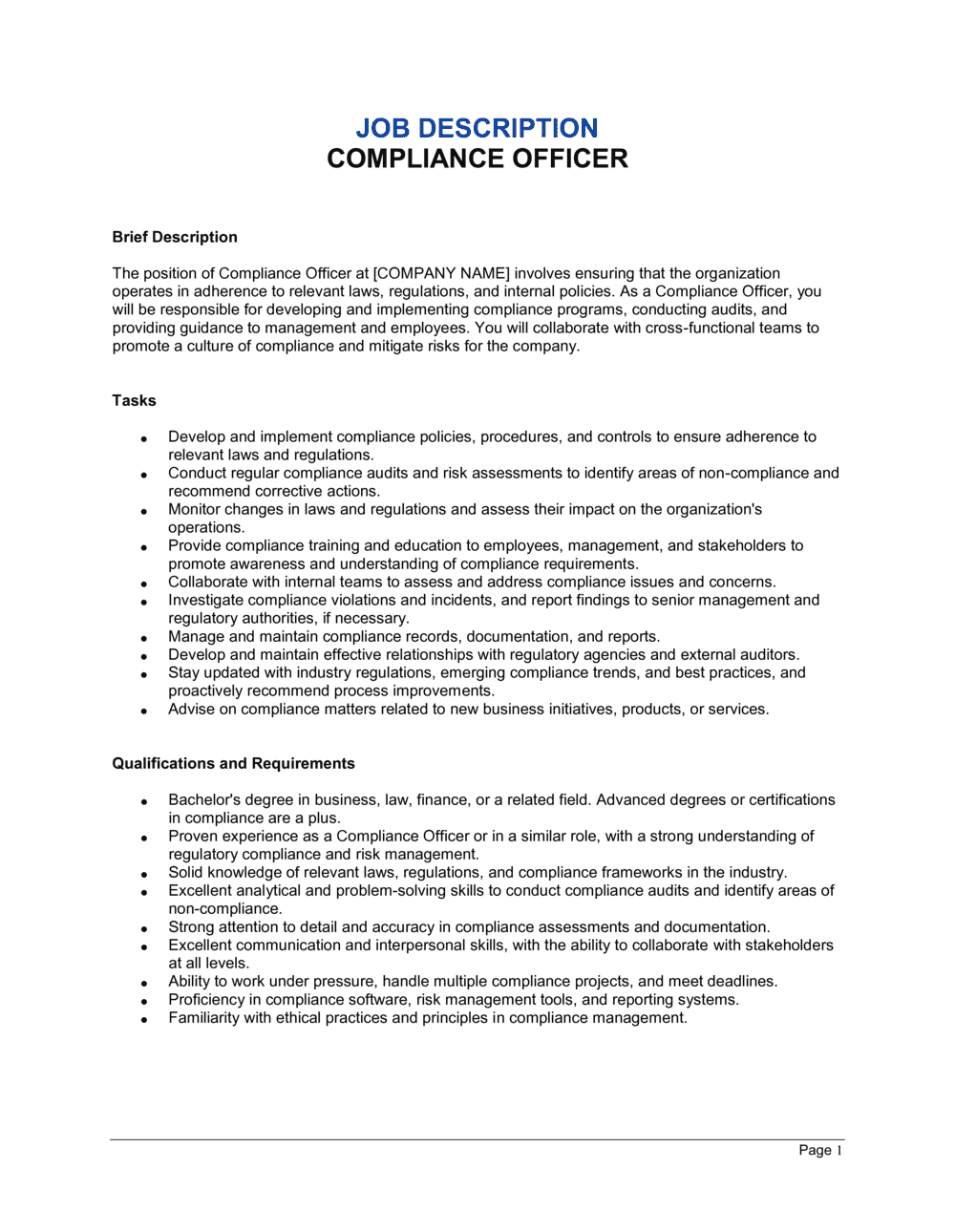
Compliance Officer Job Description Template

Free Word download • Edit online • Save & share with Drive • Export to PDF

2 pages20–30 min to fillDifficulty: StandardSignature requiredLegal review recommended
Learn more ↓
FreeCompliance Officer Job Description Template

At a glance

What it is
A Compliance Officer Job Description is a formal document that defines the authority, duties, qualifications, reporting structure, and scope of accountability for a compliance officer role within an organization. This free Word download gives you a structured, legally grounded starting point you can edit online and export as PDF — suitable for financial services, healthcare, manufacturing, and any regulated sector.
When you need it
Use it when creating or filling a new compliance officer position, when restructuring a compliance function after a regulatory finding, or when a board or regulator requires documented evidence that compliance responsibilities are formally assigned.
What's inside
Role summary and organizational placement, detailed duties and responsibilities, required and preferred qualifications, reporting lines and decision-making authority, key performance indicators, confidentiality and ethical obligations, and acknowledgment and signature block.

What is a Compliance Officer Job Description?

A Compliance Officer Job Description is a formal governance document that defines the duties, authority, qualifications, reporting structure, performance standards, and accountability obligations of the compliance officer role within an organization. Unlike a standard job posting, this document is designed to function as part of a company's compliance program infrastructure — providing regulators, auditors, and courts with documented evidence that compliance responsibilities are formally assigned to a qualified individual with sufficient independence and authority to carry them out. It is typically signed by both the compliance officer and a senior executive or board representative, creating a dated acknowledgment record that can be produced during regulatory examinations.

Why You Need This Document

Operating in a regulated industry without a formally documented compliance officer mandate is not just an administrative gap — it is a regulatory vulnerability. Regulators examining compliance programs look first for evidence that the compliance function exists, is adequately resourced, and has documented authority independent of the business lines it oversees. An unsigned or vague job description is among the most common findings in compliance program examinations, and it signals to regulators that the rest of the program may be equally informal. Beyond examinations, a clearly drafted job description protects the compliance officer personally by defining the exact scope of their mandate — preventing the role from expanding indefinitely without corresponding authority or resources. It also protects the organization by making compliance accountability auditable: when a violation occurs, a signed job description is the first document regulators and defense counsel reach for to establish who was responsible for what. This template gives you a structured, sector-adaptable starting point that covers all material provisions in a form regulators recognize as substantive.

Which variant fits your situation?

If your situation is…Use this template
Financial services firm subject to SEC, FINRA, or FCA regulationChief Compliance Officer Job Description (Financial Services)
Healthcare provider subject to HIPAA and state licensing requirementsHealthcare Compliance Officer Job Description
Publicly traded company with SOX compliance obligationsCorporate Compliance Officer Job Description (Public Company)
Technology company handling personal data under GDPR or CCPAData Protection Officer Job Description
Manufacturing firm subject to environmental and workplace safety regulationEHS Compliance Officer Job Description
General corporate hire without a specific regulatory mandateCompliance Manager Job Description
Early-stage startup needing a part-time or fractional compliance roleFractional Compliance Officer Job Description

Common mistakes to avoid

❌ Reporting line too low in the hierarchy

Why it matters: A compliance officer who reports to a business-unit head rather than the CEO or board lacks the structural independence regulators look for — and may suppress findings to protect the unit.

Fix: Place the reporting line directly to the CEO or board audit committee, and document any secondary budget reporting line separately so it does not appear to compromise independence.

❌ No explicit escalation timeframe

Why it matters: Without a defined window — such as 48 hours for material findings — compliance officers may delay escalation while attempting internal resolution, causing the organization to miss regulatory disclosure deadlines.

Fix: State the escalation trigger (material risk, suspected violation, regulatory inquiry) and the maximum hours within which the board or CEO must be notified.

❌ Generic duty list not tied to specific regulations

Why it matters: A duty list that reads 'ensure compliance with all applicable laws' assigns no one the specific tasks required by HIPAA, SOX, GDPR, or your primary regulator — leaving critical obligations unowned.

Fix: Append a schedule listing the five to ten primary regulations governing the organization and mapping each to a specific duty in the job description.

❌ No signed acknowledgment on file

Why it matters: Regulators examining compliance programs ask for evidence the role is staffed by someone who understands and has accepted the defined responsibilities — an unsigned job description provides no such evidence.

Fix: Treat the signature block as a mandatory closing step, obtain signatures on or before the first day of employment, and file the executed copy in the compliance program documentation folder.

❌ KPIs are entirely qualitative

Why it matters: Qualitative standards like 'promote a culture of compliance' cannot be measured, reviewed, or defended to a regulator as evidence of program effectiveness.

Fix: Replace or supplement qualitative language with at least three numeric KPIs — training completion rate, days to remediate findings, and exam rating — with defined thresholds and a review date.

❌ Confidentiality obligations omitted

Why it matters: The compliance officer routinely accesses investigation files, personnel records, and regulatory correspondence — without a written confidentiality obligation, unauthorized disclosure is difficult to address contractually.

Fix: Add an explicit confidentiality clause covering investigations, regulatory correspondence, personal data, and trade secrets, and cross-reference the organization's broader confidentiality and data protection policies.

The 10 key clauses, explained

Role summary and organizational placement

In plain language: Identifies the position title, the business unit it sits within, and the level in the organizational hierarchy — confirming whether the role is a first-line manager, department head, or C-suite officer.

Sample language
The Compliance Officer is a [FULL-TIME / PART-TIME] senior management role within the [LEGAL / RISK / FINANCE] function, reporting to the [CEO / BOARD AUDIT COMMITTEE / GENERAL COUNSEL], with a dotted-line relationship to the [BOARD / AUDIT COMMITTEE].

Common mistake: Placing the role too far down the reporting hierarchy — a compliance officer who reports to a business-unit head rather than directly to the CEO or board lacks the independence regulators expect, which can void the protective value of having the role at all.

Core duties and responsibilities

In plain language: Lists the day-to-day and ongoing obligations of the role — policy development, monitoring, training, investigations, and regulatory liaison — in enough specificity to support performance management.

Sample language
The Compliance Officer shall: (a) develop, implement, and maintain the Company's compliance program; (b) monitor adherence to all applicable laws, regulations, and internal policies; (c) conduct or oversee internal investigations of compliance breaches; (d) serve as the primary liaison with [REGULATOR NAME] and all other regulatory authorities.

Common mistake: Using a generic duty list copied from an internet job posting rather than mapping duties to the specific regulations that govern the organization — leaving critical sector-specific obligations unassigned.

Authority and decision-making powers

In plain language: Defines what the compliance officer is empowered to do without seeking additional approval — including the ability to halt a business activity, escalate to the board, and access all records.

Sample language
The Compliance Officer shall have authority to: (a) access all business records, systems, and personnel without restriction; (b) engage external counsel or advisors at the Company's expense subject to a budget of $[AMOUNT] per year; (c) suspend or recommend the suspension of any business activity posing a material compliance risk.

Common mistake: Describing authority in vague terms like 'appropriate access' — without an explicit right to access all systems and suspend activities, regulators may find the compliance function insufficiently independent during an examination.

Reporting lines and escalation obligations

In plain language: Specifies to whom the compliance officer reports, how often, and what triggers mandatory escalation to senior leadership or the board — ensuring material findings reach decision-makers quickly.

Sample language
The Compliance Officer shall report to the [CEO / BOARD AUDIT COMMITTEE] at least [QUARTERLY], and shall escalate immediately — within [24 / 48] hours — any finding that constitutes a material compliance risk, a suspected regulatory violation, or a matter requiring regulatory disclosure.

Common mistake: Setting the escalation threshold too high — requiring a 'confirmed violation' before escalation means leadership learns about regulatory risk after remediation windows have closed.

Qualifications and experience requirements

In plain language: Sets the minimum education, professional certifications, and years of relevant experience the incumbent must hold — establishing a baseline against which candidates and existing occupants can be measured.

Sample language
The Compliance Officer must hold a [bachelor's / master's] degree in [LAW / FINANCE / BUSINESS] and a minimum of [X] years of compliance experience in [SECTOR]. Preferred certifications: [CRCM / CCEP / CAMS / CISA]. Knowledge of [SPECIFIC REGULATION — e.g., Dodd-Frank / HIPAA / GDPR] is required.

Common mistake: Omitting sector-specific certifications or regulatory knowledge requirements — regulators examining a compliance program will ask about the officer's qualifications and a generic 'compliance experience preferred' standard undermines the program's credibility.

Confidentiality and information-handling obligations

In plain language: Requires the compliance officer to maintain the confidentiality of investigations, regulatory correspondence, and sensitive employee or customer information encountered in the role.

Sample language
The Compliance Officer shall maintain strict confidentiality with respect to all investigation findings, regulatory correspondence, personal data, and trade secrets accessed in the course of their duties, and shall not disclose such information except as required by law or with prior written approval of the [CEO / BOARD].

Common mistake: No confidentiality clause at all — a compliance officer routinely accesses personnel records, investigation reports, and regulatory correspondence, and without a written obligation, disclosure claims are harder to enforce.

Code of conduct and conflicts of interest

In plain language: Requires the compliance officer to adhere to the company's code of conduct, disclose all potential conflicts of interest, and recuse themselves from matters where a conflict exists.

Sample language
The Compliance Officer shall comply with the Company's Code of Conduct and shall promptly disclose to the [CEO / GENERAL COUNSEL / BOARD] any actual or potential conflict of interest. The Compliance Officer shall recuse themselves from any matter in which a conflict exists and shall not participate in decisions affecting their own compensation.

Common mistake: Forgetting to require recusal on compensation-related matters — a compliance officer who participates in decisions that affect their own bonus faces an obvious conflict that undermines the independence of the function.

Performance standards and key performance indicators

In plain language: Establishes the measurable criteria against which the compliance officer's performance will be evaluated — including program metrics, training completion rates, and regulatory examination outcomes.

Sample language
Performance will be evaluated annually against the following KPIs: (a) employee compliance training completion rate of no less than [95]%; (b) zero unresolved material compliance findings outstanding for more than [60] days; (c) regulatory examination ratings of [Satisfactory / No Action Required]; (d) annual compliance risk assessment completed by [DATE].

Common mistake: Using purely qualitative performance standards like 'strong compliance culture' — without measurable KPIs the role cannot be meaningfully reviewed and the organization cannot demonstrate program effectiveness to a regulator.

Whistleblower and non-retaliation obligations

In plain language: Requires the compliance officer to maintain a functioning whistleblower channel, protect reporting employees from retaliation, and escalate credible reports regardless of who is implicated.

Sample language
The Compliance Officer shall maintain and oversee the Company's confidential reporting hotline, ensure non-retaliation policies are enforced, and escalate all credible reports of compliance violations to the [BOARD / AUDIT COMMITTEE] regardless of the seniority of the implicated individual.

Common mistake: Delegating whistleblower channel management to HR without a documented compliance officer oversight obligation — most regulators expect the compliance function, not HR, to own investigation intake for regulatory matters.

Acknowledgment and signature block

In plain language: Records that the compliance officer has read, understood, and agreed to the terms of the job description — creating a dated evidentiary record for regulatory files.

Sample language
I, [EMPLOYEE FULL NAME], acknowledge that I have read and understood this Compliance Officer Job Description and agree to perform the duties described herein in accordance with all applicable laws, regulations, and Company policies. Signature: _______________ Date: [DATE].

Common mistake: Treating the signature block as optional — a signed acknowledgment is the primary evidence an organization can produce during a regulatory examination to show the compliance role is occupied by a qualified, informed individual with defined responsibilities.

How to fill it out

  1. 1

    Identify the governing regulations for your sector

    Before filling in any duties or qualifications, list every primary regulation your organization is subject to — HIPAA, Dodd-Frank, GDPR, SOX, OSHA, etc. Each regulation typically mandates specific compliance tasks that must appear in the job description.

    💡 Pull the most recent regulatory examination manual for your primary regulator — it usually contains a section on compliance program elements that maps directly to role responsibilities.

  2. 2

    Define the reporting line and independence structure

    Decide whether the compliance officer reports to the CEO, the board audit committee, or the general counsel. Document any dotted-line relationship to the board explicitly. Regulators treat reporting lines as evidence of program independence.

    💡 If the role reports to a business-unit head for budget purposes, add a direct escalation path to the board audit committee to preserve independence for examination purposes.

  3. 3

    Set explicit authority provisions

    Enter the specific powers the compliance officer holds — unrestricted record access, authority to engage outside counsel up to a stated dollar threshold, and the right to suspend activities posing material risk. Vague language will be tested by regulators.

    💡 Use dollar figures and timeframes wherever possible — 'authority to engage external counsel up to $50,000 per matter' is enforceable; 'appropriate authority' is not.

  4. 4

    Complete the qualifications and certifications block

    State the minimum degree, years of experience, and any required professional certifications (CAMS, CCEP, CRCM, CISA). Add preferred qualifications as a separate list so you can distinguish minimum requirements from aspirational criteria.

    💡 Check whether your primary regulator publishes guidance on compliance officer qualifications — the OCC, FINRA, and the FCA each have supervisory expectations that can inform this block.

  5. 5

    Draft measurable KPIs for performance review

    Convert each core duty into at least one measurable output — training completion percentage, days to close findings, exam ratings, or number of risk assessments completed. Attach target thresholds and a review cadence.

    💡 Tie KPIs to your annual compliance risk assessment cycle so performance review and program review happen on the same schedule.

  6. 6

    Include whistleblower channel ownership and non-retaliation language

    Specify that the compliance officer owns the confidential reporting hotline, is responsible for intake and triage of all compliance-related reports, and is required to escalate credible reports to the board regardless of the seniority of the subject.

    💡 Reference your whistleblower policy by name and version number so the job description and the policy stay in sync when either is updated.

  7. 7

    Obtain signatures before the role is filled or restructured

    Both the compliance officer and a senior executive (CEO or board chair) should sign the document before the officer's first day or before any restructuring takes effect. Retain the signed copy in the compliance program file.

    💡 Date the acknowledgment to the same day as the employment contract signature — regulators will cross-check both documents during examinations.

  8. 8

    Schedule an annual review and update cycle

    Add a review date — typically 12 months from execution or following any material regulatory change — and assign responsibility for initiating the update to the general counsel or board audit committee.

    💡 A job description that predates a major regulatory change (e.g., a new data privacy law) by more than 12 months will be flagged as stale during an examination.

Frequently asked questions

What does a compliance officer do?

A compliance officer is responsible for designing, implementing, and overseeing a company's program to ensure it follows all applicable laws, regulations, and internal policies. Day-to-day duties typically include developing compliance policies, conducting employee training, monitoring business activities for regulatory risk, liaising with regulators, investigating reported violations, and escalating material findings to senior leadership or the board. In regulated industries such as financial services and healthcare, the role carries personal accountability for the adequacy of the compliance program.

Is a compliance officer job description a legally binding document?

A signed compliance officer job description is generally enforceable as part of the employment relationship — it documents the duties the employee accepts and the authority the employer grants. In regulated industries, it also serves as evidence during regulatory examinations that compliance responsibilities are formally assigned to a qualified individual. Courts and regulators have referenced job descriptions when assessing whether an organization maintained an adequate compliance program. Having legal counsel review the document is advisable for any regulated organization.

What qualifications should a compliance officer have?

Minimum qualifications vary by industry, but a bachelor's degree in law, finance, or business and at least five years of compliance experience in the relevant sector are standard. Professional certifications add credibility: CAMS (anti-money laundering), CCEP (ethics and compliance), CRCM (bank compliance), and CISA (IT audit and controls) are the most recognized. In financial services, the FCA, OCC, and FINRA each publish guidance on what constitutes a qualified compliance officer for examination purposes.

Who should the compliance officer report to?

Most regulators expect the compliance officer to report directly to the CEO or the board audit committee — not to a CFO, COO, or business-unit head — to preserve independence. In practice, many organizations use a dual reporting structure: administrative reporting to the CEO for budget and staffing, with a direct escalation path to the board audit committee for material findings. The Three Lines of Defense model reinforces this by placing compliance in the second line, independent of the business activities it oversees.

Does every company need a compliance officer?

Not every company is legally required to designate a compliance officer, but regulated industries almost universally require one. Banks, broker-dealers, healthcare providers, pharmaceutical companies, and public companies subject to SOX are among those that face explicit regulatory or statutory requirements. Companies handling personal data under GDPR must appoint a Data Protection Officer in many circumstances. Even unregulated companies benefit from a defined compliance function once they exceed roughly 50 employees or enter government contracting.

What is the difference between a compliance officer and a general counsel?

A general counsel provides legal advice, manages litigation, and represents the company in legal matters — their primary obligation is to give privileged legal advice to the organization. A compliance officer oversees the operational program that keeps the company within regulatory boundaries day-to-day. The roles are distinct, and regulators typically expect them to be held by different individuals to avoid conflicts between legal privilege and compliance disclosure obligations. Small organizations sometimes combine the roles initially, but separation is considered best practice as the company grows.

Can a compliance officer be held personally liable for company violations?

In some jurisdictions and sectors, yes. The Department of Justice's individual accountability guidance (the Yates Memo) encourages prosecutors to target individuals responsible for compliance failures. UK regulators can sanction compliance officers personally under the Senior Managers and Certification Regime. In financial services, the FCA and SEC have brought enforcement actions against compliance officers who failed to act on known violations. A well-drafted job description that accurately reflects the officer's authority and scope of responsibility is part of that individual's personal compliance risk management.

How often should a compliance officer job description be updated?

At minimum, review and update the job description annually as part of the compliance program's annual risk assessment. Trigger an out-of-cycle update whenever a new primary regulation is enacted, the reporting structure changes, the organization enters a new regulated market, or a regulatory examination identifies gaps in the compliance function. An outdated job description is a red flag during examinations and suggests the compliance program has not kept pace with regulatory change.

What authority should a compliance officer have to be effective?

At minimum: unrestricted access to all business records and systems, the ability to engage outside counsel or subject-matter experts within a defined budget, the right to attend board and senior management meetings relevant to compliance risk, and the authority to suspend or recommend suspension of any activity posing a material regulatory risk. Without these powers in writing, a compliance officer cannot effectively execute their mandate — and regulators will note the absence of documented authority as a program deficiency.

How this compares to alternatives

vs Employment Contract

An employment contract governs the entire employment relationship — compensation, benefits, IP assignment, non-compete, and termination. A compliance officer job description is a supporting document that defines the specific duties, authority, and performance standards of the role. Both documents should be signed, but the job description is the regulatory-facing evidence of compliance program structure. For a compliance officer hire, you need both — the contract sets the terms, the job description defines the mandate.

vs Job Offer Letter

An offer letter confirms compensation and start date to secure the candidate's acceptance. A compliance officer job description is a formal governance document that defines duties, authority, reporting lines, and KPIs in enforceable detail. Relying on an offer letter alone leaves the compliance function without documented authority or accountability standards — and provides no evidence of program structure to regulators.

vs Compliance Policy

A compliance policy describes what rules apply to all employees and how the organization expects them to behave. A compliance officer job description defines who is responsible for designing, monitoring, and enforcing those policies. The two documents are complementary — one sets the rules, the other assigns ownership. A compliance program needs both to function, and regulators review both during examinations.

vs Internal Audit Charter

An internal audit charter defines the mandate, independence, and authority of the internal audit function — the third line of defense. A compliance officer job description governs the second-line compliance function. Both documents address independent oversight roles, but audit focuses on assurance while compliance focuses on prevention and monitoring. Confusing the two roles by combining their mandates in one document undermines the Three Lines of Defense model.

Industry-specific considerations

Financial Services

BSA/AML program ownership, FINRA or FCA registration requirements, trading surveillance, KYC/CDD oversight, and annual OFAC sanctions screening obligations are sector-specific duties that must appear explicitly in the job description.

Healthcare

HIPAA Privacy and Security Rule compliance, OIG exclusion list screening, Stark Law and Anti-Kickback Statute monitoring, and state licensing compliance are the primary duty areas distinguishing a healthcare compliance officer from a general corporate role.

Manufacturing and Energy

Environmental compliance under EPA and OSHA regulations, permit management, incident reporting obligations, and supply-chain due diligence for conflict minerals or forced-labor laws are the defining compliance responsibilities in this sector.

Technology / SaaS

GDPR and CCPA data protection program ownership, SOC 2 audit coordination, software export control compliance, and AI governance frameworks are increasingly core compliance officer duties for technology companies handling personal data at scale.

Jurisdictional notes

United States

Federal regulators including the SEC, OCC, FINRA, CFTC, and HHS each publish supervisory expectations for compliance officers in their sectors. The DOJ's individual accountability guidance increases personal exposure for compliance officers who fail to act on known violations. State-level requirements vary — California, New York, and Texas impose additional obligations in financial services, healthcare, and data privacy. SOX Section 302 and 906 certifications create personal liability for public company compliance officers.

Canada

OSFI Guideline E-13 sets out compliance function expectations for federally regulated financial institutions, including independence, authority, and reporting line requirements. Provincial securities regulators (OSC, AMF, BCSC) have parallel compliance officer registration and supervisory requirements. Quebec employers must prepare employment documents in French for provincially regulated roles. PIPEDA and provincial privacy legislation impose compliance obligations that should be reflected in job descriptions for roles with data access.

United Kingdom

The FCA's Senior Managers and Certification Regime (SM&CR) designates the Chief Compliance Officer as a Senior Manager Function (SMF16), requiring FCA approval and imposing personal accountability for compliance program adequacy. The FCA Handbook SYSC 6 sets detailed requirements for compliance function independence, resources, and reporting. Post-Brexit, UK and EU compliance obligations have diverged — organizations operating in both jurisdictions need separate job descriptions or an addendum addressing each regulatory framework.

European Union

MiFID II Article 22 requires investment firms to maintain a permanent, independent compliance function with a designated compliance officer reporting to senior management. GDPR Article 37 mandates a Data Protection Officer for certain organizations processing personal data at scale — this role has distinct obligations from a general compliance officer. Member state transposition creates variation: Germany's BaFin, France's AMF, and the Netherlands' AFM each add supervisory expectations. Compliance officers handling personal data must themselves comply with GDPR data minimization and purpose limitation principles.

Template vs lawyer — what fits your deal?

PathBest forCostTime
Use the templateLightly regulated companies creating a compliance function for the first time or updating a general corporate compliance roleFree1–2 hours
Template + legal reviewCompanies in regulated industries (financial services, healthcare, pharma) where regulator examination of the compliance program is a realistic near-term event$300–$8002–5 business days
Custom draftedPublicly traded companies, broker-dealers, banks, or organizations under active regulatory investigation where the compliance officer's mandate is subject to regulator scrutiny$2,000–$6,000+1–3 weeks

Glossary

Compliance Program
A structured set of policies, procedures, training, monitoring, and reporting mechanisms designed to ensure an organization follows applicable laws and regulations.
Regulatory Authority
A government or independent body — such as the SEC, FCA, or OCC — with the power to set rules, examine organizations, and impose penalties for non-compliance.
Three Lines of Defense
A governance model in which business units own compliance day-to-day (first line), the compliance function provides oversight (second line), and internal audit provides independent assurance (third line).
Material Compliance Risk
A regulatory or legal exposure significant enough to result in financial penalties, license revocation, or reputational harm if not mitigated.
Whistleblower Protection
Legal protections preventing retaliation against employees who report compliance violations internally or to a regulator.
Code of Conduct
A written policy stating the ethical standards and behavioral expectations the organization applies to all employees and officers.
Know Your Customer (KYC)
A compliance process requiring financial institutions to verify client identity and assess the risk of illegal activities such as money laundering.
Remediation Plan
A documented corrective action plan created in response to a compliance finding, audit exception, or regulatory examination result.
Segregation of Duties
An internal control that divides critical processes among multiple individuals to reduce the risk of error or fraud going undetected.
Tone at the Top
The ethical culture set by senior leadership — considered a leading indicator of whether a compliance program will be effective in practice.
COSO Framework
A widely adopted internal control framework published by the Committee of Sponsoring Organizations, commonly used to structure compliance and risk management programs.

Part of your Business Operating System

This document is one of 3,000+ business & legal templates included in Business in a Box.

  • Fill-in-the-blanks — ready in minutes
  • 100% customizable Word document
  • Compatible with all office suites
  • Export to PDF and share electronically

Create your document in 3 simple steps.

From template to signed document — all inside one Business Operating System.
1
Download or open template

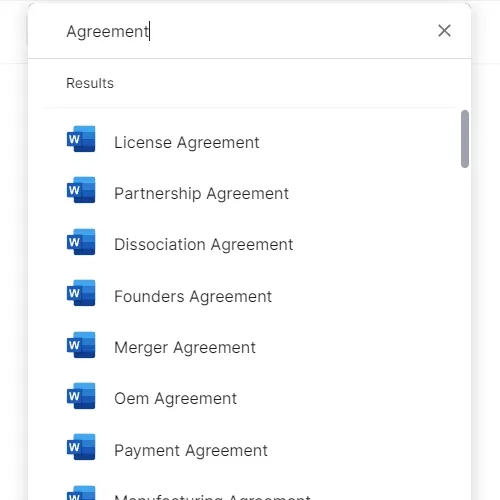
Access over 3,000+ business and legal templates for any business task, project or initiative.

2
Edit and fill in the blanks with AI

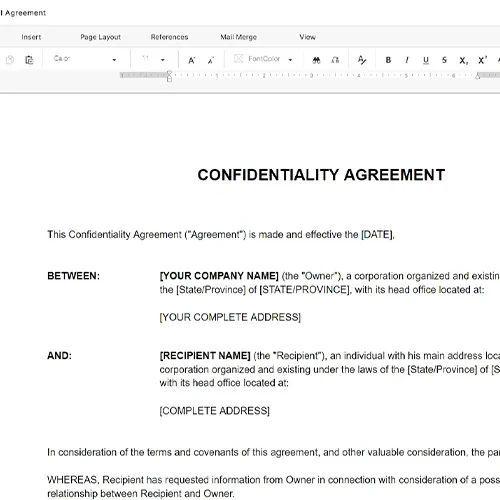
Customize your ready-made business document template and save it in the cloud.

3
Save, Share, Send, Sign

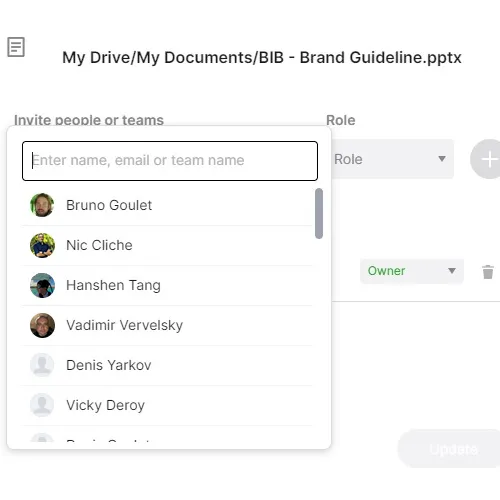
Share your files and folders with your team. Create a space of seamless collaboration.

Save time, save money, and create top-quality documents.

★★★★★

"Fantastic value! I'm not sure how I'd do without it. It's worth its weight in gold and paid back for itself many times."

Managing Director · Mall Farm
Robert Whalley
Managing Director, Mall Farm Proprietary Limited
★★★★★

"I have been using Business in a Box for years. It has been the most useful source of templates I have encountered. I recommend it to anyone."

Business Owner · 4+ years
Dr Michael John Freestone
Business Owner
★★★★★

"It has been a life saver so many times I have lost count. Business in a Box has saved me so much time and as you know, time is money."

Owner · Upstate Web
David G. Moore Jr.
Owner, Upstate Web

Run your business with a system — not scattered tools

Stop downloading documents. Start operating with clarity. Business in a Box gives you the Business Operating System used by over 250,000 companies worldwide to structure, run, and grow their business.

Free Forever Plan · No credit card required