Chief Operating Officer Job Description Template

Free Word download • Edit online • Save & share with Drive • Export to PDF

2 pages25–30 min to fillDifficulty: StandardSignature requiredLegal review recommended
Learn more ↓
FreeChief Operating Officer Job Description Template

At a glance

What it is
A Chief Operating Officer Job Description is a formal document that defines the scope of the COO role — including core duties, authority limits, reporting structure, performance expectations, and compensation framework. This free Word download gives you a structured, board-ready starting point you can edit online and export as PDF to accompany an employment agreement, present to the board, or publish as part of an executive recruiting process.
When you need it
Use it when hiring, promoting, or formally defining the COO role for the first time — or when restructuring executive responsibilities after a leadership change, merger, or significant operational expansion. It is also required when a board of directors needs to formally authorize the position.
What's inside
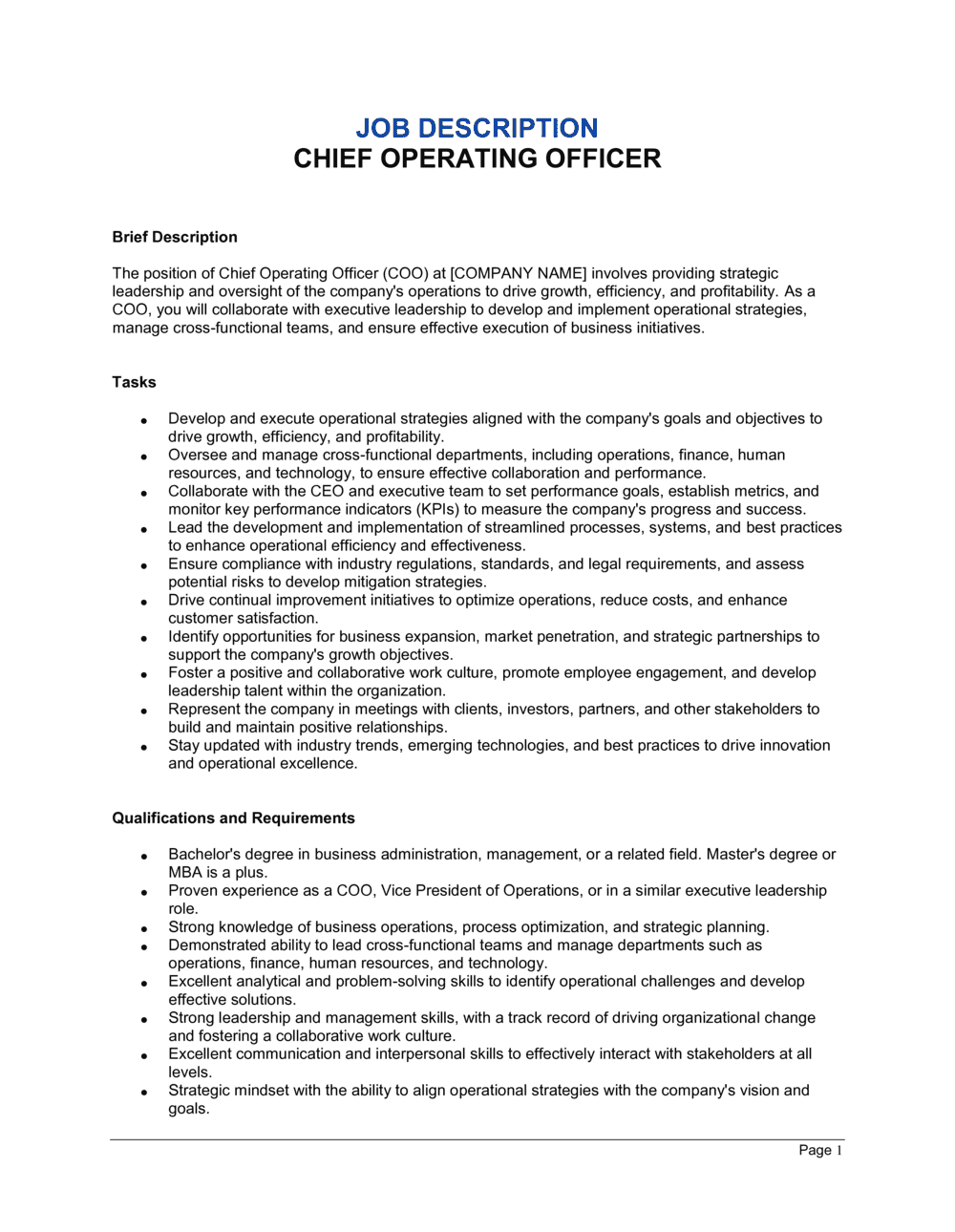
Position summary, reporting structure, core operational duties, authority and decision-making limits, key performance indicators, qualifications and experience requirements, compensation framework reference, and the board authorization clause.

What is a Chief Operating Officer Job Description?

A Chief Operating Officer Job Description is a formal governance document that defines the full scope of the COO role — including position summary, core operational duties, reporting structure, decision-making authority, key performance indicators, and minimum qualifications. Unlike an informal role summary used for recruiting, this document is designed to accompany a signed executive employment agreement, be referenced in board resolutions, and serve as the authoritative record of what the COO is accountable for delivering. When properly drafted and incorporated by reference into the employment agreement, it becomes part of the binding legal framework governing the executive relationship.

Why You Need This Document

Operating without a documented COO job description creates three compounding risks. First, authority ambiguity — without explicit spending thresholds and decision-making limits, the COO either stalls on routine approvals or makes unauthorized commitments that expose the company to contract liability. Second, performance management gaps — without written KPIs, terminating a COO for cause becomes a credibility contest rather than a contract interpretation exercise, increasing wrongful dismissal exposure significantly. Third, governance defects — investors, lenders, and acquirers routinely request C-suite role documentation during due diligence; an undocumented or informally defined COO role signals governance immaturity that can delay or kill a transaction. This template gives you a board-ready, legally structured starting point that closes all three gaps in under an hour.

Which variant fits your situation?

If your situation is…Use this template
Hiring a COO for a startup with no formal governance structure yetChief Operating Officer Job Description (Startup)
Defining a COO role within a publicly traded companyExecutive Job Description (Public Company)
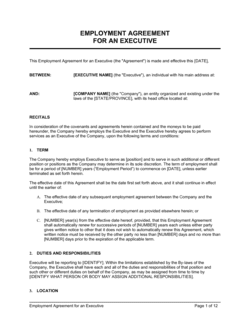
Creating a binding employment agreement for a named COOExecutive Employment Agreement
Describing a VP of Operations role below C-suite levelVP of Operations Job Description
Defining a fractional or interim COO engagementIndependent Contractor Agreement
Documenting all executive roles in a single governance frameworkCorporate Governance Policy
Preparing a board resolution to authorize the COO appointmentBoard Resolution Template

Common mistakes to avoid

❌ Omitting financial authority thresholds

Why it matters: Without defined spending limits, the COO either seeks CEO approval for routine operational purchases — creating bottlenecks — or makes commitments that exceed their delegated authority, exposing the company to unauthorized contracts.

Fix: Set specific dollar thresholds for operating expenditures, capital expenditures, vendor contracts, and headcount changes. Review and update these annually as the company scales.

❌ Embedding compensation figures directly in the job description

Why it matters: When base salary, bonus targets, or equity are renegotiated, the outdated numbers in the job description create a documentary conflict that can be used in a wrongful dismissal or breach of contract claim.

Fix: Reference the executive employment agreement for all compensation terms. The job description should state only the compensation structure categories, not specific dollar amounts.

❌ Treating the job description as a standalone enforceable contract

Why it matters: A job description is an internal governance document. Without a signed employment agreement that incorporates it by reference, restrictive covenants — non-compete, non-solicit, IP assignment — in the job description may not be enforceable.

Fix: Always pair the job description with a signed executive employment agreement. Include an incorporation-by-reference clause in both documents.

❌ Defining KPIs outside the COO's direct influence

Why it matters: Holding a COO accountable for metrics driven entirely by sales performance or external market conditions makes performance-based termination for cause legally contested and demoralizes capable executives.

Fix: Select KPIs that measure operational execution — on-time delivery, cost efficiency, process adherence, team health — where the COO's decisions are the primary driver of outcomes.

❌ Failing to obtain a board resolution authorizing the position

Why it matters: In most corporate structures, creating a C-suite officer role without board authorization is a governance defect that can be challenged by shareholders, lenders, or acquirers during due diligence.

Fix: Pass a board resolution authorizing the COO position before the job description is finalized or the employment agreement is signed. Attach the resolution as an exhibit.

❌ Using identical duty language for the COO and CEO roles

Why it matters: Overlapping duty language between the CEO and COO job descriptions creates ambiguity about accountability, complicates performance management, and signals to candidates and investors that the company has not thought through its leadership structure.

Fix: Audit both descriptions side by side. The CEO should own strategy, capital allocation, and external relationships; the COO should own execution, operations, and internal systems. Eliminate all duplicate duty statements.

The 10 key clauses, explained

Position Title and Organizational Placement

In plain language: States the exact job title, the business unit or company entity to which the role belongs, and where the COO sits in the organizational hierarchy.

Sample language
The Chief Operating Officer ('COO') of [COMPANY LEGAL NAME] reports directly to the Chief Executive Officer ('CEO') and is a member of the Executive Leadership Team. The COO holds authority over all operational functions as defined herein.

Common mistake: Using a trade name instead of the registered legal entity. If the employing entity differs from the operating brand, enforcement of restrictive covenants becomes complicated.

Position Summary

In plain language: A 3–5 sentence overview of the role's primary purpose — what the COO is ultimately accountable for delivering.

Sample language
The COO is responsible for translating [COMPANY NAME]'s strategic objectives into executable operational plans, overseeing day-to-day business functions across [LIST DEPARTMENTS], and ensuring the company meets its financial, operational, and cultural performance targets.

Common mistake: Writing a position summary so broad it applies to any executive. Investors and courts will reference this language — vagueness undermines performance management and termination-for-cause determinations.

Core Duties and Responsibilities

In plain language: An itemized list of the COO's primary operational duties, covering functional oversight, process improvement, cross-functional leadership, and reporting obligations.

Sample language
The COO shall: (a) oversee daily operations across [FUNCTIONS]; (b) develop and implement operational policies and procedures; (c) monitor KPIs and present monthly operational reports to the CEO and Board; (d) manage direct reports including [TITLES]; and (e) lead capacity planning and resource allocation for [FISCAL YEAR].

Common mistake: Listing responsibilities without specifying which require independent authority and which require CEO or board sign-off. Ambiguity here is the root cause of most COO-CEO disputes.

Reporting Structure and Direct Reports

In plain language: Defines who the COO reports to, which executives or department heads report to the COO, and any dotted-line or matrix relationships.

Sample language
The COO reports directly to the CEO. The following positions report directly to the COO: VP of Operations, VP of Engineering, Director of Customer Success, and Director of Supply Chain. Functional dotted-line reporting includes the Chief Financial Officer for budget approval workflows.

Common mistake: Omitting dotted-line and matrix relationships. Undefined cross-functional reporting creates authority gaps that stall operational decisions during critical growth phases.

Authority and Decision-Making Limits

In plain language: Sets the financial and operational thresholds within which the COO may act unilaterally, and identifies decisions that require CEO or board approval.

Sample language
The COO is authorized to approve operating expenditures up to $[AMOUNT] per transaction and $[AMOUNT] annually without CEO approval. Capital expenditures above $[AMOUNT], new vendor contracts exceeding $[AMOUNT] annually, and changes to headcount above [X] FTEs require prior written CEO approval.

Common mistake: No dollar thresholds at all, or thresholds set so low they require CEO sign-off on routine purchases. Either extreme makes the COO ineffective and creates liability exposure for unauthorized commitments.

Key Performance Indicators and Success Metrics

In plain language: Specifies the measurable outcomes the COO is accountable for — operational efficiency, cost targets, revenue enablement, team health, and customer satisfaction metrics.

Sample language
Performance shall be evaluated against the following annual targets: (a) operational cost as a percentage of revenue below [X]%; (b) on-time delivery rate above [X]%; (c) employee engagement score above [X]/10; (d) customer satisfaction (CSAT) above [X]%; and (e) quarterly OKR completion rate above [X]%.

Common mistake: Setting KPIs that are entirely outside the COO's control, or omitting KPIs altogether. Without defined metrics, performance-based termination for cause becomes legally contested.

Qualifications and Experience Requirements

In plain language: Lists the minimum education, years of experience, industry background, and functional expertise required to hold the role.

Sample language
Minimum qualifications: (a) [X]+ years of progressive operational leadership experience, including [X]+ years in a senior executive role; (b) demonstrated track record scaling operations in a [INDUSTRY/STAGE] company; (c) [DEGREE] in [FIELD] or equivalent experience; (d) experience managing cross-functional teams of [X]+ employees.

Common mistake: Setting credential requirements so narrow (e.g., 'must have Fortune 500 COO experience') that a qualified internal promotion candidate is technically disqualified — creating an inconsistent application of the role definition.

Compensation Framework Reference

In plain language: References the compensation structure without embedding specific dollar amounts — deferring to the employment agreement or offer letter to avoid amendment obligations when pay changes.

Sample language
Compensation, including base salary, annual performance bonus, long-term incentive plan participation, and benefits eligibility, is governed by the Executive Employment Agreement entered into between [COMPANY NAME] and [COO NAME] dated [DATE], as amended from time to time.

Common mistake: Detailing specific salary figures, bonus percentages, and equity grants inside the job description. When compensation is renegotiated, the outdated figure in the job description creates a documentary conflict.

Confidentiality and Non-Solicitation Obligations

In plain language: Binds the COO to protect company confidential information and restricts post-departure solicitation of employees and customers for a defined period.

Sample language
During and for [24] months following termination of employment, the COO shall not: (a) disclose or use any Confidential Information of [COMPANY NAME]; (b) solicit, recruit, or hire any employee of [COMPANY NAME]; or (c) solicit any customer or client with whom the COO had material contact during the preceding [24] months.

Common mistake: Relying on a confidentiality clause in the job description without a standalone NDA or employment agreement. Courts treat a job description as an internal governance document, not necessarily an enforceable contract — restrictive covenants need to appear in a signed agreement.

Governing Law and Amendment Procedure

In plain language: Specifies the jurisdiction whose law governs interpretation of the job description and the process required to amend it — typically board resolution or CEO approval in writing.

Sample language
This Position Description is governed by the laws of [STATE / PROVINCE / COUNTRY]. It may be amended only by written resolution of the Board of Directors or by written agreement signed by the CEO and the COO. This document is incorporated by reference into the Executive Employment Agreement dated [DATE].

Common mistake: No amendment clause at all. Without one, informal email exchanges and verbal agreements accumulate over time and can be introduced as evidence of de facto role modifications.

How to fill it out

  1. 1

    Enter the company's legal name and entity type

    Use the full registered legal entity name — not the brand or trade name. Confirm it matches the employing entity on payroll and in the executive employment agreement.

    💡 If the COO will be employed by a holding company but operationally responsible for a subsidiary, name both entities and clarify the employing entity explicitly.

  2. 2

    Define the reporting structure and direct reports

    Specify the exact title the COO reports to (typically CEO), list every direct report by their title, and document any dotted-line or matrix relationships with other C-suite members.

    💡 Review the org chart before completing this section — discrepancies between the job description and the actual reporting structure surface during onboarding and create confusion.

  3. 3

    List core duties with clear authority demarcations

    Itemize operational responsibilities using action verbs — oversee, approve, present, manage, develop. For each category of duty, note whether the COO acts independently or with CEO or board co-authorization.

    💡 Aim for 8–12 specific duty statements. Fewer than 8 is too vague to manage against; more than 15 signals an overloaded role that won't attract strong candidates.

  4. 4

    Set dollar thresholds in the authority clause

    Enter specific expenditure limits for operating spend, capital spend, vendor contract value, and headcount changes. Calibrate to the company's revenue scale — a $5M company and a $500M company need very different thresholds.

    💡 Benchmark against the CFO's signing authority. The COO's operational authority should typically align with or slightly exceed the CFO's on operating costs while remaining below the CEO on capital allocation.

  5. 5

    Define KPIs with measurable targets

    Select 4–6 KPIs that the COO can directly influence. For each, set a specific annual target — a percentage, dollar figure, or index score — and the measurement cadence.

    💡 Avoid vanity metrics. If a KPI can be hit while the business is failing, it is the wrong metric for a COO.

  6. 6

    Complete the qualifications section honestly

    Set minimum qualifications that reflect what the role genuinely requires — not a profile of the ideal candidate that would disqualify qualified internal candidates or create adverse-impact risk.

    💡 Label some requirements as 'preferred' rather than 'required' to preserve flexibility in the hiring process without weakening the document.

  7. 7

    Cross-reference the executive employment agreement

    Add the execution date of the employment agreement to the compensation framework reference clause and confirm the two documents are internally consistent on title, duties, and authority.

    💡 Any conflict between the job description and the employment agreement will typically be resolved in favor of the employment agreement — make sure the job description does not promise more than the agreement delivers.

  8. 8

    Obtain board authorization before issuing the document

    In most corporate governance frameworks, creating a C-suite position requires a board resolution. Have the board pass a resolution authorizing the COO role before the job description is executed or published.

    💡 Attach the board resolution as an exhibit to the job description and reference it in the governing law clause to create a complete governance record.

Frequently asked questions

What is a Chief Operating Officer job description?

A Chief Operating Officer job description is a formal document that defines the COO's core duties, reporting relationships, decision-making authority, performance metrics, and qualifications. It serves as both an internal governance record and a foundation for the executive employment agreement. When signed and incorporated by reference into the employment agreement, it becomes part of the binding legal framework governing the COO's role.

What does a Chief Operating Officer do?

A COO is responsible for translating the company's strategic objectives into day-to-day operational execution. Core responsibilities typically include overseeing production, supply chain, customer operations, and technology functions; managing direct reports across multiple departments; presenting operational performance reports to the CEO and board; and leading capacity planning and process improvement initiatives. The exact scope varies significantly by industry, company size, and the CEO's own operational involvement.

Is a COO job description legally binding?

A job description is generally not binding on its own — it is an internal governance document. It becomes legally enforceable when incorporated by reference into a signed executive employment agreement. Courts in most jurisdictions treat the employment agreement as the operative contract; the job description provides interpretive context for duties and authority but does not independently create enforceable obligations unless explicitly signed and contracted.

What is the difference between a COO job description and an executive employment agreement?

A job description defines the operational scope of the role — duties, reporting structure, authority, and KPIs. An executive employment agreement creates the binding legal relationship — compensation, equity, IP assignment, confidentiality, non-compete, severance, and termination terms. Both documents are necessary. Relying only on a job description leaves critical legal protections unenforced; relying only on an employment agreement without a job description leaves role accountability undefined.

Does appointing a COO require board approval?

In most corporate governance frameworks — including Delaware corporations, Canadian federally incorporated companies, and UK private limited companies — appointing a C-suite officer requires a formal board resolution. Operating without board authorization creates a governance defect that can surface during financing, acquisition due diligence, or shareholder disputes. Always obtain a board resolution before executing the employment agreement or publishing the job description externally.

How should compensation be handled in a COO job description?

Compensation should be referenced by category only — base salary, annual bonus, long-term incentive plan, and benefits — with a cross-reference to the executive employment agreement for specific amounts. Embedding dollar figures in the job description creates amendment obligations every time pay is renegotiated and can be used as evidence of a higher compensation entitlement in wrongful dismissal proceedings.

What KPIs are typically included in a COO job description?

Common COO KPIs include operational cost as a percentage of revenue, on-time delivery or project completion rate, employee engagement score, customer satisfaction or net promoter score, process cycle time improvements, and OKR or initiative completion rate. The best KPIs are metrics the COO can directly influence through operational decisions — not top-line revenue or external market factors primarily driven by sales or macroeconomic conditions.

Can I use the same COO job description for different company sizes or industries?

The core structure applies across company sizes and industries, but the authority thresholds, KPIs, direct report titles, and qualifications requirements must be tailored. A COO at a 20-person startup with $5M ARR needs different spending limits and functional coverage than a COO at a 1,000-person manufacturer with $200M in revenue. Use the template as a structural starting point and calibrate every quantitative placeholder to the company's actual operating context.

Should a COO job description include a non-compete clause?

Non-compete and non-solicitation language can appear in the job description for clarity, but it must also appear in the signed executive employment agreement to be enforceable. Courts in many jurisdictions will not enforce restrictive covenants found only in an unsigned internal document. Additionally, non-compete enforceability varies significantly by jurisdiction — California, Minnesota, and several EU member states restrict or ban them entirely for most employees, including executives.

How this compares to alternatives

vs Executive Employment Agreement

An executive employment agreement is the binding legal contract that governs the COO's compensation, equity, IP assignment, confidentiality, non-compete, and severance terms. A job description defines operational scope and accountability. Both are necessary — the job description without the employment agreement is unenforceable; the employment agreement without the job description leaves role accountability undefined. The two documents should be executed together and cross-reference each other.

vs VP of Operations Job Description

A VP of Operations typically reports to the COO or CEO and owns a narrower operational scope — often a single function such as logistics, manufacturing, or service delivery. The COO holds company-wide operational authority, sits on the executive leadership team, and is accountable for enterprise-level performance metrics. Use the VP of Operations description when the role does not carry C-suite authority or board visibility.

vs CEO Job Description

The CEO is accountable for company strategy, capital allocation, external stakeholder relationships, and ultimate organizational performance. The COO translates that strategy into operational execution and manages the internal functional machine. The two job descriptions must be audited side-by-side to eliminate overlapping duty language — ambiguity between CEO and COO accountability is one of the most common causes of C-suite conflict.

vs Independent Contractor Agreement

A fractional or interim COO is often engaged as an independent contractor rather than an employee — in which case an independent contractor agreement governs the relationship instead of a job description paired with an employment agreement. The contractor agreement covers scope of work, fees, IP ownership, and confidentiality, but does not confer the authority, fiduciary duties, or benefits of an employed COO. Misclassifying an employed COO as a contractor triggers significant tax and employment law liability.

Industry-specific considerations

Technology / SaaS

COO scope typically covers engineering, product operations, customer success, and security; authority thresholds calibrated to cloud spend and headcount velocity in high-growth environments.

Manufacturing

COO owns production planning, supply chain, quality assurance, and facilities; KPIs center on throughput, defect rates, and cost-per-unit benchmarks tied to shift and plant-level targets.

Healthcare

COO responsibilities include regulatory compliance operations, clinical workflow management, and credentialing oversight; authority limits must align with HIPAA and state health department requirements.

Financial Services

COO role intersects with risk management, compliance operations, and regulatory reporting; authority matrix must explicitly exclude decisions reserved for the Chief Risk Officer or Chief Compliance Officer.

Retail / E-commerce

COO typically owns fulfillment, inventory management, vendor relations, and omnichannel operations; KPIs tie to in-stock rates, fulfillment speed, and return processing efficiency.

Professional Services

COO focuses on utilization rates, project delivery methodology, talent operations, and client escalation protocols; authority over staffing decisions is central to the role definition.

Jurisdictional notes

United States

C-suite officers typically qualify as FLSA-exempt executive employees, removing overtime obligations. Delaware corporate law requires board authorization to appoint officers. Non-compete enforceability is highly state-specific — California, Minnesota, and Oklahoma effectively ban post-employment non-competes, including for executives. The FTC's 2024 proposed rule on non-competes was blocked in federal court as of late 2025; confirm current status before relying on any restriction.

Canada

Canadian corporate law under the CBCA and provincial equivalents requires board authorization for officer appointments. There is no at-will employment doctrine — the COO is entitled to reasonable notice or pay in lieu upon termination, which at the executive level can reach 18–24 months under common law. Quebec employers must provide French-language employment documents for provincially regulated entities. Non-compete enforceability is narrow — courts apply a strict reasonableness test and frequently strike down broad restrictions.

United Kingdom

UK company directors and officers must be formally appointed by board resolution and recorded at Companies House if they are also directors. The COO role does not carry automatic director status, but fiduciary duties apply if the COO acts as a de facto director. Post-termination non-competes are enforceable if reasonable in duration and scope; garden leave provisions are commonly used at the COO level to protect sensitive operational knowledge during the notice period.

European Union

EU member states require written employment terms under the Transparent and Predictable Working Conditions Directive, including for executive roles. Post-employment non-competes typically require financial compensation to the departing executive — ranging from 25% to 100% of base salary depending on the member state — to be enforceable. GDPR obligations must be reflected in the confidentiality clause when the COO has access to personal data of employees or customers. France and Germany impose statutory notice and severance floors that override contractual minimums.

Template vs lawyer — what fits your deal?

PathBest forCostTime
Use the templateCompanies defining the COO role for internal clarity or launching an executive search at the startup or growth stageFree30–60 minutes
Template + legal reviewCompanies hiring a named COO where the job description will be incorporated into a signed employment agreement$400–$800 for a 1–2 hour employment counsel review2–5 days
Custom draftedPublic companies, heavily regulated industries, cross-border executive hires, or situations involving equity, clawbacks, and complex non-compete requirements$2,000–$8,000+1–3 weeks

Glossary

Job Description
A formal document stating the duties, reporting relationships, authority limits, and qualifications for a specific role — used in hiring, performance management, and legal disputes.
Reporting Line
The chain of command specifying to whom a position reports directly and, where applicable, which roles report to it.
Authority Matrix
A document or clause listing the financial and operational decisions an executive may make independently versus those requiring board or CEO approval.
KPI (Key Performance Indicator)
A measurable metric used to evaluate whether a role or business unit is achieving its defined objectives within a set timeframe.
At-Will Employment
An employment relationship in which either party may terminate at any time for any lawful reason — relevant in US jurisdictions where this doctrine applies.
Fiduciary Duty
A legal obligation to act in the best interests of the company, its shareholders, or its board — applicable to executive officers including the COO.
FLSA Exemption
A classification under the US Fair Labor Standards Act that exempts certain executive employees from overtime pay requirements based on salary level and job duties.
Delegation of Authority
The formal act of transferring specific decision-making power from the CEO or board to the COO for defined operational matters.
Span of Control
The number of direct reports or business functions an executive oversees — used to calibrate whether the COO role is operationally feasible as written.
Board Resolution
A formal written decision by a company's board of directors, required in many jurisdictions to authorize the creation or filling of a C-suite position.
Non-Compete Covenant
A post-employment restriction preventing the COO from joining a competitor or starting a competing business within a defined geography and time period.

Part of your Business Operating System

This document is one of 3,000+ business & legal templates included in Business in a Box.

  • Fill-in-the-blanks — ready in minutes
  • 100% customizable Word document
  • Compatible with all office suites
  • Export to PDF and share electronically

Create your document in 3 simple steps.

From template to signed document — all inside one Business Operating System.
1
Download or open template

Access over 3,000+ business and legal templates for any business task, project or initiative.

2
Edit and fill in the blanks with AI

Customize your ready-made business document template and save it in the cloud.

3
Save, Share, Send, Sign

Share your files and folders with your team. Create a space of seamless collaboration.

Save time, save money, and create top-quality documents.

★★★★★

"Fantastic value! I'm not sure how I'd do without it. It's worth its weight in gold and paid back for itself many times."

Managing Director · Mall Farm
Robert Whalley
Managing Director, Mall Farm Proprietary Limited
★★★★★

"I have been using Business in a Box for years. It has been the most useful source of templates I have encountered. I recommend it to anyone."

Business Owner · 4+ years
Dr Michael John Freestone
Business Owner
★★★★★

"It has been a life saver so many times I have lost count. Business in a Box has saved me so much time and as you know, time is money."

Owner · Upstate Web
David G. Moore Jr.
Owner, Upstate Web

Run your business with a system — not scattered tools

Stop downloading documents. Start operating with clarity. Business in a Box gives you the Business Operating System used by over 250,000 companies worldwide to structure, run, and grow their business.

Start free · No credit card required