Supplier Scorecard Template

Free download • Use as a template • Print or share

1 page20–30 min to useDifficulty: StandardSignature requiredLegal review recommended
Learn more ↓
FreeSupplier Scorecard Template

At a glance

What it is
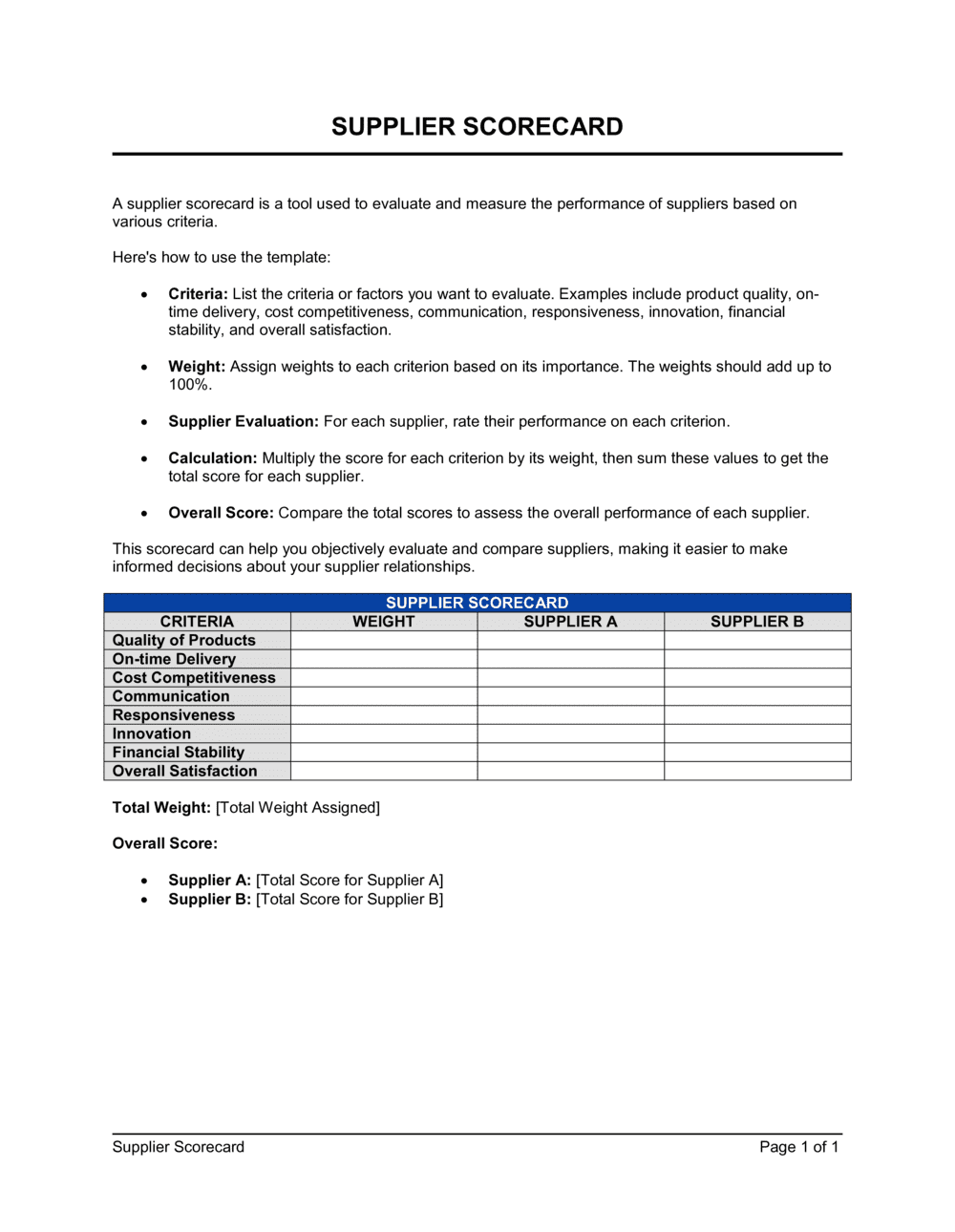
A Supplier Scorecard is a structured evaluation document used by buyers to measure and record vendor performance against agreed criteria — including quality, on-time delivery, pricing accuracy, regulatory compliance, and responsiveness. This free Word download gives you a ready-to-use template you can edit online, attach to a supply agreement, and export as PDF for formal review meetings or contract-renewal decisions.
When you need it
Use it during scheduled vendor review cycles, before renewing or renegotiating a supply contract, or whenever a supplier's performance has triggered a formal corrective-action process. It is also used at contract award to establish the baseline metrics a new supplier must meet.
What's inside
Supplier identification and contract reference details, weighted performance criteria covering quality, delivery, cost, and compliance, scoring scales with defined rating anchors, a corrective-action section for below-threshold scores, and signature blocks for both buyer and supplier acknowledgment.

What is a Supplier Scorecard?

A Supplier Scorecard is a structured performance-evaluation document that buyers use to measure, record, and communicate a vendor's results against agreed criteria — covering quality, on-time delivery, pricing accuracy, regulatory compliance, and service responsiveness — over a defined review period. Unlike an informal vendor check-in, a properly completed and signed supplier scorecard creates a formal contractual record that links observed performance data to the obligations set out in the underlying supply agreement. When built into the supply relationship from the start, it gives procurement teams an objective, repeatable basis for renewal decisions, corrective-action requirements, and — where performance persistently falls short — contract termination.

Why You Need This Document

Without a signed, data-backed supplier scorecard, your ability to enforce supply contracts erodes the moment a vendor disputes your assessment of their performance. Buyers who rely on informal feedback or email threads find themselves unable to demonstrate a documented pattern of underperformance when they need to invoke a corrective-action clause or terminate for cause — leaving them exposed to wrongful-termination claims or protracted disputes. A scorecard completed each review cycle, acknowledged by the supplier, and filed against the supply contract closes that gap: it transforms performance management from a relationship conversation into a legal record. Beyond enforcement, the scorecard disciplines your own procurement process — forcing you to define what good looks like before performance issues emerge, and giving suppliers the transparency they need to meet your standards rather than guess at them. This template gives you a ready-to-use starting point that you can tailor to your industry, weight to your priorities, and integrate with your existing supply agreements in under an hour.

Which variant fits your situation?

If your situation is…Use this template
Evaluating a single critical supplier on a recurring quarterly basisSupplier Scorecard
Onboarding a new vendor and setting baseline performance expectationsVendor Evaluation Form
Managing a formal corrective-action response to a supplier failureCorrective Action Plan
Selecting between multiple competing suppliers at RFP stageRequest for Proposal (RFP) Evaluation Matrix
Conducting a full annual review of all strategic suppliersSupplier Performance Review Report
Documenting the binding terms under which a supplier is evaluatedVendor Agreement
Issuing a formal notice after a supplier fails a scorecard thresholdSupplier Warning Letter

Common mistakes to avoid

❌ Never sharing the scorecard with the supplier

Why it matters: An internal-only scorecard cannot support contract enforcement, termination, or claims because the supplier has never formally acknowledged the performance record.

Fix: Send the completed scorecard to the supplier's authorized contact before the review meeting and obtain a signed acknowledgment before filing it.

❌ Assigning equal weights to all performance categories

Why it matters: Equal weighting treats a minor communication delay the same as a critical delivery failure, producing scores that do not reflect actual business impact and cannot drive meaningful supplier decisions.

Fix: Set category weights based on documented business priorities — involve operations, finance, and quality teams to validate the weighting before the first review cycle.

❌ Scoring based on general impressions rather than data

Why it matters: Impression-based scores are subjective, inconsistent across reviewers, and indefensible in a dispute. They also prevent year-over-year trend analysis.

Fix: Define the specific data source for each metric — defect reports, delivery logs, invoice records — and pull that data before opening the scorecard template.

❌ No defined consequence for falling below the threshold

Why it matters: A scorecard that places a supplier on Probationary status with no stated consequence gives the supplier no contractual incentive to improve and no legal basis for termination if they do not.

Fix: Link each status tier explicitly to a defined operational consequence — increased audit frequency, volume reductions, CAP deadlines, and a termination trigger — and reference the relevant clause in the supply agreement.

❌ Using the same scorecard template for all suppliers regardless of category

Why it matters: A scorecard designed for a raw-materials supplier is inappropriate for a logistics provider or a professional-services vendor, producing scores that measure irrelevant criteria.

Fix: Maintain category-specific scorecard variants — at minimum, separate templates for goods suppliers, logistics providers, and service vendors — with metrics and weights tailored to each category.

❌ Failing to obtain signatures before the review period closes

Why it matters: A scorecard signed months after the review period it covers is less credible in a dispute and may be challenged as retrospectively constructed.

Fix: Build a signature deadline into the scorecard process — typically within 10 business days of the review meeting — and follow up in writing if the supplier delays.

The 10 key clauses, explained

Supplier and Contract Identification

In plain language: Identifies the supplier by legal name, the relevant contract or purchase-order references, the review period covered, and the names of the evaluating and receiving parties.

Sample language
Supplier: [SUPPLIER LEGAL NAME] | Contract Reference: [CONTRACT NUMBER] | Review Period: [START DATE] to [END DATE] | Evaluated by: [BUYER CONTACT NAME, TITLE] | Acknowledged by: [SUPPLIER CONTACT NAME, TITLE].

Common mistake: Using a trading name instead of the supplier's registered legal entity name. If enforcement action becomes necessary, the wrong name on the document creates ambiguity about which entity is bound.

Performance Categories and Weightings

In plain language: Lists the categories being scored — typically quality, delivery, cost, service, and compliance — and assigns a percentage weight to each so that all weights sum to 100%.

Sample language
Quality: [30]% | On-Time Delivery: [25]% | Cost and Pricing Accuracy: [20]% | Regulatory Compliance: [15]% | Responsiveness and Communication: [10]% | Total: 100%.

Common mistake: Assigning equal weights to all categories regardless of their business impact. A late delivery in a just-in-time environment is far more damaging than a pricing discrepancy — weights should reflect actual business priorities.

Scoring Scale and Rating Anchors

In plain language: Defines the numeric scale used (e.g., 1–5 or 0–100) and provides clear, observable descriptions for each rating level to eliminate subjectivity between reviewers.

Sample language
5 — Exceeds all targets consistently; 4 — Meets all targets; 3 — Minor deviations, self-corrected; 2 — Repeated deviations requiring buyer intervention; 1 — Critical failures with business impact.

Common mistake: Using a numeric scale with no rating anchors. Without defined descriptions for each score level, two reviewers scoring the same supplier will produce materially different results, making trend analysis unreliable.

Quality Performance Metrics

In plain language: Records the defect rate, rejection rate, and any audit or inspection results for the review period, scored against the contracted quality threshold.

Sample language
Defect Rate: [X]% (Target: ≤[Y]%) | Lots Rejected: [N] of [N] received | Quality Audit Result: [PASS / FAIL / CONDITIONAL] | Score: [X] / 5.

Common mistake: Recording only the final score without attaching the supporting defect data. A score without data cannot be defended in a dispute and gives the supplier grounds to challenge the rating.

Delivery Performance Metrics

In plain language: Captures on-time delivery rate, average lead time versus contracted lead time, and the number of orders delivered short or with incorrect quantities.

Sample language
On-Time Delivery Rate: [X]% (Target: ≥[Y]%) | Average Lead Time: [X] days (Contracted: [Y] days) | Short Shipments: [N] | Score: [X] / 5.

Common mistake: Measuring delivery against ship date rather than receipt date. A supplier may ship on time but use a slower carrier, causing a late arrival — contractual SLAs should reference the delivery date at the buyer's facility.

Cost and Pricing Compliance

In plain language: Compares invoiced prices against contracted prices, records the frequency and value of unauthorized price changes, and notes any volume rebate or discount compliance.

Sample language
Pricing Accuracy Rate: [X]% | Unauthorized Price Deviations: [N] instances totaling $[AMOUNT] | Rebate Compliance: [YES / NO] | Score: [X] / 5.

Common mistake: Omitting this category because it feels adversarial. Pricing deviations are one of the most common supplier disputes — a documented history of overcharges is essential evidence if recovery or termination becomes necessary.

Regulatory and Compliance Obligations

In plain language: Records the supplier's adherence to required certifications, environmental standards, labor practices, and any applicable regulatory audits for the review period.

Sample language
ISO [9001/14001] Certification: [Current / Expired / Not Held] | Last Compliance Audit Date: [DATE] | Result: [PASS / CONDITIONAL / FAIL] | Outstanding Corrective Actions: [N] | Score: [X] / 5.

Common mistake: Treating compliance as a binary pass/fail with no nuance. A supplier with one minor non-conformance and a completed CAP is materially different from one with open critical findings — the scorecard should reflect that distinction.

Corrective Action Requirements

In plain language: Specifies the score threshold that triggers a mandatory corrective-action plan, the timeframe for submission, and the consequences of failing to submit or implement the plan.

Sample language
Any category score of [2] or below, or an overall weighted score below [60]%, requires submission of a Corrective Action Plan within [15] business days. Failure to submit or implement a CAP within [60] days constitutes a material breach of the Supply Agreement and may result in probationary status or contract termination.

Common mistake: Referencing a corrective-action requirement without tying it to a specific contractual consequence. Without an explicit breach-and-remedy chain, the supplier has no legal incentive to comply.

Overall Weighted Score and Status Classification

In plain language: Calculates the overall weighted score, maps it to a supplier status — Preferred, Approved, Probationary, or At Risk — and records the outcome and any escalation decisions.

Sample language
Overall Weighted Score: [X]% | Status: [PREFERRED (≥85%) / APPROVED (70–84%) / PROBATIONARY (55–69%) / AT RISK (<55%)] | Outcome: [No action / CAP required / Contract review initiated / Termination notice issued].

Common mistake: Using status labels without defining the operational consequences of each tier. A supplier placed on Probationary status needs to know exactly what that means — increased audit frequency, reduced order volumes, or a termination timeline.

Acknowledgment and Signature Block

In plain language: Records formal acknowledgment by both the buyer and the supplier that the scorecard results have been reviewed, discussed, and accepted as the official record for the period.

Sample language
Buyer: [NAME], [TITLE], [COMPANY] | Signature: _______________ | Date: _______________ | Supplier: [NAME], [TITLE], [COMPANY] | Signature: _______________ | Date: _______________.

Common mistake: Treating the scorecard as an internal document and never sending it to the supplier for acknowledgment. An unsigned scorecard is an opinion; a signed one is a contractual record that can support termination, escalation, or claims.

How to fill it out

  1. 1

    Enter supplier and contract identification details

    Record the supplier's registered legal name, the relevant contract or master supply agreement reference number, and the exact start and end dates of the review period being evaluated.

    💡 Cross-reference the legal name against the signed supply contract before entering it — any mismatch creates an enforceability gap.

  2. 2

    Set category weights to reflect your business priorities

    Assign a percentage weight to each performance category — quality, delivery, cost, compliance, and service. Confirm they sum to exactly 100% before proceeding.

    💡 Review weights with your operations and finance teams annually. A business that has shifted to just-in-time inventory may need to raise the delivery weighting from 20% to 35%.

  3. 3

    Pull objective data for each metric

    Gather defect reports, goods-received records, invoice logs, and audit results for the review period before scoring. Every score should reference a specific data source.

    💡 Document the data source next to each metric in the scorecard — 'per WMS report dated [DATE]' — so the supplier cannot challenge the factual basis of the rating.

  4. 4

    Apply the rating scale consistently

    Score each category using the defined rating anchors, not general impressions. Compare the actual metric to the contracted target, then select the score that most closely matches the anchor description.

    💡 If two evaluators will be scoring the same supplier independently, calibrate on one historic scorecard together before the live review cycle to align interpretation of each rating level.

  5. 5

    Calculate the overall weighted score

    Multiply each category score by its weight, sum the results, and express the total as a percentage. Map the result to the defined supplier status tier.

    💡 Build the weighted calculation into the Excel or Word template as a formula so arithmetic errors cannot affect the outcome or create a dispute.

  6. 6

    Complete the corrective-action section if required

    If any category score or the overall score falls below the defined threshold, complete the corrective-action trigger section: specify the failing category, the required improvement, and the CAP submission deadline.

    💡 Reference the specific clause in the supply agreement that makes a CAP mandatory — this converts a request into a contractual obligation.

  7. 7

    Conduct a formal review meeting with the supplier

    Share the completed scorecard with the supplier at least 48 hours before the review meeting. Walk through each category score, provide the supporting data, and allow the supplier to respond formally.

    💡 Record the meeting outcome in the scorecard's notes section — including any commitments the supplier makes verbally — before asking both parties to sign.

  8. 8

    Obtain signatures and file the executed copy

    Have both the buyer's authorized representative and the supplier's authorized contact sign and date the scorecard. Retain the executed copy in your vendor management system linked to the supply contract.

    💡 File each executed scorecard against the supplier's contract record so the full performance history is immediately accessible if termination proceedings become necessary.

Frequently asked questions

What is a supplier scorecard?

A supplier scorecard is a structured evaluation document that measures a vendor's performance against defined, weighted criteria — typically covering quality, on-time delivery, cost compliance, regulatory adherence, and service responsiveness. It converts subjective assessments into an objective, signed record that can support contract renewal decisions, corrective-action processes, or termination proceedings.

Why should a supplier scorecard be signed by both parties?

A signed scorecard creates a mutual acknowledgment that the performance record is accurate for the review period. Without a supplier signature, the document is an internal opinion rather than a contractual record. If you later need to terminate a supply contract for cause or pursue a claim, a series of signed scorecards demonstrating persistent underperformance is significantly stronger evidence than internal memos.

How often should supplier scorecards be completed?

Most businesses complete scorecards quarterly for strategic and high-volume suppliers, and annually for lower-risk or low-spend vendors. For suppliers on a corrective-action plan, monthly scoring is standard until performance returns to the acceptable threshold. The review frequency should be stated in the master supply agreement so both parties have a contractual obligation to participate.

What performance categories should a supplier scorecard include?

The five core categories are quality (defect rate, rejection rate, audit results), delivery (on-time delivery rate, lead time variance), cost and pricing accuracy (invoice errors, unauthorized price changes), regulatory and compliance (certifications, audit outcomes, labor standards), and service and responsiveness (response time to queries, complaint resolution speed). Weights should reflect the relative business impact of each category in your specific supply chain.

What happens when a supplier scores below the acceptable threshold?

A below-threshold score should trigger a mandatory corrective-action plan, which the supplier is required to submit within a defined timeframe — typically 10 to 15 business days. The CAP should include a root-cause analysis, specific remediation steps, and measurable targets with dates. If the supplier fails to submit or implement the plan, that failure typically constitutes a material breach of the supply agreement, giving the buyer termination rights.

Is a supplier scorecard legally binding?

The scorecard itself is an evaluation record, not a standalone contract. Its legal weight depends on how it is referenced in the master supply agreement. When the supply contract explicitly requires scorecard reviews, defines the consequences of failing scores, and mandates corrective-action obligations, a signed scorecard becomes a contractual record. Without that contractual foundation, it functions as evidence of performance history but not as a self-executing legal instrument.

Can a supplier challenge a scorecard score?

Yes, and building a formal dispute process into the scorecard is advisable. A common approach is to allow the supplier to submit a written challenge within 10 business days of receiving the scorecard, supported by data. The buyer then reviews the challenge and either adjusts the score or maintains it with a written explanation. This process should be documented in the scorecard template and referenced in the supply agreement to avoid ad-hoc disputes.

How is the overall weighted score calculated?

Multiply each category's raw score by its assigned weight percentage, then sum the results to produce the overall weighted score. For example, a quality score of 4 out of 5 with a 30% weight contributes 0.30 × 4 = 1.20 to the total. A delivery score of 3 with a 25% weight contributes 0.25 × 3 = 0.75. Summing all weighted contributions and expressing the result as a percentage of the maximum possible score gives the overall performance percentage. Building this formula into the template eliminates arithmetic disputes.

What is the difference between a supplier scorecard and a vendor evaluation form?

A vendor evaluation form is typically used once, during the initial qualification or onboarding of a new supplier, to assess capability and suitability before awarding a contract. A supplier scorecard is a recurring performance-measurement document used throughout the life of the supply relationship to track trends, enforce SLAs, and support contract decisions. Both documents complement each other — the evaluation form sets the entry standard; the scorecard enforces it over time.

How this compares to alternatives

vs Vendor Agreement

A vendor agreement is the binding contract that establishes the terms of the supply relationship — price, delivery obligations, IP ownership, and termination rights. A supplier scorecard is the recurring performance-measurement tool that enforces those obligations. The scorecard derives its legal weight from being referenced in the vendor agreement; used without one, it is persuasive but not contractually self-executing.

vs Corrective Action Plan

A corrective action plan is a reactive document a supplier submits after a scorecard reveals below-threshold performance. The scorecard identifies and records the problem; the CAP defines the remedy and timeline. Both documents work together — a scorecard without a CAP process has no teeth; a CAP without a scorecard history lacks the documented evidence trail needed to justify termination if the plan fails.

vs Request for Proposal (RFP)

An RFP is used before a supplier relationship begins to solicit and compare competing bids. A supplier scorecard is used after the contract is awarded to track whether the chosen supplier is delivering on the promises that won them the business. RFPs set the expectation; scorecards measure the reality.

vs Purchase Order

A purchase order is a transaction document that authorizes a specific delivery at a specific price. A supplier scorecard is a relationship-level document that evaluates aggregate performance across many purchase orders over a defined period. Purchase orders create individual transaction records; the scorecard synthesizes those records into a strategic assessment.

Industry-specific considerations

Manufacturing

Defect rates measured in parts per million, on-time delivery tied to production schedules, and compliance with ISO 9001 and IATF 16949 quality standards are core scorecard metrics.

Retail and E-commerce

Fill rate, packaging compliance, and accurate advance shipping notices are weighted heavily because supplier failures translate directly into out-of-stock events and customer complaints.

Healthcare and Pharmaceuticals

Regulatory compliance scores carry the highest weight — FDA 21 CFR Part 820, GMP certifications, and cold-chain delivery compliance are non-negotiable criteria with immediate probationary consequences for failure.

Construction

Material quality, delivery to site on the promised date, and safety compliance (OSHA certifications, incident rates) are the primary scorecard categories, with delivery delays weighted heavily due to project-schedule knock-on costs.

Food and Beverage

Food safety certifications (SQF, BRC, FSSC 22000), allergen control compliance, and cold-chain integrity are evaluated alongside standard delivery and pricing metrics, with any food-safety failure triggering immediate escalation.

Technology and Electronics

Component authenticity verification, RoHS and REACH compliance, lead times against production-line pull schedules, and warranty return rates are the defining scorecard metrics for electronics supply chains.

Jurisdictional notes

United States

There is no federal statute governing supplier scorecards, but courts in commercial disputes have treated signed scorecards as admissible evidence of performance history under UCC Article 2 for goods contracts. California and New York courts have upheld termination-for-cause clauses supported by documented scorecard records. For government contracting, FAR 42.15 requires formal contractor performance assessments — scorecards aligned to CPARS criteria fulfill this requirement.

Canada

Supplier scorecards are enforceable as part of the overall supply agreement under common-law contract principles in all provinces. In Quebec, contracts are governed by the Civil Code of Quebec rather than common law — ensure the scorecard's corrective-action and termination language is reviewed against Civil Code obligations, particularly regarding good-faith dealing under Article 1375. French-language versions may be required for Quebec-based suppliers under the Charter of the French Language.

United Kingdom

Under the UK Sale of Goods Act 1979 and the Supply of Goods and Services Act 1982, buyers have statutory remedies for supplier failures that scorecards help document. Post-Brexit, UK public sector buyers are subject to the Procurement Act 2023, which requires formal supplier performance monitoring — scorecards aligned to KPIs in the contract directly support compliance. The Prompt Payment Code and late-payment legislation mean that pricing-accuracy scorecard findings can also support interest claims on overcharged invoices.

European Union

EU public procurement rules under Directive 2014/24/EU require contracting authorities to evaluate supplier performance and may debar persistently underperforming suppliers from future tenders — a signed scorecard history supports both processes. GDPR applies if the scorecard records personal data about named supplier contacts; limit personal data to what is necessary and ensure data retention periods are defined. Germany, France, and the Netherlands each have national laws on supply chain due diligence (notably Germany's Lieferkettensorgfaltspflichtengesetz) that create additional compliance criteria appropriate for inclusion in the regulatory section of the scorecard.

Template vs lawyer — what fits your deal?

PathBest forCostTime
Use the templateProcurement teams establishing a structured supplier review process for standard commercial supply relationshipsFree30–60 minutes per scorecard cycle
Template + legal reviewBusinesses integrating the scorecard into an existing supply agreement or adding formal corrective-action and termination triggers$300–$800 for a contract attorney to review and align the scorecard with the supply agreement2–5 business days
Custom draftedRegulated industries (healthcare, aerospace, defense) where scorecard results trigger regulatory reporting obligations or high-value contract terminations$1,500–$5,000+1–3 weeks

Glossary

Key Performance Indicator (KPI)
A measurable metric used to assess how well a supplier is meeting a specific contractual or operational standard.
Weighted Scoring
A method of assigning different importance levels to performance categories so that higher-priority criteria have a greater impact on the overall score.
On-Time Delivery Rate (OTD)
The percentage of purchase orders delivered on or before the agreed delivery date within a defined review period.
Defect Rate
The number of non-conforming units or batches as a proportion of total units received, typically expressed as parts per million (PPM) or a percentage.
Corrective Action Plan (CAP)
A formal, time-bound plan a supplier submits when their scorecard results fall below a defined threshold, describing root cause analysis and remediation steps.
Preferred Supplier Status
A designation awarded to suppliers whose scorecard scores consistently exceed a defined threshold, typically conferring priority contract allocation or extended terms.
Probationary Status
A formal designation applied to suppliers whose scores fall below an acceptable threshold, triggering closer monitoring and a mandatory corrective-action process.
Total Cost of Ownership (TCO)
The complete cost of working with a supplier, including unit price, logistics, quality failures, administrative burden, and the cost of switching away.
Service Level Agreement (SLA)
A contractually defined standard for a specific service or delivery metric, breach of which may trigger penalties, escalation, or termination rights.
Audit Compliance Score
A rating reflecting a supplier's adherence to required regulatory, environmental, or quality standards during a formal inspection or audit.
Lead Time
The elapsed time between a buyer submitting a purchase order and the supplier completing delivery to the agreed destination.

Part of your Business Operating System

This document is one of 3,000+ business & legal templates included in Business in a Box.

  • Fill-in-the-blanks — ready in minutes
  • 100% customizable Word document
  • Compatible with all office suites
  • Export to PDF and share electronically

Create your document in 3 simple steps.

From template to signed document — all inside one Business Operating System.
1
Download or open template

Access over 3,000+ business and legal templates for any business task, project or initiative.

2
Edit and fill in the blanks with AI

Customize your ready-made business document template and save it in the cloud.

3
Save, Share, Send, Sign

Share your files and folders with your team. Create a space of seamless collaboration.

Save time, save money, and create top-quality documents.

★★★★★

"Fantastic value! I'm not sure how I'd do without it. It's worth its weight in gold and paid back for itself many times."

Managing Director · Mall Farm
Robert Whalley
Managing Director, Mall Farm Proprietary Limited
★★★★★

"I have been using Business in a Box for years. It has been the most useful source of templates I have encountered. I recommend it to anyone."

Business Owner · 4+ years
Dr Michael John Freestone
Business Owner
★★★★★

"It has been a life saver so many times I have lost count. Business in a Box has saved me so much time and as you know, time is money."

Owner · Upstate Web
David G. Moore Jr.
Owner, Upstate Web

Run your business with a system — not scattered tools

Stop downloading documents. Start operating with clarity. Business in a Box gives you the Business Operating System used by over 250,000 companies worldwide to structure, run, and grow their business.

Start free · No credit card required