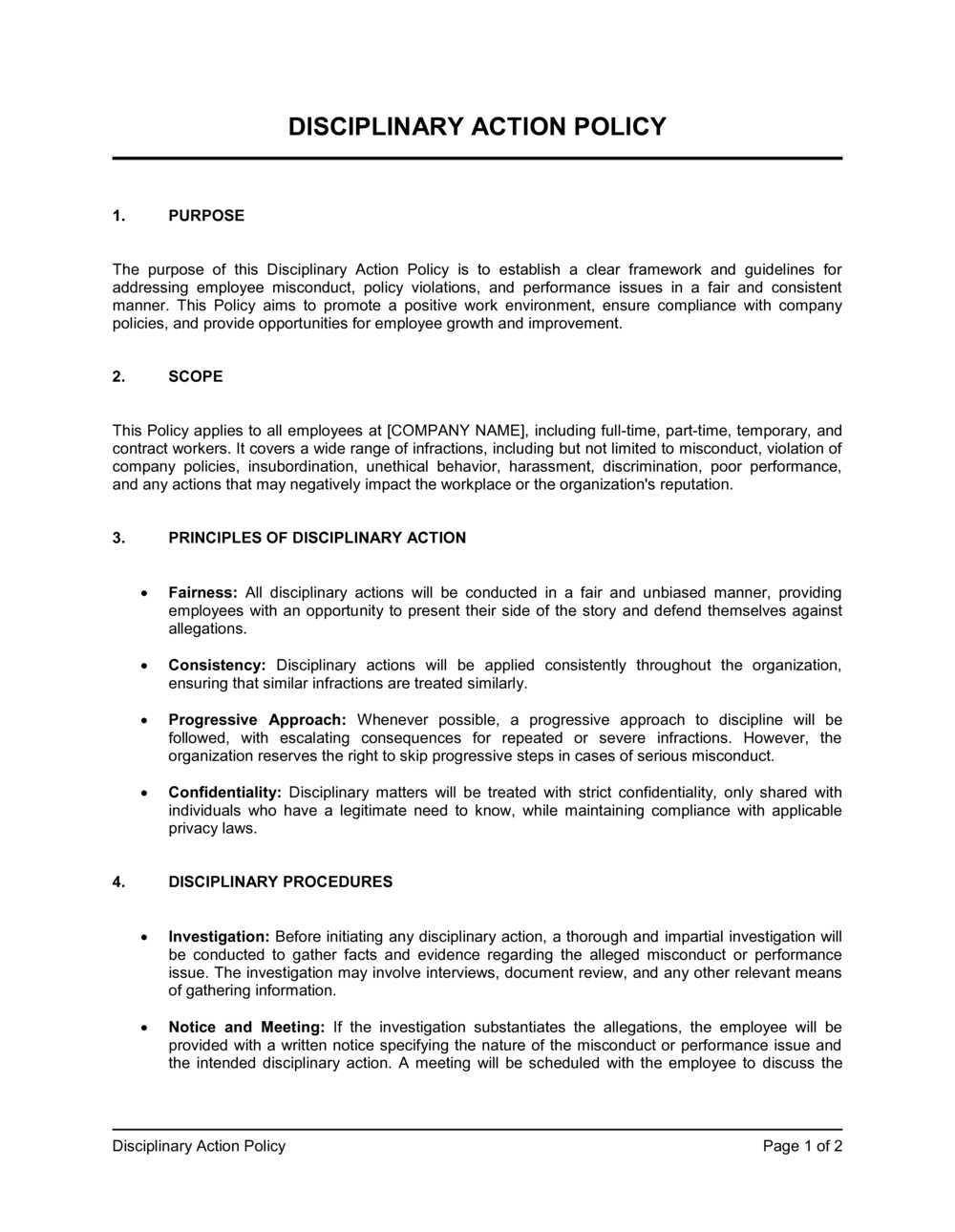
Disciplinary Action Policy Template

Free Word download β€’ Edit online β€’ Save & share with Drive β€’ Export to PDF

2 pagesβ€’20–25 min to fillβ€’Difficulty: Standard
Learn more ↓
FreeDisciplinary Action Policy Template

At a glance

What it is
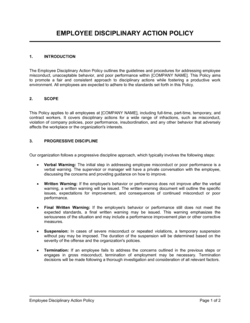
A Disciplinary Action Policy is a formal HR document that defines the rules of conduct employees are expected to follow, outlines the progressive steps a manager takes when those rules are broken, and specifies what documentation must be created at each stage. This free Word download gives you a ready-to-edit policy you can tailor to your organization's size and culture, then export as PDF for inclusion in your employee handbook.
When you need it
Use it when onboarding your first employees, when a conduct incident occurs and you lack a consistent process to follow, or when an audit, complaint, or legal inquiry reveals that your current disciplinary approach is informal and undocumented. It also becomes essential any time you are scaling a team and need managers to handle performance issues consistently across departments.
What's inside
Policy scope and purpose, definitions of misconduct categories, the full progressive discipline sequence from verbal warning through termination, documentation requirements at each step, employee rights and appeal procedures, and manager responsibilities for consistent enforcement.

What is a Disciplinary Action Policy?

A Disciplinary Action Policy is a formal HR document that defines the conduct standards all employees are expected to meet, classifies violations by severity, and outlines the structured sequence of steps β€” from verbal warning to termination β€” that managers must follow when those standards are breached. It specifies what documentation is required at each step, what rights employees have to respond and appeal, and how records are stored and expired. Rather than leaving managers to improvise when a conduct issue arises, the policy gives every person in a leadership role a consistent, auditable process to follow regardless of the employee involved.

Why You Need This Document

Without a written disciplinary action policy, every conduct incident is handled on instinct β€” and inconsistency is the predictable result. When two employees receive different consequences for the same violation, the gap between those outcomes becomes the employer's legal exposure, particularly when the employees differ in age, gender, or other protected characteristics. Employment tribunals and wrongful termination lawsuits are rarely won or lost on whether the misconduct occurred; they are won or lost on whether the employer followed a fair, documented process. A policy distributed at onboarding β€” and signed for β€” establishes that every employee knew the rules and the consequences before an incident occurred. This template gives you the complete framework to build that process in under two hours, with every procedural safeguard already in place.

Which variant fits your situation?

If your situation is…Use this template
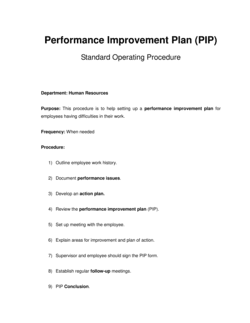
Managing recurring performance issues rather than conduct violationsPerformance Improvement Plan (PIP)
Documenting a single warning issued to an employeeEmployee Warning Letter
Formalizing the termination outcome of a disciplinary processEmployee Termination Letter
Creating a full-organization conduct and HR reference for employeesEmployee Handbook
Addressing a specific code of conduct violation in writingEmployee Disciplinary Notice
Documenting an employee grievance or internal complaintEmployee Grievance Form
Setting attendance and punctuality expectationsAttendance Policy

Common mistakes to avoid

❌ Applying discipline inconsistently across employees

Why it matters: If two employees commit the same violation and receive different outcomes, the inconsistency itself becomes the legal exposure β€” particularly if the employees differ in a protected characteristic such as gender, age, or race.

Fix: Require HR review before any suspension or termination is issued, and document the reasoning for any deviation from the standard sequence.

❌ Skipping a documented investigation before imposing discipline

Why it matters: Without a record showing the employee was notified of the allegation and given a chance to respond, the employer has no procedural defense against a wrongful termination or unfair dismissal claim.

Fix: Build a mandatory investigation step into the policy for every violation above verbal warning, and record the outcome β€” even if the investigation is brief.

❌ Using the same progressive sequence for gross misconduct

Why it matters: A policy that requires a verbal warning before terminating an employee for theft or violence will be impossible to follow in a real incident and will leave managers unclear on what authority they have to act immediately.

Fix: Explicitly state that gross misconduct bypasses progressive steps and may result in immediate termination pending investigation.

❌ Never expiring warning records

Why it matters: Using a 4-year-old written warning as a factor in a current termination decision is legally and ethically difficult to defend and signals a retaliatory or pretextual motive.

Fix: Add a clear expiry clause: warnings that are not followed by another violation within 12 months are no longer active factors in future disciplinary decisions.

❌ Routing appeals to the original decision-maker

Why it matters: An appeal process that sends the complaint back to the same manager who issued the discipline is procedurally meaningless and will be dismissed as such by any employment tribunal or arbitrator.

Fix: Designate an appeal reviewer who was not involved in the original decision β€” typically HR leadership or a senior manager outside the employee's reporting line.

❌ Publishing the policy without manager training

Why it matters: A policy that exists in the handbook but that managers have never been walked through is not a reliable defense. When managers improvise around an unfamiliar process, they create the very inconsistencies that generate claims.

Fix: Conduct a brief manager training session each time the policy is issued or materially updated, and log attendance as part of your compliance records.

The 9 key sections, explained

Purpose and scope

Conduct expectations and violation categories

Progressive discipline steps

Investigation procedure

Documentation requirements

Employee rights and response process

Appeal procedure

Manager responsibilities and consistency requirements

Record retention and confidentiality

How to fill it out

  1. 1

    Define the scope and covered employees

    Enter your company name and specify which employment types the policy covers β€” full-time, part-time, temporary, and contractor. Note any exclusions and state which locations or business units the policy applies to.

    πŸ’‘ If your business operates in multiple states or countries, note that local employment law governs where it conflicts with this policy β€” this single sentence reduces legal exposure significantly.

  2. 2

    Categorize your violation tiers

    Sort policy violations into at least two tiers β€” minor and gross misconduct β€” with three tiers (minor, serious, gross) preferred for companies with more than 25 employees. Add industry-specific examples under each tier.

    πŸ’‘ List examples, not exhaustive categories. Use language like 'including but not limited to' so unlisted violations are still covered.

  3. 3

    Map out the progressive discipline sequence

    Confirm which steps apply to which violation tiers. Minor violations typically follow all five steps; serious violations may start at written warning; gross misconduct goes straight to termination. Document this mapping explicitly.

    πŸ’‘ Explicitly state that steps may be skipped at management discretion for serious violations β€” this preserves flexibility without abandoning the process.

  4. 4

    Write the investigation procedure

    Name the role (not a specific person) responsible for conducting investigations, set a response timeframe in business days, and describe how the employee is notified and given an opportunity to respond.

    πŸ’‘ A 5-business-day investigation window is realistic for most incidents. Investigations that drag beyond 10 days without a status update create anxiety, rumor, and potential constructive dismissal exposure.

  5. 5

    Specify documentation requirements at each step

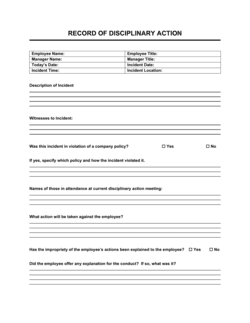
    Name the form or document required at each discipline step, who must sign it, the HR review requirement, and where it is filed. Reference your Disciplinary Action Form template by name.

    πŸ’‘ Require HR countersignature before any suspension or termination is communicated β€” this is the single most effective gate against inconsistent enforcement.

  6. 6

    Add the employee rights and appeal sections

    Set a specific number of business days for the employee's written response (5 is standard) and for the appeal submission window (10 days is common). Name the appeal reviewer role and the turnaround for the appeal decision.

    πŸ’‘ Route appeals to someone at least one level above the issuing manager and outside the original incident's reporting chain.

  7. 7

    Set record retention rules and expiry timelines

    Enter the retention period for disciplinary records (typically 2–5 years), the expiry period after which an active warning is no longer considered in future decisions (typically 12 months of clean service), and who has access to the file.

    πŸ’‘ Align your retention period with the statute of limitations for employment claims in your primary jurisdiction β€” typically 2–3 years in the US and Canada.

  8. 8

    Review with legal counsel and distribute to managers

    Have HR or outside counsel review the final policy for consistency with local employment law, then distribute it to all people managers before publishing it in the employee handbook. Log the distribution date.

    πŸ’‘ Train managers on the policy in a 30-minute walkthrough session β€” a policy managers haven't read is not a defense in an employment dispute.

Frequently asked questions

What is a disciplinary action policy?

A disciplinary action policy is an HR document that defines the conduct standards employees must meet and the structured process a company follows when those standards are violated. It typically covers progressive steps from verbal warning through termination, documentation requirements at each step, employee rights, and manager responsibilities. Its primary purpose is to ensure violations are handled consistently, fairly, and with adequate documentation to protect both employees and the organization.

What is progressive discipline?

Progressive discipline is a structured approach that applies increasingly serious consequences for repeated or escalating policy violations. The typical sequence is verbal warning, written warning, final written warning, suspension without pay, and termination. The goal is to give employees a clear opportunity to correct their behavior at each stage before the consequence escalates. Serious or gross misconduct can bypass earlier steps and proceed directly to suspension or termination.

Does a disciplinary action policy need to be in the employee handbook?

Including the policy in the employee handbook is strongly recommended because it ensures every employee receives it at onboarding and acknowledges it in writing. A standalone policy distributed separately can get lost; a handbook acknowledgment creates a documented record that the employee was informed of the rules and consequences before any incident occurred.

What documentation should be created at each disciplinary step?

At a minimum: a dated memo or disciplinary action form describing the violation, the policy provision it breaches, the corrective action required, and the consequence of further violations. The document should be signed by the issuing manager, reviewed by HR, and signed by the employee to acknowledge receipt. A copy belongs in the employee's personnel file. Refusals to sign should be noted on the form rather than treated as blocking the process.

Can an employee be terminated immediately without going through all disciplinary steps?

Yes, for gross misconduct β€” theft, violence, fraud, harassment, or other serious violations. A well-drafted policy explicitly states that gross misconduct may result in immediate termination pending investigation, bypassing the standard progressive steps. Even in immediate-termination situations, conducting a brief documented investigation and giving the employee an opportunity to respond before the final decision reduces legal exposure significantly.

How long should disciplinary records be kept?

Most organizations retain disciplinary records for 2–5 years from the date of issue, aligned with the statute of limitations for employment claims in the applicable jurisdiction. Active warnings are typically treated as no longer relevant after 12 months of violation-free service. Records should be stored securely, accessible only to HR and relevant management, and disposed of according to your data retention schedule.

What is the difference between a disciplinary action policy and a performance improvement plan?

A disciplinary action policy addresses conduct violations β€” attendance, insubordination, misconduct, policy breaches. A performance improvement plan (PIP) addresses skill gaps or output deficiencies where the employee is willing but underperforming. The two processes often run parallel but should be kept distinct: mixing them creates confusion about whether the employee is being disciplined or supported, which complicates any subsequent termination.

Do small businesses need a formal disciplinary action policy?

Any business with employees benefits from a written disciplinary policy. For companies under 10 employees, a streamlined two-page policy covering violation categories, the basic progressive sequence, and documentation requirements is sufficient. As headcount grows past 15–20, a more detailed policy becomes essential because the risk of inconsistent enforcement across managers and departments increases significantly with team size.

What should managers avoid doing during a disciplinary meeting?

Managers should avoid issuing discipline verbally without written follow-up, making promises about outcomes they cannot guarantee, discussing the discipline with other employees, or conducting the meeting without an HR representative present for suspension or termination decisions. Disciplinary meetings should be private, factual, and focused on the specific violation β€” not the employee's general character or attitude.

How this compares to alternatives

vs Performance Improvement Plan

A performance improvement plan (PIP) is used when an employee is willing but underperforming against measurable output or skill targets. A disciplinary action policy governs conduct violations β€” rule-breaking, attendance, misconduct. Mixing the two processes blurs accountability and creates ambiguity about whether the employee is being supported or disciplined. Use a PIP for capability issues; use the disciplinary policy for conduct issues.

vs Employee Warning Letter

A warning letter is a single-instance document issued at a specific discipline step. A disciplinary action policy is the governing framework that defines all steps, documentation standards, and procedures across the organization. The warning letter is an output of the policy, not a substitute for it. Using only warning letters without a governing policy leaves managers with no consistent process to follow.

vs Employee Handbook

An employee handbook is a comprehensive reference covering all HR policies, benefits, and workplace rules. A disciplinary action policy is a dedicated, detailed document that covers the discipline process with enough procedural depth to guide managers through real incidents. Handbooks often summarize the discipline policy in a few paragraphs and reference the standalone policy for the full procedure β€” both documents serve different purposes.

vs Employee Termination Letter

A termination letter documents the final outcome of the disciplinary process for the employee's records. The disciplinary action policy is the procedural framework that must be followed before that letter is issued. Issuing a termination letter without the documented disciplinary process behind it leaves the employer exposed to wrongful termination claims with no procedural defense.

Industry-specific considerations

Retail and hospitality

High turnover and shift-based scheduling require a fast, lightweight process β€” verbal and written warnings delivered same-day with standardized forms managers can complete without HR present.

Healthcare

Patient safety violations and licensing compliance failures may require immediate suspension pending investigation, making the gross-misconduct bypass provision especially critical.

Manufacturing

Safety rule violations are typically classified as serious or gross misconduct regardless of intent, and union environments require strict adherence to the agreed disciplinary procedure in the collective agreement.

Professional services

Conflicts of interest, client confidentiality breaches, and billing irregularities are the most common gross-misconduct triggers and warrant their own explicitly listed violation examples in the policy.

Technology and SaaS

Remote and distributed teams require clear guidance on how disciplinary meetings are conducted virtually, how documentation is signed electronically, and how investigation timelines account for time zone differences.

Education

Safeguarding violations involving students require mandatory reporting steps that run in parallel with β€” not instead of β€” the internal disciplinary process, and both tracks must be documented separately.

Template vs pro β€” what fits your needs?

PathBest forCostTime
Use the templateSmall businesses and startups creating their first formal discipline process for a team under 50 employeesFree1–2 hours to customize and distribute
Template + professional reviewGrowing teams, multi-state employers, or businesses that have experienced an HR complaint or audit$200–$600 for an HR consultant or employment attorney review3–5 business days
Custom draftedEnterprise organizations, unionized workplaces, or companies operating across multiple countries with distinct employment law obligations$1,000–$3,500+2–4 weeks

Glossary

Progressive Discipline
A structured approach that applies increasingly serious consequences for repeated or escalating violations, giving employees the opportunity to correct behavior before termination.
Verbal Warning
The first formal step in progressive discipline, in which a manager notifies an employee of a violation and the expected correction β€” documented in writing even though delivered verbally.
Written Warning
A formal notice documenting a policy violation, the corrective action required, and the consequence of further violations, signed by both the manager and the employee.
Suspension Without Pay
A temporary removal from the workplace, without compensation, used as an intermediate disciplinary step before termination for serious or repeated violations.
Gross Misconduct
Behavior so serious β€” such as theft, violence, or fraud β€” that it warrants immediate termination without progressing through prior warning steps.
Final Written Warning
A written notice stating that the next policy violation will result in immediate termination, typically issued after a standard written warning has failed to produce correction.
At-Cause Termination
Ending employment specifically because of documented policy violations or misconduct, as distinguished from a layoff or reduction in force.
Due Process
The practice of giving an employee notice of the allegation, an opportunity to respond, and a fair investigation before a disciplinary decision is made.
Corrective Action
Any step β€” training, reassignment, a performance plan, or a warning β€” intended to fix the underlying behavior rather than purely penalize it.
Disciplinary Record
The cumulative file of documented warnings, notices, and outcomes maintained in an employee's personnel file throughout the disciplinary process.

Part of your Business Operating System

This document is one of 3,000+ business & legal templates included in Business in a Box.

  • Fill-in-the-blanks β€” ready in minutes
  • 100% customizable Word document
  • Compatible with all office suites
  • Export to PDF and share electronically

Create your document in 3 simple steps.

From template to signed document β€” all inside one Business Operating System.
1
Download or open template

Access over 3,000+ business and legal templates for any business task, project or initiative.

2
Edit and fill in the blanks with AI

Customize your ready-made business document template and save it in the cloud.

3
Save, Share, Send, Sign

Share your files and folders with your team. Create a space of seamless collaboration.

Save time, save money, and create top-quality documents.

β˜…β˜…β˜…β˜…β˜…

"Fantastic value! I'm not sure how I'd do without it. It's worth its weight in gold and paid back for itself many times."

Managing Director Β· Mall Farm
Robert Whalley
Managing Director, Mall Farm Proprietary Limited
β˜…β˜…β˜…β˜…β˜…

"I have been using Business in a Box for years. It has been the most useful source of templates I have encountered. I recommend it to anyone."

Business Owner Β· 4+ years
Dr Michael John Freestone
Business Owner
β˜…β˜…β˜…β˜…β˜…

"It has been a life saver so many times I have lost count. Business in a Box has saved me so much time and as you know, time is money."

Owner Β· Upstate Web
David G. Moore Jr.
Owner, Upstate Web

Run your business with a system β€” not scattered tools

Stop downloading documents. Start operating with clarity. Business in a Box gives you the Business Operating System used by over 250,000 companies worldwide to structure, run, and grow their business.

Start freeΒ Β·Β No credit card required