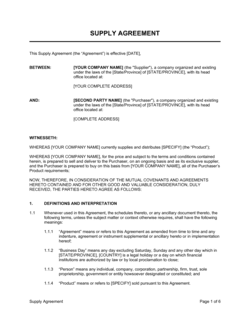
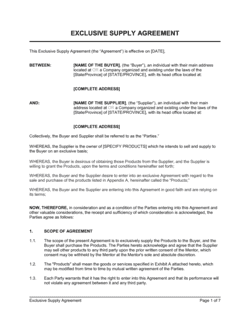
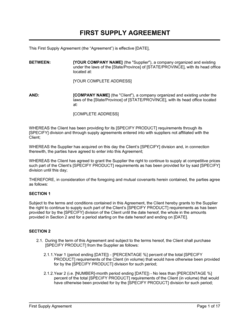
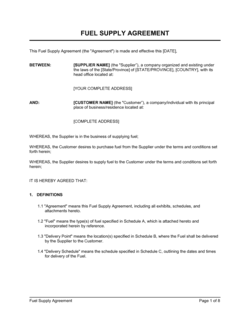
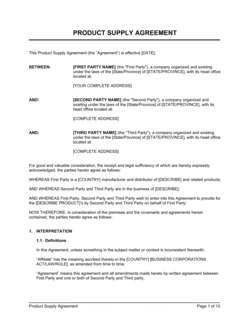
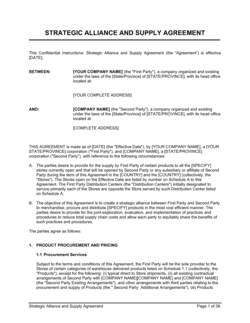
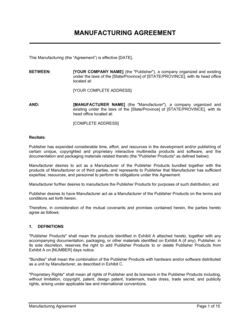
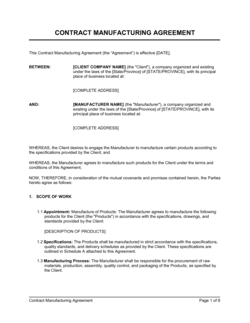
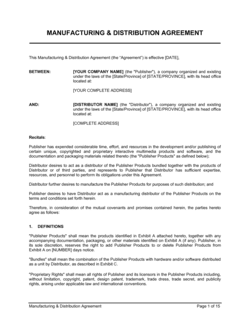
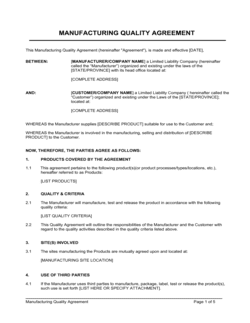
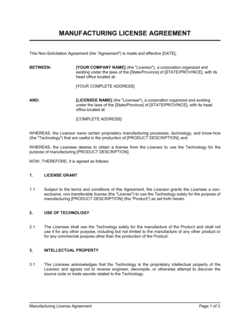
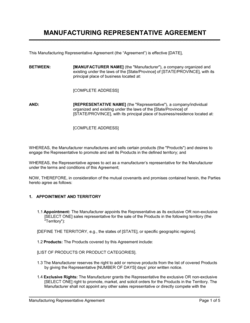
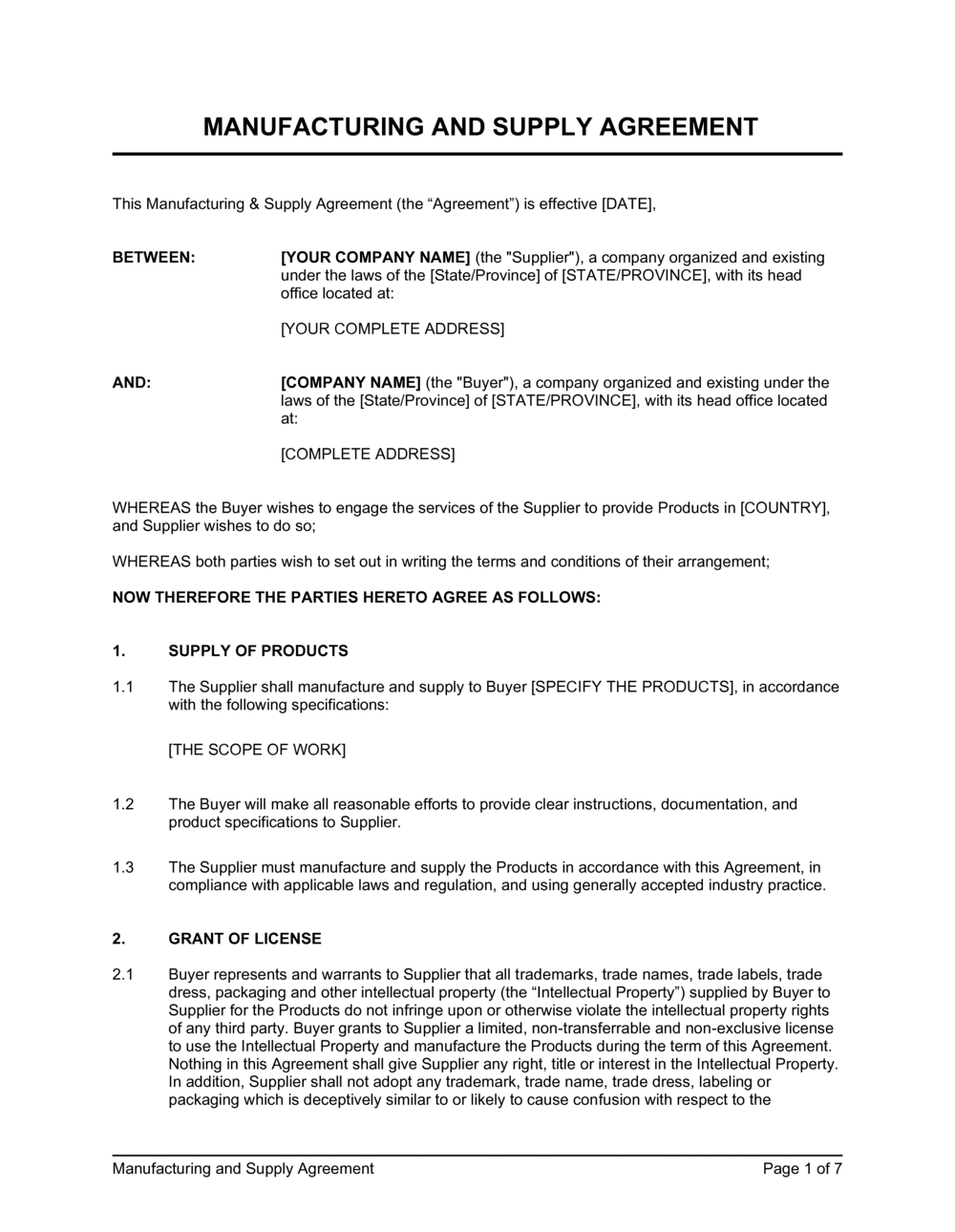
Manufacturing and Supply Agreement Template

Free Word download β€’ Edit online β€’ Save & share with Drive β€’ Export to PDF

7 pagesβ€’30–40 min to fillβ€’Difficulty: Complexβ€’Signature requiredβ€’Legal review recommended
Learn more ↓
FreeManufacturing and Supply Agreement Template

At a glance

What it is
A Manufacturing and Supply Agreement is a legally binding contract between a buyer (the company ordering goods) and a manufacturer or supplier (the party producing or fulfilling them) that defines every material term of the production and delivery relationship. This free Word download covers product specifications, pricing, minimum order quantities, delivery schedules, quality standards, IP ownership, confidentiality, and termination in a single structured document you can edit online and export as PDF.
When you need it
Use it before placing the first production order with any contract manufacturer, OEM, or third-party supplier β€” especially when the relationship involves custom-built products, branded goods, or proprietary specifications. It is equally critical when switching suppliers, scaling production volume, or entering a multi-year supply arrangement.
What's inside
Product specifications and approved materials, pricing and payment terms, minimum order quantities and forecasting obligations, delivery schedules and lead times, quality assurance and inspection rights, intellectual property assignment and licensing, confidentiality obligations, representations and warranties, indemnification, limitation of liability, and termination and transition assistance.

What is a Manufacturing and Supply Agreement?

A Manufacturing and Supply Agreement is a legally binding contract between a buyer and a contract manufacturer or supplier that governs every material term of an ongoing production and delivery relationship. It defines the product specifications the manufacturer must follow, the pricing and payment terms, the minimum order quantities and delivery schedules, the quality standards and inspection rights, ownership of intellectual property and tooling, and the conditions under which either party may terminate the relationship. Unlike a simple purchase order, this agreement creates a durable framework that applies across all orders placed during the contract term β€” giving both parties enforceable rights and predictable obligations throughout the supply relationship.

Why You Need This Document

Operating without a formal manufacturing and supply agreement is one of the most common and costly mistakes product-based businesses make. Without one, a manufacturer can raise prices without notice, deliver non-conforming goods with no contractual remedy beyond a dispute over the purchase price, and walk away with your proprietary formula, mold designs, or production tooling when the relationship ends. Buyers who have funded custom tooling but failed to document ownership have found themselves effectively locked into a single supplier β€” unable to move production without abandoning their capital investment. A signed agreement also establishes the quality acceptance process that protects you from taking on defective inventory and the transition obligations that allow you to switch suppliers without a months-long production gap. This template gives you a professionally structured starting point that addresses all of these risks in a single document, saving the time and cost of building one from scratch while leaving room to customize terms to your specific supply relationship.

Which variant fits your situation?

If your situation is…Use this template
Buying standard catalogue products from a distributorPurchase Agreement
Sourcing goods from an overseas manufacturer with customs requirementsInternational Supply Agreement
Engaging a toll manufacturer that uses buyer-supplied raw materialsToll Manufacturing Agreement
Licensing a manufacturer to produce goods under your brand nameOEM Manufacturing Agreement
Hiring a co-packer for food, beverage, or personal care productsCo-Packing Agreement
Securing components from a sole-source supplier critical to productionSole Supplier Agreement
Purchasing raw materials or commodities under recurring termsSupply of Goods Agreement

Common mistakes to avoid

❌ Treating forecasts as binding purchase commitments

Why it matters: If a rolling forecast is written without an explicit non-binding carve-out, courts may treat it as a take-or-pay obligation β€” leaving the buyer liable for shortfall payments on volumes never ordered.

Fix: Label all forecast provisions explicitly as 'non-binding good-faith estimates' and state that only issued Purchase Orders create a binding purchase obligation.

❌ Omitting a price adjustment cap

Why it matters: Without a cap or indexed formula, a manufacturer can demand price increases of any amount at any time, forcing costly renegotiation or supply disruption when input costs rise.

Fix: Add a clause capping annual price increases at the prior year's change in a relevant commodity or producer price index, with a minimum notice period of 90 days.

❌ No post-termination tooling return mechanism

Why it matters: A manufacturer holding buyer-owned tooling after contract termination can effectively hold production hostage β€” delaying the buyer's ability to qualify a replacement supplier for months.

Fix: Include a clause requiring return or transfer of all buyer-owned tooling and materials within 30 days of termination, and specify that the manufacturer's lien (if any) on tooling is waived upon payment of outstanding invoices.

❌ Confidentiality that expires at contract end

Why it matters: Proprietary formulas, specifications, and production processes have commercial value long after a supply relationship ends. A clause that expires with the contract leaves them unprotected.

Fix: Extend the confidentiality obligation for at least 3–5 years post-termination, and identify trade secrets as surviving indefinitely where the applicable law permits.

❌ Silent on IP improvements made during production

Why it matters: Manufacturers routinely optimize processes and formulations. Without an express assignment of improvements, the manufacturer may own β€” and commercialize β€” enhancements to the buyer's own IP.

Fix: Add a clause assigning all improvements, modifications, and derivative works relating to Buyer IP to the buyer automatically upon creation, without additional consideration.

❌ No inspection window or deemed-acceptance clause

Why it matters: Without a stated deadline for raising defect claims, buyers can assert quality issues months after delivery β€” making it nearly impossible for the manufacturer to investigate the root cause or defend against inflated claims.

Fix: State a specific acceptance period (e.g., 15 business days from delivery) after which goods are deemed accepted, while preserving latent defect claims for the warranty period.

The 10 key clauses, explained

Parties, recitals, and definitions

In plain language: Identifies the buyer and manufacturer as legal entities, summarizes the commercial purpose of the relationship, and defines key terms used throughout the agreement.

Sample language
This Manufacturing and Supply Agreement ('Agreement') is entered into as of [DATE] between [BUYER LEGAL NAME], a [STATE/COUNTRY] [ENTITY TYPE] ('Buyer'), and [MANUFACTURER LEGAL NAME], a [STATE/COUNTRY] [ENTITY TYPE] ('Manufacturer'). Capitalized terms have the meanings set out in Schedule 1.

Common mistake: Using trade names instead of registered legal entity names. If the contracting entity doesn't match the signing entity, enforcing IP assignment or indemnification obligations against the correct party becomes legally complicated.

Product specifications and approved materials

In plain language: Incorporates detailed specifications by reference to a Schedule, sets out the approved raw material list, and establishes how changes to specs are formally authorized.

Sample language
Manufacturer shall produce the Products strictly in accordance with the Specifications set out in Schedule A. No substitution of materials or deviation from Specifications is permitted without prior written approval from Buyer's authorized representative.

Common mistake: Embedding specifications in the body of the agreement instead of a Schedule. Specifications change frequently β€” embedding them requires formal contract amendments for every update.

Orders, forecasts, and minimum order quantities

In plain language: Governs how the buyer places purchase orders, any rolling forecast obligations, and the minimum quantities the manufacturer will accept per order or per contract year.

Sample language
Buyer shall issue Purchase Orders in writing at least [X] business days before the required delivery date. Buyer shall provide a non-binding [X]-month rolling forecast updated monthly. Minimum Order Quantity per PO is [QUANTITY] units.

Common mistake: Making forecasts legally binding without an explicit carve-out. If a forecast is binding, a buyer who orders less may owe a shortfall payment β€” often an unintended result.

Pricing, invoicing, and payment terms

In plain language: Sets the unit price or pricing formula, when and how the manufacturer may adjust pricing, invoicing timing, and payment due dates.

Sample language
The unit price for each Product is as set out in Schedule B. Manufacturer may not increase pricing by more than [X]% in any calendar year without [90] days' prior written notice. Invoices are due net [30] days from delivery of conforming goods.

Common mistake: No price adjustment cap or mechanism. Manufacturers facing raw material inflation will seek price increases β€” without a cap or a formula (e.g., tied to a PPI index), the buyer has no contractual protection.

Delivery, title, and risk of loss

In plain language: Specifies delivery terms (Incoterms or equivalent), the point at which title and risk pass from manufacturer to buyer, and the consequences of late delivery.

Sample language
Delivery shall be [FCA / EXW / DAP] [LOCATION] (Incoterms 2020). Title and risk of loss pass to Buyer upon [delivery to carrier / arrival at Buyer's facility]. Late delivery of more than [X] business days entitles Buyer to a [X]% discount on the affected PO.

Common mistake: Omitting an Incoterm or using an ambiguous delivery description like 'delivered to buyer.' Without a defined Incoterm, disputes over who bears the cost and risk of damage in transit are difficult to resolve.

Quality assurance, inspection, and rejection

In plain language: Requires the manufacturer to maintain a documented QA plan, grants the buyer the right to inspect facilities and finished goods, and defines the process for rejecting non-conforming batches.

Sample language
Manufacturer shall maintain a QA plan meeting [ISO 9001 / Buyer's QA Requirements attached as Schedule C]. Buyer may inspect the Manufacturer's facilities on [X] business days' notice. Buyer has [X] business days after delivery to reject non-conforming goods; silence constitutes acceptance.

Common mistake: No inspection timeline or deemed-acceptance clause. Without a defined acceptance window, buyers may claim defects months after delivery, leaving the manufacturer with no practical ability to investigate or remedy.

Intellectual property ownership and licensing

In plain language: Allocates ownership of buyer-provided IP, any IP created during the relationship, tooling, and improvements β€” and grants the manufacturer a limited license to use buyer IP solely for production purposes.

Sample language
All Buyer IP, including Specifications, trademarks, and tooling funded by Buyer, remains the sole property of Buyer. Manufacturer is granted a limited, non-exclusive license to use Buyer IP solely to manufacture Products for Buyer under this Agreement. Any improvements to Buyer IP are hereby assigned to Buyer.

Common mistake: No assignment of improvements. If the manufacturer optimizes a buyer-owned formula or process and the contract is silent, the manufacturer may own the improvement β€” including the right to use it for other clients.

Confidentiality and non-use

In plain language: Prohibits the manufacturer from disclosing or using the buyer's confidential information β€” formulas, specifications, customer data, and pricing β€” beyond what is necessary to fulfill production orders.

Sample language
Manufacturer shall hold all Confidential Information of Buyer in strict confidence and shall not disclose it to any third party or use it for any purpose other than manufacturing Products for Buyer under this Agreement. This obligation survives termination for [5] years.

Common mistake: A confidentiality clause that expires at contract termination. Manufacturing secrets and product formulas need post-termination protection β€” a 3–5 year survival period is standard minimum.

Representations, warranties, and indemnification

In plain language: The manufacturer warrants that goods will conform to specifications, be free from defects, and comply with applicable laws. Each party indemnifies the other for losses arising from its own breach, negligence, or IP infringement.

Sample language
Manufacturer warrants that all Products will (a) conform to the Specifications, (b) be free from defects in materials and workmanship for [X] months from delivery, and (c) comply with all applicable laws. Each party shall indemnify the other for losses arising from its own breach of this Agreement or negligence.

Common mistake: Buyer-only indemnification with no reciprocal obligation. Courts in most jurisdictions will enforce one-sided indemnification clauses as written β€” so a manufacturer that accepts sole indemnification exposure faces uncapped liability for the buyer's own product liability claims.

Termination, transition assistance, and tooling return

In plain language: States the notice period for termination without cause, grounds for immediate termination for cause, the manufacturer's obligation to assist with transition to a new supplier, and the process for returning buyer-owned tooling and materials.

Sample language
Either party may terminate for convenience on [90] days' written notice. Buyer may terminate immediately for cause upon Manufacturer's material breach, insolvency, or failure to meet quality standards for [X] consecutive POs. Upon termination, Manufacturer shall return all Buyer-owned tooling, materials, and IP within [30] days.

Common mistake: No transition assistance clause. A manufacturer that loses the contract has little incentive to train a replacement supplier or transfer tooling promptly β€” without contractual obligations, buyers frequently face 3–6 month production gaps when switching.

How to fill it out

  1. 1

    Identify both parties with their registered legal names

    Enter the full legal name and jurisdiction of incorporation for both the buyer and the manufacturer. Confirm the signing individual has authority to bind the entity β€” a director or authorized officer.

    πŸ’‘ Request a certificate of incorporation or equivalent from a new manufacturer before signing β€” verifying the entity is in good standing protects you from contracting with a shell or dissolved company.

  2. 2

    Attach product specifications as Schedule A

    Reference the specifications in the body of the agreement but place all technical detail β€” drawings, formulas, material lists, tolerances, labeling requirements β€” in Schedule A. Include a version number and date on the Schedule.

    πŸ’‘ Using a versioned Schedule rather than embedding specs in the agreement body means you can update specifications with a countersigned Schedule amendment instead of a full contract amendment.

  3. 3

    Define ordering mechanics, MOQs, and forecasting obligations

    State the minimum order quantity per purchase order, lead time from PO to delivery, and whether rolling forecasts are binding or non-binding. Specify the PO form to be used and any required electronic ordering system.

    πŸ’‘ Mark forecasts explicitly as 'non-binding estimates only' unless you intend to be contractually committed to purchase forecast quantities β€” binding forecasts function as take-or-pay obligations.

  4. 4

    Set pricing, adjustment limits, and payment terms

    Enter the unit price for each product in Schedule B. Add a price adjustment clause capping annual increases (e.g., no more than the prior year's PPI increase) and state payment terms precisely β€” net 30 from invoice date, not 'net 30 from delivery.'

    πŸ’‘ Tie any price adjustment mechanism to a published index (US Producer Price Index, Statistics Canada's Raw Materials Price Index) so increases are verifiable and not subject to negotiation each cycle.

  5. 5

    Specify delivery terms using Incoterms 2020

    Choose the appropriate Incoterm for your supply chain β€” EXW if you arrange freight, DAP if the manufacturer delivers to your door β€” and name the specific delivery location. State the late delivery remedy (discount, right to cancel the PO, or cover purchase rights).

    πŸ’‘ For international supply relationships, DAP (Delivered At Place) places export and import customs obligations on the most experienced party β€” typically the manufacturer for export and the buyer for import.

  6. 6

    Define QA requirements and inspection rights

    Either attach your QA requirements as a Schedule or reference a recognized standard (ISO 9001). State the buyer's right to audit facilities with reasonable notice and define the acceptance window β€” the number of business days after delivery within which the buyer must raise a rejection.

    πŸ’‘ A 10–15 business day acceptance window is standard for most manufactured goods; food, pharma, and electronics often require shorter windows due to shelf life or regulatory testing lead times.

  7. 7

    Confirm IP ownership and tooling title

    Identify all buyer-owned IP (specifications, formulas, trademarks, tooling) and confirm assignment of any improvements back to the buyer. State which party funds tooling and confirm buyer's title to all tooling held at the manufacturer's facility.

    πŸ’‘ Include a specific list of tooling (mold numbers, die IDs, fixture names) in the IP Schedule so there is no dispute about which assets belong to the buyer upon termination.

  8. 8

    Finalize termination, notice periods, and transition obligations

    Set a notice period proportionate to the complexity of the supply relationship β€” 60 days for simple commodity goods, 90–180 days for custom-tooled products. Add a transition assistance clause requiring the manufacturer to support knowledge transfer for a defined period post-termination.

    πŸ’‘ Tie transition assistance to a daily rate rather than asking for it 'at no cost' β€” manufacturers will comply more reliably when there is a financial incentive.

Frequently asked questions

What is a manufacturing and supply agreement?

A manufacturing and supply agreement is a legally binding contract between a buyer and a manufacturer or supplier that governs the production and delivery of goods. It covers product specifications, pricing, minimum order quantities, delivery terms, quality standards, intellectual property ownership, confidentiality, and termination. It replaces informal purchase order arrangements with enforceable obligations on both sides and is essential whenever the relationship involves custom products, branded goods, or proprietary specifications.

What is the difference between a manufacturing agreement and a supply agreement?

A manufacturing agreement focuses on the production process β€” specifications, tooling, QA obligations, and IP created during manufacturing. A supply agreement focuses on the commercial terms of delivering goods β€” pricing, volume commitments, delivery schedules, and payment. In practice, most B2B relationships involving custom-built products require both sets of terms, which is why the two are typically combined into a single manufacturing and supply agreement.

Is a manufacturing and supply agreement legally required?

No jurisdiction legally requires a written manufacturing and supply agreement for every supplier relationship. However, operating without one leaves the buyer with no enforceable quality standards, no IP protection, no pricing stability, and no transition rights if the relationship breaks down. Courts typically apply general contract and sale-of-goods law to fill the gaps β€” often producing outcomes that favor neither party.

Who owns the tooling and molds in a manufacturing agreement?

Ownership depends on who paid for the tooling and what the contract says. When the buyer funds tooling β€” molds, dies, jigs β€” the agreement should expressly confirm buyer title and require the manufacturer to hold the tooling on the buyer's behalf. Without written confirmation of title, a manufacturer facing financial distress may claim tooling as a business asset or use it as leverage in a payment dispute.

What Incoterms should I use in a manufacturing and supply agreement?

The right Incoterm depends on your logistics model. EXW (Ex Works) places all freight and customs responsibility on the buyer from the factory door β€” suitable when the buyer has a freight forwarder and wants full control. FCA (Free Carrier) is cleaner for container shipments where the buyer arranges main carriage. DAP (Delivered At Place) works when the manufacturer arranges delivery to the buyer's facility. Always specify the Incoterms 2020 edition and the exact named location.

How do I protect my product formula or design in a manufacturing agreement?

Protection comes from three overlapping provisions: a confidentiality clause with post-termination survival, an IP assignment clause confirming that specifications and any improvements belong to the buyer, and a restricted-use clause limiting the manufacturer to producing the product solely for the buyer under the agreement. For formulas that qualify as trade secrets, mark them as such in Schedule A and require the manufacturer to implement reasonable security measures.

What happens if the manufacturer delivers defective goods?

A properly drafted agreement gives the buyer the right to reject non-conforming goods within an acceptance window, require the manufacturer to replace or rework them at no cost, and claim damages for costs incurred as a result of the defect β€” including rework, recall costs, and third-party claims. Persistent quality failures should trigger a termination-for-cause right. Without these provisions, the buyer's remedy defaults to the applicable sale-of-goods statute, which typically covers only the purchase price.

Can I add an exclusivity clause to a manufacturing and supply agreement?

Yes. Exclusivity can run in either direction: the manufacturer agrees not to produce the same product for competitors, or the buyer agrees to source exclusively from this manufacturer. Exclusivity provisions must be carefully scoped β€” overbroad restrictions raise competition law concerns in the EU and UK. Consider limiting exclusivity to a specific product category, geography, or volume threshold rather than an absolute restriction.

Do I need a lawyer to draft a manufacturing and supply agreement?

For straightforward domestic supply relationships with a reputable manufacturer, a well-structured template reviewed by an experienced contracts attorney is typically sufficient. Engage a lawyer directly when the relationship involves significant custom tooling investment (over $50K), cross-border manufacturing with IP or trade secret exposure, regulated industries such as food, pharma, or medical devices, or annual purchase volumes exceeding $500K. A 2–4 hour template review typically costs $600–$1,500 and is worthwhile for any material supply relationship.

How this compares to alternatives

vs Purchase Agreement

A purchase agreement covers a single or spot-buy transaction β€” it records what was bought, for how much, and on what delivery terms. A manufacturing and supply agreement governs an ongoing production relationship across multiple orders, adding quality obligations, IP protection, pricing mechanisms, tooling ownership, and termination rights that a single-transaction purchase agreement does not address.

vs Independent Contractor Agreement

An independent contractor agreement covers a service-based relationship where a person or firm performs work for hire. A manufacturing and supply agreement governs the production and sale of physical goods β€” the manufacturer retains control of the production process and delivers a finished product, not a service. The two documents have different IP, liability, and tax classification implications.

vs Non-Disclosure Agreement

An NDA protects confidential information shared during pre-contract discussions or evaluation. A manufacturing and supply agreement includes confidentiality provisions as one clause within a comprehensive commercial contract. An NDA alone is insufficient for an active manufacturing relationship because it does not cover specifications, pricing, delivery, quality, IP ownership, or termination.

vs Distribution Agreement

A distribution agreement governs the resale of finished goods by a third party to end customers. A manufacturing and supply agreement governs the production of those goods upstream. Companies with both a manufacturer and a distributor typically need both documents β€” they operate at different points in the supply chain and create different legal relationships.

Industry-specific considerations

Consumer Goods and Retail

Branded packaging specifications, private-label IP protection, seasonal order forecasting, and retailer compliance documentation requirements.

Food and Beverage

Proprietary recipe and formula protection, FDA or CFIA co-packer compliance requirements, allergen management protocols, and short shelf-life delivery windows.

Electronics and Technology Hardware

Component-level specifications, PCB tolerances, RoHS and REACH compliance, firmware IP ownership, and factory acceptance testing protocols.

Medical Devices and Life Sciences

FDA 21 CFR Part 820 or ISO 13485 QMS requirements, device history records, lot traceability, and regulatory submission data ownership.

Automotive and Aerospace

IATF 16949 or AS9100 quality standards, first-article inspection requirements, engineering change order processes, and tooling liability for production downtime.

Apparel and Textiles

Approved vendor lists for fabrics and trims, country-of-origin documentation for customs and labeling compliance, and seasonal style development confidentiality.

Jurisdictional notes

United States

The UCC Article 2 governs the sale of goods in all US states and fills contract gaps where the agreement is silent β€” including implied warranties of merchantability and fitness for a particular purpose, which parties typically disclaim expressly. California, Texas, and New York each have meaningful case law variations on non-compete enforceability for supply relationships. State lien laws govern a manufacturer's right to hold finished goods pending payment.

Canada

Each province has its own Sale of Goods Act modeled on the UK 1979 Act; Ontario and BC are most commonly chosen as governing law for domestic supply agreements. Quebec civil law applies different implied warranty and acceptance rules. The Competition Act governs exclusivity and resale price maintenance provisions. Export controls under the Export and Import Permits Act apply to goods with dual-use potential.

United Kingdom

The Sale of Goods Act 1979 and the Supply of Goods and Services Act 1982 imply terms of satisfactory quality and fitness for purpose that cannot be excluded in consumer contracts and are difficult to exclude in B2B agreements unless the exclusion is 'reasonable' under UCTA 1977. Post-Brexit, CE marking has been replaced by UKCA marking for goods placed on the UK market. Retention of title clauses are commonly used and enforceable under English law.

European Union

The EU Sale of Goods Directive (2019/771) and Vertical Block Exemption Regulation (VBER 2022) constrain exclusivity and non-compete provisions β€” restrictions that go beyond 5 years or cover more than 30% market share require individual assessment. GDPR applies if customer or employee data is shared with the manufacturer. CE marking obligations, product liability under the Product Liability Directive, and country-of-origin labeling rules must be addressed in the specifications schedule.

Template vs lawyer β€” what fits your deal?

PathBest forCostTime
Use the templateDomestic supply relationships with reputable manufacturers, annual volumes under $250K, and standard off-the-shelf or lightly customized productsFree1–2 hours to customize
Template + legal reviewCustom-tooled products, cross-border supply, regulated categories (food, supplements, electronics), or annual volumes between $250K and $1M$600–$1,500 for a 2–4 hour attorney review3–5 business days
Custom draftedComplex OEM relationships, medical device or pharmaceutical manufacturing, multi-jurisdiction supply chains, or annual volumes exceeding $1M$3,000–$10,000+2–6 weeks

Glossary

Contract Manufacturer
A third-party company that produces finished goods or components to a buyer's specifications under a service arrangement β€” not as a joint venture or equity partner.
Minimum Order Quantity (MOQ)
The smallest batch size the manufacturer will accept per purchase order, typically driven by setup costs, material procurement, or production run economics.
Product Specifications
Detailed written documentation β€” drawings, formulas, materials lists, tolerances β€” that define exactly what the manufacturer must produce and to what standard.
Quality Assurance (QA) Plan
A documented set of inspection procedures, defect thresholds, testing protocols, and corrective action timelines the manufacturer must follow before shipment.
Acceptance Criteria
The measurable standards a delivered batch must meet for the buyer to be obligated to accept and pay β€” typically referencing defect rate thresholds and specification tolerances.
Lead Time
The elapsed time between the buyer issuing a purchase order and the manufacturer delivering compliant goods to the agreed delivery point.
Exclusivity
A contractual restriction preventing the manufacturer from producing the same or substantially similar product for a competing buyer, or preventing the buyer from sourcing from other manufacturers.
IP Assignment
A clause transferring ownership of any tooling, molds, formulas, or improvements developed during the manufacturing relationship to the buyer.
Indemnification
An obligation by one party to cover the other's losses, legal costs, or liabilities arising from a defined category of breach, negligence, or third-party claim.
Force Majeure
A clause excusing a party from performance obligations when a qualifying event outside its reasonable control β€” natural disaster, war, or government action β€” prevents or delays production or delivery.
Tooling
Molds, dies, jigs, fixtures, or other specialized equipment fabricated specifically to produce the buyer's product, typically funded by the buyer and held at the manufacturer's facility.
Purchase Order (PO)
A formal written order issued by the buyer under the agreement specifying product, quantity, price, and delivery date for a specific production run.

Part of your Business Operating System

This document is one of 3,000+ business & legal templates included in Business in a Box.

  • Fill-in-the-blanks β€” ready in minutes
  • 100% customizable Word document
  • Compatible with all office suites
  • Export to PDF and share electronically

Create your document in 3 simple steps.

From template to signed document β€” all inside one Business Operating System.
1
Download or open template

Access over 3,000+ business and legal templates for any business task, project or initiative.

2
Edit and fill in the blanks with AI

Customize your ready-made business document template and save it in the cloud.

3
Save, Share, Send, Sign

Share your files and folders with your team. Create a space of seamless collaboration.

Save time, save money, and create top-quality documents.

β˜…β˜…β˜…β˜…β˜…

"Fantastic value! I'm not sure how I'd do without it. It's worth its weight in gold and paid back for itself many times."

Managing Director Β· Mall Farm
Robert Whalley
Managing Director, Mall Farm Proprietary Limited
β˜…β˜…β˜…β˜…β˜…

"I have been using Business in a Box for years. It has been the most useful source of templates I have encountered. I recommend it to anyone."

Business Owner Β· 4+ years
Dr Michael John Freestone
Business Owner
β˜…β˜…β˜…β˜…β˜…

"It has been a life saver so many times I have lost count. Business in a Box has saved me so much time and as you know, time is money."

Owner Β· Upstate Web
David G. Moore Jr.
Owner, Upstate Web

Run your business with a system β€” not scattered tools

Stop downloading documents. Start operating with clarity. Business in a Box gives you the Business Operating System used by over 250,000 companies worldwide to structure, run, and grow their business.

Start freeΒ Β·Β No credit card required