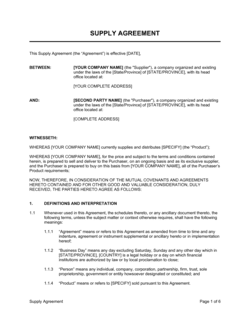
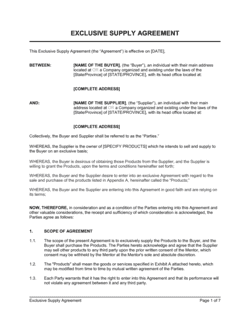
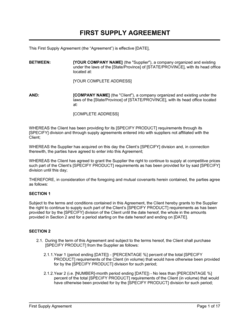
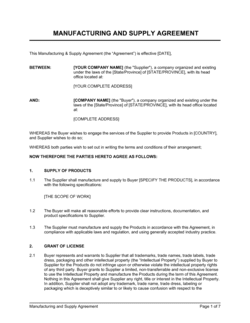
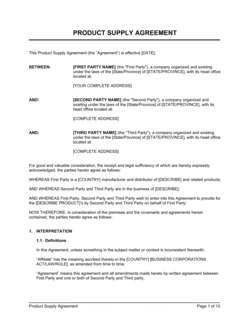
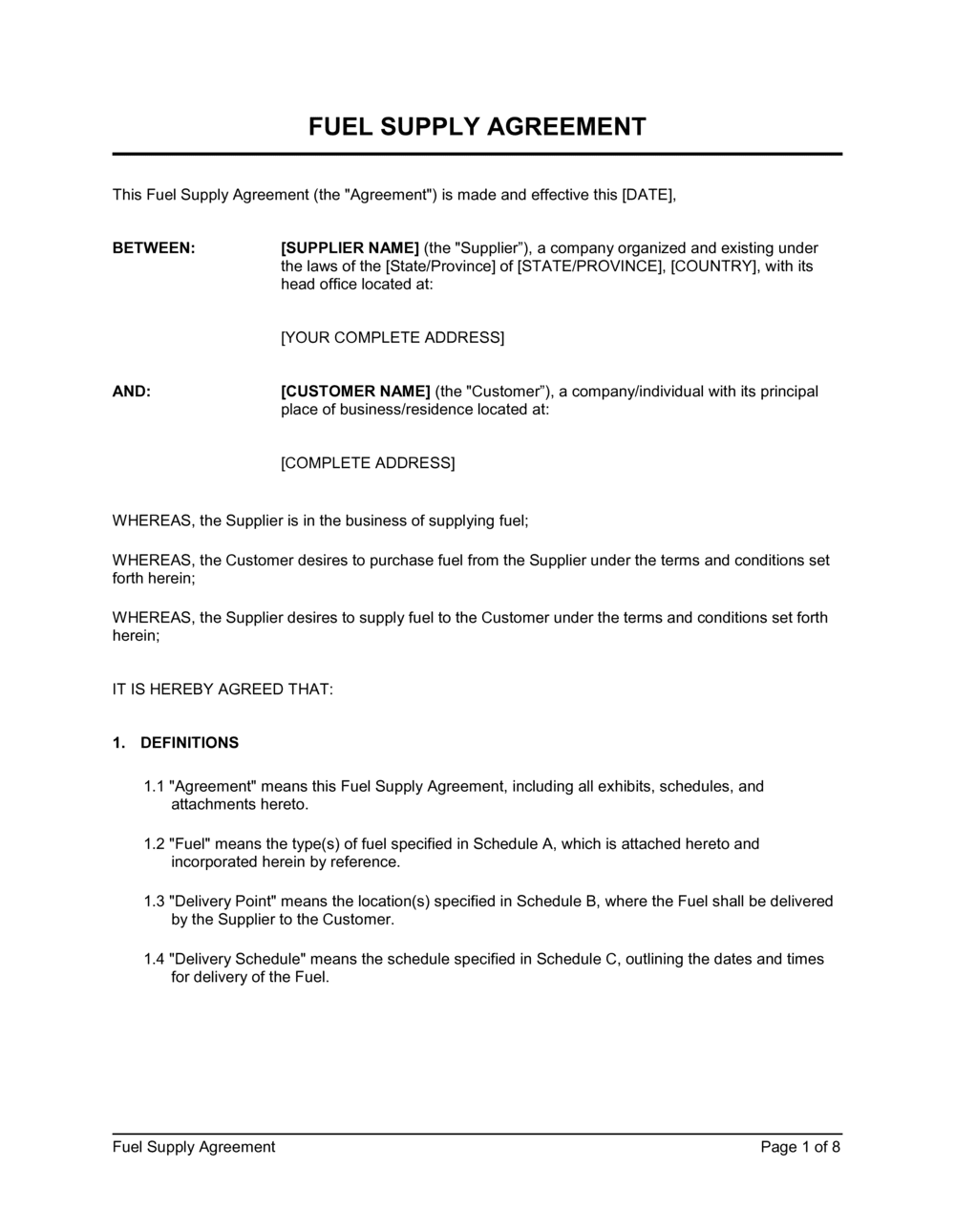
Fuel Supply Agreement Template

Free Word download β€’ Edit online β€’ Save & share with Drive β€’ Export to PDF

8 pagesβ€’25–35 min to fillβ€’Difficulty: Complexβ€’Signature requiredβ€’Legal review recommended
Learn more ↓
FreeFuel Supply Agreement Template

At a glance

What it is
A Fuel Supply Agreement is a legally binding contract between a fuel supplier and a buyer β€” such as a fleet operator, generator owner, or vessel operator β€” governing the regular delivery of fuel over a defined term. This free Word download covers committed volumes, index-linked pricing, delivery schedules, quality specifications, force majeure, and termination rights in a single structured document you can edit online and export as PDF for execution.
When you need it
Use it whenever you are committing to recurring fuel purchases from a single supplier, negotiating volume discounts, or need to lock in delivery obligations and price-adjustment mechanisms for a defined period. It is equally necessary for suppliers who need to enforce minimum purchase commitments and protect against non-payment.
What's inside
Contract term and renewal options, committed volumes and tolerance bands, pricing formula tied to a market index, delivery schedule and logistics obligations, fuel quality specifications and testing rights, payment terms, force majeure, liability caps, termination for cause or convenience, and governing law.

What is a Fuel Supply Agreement?

A Fuel Supply Agreement is a legally binding contract between a fuel supplier and a buyer β€” typically a fleet operator, marine or vessel operator, generator owner, or industrial facility β€” that governs the regular delivery of petroleum products over a defined term. It moves the relationship beyond informal spot purchases by establishing committed volumes, an index-linked pricing formula, a delivery schedule with enforceable lead times, fuel quality specifications, and the rights and remedies of both parties if delivery fails or payment is not made. Unlike a one-off purchase order, a fuel supply agreement creates ongoing obligations on both sides: the supplier must deliver to spec and on schedule; the buyer must lift a minimum volume or pay a take-or-pay charge.

Why You Need This Document

Operating without a written fuel supply agreement exposes both parties to significant financial and operational risk. A buyer who relies on informal arrangements or verbal pricing has no contractual recourse when the supplier raises prices unilaterally, delivers off-spec fuel that damages equipment, or simply fails to show up during a supply crunch. A supplier without a signed commitment has no enforceable take-or-pay protection if the buyer switches to a competitor mid-contract after the supplier has pre-purchased inventory and committed logistics capacity. Off-spec fuel delivered under an undocumented arrangement is notoriously difficult to claim against β€” without a signed quality specification and sampling protocol, the dispute becomes a credibility contest rather than a contract question. A properly executed fuel supply agreement closes all of these gaps: it locks in the pricing mechanism, defines quality obligations with a binding test procedure, sets delivery windows with financial consequences for breach, and gives both parties a clear exit path if performance breaks down.

Which variant fits your situation?

If your situation is…Use this template
Regular diesel or petrol supply to a commercial fleetFuel Supply Agreement
One-off or spot purchase of fuel without recurring obligationsFuel Purchase Order
Marine bunker fuel supply to vessels at portBunker Fuel Supply Agreement
Supplier storing fuel on-site at the buyer's premisesConsignment and Storage Agreement
Biofuel or renewable energy feedstock supplyCommodity Supply Agreement
Long-term natural gas or LNG supply arrangementGas Supply Agreement
Government or municipal fuel procurement tenderGovernment Procurement Supply Contract

Common mistakes to avoid

❌ No take-or-pay consequence for shortfall volumes

Why it matters: Without it, the buyer can consistently order below the committed volume with no financial consequence, leaving the supplier unable to recover logistics and inventory costs it planned around.

Fix: Include an explicit take-or-pay formula: shortfall volume multiplied by the contract price, payable within 30 days of period end, with a credit mechanism if volumes recover in the next period.

❌ Referencing a pricing index without a fallback mechanism

Why it matters: Major pricing indexes β€” Platts, OPIS β€” occasionally suspend or restructure specific assessments. A contract with no fallback becomes unenforceable on pricing the moment the referenced index changes.

Fix: Add a clause requiring the parties to agree a replacement index within 15 Business Days of a discontinuation notice, and specifying that the last published price plus CPI applies in the interim.

❌ Omitting the risk-of-loss transfer point in the delivery clause

Why it matters: If fuel is contaminated or lost in transit and the contract does not specify where title and risk pass, both parties face simultaneous claims and counterclaims that are expensive to resolve.

Fix: State explicitly that risk and title pass to the buyer upon completion of discharge at the nominated delivery point, and that the supplier bears risk during transit.

❌ Drafting force majeure to include foreseeable supply disruptions

Why it matters: Listing events like 'refinery maintenance', 'transportation strikes', or 'port congestion' as force majeure gives the supplier a routine excuse to suspend deliveries without liability, destroying the contract's supply-security value.

Fix: Limit force majeure to genuinely unforeseeable events β€” natural disasters, war, government embargoes β€” and require the supplier to maintain contingency supply arrangements for all other disruptions.

The 10 key clauses, explained

Parties, term, and commencement

In plain language: Identifies the supplier and buyer as legal entities, sets the contract start date, initial term length, and any automatic renewal or extension mechanism.

Sample language
This Fuel Supply Agreement is entered into on [DATE] between [SUPPLIER LEGAL NAME], a [STATE/COUNTRY] [ENTITY TYPE] ('Supplier'), and [BUYER LEGAL NAME], a [STATE/COUNTRY] [ENTITY TYPE] ('Buyer'). The Agreement commences on [START DATE] and continues for an initial term of [X] months, automatically renewing for successive [X]-month periods unless either party provides [X days'] written notice of non-renewal.

Common mistake: Using a supplier's trade name rather than its registered legal entity name. If the contracting entity is wound up or reorganised, enforcing delivery obligations or seeking damages against the correct successor becomes difficult.

Committed volumes and tolerance band

In plain language: States the minimum volume the buyer agrees to purchase per delivery period, the tolerance band around that figure, and the take-or-pay consequence if the buyer falls below the minimum.

Sample language
Buyer shall purchase a minimum of [X,000] litres of [FUEL TYPE] per [MONTH / QUARTER] ('Committed Volume'), with a tolerance of plus or minus [10]%. If Buyer's actual purchases in any period fall below [90]% of the Committed Volume, Buyer shall pay Supplier the shortfall quantity at the contract price as a take-or-pay charge within [30] days of period end.

Common mistake: Setting committed volumes without a tolerance band. Actual consumption fluctuates with season, operations, and weather β€” a zero-tolerance commitment exposes the buyer to take-or-pay charges even for minor shortfalls outside its control.

Pricing formula and price adjustment

In plain language: Defines how the price per litre is calculated at each delivery, referencing a named market index plus an agreed fixed margin, and sets the frequency and mechanism for price adjustments.

Sample language
The price per litre shall be the [PLATTS / OPIS / ICE GASOIL] daily index price for [GRADE] as published on the delivery date, plus a margin of [X] cents per litre. The margin shall remain fixed for the initial [X]-month period and may be renegotiated by either party on [X] days' written notice thereafter.

Common mistake: Referencing a pricing index without specifying the grade, publication, and date of determination. If the index source changes methodology or ceases publication, the pricing clause becomes unworkable.

Delivery obligations and logistics

In plain language: Specifies the delivery locations, delivery method (road tanker, barge, pipeline), the order lead time, the delivery window, and which party bears the cost of delivery logistics.

Sample language
Supplier shall deliver [FUEL TYPE] by road tanker to [DELIVERY ADDRESS / GPS COORDINATES] within [48] hours of receiving a valid purchase order. Delivery shall occur between [06:00–18:00] on Business Days. Delivery costs to the nominated delivery point are included in the margin. Risk and title in the fuel pass to Buyer upon completion of discharge at the delivery point.

Common mistake: Omitting a risk-of-loss transfer point. If fuel is lost or contaminated during transit and the contract does not specify when title and risk pass, both parties may claim the other bears the loss.

Fuel quality specifications and testing

In plain language: Sets the technical specification the fuel must meet at delivery, identifies the governing standard, and establishes the process for sampling, testing, and dispute resolution if quality is rejected.

Sample language
All fuel delivered shall conform to [ASTM D975 / EN 590 / [OTHER STANDARD]] as at the date of delivery. Supplier shall provide a certificate of conformance with each delivery. Buyer may take a sealed sample at delivery; if a dispute arises, the sample shall be submitted to [NAMED LABORATORY] for binding analysis within [10] Business Days of delivery.

Common mistake: Specifying a quality standard without stating the version or date in effect. Standards are revised periodically β€” an outdated specification may permit delivery of fuel that is incompatible with modern engines.

Payment terms and invoicing

In plain language: States when invoices are issued, the payment due date, accepted payment methods, and the consequences of late payment including interest and suspension of deliveries.

Sample language
Supplier shall invoice Buyer within [2] Business Days of each delivery. Payment is due within [30] days of the invoice date by bank transfer to [ACCOUNT DETAILS]. Overdue amounts accrue interest at [X]% per month or the maximum rate permitted by applicable law, whichever is lower. Supplier may suspend deliveries after [X] days of non-payment without liability.

Common mistake: No suspension-of-delivery right on non-payment. Without it, the supplier must continue delivering at its own cost while pursuing a debt claim β€” a significant cash exposure on high-volume contracts.

Force majeure

In plain language: Excuses a party from performance when an event beyond its reasonable control prevents delivery or payment, defines the notice and mitigation obligations, and sets the maximum duration before the contract may be terminated.

Sample language
Neither party shall be liable for delay or failure to perform caused by an event of Force Majeure, provided the affected party gives written notice within [5] Business Days of the event and uses commercially reasonable efforts to mitigate its effects. If a Force Majeure event continues for more than [60] consecutive days, either party may terminate this Agreement on [30] days' written notice without penalty.

Common mistake: Listing force majeure events so broadly that foreseeable supply-chain disruptions β€” such as scheduled refinery maintenance or port congestion β€” are treated as excusing events. Courts tend to interpret force majeure clauses narrowly; specificity protects both parties.

Liability cap and consequential loss exclusion

In plain language: Limits each party's aggregate liability under the contract and excludes recovery of indirect or consequential losses such as lost profits, lost production, or business interruption.

Sample language
Each party's total aggregate liability under this Agreement shall not exceed [the total value of invoices paid in the preceding 12 months / $[AMOUNT]]. Neither party shall be liable for indirect, consequential, or special losses, including but not limited to loss of profit, loss of production, or business interruption, whether arising in contract, tort, or otherwise.

Common mistake: No carve-out from the consequential loss exclusion for wilful misconduct or gross negligence. Courts in many jurisdictions will not enforce a clause that allows a party to escape liability for deliberate harm β€” including the consequential loss waiver β€” if the exclusion is drafted without this carve-out.

Termination for cause and for convenience

In plain language: Defines the events that entitle a party to terminate immediately for cause β€” non-payment, insolvency, material breach β€” and whether either party may terminate without cause on notice.

Sample language
Either party may terminate immediately on written notice if the other party: (a) fails to pay any amount due and does not cure within [15] Business Days of written notice; (b) commits a material breach and does not cure within [30] days of written notice; or (c) becomes insolvent, enters administration, or makes an assignment for the benefit of creditors. Buyer may terminate for convenience on [90] days' written notice, subject to payment of a [X]% early termination fee on the estimated value of the remaining committed volumes.

Common mistake: No early termination fee on convenience termination. Without one, the buyer can exit at any time, leaving the supplier holding pre-purchased inventory and stranded logistics capacity.

Governing law and dispute resolution

In plain language: Specifies which jurisdiction's law governs the contract and sets out the mechanism β€” negotiation, mediation, arbitration, or litigation β€” for resolving disputes.

Sample language
This Agreement is governed by the laws of [STATE / PROVINCE / COUNTRY], without regard to conflict-of-laws principles. Any dispute not resolved by good-faith negotiation within [30] days shall be submitted to binding arbitration under the rules of [AAA / LCIA / ICC] in [CITY], with proceedings conducted in [LANGUAGE]. Judgment on the arbitration award may be entered in any court of competent jurisdiction.

Common mistake: Choosing a governing law that has no connection to where either party is incorporated or where deliveries occur. Courts in several jurisdictions will disregard a chosen governing law that appears purely tactical, applying local law instead.

How to fill it out

  1. 1

    Enter legal entity names and delivery locations

    Use each party's full registered legal name β€” not a trading name β€” and list every delivery address or GPS coordinate where fuel will be received. Confirm each location is authorised to receive the relevant fuel grade.

    πŸ’‘ Request a copy of the supplier's current operating licence and insurance certificate before executing β€” fuel delivery is a regulated activity in most jurisdictions.

  2. 2

    Set the committed volume and tolerance band

    Enter the minimum monthly or quarterly volume based on your actual average consumption over the previous 12 months. Apply a tolerance band of at least 10% in each direction to absorb seasonal and operational variation.

    πŸ’‘ If your operation is new or seasonal, negotiate a lower committed volume for the first two to three periods with a review clause rather than locking in a figure you may not reach.

  3. 3

    Define the pricing formula and index reference

    Name the specific index (e.g., Platts Singapore Gasoil 0.001% or OPIS US No. 2 Diesel), the grade, the publication date used for each delivery, and the fixed margin in cents or pence per litre.

    πŸ’‘ Include a fallback pricing mechanism β€” such as the last published price plus CPI adjustment β€” in case the chosen index ceases publication or changes methodology.

  4. 4

    Specify the delivery schedule and logistics terms

    State the order lead time in Business Days, the delivery window (hours and days), the transfer-of-title point, and which party bears transport costs. Include demurrage rates if delivery vehicles may be held on-site.

    πŸ’‘ If deliveries will occur at multiple locations, attach a Schedule listing each site with its own lead time and access requirements rather than embedding all details in the main body.

  5. 5

    Confirm the fuel quality standard and sampling procedure

    Identify the governing standard by name, edition, and key parameters (sulphur content, cetane minimum, flash point). Describe the sampling procedure β€” who takes the sample, how it is sealed, and which laboratory will conduct binding analysis in a dispute.

    πŸ’‘ Specify that Supplier must provide a certificate of conformance from the refinery or terminal for every delivery β€” this is your first line of defence against an off-spec delivery claim.

  6. 6

    Set payment terms and late-payment consequences

    Enter the invoice-issuance window, the payment due date (Net 30 is standard for commercial fuel), the interest rate on overdue amounts, and the number of days of non-payment that trigger delivery suspension.

    πŸ’‘ Ask your bank whether a standby letter of credit or trade credit insurance is available if the supplier requires security β€” it is often cheaper than a cash deposit.

  7. 7

    Tailor force majeure, liability cap, and termination terms

    List only genuinely unforeseeable events in the force majeure clause. Set the liability cap as a multiple of the last 12 months' invoiced value. Include an early termination fee on convenience termination proportionate to the supplier's sunk logistics costs.

    πŸ’‘ Have a lawyer review the force majeure and liability cap clauses if the contract value exceeds $500K annually β€” these are the two clauses most frequently litigated in commodity supply disputes.

  8. 8

    Execute before the first delivery

    Both parties must sign before the first delivery takes place. Deliveries made before execution may be treated as spot sales under standard commercial terms rather than the negotiated contract terms.

    πŸ’‘ Use a signature block that captures each signatory's name, title, and date separately β€” a single undated signature is regularly challenged in enforcement proceedings.

Frequently asked questions

What is a fuel supply agreement?

A fuel supply agreement is a legally binding contract between a fuel supplier and a buyer that governs the recurring delivery of petroleum products β€” diesel, petrol, marine fuel, or aviation fuel β€” over a defined term. It specifies committed volumes, index-linked pricing, delivery schedules, quality standards, and the rights and obligations of both parties if delivery or payment fails. It replaces ad hoc spot purchases with a structured, enforceable supply arrangement.

Who needs a fuel supply agreement?

Any organisation that purchases fuel regularly and in volume should formalise the arrangement in a written contract. Fleet operators, marine and vessel operators, construction and mining companies, data centre and generator operators, agricultural businesses, and fuel distributors all use fuel supply agreements. The contract protects buyers against supply interruption and protects suppliers against volume shortfalls and non-payment.

What pricing mechanism is typically used in a fuel supply agreement?

Most commercial fuel supply agreements tie the price per litre to a published market index β€” such as Platts, OPIS, or the ICE Gasoil futures price β€” plus a fixed margin negotiated between the parties. This structure allows pricing to move with the commodity market while giving both parties cost certainty on the margin component. Fixed-price arrangements are less common because they require one party to absorb market risk over the full contract term.

What is a take-or-pay clause in a fuel supply agreement?

A take-or-pay clause requires the buyer to pay for a minimum quantity of fuel in each period whether or not that quantity is actually lifted. It compensates the supplier for logistics costs and inventory it has committed to deliver. Buyers should negotiate a tolerance band β€” typically plus or minus 10% of the committed volume β€” before a take-or-pay charge is triggered, and should push for a make-up period in which volumes purchased above the minimum in a later period offset the shortfall charge.

What quality standard should a fuel supply agreement reference?

The appropriate standard depends on the fuel grade and delivery location. ASTM D975 governs diesel fuel in the United States. EN 590 is the standard for automotive diesel in the European Union and United Kingdom. Marine fuels are governed by ISO 8217. Aviation fuels reference DEF STAN 91-091 or ASTM D1655. The agreement should name the standard, specify the key parameters that matter for the buyer's equipment, and require a certificate of conformance with each delivery.

How long should a fuel supply agreement run?

Terms of one to three years are most common for commercial fuel supply contracts. Longer terms give buyers pricing certainty and typically secure better margins from the supplier, but reduce flexibility if consumption patterns change. Shorter terms are better suited to project- based operations or volatile market conditions. Include an automatic renewal provision with a reasonable notice period β€” typically 60 to 90 days β€” to avoid gaps in supply at expiry.

What happens if the supplier fails to deliver fuel on time?

The contract should specify the consequences of a failed or late delivery β€” typically the right to source fuel from an alternative supplier at the non-performing supplier's cost, plus reimbursement of any premium paid. If a force majeure event caused the failure, the supplier is generally excused from liability for the duration of the event but must notify the buyer promptly and use reasonable efforts to mitigate. Habitual late delivery that does not meet the force majeure threshold may constitute a material breach entitling the buyer to terminate.

Is a fuel supply agreement the same as a commodity supply contract?

A fuel supply agreement is a specific type of commodity supply contract tailored to refined petroleum products. General commodity supply contracts cover a broader range of goods and may lack fuel-specific provisions such as quality standards referencing ASTM or EN 590, demurrage terms for tanker or vessel delays, and hazardous-goods handling obligations. For fuel procurement, a purpose-built fuel supply agreement provides more precise protection than a generic commodity contract.

Do I need a lawyer to draft or review a fuel supply agreement?

For straightforward domestic fuel supply with a single location and standard index pricing, a well-structured template is a sound starting point. Engage a lawyer when the annual contract value exceeds $500K, when deliveries cross international borders, when marine bunker or aviation fuel is involved, or when the pricing mechanism involves derivatives or hedging arrangements. A one-to-two-hour review typically costs $400–$800 and is worthwhile for any contract with significant take-or-pay exposure.

How this compares to alternatives

vs Purchase Order for Fuel

A purchase order covers a single, one-off fuel transaction with no volume commitment, index pricing, or ongoing obligations. A fuel supply agreement governs a recurring relationship over months or years, with committed volumes, take-or-pay protections, and a structured pricing mechanism. Use a purchase order for spot buys; use a supply agreement when you need supply security and pricing predictability.

vs General Commodity Supply Agreement

A general commodity supply contract is designed for a broad range of goods and typically lacks fuel-specific provisions β€” quality standards referencing ASTM or EN 590, demurrage terms, hazardous-goods handling clauses, and index-linked pricing tied to petroleum benchmarks. A fuel supply agreement includes all of these by design and is the appropriate choice for any petroleum product procurement.

vs Service Level Agreement

A service level agreement defines performance standards for an ongoing service relationship β€” response times, uptime, and remedies for non-performance. A fuel supply agreement is a goods contract, not a services contract. The two documents may coexist if a supplier also maintains on-site storage or manages a cardlock system for the buyer, but they serve fundamentally different legal functions.

vs Distribution Agreement

A distribution agreement appoints a third party to resell or distribute a supplier's products to end customers. A fuel supply agreement is a direct buyer-seller contract with no resale or distribution element. A fuel distributor sourcing product from a refiner uses a supply agreement; the same distributor appointing a sub-distributor uses a distribution agreement.

Industry-specific considerations

Transportation and logistics

Multi-depot delivery structures, volume rebates tied to fleet size, and cardlock or wet-hose delivery options for high-frequency refuelling.

Marine and shipping

ISO 8217 quality specifications, port-specific delivery windows, demurrage rates for vessel waiting time, and MARPOL compliance clauses for sulphur content.

Construction and mining

On-site bulk storage and delivery to remote locations, seasonal volume variation tied to project phase, and coloured or off-road diesel tax status.

Energy and utilities

Emergency delivery obligations for critical infrastructure, standby volume reserves, and dual-fuel provisions for sites switching between gas and diesel.

Jurisdictional notes

United States

Fuel supply contracts in the US are governed primarily by the Uniform Commercial Code (UCC) Article 2 as adopted in each state, which implies warranties of merchantability and fitness for purpose unless explicitly disclaimed. Federal and state environmental regulations β€” including EPA and state-level clean fuel standards β€” affect the quality specifications that must be referenced. Non-compete and price-gouging rules in certain states can affect supplier pricing flexibility during declared emergencies.

Canada

Commercial fuel supply contracts in Canada are governed by provincial sale-of-goods legislation and common law, with significant variation between provinces in implied terms and remedies. Quebec civil law applies a different framework from the common-law provinces. Federal and provincial environmental levies β€” including the carbon price under the Greenhouse Gas Pollution Pricing Act β€” must be addressed in the pricing clause to avoid disputes over who absorbs regulatory cost increases.

United Kingdom

The Sale of Goods Act 1979 and the Supply of Goods and Services Act 1982 imply quality and fitness-for-purpose terms into UK fuel supply contracts. The Unfair Contract Terms Act 1977 restricts the extent to which liability for breach of these implied terms can be excluded in B2B contracts. Post-Brexit, UK fuel quality specifications have diverged incrementally from EU standards; ensure the quality clause references the current UK-specific regulation rather than an EU directive.

European Union

EU fuel supply contracts must comply with Directive 98/70/EC on fuel quality as amended, and with national transpositions that vary by member state. The EU Emissions Trading System (ETS) may impose additional obligations on large industrial fuel buyers. GDPR applies to any personal data exchanged in connection with the contract, including delivery personnel details and customer account information. Cross-border fuel transactions within the EU trigger excise-duty and customs documentation requirements that should be addressed in the logistics clause.

Template vs lawyer β€” what fits your deal?

PathBest forCostTime
Use the templateSingle-site domestic fuel buyers with standard volume, index pricing, and no cross-border elementFree30–60 minutes
Template + legal reviewMulti-site operations, contracts above $250K annually, or any marine or aviation fuel arrangement$400–$800 (1–2 hours with an energy or commercial lawyer)2–5 days
Custom draftedLarge-volume industrial or utility supply, cross-border fuel procurement, or contracts with hedging and derivative pricing components$2,000–$8,000+2–6 weeks

Glossary

Committed Volume
The minimum quantity of fuel the buyer agrees to purchase from the supplier over a defined period, typically expressed in litres or US gallons per month.
Take-or-Pay
A contractual obligation requiring the buyer to pay for a minimum volume of fuel whether or not that volume is actually taken, protecting the supplier's revenue forecast.
Price Index
A published benchmark β€” such as Platts, OPIS, or the ICE futures price β€” used to calculate the fuel price at each delivery, adjusted by an agreed margin.
Tolerance Band
The percentage above or below the committed volume that the buyer may order without penalty, commonly set at plus or minus 10%.
Force Majeure
A clause excusing a party from performance obligations caused by events beyond its reasonable control β€” such as natural disasters, war, or government action β€” for the duration of the event.
Quality Specification
The technical standards β€” such as ASTM D975 for diesel or EN 590 in Europe β€” that the delivered fuel must meet, including sulphur content, flash point, and cetane rating.
Delivery Window
The agreed time frame β€” hours, days, or a calendar period β€” within which the supplier must complete each fuel delivery at the specified location.
Demurrage
A charge levied on the buyer when a delivery vehicle or vessel is held beyond the agreed unloading time, compensating the supplier for the delay.
Hedging
A financial arrangement β€” such as a fixed-price swap or cap β€” that one or both parties may use to lock in fuel costs independently of the index used in the supply agreement.
Offtake Agreement
A broader agreement committing a buyer to purchase a specified output from a supplier over a term β€” a fuel supply agreement is a specific form of offtake contract for refined petroleum products.
Liability Cap
A contractual ceiling on the total damages one party may claim from the other, typically expressed as a multiple of the contract value or the last 12 months of invoiced amounts.

Part of your Business Operating System

This document is one of 3,000+ business & legal templates included in Business in a Box.

  • Fill-in-the-blanks β€” ready in minutes
  • 100% customizable Word document
  • Compatible with all office suites
  • Export to PDF and share electronically

Create your document in 3 simple steps.

From template to signed document β€” all inside one Business Operating System.
1
Download or open template

Access over 3,000+ business and legal templates for any business task, project or initiative.

2
Edit and fill in the blanks with AI

Customize your ready-made business document template and save it in the cloud.

3
Save, Share, Send, Sign

Share your files and folders with your team. Create a space of seamless collaboration.

Save time, save money, and create top-quality documents.

β˜…β˜…β˜…β˜…β˜…

"Fantastic value! I'm not sure how I'd do without it. It's worth its weight in gold and paid back for itself many times."

Managing Director Β· Mall Farm
Robert Whalley
Managing Director, Mall Farm Proprietary Limited
β˜…β˜…β˜…β˜…β˜…

"I have been using Business in a Box for years. It has been the most useful source of templates I have encountered. I recommend it to anyone."

Business Owner Β· 4+ years
Dr Michael John Freestone
Business Owner
β˜…β˜…β˜…β˜…β˜…

"It has been a life saver so many times I have lost count. Business in a Box has saved me so much time and as you know, time is money."

Owner Β· Upstate Web
David G. Moore Jr.
Owner, Upstate Web

Run your business with a system β€” not scattered tools

Stop downloading documents. Start operating with clarity. Business in a Box gives you the Business Operating System used by over 250,000 companies worldwide to structure, run, and grow their business.

Start freeΒ Β·Β No credit card required