Vendor and Supplier Management Policy Template

Free Word download β€’ Edit online β€’ Save & share with Drive β€’ Export to PDF

2 pagesβ€’20–25 min to fillβ€’Difficulty: Standard
Learn more ↓
FreeVendor and Supplier Management Policy Template

At a glance

What it is
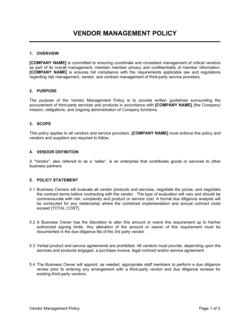
A Vendor and Supplier Management Policy is an internal governance document that defines how an organization identifies, evaluates, onboards, monitors, and offboards vendors and suppliers. This free Word download gives you a structured, editable starting point you can tailor to your procurement processes and export as PDF for distribution to staff and stakeholders.
When you need it
Use it when formalizing a procurement function, preparing for an audit or ISO certification, or when vendor-related incidents β€” cost overruns, quality failures, or compliance gaps β€” signal that informal supplier relationships need structure.
What's inside
Policy scope and objectives, vendor classification criteria, selection and due diligence procedures, contract requirements, onboarding steps, performance monitoring frameworks, risk management protocols, and offboarding and transition procedures.

What is a Vendor and Supplier Management Policy?

A Vendor and Supplier Management Policy is an internal governance document that establishes how an organization identifies, evaluates, contracts with, monitors, and exits relationships with external vendors and suppliers. It replaces informal, department-by-department procurement habits with a single documented standard that applies consistently across the business β€” defining who can approve vendors, what due diligence is required before engagement, how performance is measured, and what steps must be followed when a vendor relationship ends. The policy typically classifies vendors into tiers based on spend and criticality, calibrating oversight effort to actual risk rather than treating a cloud security provider the same as an office supply contract.

Why You Need This Document

Without a formal vendor management policy, third-party relationships accumulate on terms set by whoever happened to negotiate them β€” producing inconsistent contracts, unmonitored SLAs, undocumented system access, and no clear process when something goes wrong. The cost is concrete: vendor performance issues escalate into operational disruptions before anyone has authority to act; former vendors retain data access months after termination; auditors find no documented controls for supplier risk and flag the gap immediately. For organizations pursuing SOC 2, ISO 27001, or any regulated industry certification, a vendor management policy is not optional β€” it is a required control. This template gives you a structured, customizable starting point that covers every dimension of the vendor lifecycle, so you can build a defensible procurement governance framework in hours rather than weeks.

Which variant fits your situation?

If your situation is…Use this template
Organization needs a high-level vendor governance policy onlyVendor and Supplier Management Policy
Need a detailed process for evaluating and selecting new vendorsVendor Evaluation Form
Formalizing the terms of engagement with a specific supplierVendor Agreement
Tracking ongoing vendor performance against defined KPIsSupplier Performance Review Template
Managing IT and software vendor access to company systemsIT Vendor Management Policy
Conducting due diligence on a new third-party partnerThird-Party Risk Assessment
Governing purchasing decisions below a defined spend thresholdProcurement Policy

Common mistakes to avoid

❌ Applying the same oversight to all vendors regardless of risk

Why it matters: Treating a $500 stationery supplier with the same rigor as a critical cloud infrastructure provider wastes procurement resources and creates fatigue that reduces compliance with the policy overall.

Fix: Implement a tiering system with clearly differentiated requirements so oversight effort is proportionate to actual risk and spend.

❌ No named owner for each vendor relationship

Why it matters: When no individual is accountable for a vendor, contracts lapse unnoticed, performance issues go unaddressed, and offboarding steps are skipped β€” often discovered only after an incident.

Fix: Require a named internal relationship manager for every vendor above Tier 3, documented in the vendor register at onboarding.

❌ Treating the policy as a one-time document

Why it matters: Vendor landscapes change: suppliers are acquired, face financial distress, or become subject to new regulations. A policy written three years ago may no longer reflect current risk exposures or business requirements.

Fix: Schedule a mandatory annual policy review with a named reviewer, and trigger an out-of-cycle review any time a Tier 1 vendor experiences a material change.

❌ No data protection requirements for non-IT vendors

Why it matters: HR, payroll, legal, and facilities vendors often handle sensitive personal or financial data. Excluding them from data security requirements creates compliance gaps under GDPR, CCPA, and similar frameworks.

Fix: Apply data classification and protection requirements to any vendor that touches personal, financial, or confidential company data β€” regardless of whether they are categorized as an IT vendor.

The 9 key sections, explained

Purpose, scope, and objectives

Vendor classification and tiering

Vendor selection and due diligence

Contract and commercial requirements

Vendor onboarding

Performance monitoring and KPIs

Vendor risk management

Data protection and confidentiality

Vendor offboarding and transition

How to fill it out

  1. 1

    Define the scope and assign policy ownership

    Identify all departments that engage external vendors and confirm which will be covered. Assign a named policy owner β€” typically the Head of Procurement, COO, or CFO β€” who is accountable for implementation and annual review.

    πŸ’‘ Name a specific role, not just a department, as policy owner. Policies with no named owner are rarely enforced consistently.

  2. 2

    Set your vendor tiering criteria

    Define the spend thresholds and risk factors that place a vendor in Tier 1, 2, or 3. Include at least two criteria β€” spend level and operational criticality β€” to avoid misclassifying high-risk, low-spend vendors.

    πŸ’‘ Run your existing vendor list through the new tiers before publishing the policy. Reclassifying vendors retroactively is harder than doing it at launch.

  3. 3

    Document the due diligence process for each tier

    Specify which due diligence steps are required at each tier β€” financial checks, reference calls, security questionnaires, insurance certificates. Define who must approve the vendor before a contract is issued.

    πŸ’‘ Build a Due Diligence Checklist as a companion document so reviewers cannot skip steps without a documented exception.

  4. 4

    List the mandatory contract requirements

    State which contract clauses are non-negotiable for each tier β€” SLAs, data protection, termination rights, indemnification. Identify who holds contract signature authority for each spend level.

    πŸ’‘ Keep a redline-approved contract template for each tier so procurement can move fast without sacrificing required protections.

  5. 5

    Define KPIs and the review cadence

    For each tier, specify the metrics that will be tracked and how frequently formal reviews occur. Confirm the data sources needed to measure each KPI are available in your current systems.

    πŸ’‘ Start with three to five measurable KPIs per tier rather than an exhaustive list. A short list that gets measured beats a long list that doesn't.

  6. 6

    Set risk management thresholds and escalation paths

    Define the concentration risk threshold, the minimum insurance requirements for critical vendors, and the escalation path when a vendor fails a risk assessment or remediation plan.

    πŸ’‘ Include a named escalation contact β€” not just 'senior management' β€” so staff know exactly who to notify when a vendor issue crosses the risk threshold.

  7. 7

    Draft the offboarding checklist

    List every step required to close a vendor relationship cleanly: access revocation, data handling, asset return, and transition documentation. Assign a responsible owner for each step.

    πŸ’‘ Test the offboarding checklist against your most complex current vendor relationship to confirm it covers every system access and data flow involved.

  8. 8

    Communicate, train, and schedule an annual review

    Distribute the policy to all affected departments, confirm acknowledgment, and schedule the first annual policy review date before publishing. Record the effective date on the document.

    πŸ’‘ A policy that staff have never read is not a control. A short 30-minute briefing at launch increases adoption significantly more than a PDF in a shared drive.

Frequently asked questions

What is a vendor and supplier management policy?

A vendor and supplier management policy is an internal governance document that defines how an organization selects, onboards, monitors, and offboards external vendors and suppliers. It establishes consistent standards for due diligence, contract requirements, performance measurement, and risk management across all third-party relationships β€” replacing ad hoc, department-level approaches with a single organizational standard.

Why do organizations need a formal vendor management policy?

Without a formal policy, vendor relationships are governed by whoever happens to manage them β€” leading to inconsistent contract terms, missed renewal dates, unmonitored performance, and undocumented data access. A policy creates accountability, reduces third-party risk, and provides the documented controls required for SOC 2, ISO 27001, and regulatory audits. It also gives procurement teams a defensible basis for vendor decisions.

What is vendor tiering and why does it matter?

Vendor tiering is a classification system that groups suppliers by their criticality, spend level, or risk profile β€” typically into three tiers. It matters because a $5,000-per-year vendor with access to sensitive customer data requires more oversight than a $100,000 office supplies contract. Tiering ensures that due diligence, review frequency, and contract requirements are proportionate to actual risk rather than applied uniformly.

What should a vendor management policy include?

A complete policy covers vendor classification and tiering, selection and due diligence procedures, contract requirements, onboarding steps, performance monitoring with defined KPIs, risk management protocols, data protection requirements, and offboarding procedures. It should also name a policy owner, define approval authorities at each spend level, and include an annual review schedule.

How often should vendor performance be reviewed?

Review frequency should be tied to the vendor's tier. Critical or Tier 1 vendors typically warrant quarterly performance reviews given their operational impact. Tier 2 vendors are commonly reviewed semi-annually. Tier 3 or low-risk vendors can be reviewed annually. Any vendor that misses an SLA or triggers a risk flag should receive an immediate out-of-cycle review regardless of their tier.

What is vendor offboarding and why does it need a documented process?

Vendor offboarding is the formal process of ending a supplier relationship in an orderly way β€” revoking system access, recovering or deleting company data, retrieving assets, and closing the contract. Without a documented process, companies routinely discover former vendor credentials still active in their systems months after termination, creating security and compliance exposure. A checklist-driven offboarding process ensures nothing is missed.

How does a vendor management policy support ISO 27001 or SOC 2 compliance?

Both ISO 27001 and SOC 2 include specific controls for supplier relationships. ISO 27001 Annex A.15 requires documented policies for information security in supplier relationships. SOC 2 CC9.2 requires evidence of vendor risk assessment and monitoring processes. A vendor and supplier management policy, combined with a vendor risk register and performance scorecards, directly satisfies these control requirements and reduces audit preparation time significantly.

Who should own the vendor management policy?

Ownership typically sits with the Head of Procurement, COO, or CFO depending on how procurement is structured. For organizations without a formal procurement function, the operations manager or finance director is a practical choice. The key criterion is that the owner has authority to enforce the policy across all departments β€” a policy owner without cross-departmental authority cannot resolve the shadow procurement problem that causes most vendor management failures.

What is concentration risk in vendor management?

Concentration risk is the operational and financial exposure that arises when a company relies on a single vendor β€” or a very small number of vendors β€” for a critical function. If that vendor fails, is acquired, or raises prices dramatically, the company has limited recourse. The policy should define a concentration threshold (for example, no single vendor providing more than 60% of a critical function) and require a documented mitigation plan when the threshold is exceeded.

How this compares to alternatives

vs Procurement Policy

A procurement policy governs how purchasing decisions are made β€” approval thresholds, competitive bidding requirements, and spend authorization. A vendor management policy governs the ongoing relationship after a vendor is selected β€” onboarding, performance monitoring, risk management, and offboarding. Organizations typically need both: procurement policy handles how you buy; vendor management policy handles how you manage what you have bought.

vs Vendor Agreement

A vendor agreement is a bilateral contract between the company and a specific supplier that establishes legally binding commercial terms. A vendor management policy is an internal governance document that defines how the organization manages all vendor relationships. The policy tells employees what to do; the agreement binds the vendor to specific obligations.

vs Third-Party Risk Assessment

A third-party risk assessment is a point-in-time evaluation of the risks posed by a specific vendor β€” covering financial stability, security posture, and compliance status. A vendor management policy is the governing framework that specifies when assessments are required, what they must cover, and how findings are acted upon. The assessment is a tool the policy requires you to use.

vs Supplier Code of Conduct

A supplier code of conduct defines the ethical, environmental, and labor standards vendors must meet β€” covering areas like anti-bribery, human rights, and sustainability. A vendor management policy covers the operational and commercial dimensions of the relationship. Both documents are typically issued together at vendor onboarding, with the code of conduct forming an exhibit to the main contract.

Industry-specific considerations

Technology / SaaS

Software and cloud vendor access controls, fourth-party risk from vendor subprocessors, and annual SOC 2 report requirements for all Tier 1 suppliers.

Financial Services

Regulatory requirements for third-party oversight (OCC, FCA, OSFI), mandatory business continuity testing for critical vendors, and enhanced due diligence for vendors with access to financial or customer data.

Healthcare

HIPAA Business Associate Agreement requirements for any vendor handling protected health information, and heightened scrutiny of medical device and diagnostics suppliers on quality and recall history.

Manufacturing

Supply chain concentration risk, raw material supplier qualification audits, on-time delivery and defect rate KPIs, and contingency sourcing requirements for single-source components.

Template vs pro β€” what fits your needs?

PathBest forCostTime
Use the templateSmall to mid-sized businesses formalizing vendor oversight for the first time or preparing for an internal auditFree2–4 hours to customize and distribute
Template + professional reviewOrganizations pursuing ISO 27001 or SOC 2 certification, or those with more than 20 active vendor relationships$500–$1,500 for a compliance consultant or operations advisor review3–5 business days
Custom draftedRegulated financial institutions, healthcare organizations, or enterprises with complex global supply chains requiring jurisdiction-specific controls$3,000–$8,000 for a risk management consultant or law firm3–6 weeks

Glossary

Vendor
Any external company or individual that provides goods, services, or software to the organization in exchange for payment.
Preferred Vendor List
A pre-approved roster of suppliers that have passed due diligence and can be engaged without a full re-evaluation process.
Due Diligence
The process of investigating a prospective vendor's financial stability, compliance status, security posture, and operational capacity before awarding a contract.
Vendor Tiering
A classification system that groups vendors by spend level, criticality, or risk β€” typically Tier 1 (critical), Tier 2 (significant), and Tier 3 (low-risk) β€” to calibrate oversight effort.
KPI (Key Performance Indicator)
A measurable metric used to evaluate whether a vendor is meeting agreed service, quality, or delivery standards.
SLA (Service Level Agreement)
A contractual commitment that defines the minimum performance standards a vendor must meet, including uptime, response times, or defect rates.
Vendor Offboarding
The formal process of terminating a vendor relationship, including contract close-out, data deletion, access revocation, and transition of services.
Concentration Risk
Operational exposure that arises when a company relies on a single vendor or a small number of vendors for a critical function, leaving it vulnerable if one fails.
Fourth-Party Risk
Risk introduced by a vendor's own suppliers or subcontractors β€” parties the organization has no direct relationship with but whose failures can affect service delivery.
Remediation Plan
A documented corrective action plan issued to a vendor when performance falls below agreed thresholds, specifying what must change and by when.

Part of your Business Operating System

This document is one of 3,000+ business & legal templates included in Business in a Box.

  • Fill-in-the-blanks β€” ready in minutes
  • 100% customizable Word document
  • Compatible with all office suites
  • Export to PDF and share electronically

Create your document in 3 simple steps.

From template to signed document β€” all inside one Business Operating System.
1
Download or open template

Access over 3,000+ business and legal templates for any business task, project or initiative.

2
Edit and fill in the blanks with AI

Customize your ready-made business document template and save it in the cloud.

3
Save, Share, Send, Sign

Share your files and folders with your team. Create a space of seamless collaboration.

Save time, save money, and create top-quality documents.

β˜…β˜…β˜…β˜…β˜…

"Fantastic value! I'm not sure how I'd do without it. It's worth its weight in gold and paid back for itself many times."

Managing Director Β· Mall Farm
Robert Whalley
Managing Director, Mall Farm Proprietary Limited
β˜…β˜…β˜…β˜…β˜…

"I have been using Business in a Box for years. It has been the most useful source of templates I have encountered. I recommend it to anyone."

Business Owner Β· 4+ years
Dr Michael John Freestone
Business Owner
β˜…β˜…β˜…β˜…β˜…

"It has been a life saver so many times I have lost count. Business in a Box has saved me so much time and as you know, time is money."

Owner Β· Upstate Web
David G. Moore Jr.
Owner, Upstate Web

Run your business with a system β€” not scattered tools

Stop downloading documents. Start operating with clarity. Business in a Box gives you the Business Operating System used by over 250,000 companies worldwide to structure, run, and grow their business.

Start freeΒ Β·Β No credit card required