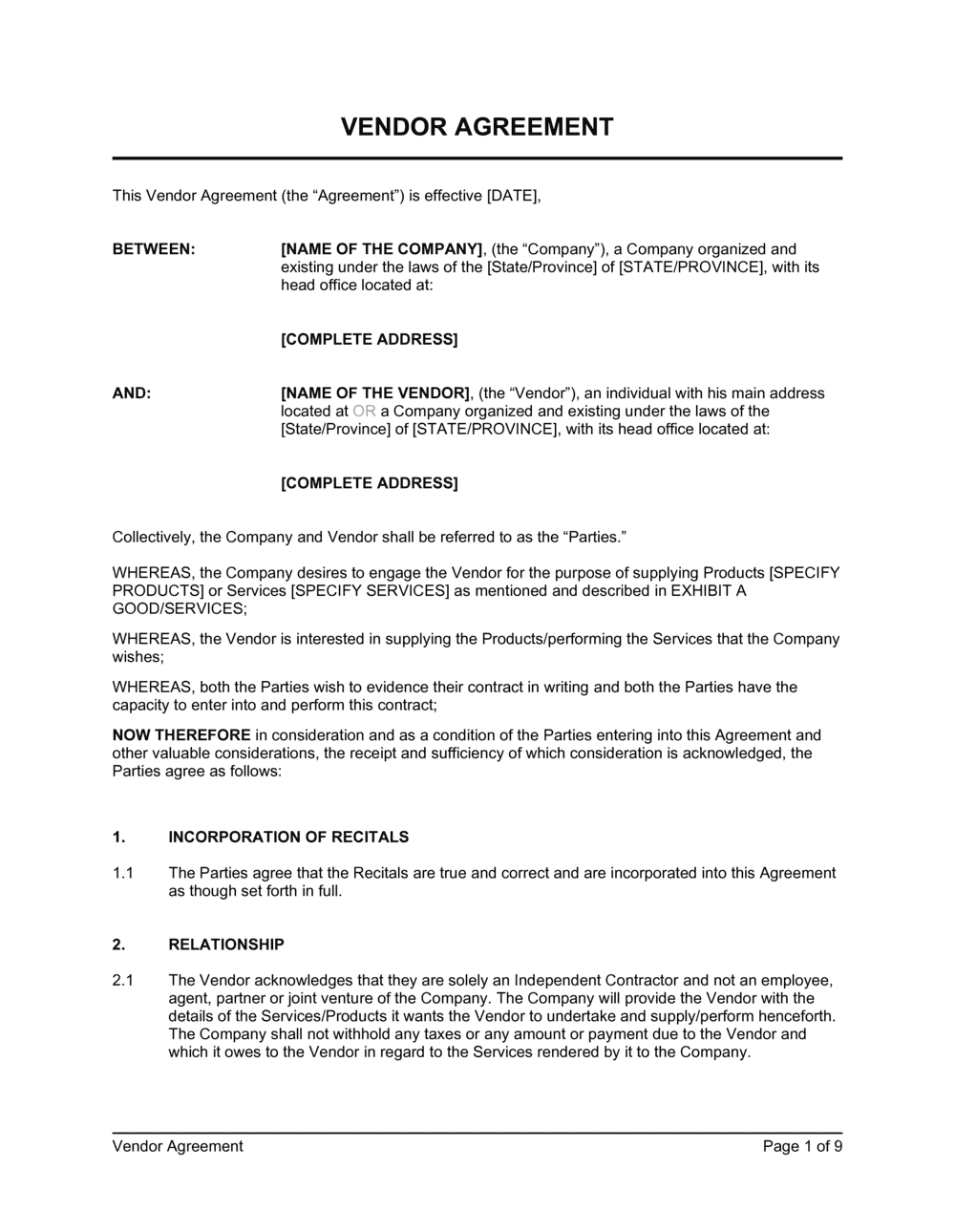
Vendor Agreement Template

Free Word download β€’ Edit online β€’ Save & share with Drive β€’ Export to PDF

9 pagesβ€’30–40 min to fillβ€’Difficulty: Complexβ€’Signature requiredβ€’Legal review recommended
Learn more ↓
FreeVendor Agreement Template

At a glance

What it is
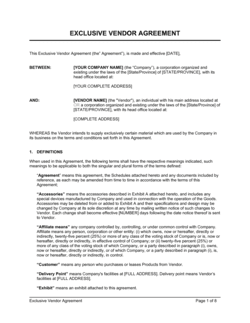
A Vendor Agreement is a legally binding contract between a buyer and a vendor that governs the ongoing supply of goods or services β€” covering pricing, ordering procedures, delivery obligations, quality standards, IP ownership, confidentiality, indemnification, and how the relationship can be terminated. This free Word download gives you an editable, professional starting point you can tailor online and export as PDF before signing.
When you need it
Use it before placing the first purchase order with any vendor whose goods or services are material to your operations β€” whether that's a recurring supplier, a SaaS platform, a manufacturing partner, or a professional services firm. A signed vendor agreement should precede individual purchase orders, not follow them.
What's inside
Scope of supply and ordering process, pricing and payment terms, delivery and acceptance procedures, quality and warranty standards, intellectual property assignment and licensing, confidentiality obligations, indemnification and liability caps, term and termination rights, and governing law.

What is a Vendor Agreement?

A Vendor Agreement is a legally binding master contract between a buyer and a vendor that establishes the governing terms for an ongoing supply relationship β€” covering the ordering process, pricing and payment, delivery obligations, acceptance and warranty standards, intellectual property ownership, confidentiality, indemnification, liability limits, and how either party can exit the arrangement. Unlike a purchase order, which authorizes a single transaction, a vendor agreement creates the legal framework under which all future orders are issued, eliminating the need to re-negotiate core terms every time a new purchase is placed. It functions as the foundation document of the buyer-vendor relationship and is typically signed once, then referenced by individual purchase orders or statements of work for the life of the relationship.

Why You Need This Document

Operating without a signed vendor agreement means every purchase order you issue is governed by the vendor's own standard terms β€” documents written by the vendor's lawyers to protect the vendor, not you. Without your own agreement in place, you have no contractual right to reject non-conforming goods within a defined window, no guarantee that custom deliverables belong to your company, no ceiling on the vendor's ability to change prices mid-relationship, and no enforceable confidentiality obligation if the vendor mishandles your proprietary data or pricing information. When a vendor relationship goes wrong β€” a missed delivery, a defective product shipment, a data breach, or an IP dispute β€” the party with the governing contract controls the outcome. A signed vendor agreement, executed before the first purchase order, closes those gaps for any supplier whose goods or services are material to your operations.

Which variant fits your situation?

If your situation is…Use this template
Purchasing physical goods from a manufacturer or distributorPurchase Agreement
Engaging a vendor to provide professional or technical servicesService Agreement
Issuing a single order against an existing vendor agreementPurchase Order
Sourcing goods internationally across bordersInternational Vendor Agreement
Engaging a software or SaaS vendor for ongoing platform accessSoftware Subscription Agreement
Contracting an independent consultant rather than a product vendorIndependent Contractor Agreement
Requiring a vendor to keep information confidential before terms are finalizedNon-Disclosure Agreement

Common mistakes to avoid

❌ Issuing purchase orders before the master agreement is signed

Why it matters: POs issued without a governing master agreement are governed only by the vendor's standard terms β€” which are written to protect the vendor, not the buyer. The buyer inherits whatever terms are printed on the vendor's order acknowledgment.

Fix: Sign the vendor agreement before placing the first order. If a PO must be issued urgently, attach a letter stating that the PO is subject to the master agreement currently under negotiation.

❌ No defined acceptance window for goods or deliverables

Why it matters: Without an explicit acceptance period, buyers in most common-law jurisdictions are deemed to have accepted goods after a commercially reasonable inspection period β€” losing the right to reject defective shipments retroactively.

Fix: State a specific number of business days for inspection and acceptance in the agreement, and document every acceptance or rejection in writing.

❌ Omitting IP assignment language for custom deliverables

Why it matters: Without an explicit assignment, the vendor retains copyright in custom software, designs, or reports by default β€” meaning the buyer has paid for something it cannot freely use, sublicense, or modify.

Fix: Include a work-made-for-hire clause with a backup assignment for any deliverable the vendor creates specifically for the buyer. Have the vendor disclose background IP at the outset.

❌ No carve-outs to the liability cap for high-severity breaches

Why it matters: A liability cap that covers IP infringement and confidentiality breaches can leave the buyer with a damages ceiling far below its actual loss β€” particularly when proprietary data is exposed or a third-party patent suit follows.

Fix: Carve out at minimum: IP indemnification, confidentiality breaches, gross negligence, willful misconduct, and fraud from the liability cap on both sides.

❌ Automatic renewal with no notice-period reminder system

Why it matters: A 30-day non-renewal window on a one-year agreement can pass unnoticed during a busy quarter, committing the buyer to another full term at potentially outdated pricing with a vendor they intended to replace.

Fix: Set a calendar reminder at the time of signing for 45 days before the non-renewal deadline. Add a contract-tracking field in your vendor management system for every agreement with auto-renewal.

❌ One-sided confidentiality that only binds the vendor

Why it matters: Buyers routinely share pricing strategies, product roadmaps, customer data, and operational processes with vendors. A clause that only protects the vendor's information leaves the buyer's most sensitive commercial information unprotected.

Fix: Use mutual confidentiality language that binds both parties equally, with a definition of Confidential Information broad enough to cover non-public business information shared in either direction.

The 10 key clauses, explained

Parties, recitals, and definitions

In plain language: Identifies the buyer and vendor as legal entities, states the purpose of the agreement, and defines key terms used throughout the document.

Sample language
This Vendor Agreement ('Agreement') is entered into as of [DATE] by and between [BUYER LEGAL NAME], a [STATE] [ENTITY TYPE] ('Buyer'), and [VENDOR LEGAL NAME], a [STATE] [ENTITY TYPE] ('Vendor'). Capitalized terms used herein have the meanings set out in Schedule A.

Common mistake: Using trade names instead of registered legal entity names β€” if the contracting entity doesn't match the entity on invoices or payroll, enforcing the agreement against the right party becomes difficult.

Scope of supply and ordering process

In plain language: Describes what the vendor will supply β€” goods, services, or both β€” and how individual orders will be placed, acknowledged, and governed by this master agreement.

Sample language
Vendor shall supply the goods and/or services described in each Purchase Order issued by Buyer ('Order'). Each Order is incorporated into this Agreement by reference. In the event of conflict between an Order and this Agreement, this Agreement controls unless the Order expressly states otherwise.

Common mistake: Failing to state which document controls in a conflict β€” when PO terms and master agreement terms diverge, courts apply state-specific rules of construction that may not favor the buyer.

Pricing, invoicing, and payment terms

In plain language: Sets the pricing basis β€” fixed, time-and-materials, or schedule β€” payment due dates, accepted invoice formats, and any late-payment interest.

Sample language
Buyer shall pay undisputed invoices within [30] days of receipt. Invoices must reference the applicable Order number. Overdue amounts accrue interest at [1.5]% per month or the maximum rate permitted by law, whichever is less.

Common mistake: Omitting a dispute process for invoices β€” without one, vendors treat any non-payment as a breach even when the buyer has a legitimate quality dispute pending.

Delivery, title, and risk of loss

In plain language: Specifies delivery terms (e.g., FOB destination), the point at which title and risk of loss pass from vendor to buyer, and lead-time obligations.

Sample language
Vendor shall deliver goods [FOB DESTINATION / EXW VENDOR FACILITY] by the date specified in the applicable Order. Title and risk of loss pass to Buyer upon delivery and written acceptance. Vendor bears all risk of loss in transit unless otherwise agreed in writing.

Common mistake: Leaving delivery terms undefined and relying on 'reasonable time.' Courts apply a reasonableness standard that varies by jurisdiction and gives vendors significant latitude to delay.

Acceptance, rejection, and warranties

In plain language: Defines the acceptance testing process, the window in which the buyer may reject non-conforming goods or services, and the vendor's warranty obligations.

Sample language
Buyer shall have [10] business days after delivery to inspect and accept or reject goods. Vendor warrants that all goods will be free from defects in materials and workmanship for [12] months from acceptance. Vendor shall replace or repair rejected goods at no cost to Buyer within [15] business days.

Common mistake: No defined acceptance window β€” without one, buyers in many jurisdictions are deemed to have accepted goods after a commercially reasonable inspection period, losing the right to reject.

Intellectual property ownership and licensing

In plain language: Allocates ownership of IP created during the engagement β€” custom deliverables, software, or reports β€” and grants any licenses needed for the other party to use pre-existing IP.

Sample language
All work product and deliverables created specifically for Buyer under this Agreement ('Buyer IP') are works made for hire and are the sole property of Buyer. To the extent any Buyer IP incorporates Vendor's pre-existing IP ('Vendor Background IP'), Vendor grants Buyer a perpetual, royalty-free license to use Vendor Background IP solely as embedded in the deliverables.

Common mistake: No IP clause at all for service engagements β€” courts default to the vendor retaining copyright in custom deliverables absent an explicit assignment, leaving buyers unable to freely use work they paid for.

Confidentiality

In plain language: Prohibits both parties from disclosing the other's confidential information β€” trade secrets, pricing, customer data, and technical specifications β€” during and after the agreement term.

Sample language
Each party ('Receiving Party') shall hold the other party's Confidential Information in strict confidence and shall not disclose it to any third party without prior written consent. 'Confidential Information' means any non-public information disclosed in connection with this Agreement, marked as confidential or reasonably understood to be so.

Common mistake: One-sided confidentiality clauses that only bind the vendor β€” buyers also share pricing strategies, forecasts, and proprietary processes that deserve equal protection.

Indemnification and liability cap

In plain language: Obligates each party to indemnify the other for specified categories of loss and places a ceiling on the total liability either party can face under the agreement.

Sample language
Vendor shall indemnify Buyer against third-party claims arising from Vendor's gross negligence, willful misconduct, or IP infringement. Each party's total liability under this Agreement shall not exceed the greater of [AMOUNT] or the total fees paid by Buyer in the [12] months preceding the claim.

Common mistake: No carve-outs to the liability cap for IP infringement, confidentiality breaches, or gross negligence β€” courts in most jurisdictions will honor a cap that covers these categories, leaving the buyer exposed on its most serious risks.

Term, termination, and wind-down

In plain language: States the initial agreement term, renewal mechanics, termination rights for cause and convenience, and obligations during the wind-down period.

Sample language
This Agreement commences on [DATE] and continues for [1] year, renewing automatically for successive one-year terms unless either party gives [60] days' written notice of non-renewal. Either party may terminate for cause upon [30] days' written notice if the other party materially breaches and fails to cure within that period.

Common mistake: Automatic renewal without a notice period for non-renewal β€” buyers locked into unwanted renewals have limited options to exit without paying the full term, particularly for subscription-based vendor services.

Governing law, dispute resolution, and general provisions

In plain language: Specifies the jurisdiction whose law governs, the dispute resolution mechanism (arbitration, mediation, or litigation), and standard boilerplate covering amendments, waiver, severability, and the entire agreement.

Sample language
This Agreement is governed by the laws of [STATE/PROVINCE/COUNTRY], without regard to conflict-of-law principles. Disputes shall be resolved by binding arbitration under [AAA/JAMS] rules in [CITY], except that either party may seek injunctive relief in any court of competent jurisdiction.

Common mistake: Choosing a governing law with no connection to where either party operates or where delivery occurs β€” several jurisdictions apply local mandatory commercial law regardless of what the contract states.

How to fill it out

  1. 1

    Identify both parties with their full legal entity names

    Enter the registered legal name, entity type (LLC, Inc., Ltd.), and state or country of incorporation for both the buyer and the vendor. Confirm these match the entities on each party's invoices and bank accounts.

    πŸ’‘ Run a quick search on your state's business entity registry to confirm the exact legal name before signing β€” a mismatch between the contract name and the invoicing entity creates enforcement gaps.

  2. 2

    Define the scope of supply clearly

    Describe the categories of goods or services covered by this master agreement. Reference a Schedule A or product/service schedule if the scope is detailed. Confirm whether the agreement covers goods only, services only, or both.

    πŸ’‘ Keep the master agreement scope broad and push specifics β€” SKUs, quantities, deliverables β€” into individual purchase orders. This lets the master agreement govern new categories without requiring an amendment.

  3. 3

    Set pricing, payment terms, and invoice requirements

    Enter the payment due period (e.g., Net 30 from invoice date), specify what information invoices must include (PO number, line-item detail, tax ID), and state the late-payment interest rate.

    πŸ’‘ Add a formal invoice dispute process β€” e.g., buyer must notify vendor of any disputed amount within 10 business days of receipt β€” to prevent unpaid disputes from triggering a breach claim.

  4. 4

    Specify delivery terms and acceptance windows

    Select a delivery standard (FOB Destination, EXW, or DDP for international). Enter the number of business days the buyer has to inspect and accept or reject delivered goods or completed services.

    πŸ’‘ 10 business days is a commercially standard acceptance window. Shorter windows favor the vendor; longer windows are harder to enforce without documented inspection logs.

  5. 5

    Allocate IP ownership for custom deliverables

    If the vendor will create anything custom β€” software, designs, reports, or tools β€” use the work-made-for-hire and IP assignment language to ensure those deliverables belong to the buyer. License back any vendor background IP embedded in the deliverables.

    πŸ’‘ Ask the vendor to disclose any open-source software or third-party components they plan to incorporate before work begins β€” some licenses (GPL) impose conditions that affect the buyer's right to use the deliverable commercially.

  6. 6

    Calibrate the indemnification and liability cap

    Set the liability cap as a multiple of fees paid in the trailing 12 months β€” typically 1Γ— to 2Γ— for standard commercial agreements. Carve out IP infringement, confidentiality breaches, gross negligence, and willful misconduct from the cap.

    πŸ’‘ For vendors supplying mission-critical goods or services, negotiate mutual indemnification for IP infringement β€” if the vendor's software infringes a third-party patent, the buyer facing a lawsuit needs the vendor on the hook.

  7. 7

    Set the term, renewal, and termination mechanics

    Enter the initial term length, the auto-renewal period, and the notice period required to prevent auto-renewal. Add a termination-for-convenience right with a 30–60 day notice period for operational flexibility.

    πŸ’‘ Set a calendar reminder for the non-renewal notice deadline at the time of signing β€” missing a 30-day window on a one-year contract means committing to another full year with a vendor you may want to exit.

  8. 8

    Confirm governing law and execute before first order

    Select the jurisdiction whose law governs β€” ideally the buyer's home jurisdiction for domestic agreements. Both authorized signatories must sign before the first purchase order is issued under the agreement.

    πŸ’‘ For agreements with Canadian vendors, confirm whether Quebec law applies β€” if so, the agreement may need to be available in French to be enforceable against a Quebec-based party.

Frequently asked questions

What is a vendor agreement?

A vendor agreement is a legally binding contract between a buyer and a supplier that governs the ongoing supply of goods or services. It establishes the master terms β€” pricing, ordering, delivery, quality, IP, confidentiality, and termination β€” under which individual purchase orders are issued. Rather than re-negotiating terms for every transaction, both parties execute one master agreement and reference it in subsequent orders.

What is the difference between a vendor agreement and a purchase order?

A vendor agreement is the master contract that sets the legal rules of the relationship β€” warranties, IP, indemnification, governing law. A purchase order is a transaction document that authorizes a specific delivery of goods or services at a defined price and date, referencing the master agreement for all other terms. The agreement governs the relationship; the PO triggers individual transactions within it.

Is a vendor agreement legally binding?

Yes, a vendor agreement is generally enforceable as a binding contract when both parties sign, there is valid consideration (the exchange of goods, services, or payment), and the parties have legal authority to contract. As with any commercial contract, enforceability of specific clauses β€” particularly non-compete restrictions and liability caps β€” depends on jurisdiction. Consider having legal counsel review agreements with high financial exposure or cross-border complexity.

Who should sign a vendor agreement?

An authorized signatory for each party β€” typically a director, officer, or manager with signing authority under the entity's governing documents β€” must execute the agreement. For companies, this is often the CEO, CFO, or VP of Procurement depending on the spend threshold. Confirm signing authority limits in your internal policies before execution; some boards require approval for agreements above a stated dollar threshold.

What payment terms should a vendor agreement include?

Net 30 from invoice receipt is the most common B2B standard. Buyers with strong negotiating leverage sometimes secure Net 45 or Net 60. The agreement should specify the invoice format required (PO reference, itemization, tax ID), the late-payment interest rate (typically 1.5% per month or the statutory maximum), and a formal dispute process allowing the buyer to contest invoice items without triggering a breach claim.

Does a vendor agreement need to be renewed?

Most vendor agreements include an automatic renewal clause that extends the term for successive one-year periods unless either party gives written notice of non-renewal before a defined deadline β€” typically 30 to 60 days before the current term ends. Track renewal windows actively; missing the notice deadline commits your organization to another full term, even if the relationship or pricing no longer serves your needs.

What happens if a vendor delivers non-conforming goods?

A well-drafted vendor agreement gives the buyer a defined acceptance window β€” typically 10 business days β€” to inspect and reject non-conforming goods. The vendor is then obligated to replace, repair, or refund within a stated period at no cost to the buyer. Without this clause, buyers in most jurisdictions must rely on implied warranty of merchantability, which is harder to enforce and may require litigation to resolve.

Who owns the IP created by a vendor?

By default in most jurisdictions, a vendor retains copyright and other IP rights in work it creates, even if the buyer paid for it β€” unless there is a written assignment or work-made-for-hire agreement. A vendor agreement should include an explicit IP assignment for all custom deliverables created specifically for the buyer, along with a license back for any vendor background IP embedded in those deliverables.

Do I need a lawyer to draft a vendor agreement?

For standard domestic supplier relationships with moderate spend, a quality template is typically sufficient as a starting point. Engaging legal counsel is advisable when the vendor supplies mission-critical goods or services, when spend exceeds $100K annually, when custom IP is involved, when the vendor operates in a different country, or when the liability exposure is material. A focused template review typically costs $300–$800 and is worthwhile before committing to a multi-year relationship.

How this compares to alternatives

vs Purchase Agreement

A purchase agreement governs a single, discrete transaction β€” buying a specific asset or a one-time shipment. A vendor agreement is a master contract that governs an ongoing supply relationship and covers all future purchase orders issued under it. Use a purchase agreement for a one-off acquisition; use a vendor agreement when you expect to transact repeatedly with the same supplier.

vs Service Agreement

A service agreement focuses entirely on the provision of services β€” deliverables, timelines, and performance standards β€” and typically does not address physical goods delivery, title passage, or inventory risk. A vendor agreement covers both goods and services supply under one framework. Use a service agreement for pure professional or technical services engagements; use a vendor agreement when your relationship involves physical products or a mix of goods and services.

vs Independent Contractor Agreement

An independent contractor agreement engages an individual or sole proprietor for project-based work, with explicit classification as a non-employee. A vendor agreement is a commercial B2B contract between two business entities for the supply of goods or services at scale. Misclassifying a vendor relationship as an independent contractor arrangement β€” or vice versa β€” can trigger tax and employment law liability.

vs Purchase Order

A purchase order is a transactional document that authorizes a single delivery at a stated price and date. Issued alone, it relies on the vendor's own terms and conditions for everything else. Issued under a signed vendor agreement, it inherits all the protective master terms β€” IP assignment, liability cap, warranties β€” without needing to restate them. A PO without a master vendor agreement is a legally thin document.

Industry-specific considerations

Manufacturing and supply chain

Raw material sourcing with lead-time SLAs, quality inspection and rejection procedures, FOB shipping terms, and volume-based pricing tiers tied to annual purchase commitments.

Technology / SaaS

Software and API vendor agreements add uptime SLAs, data processing addenda for GDPR and CCPA compliance, source-code escrow requirements, and subscription auto-renewal terms.

Retail and e-commerce

Vendor compliance manuals, EDI ordering requirements, chargeback and non-compliance fee structures, and exclusivity or minimum-order obligations tied to shelf or platform placement.

Professional services

Services-focused vendor agreements emphasize SOW governance, deliverable acceptance criteria, key-person clauses, and IP assignment for custom research, reports, or software produced during the engagement.

Jurisdictional notes

United States

The Uniform Commercial Code (UCC) Article 2 governs contracts for the sale of goods in all US states; common law governs pure service agreements. UCC gap-fillers apply wherever the agreement is silent β€” particularly on delivery terms, acceptance, and risk of loss β€” so specifying these terms expressly is critical. Non-compete and choice-of-law clauses are subject to state-specific enforceability rules, and California's buyer-friendly implied warranty standards make acceptance language especially important for California-based buyers.

Canada

Provincial sale-of-goods legislation (modeled on the UK Sale of Goods Act) applies in most provinces, implying fitness-for-purpose and merchantability warranties that parties can only partially disclaim. Quebec's Civil Code governs commercial contracts differently from common-law provinces, and agreements with Quebec-based vendors may need to be available in French under the Charter of the French Language. Prompt-payment legislation in several provinces sets statutory timelines for construction and government-related supply contracts.

United Kingdom

The Sale of Goods Act 1979 and the Supply of Goods and Services Act 1982 imply statutory terms β€” satisfactory quality, fitness for purpose, and reasonable care β€” that cannot be fully excluded in consumer contracts and are subject to a reasonableness test in B2B agreements under the Unfair Contract Terms Act 1977. The Late Payment of Commercial Debts Act entitles vendors to statutory interest (Bank of England base rate plus 8%) on overdue B2B invoices. Post-Brexit, CE marking and product standards diverge from EU requirements for physical goods.

European Union

GDPR applies whenever the vendor processes personal data on behalf of the buyer β€” a data processing agreement (DPA) must be in place alongside the vendor agreement. EU member states impose varying rules on payment terms: the Late Payment Directive (2011/7/EU) caps B2B payment terms at 60 days unless expressly agreed otherwise. Product liability rules under the Product Liability Directive may expose buyers who further distribute vendor-supplied goods. Governing law choices within the EU are generally honored under the Rome I Regulation.

Template vs lawyer β€” what fits your deal?

PathBest forCostTime
Use the templateStandard domestic vendor relationships with annual spend below $50K and no custom IP or mission-critical supplyFree30–60 minutes
Template + legal reviewVendors supplying critical inputs, agreements involving custom deliverables or IP, or cross-border supply relationships$300–$8002–5 days
Custom draftedHigh-value or sole-source vendor relationships, regulated industries, international manufacturing agreements, or complex multi-tier supply chains$1,500–$5,000+1–3 weeks

Glossary

Master Agreement
A standing contract that sets the legal framework for an ongoing relationship, with individual purchase orders or statements of work issued under it without re-negotiating core terms each time.
Purchase Order (PO)
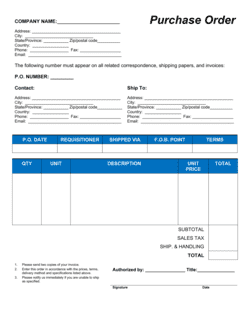
A buyer-issued document that authorizes a specific transaction β€” quantity, price, delivery date β€” referencing the master vendor agreement for all other terms.
Statement of Work (SOW)
A document attached to a services agreement that describes the specific deliverables, timelines, and success criteria for a defined engagement.
Indemnification
A contractual obligation by one party to compensate the other for specified losses, damages, or legal costs arising from defined events or breaches.
Liability Cap
A contractual ceiling on the total damages one party can claim from the other β€” typically expressed as a multiple of fees paid in a trailing 12-month period.
Warranty
A vendor's contractual promise that goods or services will meet defined quality, fitness, or performance standards for a stated period.
Acceptance Testing
A defined process by which the buyer verifies that delivered goods or services conform to the agreed specifications before payment is triggered or title passes.
Force Majeure
A clause excusing a party from performance obligations when a qualifying event beyond their control β€” natural disaster, pandemic, government action β€” prevents timely delivery.
IP Assignment
A clause transferring ownership of intellectual property created by the vendor during the engagement β€” custom software, designs, or reports β€” to the buyer.
Termination for Convenience
A right allowing either party to end the agreement without cause by providing a defined notice period, typically 30 to 90 days, without owing breach damages.
Preferred Vendor Status
A designation granted by a buyer to a vendor that has met qualification criteria, entitling the vendor to first consideration for new purchase orders within a defined category.
Audit Rights
A contractual right allowing the buyer to inspect the vendor's records, invoices, or compliance documentation to verify that the agreement's terms are being met.

Part of your Business Operating System

This document is one of 3,000+ business & legal templates included in Business in a Box.

  • Fill-in-the-blanks β€” ready in minutes
  • 100% customizable Word document
  • Compatible with all office suites
  • Export to PDF and share electronically

Create your document in 3 simple steps.

From template to signed document β€” all inside one Business Operating System.
1
Download or open template

Access over 3,000+ business and legal templates for any business task, project or initiative.

2
Edit and fill in the blanks with AI

Customize your ready-made business document template and save it in the cloud.

3
Save, Share, Send, Sign

Share your files and folders with your team. Create a space of seamless collaboration.

Save time, save money, and create top-quality documents.

β˜…β˜…β˜…β˜…β˜…

"Fantastic value! I'm not sure how I'd do without it. It's worth its weight in gold and paid back for itself many times."

Managing Director Β· Mall Farm
Robert Whalley
Managing Director, Mall Farm Proprietary Limited
β˜…β˜…β˜…β˜…β˜…

"I have been using Business in a Box for years. It has been the most useful source of templates I have encountered. I recommend it to anyone."

Business Owner Β· 4+ years
Dr Michael John Freestone
Business Owner
β˜…β˜…β˜…β˜…β˜…

"It has been a life saver so many times I have lost count. Business in a Box has saved me so much time and as you know, time is money."

Owner Β· Upstate Web
David G. Moore Jr.
Owner, Upstate Web

Run your business with a system β€” not scattered tools

Stop downloading documents. Start operating with clarity. Business in a Box gives you the Business Operating System used by over 250,000 companies worldwide to structure, run, and grow their business.

Start freeΒ Β·Β No credit card required