1
Identify both parties with full legal entity names
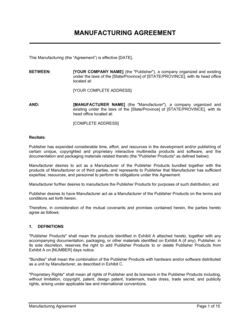
Enter the registered legal name, entity type (LLC, corporation, partnership), and principal business address of both the supplier and the buyer. Cross-reference each party's corporate registry filing to confirm accuracy.
💡 Request a copy of the other party's certificate of incorporation or equivalent before signing — it confirms the entity exists and is in good standing.
2
Complete Schedule A with detailed product specifications
List every product being supplied with its SKU, full description, dimensions, materials, applicable certifications, and quality standards. Attach technical data sheets or product samples as exhibits where specifications are complex.
💡 The more precise Schedule A is, the fewer disputes you will have. Vague specifications like 'standard quality' are litigated constantly; specific tolerances and test standards are not.
3
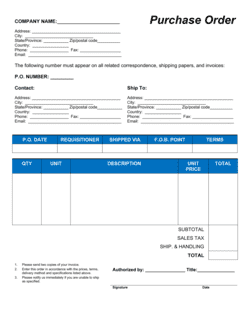
Set pricing, payment terms, and price-change notice
Enter unit prices in Schedule B, specify the payment due period (Net 30, Net 45, or Net 60), the late-interest rate, and the minimum notice the supplier must give before increasing prices.
💡 Tie the price-change notice period to your own customer contract renewal cycle so you are never contractually obligated to sell at a loss.
4
Define MOQ, forecast obligations, and order process
State the minimum order quantity per Purchase Order, any annual or quarterly volume commitments, and the rolling forecast period the buyer must provide. Clarify whether forecasts are binding or indicative.
💡 Non-binding forecasts are standard but make clear they carry no purchase obligation — some suppliers treat a forecast as a soft commitment and claim damages when the buyer orders less.
5
Specify delivery terms using recognized Incoterms
Select an Incoterm (FOB, EXW, DDP, CIF) that clearly allocates freight cost and risk of loss between the parties. State the exact delivery point and the lead time from confirmed Purchase Order to delivery.
💡 DDP (Delivered Duty Paid) is the most buyer-friendly term — the supplier bears all cost and risk until goods arrive at the buyer's door. FOB origin shifts risk as soon as the carrier picks up the goods.
6
Draft the exclusivity clause with a minimum purchase threshold
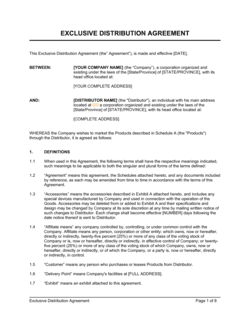
If exclusivity is being granted, define the territory, the channel (e.g., online only, retail only), the minimum purchase volume required to maintain exclusivity, and what happens when the minimum is missed.
💡 Set the minimum at a level the buyer can realistically achieve in Year 1, even in a conservative scenario — an unachievable minimum converts a motivated buyer into a non-exclusive one within months.
7
Set the term, renewal, and termination notice periods
Choose an initial term that reflects how long it takes both parties to recoup onboarding investment (typically 1–3 years). Set the auto-renewal mechanism and the cure period for material breaches.
💡 For a first supply relationship, a 1-year initial term with a 90-day non-renewal notice strikes a workable balance — long enough to justify investment, short enough to limit exposure if the relationship underperforms.
8
Sign before placing or accepting the first order
Both parties must execute the agreement before any Purchase Order is issued or inventory is committed. In common-law jurisdictions, a signed written agreement supersedes any prior verbal understandings or email negotiations.
💡 Use a timestamped e-signature tool to create a clear execution record — useful if the agreement is ever disputed or referenced in litigation.