1
Identify the parties and the products precisely
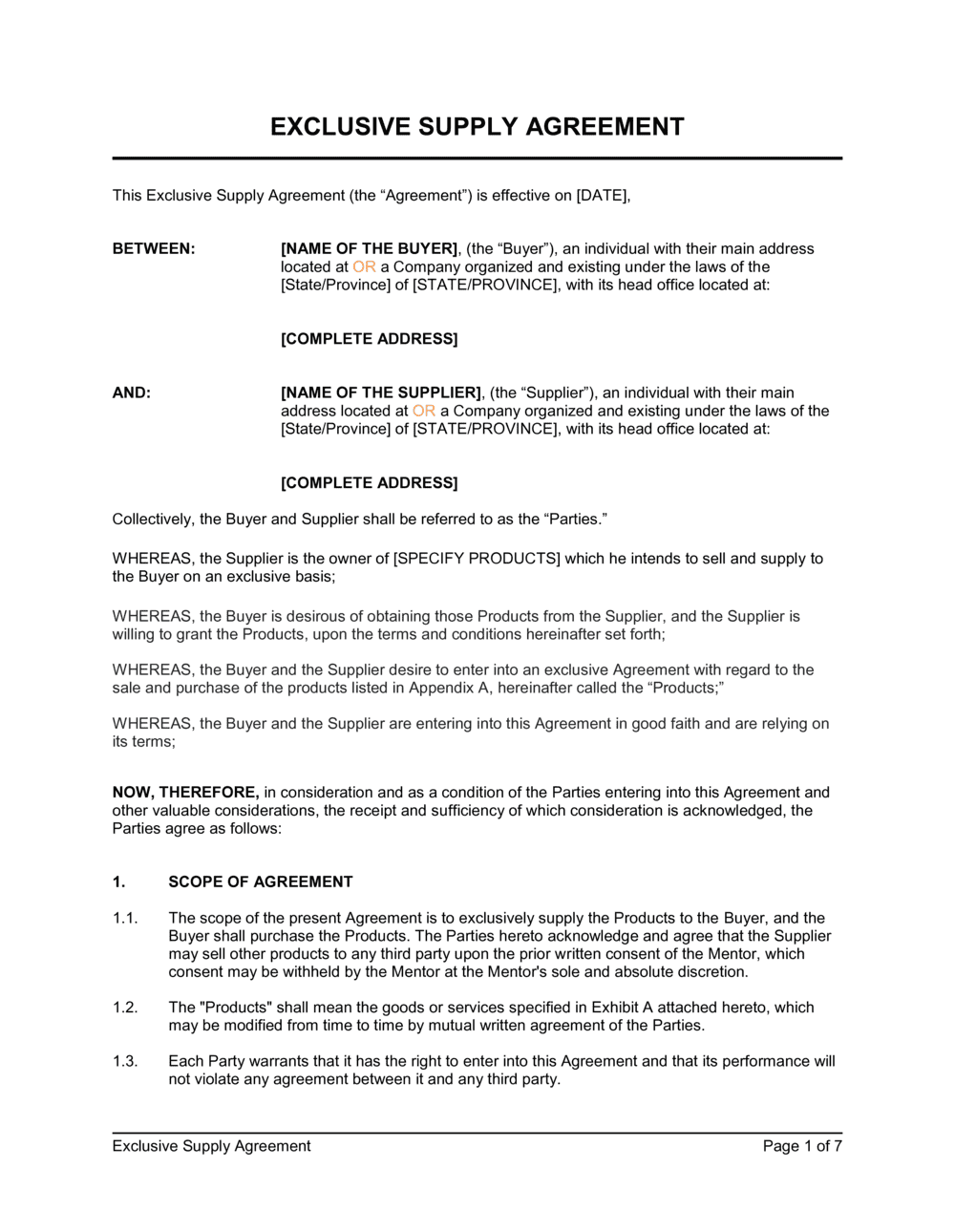
Enter the full legal names and registered addresses of both parties. Attach a product schedule (Schedule A) listing each SKU, product description, unit of measure, and applicable specification or regulatory standard. Do not rely on a general category description in the body of the agreement.
💡 Cross-reference the SKU list against the supplier's current product catalog before signing — suppliers sometimes discontinue or rename SKUs after execution, creating ambiguity about what is covered.
2
Define the exclusivity scope and territory
State clearly whether the exclusivity runs to the supplier (buyer is the sole customer), the buyer (supplier is the sole source), or both. Define the territory as precisely as possible — country, named states or provinces, or a list of postal codes.
💡 If you intend to expand the territory later, add a right-of-first-refusal clause for adjacent territories rather than leaving scope open — vague territory definitions are litigated more than any other clause in supply agreements.
3
Set minimum purchase commitments with consequences
Enter the MPC quantity or dollar value for each measurement period (monthly, quarterly, or annual). Choose a consequence for shortfall: automatic conversion to non-exclusive, a shortfall fee expressed as a percentage of the unfulfilled value, or take-or-pay payment.
💡 A quarterly MPC with a shortfall fee is more enforceable in practice than an annual MPC — quarterly measurement catches deteriorating performance 9 months earlier.
4
Complete the pricing and adjustment mechanism
Enter the unit price, currency, and Net payment terms. Choose a price adjustment formula — CPI-linked, raw-material index-linked, or fixed annual cap — and the notice period required before a price change takes effect.
💡 Index price adjustments to the specific commodity that dominates your COGS, not general CPI. A plastics supplier whose raw-material cost moves with crude oil should use a petrochemical index, not a consumer price index.
5
Specify delivery terms using an Incoterm
Select the applicable Incoterm (DAP, DDP, FOB, or CIF), the delivery location, and the lead time in business days from purchase order confirmation. Attach a delivery schedule if shipments follow a fixed cadence.
💡 DDP (Delivered Duty Paid) places all import costs on the supplier — convenient for the buyer but often refused by foreign suppliers. Negotiate DAP and take responsibility for import duties yourself if the supplier is offshore.
6
Allocate IP ownership for custom tooling and artwork
Complete Schedule B by listing any tooling, molds, dies, packaging artwork, or formulations developed for this relationship, who paid for them, and who owns them. State explicitly whether ownership transfers if the agreement terminates.
💡 If the buyer is funding tooling, include a clause requiring the supplier to deliver the tooling to the buyer or a nominated third party within 30 days of termination — without it, the supplier has no practical incentive to cooperate.
7
Set the term, renewal notice, and performance review triggers
Enter the initial term length, the rolling renewal period, and the notice deadline for non-renewal. Add a performance review clause linking continued exclusivity to cumulative MPC attainment over a trailing 12-month period.
💡 Set the renewal notice period at least 90 days before expiry — 30-day periods are too short for either party to find an alternative supplier or buyer in a specialized market.
8
Confirm governing law and dispute resolution before signing
Choose the governing jurisdiction's law based on where most of the performance occurs, not simply where the supplier is incorporated. Decide between binding arbitration and court litigation for dispute resolution and specify the forum.
💡 For cross-border agreements, institutional arbitration (ICC, AAA, LCIA) is generally faster and more enforceable internationally than pursuing a court judgment across jurisdictions.