How to Select a Supplier

Free to read β€’ Save or share with one click

FreeHow to Select a Supplier Template

At a glance

What it is
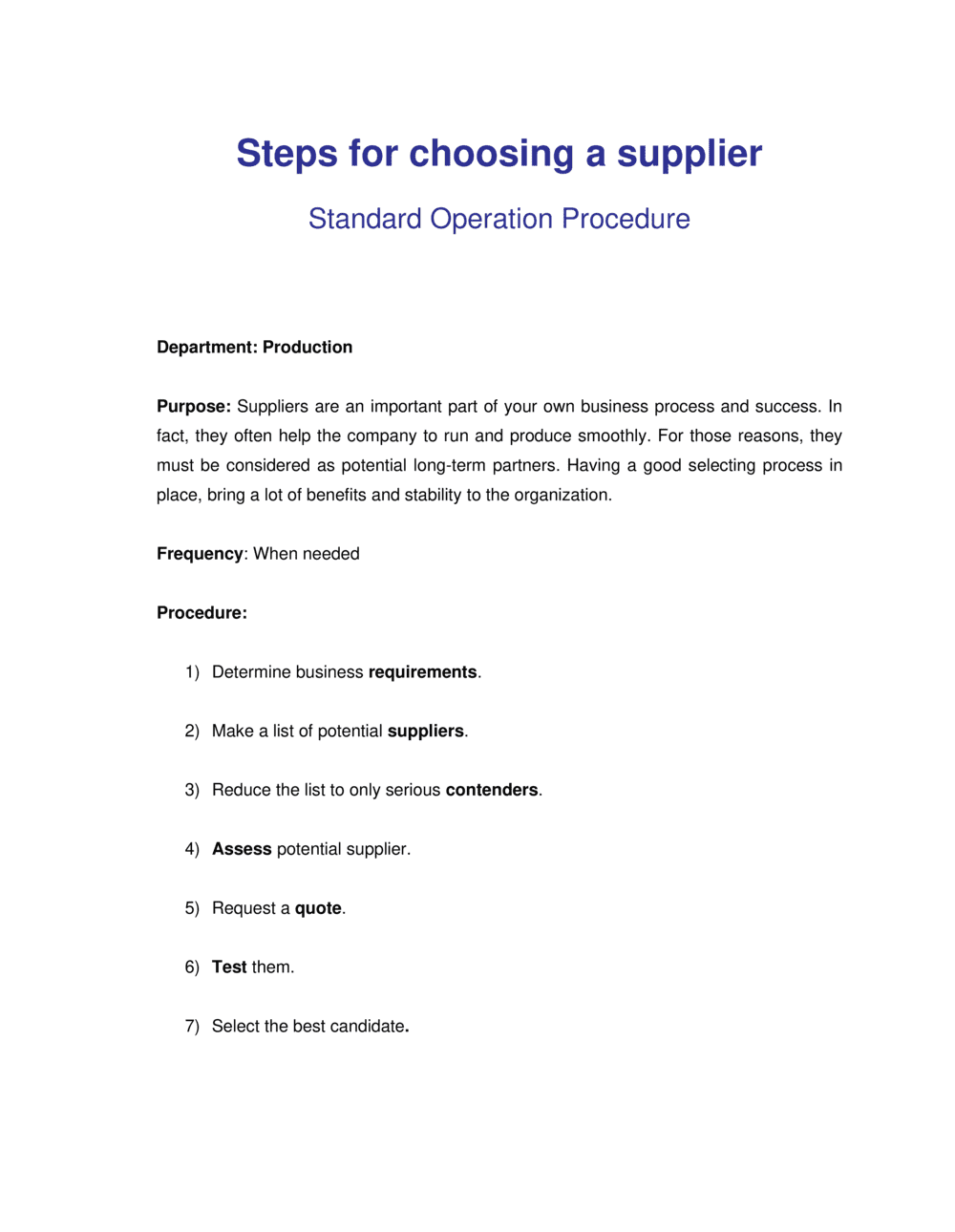
A How To Select A Supplier document is a structured operational guide that defines your organization's step-by-step process for identifying, evaluating, scoring, and approving new suppliers. This free Word download gives you a ready-to-edit framework covering criteria weighting, risk assessment, and final decision documentation β€” exportable as PDF to share with procurement teams, finance, or senior leadership.
When you need it
Use it when onboarding a new vendor, replacing an underperforming supplier, launching a new product line that requires new inputs, or formalizing a previously informal procurement process. It is also required when internal audit or ISO certification demands documented supplier qualification procedures.
What's inside
Purpose and scope, supplier identification criteria, a weighted scoring matrix, due diligence and risk assessment checklist, commercial and financial evaluation guidelines, reference and compliance checks, decision approval workflow, and onboarding handoff instructions.

What is a How To Select A Supplier document?

A How To Select A Supplier document is a structured operational procedure that defines every step your organization follows to identify, evaluate, score, and approve new vendors before committing to a commercial relationship. It codifies the evaluation criteria and their relative weights, the due diligence checks required at each stage, how competing proposals are scored and compared, and which roles hold authority to approve a new supplier at different spend levels. Rather than leaving vendor decisions to individual judgment calls, this document creates a repeatable, auditable process that produces consistent outcomes regardless of who runs the evaluation.

Why You Need This Document

Without a formal supplier selection procedure, purchasing decisions default to whoever shouts loudest, the most familiar name, or the lowest quoted price β€” none of which reliably produces the best commercial or operational outcome. The consequences are concrete: supplier failures mid-contract with no qualified alternative on standby, audit findings from customers or certification bodies that your qualification process is undocumented, and overpayment driven by single-source dependence with no competitive benchmarking. Organizations that formalize their supplier selection process typically reduce TCO by 8–15% in the first year simply by introducing competitive tension and structured TCO modeling. This template gives procurement teams, operations managers, and small business owners a ready-to-use framework that can be customized in hours and referenced every time a new supplier relationship begins.

Which variant fits your situation?

If your situation is…Use this template
Evaluating multiple competing vendors side by sideSupplier Comparison Matrix
Assessing an existing supplier's ongoing performanceSupplier Evaluation Form
Formally requesting pricing and terms from prospective suppliersRequest for Proposal (RFP)
Requesting pricing only without full proposal requirementsRequest for Quotation (RFQ)
Documenting the agreed terms once a supplier is selectedPurchase Agreement
Managing approved suppliers and their contract renewal datesVendor Management Policy
Conducting a formal audit of a shortlisted supplier's operationsSupplier Audit Checklist

Common mistakes to avoid

❌ Selecting on unit price alone

Why it matters: The lowest-quoted price frequently becomes the highest total cost once minimum order quantities, freight, payment terms, and quality failure rates are factored in. Decisions based on unit price alone regularly cost 10–20% more over a 12-month horizon.

Fix: Calculate TCO over a 12–24 month period for every shortlisted supplier, including carrying cost of safety stock required to cover the supplier's lead time variability.

❌ Skipping financial due diligence on small suppliers

Why it matters: A supplier with fewer than two years of operating history or deteriorating margins can fail mid-contract, halting your production or service delivery with no qualified alternative available.

Fix: Run a credit check or review two years of financial statements for every supplier above your defined spend threshold, regardless of relationship length or referral source.

❌ Using undefined scoring scales

Why it matters: Without anchored score definitions, two evaluators scoring the same supplier will diverge significantly, making the matrix comparison meaningless and opening the decision to bias or challenge.

Fix: Define what a 1, 3, and 5 score means for each criterion before scoring begins. Document these definitions in the scoring matrix so any team member can replicate the evaluation.

❌ No approval authority matrix

Why it matters: When approval levels are undefined, high-value supplier decisions get made by junior buyers, or routine low-risk approvals require executive sign-off and create procurement bottlenecks.

Fix: Define at least three spend tiers with a named role for each approval level, and build these thresholds into your procurement system so exceptions require documented justification.

The 10 key sections, explained

Purpose and scope

Supplier identification and longlist

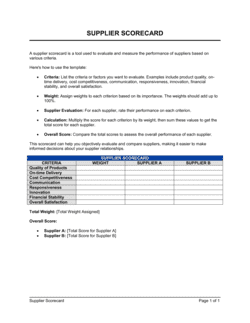
Evaluation criteria and weighting

Due diligence and risk assessment

Commercial and financial evaluation

Reference and compliance checks

Scoring, shortlist, and recommendation

Approval and decision workflow

Onboarding and handoff

Review and continuous improvement

How to fill it out

  1. 1

    Define the scope and ownership

    Fill in which spend categories, departments, and supplier types this procedure covers. Name the role responsible for initiating, executing, and approving each stage.

    πŸ’‘ Segment by spend tier β€” a $2,000 annual supplier does not need the same process depth as a $200,000 strategic vendor. Define your thresholds before you start.

  2. 2

    Set your evaluation criteria and weights

    Choose 5–8 criteria relevant to your business priorities and assign percentage weights that total 100%. Adjust weights by category β€” quality may warrant 40% for a food ingredient supplier and 15% for an office supply vendor.

    πŸ’‘ Involve at least two stakeholders (procurement and the end-user department) when setting weights β€” this prevents procurement from optimizing purely on price while operations prioritizes delivery reliability.

  3. 3

    Build the scoring matrix

    Create a table with suppliers as rows and criteria as columns. Define a 1–5 or 1–10 scoring scale with anchored descriptors β€” e.g., '5 = delivers to requested date 98%+ of the time; 1 = no reliable delivery data available.'

    πŸ’‘ Anchored scoring scales reduce scorer bias significantly. Two evaluators given the same supplier data with anchored descriptions will land within one point of each other; without anchors, variance routinely runs 3–4 points.

  4. 4

    Complete the due diligence checklist

    Work through each due diligence item β€” financial check, references, certifications, site visit β€” and document findings with dates and the name of the person who conducted each check.

    πŸ’‘ Run the financial check before investing time in a full evaluation. A supplier with a poor credit score or one year of operating history changes your risk calculus before you spend hours on scoring.

  5. 5

    Collect standardized commercial proposals

    Send the quote template to all shortlisted suppliers simultaneously and set a firm response deadline. Require pricing at two or three volume tiers to model TCO accurately.

    πŸ’‘ Tell suppliers the number of other bidders and the decision timeline β€” this improves response quality and creates competitive tension without disclosing competing prices.

  6. 6

    Document the recommendation and obtain approvals

    Complete the supplier recommendation form with total scores, risk summary, TCO comparison, and the rationale for the preferred supplier. Route for sign-off according to the approval matrix.

    πŸ’‘ Include a one-paragraph 'rejected supplier' note for each shortlisted supplier not selected. Auditors and losing bidders may request it, and having it ready saves significant time.

  7. 7

    Execute onboarding and set a performance review date

    Add the supplier to your ERP system, send the Supplier Code of Conduct, and schedule a 90-day performance review at the same time you kick off the relationship.

    πŸ’‘ Set the 90-day review in both parties' calendars at the kickoff call β€” suppliers perform differently when they know a structured evaluation is coming.

Frequently asked questions

What is a supplier selection process?

A supplier selection process is a structured series of steps an organization follows to identify, evaluate, score, and approve new vendors before placing orders. It typically includes defining evaluation criteria, requesting proposals, conducting due diligence, scoring candidates on a weighted matrix, and documenting the final decision. A formal process reduces supply chain risk, improves commercial outcomes, and creates an auditable record of how vendor decisions were made.

What criteria should I use to evaluate suppliers?

The most widely used criteria are quality and certifications, unit price and total cost of ownership, delivery reliability and lead time, financial stability, production capacity, regulatory compliance, and customer references. Criteria weights should reflect your business priorities β€” a manufacturer of safety-critical components will weight quality far higher than a retailer sourcing promotional merchandise. Aim for 5–8 criteria to keep the evaluation manageable without oversimplifying the decision.

How many suppliers should I evaluate before making a decision?

A standard approach is to longlist 8–12 candidates, shortlist 3–5 after initial screening, and request full proposals from the shortlist. For commodity categories with many qualified vendors, a three-supplier shortlist is typically sufficient. For strategic or sole-source categories, evaluating at least five candidates ensures you have genuine competitive tension and a qualified backup if your preferred supplier cannot meet terms.

What is a weighted scoring matrix and why does it matter?

A weighted scoring matrix assigns a percentage importance to each evaluation criterion and multiplies supplier scores by those weights to produce a comparable total score. It matters because it makes the selection decision transparent, repeatable, and defensible β€” anyone reviewing the matrix can see exactly why Supplier A scored higher than Supplier B. Without it, decisions default to the loudest voice in the room or the most familiar vendor name.

What due diligence should I conduct before selecting a supplier?

At a minimum, verify financial health through a credit report or two years of financial statements, contact at least two trade references, confirm that all stated certifications are current and valid, and review insurance coverage. For high-value or sole-source suppliers, a site visit or third-party audit adds a further layer of assurance. The depth of due diligence should be proportionate to the spend value and the criticality of the supply to your operations.

What is total cost of ownership (TCO) in supplier selection?

TCO is the full cost of working with a supplier over a defined period, including unit price, freight and logistics, quality failure and rework costs, inventory carrying costs driven by lead time variability, administrative overhead, and switching costs. A supplier quoting 10% below market on unit price can still deliver a higher TCO if their longer lead times require you to hold 30% more safety stock. Always model TCO over at least 12 months before making a final selection decision.

Do I need a formal supplier selection process for every purchase?

No β€” a full selection process is appropriate for new strategic or high-value suppliers, sole-source arrangements, and vendor categories subject to regulatory compliance requirements. Routine low-value purchases from established vendors on your approved supplier list do not require a full evaluation. Define spend and risk thresholds in your procedure so teams know when the full process applies and when a simplified review is sufficient.

How does this document relate to an RFP or RFQ?

The supplier selection procedure is the overarching process document that governs how the decision is made. An RFP (Request for Proposal) or RFQ (Request for Quotation) is a tactical tool used at one step within that process to solicit comparable proposals from shortlisted candidates. The selection procedure tells you when to issue an RFP, how to score responses, and who must approve the outcome β€” the RFP itself just collects the information.

How often should a supplier selection procedure be reviewed?

An annual review is the standard for most organizations, aligned to the fiscal year or procurement calendar. Trigger an out-of-cycle review after any significant supply chain disruption, a supplier failure that exposed a gap in your process, or a material change in regulatory requirements affecting your vendor categories. A procedure that has not been reviewed in more than 18 months is unlikely to reflect current business priorities or risk standards.

How this compares to alternatives

vs Supplier Evaluation Form

A supplier evaluation form assesses an existing supplier's ongoing performance against agreed KPIs β€” quality, delivery, responsiveness, and commercial compliance. A supplier selection document governs the process of choosing a new supplier before any commercial relationship exists. Use the selection procedure first; use the evaluation form on a quarterly or annual basis once the supplier is active.

vs Request for Proposal (RFP)

An RFP is the document you send to shortlisted suppliers to collect structured proposals. The supplier selection procedure is the governance framework that defines when to issue an RFP, how to score responses, and who approves the outcome. An RFP without a selection procedure produces proposals you cannot compare consistently; a selection procedure without an RFP gives you no standardized data to score.

vs Purchase Agreement

A purchase agreement is the legally binding contract that documents the terms agreed with the chosen supplier β€” price, quantity, delivery, warranties, and liability. The supplier selection procedure is the process that determines which supplier receives that contract. Complete the selection process first; execute the purchase agreement once a supplier is approved and terms are negotiated.

vs Vendor Management Policy

A vendor management policy governs the entire lifecycle of supplier relationships β€” selection, performance monitoring, contract renewal, and off-boarding. A supplier selection document focuses exclusively on the qualification and decision-making stage at the front of that lifecycle. Organizations with a mature procurement function typically need both: the policy as the overarching framework and the selection document as the detailed procedure for one critical stage within it.

Industry-specific considerations

Manufacturing

Component quality certifications, lead time and capacity verification, and multi-tier supply chain risk assessment are central to the evaluation β€” a single unqualified sub-supplier can halt a production line.

Retail and E-commerce

Minimum order quantities, seasonal capacity commitments, and landed cost modeling (unit price plus freight plus duties) drive the TCO comparison; ESG and ethical sourcing compliance is increasingly required by large retail buyers.

Healthcare and Life Sciences

FDA-registered or CE-certified suppliers, documented quality management systems, and supplier qualification records are regulatory requirements β€” not optional enhancements β€” for any supplier of materials or services touching a regulated product.

Professional Services and Consulting

Supplier selection applies to subcontractors, technology vendors, and specialist consultants; evaluation focuses on expertise, availability, data security practices, and contractual liability coverage rather than physical goods quality.

Template vs pro β€” what fits your needs?

PathBest forCostTime
Use the templateSmall and mid-size businesses formalizing procurement for the first time, or teams documenting an existing informal processFree2–4 hours to customize and complete
Template + professional reviewOrganizations seeking ISO 9001 certification or responding to a customer audit that requires documented supplier qualification procedures$300–$800 for a procurement consultant or quality manager review1–3 days
Custom draftedEnterprise procurement teams managing regulated supply chains, multi-tier supplier networks, or categories with significant ESG and compliance reporting requirements$2,000–$8,000 for a supply chain consultant or procurement specialist engagement2–6 weeks

Glossary

Weighted Scoring Matrix
A table that assigns a percentage weight to each evaluation criterion and multiplies supplier scores by those weights to produce a comparable total score.
Approved Supplier List (ASL)
A maintained register of vendors that have passed the organization's qualification process and are authorized to receive purchase orders.
Due Diligence
The process of verifying a supplier's financial health, legal standing, operational capacity, and compliance before entering a commercial relationship.
Total Cost of Ownership (TCO)
The full cost of working with a supplier, including unit price, shipping, quality failure costs, switching costs, and administrative overhead β€” not just the quoted price.
Lead Time
The elapsed time from placing a purchase order to receiving the goods or services, used to assess a supplier's delivery reliability.
Single-Source Risk
The operational exposure created by relying on one supplier for a critical input, with no qualified alternative in place.
Supplier Qualification
The formal process of verifying that a potential supplier meets the minimum quality, financial, and compliance standards required to be added to the approved supplier list.
Request for Information (RFI)
A preliminary document sent to prospective suppliers to gather general capability and capacity information before issuing a formal RFP or RFQ.
Compliance Certificate
Documentation from a supplier confirming adherence to specific standards β€” such as ISO 9001, conflict minerals regulations, or food safety certifications.
Switching Cost
The time, money, and operational disruption involved in replacing one supplier with another, used to quantify dependency risk in the selection decision.

Part of your Business Operating System

This document is one of 3,000+ business & legal templates included in Business in a Box.

  • Fill-in-the-blanks β€” ready in minutes
  • Compatible with all office suites
  • Export to PDF and share electronically

Create your document in 3 simple steps.

From template to signed document β€” all inside one Business Operating System.
1
Download or open template

Access over 3,000+ business and legal templates for any business task, project or initiative.

2
Edit and fill in the blanks with AI

Customize your ready-made business document template and save it in the cloud.

3
Save, Share, Send, Sign

Share your files and folders with your team. Create a space of seamless collaboration.

Save time, save money, and create top-quality documents.

β˜…β˜…β˜…β˜…β˜…

"Fantastic value! I'm not sure how I'd do without it. It's worth its weight in gold and paid back for itself many times."

Managing Director Β· Mall Farm
Robert Whalley
Managing Director, Mall Farm Proprietary Limited
β˜…β˜…β˜…β˜…β˜…

"I have been using Business in a Box for years. It has been the most useful source of templates I have encountered. I recommend it to anyone."

Business Owner Β· 4+ years
Dr Michael John Freestone
Business Owner
β˜…β˜…β˜…β˜…β˜…

"It has been a life saver so many times I have lost count. Business in a Box has saved me so much time and as you know, time is money."

Owner Β· Upstate Web
David G. Moore Jr.
Owner, Upstate Web

Run your business with a system β€” not scattered tools

Stop downloading documents. Start operating with clarity. Business in a Box gives you the Business Operating System used by over 250,000 companies worldwide to structure, run, and grow their business.

Start freeΒ Β·Β No credit card required