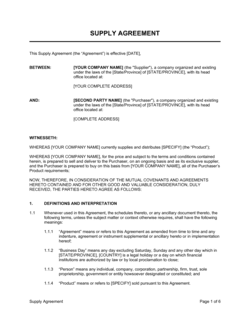
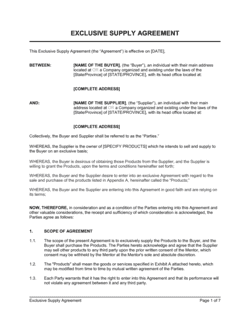
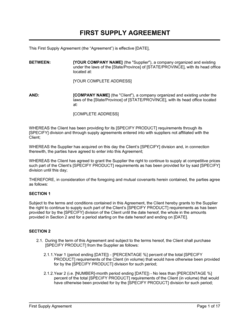
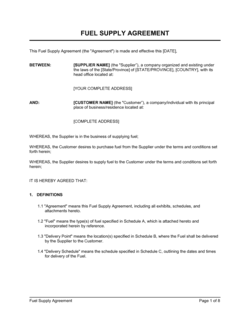
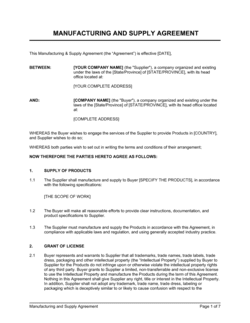
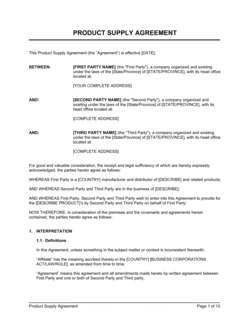
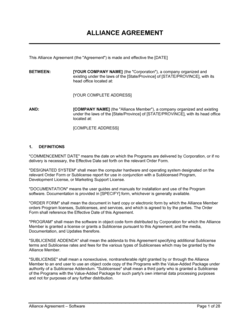
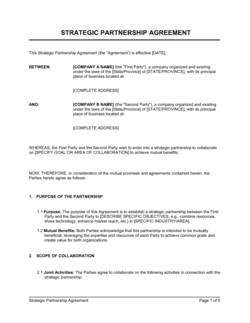
Strategic Alliance and Supply Agreement Template

Free Word download β€’ Edit online β€’ Save & share with Drive β€’ Export to PDF

38 pagesβ€’40–55 min to fillβ€’Difficulty: Expert
Learn more ↓
FreeStrategic Alliance and Supply Agreement Template

At a glance

What it is
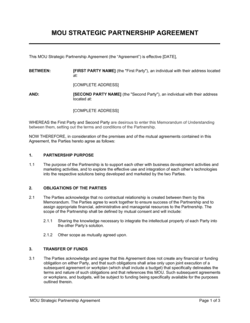
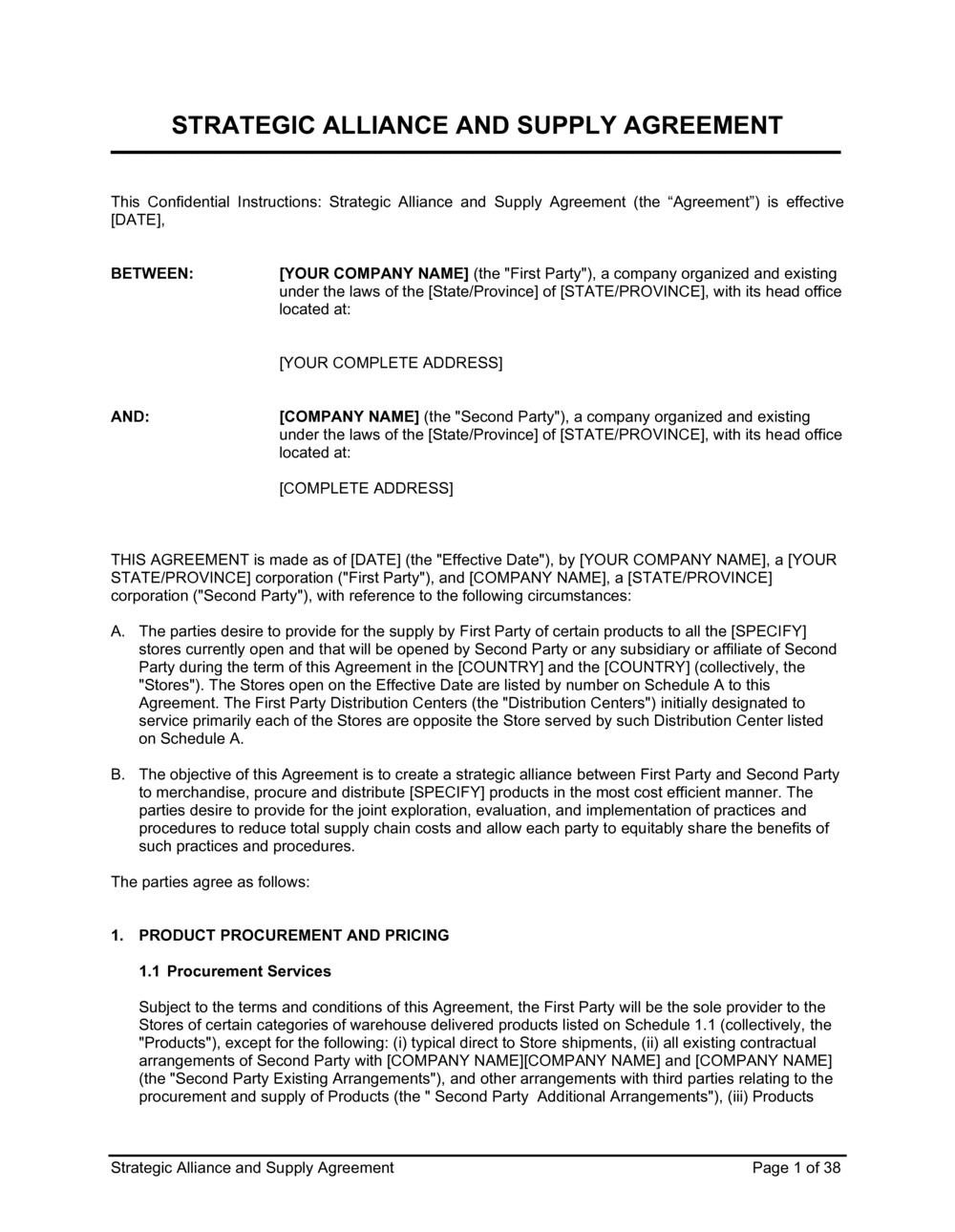
A Strategic Alliance and Supply Agreement is an operational document that formalizes a business partnership in which one party commits to supply goods or services to another on defined terms, while both parties agree to coordinate strategically toward shared commercial goals. This free Word download covers pricing structures, supply volumes, exclusivity, quality standards, IP use, and exit provisions in a single structured template you can edit online and share with counterparties.
When you need it
Use it when two businesses are moving beyond a standard vendor relationship into a coordinated supply arrangement β€” such as a preferred-supplier designation, a co-distribution deal, or a joint go-to-market partnership backed by committed supply volumes. It is also appropriate when an existing informal alliance needs to be documented before a new product launch, market expansion, or investment event.
What's inside
The template covers the alliance objectives, supply obligations and forecasts, pricing and payment terms, quality and compliance standards, intellectual property licensing, exclusivity provisions, performance metrics, and termination procedures. Supporting sections on dispute resolution and confidentiality round out the document.

What is a Strategic Alliance and Supply Agreement?

A Strategic Alliance and Supply Agreement is an operational document that formalizes both the transactional mechanics of a supply relationship and the broader partnership framework that surrounds it. It defines what one party will supply, at what price and volume, to what quality standard, and on what delivery schedule β€” while also aligning both parties around shared commercial objectives such as market expansion, product co-development, or joint distribution. Unlike a standard purchase order or basic vendor contract, this document includes alliance governance provisions, exclusivity terms, performance KPIs, and an IP licensing section that reflect the deeper interdependency of a strategic supply relationship. The free Word download covers all major sections and can be edited online and exported as PDF for counterparty review.

Why You Need This Document

Operating a strategic supply relationship on informal terms or a basic purchase order exposes both parties to significant operational and commercial risk. Without defined minimum volumes and exclusivity conditions, a supplier cannot safely allocate production capacity β€” leading to stock-outs at critical moments. Without a price adjustment mechanism, a multi-year commitment becomes economically unworkable within a year of signing. Without performance KPIs linked to remedies, there is no contractual lever to address chronic late deliveries or quality failures before they damage your own customers. For buyers building a product or go-to-market strategy around a key supplier's capabilities, an undocumented or loosely documented relationship also creates material risk when raising capital β€” investors and acquirers routinely require evidence of committed supply before closing. This template gives both parties a structured, enforceable framework that protects the supply relationship while preserving the flexibility to adapt as the alliance matures.

Which variant fits your situation?

If your situation is…Use this template
Simple recurring supply of standard goods with no strategic coordinationSupply Agreement
Two companies sharing revenue and resources on a joint projectJoint Venture Agreement
Distributing a supplier's products under your own brandDistribution Agreement
Licensing a partner's intellectual property for use in your supply chainIntellectual Property License Agreement
Short-term purchase of a defined quantity of goods at a fixed pricePurchase Agreement
Engaging a supplier as an exclusive reseller in a specific territoryExclusive Distribution Agreement
Coordinating marketing activities alongside supply without binding volume commitmentsStrategic Partnership Agreement

Common mistakes to avoid

❌ Vague alliance objectives with no measurable milestones

Why it matters: Without measurable goals, neither party can determine whether the alliance is succeeding or use underperformance as a basis for renegotiation or exit.

Fix: Write at least two SMART objectives β€” specific, measurable, time-bound β€” in the objectives section and reference them in the KPI schedule.

❌ No binding horizon on the rolling purchase forecast

Why it matters: A forecast with no binding window gives the supplier no production commitment, so they cannot safely allocate capacity β€” leading to stock-outs and missed deliveries.

Fix: Specify that the first four to eight weeks of every rolling forecast constitute a binding purchase order, aligned to the supplier's lead time.

❌ Multi-year fixed pricing with no adjustment clause

Why it matters: Raw material cost increases or currency movements can make a fixed price unworkable within a year, pushing the supplier to cut quality or breach the agreement.

Fix: Include a price adjustment mechanism tied to a published index with a cap per period β€” this preserves price predictability for the buyer while giving the supplier a cost-pass-through safety valve.

❌ Exclusivity with no linked minimum purchase commitment

Why it matters: A supplier who grants exclusivity but receives no volume guarantee may miss revenue from other customers they turned away, with no contractual remedy.

Fix: Tie exclusivity directly to a minimum annual purchase commitment, with automatic reversion to non-exclusive status if the commitment is missed in any contract year.

❌ Performance KPIs with no defined consequence

Why it matters: Metrics that carry no remedy give the underperforming party no contractual pressure to improve and make the whole performance section unenforceable in practice.

Fix: Add a clear remedy for each KPI breach β€” such as a price credit, a cure period, or a right to dual-source β€” and specify how many consecutive missed periods trigger a termination-for-cause right.

❌ Auto-renewal notice period shorter than internal approval cycle

Why it matters: Procurement teams routinely miss short notice windows, locking the company into another multi-year term at pricing it intended to renegotiate.

Fix: Set the auto-renewal notice period at 90 days minimum and add a calendar reminder obligation for the buyer's procurement lead at the time of signing.

The 10 key sections, explained

Alliance objectives and scope

Supply obligations and forecasting

Pricing, payment terms, and adjustments

Quality standards and compliance

Exclusivity and preferred-supplier terms

Intellectual property and branding

Performance metrics and review

Term, renewal, and termination

Confidentiality and data sharing

Dispute resolution and governing law

How to fill it out

  1. 1

    Define the alliance scope and objectives

    Start by writing one or two specific, measurable commercial objectives that both parties are agreeing to pursue β€” such as a revenue target, a market entry milestone, or a product launch date. Tie these to the supply categories and territories covered.

    πŸ’‘ If you cannot write a measurable objective in one sentence, the alliance is not yet defined clearly enough to document.

  2. 2

    Specify supply obligations and the forecasting cadence

    Enter the product or service description, minimum delivery quantities, and the rolling forecast period. Confirm whether the first four or eight weeks of each forecast will be treated as binding purchase orders.

    πŸ’‘ Align the binding horizon of the rolling forecast with the supplier's production lead time β€” if lead time is six weeks, the binding window should be at least six weeks.

  3. 3

    Complete the pricing and payment terms

    Enter the initial unit price, payment terms (e.g., Net 30 from invoice date), and the price adjustment mechanism β€” index reference, trigger threshold, and cap per adjustment period.

    πŸ’‘ Anchor the price adjustment formula to a publicly available index (e.g., the US PPI for the relevant commodity) so neither party can manipulate the trigger.

  4. 4

    Attach a signed product specification schedule

    Draft Schedule A with the full technical specification β€” dimensions, materials, tolerances, testing standards, and applicable certifications. Both parties should sign the schedule at the same time as the main agreement.

    πŸ’‘ Version-control the specification schedule (e.g., Schedule A v1.0, dated [DATE]) so future revisions are tracked and agreed in writing.

  5. 5

    Set exclusivity terms and minimum purchase commitments

    Decide whether exclusivity is appropriate and, if so, define the territory, product category, and the minimum purchase volume that maintains it. Link the loss of exclusivity directly to a shortfall in that commitment.

    πŸ’‘ Express the minimum commitment as a dollar value rather than a unit count when prices are subject to adjustment β€” this prevents volume gaming as prices change.

  6. 6

    Define KPIs and the review schedule

    List four to six measurable KPIs in Schedule B β€” delivery rate, defect rate, forecast accuracy, and any revenue or market-share targets. Set a quarterly review meeting and define the consequence for missing any KPI for two or more consecutive periods.

    πŸ’‘ Include an escalation matrix naming the specific executive on each side responsible for quarterly reviews β€” named accountability reduces the chance reviews are skipped.

  7. 7

    Set the term, renewal notice, and termination triggers

    Enter the start date, initial term length, auto-renewal provisions, and the notice period required to prevent renewal. Add termination-for-cause triggers for material breach, insolvency, and persistent SLA failure.

    πŸ’‘ Set the auto-renewal notice period at least 30 days longer than your internal procurement approval cycle to avoid accidental lock-in.

  8. 8

    Confirm governing law and the dispute resolution process

    Choose a governing jurisdiction acceptable to both parties and define the dispute escalation steps β€” starting with senior-management negotiation, then mediation or arbitration if unresolved within 30 days.

    πŸ’‘ If the parties are in different countries, consider a neutral arbitration seat (e.g., Singapore or New York) rather than defaulting to the jurisdiction of whichever party drafted the agreement.

Frequently asked questions

What is a strategic alliance and supply agreement?

A strategic alliance and supply agreement is an operational document that combines a preferred-supplier commitment with a broader partnership framework. It sets out what goods or services the supplier will provide, at what price and volume, while also aligning both parties around shared commercial goals β€” such as a joint market entry, a co-developed product line, or a distribution expansion. Unlike a standard purchase order or supply contract, it includes alliance governance, performance metrics, and exclusivity provisions that reflect a longer-term strategic relationship.

How is this different from a standard supply agreement?

A standard supply agreement governs the transactional mechanics of a vendor relationship β€” price, delivery, and quality. A strategic alliance and supply agreement adds a partnership layer: shared objectives, KPIs tracked at the executive level, exclusivity arrangements, IP licensing, and joint market development obligations. The strategic layer makes the document more complex but also creates a stronger mutual commitment that supports multi-year planning and investment by both sides.

When should two companies sign this type of agreement?

Sign this agreement when the supply relationship involves strategic dependency β€” for example, when one party is building a product or go-to-market strategy around the other's components or capabilities, when exclusivity is being granted or requested, or when both parties are investing in joint product development or co-marketing. It is also appropriate before a funding round when investors want evidence of committed supply and commercial partnerships.

Does this agreement need to be signed by both parties to be effective?

Yes. While this template does not require notarization, both parties should sign before either begins performing obligations under the agreement. A countersigned copy creates a clear effective date and ensures both parties have reviewed and accepted the terms. Using an e-signature tool with timestamped execution records is strongly recommended for multi-party agreements involving cross-border partners.

What should the pricing section include?

The pricing section should state the initial unit price or pricing schedule, the invoice currency, payment terms (e.g., Net 30 from invoice date), and the mechanism for future price adjustments β€” including the index or benchmark used, the adjustment frequency, and a cap per adjustment period. For long-term agreements, omitting the adjustment mechanism is one of the most common and costly drafting errors.

How should exclusivity be structured in this agreement?

Exclusivity should specify the product category, geographic territory, and duration β€” and it must be linked to a minimum purchase commitment that the buyer must meet to maintain exclusive status. Without this linkage, the supplier has no protection against a buyer who takes exclusivity, blocks competitors, and then fails to generate the expected volume. Automatic reversion to non-exclusive status upon commitment shortfall is a standard safeguard.

What happens when one party fails to meet performance KPIs?

The agreement should define a tiered remedy structure: first, a written notice and a 30-day cure period; then, if the KPI breach continues, a price credit, a right to dual-source from an alternative supplier, or a right to terminate for cause. KPIs without linked remedies are aspirational targets rather than enforceable obligations, so the consequence structure is as important as the metrics themselves.

Can this template be used for international supply arrangements?

Yes, with appropriate modifications to the governing law and dispute resolution sections. For cross-border arrangements, choose a neutral arbitration seat rather than the jurisdiction of either party, specify the currency for all payment and penalty calculations, and confirm that any exclusivity provisions comply with competition law in the relevant markets. Import/export control obligations and customs documentation requirements should be addressed in the supply obligations section or a dedicated addendum.

How long should the initial term of this agreement be?

Initial terms of two to three years are typical for strategic supply alliances where both parties are making meaningful investment in the relationship. Shorter terms (one year) work for lower-stakes preferred supplier arrangements where flexibility is more valuable than commitment. Longer terms (five or more years) are appropriate when the supplier is investing in dedicated capacity or tooling and needs revenue certainty to justify the capital outlay.

How this compares to alternatives

vs Distribution Agreement

A distribution agreement governs the resale of a supplier's products through a distributor's sales channels β€” the distributor buys and resells, taking on inventory risk. A strategic alliance and supply agreement governs direct supply to the buying party for internal use or integration, not resale. The commercial model, margin structure, and risk allocation are fundamentally different.

vs Joint Venture Agreement

A joint venture creates a new shared legal entity or project in which both parties contribute capital, share profits, and bear joint liability. A strategic alliance and supply agreement keeps both parties as independent entities with defined obligations to each other β€” there is no shared entity, no pooled capital, and no joint profit distribution. Use a joint venture when the collaboration produces shared revenue; use this template when one party is supplying the other.

vs Strategic Partnership Agreement

A strategic partnership agreement focuses on coordination, co-marketing, and aligned commercial activities without binding supply commitments. A strategic alliance and supply agreement adds enforceable supply volumes, pricing terms, quality SLAs, and delivery obligations to the partnership framework. If committed supply is central to the relationship, this template is the appropriate choice.

vs Purchase Agreement

A purchase agreement governs a single, defined transaction β€” a specific quantity of goods at a fixed price with a one-time delivery. A strategic alliance and supply agreement covers an ongoing supply relationship with rolling forecasts, price adjustment mechanisms, performance KPIs, and an alliance governance layer. Use a purchase agreement for a one-off buy; use this template for a multi-year supply partnership.

Industry-specific considerations

Manufacturing

Component suppliers commit to dedicated production capacity and quality certifications, with step-in rights and dual-sourcing triggers built into the SLA schedule.

Retail and e-commerce

Exclusive or preferred-supplier arrangements for private-label goods, with rolling seasonal forecasts and sell-through performance targets tied to pricing tier adjustments.

Technology and SaaS

Software or API supply agreements with uptime SLAs, data-sharing provisions under a mutual NDA, and IP licensing for jointly developed integrations.

Food and beverage

Ingredient supply with food-safety certification requirements, shelf-life and cold-chain compliance standards, and commodity price adjustment mechanisms tied to published agricultural indices.

Template vs pro β€” what fits your needs?

PathBest forCostTime
Use the templateOperations teams formalizing a preferred-supplier or co-distribution relationship with a trusted partnerFree2–4 hours to complete and align with the counterparty
Template + professional reviewArrangements involving exclusivity, significant volume commitments, IP licensing, or cross-border parties$500–$1,500 for a commercial lawyer or procurement specialist review3–7 business days
Custom draftedHigh-value multi-year supply deals, regulated industries, or alliances involving jointly developed IP with material valuation$2,000–$8,000+2–4 weeks

Glossary

Alliance Objectives
The stated commercial goals both parties agree to pursue together through the supply relationship, such as market share targets or joint product development.
Minimum Purchase Commitment
The lowest volume of goods or services the buyer contractually agrees to purchase from the supplier over a defined period.
Rolling Forecast
A buyer-provided projection of expected purchase volumes updated on a regular cadence β€” typically monthly or quarterly β€” to help the supplier plan production capacity.
Exclusivity
A restriction preventing one or both parties from entering into equivalent supply or distribution arrangements with competing parties in a defined market or territory.
Service Level Agreement (SLA)
Measurable performance standards β€” such as on-time delivery rate, defect rate, or lead time β€” that the supplier is contractually required to meet.
Preferred Supplier Status
A designation granting a supplier priority consideration for new purchase orders before the buyer solicits competing bids.
Price Adjustment Mechanism
A formula or trigger β€” such as a CPI index or raw-material cost threshold β€” that allows contract pricing to be revised without renegotiating the entire agreement.
Force Majeure
A clause excusing a party from performance obligations when supply or delivery is prevented by events outside their reasonable control, such as natural disasters or government actions.
Intellectual Property License
Permission granted by one party to the other to use specified trademarks, patents, formulas, or processes solely in connection with the supply arrangement.
Step-In Rights
A buyer's contractual right to source goods from an alternative supplier at the original contract price if the primary supplier fails to meet delivery or quality obligations.
Termination for Convenience
A provision allowing either party to end the agreement without cause by giving a defined notice period β€” typically 30 to 90 days β€” without triggering breach or penalty.

Part of your Business Operating System

This document is one of 3,000+ business & legal templates included in Business in a Box.

  • Fill-in-the-blanks β€” ready in minutes
  • 100% customizable Word document
  • Compatible with all office suites
  • Export to PDF and share electronically

Create your document in 3 simple steps.

From template to signed document β€” all inside one Business Operating System.
1
Download or open template

Access over 3,000+ business and legal templates for any business task, project or initiative.

2
Edit and fill in the blanks with AI

Customize your ready-made business document template and save it in the cloud.

3
Save, Share, Send, Sign

Share your files and folders with your team. Create a space of seamless collaboration.

Save time, save money, and create top-quality documents.

β˜…β˜…β˜…β˜…β˜…

"Fantastic value! I'm not sure how I'd do without it. It's worth its weight in gold and paid back for itself many times."

Managing Director Β· Mall Farm
Robert Whalley
Managing Director, Mall Farm Proprietary Limited
β˜…β˜…β˜…β˜…β˜…

"I have been using Business in a Box for years. It has been the most useful source of templates I have encountered. I recommend it to anyone."

Business Owner Β· 4+ years
Dr Michael John Freestone
Business Owner
β˜…β˜…β˜…β˜…β˜…

"It has been a life saver so many times I have lost count. Business in a Box has saved me so much time and as you know, time is money."

Owner Β· Upstate Web
David G. Moore Jr.
Owner, Upstate Web

Run your business with a system β€” not scattered tools

Stop downloading documents. Start operating with clarity. Business in a Box gives you the Business Operating System used by over 250,000 companies worldwide to structure, run, and grow their business.

Start freeΒ Β·Β No credit card required