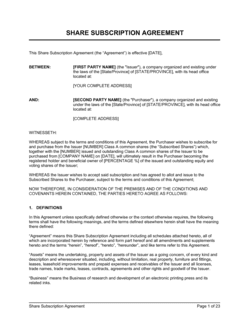
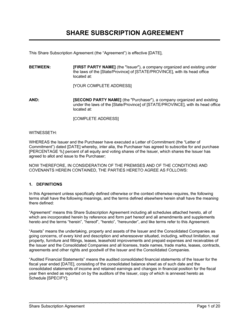
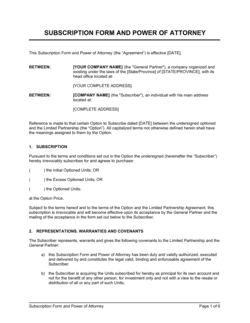
Online Subscription Agreement Template

Free Word download • Edit online • Save & share with Drive • Export to PDF

3 pages25–30 min to fillDifficulty: ComplexSignature requiredLegal review recommended
Learn more ↓
FreeOnline Subscription Agreement Template

At a glance

What it is
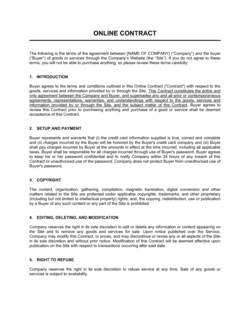
An Online Subscription Agreement is a legally binding contract between a service provider and a subscriber that governs access to a digital product or service — typically software, a SaaS platform, or recurring online content — in exchange for periodic fees. This free Word download gives you a structured, attorney-reviewed starting point covering billing cycles, acceptable use, intellectual property, data handling, and termination rights, which you can edit online and export as PDF for electronic signature.
When you need it
Use it whenever you sell access to a software product, digital platform, or recurring online service and need enforceable terms governing payment, cancellation, and liability. It is also appropriate when onboarding enterprise or B2B customers who require a negotiated, countersigned agreement rather than a clickwrap terms-of-service.
What's inside
Subscription scope and service description, billing and auto-renewal terms, acceptable use policy, intellectual property and license grant, data privacy and security obligations, confidentiality, limitation of liability, warranties and disclaimers, termination and suspension rights, and governing law and dispute resolution.

What is an Online Subscription Agreement?

An Online Subscription Agreement is a legally binding contract between a digital service provider and a subscriber that governs access to a software platform, SaaS product, or recurring online service in exchange for periodic fees. Unlike a clickwrap terms-of-service that a user accepts by clicking a button, a subscription agreement is a negotiated, countersigned document that creates specific, enforceable obligations on both sides — covering the license grant, billing and auto-renewal terms, acceptable use, intellectual property ownership, data privacy and security, uptime commitments, limitation of liability, and termination rights. It functions as the commercial and legal foundation of every B2B customer relationship built on a recurring revenue model.

Why You Need This Document

Operating a subscription-based service without a signed agreement exposes you on every front that matters commercially and legally. Without defined auto-renewal terms, subscribers dispute renewal charges and payment processors side with them — resulting in chargebacks, lost revenue, and account flags. Without an IP ownership clause, ambiguity over who owns data uploaded to your platform becomes a litigation risk the moment a high-value customer churns. Without a limitation-of-liability cap, a single data-security incident can expose you to damages far exceeding the contract value. And without a post-termination data clause, enterprise and EU-based buyers will stall or kill the deal entirely during procurement review. A properly drafted online subscription agreement closes all of these gaps before the first invoice goes out — protecting your revenue, your platform, and your ability to scale customer relationships without renegotiating terms one deal at a time.

Which variant fits your situation?

If your situation is…Use this template
Selling SaaS to enterprise clients requiring a negotiated, countersigned contractOnline Subscription Agreement
Offering a self-serve consumer product where clickthrough acceptance is sufficientTerms of Service Agreement
Licensing perpetual software without a recurring subscription modelSoftware License Agreement
Granting temporary access to software for evaluation before purchaseSoftware Evaluation Agreement
Providing API access to developers building on your platformAPI License Agreement
Engaging a vendor as a SaaS subscriber requiring a data processing addendumData Processing Agreement
Reselling a third-party SaaS platform to your own clientsReseller Agreement

Common mistakes to avoid

❌ Referencing a live URL for the service description without archiving it

Why it matters: The provider can update the website at any time, silently removing or downgrading features the subscriber believed were contractually included. This creates a breach of contract claim the provider cannot easily defend.

Fix: Attach a dated exhibit or screenshot of the service description at signing, and include a change-notification clause requiring advance written notice of material feature changes.

❌ No defined cancellation notice window for auto-renewal

Why it matters: Without a specific notice period, both parties interpret 'reasonable notice' differently. Disputed auto-renewals are one of the most common SaaS billing complaints to consumer protection agencies.

Fix: State the cancellation window explicitly — '30 days prior written notice before the end of the then-current term' — and bold or highlight it in any customer-facing version to meet FTC and EU auto-renewal disclosure requirements.

❌ Failing to include a post-termination data return or deletion clause

Why it matters: Enterprise buyers and EU-based subscribers are increasingly required by their own data governance policies to confirm how and when their data will be handled at contract end. Missing this clause stalls sales cycles and creates GDPR compliance exposure.

Fix: Add a clause specifying a 30-day window post-termination during which the subscriber may export data, after which the provider will delete it within a stated timeframe and, upon request, provide written confirmation of deletion.

❌ Using a mutual liability cap that is commercially disproportionate

Why it matters: Capping both parties' liability at 12 months of subscription fees sounds balanced, but if the provider suffers a data breach exposing the subscriber's customer records, the subscriber's losses can dwarf the fee cap — leaving them effectively uncompensated.

Fix: Carve out data breach, confidentiality violations, and IP indemnification claims from the mutual cap, or negotiate a higher cap for data-security incidents specifically. Enterprise buyers will push for this regardless.

❌ No authorized-user limit in the license grant

Why it matters: A single-seat subscription shared across a 50-person team represents lost revenue and, in competitive markets, gives the subscriber's organization-wide access to the platform without paying for it.

Fix: Define authorized users in the license grant and cross-reference a Schedule A that specifies the seat count tied to the subscription fee. Make credential sharing an explicit material breach trigger.

❌ Choosing governing law without checking enforceability in the subscriber's jurisdiction

Why it matters: Selecting a US state's governing law does not override mandatory EU consumer protection law, GDPR, or the subscriber's local statutory rights. A governing-law clause that ignores this exposes the provider to regulatory action in the subscriber's home jurisdiction.

Fix: Include a carve-out stating that nothing in the governing-law clause overrides mandatory local law in the subscriber's jurisdiction, and engage local counsel before expanding into the EU, UK, or Canada at scale.

The 10 key clauses, explained

Parties, service description, and subscription scope

In plain language: Identifies the provider and subscriber as legal entities and defines exactly which product, plan tier, and features are covered by the agreement.

Sample language
This Online Subscription Agreement ('Agreement') is entered into as of [EFFECTIVE DATE] between [PROVIDER LEGAL NAME], a [STATE] [ENTITY TYPE] ('Provider'), and [SUBSCRIBER LEGAL NAME] ('Subscriber'). Provider will make available to Subscriber the [PRODUCT NAME] subscription service, [PLAN TIER], as described at [URL] ('Service').

Common mistake: Referencing a website URL for the service description without archiving the page contents — the provider can change the description, and the subscriber loses a key term without notice.

License grant and restrictions

In plain language: Grants the subscriber a limited right to use the service for internal business purposes and lists what the subscriber may not do — reverse engineer, resell, or exceed seat limits.

Sample language
Provider grants Subscriber a non-exclusive, non-transferable, revocable license to access and use the Service solely for Subscriber's internal business operations during the Subscription Term. Subscriber shall not: (a) sublicense or resell access; (b) reverse engineer or decompile the Service; (c) exceed the number of authorized users set out in Schedule A.

Common mistake: Failing to cap the number of authorized users in the license grant, allowing a single-seat purchase to be shared across an entire organization.

Subscription fees, billing, and auto-renewal

In plain language: States the subscription price, billing frequency, accepted payment methods, what happens on failed payment, and the auto-renewal and cancellation notice window.

Sample language
Subscriber shall pay the Subscription Fee of $[AMOUNT] per [month/year], billed in advance on the [BILLING DATE]. Fees are non-refundable except as set out in Section [X]. This Agreement automatically renews for successive [TERM LENGTH] periods unless either party provides written notice of non-renewal at least [30] days before the end of the then-current term.

Common mistake: Not specifying the cancellation notice window. Without a defined window, subscribers claim they cancelled in time and providers claim they did not — resulting in disputed charges.

Acceptable use and prohibited conduct

In plain language: Lists specific behaviors that violate the terms and authorizes the provider to suspend or terminate access immediately if the subscriber engages in them.

Sample language
Subscriber shall not use the Service to: (a) transmit malware or unauthorized data; (b) violate applicable law; (c) harvest or scrape data from the Service; (d) interfere with the Service's infrastructure. Provider may suspend access immediately upon detection of prohibited use without liability.

Common mistake: Drafting an AUP that is so broad it could be read to prohibit legitimate competitive benchmarking or API integrations the subscriber reasonably expects to use.

Intellectual property ownership

In plain language: Confirms that the provider retains all rights to the platform, software, and content while the subscriber retains ownership of its own data uploaded to the service.

Sample language
Provider retains all right, title, and interest in and to the Service, including all underlying software, documentation, and improvements. Subscriber retains all right, title, and interest in Subscriber Data. Nothing in this Agreement transfers ownership of either party's intellectual property to the other.

Common mistake: Omitting a clause on what happens to subscriber data at termination — courts and regulators increasingly require providers to specify a data return or deletion window.

Data privacy, security, and confidentiality

In plain language: Commits the provider to handling subscriber data in accordance with its privacy policy and applicable law, and imposes mutual confidentiality obligations on both parties.

Sample language
Provider shall process Subscriber Data in accordance with its Privacy Policy located at [URL] and applicable data protection law. Each party agrees to protect the other's Confidential Information using at least the same degree of care it uses to protect its own, and no less than reasonable care.

Common mistake: Referencing a live privacy policy URL without versioning or locking the policy at signing — provider policy updates can silently change how subscriber data is handled.

Uptime SLA and service credits

In plain language: Defines the provider's availability commitment and the subscriber's sole remedy — typically service credits — when that commitment is not met.

Sample language
Provider shall use commercially reasonable efforts to maintain Service availability of at least [99.9]% per calendar month ('Uptime Commitment'), excluding scheduled maintenance. If Provider fails to meet the Uptime Commitment, Subscriber shall be entitled to a service credit equal to [X]% of the monthly fee for each [Y] minutes of excess downtime, up to a maximum of [Z]% of monthly fees.

Common mistake: Making the SLA the subscriber's 'sole and exclusive remedy' without providing a meaningful credit formula — a 1% credit for 4 hours of downtime is not a genuine remedy and can be challenged.

Limitation of liability and disclaimer of warranties

In plain language: Caps the provider's total liability and disclaims implied warranties — including fitness for a particular purpose — while preserving the subscriber's rights that cannot be waived by law.

Sample language
TO THE MAXIMUM EXTENT PERMITTED BY LAW, PROVIDER'S TOTAL LIABILITY FOR ANY CLAIMS ARISING UNDER THIS AGREEMENT SHALL NOT EXCEED THE FEES PAID BY SUBSCRIBER IN THE [12] MONTHS PRECEDING THE CLAIM. IN NO EVENT SHALL EITHER PARTY BE LIABLE FOR INDIRECT, INCIDENTAL, OR CONSEQUENTIAL DAMAGES. THE SERVICE IS PROVIDED 'AS IS' WITHOUT WARRANTY OF ANY KIND.

Common mistake: Writing a mutual limitation of liability when the cap is commercially asymmetric — a subscriber paying $500/month should not face the same $500 liability cap as the provider for a data breach causing millions in harm.

Term, termination, and suspension

In plain language: Defines the agreement's initial term, grounds for termination by either party, what happens to access and data upon termination, and the provider's right to suspend for non-payment.

Sample language
This Agreement commences on the Effective Date and continues for the Initial Subscription Term set out in Schedule A. Either party may terminate for material breach upon [30] days' written notice if the breach is not cured within that period. Provider may terminate immediately for non-payment outstanding more than [15] days after the due date or for AUP violations.

Common mistake: Not specifying a data retrieval window post-termination. GDPR Article 28 and many enterprise procurement teams require a defined period — typically 30 days — during which the subscriber can export their data before it is deleted.

Governing law, dispute resolution, and general provisions

In plain language: Specifies which jurisdiction's law governs the agreement, how disputes are resolved (arbitration or litigation), and standard boilerplate including the entire-agreement and severability clauses.

Sample language
This Agreement is governed by the laws of [STATE/COUNTRY], without regard to conflict-of-law principles. Any dispute shall be resolved by binding arbitration under the [AAA/JAMS] rules in [CITY], except that either party may seek injunctive relief in any court of competent jurisdiction. This Agreement constitutes the entire agreement between the parties.

Common mistake: Choosing a governing-law state solely for provider convenience without confirming it is enforceable — several US states and EU member countries apply local consumer and data-protection law regardless of the contract's choice-of-law clause.

How to fill it out

  1. 1

    Enter legal entity names and effective date

    Use each party's full registered legal name — not a trading name or brand. Enter the effective date as the date of last signature, not the date you drafted the document.

    💡 Confirm your entity type and registration state in your corporate registry filing before inserting it — mismatches create enforceability questions.

  2. 2

    Define the service and plan tier precisely

    Describe the specific product, plan name, and feature set covered by this agreement. If the service description is on your website, attach a dated screenshot as an exhibit rather than referencing a live URL.

    💡 Version-control your service description. Subscribers who bought a feature set expect it to stay in scope — material reductions without notice can constitute breach.

  3. 3

    Set the subscription fee, billing cycle, and auto-renewal window

    Enter the exact dollar amount, billing frequency, billing date, and the number of days' notice required to cancel before auto-renewal. Specify the currency if your customers are in multiple countries.

    💡 Many US states and the EU require auto-renewal disclosures to be 'clearly and conspicuously' presented — bold or box the renewal terms in any customer-facing version.

  4. 4

    Cap authorized users and define the license scope

    Specify the number of seats, user accounts, or API call limits included at the stated price, and reference a Schedule A for volume tiers. State explicitly that sharing credentials beyond the authorized count is a material breach.

    💡 Tying the authorized-user count to Schedule A (rather than the main body) lets you issue order forms with different seat counts without amending the master agreement.

  5. 5

    Tailor the acceptable use policy to your platform's risk profile

    List specific prohibited behaviors relevant to your service — data scraping, credential sharing, prohibited industries, or geographic restrictions. Avoid generic boilerplate that inadvertently covers legitimate use cases.

    💡 If your platform serves regulated industries (healthcare, finance), include a line confirming the subscriber is responsible for their own regulatory compliance when using the service.

  6. 6

    Complete the data privacy and security obligations

    Confirm whether you act as a data controller or data processor for subscriber data. If you process personal data on the subscriber's behalf, attach a Data Processing Addendum meeting GDPR Article 28 requirements. Reference your privacy policy by a versioned URL or attach it as an exhibit.

    💡 Enterprise and public-sector buyers almost always require a signed DPA before procurement approval — having one ready cuts the sales cycle significantly.

  7. 7

    Set the termination triggers and post-termination data window

    Define cure periods for material breach (30 days is standard), immediate-termination triggers (non-payment, AUP violation), and the window — typically 30 days — during which the subscriber can export data after termination.

    💡 Including a data-return clause voluntarily signals trustworthiness to enterprise buyers and is increasingly required by GDPR, CCPA, and standard procurement checklists.

  8. 8

    Execute before the subscriber accesses the service

    Obtain signatures from both parties — or electronic acceptance — before granting access credentials. Post-access execution creates a fresh consideration problem in common-law jurisdictions and can void restrictive clauses.

    💡 Use Business in a Box eSign to timestamp execution and store the countersigned agreement in BIB Drive alongside the applicable order form.

Frequently asked questions

What is an online subscription agreement?

An online subscription agreement is a legally binding contract between a digital service provider and a subscriber that governs access to a software platform, SaaS product, or recurring online service in exchange for periodic fees. It sets out the license grant, billing terms, acceptable use, intellectual property ownership, data handling, liability limits, and termination rights. Unlike a clickwrap terms-of-service, a countersigned subscription agreement is typically used for B2B relationships where both parties negotiate and sign a formal written contract.

What is the difference between a subscription agreement and terms of service?

Terms of service are typically clickwrap — the user accepts them by clicking a button, without negotiation or signature. They are appropriate for consumer-facing or self-serve products. A subscription agreement is a negotiated, countersigned contract used for B2B or enterprise relationships where the subscriber expects specific commitments on uptime, data security, liability, and billing. Both are legally enforceable, but the subscription agreement offers more certainty and is harder to modify unilaterally.

Is an online subscription agreement legally binding?

Yes — a properly executed online subscription agreement is generally enforceable in most jurisdictions when it contains the essential elements of a contract: offer, acceptance, and consideration. Electronic signatures are legally valid under the US ESIGN Act, the EU eIDAS Regulation, and Canada's PIPEDA-aligned provincial laws. Enforceability of specific clauses — particularly limitation-of-liability caps and non-negotiated terms — can vary by jurisdiction and the relative bargaining power of the parties.

Does a subscription agreement need to comply with GDPR?

If your subscribers are based in the European Union or the UK, and your platform processes their users' personal data, then yes — GDPR Article 28 requires a Data Processing Agreement (DPA) in place between you and each subscriber for whom you act as a data processor. The subscription agreement itself should reference or incorporate the DPA. Failing to have a DPA in place can result in regulatory fines for both the provider and the subscriber.

What should auto-renewal terms include to be enforceable?

Enforceable auto-renewal clauses should clearly state the renewal period, the notice window required to cancel (typically 30 days), the method of notice, and what happens to fees already charged if the subscriber misses the window. Several US states — including California, New York, and Illinois — have specific auto-renewal disclosure laws requiring the terms to be presented clearly and conspicuously before the subscriber agrees. The FTC's Negative Option Rule also imposes disclosure requirements for subscriptions marketed to consumers.

Can I limit my liability as a SaaS provider in a subscription agreement?

Yes, limitation-of-liability clauses are standard and generally enforceable in B2B subscription agreements in most jurisdictions. However, courts scrutinize caps that are grossly disproportionate to the potential harm — particularly for data breaches. Many enterprise buyers negotiate carve-outs from the cap for confidentiality breaches, IP indemnification, and data-security incidents. Consumer-facing agreements face additional restrictions under consumer protection laws in the EU, UK, and Australia, which may void unfair or one-sided limitations.

What happens to subscriber data when the subscription is terminated?

The agreement should specify a data export window — typically 30 days post-termination — during which the subscriber can retrieve their data, followed by a deletion or anonymization commitment from the provider. GDPR Article 28(3)(g) requires that data processors delete or return all personal data at the end of the contract and provide written confirmation upon request. Enterprise buyers increasingly require this clause as a standard procurement term, regardless of geography.

Do I need a lawyer to draft an online subscription agreement?

For straightforward B2B SaaS with standard billing and no complex data processing, a high-quality template is usually sufficient to get started. Engage a lawyer when your subscribers are enterprise clients negotiating liability caps and DPA terms, when you process sensitive personal data subject to GDPR or HIPAA, when you are expanding into the EU or UK, or when your annual contract values exceed $50,000 per customer. A 2–4 hour template review typically costs $500–$1,500 and is worthwhile before your first major enterprise deal.

What is an uptime SLA and should it be in a subscription agreement?

An uptime SLA (Service Level Agreement) is a contractual commitment specifying the minimum availability percentage — typically 99.9% per calendar month — along with the subscriber's remedy when that target is not met, usually a service credit calculated against the monthly fee. Including an uptime SLA is standard for B2B SaaS agreements and is increasingly expected by enterprise and mid-market buyers. Make the credit formula meaningful — a 1% credit for four hours of downtime provides no real relief and signals bad faith in negotiations.

How this compares to alternatives

vs Terms of Service Agreement

A terms-of-service agreement is a clickwrap document accepted unilaterally by the user — no negotiation, no signature. It is appropriate for consumer-facing or self-serve products where individual negotiation is impractical. An online subscription agreement is a negotiated, countersigned contract for B2B relationships where the subscriber expects specific uptime, data-security, and billing commitments. For enterprise sales, a terms-of-service alone is insufficient.

vs Software License Agreement

A software license agreement typically governs a perpetual license to installed software — a one-time transaction with no recurring billing. An online subscription agreement governs time-limited, recurring access to a cloud-hosted service. The subscription model means auto-renewal, ongoing service-level obligations, and data-handling responsibilities are central to the subscription agreement but largely absent from a perpetual license.

vs Data Processing Agreement

A data processing agreement is a supplementary contract governing how the provider handles personal data on behalf of the subscriber, required by GDPR Article 28 when the provider acts as a data processor. It is not a standalone access agreement — it must be used alongside a subscription agreement, not instead of one. The subscription agreement governs the commercial relationship; the DPA governs the data-handling obligations within it.

vs Service Level Agreement

A standalone service level agreement defines availability targets, incident response times, and remedies in a dedicated document, often used by managed-service providers. For most SaaS products, uptime commitments and credits are embedded directly in the subscription agreement or attached as a schedule, making a standalone SLA unnecessary unless the operational complexity warrants a separate, detailed document.

Industry-specific considerations

SaaS / Technology

Multi-seat license grants, uptime SLAs with credit formulas, API rate limits, and data processing addenda for GDPR compliance are all standard in SaaS subscription agreements.

Healthcare / HealthTech

HIPAA Business Associate Agreement requirements, data encryption and access-control commitments, and subscriber-side compliance responsibilities must be addressed explicitly when the platform handles protected health information.

Financial Services / FinTech

Regulatory data residency requirements, SOC 2 audit report sharing obligations, and enhanced confidentiality provisions for financial data are common negotiation points in fintech subscription agreements.

Education / E-Learning

FERPA compliance obligations for student data, district-level acceptable use policy alignment, and multi-tier license structures for institution-wide deployments are distinctive to education sector subscription agreements.

Jurisdictional notes

United States

Auto-renewal disclosures are regulated at the state level — California (Business & Professions Code §17601), New York, and Illinois impose specific notice and consent requirements for subscriptions marketed to consumers. The FTC's Negative Option Rule applies to subscriptions offered to consumers nationally. Limitation-of-liability clauses are generally enforceable in B2B agreements; courts scrutinize unusually low caps in cases involving data breaches or gross negligence. Choice-of-law clauses are generally enforced between commercial parties, but several states apply local law to protect their residents regardless.

Canada

PIPEDA (federal) and provincial privacy laws — including Quebec Law 25, which came into full effect in September 2023 — impose obligations on providers handling Canadian subscriber data, including mandatory breach notification and data-subject rights. Quebec Law 25 is the most stringent, requiring privacy impact assessments, data minimization, and retention schedules. Auto-renewal terms for consumer subscriptions must be clearly disclosed under provincial consumer protection acts in Ontario, Quebec, and British Columbia. French-language contract requirements apply to Quebec-based subscribers.

United Kingdom

The UK GDPR (retained post-Brexit) imposes the same Article 28 data-processor requirements as EU GDPR, requiring a signed DPA when the provider processes subscriber personal data. The Consumer Rights Act 2015 restricts unfair contract terms in B2C subscription agreements, including broad exclusion-of-liability and auto-renewal clauses. The UK's Digital Markets, Competition and Consumers Act (expected in force 2025–2026) introduces new auto-renewal notification obligations for consumer-facing subscriptions. ICO registration may be required for providers handling UK personal data.

European Union

GDPR Article 28 mandates a compliant Data Processing Agreement whenever the provider processes EU subscriber personal data as a data processor — this is non-negotiable and cannot be waived by contract. Limitation-of-liability clauses must not exclude liability for gross negligence or intentional misconduct under most member-state civil codes. The EU Unfair Contract Terms Directive restricts one-sided exclusions in B2C agreements. Standard Contractual Clauses (SCCs) are required for transfers of EU personal data to providers in non-adequate third countries, including the US unless the provider is Privacy Shield / EU-US Data Privacy Framework certified.

Template vs lawyer — what fits your deal?

PathBest forCostTime
Use the templateSaaS founders and digital service providers closing standard B2B deals below $25,000 annual contract value in a single jurisdictionFree30–60 minutes
Template + legal reviewProviders processing personal data under GDPR or HIPAA, or closing deals with enterprise buyers negotiating liability caps and DPAs$500–$1,5003–5 days
Custom draftedEnterprise SaaS with ACV above $50,000, multi-jurisdictional deployments, regulated-industry data handling, or complex multi-product licensing structures$2,000–$8,000+2–4 weeks

Glossary

Subscription Term
The defined period — monthly, annual, or multi-year — during which the subscriber is entitled to access the service.
Auto-Renewal Clause
A provision that automatically extends the subscription for another term at the end of the current period unless either party provides notice of cancellation within a specified window.
License Grant
The contractual permission the provider gives the subscriber to use the software or platform — typically non-exclusive, non-transferable, and limited to the subscriber's internal business purposes.
Acceptable Use Policy (AUP)
A schedule or clause listing prohibited uses of the service — such as scraping, reselling access, or using the platform for illegal activity — that can trigger suspension or termination.
Uptime SLA
A service-level commitment, expressed as a percentage of monthly availability (e.g., 99.9%), along with remedies such as service credits if the target is not met.
Limitation of Liability
A clause capping the provider's maximum financial exposure to the subscriber — typically limited to fees paid in the prior 12 months — and excluding consequential or indirect damages.
Data Processing Agreement (DPA)
A supplementary contract governing how the provider processes personal data on behalf of the subscriber, required under GDPR and other privacy laws when the provider acts as a data processor.
Clickwrap Agreement
A form of online contract where the user accepts terms by clicking 'I Agree' — enforceable in most jurisdictions but less robust than a countersigned written agreement for B2B relationships.
Mutual Non-Disclosure
A confidentiality obligation running in both directions — the subscriber protects the provider's pricing and technical details, and the provider protects the subscriber's business data.
Suspension Right
The provider's contractual right to disable the subscriber's access — typically for non-payment, AUP violation, or legal obligation — without terminating the agreement entirely.
Pro-Rata Refund
A partial refund calculated in proportion to unused subscription time remaining after an early cancellation or service failure.

Part of your Business Operating System

This document is one of 3,000+ business & legal templates included in Business in a Box.

  • Fill-in-the-blanks — ready in minutes
  • 100% customizable Word document
  • Compatible with all office suites
  • Export to PDF and share electronically

Create your document in 3 simple steps.

From template to signed document — all inside one Business Operating System.
1
Download or open template

Access over 3,000+ business and legal templates for any business task, project or initiative.

2
Edit and fill in the blanks with AI

Customize your ready-made business document template and save it in the cloud.

3
Save, Share, Send, Sign

Share your files and folders with your team. Create a space of seamless collaboration.

Save time, save money, and create top-quality documents.

★★★★★

"Fantastic value! I'm not sure how I'd do without it. It's worth its weight in gold and paid back for itself many times."

Managing Director · Mall Farm
Robert Whalley
Managing Director, Mall Farm Proprietary Limited
★★★★★

"I have been using Business in a Box for years. It has been the most useful source of templates I have encountered. I recommend it to anyone."

Business Owner · 4+ years
Dr Michael John Freestone
Business Owner
★★★★★

"It has been a life saver so many times I have lost count. Business in a Box has saved me so much time and as you know, time is money."

Owner · Upstate Web
David G. Moore Jr.
Owner, Upstate Web

Run your business with a system — not scattered tools

Stop downloading documents. Start operating with clarity. Business in a Box gives you the Business Operating System used by over 250,000 companies worldwide to structure, run, and grow their business.

Free Forever Plan · No credit card required