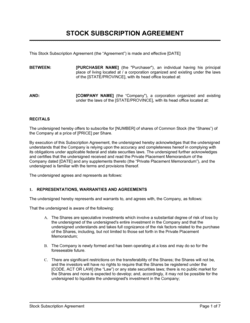
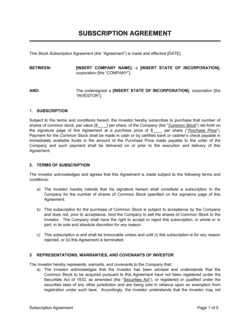
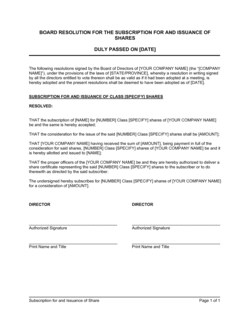
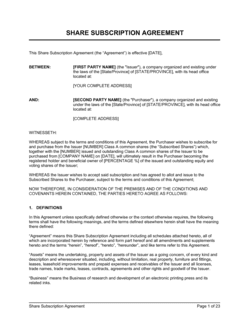
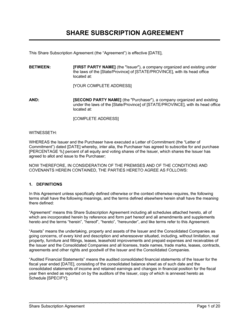
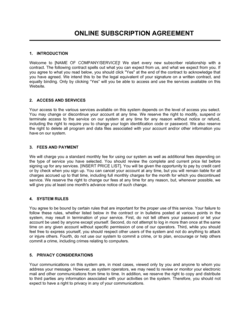
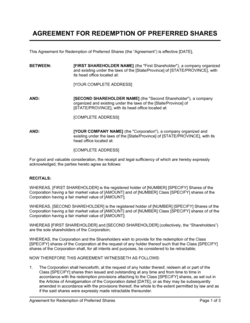
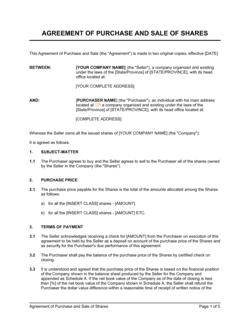
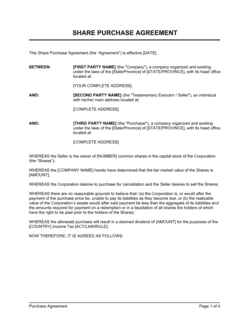
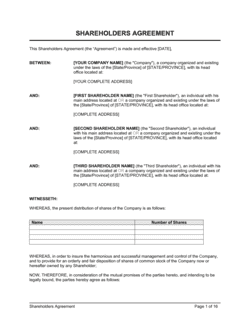
Agreement for the Subscription of Shares Template

Free Word download • Edit online • Save & share with Drive • Export to PDF

2 pages25–30 min to fillDifficulty: StandardSignature requiredLegal review recommended
Learn more ↓
FreeAgreement for the Subscription of Shares Template

At a glance

What it is
An Agreement for the Subscription of Shares is a legally binding contract between a company and one or more investors under which the company issues newly created shares and the investor commits to paying the agreed subscription price in exchange. This free Word download gives you a structured, investor-ready starting point you can edit online and export as PDF to execute at closing.
When you need it
Use it whenever a company raises capital by issuing new equity — whether in a seed round, a Series A, a private placement, or a one-off strategic investment — and needs a binding written record of the price, quantity, representations, and conditions that govern that issuance.
What's inside
Parties and recitals, subscription commitment and share price, representations and warranties from both company and investor, conditions precedent to closing, anti-dilution and pre-emption rights, use of proceeds, governing law, and signature blocks for each subscribing party.

What is an Agreement for the Subscription of Shares?

An Agreement for the Subscription of Shares is a legally binding contract between a company and one or more investors under which the company creates and issues new shares directly to the investor in exchange for payment of an agreed subscription price. Unlike a share purchase agreement — which transfers existing shares between private parties — a subscription agreement always results in new equity being created, increasing the company's total shares outstanding and diluting existing shareholders proportionally. The agreement records every material term of that issuance: the share class, quantity, price per share, representations each party makes to the other, the conditions that must be satisfied before closing, and the mechanics of how payment and allotment occur simultaneously.

Why You Need This Document

Raising capital without a signed share subscription agreement exposes both the company and the investor to serious legal and financial risk. Without it, there is no binding record of the price agreed, the conditions attached to the investment, or the representations the company made about its financial position — leaving both parties reliant on email chains and verbal understandings that courts treat as incomplete contracts. For the company, an undocumented issuance can invalidate the allotment if pre-emption rights were not properly waived, create unauthorized share issuance liability, or trigger securities law violations for failure to rely on a recognized exemption. For the investor, no written agreement means no enforceable warranty claims if the company's representations turn out to be false. A properly executed subscription agreement, signed before any funds change hands, closes all of these gaps — and this template gives you the structure to do it efficiently, whether you are closing a $50,000 angel round or a $2 million seed raise.

Which variant fits your situation?

If your situation is…Use this template
Single investor subscribing to ordinary shares at a fixed priceAgreement for the Subscription of Shares
Multiple investors subscribing in the same funding roundShareholders Agreement
Investor converting a loan into equity at a discountConvertible Note Agreement
Issuing shares to an employee or advisor under an equity planStock Option Plan
Transferring existing shares from one shareholder to anotherShare Transfer Agreement
Early-stage raise where valuation is deferredSAFE (Simple Agreement for Future Equity)
Investor acquiring a controlling stake as part of an acquisitionShare Purchase Agreement

Common mistakes to avoid

❌ No longstop date on conditions precedent

Why it matters: Without a deadline, either party can delay closing indefinitely while the other remains contractually bound, creating leverage for renegotiation as market conditions shift.

Fix: Set a specific longstop date — typically 30 to 60 days from signing — and include a mutual walk-away right if conditions remain unsatisfied by that date.

❌ Skipping pre-emption right waivers

Why it matters: Issuing new shares without following the pre-emption procedure required by the articles or an existing shareholders agreement can make the allotment voidable at the election of the bypassed shareholders.

Fix: Identify all holders of pre-emption rights before drafting, obtain written waivers, and attach them as a schedule to the agreement before execution.

❌ Omitting the investor's accredited-investor confirmation on US raises

Why it matters: Without documented accredited-investor status, the company cannot rely on Regulation D or equivalent private-placement exemptions and may be conducting an unregistered securities offering, exposing it to SEC enforcement and rescission rights.

Fix: Include a warranty from the subscriber confirming accredited-investor status under Rule 501 of Regulation D and require supporting documentation at closing.

❌ Indefinite survival of representations and warranties

Why it matters: Representations that survive without a time limit expose the company to claims years after closing, long after the factual basis for any warranty can be verified or insurance obtained.

Fix: Cap warranty survival at 12 to 24 months from closing and include a financial liability cap — typically the subscription price — for non-fraud claims.

❌ Using the wrong share class or one not yet authorized

Why it matters: Agreeing to issue preferred shares or a new class that does not exist in the articles renders the allotment void — the shares cannot legally be created until the articles are amended by shareholder resolution.

Fix: Confirm the target share class exists in the current articles before drafting, and amend the articles by special resolution before or simultaneously with execution if needed.

❌ No simultaneous-exchange mechanism at closing

Why it matters: If the investor pays the subscription price before the board formally resolves to allot, the company holds cash without a completed share issuance — creating a trust or unjust-enrichment exposure if the allotment later fails.

Fix: Structure closing as a simultaneous exchange: payment instruction and board allotment resolution are released at exactly the same time, typically through solicitors holding funds in escrow.

The 10 key clauses, explained

Parties and recitals

In plain language: Identifies the company issuing shares and each subscribing investor by legal name, and sets out the background and purpose of the agreement.

Sample language
This Agreement is entered into on [DATE] between [COMPANY LEGAL NAME], a [STATE/COUNTRY] [ENTITY TYPE] ('Company'), and [INVESTOR FULL NAME / ENTITY NAME] ('Subscriber'). The Company wishes to issue and allot [NUMBER] [CLASS] Shares and the Subscriber wishes to subscribe for those shares on the terms set out herein.

Common mistake: Using a trading name instead of the company's registered legal name. A mismatch between the agreement and the share register can render the allotment defective and require court correction.

Subscription commitment and share details

In plain language: States the exact number of shares being subscribed, the share class, the subscription price per share, and the aggregate subscription amount.

Sample language
The Subscriber hereby irrevocably subscribes for [NUMBER] [CLASS] Shares at a price of $[PRICE] per share, for an aggregate subscription price of $[TOTAL AMOUNT] ('Subscription Price'), on the terms of this Agreement.

Common mistake: Leaving the share class undefined or inconsistent with the articles of association. Issuing shares of a class not yet authorized requires a prior articles amendment or the allotment is void.

Conditions precedent to closing

In plain language: Lists the events or approvals — such as board resolution, regulatory clearance, or waiver of pre-emption rights — that must be satisfied before the parties are bound to complete.

Sample language
Completion is conditional on: (a) the Board passing a resolution to allot the Shares; (b) each existing shareholder waiving or having been given requisite notice of pre-emption rights; and (c) [ANY REGULATORY APPROVAL] having been obtained no later than [LONGSTOP DATE].

Common mistake: No longstop date on conditions precedent. Without a deadline, either party can indefinitely postpone closing or hold the other in limbo while market conditions change.

Representations and warranties of the company

In plain language: The company confirms that it is duly incorporated, has authority to issue the shares, the shares will be free of encumbrances, and the information provided to the investor is accurate.

Sample language
The Company represents and warrants to the Subscriber that: (a) it is validly incorporated and in good standing; (b) the Shares, when allotted, will be fully paid and free from all encumbrances; (c) no material adverse change has occurred since [DATE] in the Company's financial position; and (d) the information memorandum dated [DATE] is accurate in all material respects.

Common mistake: Giving no time limit on the survival of representations. Warranties that survive indefinitely expose the company to claims years after closing; a 12–24 month survival period with a financial cap is standard practice.

Representations and warranties of the subscriber

In plain language: The investor confirms they have authority to enter the agreement, the funds are their own, and — where required — they qualify as an accredited or sophisticated investor.

Sample language
The Subscriber represents and warrants that: (a) it has full legal capacity to enter into this Agreement; (b) the subscription funds are from lawful sources; (c) it is an 'accredited investor' as defined in Rule 501 of Regulation D [OR EQUIVALENT]; and (d) it is acquiring the Shares for investment and not with a view to immediate resale.

Common mistake: Omitting the investor's accredited-investor status confirmation on US-based raises. Without it, the company cannot rely on Regulation D exemptions and may be conducting an unregistered public offering.

Completion and allotment mechanics

In plain language: Sets out exactly what happens at closing: when the investor pays, when the board resolves to allot, and when the shares appear on the register.

Sample language
Completion shall take place on [DATE] ('Completion Date'). At Completion: (a) the Subscriber shall transfer the Subscription Price to [BANK ACCOUNT DETAILS]; (b) the Board shall pass a resolution allotting the Shares to the Subscriber; and (c) the Company shall update the Shareholder Register and deliver a share certificate within [5] business days.

Common mistake: No simultaneous-exchange mechanism. If the investor pays before the board formally allots, the company holds funds without a completed issuance — creating a trust or restitution exposure if the deal falls through.

Use of proceeds

In plain language: Describes how the company intends to deploy the subscription funds, giving the investor comfort that capital will be used for the stated business purpose.

Sample language
The Company intends to apply the Subscription Price as follows: [X]% for [PRODUCT DEVELOPMENT / HIRING / WORKING CAPITAL / DEBT REPAYMENT], subject to adjustment by the Board in good faith to meet operational requirements.

Common mistake: Omitting a use-of-proceeds section entirely. Investors rely on it; its absence weakens the company's position if the investor later claims misrepresentation about how funds were deployed.

Anti-dilution and pre-emption rights

In plain language: Defines whether the new subscriber receives protection against future down-round dilution and whether existing shareholders' pre-emption rights have been waived or are preserved.

Sample language
If the Company issues shares at a price per share lower than the Subscription Price within [24] months of Completion, the Subscriber shall be entitled to an adjustment on a [WEIGHTED AVERAGE / FULL RATCHET] basis as set out in Schedule [X]. Pre-emption rights of existing shareholders in respect of this issuance are hereby waived by written consent dated [DATE].

Common mistake: Using a full-ratchet mechanism without the board understanding its dilutive effect. A full ratchet in a down round can effectively wipe out founders' percentage ownership; weighted-average is the market standard for most early-stage deals.

Restrictions on transfer

In plain language: Limits the subscriber's ability to sell or transfer the new shares for a defined lock-up period and sets out the board approval or right-of-first-refusal process for any permitted transfers.

Sample language
The Subscriber shall not transfer any Shares for a period of [12] months from Completion without the prior written consent of the Board. After the lock-up period, the Subscriber must offer the Shares first to existing shareholders on a pro-rata basis before transferring to any third party.

Common mistake: No lock-up period at all for early-stage investments. An investor who immediately flips shares to an unknown third party can destabilize the cap table and trigger tag-along rights across all other shareholders.

Governing law and dispute resolution

In plain language: Specifies which jurisdiction's law governs the agreement and how disagreements — over the allotment, warranties, or payment — will be resolved.

Sample language
This Agreement is governed by the laws of [STATE / PROVINCE / COUNTRY]. Any dispute shall be resolved by binding arbitration under the [AAA / LCIA / ICC] Rules in [CITY], except that either party may seek injunctive relief in a court of competent jurisdiction.

Common mistake: Choosing a governing law that differs from the company's place of incorporation without considering mandatory local corporate law. Share allotments must comply with the Companies Act or equivalent in the jurisdiction of incorporation regardless of what the contract says.

How to fill it out

  1. 1

    Enter the parties' full legal names and details

    Use the company's registered legal name exactly as it appears on its certificate of incorporation, and the investor's full legal name or registered entity name. Include registered addresses for both.

    💡 Cross-check the company name against the corporate registry before signing — a single word difference (e.g., 'Inc.' vs 'LLC') can require a court correction to fix a defective allotment.

  2. 2

    Define the share class, quantity, and subscription price

    Specify the class of shares (ordinary, preferred, Series A), the exact number being subscribed, the price per share, and the aggregate subscription amount. Confirm the share class exists in the company's articles of association.

    💡 If the share class does not yet exist in the articles, amend the articles by shareholder resolution before executing this agreement — not after.

  3. 3

    Document pre-emption right waivers

    Confirm whether existing shareholders hold pre-emption rights under the articles or a prior shareholders agreement. Obtain written waivers from each holder or follow the articles' notice procedure before closing.

    💡 Attach the waiver consents as a schedule to the agreement so there is no dispute about whether pre-emption was properly waived.

  4. 4

    Set the conditions precedent and longstop date

    List every approval or event required before closing — board resolution, regulatory clearance, investor due diligence sign-off — and set a longstop date after which either party may walk away if conditions remain unsatisfied.

    💡 Keep the conditions list short and objective. Vague conditions like 'satisfactory due diligence' give one party too much discretion to avoid completing.

  5. 5

    Complete the representations and warranties schedules

    Work through each company warranty and add a disclosure schedule listing any known exceptions — for example, existing litigation, IP disputes, or undisclosed liabilities. The investor's warranties should confirm accredited-investor status and fund source.

    💡 A thorough disclosure schedule protects the company from warranty breach claims — undisclosed items not in the schedule remain live liabilities after closing.

  6. 6

    Draft the use-of-proceeds table

    Break the subscription amount into at least three spending categories (product, sales/marketing, operations, G&A) with a dollar amount and percentage for each. Attach as a schedule.

    💡 Investors will hold you to the use-of-proceeds table in subsequent board discussions — only commit to categories you can actually deliver on.

  7. 7

    Configure anti-dilution and transfer restrictions

    Decide whether anti-dilution protection applies and, if so, whether weighted-average or full-ratchet mechanics are appropriate. Set the lock-up period and right-of-first-refusal process for transfers.

    💡 For seed and angel rounds, weighted-average anti-dilution with a 12-month lock-up is the market standard — full-ratchet is typically reserved for highly negotiated preferred rounds.

  8. 8

    Execute before funds are transferred and shares allotted

    Both the company (by an authorized director) and each subscriber must sign the agreement before the subscription price is paid and before the board passes the allotment resolution.

    💡 Use a digital signing tool with a timestamp audit trail — this creates evidence of execution date that is critical if the closing mechanics are later disputed.

Frequently asked questions

What is a share subscription agreement?

A share subscription agreement is a legally binding contract under which a company agrees to issue newly created shares to an investor and the investor agrees to pay the subscription price for those shares. Unlike a share purchase agreement — which transfers existing shares between two private parties — a subscription agreement always involves newly issued equity, increasing the company's total share count and diluting existing holders proportionally.

When do you need a share subscription agreement?

You need one any time a company raises capital by issuing new equity to one or more investors, whether in a seed round, a bridge round, a Series A, or a private placement to a strategic partner. It is the binding document that records the price, quantity, representations, and conditions governing the issuance and is typically executed alongside or before a shareholders agreement when multiple investors are involved.

What is the difference between a share subscription agreement and a share purchase agreement?

A share purchase agreement transfers existing shares from a selling shareholder to a buyer — no new shares are created and the company's total share count stays the same. A share subscription agreement creates and issues new shares directly from the company to the investor, increasing total shares outstanding and diluting existing holders. The two documents serve fundamentally different transactions and are not interchangeable.

Do existing shareholders need to approve a new share subscription?

In most jurisdictions, the company's articles of association grant existing shareholders pre-emption rights — the right to subscribe for new shares in proportion to their current holdings before new investors are offered them. These rights must either be waived by written consent of each holder or disapplied by a shareholder resolution before new shares can be issued to an outside investor. Skipping this step can make the allotment voidable.

What representations and warranties should the company give in a subscription agreement?

Standard company warranties cover: valid incorporation and good standing, authority to issue the shares, absence of material litigation or undisclosed liabilities, accuracy of the financial information provided to the investor, title to key assets and IP, and confirmation that the shares will be fully paid and free from encumbrances upon allotment. Each warranty should be qualified by a disclosure schedule listing known exceptions.

What anti-dilution protection is standard in a share subscription agreement?

Weighted-average anti-dilution is the market standard for most seed and Series A rounds — it adjusts the effective price of the investor's shares if the company later issues equity at a lower price, but the adjustment is moderated by the size of the down-round issuance. Full-ratchet anti-dilution resets the investor's price to the lower round price regardless of size and is significantly more dilutive to founders; it appears mainly in heavily negotiated preferred-stock rounds.

Does a share subscription agreement need to be notarized?

Notarization is not required in the US, Canada, or the UK for a standard share subscription agreement to be legally binding. However, some civil-law jurisdictions in continental Europe — including France, Germany, and Spain — require notarial authentication for share issuances or amendments to the company's constitutional documents that accompany the subscription. Always check the requirement in the company's jurisdiction of incorporation.

What happens if the conditions precedent are not satisfied?

If a condition precedent is not satisfied by the longstop date, the agreement typically terminates automatically and neither party is obligated to complete. The investor's deposit or signed subscription documents are returned and no shares are issued. If no longstop date is specified, both parties remain in contractual limbo — which is why setting a clear deadline and walk-away mechanism is critical.

Do I need a lawyer to draft a share subscription agreement?

For straightforward domestic seed rounds with a single investor and a simple share structure, a high-quality template reviewed by a lawyer is typically sufficient. Engage a corporate lawyer for any raise involving preferred shares with liquidation preferences, multi-investor rounds, cross-border investors, regulatory restrictions on foreign ownership, or subscription prices above $500K where warranty breach exposure is material. A 2–4 hour template review typically costs $500–$1,200 and is worthwhile for any institutional investor.

How this compares to alternatives

vs Share Purchase Agreement

A share purchase agreement transfers existing shares from a selling shareholder to a buyer — the company's total share count does not change. A subscription agreement creates new shares issued directly by the company to the investor, diluting existing holders. Use a share purchase agreement for secondary sales between shareholders; use a subscription agreement when the company itself is raising new capital.

vs Shareholders Agreement

A shareholders agreement governs the ongoing relationship between all shareholders — voting rights, dividend policy, tag-along and drag-along rights, and deadlock resolution. A subscription agreement is a one-time transaction document covering a single share issuance. In practice, a new investor will typically execute both: a subscription agreement to buy in and a shareholders agreement to define their ongoing rights alongside existing shareholders.

vs SAFE (Simple Agreement for Future Equity)

A SAFE is a deferred-equity instrument where the investor provides capital today in exchange for the right to receive shares at a future priced round, typically at a discount or with a valuation cap. A subscription agreement issues shares immediately at a defined price. Use a SAFE when a startup is not ready to set a valuation; use a subscription agreement when both parties have agreed on a price and are ready to close.

vs Convertible Note Agreement

A convertible note is a loan that converts into equity at a future round, accruing interest until conversion. A subscription agreement issues shares immediately in exchange for payment — there is no debt instrument and no interest accrual. Convertible notes are preferred when founders want to defer valuation; subscription agreements are used once price is agreed and the company is ready to issue equity outright.

Industry-specific considerations

Technology / SaaS

Preferred share classes with liquidation preferences and weighted-average anti-dilution are standard; IP assignment confirmations often form part of the company warranty schedule.

Fintech and Financial Services

Regulatory pre-approval from the FCA, SEC, or equivalent is frequently a condition precedent; investor accredited-status and AML source-of-funds documentation are required at closing.

Healthcare and Life Sciences

FDA regulatory pathway status and clinical trial milestones are often represented as warranties; milestone-based tranched subscription structures are common to align funding with trial outcomes.

Real Estate and Property Development

Shares often represent interests in a special-purpose vehicle holding a single asset; planning permission or title search completion typically form conditions precedent to closing.

Jurisdictional notes

United States

New share issuances to private investors typically rely on Regulation D (Rule 506(b) or 506(c)) for exemption from SEC registration. The subscriber's accredited-investor status must be confirmed and documented. State Blue Sky laws may impose additional filing or qualification requirements. Delaware corporations must ensure the board has sufficient authorized but unissued shares before any allotment.

Canada

Private placements are governed by National Instrument 45-106, with accredited-investor exemptions mirroring US practice in most provinces. Quebec subscribers may require French-language documentation under the Charter of the French Language. Federal and provincial Business Corporations Acts require a board resolution for each allotment, and the shareholder register must be updated within a defined period after closing.

United Kingdom

The Companies Act 2006 governs share allotments in England, Wales, and Scotland. Directors must have authority to allot shares under the articles or a shareholder resolution, and pre-emption rights under Section 561 must be dis-applied by special resolution or waived in writing by all holders. HMRC's SEIS and EIS relief schemes impose additional conditions on qualifying share subscriptions, including share class and holding period requirements.

European Union

Requirements vary significantly by member state. France and Germany require notarial involvement for share issuances in SARLs/GmbHs, adding cost and lead time. The EU Prospectus Regulation exempts most private placements to fewer than 150 investors per member state from prospectus requirements. GDPR obligations apply to personal data collected from individual subscribers as part of KYC and accreditation processes.

Template vs lawyer — what fits your deal?

PathBest forCostTime
Use the templateDomestic seed-stage raises under $250K with a single investor subscribing to ordinary sharesFree1–2 hours to complete
Template + legal reviewRaises of $250K–$1M, preferred share classes, multiple subscribers, or investors in a different jurisdiction$500–$1,200 for a corporate lawyer review2–5 days
Custom draftedSeries A and above, institutional investors, cross-border raises, complex preferred terms, or regulatory pre-approval required$3,000–$15,000+2–6 weeks

Glossary

Subscription Price
The price per share the investor agrees to pay in exchange for the newly issued shares — typically expressed as a fixed dollar or pence amount.
Allotment
The formal act by which a company's board resolves to create and issue new shares to a subscriber, completing the issuance side of the transaction.
Pre-emption Rights
The existing shareholders' right to be offered new shares in proportion to their current holdings before those shares are offered to outside investors.
Representations and Warranties
Factual statements made by each party at signing that the other party relies on — breach of these typically gives rise to an indemnity claim.
Conditions Precedent
Specific events or approvals that must occur before the parties are obligated to complete the subscription — for example, board approval or regulatory clearance.
Anti-Dilution Protection
A provision protecting an investor from percentage-ownership reduction in future down rounds, typically through weighted-average or full-ratchet adjustment mechanisms.
Cap Table
A schedule listing every equity holder, their share class, quantity, and ownership percentage — updated after each new subscription to reflect dilution.
Closing
The date on which the investor transfers the subscription price and the company allots and registers the shares in the investor's name.
Private Placement
A securities issuance made directly to a limited number of accredited or institutional investors without a public offering, typically exempt from registration requirements.
Drag-Along Right
A clause allowing majority shareholders to compel minority shareholders — including the new subscriber — to join in a sale of the company on the same terms.
Accredited Investor
In the US, an individual or entity meeting SEC-defined income or net-worth thresholds, qualifying to participate in unregistered securities offerings.
Shareholder Register
The official record of a company's shareholders, updated after each allotment to reflect the new subscriber's name, address, and share count.

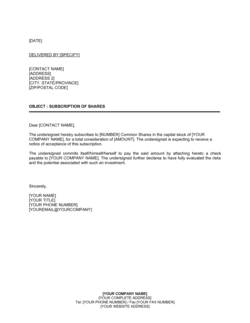
Part of your Business Operating System

This document is one of 3,000+ business & legal templates included in Business in a Box.

  • Fill-in-the-blanks — ready in minutes
  • 100% customizable Word document
  • Compatible with all office suites
  • Export to PDF and share electronically

Create your document in 3 simple steps.

From template to signed document — all inside one Business Operating System.
1
Download or open template

Access over 3,000+ business and legal templates for any business task, project or initiative.

2
Edit and fill in the blanks with AI

Customize your ready-made business document template and save it in the cloud.

3
Save, Share, Send, Sign

Share your files and folders with your team. Create a space of seamless collaboration.

Save time, save money, and create top-quality documents.

★★★★★

"Fantastic value! I'm not sure how I'd do without it. It's worth its weight in gold and paid back for itself many times."

Managing Director · Mall Farm
Robert Whalley
Managing Director, Mall Farm Proprietary Limited
★★★★★

"I have been using Business in a Box for years. It has been the most useful source of templates I have encountered. I recommend it to anyone."

Business Owner · 4+ years
Dr Michael John Freestone
Business Owner
★★★★★

"It has been a life saver so many times I have lost count. Business in a Box has saved me so much time and as you know, time is money."

Owner · Upstate Web
David G. Moore Jr.
Owner, Upstate Web

Run your business with a system — not scattered tools

Stop downloading documents. Start operating with clarity. Business in a Box gives you the Business Operating System used by over 250,000 companies worldwide to structure, run, and grow their business.

Free Forever Plan · No credit card required