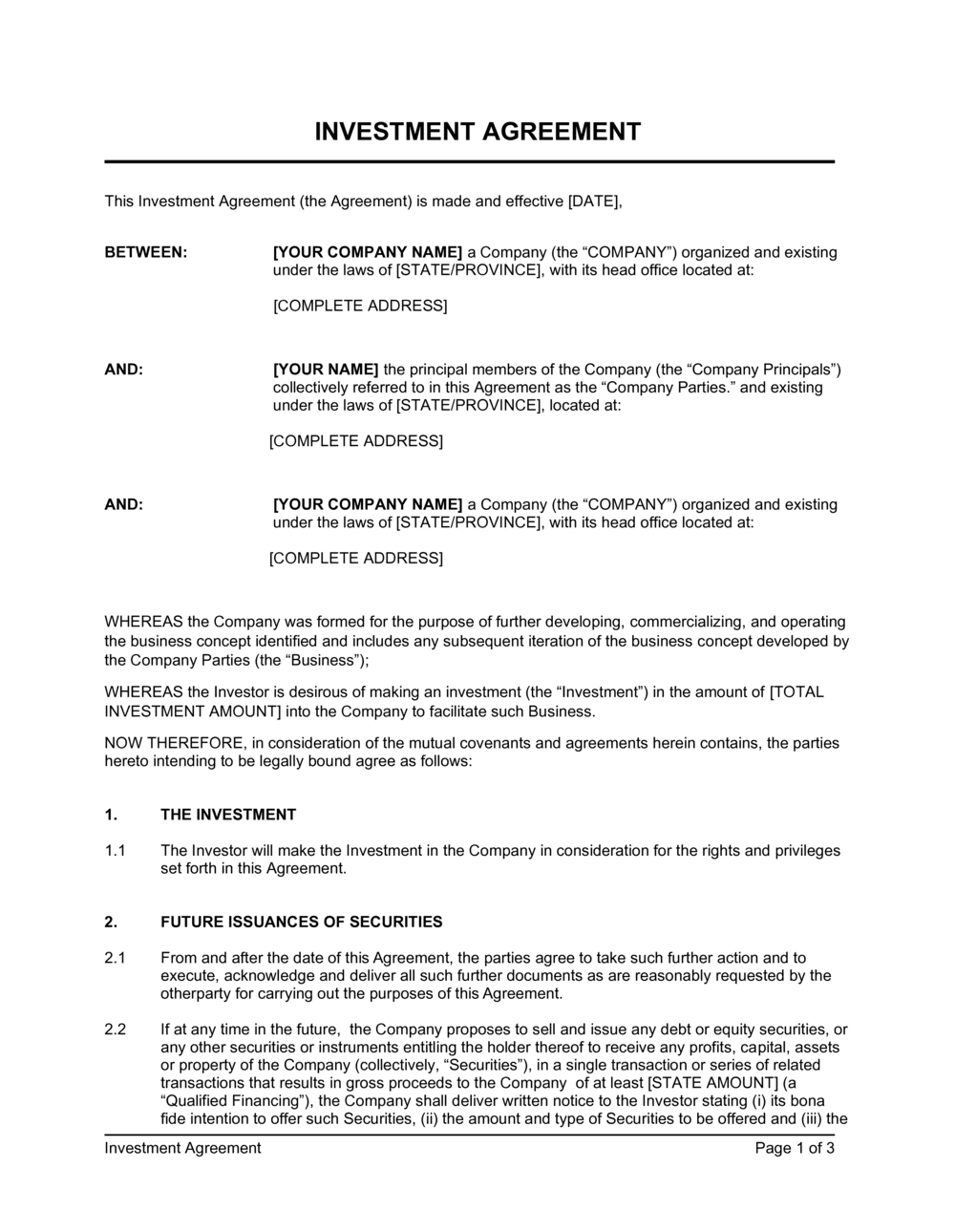
Investment Agreement Template

Free Word download β€’ Edit online β€’ Save & share with Drive β€’ Export to PDF

3 pagesβ€’25–30 min to fillβ€’Difficulty: Complexβ€’Signature requiredβ€’Legal review recommended
Learn more ↓
FreeInvestment Agreement Template

At a glance

What it is
An Investment Agreement is a legally binding contract between an investor and a company that governs the terms of an equity or convertible investment. This free Word download covers investment amount, pre-money valuation, security type, investor rights, representations and warranties, and protective provisions β€” giving both parties an enforceable record of exactly what was agreed before any money changes hands.
When you need it
Use it when a company is accepting capital from an angel investor, a syndicate, or a small fund in exchange for equity shares or a convertible instrument. It is appropriate for pre-seed and seed rounds where a full venture-grade term sheet and separate shareholders' agreement may not yet be warranted.
What's inside
Investment amount and closing mechanics, pre-money valuation and share price, security type (common shares, preferred shares, or convertible note), representations and warranties by both parties, investor information rights, anti-dilution provisions, board and voting rights, and termination and governing law clauses.

What is an Investment Agreement?

An Investment Agreement is a legally binding contract between an investor and a company that governs the terms on which capital is provided in exchange for equity shares or a convertible instrument. It records the investment amount, the pre-money valuation, the class of security being issued, and the full set of investor rights β€” information rights, anti-dilution protection, pro-rata participation, and board access β€” alongside the representations and warranties each party makes at closing. Unlike an informal term sheet or a handshake deal, a signed investment agreement creates enforceable obligations on both sides and establishes the legal record that governs the entire relationship from closing through exit.

Why You Need This Document

Accepting capital without a written investment agreement exposes both the company and the investor to significant legal and financial risk. Without it, the investor's ownership percentage, rights to future rounds, and priority in a liquidity event are undefined β€” disputes over these points regularly destroy relationships and derail promising companies. For the company, an undocumented investment creates a cap table that cannot support a future funding round or acquisition due diligence process, since every subsequent investor will require a clean legal history. Securities regulators in the US, Canada, the UK, and the EU also require private placements to be documented to qualify for prospectus exemptions β€” accepting investor funds without proper documentation can make the transaction voidable and expose the company to regulatory penalties. This template gives both parties a structured, investor-ready starting point that captures all material terms, closes the most common drafting gaps, and reduces the cost of legal review to a focused conversation rather than a full-document build from scratch.

Which variant fits your situation?

If your situation is…Use this template
Investing via a convertible instrument with a valuation cap and discountConvertible Note Agreement
Issuing preferred shares with liquidation preference to a VC fundPreferred Share Investment Agreement
Founding team splitting equity before any outside investmentShareholders Agreement
Investor joining an existing shareholders' structure post-incorporationShare Subscription Agreement
Simple equity investment between two individuals with no board rightsSimple Investment Agreement
Investor lending money with a right to convert to equity at a future roundSAFE Agreement
Late-stage equity round with full VC term sheet and side lettersVenture Capital Term Sheet

Common mistakes to avoid

❌ Omitting the fully diluted share count from the valuation

Why it matters: If options and convertible notes are excluded from the denominator, the investor's actual ownership at closing is lower than the percentage stated in the agreement, creating a dispute and potential rescission claim.

Fix: Always attach a fully diluted cap table as Schedule A and confirm the share price is calculated against that number, not the issued-and-outstanding count.

❌ Issuing common shares when preferred share rights were discussed

Why it matters: Common shares carry no liquidation preference, anti-dilution protection, or dividend priority. An investor who expected downside protection and received common shares has grounds to dispute the closing.

Fix: Specify the exact share class in the agreement body and attach a Schedule B with preferred share terms if anything other than plain common equity is being issued.

❌ No confidentiality obligation on information rights

Why it matters: An investor receiving monthly financials, customer lists, and pipeline data with no restriction can share it with your competitors or use it to inform other investments β€” you have no legal remedy.

Fix: Include a confidentiality clause that expressly applies to all non-public information provided under the information rights section, with a standard carve-out for the investor's legal and financial advisors.

❌ Using full-ratchet instead of weighted-average anti-dilution

Why it matters: Full-ratchet anti-dilution reprices the investor's entire holding to the down-round price, which can wipe out the founders' equity in any corrective financing and makes the company nearly uninvestable for follow-on capital.

Fix: Use broad-based weighted-average anti-dilution, which is the accepted market standard for angel and seed rounds. Full ratchet is almost never appropriate outside of a distressed restructuring.

❌ Signing the agreement after funds have already been wired

Why it matters: In most common-law jurisdictions, consideration must flow as part of the contract formation. Executing a retroactive agreement after money has transferred creates ambiguity about whether the agreed terms were actually in force at the time of payment.

Fix: Execute the agreement and deliver the board resolution authorizing share issuance before wiring any funds. Close in sequence: sign, authorize, wire, issue shares.

❌ No minimum shareholding threshold for investor rights

Why it matters: Board seats, information rights, and pro-rata rights granted without a threshold survive even after the investor has sold 95% of their position, imposing ongoing obligations on the company for a de minimis holder.

Fix: Tie all ongoing investor rights β€” board seat, information rights, pro-rata β€” to a minimum shareholding (typically 5% of outstanding shares) so rights lapse automatically when the investor's stake falls below that level.

The 10 key clauses, explained

Parties, Recitals, and Investment Amount

In plain language: Identifies the company and investor as legal entities, states the purpose of the agreement, and records the exact dollar amount being invested.

Sample language
This Investment Agreement is entered into on [DATE] between [COMPANY LEGAL NAME], a [STATE/COUNTRY] [ENTITY TYPE] ('Company'), and [INVESTOR FULL NAME / ENTITY NAME] ('Investor'). Investor agrees to invest $[AMOUNT] in the Company on the terms set out herein.

Common mistake: Using a trade name or DBA instead of the registered legal entity name. If the entity name does not match incorporation documents, the agreement may not be enforceable against the correct legal person.

Valuation and Share Price

In plain language: States the pre-money valuation, the resulting post-money valuation, the price per share, and the total number of new shares being issued to the investor.

Sample language
The pre-money valuation of the Company is $[PRE-MONEY AMOUNT]. At the investment amount of $[INVESTMENT], the post-money valuation is $[POST-MONEY AMOUNT]. The price per share is $[PRICE PER SHARE], and the Investor shall receive [NUMBER] [CLASS] shares.

Common mistake: Omitting the fully diluted share count from the valuation calculation. If options, warrants, or convertible notes are excluded from the denominator, the investor's actual ownership percentage at closing will be lower than represented.

Security Type and Issuance

In plain language: Specifies whether the investor receives common shares, preferred shares, or a convertible instrument, and describes any special rights attached to that class.

Sample language
In consideration of the Investment Amount, Company shall issue [NUMBER] [CLASS A PREFERRED / COMMON] shares to Investor at Closing. Preferred shares shall carry the rights set out in Schedule B β€” Preferred Share Terms.

Common mistake: Issuing common shares to investors when the intent was to give liquidation preference and anti-dilution protection. Common shares carry none of these rights unless specifically granted, and amending the share structure after closing is costly.

Representations and Warranties

In plain language: Records the factual statements each party confirms to be true at closing β€” the company's corporate standing, IP ownership, and cap table accuracy; the investor's accredited status and source of funds.

Sample language
The Company represents and warrants that: (a) it is duly incorporated and in good standing under the laws of [JURISDICTION]; (b) the shares to be issued are free of encumbrances; (c) the cap table attached as Schedule A is complete and accurate as of the date hereof.

Common mistake: Copying generic representations without tailoring them to actual due-diligence findings. A warranty that proves false at closing can allow the investor to rescind the deal or claim damages β€” vague or inaccurate reps create more exposure, not less.

Closing Conditions and Mechanics

In plain language: Lists the conditions both parties must satisfy before funds transfer β€” e.g., board resolutions, updated shareholder register, subscription documentation β€” and states the closing date and wire instructions.

Sample language
Closing shall occur on [CLOSING DATE] or such other date as the parties agree in writing. Conditions to Closing include: (a) execution of this Agreement by both parties; (b) delivery of a board resolution authorizing the issuance; (c) receipt of the Investment Amount by the Company.

Common mistake: No written closing checklist or conditions precedent. Verbal confirmations of readiness are not enforceable β€” missing a closing condition quietly and proceeding anyway can invalidate the share issuance.

Investor Information Rights

In plain language: Grants the investor ongoing access to financial statements, management accounts, and material company information for the duration of their investment.

Sample language
The Company shall provide Investor with: (a) unaudited monthly management accounts within [30] days of month-end; (b) audited annual financial statements within [90] days of fiscal year-end; (c) prompt written notice of any event materially affecting the Company's financial position.

Common mistake: Granting unlimited information rights with no confidentiality obligation attached. An investor who receives sensitive financials, customer lists, or pipeline data with no confidentiality restriction on their use can share it with competitors.

Anti-Dilution and Pro-Rata Rights

In plain language: Protects the investor if the company later issues shares at a lower price (anti-dilution) and gives the investor the right to participate in future rounds to maintain their percentage (pro-rata).

Sample language
Investor shall have broad-based weighted-average anti-dilution protection in the event of a down round. Investor shall have a pro-rata right to participate in any future equity offering up to their then-current ownership percentage, on the same terms offered to new investors.

Common mistake: Granting full-ratchet anti-dilution instead of weighted-average. Full ratchet dramatically increases founder dilution in a down round and is rarely accepted by experienced investors β€” including it signals unfamiliarity with market standards.

Board and Voting Rights

In plain language: States whether the investor receives a board seat, observer rights, or special voting rights β€” and any matters that require investor approval (protective provisions).

Sample language
Investor shall be entitled to [one board seat / one board observer seat] for so long as Investor holds at least [X]% of the outstanding shares. The following actions require prior written consent of Investor: (a) issuance of new equity; (b) incurrence of debt exceeding $[AMOUNT]; (c) sale or merger of the Company.

Common mistake: Granting an investor a board seat without defining the removal mechanism or what happens when their shareholding drops below the threshold. Minority investors who retain board seats indefinitely can block decisions long after their economic stake has been diluted away.

Drag-Along and Tag-Along Rights

In plain language: Drag-along lets the majority compel minority holders to sell in a company acquisition; tag-along lets minority holders join a majority-initiated sale on the same terms.

Sample language
If holders of more than [X]% of the outstanding shares approve a sale of the Company, each shareholder (including Investor) shall vote in favor of and participate in such sale on the same terms ('Drag-Along Right'). Investor shall have the right to participate in any transfer of shares by a Founder on the same price and terms ('Tag-Along Right').

Common mistake: Including drag-along without a minimum price floor or approval threshold. An uncapped drag-along allows a majority shareholder to force a distressed sale at any price, wiping out smaller investors who have no recourse.

Governing Law, Dispute Resolution, and Entire Agreement

In plain language: Specifies the jurisdiction whose law governs the agreement, how disputes are resolved (arbitration or litigation), and confirms this document supersedes all prior negotiations.

Sample language
This Agreement is governed by the laws of [STATE / PROVINCE / COUNTRY]. Any dispute shall be resolved by [binding arbitration / litigation] in [CITY, JURISDICTION]. This Agreement constitutes the entire agreement between the parties and supersedes all prior representations and understandings.

Common mistake: Choosing a governing law with no connection to where either party operates or where the company is incorporated. Several jurisdictions β€” including Delaware and Ontario β€” have well-developed corporate case law that offers predictable outcomes; others do not.

How to fill it out

  1. 1

    Enter the legal names of both parties

    Use the company's full registered legal name as it appears on its certificate of incorporation, and the investor's legal name or entity name. Include the jurisdiction of incorporation for the company.

    πŸ’‘ Cross-check the company name against the current corporate registry filing β€” a one-word mismatch can create enforceability questions at closing.

  2. 2

    Set the investment amount and valuation

    Enter the exact dollar amount being invested, the agreed pre-money valuation, and the resulting post-money valuation. Calculate the share price by dividing the pre-money valuation by the fully diluted share count.

    πŸ’‘ Always use the fully diluted share count β€” including all outstanding options, warrants, and convertible instruments β€” when calculating share price and ownership percentage.

  3. 3

    Choose and describe the security type

    Decide whether the investor receives common shares, preferred shares, or a convertible instrument. If issuing preferred shares, attach a Schedule B detailing liquidation preference, dividend rights, and conversion terms.

    πŸ’‘ Angel investors at pre-seed typically accept common shares or a SAFE; investors expecting downside protection at seed or Series A expect preferred shares with a 1Γ— non-participating liquidation preference.

  4. 4

    Complete the representations and warranties

    Review each representation carefully and confirm it matches the current state of the company β€” cap table, IP ownership, absence of litigation, and regulatory compliance. Attach the current cap table as Schedule A.

    πŸ’‘ Attach a disclosure schedule for any warranty that is not fully accurate. A disclosed exception cannot later be used as grounds to rescind the deal; an undisclosed one can.

  5. 5

    Define information rights and confidentiality

    Set the frequency and format of financial reporting the investor will receive β€” monthly management accounts, annual audited statements, and material-event notices. Include a confidentiality obligation on the investor for all non-public information received.

    πŸ’‘ Tie the information rights obligation to a minimum shareholding threshold (e.g., 5%) so reporting obligations lapse automatically if the investor sells most of their position.

  6. 6

    Configure anti-dilution and pro-rata rights

    Select broad-based weighted-average anti-dilution (the market standard) and specify whether the pro-rata right is limited to a percentage of the next round or is fully open-ended.

    πŸ’‘ Cap the pro-rata right at the investor's current ownership percentage β€” uncapped pro-rata rights can allow early investors to crowd out new lead investors in later rounds.

  7. 7

    Agree on board and protective provisions

    State whether the investor receives a board seat or observer rights, the threshold shareholding required to maintain that right, and the list of reserved matters requiring investor consent.

    πŸ’‘ Keep the reserved-matters list short and focused on existential decisions β€” new equity issuances, debt above a threshold, and M&A. Overly long lists create operational paralysis.

  8. 8

    Set governing law and execute before funds transfer

    Choose a governing jurisdiction with a connection to the company's place of incorporation. Both parties must sign β€” and the company must deliver a board resolution authorizing the issuance β€” before any funds are wired.

    πŸ’‘ Use Business in a Box eSign to timestamp execution and store the fully signed agreement alongside the updated cap table and share register.

Frequently asked questions

What is an investment agreement?

An investment agreement is a legally binding contract between an investor and a company that sets out the terms on which capital is provided in exchange for equity or a convertible instrument. It records the investment amount, the company's valuation, the security type being issued, and the rights and obligations of both parties from closing through the life of the investment. It is the foundational document for any private equity or angel investment transaction.

What is the difference between an investment agreement and a shareholders agreement?

An investment agreement governs the transaction itself β€” the terms on which new capital is invested and new shares are issued. A shareholders agreement governs the ongoing relationship between all shareholders after closing β€” including governance, transfer restrictions, drag-along and tag-along rights, and dispute resolution among existing owners. In a simple angel deal, both sets of provisions are often combined in a single document; in a formal VC round, they are separate instruments.

Do I need a lawyer to draft an investment agreement?

For straightforward seed investments under $500K between parties who have already agreed on the key commercial terms, a high-quality template is a sound starting point. Legal review is strongly recommended when the investment exceeds $500K, when preferred shares with complex rights are being issued, when the investor or company is in a regulated industry, or when the parties are in different countries. A 2–4 hour legal review typically costs $600–$1,500 and is warranted for any deal material to the business.

What is a pre-money valuation and why does it matter?

Pre-money valuation is the agreed value of the company immediately before the investment is made. It determines the investor's ownership percentage: an investor putting in $500K at a $4.5M pre-money valuation owns 10% of a $5M post-money company. Getting the valuation number right β€” and calculating it on a fully diluted basis β€” is the most commercially significant variable in the entire agreement.

What is the difference between a convertible note and an equity investment agreement?

An equity investment agreement issues shares immediately at an agreed valuation. A convertible note is a debt instrument that converts into equity at a future priced round, typically at a discount (e.g., 20%) and subject to a valuation cap. Convertible notes defer the valuation question to the next round and are faster and cheaper to execute. Equity agreements give the investor immediate ownership but require both parties to agree on valuation at the time of investment.

What investor rights are typically included in an investment agreement?

Standard investor rights at the seed stage include information rights (monthly management accounts and annual audited financials), pro-rata rights to participate in future rounds, anti-dilution protection (typically weighted-average), a board observer seat or full board seat for larger investments, and a short list of reserved matters requiring investor consent. Liquidation preference and drag-along and tag-along rights are also common when preferred shares are being issued.

What is anti-dilution protection in an investment agreement?

Anti-dilution protection adjusts an investor's share price downward if the company later issues shares at a lower price β€” protecting the investor from being penalized in a down round. Broad-based weighted-average anti-dilution is the market standard: it recalculates the investor's effective price based on the weighted average of all shares outstanding. Full-ratchet anti-dilution reprices the entire holding to the new low price and is considered founder-hostile in most markets.

Is an investment agreement legally enforceable?

An investment agreement is generally enforceable as a binding contract when it is properly executed by both parties, supported by genuine consideration (the investment funds), and the representations and warranties are accurate at closing. Enforceability depends on the governing jurisdiction and whether any mandatory securities law requirements β€” such as investor accreditation verification or prospectus exemptions β€” were satisfied. Consider consulting a lawyer to confirm compliance with applicable securities regulations before closing.

What securities law requirements apply to an investment agreement?

In the US, private investment agreements typically rely on Regulation D exemptions (Rule 506(b) or 506(c)) and require the investor to be an accredited investor. In Canada, securities law exemptions vary by province β€” the accredited investor exemption and the offering memorandum exemption are most commonly used. In the UK, investments may qualify under the EIS or SEIS schemes. Each jurisdiction has its own filing and disclosure requirements; securities law non-compliance can make a deal voidable and expose the company to regulatory penalties.

How this compares to alternatives

vs Convertible Note Agreement

A convertible note is a debt instrument that defers the valuation question to a future priced round, converting to equity at a discount. An investment agreement issues equity immediately at an agreed valuation. Convertible notes are faster and cheaper to execute for early rounds where valuation is hard to establish; investment agreements are appropriate once the company has enough traction to defend a specific number.

vs Shareholders Agreement

An investment agreement governs the transaction β€” how capital enters the company and what security is issued. A shareholders agreement governs the ongoing relationship among all shareholders after closing β€” decision-making, transfer restrictions, and exit mechanics. Both are typically needed in a formal investment; the investment agreement is executed first and the shareholders agreement either replaces or supplements it.

vs Term Sheet

A term sheet summarizes the key commercial terms of an investment in a non-binding format to align both parties before legal drafting begins. An investment agreement is the binding legal document that follows. Signing a term sheet does not obligate either party to close; signing the investment agreement does.

vs SAFE Agreement

A SAFE (Simple Agreement for Future Equity) is a non-debt instrument that grants the right to receive equity at the next priced round, with no interest and no maturity date. It is simpler and faster than a full investment agreement but defers investor rights β€” including information rights and board access β€” until conversion. An investment agreement is appropriate when the investor needs immediate equity and defined rights at closing.

Industry-specific considerations

Technology / SaaS

IP assignment confirmations are critical alongside the investment; software companies often pair the agreement with a separate IP ownership warranty and an updated cap table reflecting option pool expansion.

Biotech and Life Sciences

Milestone-based tranched funding structures are common, with each tranche conditional on clinical, regulatory, or development targets set as closing conditions in the agreement.

Real Estate and PropTech

Investment agreements in real estate often include preferred return waterfall provisions and deal-level rather than company-level investment structures, requiring additional entity-specific schedules.

Consumer Goods and E-commerce

Revenue-based anti-dilution benchmarks and inventory or purchase-order covenants are frequently added as protective provisions for investors in capital-intensive consumer product businesses.

Jurisdictional notes

United States

Private placements in the US must comply with Regulation D under the Securities Act of 1933. Most angel and seed deals rely on Rule 506(b), which limits the offering to accredited investors and up to 35 sophisticated non-accredited investors with no general solicitation. Verify investor accreditation before accepting funds. Delaware is the governing law of choice for most venture-backed companies due to its developed corporate case law.

Canada

Canadian securities law is provincially regulated. The accredited investor exemption (available in all provinces) and the offering memorandum exemption are the two most common routes for private placements. Ontario and British Columbia require a Form 45-106F1 report of exempt distribution within 10 days of closing. Quebec requires French-language versions of investment documents for provincially regulated entities.

United Kingdom

UK private investments must comply with the Financial Services and Markets Act 2000 (FSMA). Most angel deals rely on the high-net-worth individual or sophisticated investor exemption. The Enterprise Investment Scheme (EIS) and Seed Enterprise Investment Scheme (SEIS) offer significant tax relief to qualifying investors and impose restrictions on company structure and use of funds that must be reflected in the investment agreement.

European Union

EU investment agreements must comply with the Prospectus Regulation exemptions for private placements β€” typically the less-than-150-investor rule or the qualified investor exemption. GDPR applies to any personal data exchanged during due diligence and should be addressed in a confidentiality or data processing annex. Member state rules on foreign investment screening (particularly in Germany, France, and the Netherlands) may apply to deals above certain thresholds.

Template vs lawyer β€” what fits your deal?

PathBest forCostTime
Use the templateAngel investments under $250K between parties who have agreed on commercial terms and are in the same jurisdictionFree1–2 hours to complete; 1–2 days to negotiate and close
Template + legal reviewSeed rounds of $250K–$1M, cross-border investments, or deals involving preferred shares with liquidation preference$600–$1,500 for a 2–4 hour legal review3–7 days
Custom draftedSeries A and above, regulated industries, institutional investors, or complex multi-tranche structures$3,000–$15,000+ depending on deal size and complexity2–6 weeks

Glossary

Pre-Money Valuation
The agreed value of the company immediately before the investment is made, used to calculate the investor's ownership percentage.
Post-Money Valuation
The company's value immediately after the investment closes, calculated as pre-money valuation plus the investment amount.
Equity Dilution
The reduction in existing shareholders' ownership percentage that occurs when new shares are issued to an incoming investor.
Convertible Note
A debt instrument that converts into equity β€” typically at a discount and subject to a valuation cap β€” at a future qualifying financing round.
SAFE (Simple Agreement for Future Equity)
A non-debt instrument created by Y Combinator that grants an investor the right to receive equity at the next priced round, without accruing interest.
Anti-Dilution Provision
A clause protecting an investor from dilution if the company later issues shares at a lower price than the investor paid β€” full ratchet or weighted average.
Liquidation Preference
A right granting preferred shareholders priority repayment of their invested capital (and sometimes a multiple of it) before common shareholders receive anything in a liquidity event.
Pro-Rata Rights
An investor's contractual right to participate in future funding rounds to maintain their ownership percentage by purchasing a proportional share of new shares.
Representations and Warranties
Factual statements made by each party in the agreement that, if false, can give rise to a claim for damages or rescission of the deal.
Drag-Along Right
A provision allowing majority shareholders to compel minority shareholders to vote in favor of or participate in a sale of the company on the same terms.
Tag-Along Right
A minority shareholder's right to join a sale of shares initiated by a majority shareholder on the same price and terms offered to the majority.
Closing Conditions
Specific requirements β€” such as board approval, regulatory filings, or completion of due diligence β€” that must be satisfied before the investment funds are transferred.

Part of your Business Operating System

This document is one of 3,000+ business & legal templates included in Business in a Box.

  • Fill-in-the-blanks β€” ready in minutes
  • 100% customizable Word document
  • Compatible with all office suites
  • Export to PDF and share electronically

Create your document in 3 simple steps.

From template to signed document β€” all inside one Business Operating System.
1
Download or open template

Access over 3,000+ business and legal templates for any business task, project or initiative.

2
Edit and fill in the blanks with AI

Customize your ready-made business document template and save it in the cloud.

3
Save, Share, Send, Sign

Share your files and folders with your team. Create a space of seamless collaboration.

Save time, save money, and create top-quality documents.

β˜…β˜…β˜…β˜…β˜…

"Fantastic value! I'm not sure how I'd do without it. It's worth its weight in gold and paid back for itself many times."

Managing Director Β· Mall Farm
Robert Whalley
Managing Director, Mall Farm Proprietary Limited
β˜…β˜…β˜…β˜…β˜…

"I have been using Business in a Box for years. It has been the most useful source of templates I have encountered. I recommend it to anyone."

Business Owner Β· 4+ years
Dr Michael John Freestone
Business Owner
β˜…β˜…β˜…β˜…β˜…

"It has been a life saver so many times I have lost count. Business in a Box has saved me so much time and as you know, time is money."

Owner Β· Upstate Web
David G. Moore Jr.
Owner, Upstate Web

Run your business with a system β€” not scattered tools

Stop downloading documents. Start operating with clarity. Business in a Box gives you the Business Operating System used by over 250,000 companies worldwide to structure, run, and grow their business.

Free Forever PlanΒ Β·Β No credit card required