1
Insert full legal names and jurisdictions for all parties
Enter the company's exact registered legal name, entity type (e.g., Delaware C-Corp, Ontario Inc., UK Ltd.), and registered address. Do the same for each investor entity — fund name, general partner, and domicile.
💡 Cross-reference the company's certificate of incorporation and the investor's fund formation documents to confirm legal names before execution.
2
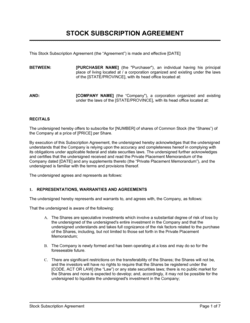
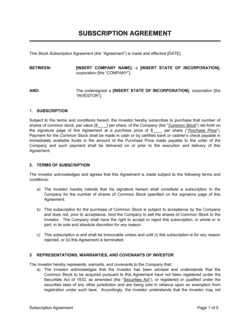
Define the share class, number, and subscription price
State whether the shares being issued are common, preferred Series A, or a new class. Specify the exact number of shares, price per share, and total aggregate consideration. Confirm these figures reconcile with the pre-money valuation and post-money cap table.
💡 Attach a pro forma cap table as Schedule A to the agreement — it eliminates ambiguity and prevents post-closing disputes about dilution percentages.
3
Draft and schedule all conditions precedent
List every item that must be completed before closing — board resolutions, articles amendments, pre-emption waivers, due diligence sign-off, and any regulatory approvals. Assign responsibility for each and set a long-stop date for satisfaction.
💡 A 30–60 day long-stop date is standard for most seed and Series A rounds. Build in buffer for articles amendment filings, which can take 5–10 business days at company registries.
4
Complete the company representations and disclosure schedule
Work through each company representation and populate the Disclosure Schedule with any known exceptions — pending litigation, IP ownership issues, existing options, outstanding debts, or material contracts that could affect the investment thesis.
💡 An accurate Disclosure Schedule is the company's primary defence against a warranty claim post-closing. Incomplete disclosure is far more damaging than disclosing a known issue upfront.
5
Confirm investor accreditation and insert applicable securities law reference
Identify the correct accreditation or sophistication standard for the investor under the governing jurisdiction's securities law — Rule 506(b) or 506(c) in the US, Section 2.3 of NI 45-106 in Canada, or the professional investor regime under MiFID II in the EU.
💡 Retain signed investor questionnaires confirming accreditation before closing — they are your primary evidence of securities law exemption compliance.
6
Set payment mechanics and closing logistics
Insert the company's designated bank account details for the wire transfer, specify the currency and value date, and set out the precise sequence of closing steps — funds received, board resolution passed, shares allotted, share register updated, share certificate issued.
💡 Use a closing checklist as an exhibit to the agreement so both parties can track completion of each step in real time on closing day.
7
Specify post-closing investor rights
Define the exact scope of information rights (monthly vs. quarterly, audited vs. unaudited), anti-dilution mechanics (broad-based weighted average is most investor-friendly without being punitive to founders), and participation rights in future rounds.
💡 Limit information rights to investors holding above a threshold percentage (e.g., 5%) to avoid reporting obligations to every small investor in a syndicated round.
8
Execute before funds are transferred
Both the company (by an authorized director or officer) and each investor must sign the agreement — and all conditions precedent must be satisfied — before any subscription price is wired. Keep fully executed originals (wet-ink or e-signed with timestamped audit trail) for each party.
💡 Use a reputable e-signature platform to timestamp execution. In most jurisdictions, e-signatures are as enforceable as wet-ink signatures for commercial contracts of this type.