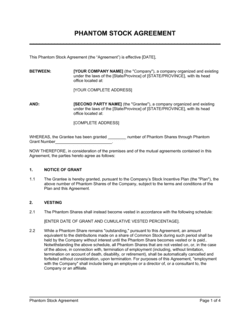
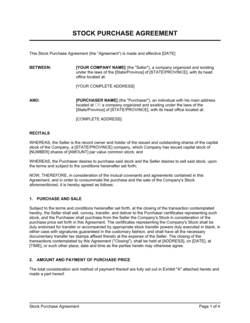
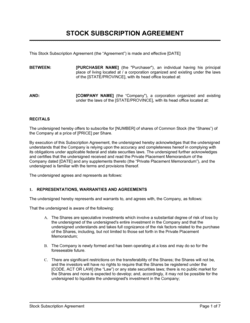
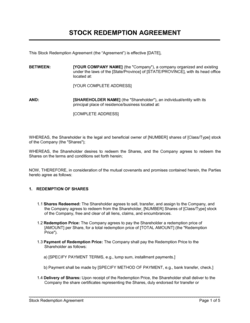
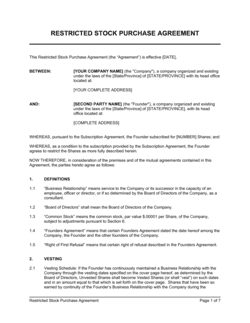
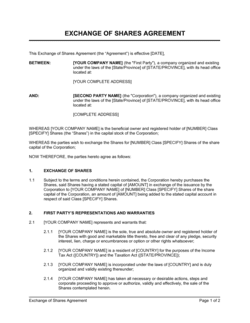
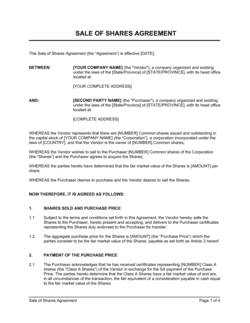
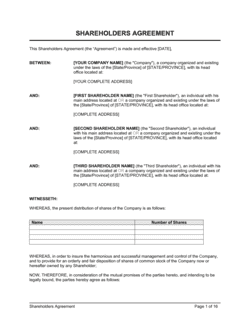
Stock Agreement Template

Free Word download • Edit online • Save & share with Drive • Export to PDF

3 pages25–35 min to fillDifficulty: ComplexSignature requiredLegal review recommended
Learn more ↓
FreeStock Agreement Template

At a glance

What it is
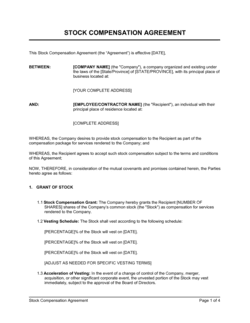
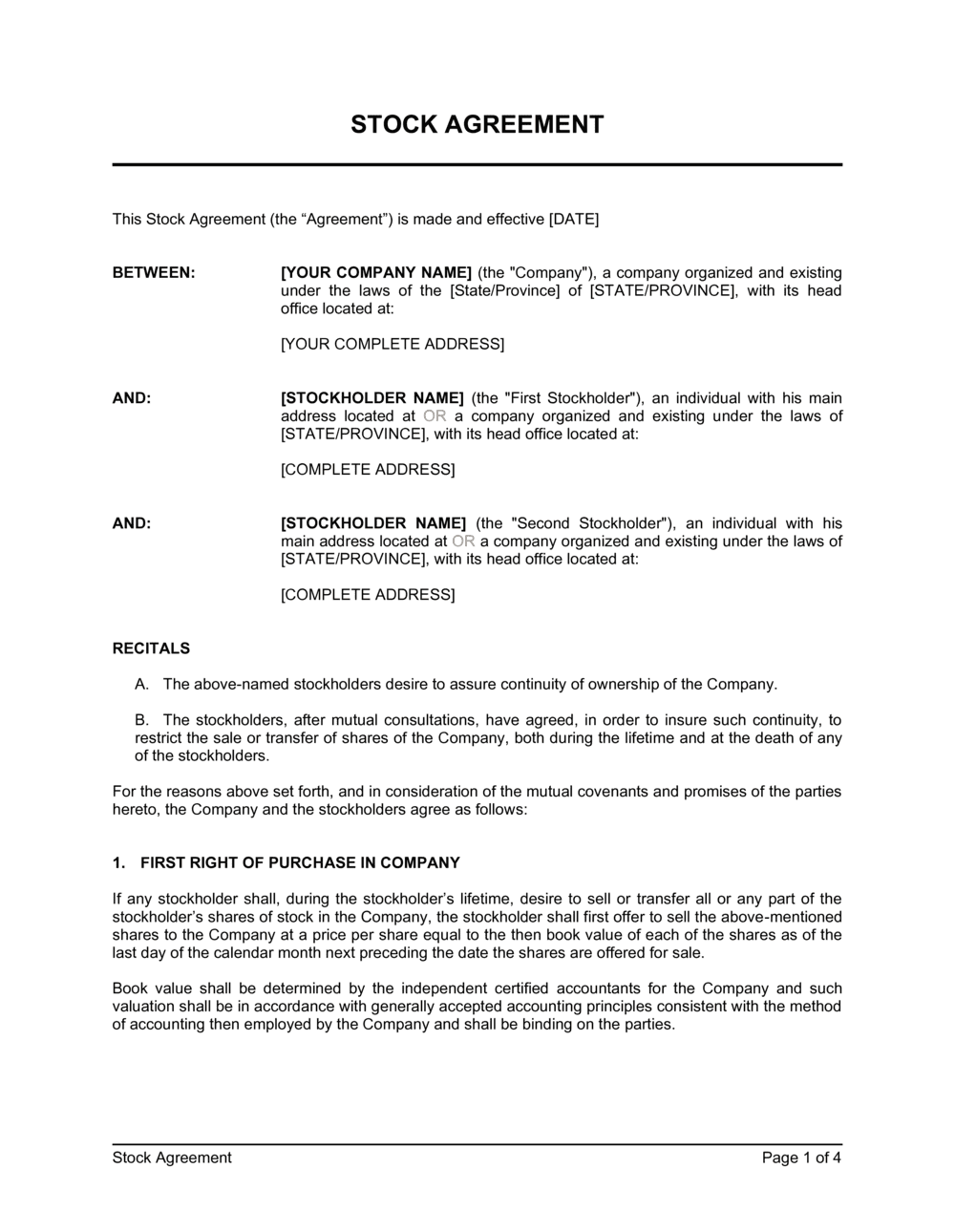
A Stock Agreement is a legally binding contract that governs the issuance, purchase, sale, or transfer of shares in a corporation. This free Word download covers the number of shares, share class, purchase price, representations and warranties, transfer restrictions, vesting schedules, and governing law — giving founders, investors, and shareholders a single enforceable document that records every material term of the equity transaction.
When you need it
Use it when issuing equity to a co-founder or early employee, selling shares to an angel investor, transferring existing shares between shareholders, or documenting a seed-round stock purchase outside a formal SAFE or convertible note.
What's inside
Party identification and share details, purchase price and payment terms, representations and warranties from both buyer and seller, transfer restrictions and right of first refusal, vesting schedule with cliff and acceleration provisions, legend requirements for restricted securities, and governing law and dispute resolution.

What is a Stock Agreement?

A Stock Agreement is a legally binding contract that documents the issuance, purchase, sale, or transfer of shares in a corporation between the company and one or more shareholders. It identifies both parties by legal name, specifies the exact number and class of shares changing hands, establishes the purchase price and closing mechanics, and sets the terms that govern the shares going forward — including vesting schedules, repurchase rights, transfer restrictions, and securities law compliance obligations. Unlike a simple cap table entry or an informal email confirmation, a properly executed stock agreement creates an enforceable record that protects both the company and the shareholder if the transaction is ever disputed, audited, or scrutinized during a future financing round.

Why You Need This Document

Without a written stock agreement, a company's equity structure exists only in a spreadsheet — with no enforceable vesting schedule to protect against a co-founder who leaves after six months, no right of first refusal to stop shares from ending up with a competitor, and no 83(b) election notice to save a founder from an unexpected six-figure tax bill. Investors conducting due diligence for a Series A routinely request signed stock agreements for every prior equity issuance; missing or defective documentation can delay a round by weeks or kill it entirely. Regulators at the SEC and state securities boards look for evidence that unregistered share sales were made only to accredited investors — a requirement documented in the purchaser representations section of this agreement. This template gives you a court-ready, investor-accepted starting point that closes those gaps in under an hour for straightforward domestic transactions, and provides the structure a corporate attorney needs to adapt quickly for more complex deals.

Which variant fits your situation?

If your situation is…Use this template
Issuing founder shares at inception with a vesting scheduleFounder Stock Purchase Agreement
Selling shares to an accredited angel investor at a fixed priceStock Purchase Agreement
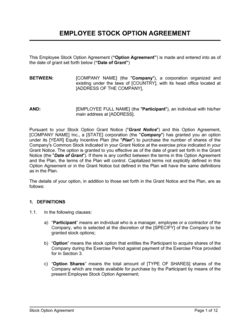
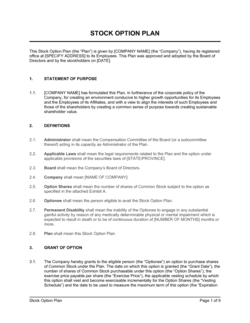
Granting stock options to employees under an equity planStock Option Agreement
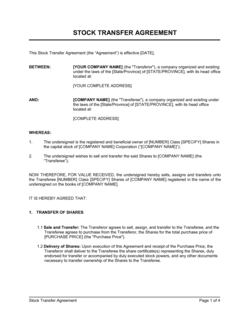
Transferring existing shares from one shareholder to anotherStock Transfer Agreement
Issuing equity with future valuation deferred to a priced roundSAFE (Simple Agreement for Future Equity)
Governing ongoing rights between all shareholdersShareholders Agreement
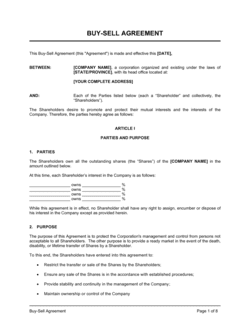
Restricting share transfers and setting buyback terms at company levelBuy-Sell Agreement

Common mistakes to avoid

❌ Missing the 30-day Section 83(b) election window

Why it matters: Founders who fail to file within 30 days of receiving unvested shares must pay ordinary income tax on the full fair market value of shares as they vest — often a six-figure liability by Series A.

Fix: Attach a completed 83(b) election form as an exhibit to the agreement and have the purchaser mail it to the IRS on the day of signing. Keep a copy with the corporate records.

❌ Describing shares as a percentage rather than a fixed number

Why it matters: A percentage ownership shifts with every new share issuance, option grant, and conversion — making it impossible to determine exactly what was sold without knowing the capitalization at every future date.

Fix: Always state shares as an absolute number (e.g., 1,000,000 shares of Common Stock) tied to a specific capitalization table dated as of the agreement date.

❌ Omitting accredited investor representations

Why it matters: Selling unregistered securities to non-accredited investors without a registered offering violates Regulation D and exposes the company to SEC enforcement, state securities regulators, and purchaser rescission rights.

Fix: Include a purchaser rep confirming accredited investor status and require documentary evidence — a signed accredited investor questionnaire — before closing.

❌ Failing to obtain board approval before signing

Why it matters: A stock issuance made without prior board authorization is technically void under most state corporate statutes, creating a defective capitalization record that must be ratified and can delay future financing rounds.

Fix: Pass a board resolution authorizing the specific issuance — number of shares, price, and recipient — before the agreement is signed. Date the resolution the same day as or prior to the agreement.

❌ Using a short repurchase window of fewer than 60 days

Why it matters: A 30-day repurchase window often lapses before the company can convene a board meeting to authorize the buyback and arrange payment — effectively giving the departing shareholder a windfall of unvested shares.

Fix: Set the repurchase window at 90 days and include a provision allowing the company to pay the repurchase price in installments if cash position is constrained.

❌ Choosing a governing law state with no connection to the company

Why it matters: Courts in the actual operating or incorporation state may apply local law regardless of what the contract specifies, creating uncertainty about which state's securities and corporate statutes govern the transaction.

Fix: Set governing law to the state of incorporation — typically Delaware — or the state where the company's principal office is located, and ensure all parties have a meaningful connection to that jurisdiction.

The 10 key clauses, explained

Parties, recitals, and share description

In plain language: Identifies the buyer and seller (or issuer) by full legal name, states the corporation's name and state of incorporation, and describes the exact number and class of shares being transferred.

Sample language
This Stock Purchase Agreement ('Agreement') is entered into as of [DATE] by and between [COMPANY NAME], a [STATE] corporation ('Company'), and [PURCHASER FULL NAME] ('Purchaser'). The Company hereby sells and issues to Purchaser [NUMBER] shares of [CLASS] Stock at a purchase price of $[PRICE] per share.

Common mistake: Describing shares by percentage instead of an absolute number. Percentages shift with every future issuance; agreements must reference a fixed share count tied to a specific capitalization date.

Purchase price and payment

In plain language: States the per-share price, total consideration, payment method, and the closing date on which shares and funds are exchanged.

Sample language
The aggregate purchase price for the Shares is $[TOTAL] (the 'Purchase Price'), payable by [wire transfer / check] on or before [CLOSING DATE]. Delivery of the Shares is conditioned on receipt of the full Purchase Price.

Common mistake: Leaving the payment mechanics vague or omitting a closing date. Without a specific date and payment method, either party can delay indefinitely and claim no breach.

Representations and warranties of the company

In plain language: The company confirms that it is validly incorporated, the shares are duly authorized and fully paid, no third-party consents are required, and the issuance does not violate any existing agreement.

Sample language
The Company represents and warrants that: (a) it is duly organized and in good standing under the laws of [STATE]; (b) the Shares, when issued, will be validly issued, fully paid, and non-assessable; (c) this Agreement has been duly authorized and constitutes a binding obligation of the Company.

Common mistake: Using boilerplate reps without tailoring them to the company's actual capitalization. If the company has outstanding warrants or convertible notes not disclosed here, a buyer can later claim fraudulent misrepresentation.

Representations and warranties of the purchaser

In plain language: The buyer confirms they are an accredited investor (if required), are purchasing for investment and not resale, understand the shares are restricted, and have had the opportunity to ask questions about the company.

Sample language
Purchaser represents and warrants that: (a) Purchaser is an 'accredited investor' within the meaning of Rule 501 of Regulation D; (b) Purchaser is acquiring the Shares for investment purposes only, not with a view to resale or distribution; (c) Purchaser has had the opportunity to review the Company's financial information and ask questions of management.

Common mistake: Omitting accredited investor representation when selling to individuals. Failing to confirm accredited status before a Regulation D offering exposes the company to SEC enforcement and potential rescission liability.

Vesting schedule and cliff

In plain language: Defines the timeline over which the purchaser earns full ownership of the shares, the minimum period before any vesting occurs, and whether unvested shares are subject to a company repurchase right on separation.

Sample language
The Shares shall vest over [48] months, with [25]% of the Shares vesting on the [12]-month anniversary of [VESTING COMMENCEMENT DATE] and the remainder vesting in equal monthly installments thereafter. Unvested Shares are subject to the Company's Repurchase Right at the original Purchase Price per Share.

Common mistake: Omitting a vesting commencement date separate from the agreement date. If a founder started contributing to the company months before incorporation, the commencement date should reflect that service — failing to do so overstates unvested exposure.

Repurchase right

In plain language: Grants the company the right — but not the obligation — to repurchase unvested shares at the original purchase price if the shareholder's employment or service relationship terminates.

Sample language
Upon termination of Purchaser's service relationship with the Company for any reason, the Company shall have an irrevocable option for [90] days to repurchase all unvested Shares at the lower of the original Purchase Price or the then-current fair market value per Share.

Common mistake: Setting the repurchase window too short (fewer than 60 days). The company may not have the liquidity or board approval time to exercise within 30 days, effectively forfeiting the right.

Transfer restrictions and right of first refusal

In plain language: Prohibits the shareholder from transferring shares without the company's consent and grants the company (and sometimes other shareholders) the right to purchase shares at the same price before any third-party sale.

Sample language
Purchaser shall not sell, assign, pledge, or otherwise transfer any Shares without the Company's prior written consent. Before any proposed transfer, Purchaser must first offer the Shares to the Company at the proposed transfer price by delivering written notice ('Transfer Notice'). The Company shall have [30] days to exercise its right of first refusal.

Common mistake: Forgetting to include permitted transfer exceptions for estate planning transfers to trusts or family members. Without them, a shareholder cannot transfer shares to a revocable trust without triggering the ROFR — creating unnecessary friction.

Legend and securities law compliance

In plain language: Requires that any stock certificate or book-entry record for the shares bear a restrictive legend notifying future parties that the shares are unregistered and subject to transfer restrictions.

Sample language
Each certificate (or book-entry notation) representing the Shares shall bear the following legend: 'THE SHARES REPRESENTED HEREBY HAVE NOT BEEN REGISTERED UNDER THE SECURITIES ACT OF 1933 AND MAY NOT BE SOLD, TRANSFERRED, OR OTHERWISE DISPOSED OF IN THE ABSENCE OF AN EFFECTIVE REGISTRATION STATEMENT OR AN OPINION OF COUNSEL THAT SUCH REGISTRATION IS NOT REQUIRED.'

Common mistake: Issuing shares via a cap table software entry without ensuring the legend is electronically noted in the platform. Uncertificated shares require the same legend applied to the book-entry record — omitting it does not exempt the shares from securities law restrictions.

Tax matters and section 83(b) election

In plain language: Addresses the tax consequences of the stock purchase, notifies the purchaser of their right to file a Section 83(b) election within 30 days of purchase if shares are subject to a vesting schedule, and makes clear the company is not providing tax advice.

Sample language
Purchaser acknowledges that the Company has advised Purchaser to consult with a tax advisor regarding the advisability of filing an election under Section 83(b) of the Internal Revenue Code within [30] days of the Grant Date. Failure to file such election in a timely manner may result in adverse tax consequences.

Common mistake: Not including an 83(b) reminder in the agreement itself. Founders who miss the 30-day filing window face ordinary income tax on the appreciated value of shares as they vest rather than capital gains — a potentially six-figure tax surprise.

Governing law, entire agreement, and dispute resolution

In plain language: Specifies the jurisdiction whose law governs the agreement, confirms it supersedes all prior negotiations and understandings, and states how disputes are resolved — arbitration, mediation, or litigation.

Sample language
This Agreement shall be governed by and construed in accordance with the laws of the State of [STATE], without regard to conflicts-of-law principles. Any dispute arising hereunder shall be resolved by binding arbitration before [AAA / JAMS] in [CITY], except that either party may seek injunctive relief in any court of competent jurisdiction.

Common mistake: Selecting a governing law state with no connection to where the company is incorporated or operates. Courts may apply the law of the state with the most significant relationship to the transaction regardless of the contract's choice, creating uncertainty.

How to fill it out

  1. 1

    Identify the parties and the corporation

    Enter the full legal name of the company as it appears in the certificate of incorporation, the state of incorporation, and the full legal name (or entity name) of the purchaser. Confirm the company's authorized share structure before drafting.

    💡 Pull the exact company name from your state's corporate registry — trade names and DBAs are not the legal entity and will create enforcement problems.

  2. 2

    Specify the share class, number, and purchase price

    State the exact number of shares, the class (common or a specific series of preferred), and the per-share price. Multiply to confirm the aggregate purchase price and enter the closing date.

    💡 For founder shares, the per-share price should reflect fair market value at issuance — even at a fraction of a cent. Document the valuation basis in your board minutes to support the price.

  3. 3

    Complete the representations and warranties sections

    Review each rep and warrant for both the company and the purchaser. Update the company reps to reflect actual capitalization — outstanding options, warrants, convertible notes, and any existing shareholder agreements.

    💡 Have your corporate attorney confirm that the share issuance does not require consent under any existing investor rights agreement or ROFR before you sign.

  4. 4

    Set the vesting schedule and commencement date

    Enter the total vesting period, cliff length, and vesting frequency (monthly is standard). Set the vesting commencement date — this may predate the agreement if the founder has been contributing for some time.

    💡 Standard four-year vesting with a one-year cliff is the market norm for founders and satisfies most institutional investor expectations at Series A.

  5. 5

    Define transfer restrictions and the ROFR

    Confirm the company holds a right of first refusal on any proposed share transfer, set the notice period (30 days is standard), and add permitted transfer exceptions for estate planning trusts and family members.

    💡 If a co-sale right (drag-along or tag-along) is needed, add it here or reference a separate shareholders agreement that governs those rights.

  6. 6

    Insert the restrictive legend language

    Copy the standard Regulation D restricted securities legend into the agreement. If shares are issued via book entry rather than physical certificates, confirm the legend notation will appear in your cap table software.

    💡 Carta, Pulley, and similar platforms allow you to add legend text directly to electronic share records — do this on the same day the agreement is signed.

  7. 7

    Address the Section 83(b) election requirement

    If the shares have a vesting schedule, include the 83(b) notice language and attach a blank election form as an exhibit. The purchaser has exactly 30 days from the grant date to file with the IRS — the agreement should document that notice was given.

    💡 Prepare two signed copies of the 83(b) election at closing so the purchaser can mail one to the IRS and retain a stamped copy as evidence of timely filing.

  8. 8

    Execute before shares are issued

    Both parties sign the agreement before any shares appear on the cap table. Date the agreement to match the board resolution authorizing the issuance. File the executed agreement with your corporate records.

    💡 Use a single signing session — electronic or in person — so the agreement date, board resolution date, and cap table entry date all align. Mismatched dates create audit and 409A valuation complications.

Frequently asked questions

What is a stock agreement?

A stock agreement is a legally binding contract that governs the issuance, purchase, sale, or transfer of shares in a corporation. It identifies the buyer and seller, specifies the share class and number, states the purchase price, and sets the terms governing restrictions, vesting, and shareholder rights. It creates an enforceable record of every material term of the equity transaction and is the primary document used to update a company's cap table after a share issuance or transfer.

What is the difference between a stock agreement and a shareholders agreement?

A stock agreement documents a specific transaction — the issuance or sale of a defined number of shares at a stated price on a particular date. A shareholders agreement governs the ongoing relationship among all shareholders — voting rights, board composition, drag-along and tag-along rights, and dividend policy. You typically need both: the stock agreement closes the transaction, and the shareholders agreement governs what happens afterward. Some stock agreements incorporate key shareholder rights by reference to a separate shareholders agreement.

Who needs to sign a stock agreement?

At minimum, both the issuing company (signed by an authorized officer, usually the CEO or CFO) and the purchaser or transferee must sign. If the shares are being transferred by an existing shareholder rather than newly issued by the company, the selling shareholder is also a party. Board authorization — documented in a board resolution — is a prerequisite to any authorized officer signing on behalf of the company.

Is a Section 83(b) election always required?

A Section 83(b) election is relevant only when shares are subject to a vesting schedule or other forfeiture condition — meaning they are not yet fully owned by the recipient. If shares are issued fully vested with no repurchase right, no 83(b) election is needed. For founder shares and restricted stock grants with a vesting schedule, filing the election within 30 days of the grant date is almost always advisable because it locks in the tax basis at the low initial value rather than the potentially much higher value at each vest date.

Can a stock agreement be used for preferred stock?

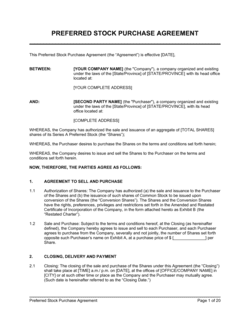
Yes — a stock purchase agreement can cover any authorized class of shares, including preferred. However, preferred stock issuances (typically Series Seed, Series A, etc.) involve additional documents: a certificate of incorporation amendment creating the preferred series, an investor rights agreement, a voting agreement, and a right of first refusal and co-sale agreement. The stock agreement alone is insufficient for a priced preferred round; it is most commonly used as a standalone document for common stock issuances and simple angel transactions.

Do stock agreements need to be notarized?

Notarization is generally not required for stock agreements in the United States, Canada, or the United Kingdom for private company share transactions. Both parties signing a dated, written agreement is typically sufficient for enforceability. Some jurisdictions require notarization for share transfers in certain regulated industries or when the transfer involves real property held by the corporation. When in doubt, consult a corporate attorney in the relevant jurisdiction.

What is a right of first refusal in a stock agreement?

A right of first refusal (ROFR) requires a shareholder who wants to sell their shares to first offer them to the company — and sometimes to other existing shareholders — at the same price and terms as the proposed third-party sale. If the company declines within the notice period (typically 30 days), the shareholder may proceed with the third-party sale. ROFRs are standard in startup stock agreements because they give the company and its investors control over who becomes a new shareholder.

What happens if shares are transferred without complying with the stock agreement?

A transfer made in violation of the agreement's restrictions — without triggering the ROFR, without company consent, or to a non-permitted transferee — is typically voidable by the company. The company can refuse to register the transfer on the cap table, treat the purported buyer as having no shareholder rights, and seek injunctive relief or damages from the selling shareholder. Courts in most US states have upheld transfer restriction clauses in private company stock agreements.

Do I need a lawyer to draft a stock agreement?

For a straightforward common stock issuance to a single founder or early employee at a nominal price, a high-quality template is generally sufficient. Engage a corporate attorney when the transaction involves preferred stock, accredited investor compliance for angel rounds, cross-border buyers, equity subject to existing investor rights agreements, or when the aggregate transaction value exceeds $100K. A typical template review costs $300–$800 and is worthwhile for any transaction that materially affects the cap table.

How this compares to alternatives

vs Shareholders Agreement

A stock agreement documents a single transaction — the purchase or issuance of a specific number of shares at a price. A shareholders agreement governs the ongoing rights and obligations of all shareholders — voting, board seats, drag-along, and co-sale rights. Both documents are typically needed: the stock agreement closes the deal; the shareholders agreement sets the rules of ongoing ownership. Using one without the other leaves material governance gaps.

vs Stock Option Plan

A stock option plan grants employees the right to purchase shares in the future at a fixed price (the strike price) upon meeting vesting conditions — no shares are issued at grant. A stock agreement transfers or issues actual shares immediately at a purchase price. Options defer both ownership and tax impact; a stock agreement with an 83(b) election can lock in a low tax basis on day one. The right instrument depends on whether immediate ownership or deferred optionality better serves the recipient.

vs Buy-Sell Agreement

A buy-sell agreement is a standing governance document that pre-establishes the terms under which shareholders must or may buy out each other's shares on trigger events — death, disability, retirement, or voluntary departure. A stock agreement is a transactional document for a specific, current share issuance or sale. Many companies use both: the stock agreement to issue shares at formation, and the buy-sell agreement to govern what happens to those shares over the company's life.

vs SAFE (Simple Agreement for Future Equity)

A SAFE gives an investor the right to receive shares in a future priced round at a discount or valuation cap, without setting a price today. A stock agreement issues actual shares immediately at a fixed current price. SAFEs defer valuation disagreements; stock agreements require alignment on value now. SAFEs are common for pre-seed rounds where valuation is contested; stock agreements are more appropriate when both parties agree on price and want immediate, clean equity ownership.

Industry-specific considerations

Technology / SaaS

Founder stock agreements with four-year vesting and one-year cliff are standard at incorporation; 83(b) elections are nearly universal to avoid outsized tax bills at Series A.

Financial Services

Regulatory licensing and FINRA/FCA registration may impose additional transfer restrictions; broker-dealer ownership changes often require regulatory pre-approval before any stock transfer closes.

Healthcare / Life Sciences

FDA-regulated entities and healthcare companies may have certificate-of-need or licensure requirements that restrict who can hold equity, making purchaser representations especially critical.

Professional Services

Law firms, accounting firms, and medical practices in many jurisdictions restrict share ownership to licensed professionals — the purchaser rep section must confirm licensing status and applicable state bar or board rules.

Manufacturing

Export-controlled manufacturers subject to ITAR or EAR must screen foreign purchasers before any stock transfer; foreign ownership of more than a threshold percentage may trigger CFIUS review.

Real Estate

Stock transfers in real-estate-holding corporations may trigger transfer taxes or mortgage due-on-sale clauses; the agreement should include representations about the absence of such encumbrances.

Jurisdictional notes

United States

Stock issuances to US persons must comply with federal securities law — typically Regulation D Rule 506(b) for private placements to accredited investors. Delaware law governs most startup equity transactions regardless of where the company operates. Section 83(b) elections must be filed with the IRS within 30 calendar days of grant; no extensions are permitted. State blue-sky laws may require a Form D filing at the state level within 15 days of the first sale.

Canada

Private company share issuances in Canada fall under provincial securities law; each province has its own exempt distribution rules, with the 'accredited investor' and 'private issuer' exemptions being the most commonly used. Quebec corporate law imposes additional formalities for share transfers in provincially-incorporated companies. Canadian residents receiving shares subject to vesting should consult a tax advisor about the equivalent of an 83(b) election under subsection 7(1) of the Income Tax Act.

United Kingdom

UK private company share transfers require a duly stamped stock transfer form (J30) and payment of 0.5% Stamp Duty on transfers above £1,000; new issuances are exempt. Companies House must be notified of new shareholder allotments by filing a Return of Allotments (SH01) within one month. EMI (Enterprise Management Incentives) options are a tax-advantaged alternative to direct stock issuances for employees. Persons with Significant Control (PSC) rules require disclosure of shareholders owning more than 25%.

European Union

Share transfer requirements vary significantly by member state — Germany requires notarial authentication for GmbH share transfers, while French SAS transfers require registration with the tax authorities. GDPR compliance is relevant when the agreement requires collection of personal data from the purchaser. The EU Prospectus Regulation provides exemptions for private placements to fewer than 150 non-qualified investors per member state. Beneficial ownership registers in most EU states require disclosure of new shareholders above 25% within a defined filing window.

Template vs lawyer — what fits your deal?

PathBest forCostTime
Use the templateStandard common stock issuances to a single domestic founder, co-founder, or early employee at a nominal price below $25,000Free30–60 minutes
Template + legal reviewAngel investor transactions, multi-founder issuances, any transaction above $25,000, or when existing investor rights agreements are in place$300–$8002–5 business days
Custom draftedPreferred stock rounds, cross-border purchasers, CFIUS-sensitive industries, or cap table structures involving multiple share classes and existing investor consent rights$1,500–$5,000+1–3 weeks

Glossary

Common Stock
The standard class of shares in a corporation, typically carrying voting rights but ranking behind preferred stock in liquidation.
Preferred Stock
A share class with priority over common stock in dividends and liquidation proceeds, commonly issued to venture capital investors.
Purchase Price
The total consideration paid by the buyer for the shares being transferred, expressed as a per-share price multiplied by the number of shares.
Vesting Schedule
A timeline over which an equity recipient earns the right to own their shares outright, typically four years with a one-year cliff.
Cliff
The minimum period that must elapse before any shares vest — commonly 12 months — after which vesting often occurs monthly or quarterly.
Right of First Refusal (ROFR)
A contractual right giving the company or existing shareholders the opportunity to purchase shares before a holder sells them to a third party.
Restricted Securities
Shares that cannot be freely resold without registration or an exemption under securities law, typically bearing a restrictive legend on the certificate.
Repurchase Right
The company's option to buy back unvested shares from an employee or founder at the original purchase price upon separation.
Representations and Warranties
Factual statements made by each party at closing that the shares are validly issued, free of liens, and that each party has authority to enter the agreement.
Accredited Investor
An individual or entity meeting SEC wealth or income thresholds — currently $1M net worth excluding primary residence or $200K annual income — who may legally purchase unregistered securities.
Cap Table
A spreadsheet listing every shareholder, the number and class of shares they hold, and the percentage ownership — updated after every stock issuance or transfer.
Legend
A notice printed on a stock certificate stating that the shares are restricted and may not be transferred without registration or a legal exemption.

Part of your Business Operating System

This document is one of 3,000+ business & legal templates included in Business in a Box.

  • Fill-in-the-blanks — ready in minutes
  • 100% customizable Word document
  • Compatible with all office suites
  • Export to PDF and share electronically

Create your document in 3 simple steps.

From template to signed document — all inside one Business Operating System.
1
Download or open template

Access over 3,000+ business and legal templates for any business task, project or initiative.

2
Edit and fill in the blanks with AI

Customize your ready-made business document template and save it in the cloud.

3
Save, Share, Send, Sign

Share your files and folders with your team. Create a space of seamless collaboration.

Save time, save money, and create top-quality documents.

★★★★★

"Fantastic value! I'm not sure how I'd do without it. It's worth its weight in gold and paid back for itself many times."

Managing Director · Mall Farm
Robert Whalley
Managing Director, Mall Farm Proprietary Limited
★★★★★

"I have been using Business in a Box for years. It has been the most useful source of templates I have encountered. I recommend it to anyone."

Business Owner · 4+ years
Dr Michael John Freestone
Business Owner
★★★★★

"It has been a life saver so many times I have lost count. Business in a Box has saved me so much time and as you know, time is money."

Owner · Upstate Web
David G. Moore Jr.
Owner, Upstate Web

Run your business with a system — not scattered tools

Stop downloading documents. Start operating with clarity. Business in a Box gives you the Business Operating System used by over 250,000 companies worldwide to structure, run, and grow their business.

Start free · No credit card required