Social Media Audit Template

Free Excel download β€’ Edit online β€’ Save & share with Drive β€’ Export to PDF

3 pagesβ€’25–35 min to fillβ€’Difficulty: Complexβ€’Signature requiredβ€’Legal review recommended
Learn more ↓
FreeXLSSocial Media Audit Template

At a glance

What it is
A Social Media Audit is a structured binding document used to formally assess a business's social media presence, content strategy, platform compliance, and brand consistency across all active channels. This free Word download gives you a ready-to-use template you can edit online and export as PDF β€” covering platform inventory, content performance metrics, audience data, policy compliance, and signed acknowledgment of findings.
When you need it
Use it when onboarding a new social media agency or manager, conducting a formal brand review before a relaunch, performing compliance checks under an advertising services agreement, or producing documented findings for a client who has engaged your agency for audit services.
What's inside
Platform inventory and access credentials log, content performance benchmarks, audience demographic summaries, brand compliance and policy-violation flags, competitive gap analysis, strategic recommendations, and a signed acknowledgment section binding both parties to the findings and any agreed remediation steps.

What is a Social Media Audit?

A Social Media Audit is a formal document that records a structured, binding review of a business's social media presence across all active platforms β€” assessing content performance, audience data, brand consistency, platform policy compliance, and strategic gaps. When conducted as a professional engagement between an auditing party and a client, it functions as a legal agreement that defines the scope of work, governs the handling of confidential analytics data, establishes IP ownership over the findings report, and binds both parties to agreed remediation timelines. Unlike an informal checklist, a signed social media audit creates enforceable obligations and a documented baseline that can be referenced in future disputes, regulatory inquiries, or due diligence processes.

Why You Need This Document

Without a signed audit agreement, both the auditor and the client are exposed on multiple fronts simultaneously. The auditor has no documented cap on liability if a compliance finding is missed and the client's account is subsequently suspended. The client has no enforceable right to a specific deliverable by a specific date, no protection for their confidential audience data, and no clear path to remediation if the findings are disputed. Regulated industries face additional risk: a social media audit that surfaces FTC disclosure violations, GDPR-noncompliant pixels, or unauthorized financial promotions creates potential reporting obligations β€” and without a signed document, there is no clear record of when findings were communicated and what corrective action was agreed. This template gives agencies, consultants, and in-house teams a ready-to-use framework that protects both sides, creates a defensible audit record, and ensures findings translate into action rather than unresolved liability.

Which variant fits your situation?

If your situation is…Use this template
Auditing a client's accounts at the start of a paid agency engagementSocial Media Audit (Agency Client)
Reviewing brand compliance across accounts before a corporate mergerSocial Media Audit (M&A Due Diligence)
Checking a single platform such as Instagram or LinkedIn onlySingle-Platform Social Media Audit
Auditing paid advertising accounts for spend efficiency and policy compliancePaid Social Media Audit
Producing a quarterly performance review for an ongoing retainer clientSocial Media Performance Report
Establishing baseline metrics as part of a broader digital marketing auditDigital Marketing Audit
Documenting social media policy adherence for HR and employee conduct purposesSocial Media Policy

Common mistakes to avoid

❌ Auditing display names instead of account URLs

Why it matters: Display names can be changed by any account owner at any time. If a handle dispute or impersonation claim arises, an audit referencing display names alone cannot confirm which account was reviewed.

Fix: Record the permanent account URL or unique platform ID for every account in the scope section of the agreement before the audit begins.

❌ Granting or accepting full admin access when analyst access is sufficient

Why it matters: Full admin credentials expose the auditor to liability if the account is used improperly during the engagement, and expose the client to risk if the auditor's systems are compromised.

Fix: Specify the minimum permission level required for each platform in the access clause and confirm that level has been granted before beginning data collection.

❌ Omitting the audit date range from the methodology

Why it matters: A findings report without a defined measurement period cannot be used as a baseline for future audits, cannot be fairly compared to competitor benchmarks, and cannot support a regulatory defense if advertising claims are challenged.

Fix: State an explicit start date and end date for data collection in the methodology clause and record the export timestamp for each data set in Schedule A.

❌ Leaving remediation ownership unassigned

Why it matters: When the report identifies a critical compliance violation but neither party has explicit responsibility for fixing it, violations persist β€” and the client remains exposed to platform suspension or regulatory penalty while both sides wait for the other to act.

Fix: Assign every finding rated Medium or above to a named responsible party β€” auditor or client β€” with a specific deadline in the remediation plan before the report is signed off.

❌ No liability cap for missed compliance findings

Why it matters: A single missed FTC disclosure violation or GDPR-noncompliant pixel can result in enforcement action with fines that far exceed the audit fee. Without a cap, the auditor faces disproportionate financial exposure.

Fix: Include a limitation of liability clause capping total auditor exposure at the fees paid in the preceding three months, with an explicit disclaimer for post-audit platform policy changes.

❌ Delivering the report before the agreement is signed

Why it matters: An unsigned report delivered in good faith can be shared externally, published, or used in ways the auditor did not intend β€” and the confidentiality, IP, and liability clauses that were meant to protect the auditor never take legal effect.

Fix: Require countersignature on the agreement β€” and, for higher-stakes engagements, on the report cover page β€” before releasing any findings, even in draft form.

The 10 key clauses, explained

Parties, scope, and engagement date

In plain language: Identifies the auditor (agency or consultant) and the client as legal entities, defines which platforms and accounts are in scope, and records the date the audit engagement begins.

Sample language
This Social Media Audit Agreement is entered into on [DATE] between [AUDITOR LEGAL NAME], a [STATE/PROVINCE] [ENTITY TYPE] ('Auditor'), and [CLIENT LEGAL NAME], a [STATE/PROVINCE] [ENTITY TYPE] ('Client'). The audit covers the following platforms and accounts: [LIST PLATFORMS AND HANDLES].

Common mistake: Listing platform handles by display name rather than unique account URL or ID. Display names can be changed; account URLs provide a permanent audit trail.

Access and credential handling

In plain language: Specifies how the auditor will receive and handle login credentials, admin permissions, and read-only access tokens β€” and what happens to those credentials when the audit concludes.

Sample language
Client shall provide Auditor with [read-only access / admin access] to each platform listed in Schedule A no later than [DATE]. Auditor shall not post, modify, or delete any content without prior written approval. All credentials shall be revoked or transferred within [5] business days of audit completion.

Common mistake: Granting full admin access when read-only or analyst-level access is sufficient. Excess permissions create liability if the auditor account is compromised during the engagement.

Confidentiality of findings and data

In plain language: Prevents the auditor from disclosing the client's audience data, performance metrics, or strategic findings to third parties β€” and prevents the client from misrepresenting the audit conclusions externally.

Sample language
Auditor agrees to hold all Confidential Information β€” including analytics data, audience demographics, and audit findings β€” in strict confidence and shall not disclose such information to any third party without Client's prior written consent. 'Confidential Information' excludes information already in the public domain.

Common mistake: Using only a mutual NDA and not including audit-specific confidentiality language in the audit document itself. The NDA may not cover forward-looking strategic recommendations produced during the engagement.

Audit methodology and data sources

In plain language: Documents the tools, date ranges, and metrics used to collect data β€” so findings can be reproduced, disputed, or updated with comparable parameters in a future audit.

Sample language
Auditor shall collect platform data using [TOOLS β€” e.g., Sprout Social, native analytics, SEMrush] covering the period from [START DATE] to [END DATE]. Metrics analyzed shall include, at minimum: follower count, engagement rate, reach, impressions, posting frequency, and audience demographics for each platform.

Common mistake: Omitting the measurement period from the methodology. A follower count or engagement rate without a defined date range is meaningless for benchmarking or year-over-year comparison.

Compliance and policy review

In plain language: Requires the auditor to flag any content, advertising claims, or account practices that violate platform terms of service, applicable advertising standards, or data privacy regulations.

Sample language
Auditor shall review all content published during the audit period against each platform's current terms of service and community guidelines, applicable advertising standards (including [FTC/ASA/CAD] requirements), and relevant data privacy laws. Violations shall be documented in Schedule B with a severity rating of [Low / Medium / High / Critical].

Common mistake: Limiting the compliance review to content only and ignoring advertising account settings, pixel configurations, and data collection practices β€” all of which are subject to platform policy and privacy law enforcement.

Findings report and deliverable specifications

In plain language: Defines the format, content, and delivery date of the written audit report β€” including the specific sections, charts, and benchmarks the client is entitled to receive.

Sample language
Auditor shall deliver a written Findings Report to Client no later than [DATE], in [PDF / Word / presentation] format. The report shall include: platform inventory, performance benchmarks, content gap analysis, compliance flags, competitive landscape summary, and strategic recommendations as set out in Schedule C.

Common mistake: Not specifying the deliverable format or deadline in the engagement clause. Disputes over what was promised are the most common reason audit engagements end in client dissatisfaction.

Remediation responsibilities and timeline

In plain language: Allocates responsibility for fixing identified issues β€” distinguishing what the auditor will fix, what the client must fix, and the timeline for completing remediation before follow-up review.

Sample language
Auditor shall provide written remediation recommendations for all issues rated Medium or above. Client is responsible for implementing all recommended changes unless Auditor is separately engaged to do so. Client shall complete remediation of Critical findings within [10] business days of report delivery.

Common mistake: Leaving remediation responsibility ambiguous. When neither party has explicit ownership, critical compliance violations can remain unaddressed β€” creating regulatory or reputational exposure for the client.

Intellectual property in deliverables

In plain language: Clarifies who owns the audit report, the methodology, the underlying data, and any strategic frameworks or templates used β€” and what rights the client has to reuse or share the deliverable.

Sample language
Auditor retains ownership of all proprietary methodologies, frameworks, and tools used to conduct the audit. Client is granted a non-exclusive, non-transferable license to use the Findings Report for internal business purposes only. Client shall not resell, sublicense, or publicly publish the Findings Report without Auditor's prior written consent.

Common mistake: Assuming the client automatically owns the full report because they paid for it. Without an IP clause, the default in many jurisdictions is that the creator (auditor) retains copyright in the deliverable.

Limitation of liability and disclaimer

In plain language: Caps the auditor's financial exposure for errors, omissions, or missed compliance issues β€” and disclaims liability for platform algorithm changes or policy updates that occur after the audit date.

Sample language
Auditor's total liability under this Agreement shall not exceed the fees paid by Client in the [3] months preceding the claim. Auditor makes no warranty that the Findings Report is exhaustive of all compliance issues. Platform policies and algorithms change frequently; Auditor is not responsible for changes that occur after the audit date stated in the report.

Common mistake: Omitting a liability cap entirely. Without one, an auditor who misses a critical ad policy violation can face claims disproportionate to the audit fee β€” especially if the client's account is subsequently suspended.

Governing law and dispute resolution

In plain language: Specifies which jurisdiction's laws govern the agreement and how disagreements over findings, deliverables, or fees are resolved.

Sample language
This Agreement is governed by the laws of [STATE / PROVINCE / COUNTRY]. Any dispute arising under or relating to this Agreement shall first be submitted to good-faith mediation. If mediation fails within [30] days, disputes shall be resolved by binding arbitration in [CITY] under the rules of [AAA / JAMS / applicable body].

Common mistake: Selecting a governing law that has no connection to where either party operates. Courts in several jurisdictions apply local consumer or service-provider protection laws regardless of the contractual choice.

How to fill it out

  1. 1

    Identify all parties and define the scope

    Enter the full legal names of the auditing party and the client. List every platform and account handle β€” including inactive accounts β€” that falls within the audit scope. Use account URLs, not just display names.

    πŸ’‘ Ask the client to run a search of their business name across all major platforms before the first meeting β€” dormant accounts are frequently discovered at this stage.

  2. 2

    Complete the access and credential log

    Record the access level granted for each platform, the date access was provided, and the name of the team member who authorized it. Confirm whether admin, analyst, or read-only access was granted.

    πŸ’‘ Request the minimum access level needed to pull analytics data. Read-only or analyst roles are sufficient for most platforms and reduce your liability exposure significantly.

  3. 3

    Define the audit date range and tools

    Set the start and end date for the data collection period. List every third-party tool used alongside native platform analytics. Record the export date for each data set to establish a clear measurement baseline.

    πŸ’‘ Use a rolling 90-day window as your default period β€” it captures seasonal variation without being so long that algorithm changes distort comparisons.

  4. 4

    Complete the compliance and policy review section

    Work through the platform terms of service, advertising policies, and applicable regulatory requirements for each account. Rate each identified violation Low, Medium, High, or Critical and attach screenshots as evidence in Schedule B.

    πŸ’‘ Check for FTC disclosure compliance on sponsored posts and influencer partnerships specifically β€” this is the most frequently cited violation category in advertising regulator enforcement actions.

  5. 5

    Document findings and benchmarks

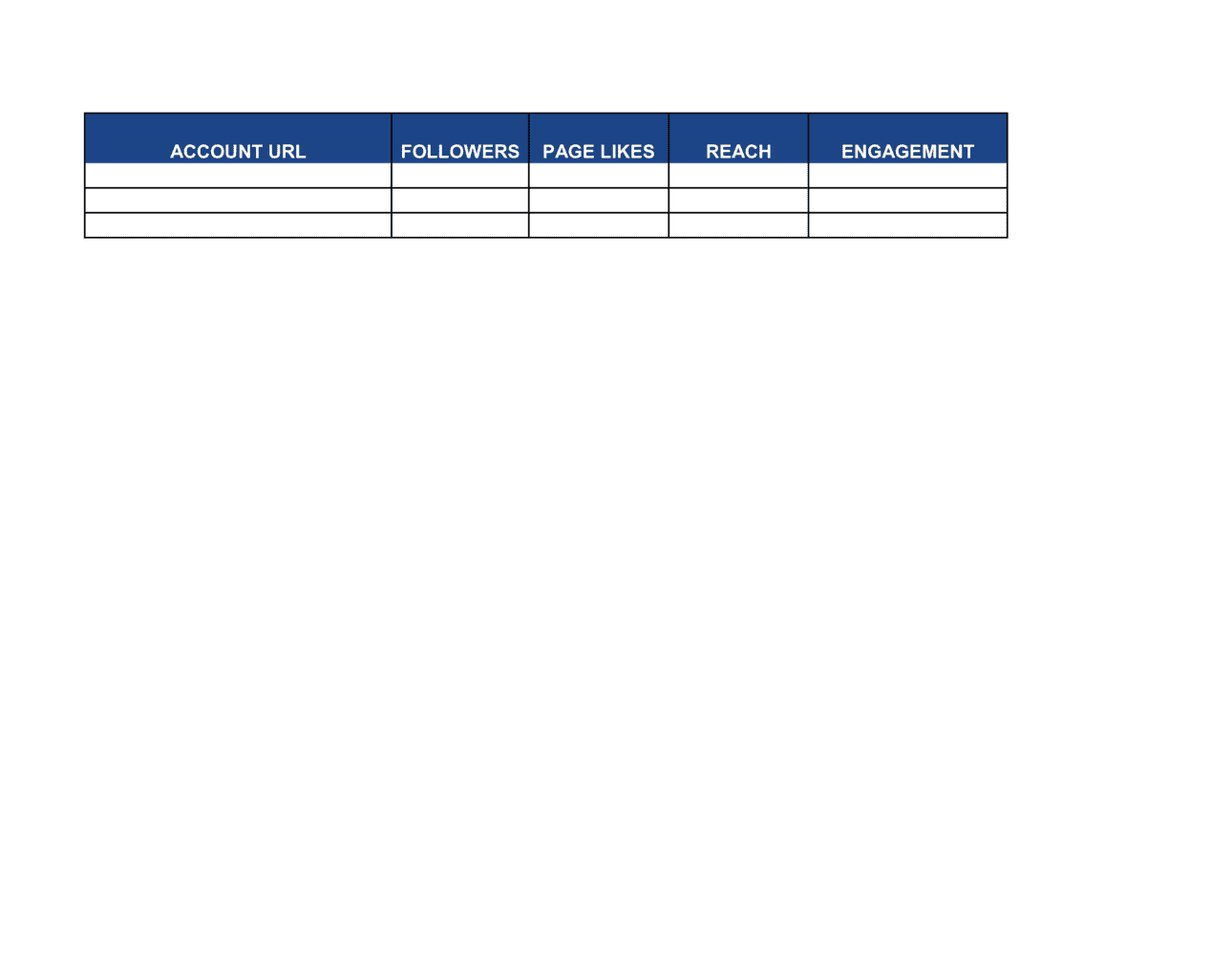
    Record the key metrics for each platform β€” follower count, engagement rate, reach, posting frequency, and audience demographics β€” against any available benchmarks for the client's industry and account size.

    πŸ’‘ Include a simple comparison to two or three direct competitors' public-facing metrics to give the client context for their relative performance.

  6. 6

    Draft the remediation plan with owners and deadlines

    For every finding rated Medium or above, assign a responsible party (auditor or client), a corrective action, and a completion deadline. Use Schedule C to tabulate these systematically.

    πŸ’‘ Separate 'quick wins' (fixable in under one business day) from structural recommendations that require resourcing decisions β€” clients act faster when the path forward is tiered.

  7. 7

    Review IP, liability, and governing law clauses

    Confirm the IP ownership clause reflects the agreed arrangement β€” especially if the client expects to publish findings externally or share the report with investors. Set the liability cap at a multiple of the audit fee that reflects the engagement's risk profile.

    πŸ’‘ If the client is in a regulated industry such as financial services or healthcare, have a lawyer review the compliance section before the report is delivered β€” findings that surface regulatory violations may trigger disclosure obligations.

  8. 8

    Obtain signatures before delivering the report

    Both parties should sign the agreement β€” and ideally the findings report cover page β€” before the full report is released. This confirms the client has received, reviewed, and agreed to the terms governing the use of findings.

    πŸ’‘ Use a timestamped eSign solution so the execution date is unambiguous if findings are later disputed or referenced in a regulatory inquiry.

Frequently asked questions

What is a social media audit?

A social media audit is a structured review of every social media account associated with a business β€” assessing platform presence, content quality, engagement performance, brand consistency, and compliance with platform policies and advertising regulations. When conducted formally between an agency and a client, it is documented in a signed agreement that binds both parties to the findings and any agreed remediation steps.

What platforms should be included in a social media audit?

At minimum, audit every platform where the business has an active account. A complete audit also inventories inactive or legacy accounts β€” these are frequently overlooked but remain visible to the public and can contain outdated claims, old branding, or abandoned advertising pixels that still collect user data. Common platforms to include are Facebook, Instagram, LinkedIn, X (Twitter), TikTok, YouTube, Pinterest, and Google Business Profile.

How often should a business conduct a social media audit?

Most marketing professionals recommend a formal audit at least twice per year for active brands, and at the start of any new agency engagement. Trigger-based audits are also warranted before a product launch or rebrand, following a platform policy update that could affect compliance status, or when a business is being acquired and the buyer needs to assess digital presence as part of due diligence.

What data does a social media auditor need access to?

Analyst or read-only access to native platform analytics is sufficient for most audits β€” covering follower demographics, reach, impressions, engagement rates, and posting history. Paid advertising audits also require access to ad account data, pixel configurations, and audience targeting settings. The access clause in the audit agreement should specify the exact permission level required for each platform and confirm that all credentials are revoked upon audit completion.

What compliance issues does a social media audit check for?

A compliance-focused audit reviews content against platform terms of service, FTC or ASA disclosure requirements for sponsored posts and influencer partnerships, advertising policy violations (prohibited claims, targeting restrictions), and data privacy obligations such as GDPR consent for pixel-based tracking and CCPA disclosures for California users. High- severity findings typically require immediate corrective action to avoid account suspension or regulatory enforcement.

Who owns the social media audit report β€” the auditor or the client?

Ownership depends on what the agreement says. Without an explicit IP clause, the default in most common-law jurisdictions is that the creator of the work β€” the auditor β€” retains copyright. Most audit agreements grant the client a non-exclusive license to use the report for internal purposes, while the auditor retains ownership of the underlying methodology and templates. If the client intends to publish or share findings externally, this must be addressed explicitly in the agreement.

What is the difference between a social media audit and a social media report?

A social media audit is a point-in-time comprehensive assessment covering all platforms, compliance status, and strategic positioning β€” typically conducted at the start of an engagement or annually. A social media report is a recurring performance review for a defined period, usually monthly or quarterly, covering agreed KPIs for accounts already under management. An audit produces a baseline and recommendations; a report tracks progress against that baseline.

Does a social media audit agreement need to be reviewed by a lawyer?

For straightforward domestic agency-client engagements, a well-drafted template is typically sufficient. Legal review is advisable when the client operates in a regulated industry such as financial services, healthcare, or pharmaceuticals, where social media content carries heightened compliance risk; when the engagement involves cross-border data flows subject to GDPR; or when the audit fee exceeds a threshold where the liability cap could expose meaningful financial risk to either party. A one-hour review typically costs $200–$400 and is worthwhile for enterprise-scale engagements.

How this compares to alternatives

vs Social Media Policy

A social media policy sets the internal rules governing how employees and representatives use social media on behalf of the business β€” it is a standing governance document, not a time-bound assessment. A social media audit reviews actual platform performance and compliance against those rules at a specific point in time. Most organizations need both: the policy defines the standard; the audit verifies adherence to it.

vs Social Media Analytics Report

An analytics report is a recurring performance document that tracks agreed KPIs β€” follower growth, engagement rate, reach β€” for accounts already under active management. A social media audit is a comprehensive diagnostic covering all platforms, compliance status, and strategic positioning, typically conducted once or twice per year or at the start of an engagement. The audit produces the baseline that analytics reports are subsequently measured against.

vs Digital Marketing Audit

A digital marketing audit covers the full breadth of a business's online presence β€” website SEO, paid search, email, and social channels together. A social media audit focuses exclusively on social platforms in greater depth: platform-by-platform compliance, account access security, content quality, and audience data. When both are needed, the digital marketing audit is the broader strategic layer; the social media audit provides deeper platform-specific findings.

vs Marketing Plan

A marketing plan is a forward-looking strategic document that sets channel priorities, campaign budgets, and audience targets for the period ahead. A social media audit is a backward-looking and present-state diagnostic that identifies gaps, violations, and underperforming assets. The audit findings typically inform and justify the strategic choices made in the subsequent marketing plan.

Industry-specific considerations

Marketing and advertising agencies

Agencies use signed audit agreements to formalize scope, protect proprietary methodology, and establish a documented baseline before taking over account management for new clients.

Retail and e-commerce

Retailers audit platforms to identify product claim compliance issues, review customer service response practices, and assess whether influencer partnerships carry required FTC disclosures.

Financial services

FINRA, FCA, and equivalent regulators require financial firms to supervise and archive social media communications β€” audits document that oversight obligations are being met and flag unregistered investment claims.

Healthcare and pharmaceuticals

FDA and equivalent agency rules restrict off-label product promotion and require fair balance disclosures β€” social media audits identify non-compliant posts before they attract enforcement attention.

SaaS and technology

Tech companies audit social channels to confirm GDPR-compliant pixel and tracking tag configurations, review data collection disclosures, and assess organic versus paid reach efficiency.

Professional services

Law firms, accountancies, and consultancies use audits to verify that published content complies with professional body advertising rules and that no unauthorized testimonials or performance guarantees appear.

Jurisdictional notes

United States

FTC Endorsement Guidelines require clear disclosure of material connections on sponsored social content β€” audit compliance sections should reference 16 CFR Part 255 and check all influencer and paid partnership posts. CCPA applies to California-resident audience data collected through platform pixels, requiring appropriate disclosures. State-level data broker laws in Virginia, Colorado, and Connecticut also affect how audience data gathered during an audit may be retained or processed.

Canada

CASL (Canada's Anti-Spam Legislation) governs commercial electronic messages including social media direct messages used for promotional purposes β€” audit compliance checks should flag DM-based marketing campaigns that lack proper consent records. PIPEDA and provincial privacy laws in Quebec (Law 25) impose obligations on the collection and processing of audience demographic data. Quebec's Law 25 requires explicit consent for cross-border data transfers, which affects third-party audit tool usage.

United Kingdom

The ASA (Advertising Standards Authority) and CAP Code require clear labeling of paid partnerships and influencer content β€” a common finding category in UK social media audits. UK GDPR and the Data Protection Act 2018 govern any audience data processed during the audit, including analytics exports. Post-Brexit, data transfers from the UK to non-adequate third countries require appropriate safeguards, which should be addressed in the audit agreement's data handling clause.

European Union

GDPR Articles 13 and 14 require transparency about data collected through social media tracking pixels β€” audits should assess whether cookie consent mechanisms are correctly configured and whether privacy notices accurately describe social platform data flows. The EU Digital Services Act (DSA) imposes additional obligations on platforms and advertisers regarding targeted advertising transparency; audit findings should flag non-compliant ad targeting practices. Member states vary in enforcement priority, but France (CNIL) and Germany (BfDI) are among the most active regulators of social media data practices.

Template vs lawyer β€” what fits your deal?

PathBest forCostTime
Use the templateFreelance consultants and small agencies conducting standard domestic social media audits for SMB clientsFree30 minutes to complete the agreement; 1–5 days for the full audit
Template + legal reviewAgency engagements involving regulated industries, cross-border data, or audit fees above $5,000$200–$500 for a one-hour legal review2–3 days including review turnaround
Custom draftedEnterprise-scale audits, multi-jurisdiction GDPR data handling, or engagements where findings will be used in regulatory filings or M&A due diligence$1,000–$3,500+1–2 weeks

Glossary

Platform Inventory
A complete list of every social media account associated with a brand, including inactive or legacy accounts that have not been formally decommissioned.
Engagement Rate
Total interactions (likes, comments, shares, saves) on a post divided by total followers or reach, expressed as a percentage.
Reach
The number of unique users who saw a piece of content during a defined period, distinct from impressions, which count repeat views.
Brand Voice Consistency
The degree to which published content across all platforms reflects the same tone, messaging pillars, and visual identity standards.
Platform Policy Compliance
Adherence to each social network's terms of service, advertising policies, and community standards β€” violations can result in account suspension.
Content Gap
A topic, format, or audience segment that competitors are addressing but the audited brand is not, representing an opportunity for incremental reach.
Share of Voice
A brand's social media mentions or engagement as a percentage of the total conversation volume in its category or market.
Audience Demographics
The age, gender, location, and device breakdown of a brand's followers or engaged users, sourced from native platform analytics.
Audit Findings
The documented conclusions drawn from analyzing platform data, content quality, and compliance status β€” the core deliverable of a social media audit.
Remediation Plan
A documented set of corrective actions β€” timelines, owners, and success metrics β€” agreed between the auditor and client to address identified gaps.
Access Credential Log
A secure record of the login credentials, admin roles, and two-factor authentication status for each audited platform account.

Part of your Business Operating System

This document is one of 3,000+ business & legal templates included in Business in a Box.

  • Fill-in-the-blanks β€” ready in minutes
  • 100% customizable Word document
  • Compatible with all office suites
  • Export to PDF and share electronically

Create your document in 3 simple steps.

From template to signed document β€” all inside one Business Operating System.
1
Download or open template

Access over 3,000+ business and legal templates for any business task, project or initiative.

2
Edit and fill in the blanks with AI

Customize your ready-made business document template and save it in the cloud.

3
Save, Share, Send, Sign

Share your files and folders with your team. Create a space of seamless collaboration.

Save time, save money, and create top-quality documents.

β˜…β˜…β˜…β˜…β˜…

"Fantastic value! I'm not sure how I'd do without it. It's worth its weight in gold and paid back for itself many times."

Managing Director Β· Mall Farm
Robert Whalley
Managing Director, Mall Farm Proprietary Limited
β˜…β˜…β˜…β˜…β˜…

"I have been using Business in a Box for years. It has been the most useful source of templates I have encountered. I recommend it to anyone."

Business Owner Β· 4+ years
Dr Michael John Freestone
Business Owner
β˜…β˜…β˜…β˜…β˜…

"It has been a life saver so many times I have lost count. Business in a Box has saved me so much time and as you know, time is money."

Owner Β· Upstate Web
David G. Moore Jr.
Owner, Upstate Web

Run your business with a system β€” not scattered tools

Stop downloading documents. Start operating with clarity. Business in a Box gives you the Business Operating System used by over 250,000 companies worldwide to structure, run, and grow their business.

Start freeΒ Β·Β No credit card required