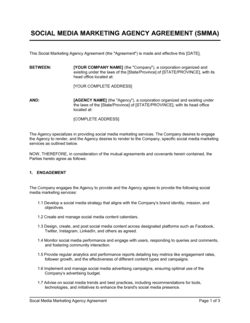
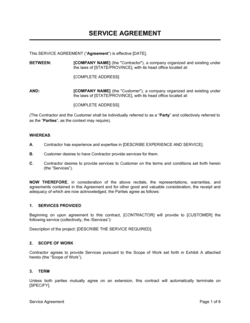
Marketing Agreement Template

Free Word download • Edit online • Save & share with Drive • Export to PDF

12 pages30–40 min to fillDifficulty: ComplexSignature requiredLegal review recommended
Learn more ↓
FreeMarketing Agreement Template

At a glance

What it is
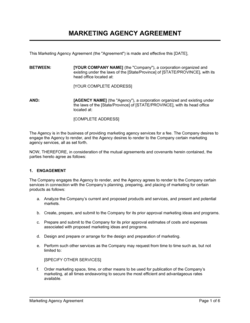
A Marketing Agreement is a legally binding contract between a business and a marketing service provider — agency, consultant, or freelancer — that defines the scope of services, compensation structure, IP ownership, confidentiality obligations, and termination conditions. This free Word download gives you a professionally structured starting point you can edit online and export as PDF for immediate execution.
When you need it
Use it whenever you engage a third party to plan, create, or execute marketing activities on your behalf — including digital campaigns, content production, SEO, paid advertising, social media management, or brand strategy. It is equally relevant when you are the agency or consultant being hired and need to document obligations clearly before work begins.
What's inside
Scope of services and deliverables, fees and payment schedule, IP assignment and license provisions, confidentiality obligations, non-solicitation restrictions, representations and warranties, indemnification, limitation of liability, termination rights, and governing law.

What is a Marketing Agreement?

A Marketing Agreement is a legally binding contract between a business and a marketing service provider — an agency, consultant, or freelancer — that governs every material dimension of the engagement: scope of services and deliverables, fees and payment schedule, ownership of creative assets, brand license terms, confidentiality obligations, exclusivity restrictions, and termination rights. Unlike an informal email exchange or a one-page proposal, a properly drafted marketing agreement creates enforceable obligations on both sides and eliminates the ambiguity that causes the majority of marketing relationship disputes — disagreements over who owns the deliverables, who controls the ad budget, and what happens when the relationship ends.

Why You Need This Document

Without a signed marketing agreement, you are exposed on several fronts before a single campaign goes live. Creative assets produced by a freelancer or agency remain their intellectual property by default in most jurisdictions — meaning you cannot legally use the work you paid for if the relationship deteriorates. Third-party ad spend managed without a written authorization clause leaves both parties uncertain about liability for budget overruns or platform policy violations. A departing agency has no legal obligation to hand over ad account credentials, analytics access, or campaign data unless the contract says so, and recovering those assets without legal recourse can take weeks and cost more than the original engagement. A well-prepared marketing agreement resolves all of these risks before work begins — and this template gives you a professionally structured starting point you can complete in under an hour.

Which variant fits your situation?

If your situation is…Use this template
Ongoing retainer relationship with a full-service marketing agencyMarketing Retainer Agreement
One-time campaign or project with a defined end dateMarketing Services Agreement (Project-Based)
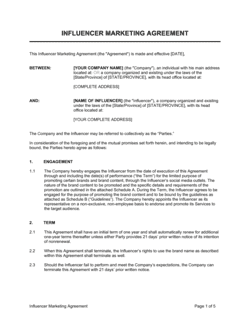
Engaging an influencer or content creator for sponsored postsInfluencer Marketing Agreement
Authorizing a third party to sell or market your products in a territoryMarketing Affiliate Agreement
Joint marketing campaign between two co-equal brandsCo-Marketing Agreement
Engaging a public relations firm for media outreach and press coveragePublic Relations Agreement
Hiring a digital advertising agency for paid search and social campaignsDigital Marketing Services Agreement

Common mistakes to avoid

❌ Vague scope of services with no measurable deliverables

Why it matters: Without specific deliverables and deadlines, the client cannot establish non-performance and the provider cannot demonstrate completion. Scope disputes are the most common cause of marketing contract litigation.

Fix: Attach a Schedule A listing every specific output — number of ads, content pieces, reports — with delivery dates and an explicit acceptance process.

❌ No IP ownership clause or a clause that only assigns work after full payment without addressing partial payment

Why it matters: If the client terminates mid-project and has paid 60% of the fee, ambiguity over who owns partial deliverables can prevent the client from using completed work and block the provider from recovering the balance.

Fix: Include a proportional IP provision: ownership of completed, accepted deliverables transfers upon payment of the fee allocated to each milestone, regardless of whether the full project is completed.

❌ Omitting a wind-down and asset-transfer clause

Why it matters: When an agency relationship ends, the client often needs immediate access to ad accounts, social media credentials, analytics platforms, and domain registrations. Without a contractual obligation to transfer these, the provider has leverage to delay.

Fix: Add a termination clause requiring the provider to transfer all account access, logins, and data within [5] business days of the termination date, and to cooperate with any transition to a successor provider.

❌ No limitation of liability or a one-sided cap that only protects one party

Why it matters: A provider running a $500K annual ad budget with no liability cap faces catastrophic exposure if a campaign error triggers brand damage claims. Without a mutual cap, providers price this risk into fees or refuse the engagement.

Fix: Include a mutual limitation of liability capping both parties' exposure at total fees paid in the preceding 12 months, with a mutual exclusion of consequential and indirect damages.

❌ Granting the provider an unrestricted license to use client brand materials

Why it matters: An unbounded license allows the provider to use your brand in case studies, award submissions, and promotional materials — potentially disclosing confidential campaign performance data or associating your brand with the provider's other clients.

Fix: Restrict the license to 'solely for purposes of performing the Services under this Agreement' and add a separate written-consent requirement for any case study or portfolio use.

❌ No exclusivity definition when exclusivity is intended

Why it matters: Assuming exclusivity without documenting it — industry, geography, service type, and duration — leaves the client with no recourse when the provider serves a direct competitor, and the provider with no clear obligation to avoid conflicts.

Fix: Define exclusivity with precision: name the specific competitive category, the geographic territory, and the duration. Vague exclusivity clauses are frequently struck down as unenforceable.

The 10 key clauses, explained

Parties and recitals

In plain language: Identifies the client and the marketing provider by their full legal names, states the nature of the relationship, and sets the effective date of the agreement.

Sample language
This Marketing Agreement ('Agreement') is entered into as of [DATE] between [CLIENT LEGAL NAME], a [STATE/PROVINCE] [ENTITY TYPE] ('Client'), and [PROVIDER LEGAL NAME], a [STATE/PROVINCE] [ENTITY TYPE] ('Provider').

Common mistake: Using trade names or brand names instead of registered legal entity names. If the named party doesn't match the signing entity, enforcing payment obligations or IP assignment against the correct party becomes complicated.

Scope of services and deliverables

In plain language: Describes exactly what the provider will do, what outputs will be delivered, in what format, and on what timeline. Usually supported by an attached Statement of Work.

Sample language
Provider shall perform the marketing services described in Schedule A ('Services'), including [LIST OF SPECIFIC DELIVERABLES], and shall deliver each item by the date specified in the project timeline attached as Exhibit 1.

Common mistake: Describing services in broad, aspirational language like 'grow the brand' without tying them to specific, measurable deliverables. Vague scope is the leading cause of marketing contract disputes.

Fees, payment schedule, and expenses

In plain language: States the total fee or rate, when invoices are due, the payment method, late-payment consequences, and how pre-approved third-party expenses are handled.

Sample language
Client shall pay Provider a monthly retainer of $[AMOUNT], due within [30] days of invoice. Late payments accrue interest at [1.5]% per month. Third-party media spend requires Client pre-approval and is billed at cost with no markup.

Common mistake: Not addressing third-party ad spend separately from the service fee. When a provider manages a six-figure ad budget, ambiguity about who controls the spend and who is liable for overruns creates serious financial exposure.

Intellectual property ownership and assignment

In plain language: Determines who owns campaign assets, copy, creative, and data generated under the agreement — typically assigning finished deliverables to the client upon full payment.

Sample language
Upon receipt of all fees due, Provider assigns to Client all right, title, and interest in the Deliverables, including all copyrights. Provider retains ownership of all pre-existing tools, methodologies, and background IP used to create the Deliverables.

Common mistake: Omitting a carve-out for the provider's background IP — templates, software, or proprietary processes they bring to the engagement. Without it, the assignment clause may inadvertently transfer tools the provider needs for every other client.

License to client materials

In plain language: Grants the provider a limited, non-exclusive license to use the client's brand assets, trademarks, and content solely to perform the services under the agreement.

Sample language
Client grants Provider a non-exclusive, royalty-free license to use Client's trademarks, logos, and content solely for the purpose of performing the Services during the Term. Provider shall not use Client's brand assets for any other purpose.

Common mistake: Granting an unlimited license to brand materials without restricting the purpose or duration. A license with no scope allows the provider to use your brand in their own promotional materials, case studies, or portfolios without further consent.

Confidentiality

In plain language: Prohibits both parties from disclosing the other's non-public business information — pricing, strategy, customer data, and campaign performance — during and after the engagement.

Sample language
Each party agrees to keep confidential all non-public information received from the other party ('Confidential Information') and not to disclose or use such information except as necessary to perform this Agreement. This obligation survives termination for [2] years.

Common mistake: A one-sided confidentiality clause that only protects the client. Providers share proprietary methodologies and pricing with clients — a mutual NDA protects both parties and is more likely to be accepted without negotiation.

Representations, warranties, and indemnification

In plain language: Each party confirms they have authority to enter the agreement and that their contributions don't infringe third-party rights. The indemnification clause allocates responsibility for losses arising from those representations being false.

Sample language
Provider represents that the Deliverables will not infringe any third-party intellectual property rights. Provider shall indemnify Client against any third-party claims arising from Provider's breach of this representation, provided Client notifies Provider promptly of any such claim.

Common mistake: One-sided indemnification requiring the provider to cover all claims regardless of fault. A balanced clause requires each party to indemnify the other only for their own breaches — courts scrutinize one-sided indemnities and may reduce their effect.

Term, termination, and wind-down

In plain language: Sets the initial contract period, how either party can terminate for convenience or cause, and the transition obligations — outstanding deliverables, final payment, and asset transfer — that apply at termination.

Sample language
This Agreement commences on [START DATE] and continues for [12] months ('Initial Term'), renewing automatically unless terminated on [60] days' written notice. Either party may terminate for Cause immediately upon written notice specifying the breach. Upon termination, Provider shall deliver all completed Deliverables and Client shall pay all undisputed fees earned through the termination date.

Common mistake: No wind-down clause. When an agreement terminates mid-campaign, the absence of explicit handover obligations — transferring ad account access, domain credentials, and analytics data — leaves the client unable to continue operations.

Limitation of liability

In plain language: Caps the maximum financial exposure of either party — typically at the total fees paid in the preceding 12 months — and excludes consequential, indirect, or punitive damages.

Sample language
Neither party's total liability under this Agreement shall exceed the total fees paid by Client in the [12] months preceding the claim. Neither party shall be liable for indirect, consequential, or punitive damages, even if advised of their possibility.

Common mistake: Not including a mutual limitation of liability. A one-sided cap that only protects the provider while leaving the client with unlimited exposure will be resisted in negotiation and may be unenforceable in some jurisdictions.

Governing law, dispute resolution, and entire agreement

In plain language: Specifies which jurisdiction's law governs, how disputes are resolved (arbitration or litigation), which courts have jurisdiction, and confirms the written agreement supersedes all prior negotiations and representations.

Sample language
This Agreement is governed by the laws of [STATE/PROVINCE/COUNTRY]. Any dispute shall be resolved by binding arbitration under [AAA / JAMS / applicable rules] in [CITY], except claims for injunctive relief. This Agreement constitutes the entire agreement between the parties and supersedes all prior representations and understandings.

Common mistake: Selecting a governing jurisdiction that has no connection to either party's location. Courts in the non-selected jurisdiction may decline to enforce the choice-of-law clause, and the parties will bear unnecessary litigation costs enforcing it remotely.

How to fill it out

  1. 1

    Identify the parties with their full legal names

    Enter the registered legal entity names — not trading names or brand names — for both the client and the provider. Include entity type (LLC, Inc., Ltd.) and state or province of incorporation.

    💡 Cross-reference the provider's entity name against your state's business registry before signing. Engaging a dissolved or incorrectly named entity creates serious enforcement problems.

  2. 2

    Draft a detailed scope of services in Schedule A

    List every specific deliverable — number of social posts per month, ad campaigns managed, content pieces produced, reporting cadence — with delivery dates and acceptance criteria. Move granular details to a Schedule rather than the main body so they can be updated by mutual written amendment without redrafting the entire agreement.

    💡 If scope is still being defined, use a phased approach: define Phase 1 fully and add a clause allowing Phase 2 scope to be attached by written addendum once agreed.

  3. 3

    Specify fees, invoicing schedule, and expense policy

    State whether the fee is a flat monthly retainer, a project fee, or an hourly rate. Set the invoice frequency, due date (Net 15 or Net 30), and the interest rate on late payments. Add a separate clause for third-party ad spend authorization if the provider will manage media budgets.

    💡 Include a provision requiring pre-approval for any single third-party expense above a defined threshold — $500 is a common floor for small engagements.

  4. 4

    Clarify IP ownership and background IP carve-outs

    State that all finished deliverables assign to the client upon full payment, and explicitly carve out any pre-existing tools, templates, or proprietary methodologies the provider retains. List specific background IP in a schedule if necessary.

    💡 If the provider uses licensed fonts, stock imagery, or software in deliverables, confirm those third-party licenses permit the intended commercial use before assignment.

  5. 5

    Set exclusivity scope and geography if required

    If the client requires exclusivity, define it narrowly: specify the industry, category of services, and geographic region. Unlimited exclusivity significantly reduces the provider's earning capacity and will increase the retainer fee.

    💡 Consider time-limited exclusivity — exclusive for the first 6 months, non-exclusive thereafter — as a compromise that protects the client's launch without permanently restricting the provider.

  6. 6

    Define the term, notice period, and termination triggers

    Set the initial term (typically 6 or 12 months), the automatic renewal mechanism, and the advance notice required to terminate for convenience (30–90 days is standard). List the specific triggers for termination for cause — material breach uncured after [14] days' notice, insolvency, or fraud.

    💡 Include a 'cure period' for non-payment termination: allow the defaulting party 10 business days to cure before termination becomes effective. This prevents accidental termination over processing delays.

  7. 7

    Fill in governing law and dispute resolution

    Select the jurisdiction where both parties operate or where disputes are most practically litigated. Choose between binding arbitration (faster, confidential, less expensive) or court litigation. Include the specific arbitration body — AAA, JAMS, or the applicable body in your country.

    💡 For cross-border engagements, arbitration under ICC or UNCITRAL rules is typically more neutral and enforceable across jurisdictions than a single-country court clause.

  8. 8

    Execute before any work begins

    Both parties must sign before the provider starts work. Work performed without a signed agreement creates scope ambiguity, IP uncertainty, and payment risk for both sides. Use an e-signature platform to timestamp execution and distribute executed copies automatically.

    💡 Send the agreement at the same time as — or before — the first invoice or project brief. Providers who receive a brief and start before signing often find it harder to negotiate terms after work has begun.

Frequently asked questions

What is a marketing agreement?

A marketing agreement is a legally binding contract between a business and a marketing service provider — such as an agency, consultant, or freelancer — that defines the scope of services, payment terms, IP ownership, confidentiality obligations, and termination conditions. It creates enforceable obligations for both parties and replaces informal email chains or verbal understandings as the governing document for the engagement.

When do I need a marketing agreement?

You need a marketing agreement any time you engage a third party to plan, produce, or execute marketing activities on your behalf — including digital advertising, content creation, SEO, social media management, influencer campaigns, or brand strategy. The agreement should be signed before any work begins and before any budget is committed to third-party media spend. Agencies and freelancers acting as providers should require one before starting work for any new client.

What is the difference between a marketing agreement and a marketing retainer agreement?

A marketing agreement is the general governing contract that defines the relationship, IP rights, confidentiality, and termination conditions. A marketing retainer agreement is a specific fee structure within that relationship — a fixed monthly payment for ongoing access to services rather than per-project billing. Many retainer arrangements use a master marketing agreement as the governing document and attach a retainer fee schedule as an exhibit.

Who owns the creative assets produced under a marketing agreement?

Ownership depends entirely on what the agreement says. In most jurisdictions, independent contractors retain copyright in work they create unless the agreement explicitly assigns it to the client or qualifies the work as 'work made for hire.' A well-drafted marketing agreement should assign all finished deliverables to the client upon full payment, while carving out the provider's pre-existing tools, templates, and background IP.

Should a marketing agreement include performance metrics or KPIs?

Including KPIs in the agreement or a Schedule is strongly recommended for performance-based engagements, but do so carefully. Tying payment directly to KPI achievement creates significant disputes when results are influenced by factors outside the provider's control — such as market conditions or client-side delays. A better approach is to include KPIs as reporting benchmarks in Schedule A, with a separate remedies clause specifying what happens if they are materially missed.

Can a marketing agreement include an exclusivity clause?

Yes, and exclusivity clauses are common in marketing agreements — for example, preventing the provider from simultaneously serving a direct competitor. For exclusivity to be enforceable, it must be specific: define the competitive category, geographic territory, and duration. Broad or unlimited exclusivity clauses are regularly challenged and may be unenforceable. Providers typically charge a premium for genuine exclusivity to compensate for lost business opportunities.

What notice period should a marketing agreement include for termination?

Thirty to ninety days is the standard range for termination for convenience in marketing agreements. Longer notice periods (60–90 days) are appropriate for retainer engagements where the provider has significant ongoing work and needs time to wind down campaigns. Shorter periods (30 days) suit project-based engagements. Either party should be able to terminate for cause — material breach, non-payment, or insolvency — immediately upon written notice after a cure period of 10–14 days.

Is a marketing agreement enforceable without a signature?

In most jurisdictions, a contract requires offer, acceptance, and consideration to be binding — but a written signature provides the clearest evidence of all three. An email exchange accepting written terms may constitute a binding agreement in some jurisdictions, but enforcing it is significantly harder than producing a signed document. Electronic signatures are legally valid in the US (ESIGN Act), Canada (PIPEDA and provincial legislation), the UK, and the EU, and are treated as equivalent to wet signatures in most commercial contexts.

Do I need a lawyer to draft a marketing agreement?

For straightforward domestic engagements, a well-prepared template reviewed against your specific situation is typically sufficient. Engage a lawyer when the engagement involves significant media spend (over $100K annually), when exclusivity or non-compete terms are central to the deal, when the provider operates in a different jurisdiction, or when the deliverables involve sensitive regulated content — such as financial services advertising or healthcare claims. A 1–2 hour template review by a commercial lawyer typically costs $300–$800 and is worthwhile for high-value retainer relationships.

How this compares to alternatives

vs Independent Contractor Agreement

An independent contractor agreement governs the general engagement of a self-employed individual and covers classification, payment, and IP at a high level. A marketing agreement is purpose-built for marketing engagements — it adds campaign-specific provisions for scope, KPIs, ad spend authorization, exclusivity, and brand license. For marketing work, a purpose-specific agreement offers far more protection than a generic contractor template.

vs Service Agreement

A service agreement is a broad template for any service-based engagement. A marketing agreement includes provisions specific to the marketing context — performance benchmarks, media budget controls, brand asset licensing, and deliverable acceptance criteria. Use a service agreement for general professional services; use a marketing agreement when the engagement is specifically campaign- or brand-related.

vs Co-Marketing Agreement

A co-marketing agreement governs a joint campaign between two equal business partners who share resources, costs, and audience access. A marketing agreement governs a client-vendor relationship where one party pays the other to provide services. The power dynamic, cost structure, and IP allocation are fundamentally different between the two documents.

vs Non-Disclosure Agreement

An NDA protects confidential information shared during preliminary discussions before an agreement is signed. A marketing agreement includes its own confidentiality clause that governs information shared during the engagement itself. For an established marketing relationship, the marketing agreement's confidentiality clause is the governing document — a standalone NDA is most useful at the pre-contract evaluation stage.

Industry-specific considerations

Technology / SaaS

Performance KPIs tied to MQL and SQL targets, product marketing deliverables for launch campaigns, and strict IP assignment for software screenshots and branded assets.

Retail / E-commerce

Paid media spend authorization for large seasonal ad budgets, influencer and affiliate program terms, and attribution reporting obligations across channels.

Healthcare and Life Sciences

Regulatory compliance warranties for promotional claims, HIPAA-compliant handling of any patient data used in targeting, and mandatory medical-legal review of all deliverables.

Financial Services

FCA, SEC, or FINRA compliance representations for all advertising content, prior-approval requirements for every campaign asset, and enhanced confidentiality covering client financial data.

Professional Services

Exclusivity clauses preventing the agency from serving competing firms in the same practice area, and co-branding restrictions on case studies or testimonials.

Food and Beverage

Brand standards and visual identity compliance for all creative output, influencer disclosure obligations under FTC guidelines, and product claim accuracy warranties.

Jurisdictional notes

United States

US marketing agreements are governed primarily by state contract law, which varies on enforceability of non-competes and exclusivity clauses — California, for example, voids most post-engagement non-solicitation of clients. The FTC's Endorsement Guides impose disclosure obligations on influencer and testimonial campaigns that should be incorporated by reference. Copyright ownership defaults to the creator under the Copyright Act unless a written work-made-for-hire agreement is in place.

Canada

Canadian marketing agreements must comply with CASL (Canada's Anti-Spam Legislation) when the engagement involves email marketing — the provider must understand consent obligations and document them. Quebec contracts for provincially-regulated businesses must be in French or bilingual. Moral rights of creators under the Copyright Act cannot be assigned — only waived — so the agreement should include an explicit moral rights waiver.

United Kingdom

UK marketing agreements must comply with ASA (Advertising Standards Authority) codes and CAP rules, particularly for digital and influencer content. The UK GDPR and Data Protection Act 2018 apply when the provider processes any personal data on behalf of the client — a data processing addendum is typically required. Post-Brexit, UK contracts may no longer rely on EU cross-border data transfer mechanisms and must address UK-specific adequacy decisions.

European Union

GDPR compliance is the primary consideration for EU marketing agreements — any processing of personal data (including targeting and analytics) requires a Data Processing Agreement under Article 28. The EU's Digital Services Act and Digital Markets Act impose additional obligations on digital advertising transparency. Member state advertising regulations vary: Germany's UWG (Unfair Competition Act) is notably strict on comparative and testimonial advertising. Moral rights are strongly protected in France and Germany and cannot be fully waived.

Template vs lawyer — what fits your deal?

PathBest forCostTime
Use the templateSmall businesses and freelancers entering standard domestic marketing engagements with modest budgetsFree30–60 minutes
Template + legal reviewRetainer engagements over $50K annually, exclusivity clauses, or multi-jurisdiction providers$300–$8002–4 days
Custom draftedLarge agency relationships with significant media budgets, regulated industries, or cross-border engagements requiring multi-jurisdiction compliance$1,500–$4,000+1–3 weeks

Glossary

Scope of Services
A detailed description of the specific marketing activities the provider is contracted to perform, used as the benchmark for performance and deliverable acceptance.
Retainer
A fixed monthly fee paid to a marketing provider in exchange for a defined level of ongoing service, regardless of the number of hours worked.
Work Made for Hire
A legal doctrine under which creative work produced by a contractor is deemed owned by the hiring party from creation, provided the agreement expressly states this and the work falls within a qualifying category.
License (IP)
Permission granted by one party to another to use intellectual property — such as a logo, copy, or campaign asset — under defined conditions without transferring ownership.
Indemnification
A contractual obligation by one party to compensate the other for specific losses, claims, or damages arising from defined circumstances — such as a third-party IP infringement claim.
Limitation of Liability
A clause capping the maximum financial exposure of one or both parties, typically expressed as a multiple of fees paid under the agreement.
Non-Solicitation
A restriction preventing one party from directly recruiting or hiring the other's employees or key contractors during and for a defined period after the engagement.
Exclusivity
A provision preventing the marketing provider from performing the same or similar services for a competing brand or business during the term of the agreement.
Performance Metrics (KPIs)
Agreed, measurable benchmarks — such as cost per lead, conversion rate, or monthly impressions — used to evaluate whether the marketing provider is meeting its obligations.
Termination for Cause
The right to end the agreement immediately, without notice or severance, based on specific documented breaches such as fraud, gross negligence, or material non-performance.
Moral Rights
Non-transferable rights of a creator to attribution and integrity of their work, recognized in Canada, the UK, and EU countries, which may need to be waived in a marketing agreement.

Part of your Business Operating System

This document is one of 3,000+ business & legal templates included in Business in a Box.

  • Fill-in-the-blanks — ready in minutes
  • 100% customizable Word document
  • Compatible with all office suites
  • Export to PDF and share electronically

Create your document in 3 simple steps.

From template to signed document — all inside one Business Operating System.
1
Download or open template

Access over 3,000+ business and legal templates for any business task, project or initiative.

2
Edit and fill in the blanks with AI

Customize your ready-made business document template and save it in the cloud.

3
Save, Share, Send, Sign

Share your files and folders with your team. Create a space of seamless collaboration.

Save time, save money, and create top-quality documents.

★★★★★

"Fantastic value! I'm not sure how I'd do without it. It's worth its weight in gold and paid back for itself many times."

Managing Director · Mall Farm
Robert Whalley
Managing Director, Mall Farm Proprietary Limited
★★★★★

"I have been using Business in a Box for years. It has been the most useful source of templates I have encountered. I recommend it to anyone."

Business Owner · 4+ years
Dr Michael John Freestone
Business Owner
★★★★★

"It has been a life saver so many times I have lost count. Business in a Box has saved me so much time and as you know, time is money."

Owner · Upstate Web
David G. Moore Jr.
Owner, Upstate Web

Run your business with a system — not scattered tools

Stop downloading documents. Start operating with clarity. Business in a Box gives you the Business Operating System used by over 250,000 companies worldwide to structure, run, and grow their business.

Free Forever Plan · No credit card required