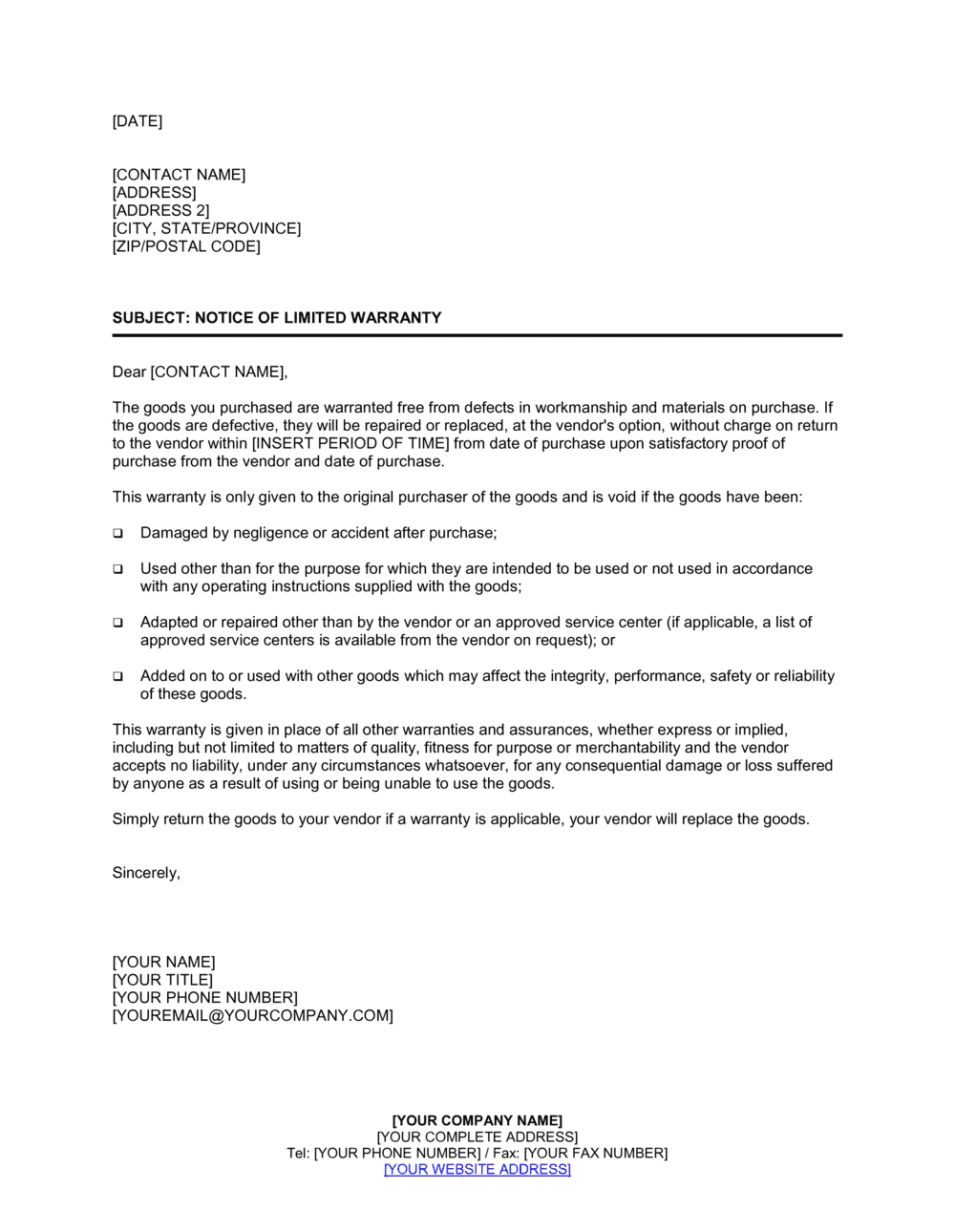
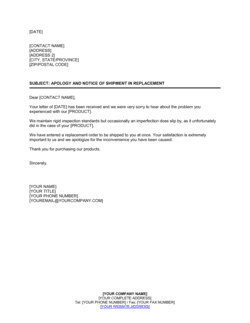
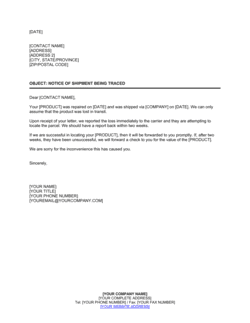
Reply Notice of Limited Warranty Template

Free Word download β€’ Edit online β€’ Save & share with Drive β€’ Export to PDF

1 pageβ€’15–25 min to fillβ€’Difficulty: Standard
Learn more ↓
FreeReply Notice of Limited Warranty Template

At a glance

What it is
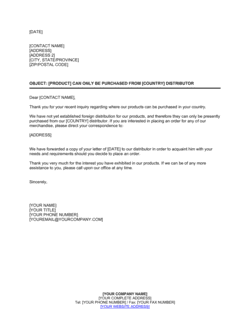
A Reply Notice of Limited Warranty is a formal business letter a seller or manufacturer sends in response to a customer's warranty claim, confirming receipt of the claim and explaining what the limited warranty covers, what it excludes, and what remedial action will be taken. This free Word download gives you a structured, professional starting point you can edit online and export as PDF in under 15 minutes.
When you need it
Use it when a customer submits a warranty claim on a product you sold or manufactured, and you need to formally acknowledge the claim, clarify the scope of your limited warranty, and communicate the next steps β€” whether that is a repair, replacement, refund, or denial.
What's inside
Sender and recipient details, claim reference number and date, acknowledgment of the original warranty notice, a clear statement of what the limited warranty covers and excludes, the remedy being offered or denied, the timeline for resolution, and a professional closing with contact information for follow-up.

What is a Reply Notice of Limited Warranty?

A Reply Notice of Limited Warranty is a formal business letter sent by a seller or manufacturer in response to a customer's warranty claim on a product. It acknowledges that the claim was received, summarizes the applicable limited warranty coverage and any relevant exclusions, states the company's decision β€” approval, partial remedy, or denial β€” and explains the next steps and timeline for resolving the claim. Unlike a casual email reply, a formal notice creates a dated, written record that links the claim to a specific decision under documented warranty terms, which is essential if the matter is later disputed.

Why You Need This Document

Responding to warranty claims verbally or through informal emails leaves your business without a clear record of what was decided, when, and on what grounds. When a customer files a credit card chargeback or a consumer protection complaint, the first thing a dispute resolution process looks for is written evidence that you handled the claim properly. A properly formatted reply notice closes that gap β€” it documents the claim reference, the coverage determination, the exclusion cited if applicable, and the remedy offered or declined. For businesses that process multiple warranty claims per month, a standardized template also ensures that every customer receives a consistent, professional response without requiring each reply to be drafted from scratch. This template gives you a ready-to-use structure that covers every required component of a warranty reply letter, so you can respond to claims accurately and on time without needing a legal team to draft each one.

Which variant fits your situation?

If your situation is…Use this template
Approving a warranty claim and offering a replacement productReply Notice of Limited Warranty (Replacement Approved)
Approving a warranty claim and arranging a repairReply Notice of Limited Warranty (Repair Approved)
Denying a warranty claim due to customer misuse or exclusionReply Notice of Limited Warranty (Claim Denied)
Acknowledging receipt while the claim is still under reviewReply Notice of Limited Warranty (Claim Under Review)
Issuing the original warranty terms to a new buyerLimited Warranty Agreement
Notifying a customer that their warranty period has expiredWarranty Expiration Notice Letter
Responding to a warranty claim on a service rather than a productService Warranty Response Letter

Common mistakes to avoid

❌ Ambiguous claim decision language

Why it matters: Phrases like 'we will do our best to assist' leave the customer uncertain whether their claim was approved or denied, generating unnecessary follow-up calls and escalation.

Fix: Use a single declarative sentence: 'Your claim has been approved and a replacement unit will be shipped to you within 5 business days of receiving your return.'

❌ Omitting the claim reference number

Why it matters: Without a reference number, both parties lose the ability to connect the reply to the original claim during follow-up, audits, or dispute resolution.

Fix: Assign a claim reference number before sending any reply and include it in the subject line of every piece of correspondence related to that claim.

❌ Citing exclusions in vague or general terms

Why it matters: Telling a customer their claim is denied due to 'warranty exclusions' without specifying which one reads as arbitrary and often triggers a dispute or chargeback.

Fix: Name the specific exclusion (e.g., 'damage resulting from unauthorized repair, per Section 3(b) of your warranty terms') and connect it to the customer's reported issue.

❌ No next-steps timeline

Why it matters: Customers who receive a reply with no timeline contact support repeatedly to check status, increasing handling costs and reducing satisfaction scores.

Fix: State a specific number of business days for each step the customer must take and each action your company will perform β€” e.g., 'replacement shipped within 5 business days of receiving the returned unit.'

The 9 key clauses, explained

Sender and recipient identification

In plain language: Identifies the company sending the reply, the customer or claimant receiving it, and their respective contact details and addresses.

Sample language
[COMPANY NAME] | [ADDRESS] | [CITY, STATE, ZIP] | [DATE] | To: [CUSTOMER NAME] | [CUSTOMER ADDRESS]

Common mistake: Using a generic department name like 'Customer Service' instead of the company's legal name β€” which matters if the letter is later referenced in a dispute.

Subject line and claim reference

In plain language: States the purpose of the letter and links it to a specific claim number or original warranty notice date so both parties can track the correspondence.

Sample language
Re: Reply to Warranty Claim No. [CLAIM NUMBER] β€” [PRODUCT NAME/MODEL], Original Notice Dated [DATE]

Common mistake: Omitting a claim reference number. Without it, both parties lose the ability to connect this reply to the original claim during follow-up or escalation.

Acknowledgment of the warranty notice

In plain language: Confirms that the company received the customer's warranty claim and the date on which it was received.

Sample language
We acknowledge receipt of your warranty claim dated [DATE] regarding [PRODUCT NAME/MODEL], Serial No. [SERIAL NUMBER], purchased on [PURCHASE DATE].

Common mistake: Skipping the acknowledgment paragraph and jumping straight to the decision. This leaves the customer uncertain whether their claim was received at all.

Statement of limited warranty coverage

In plain language: Summarizes the scope of the limited warranty β€” what it covers, for how long, and under what conditions β€” so the customer understands the basis for the reply.

Sample language
Your product is covered under our [X]-year limited warranty against defects in materials and workmanship under normal use conditions, effective from the original purchase date of [DATE].

Common mistake: Referring the customer back to 'your warranty documentation' without restating the key terms. If the customer no longer has the original warranty card, this creates unnecessary back-and-forth.

Exclusions applicable to the claim

In plain language: Identifies any specific exclusions under the limited warranty that are relevant to this claim β€” such as physical damage, unauthorized modifications, or expired warranty period.

Sample language
Please note that the limited warranty does not cover damage resulting from [MISUSE / UNAUTHORIZED REPAIR / PHYSICAL DAMAGE / NORMAL WEAR AND TEAR], as specified in Section [X] of the warranty terms.

Common mistake: Citing exclusions without connecting them specifically to the claimant's situation. Vague exclusion language reads as a blanket denial and increases the likelihood of escalation.

Decision and remedy offered

In plain language: States clearly whether the claim is approved, denied, or under review, and if approved, describes the specific remedy being provided β€” repair, replacement, or refund β€” along with any conditions.

Sample language
Based on our review of your claim, we are pleased to [authorize a replacement unit / arrange for repair / issue a credit of $[AMOUNT]] at no charge to you, subject to [CONDITION, IF ANY].

Common mistake: Using ambiguous language like 'we will try to help' instead of a definitive decision. Ambiguity invites disputes and delays resolution for both parties.

Next steps and timeline

In plain language: Tells the customer exactly what they need to do next β€” such as returning the product via RMA β€” and the expected timeline for resolution.

Sample language
To proceed, please return the product to [ADDRESS] using RMA No. [NUMBER] within [X] days of this letter. Replacement units are typically shipped within [X] business days of receiving the returned product.

Common mistake: Providing next steps without a timeline. Customers left without a timeframe contact support repeatedly, increasing handling costs.

Contact information for follow-up

In plain language: Provides a named contact, direct phone number or email, and business hours so the customer knows exactly who to reach if they have questions.

Sample language
If you have any questions regarding this notice, please contact [CONTACT NAME] at [PHONE NUMBER] or [EMAIL ADDRESS], Monday through Friday, [HOURS].

Common mistake: Listing only a general support inbox rather than a specific contact. Customers with urgent warranty issues need a direct point of contact to feel their claim is being handled.

Closing and company authorization

In plain language: Closes the letter professionally and identifies the authorized representative signing on behalf of the company.

Sample language
Sincerely, [AUTHORIZED REPRESENTATIVE NAME] | [TITLE] | [COMPANY NAME]

Common mistake: Closing with no named signatory. An unsigned or anonymously signed warranty reply carries less authority and can complicate follow-up if the customer needs to escalate.

How to fill it out

  1. 1

    Enter sender and recipient details

    Add your company's full legal name, address, and the date the letter is being sent. Then enter the customer's full name and billing or shipping address.

    πŸ’‘ Use the same company name that appears on the original warranty documentation to avoid confusion about which entity is responding.

  2. 2

    Assign a claim reference number

    Enter the warranty claim number from your tracking system in the subject line. If you do not have a formal system, create a simple reference (e.g., WC-2026-0042) and log it internally.

    πŸ’‘ A consistent numbering format makes it easy to pull correspondence quickly if the claim escalates to a chargeback or formal complaint.

  3. 3

    Acknowledge the original claim with its date

    Confirm the date you received the customer's warranty notice and identify the product by name, model number, and serial number.

    πŸ’‘ If the customer provided proof of purchase, note that you reviewed it β€” this signals due diligence and reduces follow-up queries.

  4. 4

    Summarize the applicable warranty terms

    Restate the key coverage terms β€” duration, what is covered, and any conditions β€” using plain language rather than legal cross-references.

    πŸ’‘ Keep this to three to four sentences. The goal is clarity, not a full recitation of the warranty document.

  5. 5

    Identify any relevant exclusions

    If any exclusions apply to this specific claim, name them clearly and tie them directly to the customer's reported issue.

    πŸ’‘ Cite the specific exclusion by name or section number from your warranty terms β€” this shows the decision is based on documented policy, not discretion.

  6. 6

    State the decision and remedy clearly

    Write one unambiguous sentence stating whether the claim is approved or denied and, if approved, exactly what the remedy is β€” repair, replacement, or refund amount.

    πŸ’‘ If the claim is denied, briefly explain the reason before citing the exclusion. A one-sentence explanation before the denial reduces escalation rates.

  7. 7

    Provide next steps with a specific timeline

    Tell the customer what to do next β€” return the item, await a technician visit, or expect a credit β€” and give a specific number of business days for each step.

    πŸ’‘ Include the RMA number and return address directly in this paragraph so the customer does not have to search for it elsewhere.

  8. 8

    Sign with a named representative's details

    Add the name, title, direct phone number, and email of the person authorizing the reply. Save the completed letter as PDF before sending.

    πŸ’‘ Keep a copy of the signed letter on file indexed by claim number β€” it is your primary record if the customer later disputes the outcome.

Frequently asked questions

What is a reply notice of limited warranty?

A reply notice of limited warranty is a formal letter a seller or manufacturer sends to a customer in response to a warranty claim. It acknowledges receipt of the claim, summarizes what the limited warranty covers and excludes, states the decision β€” approved, denied, or under review β€” and explains the next steps and timeline for resolution. It creates a written record of how the claim was handled.

When should I send a reply notice of limited warranty?

Send it as soon as you have reviewed the customer's warranty claim β€” ideally within 3 to 5 business days of receipt. A prompt written reply prevents misunderstanding, reduces follow-up inquiries, and creates a dated record that protects you if the customer later disputes the outcome or files a chargeback. For complex claims requiring inspection, send an acknowledgment first and a decision letter once your review is complete.

What is the difference between a limited warranty and a full warranty?

A full warranty requires the seller to repair or replace a defective product within a reasonable time at no charge, with no conditions attached. A limited warranty restricts coverage to specific defects, parts, time periods, or use conditions and typically excludes consequential damages. Most consumer product warranties are limited warranties β€” the reply notice should clearly state which type applies and what it covers.

Does a reply notice of limited warranty need to be signed?

A signature is not legally required for a warranty reply letter to be valid, but including a named, titled signatory makes the letter more authoritative and gives the customer a specific contact for follow-up. An anonymous reply is harder to act on and more likely to generate escalation or dispute.

Can I use this letter to deny a warranty claim?

Yes. A reply notice of limited warranty can communicate an approval, a partial remedy, or a denial. When denying a claim, identify the specific exclusion or condition that applies, connect it to the customer's reported issue, and cite the relevant section of your warranty terms. A well-documented denial is far less likely to result in a chargeback or consumer complaint than a vague refusal.

Should I include the original warranty terms in the reply?

You do not need to reproduce the full warranty document, but you should summarize the key coverage terms β€” duration, what is covered, and any applicable exclusions β€” in plain language within the reply. Telling a customer to 'refer to their warranty card' without restating the relevant terms creates friction and delays resolution.

How does a warranty reply letter protect my business?

A written, dated warranty reply creates a documented record of when the claim was received, what decision was made, and on what basis. This record is your primary defense if the customer files a credit card chargeback, submits a consumer protection complaint, or pursues a small claims action. Without a written reply, the transaction record consists only of the customer's account of events.

What format should I use β€” letter or email?

Either format works, but a formal letter on company letterhead (sent as a PDF attachment if delivered by email) carries more authority than a plain email body and is easier to produce as evidence in a dispute. For high-value claims or any claim you expect to contest, use the formal letter format and retain a signed copy on file.

How this compares to alternatives

vs Limited Warranty Agreement

A limited warranty agreement is the original document that establishes what a seller will and will not cover for a product. A reply notice of limited warranty is the response letter sent when a customer submits a claim under that agreement. The agreement creates the obligation; the reply letter fulfills or declines it for a specific claim.

vs Warranty Claim Form

A warranty claim form is completed by the customer to initiate a claim β€” it captures product details, purchase date, and the nature of the defect. A reply notice is the seller's formal response to that completed form. One starts the process; the other closes or advances it.

vs Product Return Authorization Letter

A return authorization letter focuses specifically on approving and instructing a product return β€” it issues an RMA number and shipping instructions. A reply notice of limited warranty is broader: it explains the warranty decision, states the remedy, and may or may not involve a return. For approved claims requiring a return, the reply notice typically references or includes the RMA details.

vs Complaint Response Letter

A complaint response letter addresses a customer's general dissatisfaction or service failure. A reply notice of limited warranty is specific to a contractual warranty claim β€” it must reference coverage terms, exclusions, and a defined remedy. The two documents serve different purposes and carry different legal weight as records of business obligation.

Industry-specific considerations

Consumer Electronics

Serial number and model verification are standard practice; RMA processes and 1-year limited warranties covering manufacturing defects are the norm.

Manufacturing

Warranty replies often cover components or machinery with multi-year limited warranties; exclusions for misuse or failure to follow maintenance schedules are particularly important to document.

Retail and E-commerce

High claim volume means standardized reply templates and claim tracking numbers are essential for consistent handling and chargeback defense.

Construction and Building Products

Limited warranties on materials and workmanship typically run 1 to 10 years; replies must address installation requirements that condition coverage under the warranty terms.

Template vs pro β€” what fits your needs?

PathBest forCostTime
Use the templateSmall businesses, retailers, and manufacturers handling standard warranty claims on consumer or commercial productsFree10–15 minutes per letter
Template + professional reviewHigh-value claims, repeated claim patterns suggesting a product defect, or claims involving potential consumer protection exposure$100–$300 for a brief legal or compliance review1–2 business days
Custom draftedEnterprise warranty programs, regulated product categories (medical devices, electrical equipment), or multi-jurisdiction warranty disputes$500–$2,000+3–7 business days

Glossary

Limited Warranty
A warranty that restricts coverage to specific defects, parts, time periods, or conditions, as opposed to a full warranty that covers all defects unconditionally.
Warranty Claim
A formal request submitted by a buyer asking the seller or manufacturer to honor the warranty by repairing, replacing, or refunding a defective product.
Remedy
The specific action a seller or manufacturer agrees to take to resolve a valid warranty claim β€” typically repair, replacement, or a full or partial refund.
Exclusion Clause
A provision in a warranty that lists specific circumstances, types of damage, or categories of use for which the warranty does not apply.
Warranty Period
The defined window of time during which a buyer may submit a valid warranty claim, usually measured from the date of purchase or delivery.
Proof of Purchase
A receipt, invoice, or other document the buyer must provide to establish the purchase date and confirm the product is covered under warranty.
Consequential Damages
Losses beyond the value of the defective product itself β€” such as lost profits or downstream repair costs β€” which limited warranties typically exclude.
Return Merchandise Authorization (RMA)
A number or code issued by the seller that authorizes a buyer to return a defective product for inspection, repair, or replacement under warranty.
Disclaimer of Implied Warranties
A statement in the warranty that limits or eliminates implied warranties β€” such as merchantability or fitness for a particular purpose β€” to the extent permitted by law.
Part of your Business Operating System

This document is one of 3,000+ business & legal templates included in Business in a Box.

  • Fill-in-the-blanks β€” ready in minutes
  • 100% customizable Word document
  • Compatible with all office suites
  • Export to PDF and share electronically

Create your document in 3 simple steps.

From template to signed document β€” all inside one Business Operating System.
1
Download or open template

Access over 3,000+ business and legal templates for any business task, project or initiative.

2
Edit and fill in the blanks with AI

Customize your ready-made business document template and save it in the cloud.

3
Save, Share, Send, Sign

Share your files and folders with your team. Create a space of seamless collaboration.

Save time, save money, and create top-quality documents.

β˜…β˜…β˜…β˜…β˜…

"Fantastic value! I'm not sure how I'd do without it. It's worth its weight in gold and paid back for itself many times."

Managing Director Β· Mall Farm
Robert Whalley
Managing Director, Mall Farm Proprietary Limited
β˜…β˜…β˜…β˜…β˜…

"I have been using Business in a Box for years. It has been the most useful source of templates I have encountered. I recommend it to anyone."

Business Owner Β· 4+ years
Dr Michael John Freestone
Business Owner
β˜…β˜…β˜…β˜…β˜…

"It has been a life saver so many times I have lost count. Business in a Box has saved me so much time and as you know, time is money."

Owner Β· Upstate Web
David G. Moore Jr.
Owner, Upstate Web

Run your business with a system β€” not scattered tools

Stop downloading documents. Start operating with clarity. Business in a Box gives you the Business Operating System used by over 250,000 companies worldwide to structure, run, and grow their business.

Free Forever PlanΒ Β·Β No credit card required