Complaint Letter Template

Free Word download β€’ Edit online β€’ Save & share with Drive β€’ Export to PDF

1 pageβ€’20–25 min to fillβ€’Difficulty: Standard
Learn more ↓
FreeComplaint Letter Template

At a glance

What it is
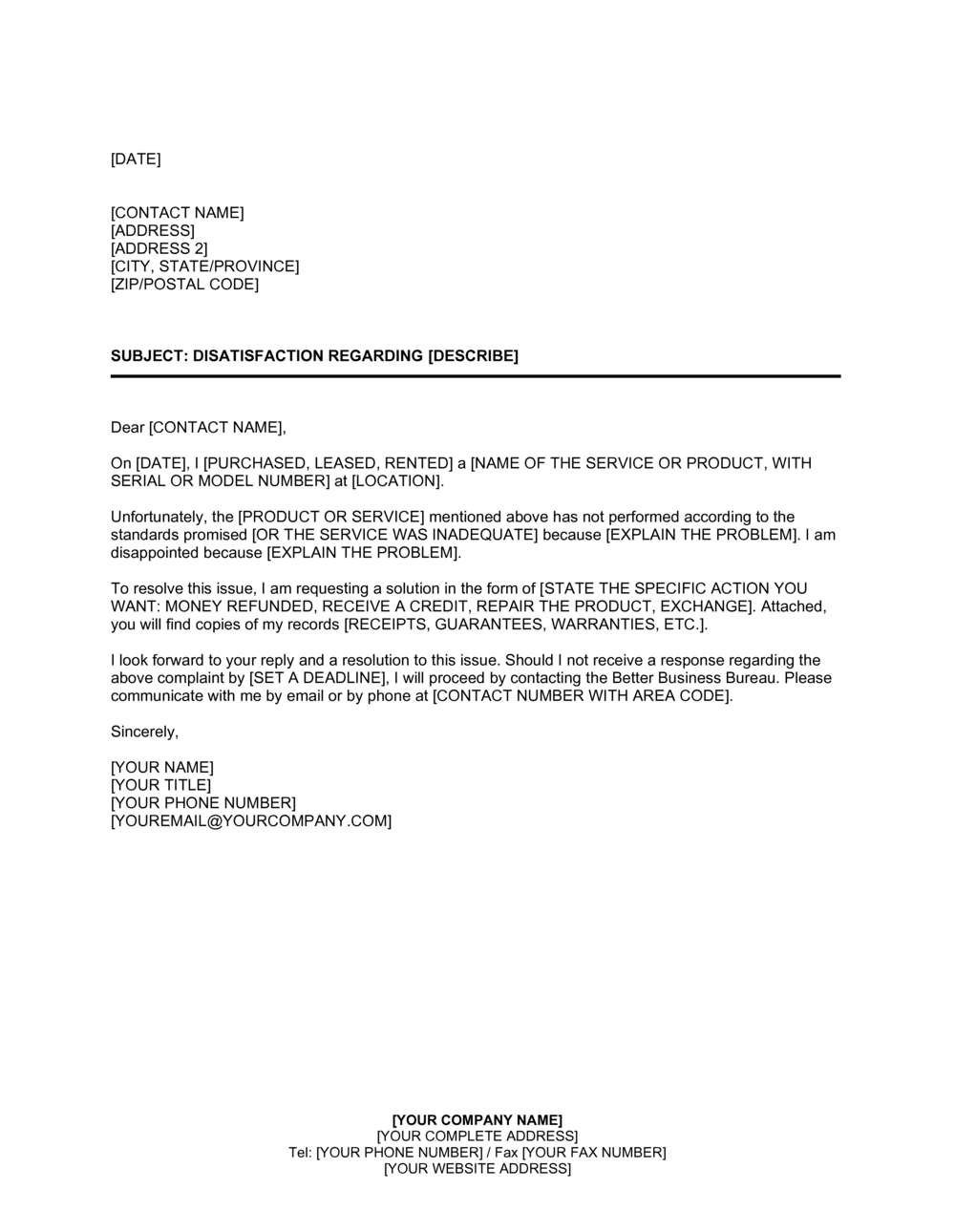
A Complaint Letter is a formal written communication from one party to another documenting a specific grievance β€” such as a defective product, poor service, billing error, or breach of contract β€” and requesting a defined remedy within a stated deadline. This template is a free Word download you can edit online and export as PDF, giving you a professional, structured starting point in minutes.
When you need it
Use it whenever an informal conversation has failed to resolve an issue and you need a written record of the complaint, the facts, and your resolution demand before escalating to mediation, a consumer agency, or legal action.
What's inside
Sender and recipient details, date of the incident, a factual account of the problem, any prior attempts to resolve it, a specific remedy demand, a compliance deadline, and a clear statement of next steps if the deadline is missed.

What is a Complaint Letter?

A Complaint Letter is a formal written communication sent from one party to another to document a specific grievance, describe its impact, and demand a defined remedy within a clear deadline. It transforms an unresolved verbal or informal dispute into a structured written record β€” identifying the problem, quantifying the harm, specifying the resolution required, and stating the consequences if no action is taken. Because it creates a paper trail of notice and good-faith effort, a complaint letter is typically the required first step before escalating to a consumer protection agency, industry regulator, or legal proceeding.

Why You Need This Document

Without a formal complaint letter, disputes stall in a cycle of unanswered phone calls and vague email threads that are easy for the other party to delay or ignore. A written complaint letter changes the dynamic: it signals that you are organized, serious, and prepared to escalate, and it gives the recipient a specific deadline and remedy to act on rather than an open-ended grievance to manage. If the matter does escalate, an unanswered complaint letter with documented delivery is one of the strongest pieces of evidence you can present to a regulator or small claims judge β€” proof that you gave the other party a fair opportunity to resolve the issue before you sought outside intervention. This template gives you a professionally structured starting point that covers every required component, so you can focus on the facts of your specific situation rather than the format.

Which variant fits your situation?

If your situation is…Use this template
Disputing a charge or error on a vendor invoiceInvoice Dispute Letter
Notifying a tenant of a lease violationLease Violation Notice
Formally demanding payment on an overdue accountDemand for Payment Letter
Raising a workplace harassment or discrimination complaintHR Complaint Letter
Escalating an unresolved complaint to a regulatory bodyRegulatory Complaint Letter
Notifying a contractor of defective work before withholding paymentNotice of Defective Work
Filing a formal complaint with a consumer protection agencyConsumer Complaint Letter

Common mistakes to avoid

❌ Using emotional or accusatory language

Why it matters: Phrases like 'your company is dishonest' shift the recipient's focus from solving the problem to defending themselves, and reduce your credibility if the matter escalates.

Fix: Rewrite every sentence in the factual account to describe observable events and measurable losses β€” no adjectives about character or intent.

❌ Failing to specify the exact remedy

Why it matters: A vague demand for 'fair compensation' gives the recipient the freedom to offer the minimum possible and claim the complaint is resolved.

Fix: State the dollar amount, replacement item, or specific action required β€” and tie it directly to the documented loss.

❌ No compliance deadline

Why it matters: Without a deadline, the complaint can be acknowledged and then left unresolved indefinitely with no clear trigger for escalation.

Fix: Always include a specific calendar date and state explicitly what action you will take if the deadline passes.

❌ Sending to the wrong contact

Why it matters: A complaint letter sent to a frontline representative rather than a manager with authority to authorize refunds or replacements can stall for weeks in a queue.

Fix: Research the correct name and title before sending, and copy a senior contact if you are unsure who has resolution authority.

❌ No proof of delivery

Why it matters: If the recipient denies receiving the letter, you lose the ability to enforce your deadline or demonstrate good-faith escalation to a regulator or court.

Fix: Always send by certified mail, tracked courier, or email with read receipt, and retain the delivery confirmation in your records.

❌ Threatening legal action you are not prepared to take

Why it matters: Empty threats are quickly identified by recipients with experienced legal or customer service teams, and they signal that the sender is unlikely to follow through.

Fix: Only reference escalation steps you are genuinely willing to take β€” consumer agency filing, small claims, or legal counsel β€” and follow through if the deadline passes.

The 9 key clauses, explained

Header β€” sender and recipient details

In plain language: Identifies the sender's full name and contact information, the recipient's full name and address, and the date the letter was written.

Sample language
[YOUR FULL NAME] | [YOUR ADDRESS] | [YOUR EMAIL] | [DATE] | [RECIPIENT NAME] | [RECIPIENT TITLE] | [COMPANY NAME] | [ADDRESS]

Common mistake: Addressing the letter to a generic department rather than a named individual β€” letters to 'Customer Service' are routed more slowly and carry less weight than those addressed to a specific manager.

Subject line

In plain language: A one-line summary of the complaint that includes a reference number, making the letter easy to file and route.

Sample language
Re: Formal Complaint β€” Order #[ORDER NUMBER] / Invoice #[INVOICE NUMBER] dated [DATE]

Common mistake: Omitting the reference number. Without a traceable ID, the recipient's team cannot locate the transaction and response time increases.

Opening β€” purpose statement

In plain language: States clearly and immediately that this is a formal complaint, so the reader understands the tone and urgency from the first sentence.

Sample language
I am writing to formally notify you of a complaint regarding [BRIEF DESCRIPTION OF ISSUE] that occurred on [DATE].

Common mistake: Opening with background context instead of the complaint itself. The reader should know within one sentence why this letter is formal rather than a routine inquiry.

Factual account of the issue

In plain language: A chronological, evidence-based description of what happened β€” dates, amounts, product or service details, and any prior attempts to resolve the issue informally.

Sample language
On [DATE], I [purchased / engaged / received] [PRODUCT OR SERVICE] under [CONTRACT / ORDER NUMBER]. On [DATE], I discovered [SPECIFIC PROBLEM]. I contacted your [team / representative] on [DATE] by [PHONE / EMAIL] and was told [RESPONSE], but the issue remains unresolved as of [DATE].

Common mistake: Including emotional language or accusations alongside the facts. Statements like 'your company is incompetent' reduce credibility and give the recipient grounds to dismiss the complaint as unreasonable.

Impact statement

In plain language: Quantifies the harm caused β€” financial loss, operational disruption, time wasted, or other measurable consequence β€” to justify the remedy being requested.

Sample language
As a direct result, [COMPANY NAME] has incurred a loss of $[AMOUNT] in [LOST REVENUE / REPLACEMENT COSTS / DOWNTIME], and operations were disrupted for [X] business days.

Common mistake: Skipping the impact statement entirely. Without it, the letter reads as a complaint without a business justification, and the recipient has no basis for calculating a fair settlement.

Remedy demand

In plain language: Specifies exactly what you want β€” a full or partial refund, replacement, repair, written apology, or corrective action β€” so there is no ambiguity about what constitutes resolution.

Sample language
I request that [COMPANY NAME] [issue a full refund of $[AMOUNT] / replace the defective unit / complete the outstanding work] no later than [DEADLINE DATE].

Common mistake: Asking for an unspecified 'appropriate resolution.' Vague demands give the recipient room to offer a token gesture and claim the matter is closed.

Compliance deadline

In plain language: Sets a firm date β€” typically 7 to 14 business days β€” by which the recipient must respond or act.

Sample language
Please respond in writing confirming your proposed resolution no later than [DATE], being [X] business days from the date of this letter.

Common mistake: Setting an unrealistically short deadline β€” fewer than five business days for a complex issue β€” which can make the sender appear unreasonable and undermine any later escalation.

Escalation notice

In plain language: States clearly what action you will take if the deadline passes without a satisfactory response β€” filing with a regulator, pursuing small claims, or engaging a lawyer.

Sample language
If I do not receive a satisfactory response by [DATE], I will escalate this matter to [RELEVANT BODY β€” e.g., the Better Business Bureau / applicable consumer protection authority / legal counsel] without further notice.

Common mistake: Threatening escalation without specifying where you will escalate. Vague threats ('I will take further action') carry little weight; naming the specific next step signals you are prepared to follow through.

Closing and signature

In plain language: A professional closing that restates your expectation of a prompt response and provides your preferred contact information.

Sample language
I trust this matter will receive your prompt attention. Please direct your response to [EMAIL / ADDRESS]. Sincerely, [YOUR FULL NAME] | [TITLE, if applicable] | [CONTACT DETAILS]

Common mistake: Ending with an aggressive or sarcastic closing. A neutral, professional tone preserves your credibility and keeps the door open for a negotiated resolution.

How to fill it out

  1. 1

    Gather all supporting documentation

    Collect the original contract, invoice, order confirmation, prior correspondence, photographs, or any other evidence related to the complaint before writing a single word.

    πŸ’‘ Reference each document by name in the letter body and mark them as Exhibit A, B, C β€” this signals to the recipient that you have a complete paper trail.

  2. 2

    Identify the correct recipient and their address

    Address the letter to the most senior named individual with authority to resolve the issue β€” typically a customer service director, general manager, or head of accounts. Include their full title and the company's registered address.

    πŸ’‘ Check the company's website or LinkedIn to confirm the correct name and title. A letter addressed to the right person is escalated faster than one routed through a general inbox.

  3. 3

    Write a specific subject line with a reference number

    Include the order number, invoice number, contract ID, or case reference in the subject line so the recipient can locate the transaction immediately.

    πŸ’‘ If you don't have a reference number, use the date of the original transaction β€” it achieves the same purpose.

  4. 4

    Write the factual account in chronological order

    Describe what happened, when it happened, and what you did to try to resolve it informally β€” in date order. Stick to facts and omit emotional commentary.

    πŸ’‘ If the account runs longer than three paragraphs, move supporting detail to an attached timeline document and keep the letter body concise.

  5. 5

    State your remedy demand precisely

    Name the exact resolution you require β€” refund amount in dollars, specific replacement item, or defined corrective action β€” and tie it directly to the loss you described.

    πŸ’‘ Expressing the remedy in the same currency and units as the original transaction makes it harder for the recipient to dispute the calculation.

  6. 6

    Set a firm, reasonable deadline

    Allow 7 to 14 business days for straightforward issues and up to 21 business days for complex matters involving investigation or approvals.

    πŸ’‘ State the deadline as a specific calendar date β€” 'by May 16, 2026' β€” not as a number of days from receipt, which is harder to enforce.

  7. 7

    Send and document delivery

    Send the letter by a method that generates proof of delivery β€” certified mail with return receipt, courier with tracking, or email with read receipt. Keep a copy of the sent message and the delivery confirmation.

    πŸ’‘ Sending by two methods (email and certified mail) on the same day eliminates any 'I never received it' defense.

Frequently asked questions

What is a complaint letter?

A complaint letter is a formal written document sent from one party to another to document a specific grievance, describe the impact of the problem, and demand a defined resolution within a stated deadline. It creates a written record of the complaint that can be used as evidence in any subsequent mediation, regulatory filing, or legal proceeding.

When should I send a complaint letter instead of calling or emailing informally?

Send a formal complaint letter when informal attempts β€” phone calls, casual emails, or in-person conversations β€” have failed to produce a resolution. A formal letter signals that you are documenting the matter for escalation purposes, and it shifts the communication to a written record that the recipient cannot later deny or mischaracterize.

What should a complaint letter include?

At minimum: your name and contact details, the recipient's name and address, a reference number tying the complaint to a specific transaction, a factual chronological account of the problem, a quantification of the harm caused, a specific remedy demand, a firm deadline, and a statement of your next steps if the deadline is missed. Supporting documentation should be attached and referenced in the body.

How formal does a complaint letter need to be?

A complaint letter should use professional, neutral business language throughout. It does not need legal terminology, but it should be free of casual phrasing, emotional language, and personal attacks. The tone should communicate that you are serious, organized, and prepared to escalate β€” not that you are angry or frustrated.

How long should a complaint letter be?

Most effective complaint letters are one to two pages. The factual account should be complete but concise β€” if the background is complex, move the detail to an attached timeline or exhibit. A longer letter is not more persuasive; a clear, well-structured one-page letter with solid documentation is typically more effective than three pages of narrative.

Does a complaint letter need to be signed?

A complaint letter does not typically require a signature to be effective, but signing it adds a layer of formality and authenticity that reinforces its seriousness. If you are sending by email, a typed signature block with your full name, title, and contact details serves the same purpose.

What happens if the recipient ignores my complaint letter?

If the deadline passes without a satisfactory response, your complaint letter becomes a documented record of good-faith effort to resolve the matter. You can then escalate to the relevant consumer protection agency, industry regulator, small claims court, or legal counsel β€” and present the unanswered letter as evidence that the respondent had notice and chose not to act.

Can I use this template for complaints to government agencies or regulators?

This template covers standard business-to-business and consumer complaint letters. Complaints to regulatory bodies β€” such as the FTC, a state attorney general, or an industry ombudsman β€” often require submission through a specific form or portal with prescribed fields. Use this template to organize your facts before completing any agency-specific submission format.

How do I send a complaint letter to maximize its impact?

Send the letter by a method that generates proof of delivery β€” certified mail with return receipt, a tracked courier service, or email with a read receipt. Address it to a named individual with authority to resolve the issue, copy a relevant senior contact if appropriate, and retain the delivery confirmation alongside your copy of the letter.

How this compares to alternatives

vs Demand for Payment Letter

A demand for payment letter is used specifically when money is owed and focuses entirely on the outstanding balance, interest, and a payment deadline. A complaint letter addresses a broader grievance β€” defective work, poor service, or a policy violation β€” where the remedy may be a refund, repair, replacement, or corrective action rather than pure debt recovery. Use a demand letter when the issue is solely financial; use a complaint letter when the issue is about performance or quality.

vs Cease and Desist Letter

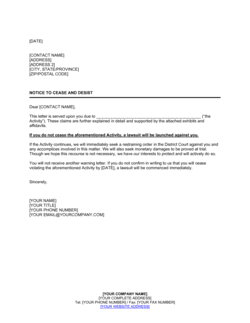
A cease and desist letter demands that the recipient stop a specific ongoing action β€” trademark infringement, harassment, or contract breach β€” and carries an implicit or explicit legal threat. A complaint letter documents a past or ongoing problem and requests resolution, but its tone is less adversarial and its purpose is remedy rather than prohibition. Cease and desist letters typically require or benefit from legal review; complaint letters generally do not.

vs Notice of Breach of Contract

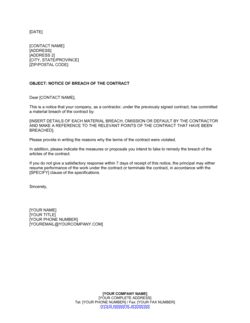
A notice of breach formally invokes contractual remedies under a signed agreement and is a legal prerequisite to damages claims under many contracts. A complaint letter is a pre-legal document used to seek resolution before invoking formal contract rights. If a contract is in place, a breach notice is the appropriate escalation; a complaint letter is the appropriate first step when the relationship is informal or when you want to preserve the option of a negotiated resolution.

vs Apology Letter

An apology letter is the response a business sends to acknowledge a complaint and offer a remedy. A complaint letter is the document that prompts that response. If you are the party who made the error, use an apology letter; if you are the party who experienced the error, use a complaint letter.

Industry-specific considerations

Retail and e-commerce

Product defect complaints, wrong-item shipments, and refund disputes where the customer has already contacted support without resolution.

Construction and trades

Formal notice of substandard workmanship or incomplete project delivery before withholding final payment or engaging a new contractor.

Professional services

Billing disputes, missed deliverables, and breach of engagement terms where a written record is needed before escalating to the professional's licensing body.

Property management

Complaints to landlords for unaddressed maintenance issues, or from landlords to tenants for lease violations, creating a paper trail before formal proceedings.

Template vs pro β€” what fits your needs?

PathBest forCostTime
Use the templateIndividuals and small businesses handling standard product, service, or billing disputesFree15–30 minutes
Template + professional reviewBusinesses with a dispute exceeding $5,000, a long-standing vendor relationship at stake, or a complaint that may precede legal action$100–$300 for a brief legal or business advisor review1–2 business days
Custom draftedHigh-value contract disputes, regulated industries, or situations where the letter will be submitted as evidence in arbitration or litigation$300–$1,000+2–5 business days

Glossary

Grievance
A specific, documented cause for complaint β€” such as a missed delivery, billing error, or breach of agreed terms.
Remedy
The specific action you are requesting to resolve the complaint, such as a refund, replacement, repair, or written apology.
Compliance Deadline
The specific calendar date by which the recipient must respond or act before further escalation is taken.
Without Prejudice
A phrase indicating that the letter cannot be used as evidence in legal proceedings if a settlement is later reached β€” consult a lawyer before using it.
Escalation
The step taken if the complaint is not resolved by the deadline, such as filing with a consumer agency, pursuing mediation, or initiating legal action.
Proof of Delivery
Documentation confirming the complaint letter was received β€” typically a return receipt, courier confirmation, or read receipt for email.
Prior Written Notice
An earlier formal communication documenting that the issue was raised before the current complaint letter was sent.
Good Faith
An honest attempt to resolve a dispute before escalating β€” demonstrating good faith often strengthens your position in any subsequent legal or regulatory process.
Reference Number
An order number, contract number, invoice number, or case ID that ties the complaint to a specific transaction or agreement.
Consequential Damages
Losses that resulted from the original issue β€” such as lost revenue caused by a delayed delivery β€” which may be referenced in the letter when quantifying the full impact.

Part of your Business Operating System

This document is one of 3,000+ business & legal templates included in Business in a Box.

  • Fill-in-the-blanks β€” ready in minutes
  • 100% customizable Word document
  • Compatible with all office suites
  • Export to PDF and share electronically

Create your document in 3 simple steps.

From template to signed document β€” all inside one Business Operating System.
1
Download or open template

Access over 3,000+ business and legal templates for any business task, project or initiative.

2
Edit and fill in the blanks with AI

Customize your ready-made business document template and save it in the cloud.

3
Save, Share, Send, Sign

Share your files and folders with your team. Create a space of seamless collaboration.

Save time, save money, and create top-quality documents.

β˜…β˜…β˜…β˜…β˜…

"Fantastic value! I'm not sure how I'd do without it. It's worth its weight in gold and paid back for itself many times."

Managing Director Β· Mall Farm
Robert Whalley
Managing Director, Mall Farm Proprietary Limited
β˜…β˜…β˜…β˜…β˜…

"I have been using Business in a Box for years. It has been the most useful source of templates I have encountered. I recommend it to anyone."

Business Owner Β· 4+ years
Dr Michael John Freestone
Business Owner
β˜…β˜…β˜…β˜…β˜…

"It has been a life saver so many times I have lost count. Business in a Box has saved me so much time and as you know, time is money."

Owner Β· Upstate Web
David G. Moore Jr.
Owner, Upstate Web

Run your business with a system β€” not scattered tools

Stop downloading documents. Start operating with clarity. Business in a Box gives you the Business Operating System used by over 250,000 companies worldwide to structure, run, and grow their business.

Start freeΒ Β·Β No credit card required