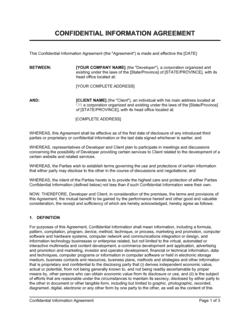
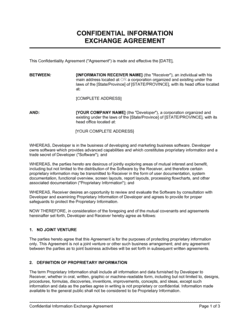
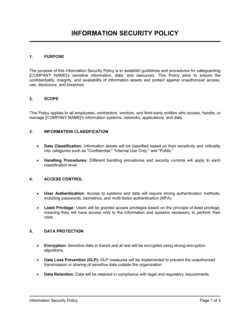
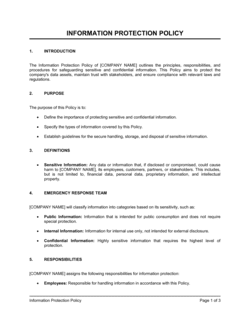
Third Party Confidential Information Policy Template

Free Word download β€’ Edit online β€’ Save & share with Drive β€’ Export to PDF

1 pageβ€’20–25 min to fillβ€’Difficulty: Standard
Learn more ↓
FreeThird Party Confidential Information Policy Template

At a glance

What it is
A Third Party Confidential Information Policy is an internal operational document that defines how employees and contractors must handle sensitive information received from external parties β€” clients, vendors, partners, and suppliers. This free Word download gives you a ready-to-edit template covering classification, handling, storage, disclosure, and disposal rules that you can adapt to your organization and export as PDF.
When you need it
Use it when your organization regularly receives proprietary data, trade secrets, or sensitive business information from outside parties under NDAs or commercial agreements β€” and needs a documented internal standard for how that information is treated, stored, and destroyed.
What's inside
Purpose and scope, definitions of confidential information categories, employee obligations, permitted and prohibited uses, storage and access controls, disclosure restrictions, breach reporting procedures, and disposal and retention rules.

What is a Third Party Confidential Information Policy?

A Third Party Confidential Information Policy is an internal operational document that defines the rules employees and contractors must follow when receiving, storing, using, and disposing of sensitive information shared by external parties β€” including clients, vendors, business partners, and suppliers. Where a non-disclosure agreement creates a legally binding obligation between two organizations, this policy translates that obligation into day-to-day procedures that individual staff members can follow. It specifies who may access third-party data, which systems may store it, when it must be destroyed, and how a suspected breach must be reported β€” creating a consistent, auditable standard across the entire organization.

Why You Need This Document

Without a written policy, your employees have no shared understanding of how to handle confidential information received from outside parties β€” and you have no defensible evidence that your organization took reasonable steps to protect it. When a client, vendor, or partner discovers that their sensitive data was stored in a personal cloud account, shared with an unauthorized colleague, or retained years after a contract ended, the consequences are concrete: NDA breach claims, damaged commercial relationships, and potential regulatory liability. A documented policy closes that gap by setting clear expectations before information is received, creating an accountability trail for audits and disputes, and giving compliance teams a framework they can actually enforce. This template gives you a complete, professional starting point that you can adapt to your organization and deploy in hours rather than weeks.

Which variant fits your situation?

If your situation is…Use this template
Setting company-wide rules for all confidential information including internal dataInformation Security Policy
Restricting a specific individual or contractor from disclosing sensitive informationNon-Disclosure Agreement (NDA)
Governing how employees handle data from customers under privacy lawData Protection and Privacy Policy
Defining how vendors and suppliers must protect your company's informationVendor Data Security Policy
Managing confidentiality obligations specific to a client engagementClient Confidentiality Agreement
Establishing rules for employee access to internal proprietary systemsAcceptable Use Policy
Covering confidentiality obligations within a broader employment relationshipEmployment Contract

Common mistakes to avoid

❌ Scoping out contractors and temporary staff

Why it matters: Contractors and temps often have the broadest access to third-party data during active engagements. Excluding them from the policy leaves the highest-risk users without any formal obligation.

Fix: Explicitly include all non-employee personnel in the scope clause and require them to acknowledge the policy as a condition of system access.

❌ Defining confidential information only as marked documents

Why it matters: Most real-world breaches involve verbally shared information, email attachments, or demo environments that were never formally labeled. A marking-only definition leaves these unprotected.

Fix: Add a 'reasonable person' standard to the definition: information is confidential if a reasonable person in the recipient's position would understand it to be sensitive, regardless of labeling.

❌ Omitting electronic storage and personal devices from prohibited channels

Why it matters: Employees routinely save work files to personal cloud accounts or devices for convenience. Without an explicit prohibition, this behavior is technically policy-compliant and creates lasting exposure.

Fix: Name specific prohibited storage channels β€” personal Gmail, Dropbox Free, iCloud personal accounts, personal USB drives β€” and pair the prohibition with a technical control where possible.

❌ No breach notification timeline for the affected third party

Why it matters: Many NDAs and regulations require notification to the disclosing party within 48–72 hours of a breach. A policy that only addresses internal escalation can put the company in breach of its own contractual obligations.

Fix: Include an external notification timeline in the incident response section and cross-reference the NDA terms that govern each active third-party relationship.

❌ Retention periods that cover physical records but not backups

Why it matters: System backups routinely preserve deleted files for months or years after an employee deletes them from active storage. If backups are excluded from the retention policy, the data is effectively never destroyed.

Fix: Extend retention and disposal obligations explicitly to backup systems, archived email, and cloud snapshots β€” and coordinate with IT to confirm technical deletion is possible on schedule.

❌ Setting no consequence for individual policy violations

Why it matters: A policy that attributes consequences only to the company rather than to the individual creates no personal deterrent. Employees who believe they face no personal risk are significantly less likely to follow security procedures.

Fix: Include explicit language on individual disciplinary consequences β€” up to termination β€” and note that personal liability may arise from deliberate or grossly negligent breaches.

The 10 key sections, explained

Purpose and scope

Definition of third party confidential information

Employee obligations and responsibilities

Permitted and prohibited uses

Storage and access controls

Disclosure restrictions and authorized sharing

Breach reporting and incident response

Retention and secure disposal

Policy enforcement and consequences

Policy review and update schedule

How to fill it out

  1. 1

    Identify all third-party relationships that generate confidential data

    List every category of external party β€” clients, vendors, partners, investors, regulators β€” that shares sensitive information with your organization. This scoping exercise determines who and what the policy must cover.

    πŸ’‘ Check your existing NDA inventory first β€” every active NDA represents a third-party confidentiality obligation this policy needs to support.

  2. 2

    Define your confidential information categories

    Draft a definition that covers both formally marked materials and information that is confidential by its nature. Include examples specific to your industry β€” for example, patient data for healthcare, source code for technology firms.

    πŸ’‘ Err on the side of breadth in the definition β€” it is easier to carve out exclusions than to argue that unmarked sensitive data falls under the policy.

  3. 3

    Map roles to access rights

    For each category of third-party confidential information, identify which roles require access and designate them as Authorized Recipients. Document this in an access matrix attached as a schedule.

    πŸ’‘ Coordinate with IT before finalizing the access matrix β€” many access decisions are already made informally at the system level and need to be formalized here.

  4. 4

    Specify approved storage systems and prohibited channels

    List every system where third-party confidential information may lawfully be stored. Explicitly name prohibited channels β€” personal email, consumer cloud drives, USB drives β€” to remove ambiguity.

    πŸ’‘ Name specific products employees actually use (e.g., personal Gmail, Dropbox Free) rather than just saying 'unapproved systems' β€” specificity drives compliance.

  5. 5

    Set retention periods by data category

    Assign a specific retention period to each category of third-party confidential information, tied to the relevant agreement term plus any statutory hold periods. Include electronic files, backups, and physical copies.

    πŸ’‘ Align retention periods with the NDA termination clauses in your active agreements β€” mismatch between the two is a common compliance gap.

  6. 6

    Define the breach reporting chain and timeline

    Name the specific person or team that receives breach reports, the maximum reporting window (24–72 hours is standard), and the steps the organization takes after a report is filed.

    πŸ’‘ Include an after-hours contact method β€” a breach discovered on a Friday evening needs a response path that does not wait until Monday morning.

  7. 7

    Establish the policy review schedule and owner

    Name the policy owner by role (not by name, since individuals change), set an annual review date, and define how employees are notified and asked to re-acknowledge changes.

    πŸ’‘ Tie the annual review to a fixed calendar event β€” Q1 legal review, ISO audit cycle, or contract renewal season β€” so it does not get skipped.

Frequently asked questions

What is a third party confidential information policy?

A third party confidential information policy is an internal document that defines how employees and contractors must handle sensitive information received from outside organizations β€” such as clients, vendors, and partners. It specifies who can access the information, where it may be stored, how it may be used, when it must be destroyed, and what to do if it is compromised. Unlike an NDA β€” which governs the legal relationship between two organizations β€” this policy governs the day-to-day behavior of individuals inside your own company.

How is this policy different from a non-disclosure agreement?

An NDA is a binding contract between two organizations setting the legal terms under which information is shared. A third party confidential information policy is an internal operational document that tells your employees how to fulfill those NDA obligations in practice. The NDA creates the obligation; the policy creates the procedures. Both are needed β€” an NDA without a supporting policy leaves your staff without clear guidance on how to comply.

Who should this policy apply to?

The policy should apply to all personnel who have access to third-party confidential information, including full-time employees, part-time staff, contractors, consultants, interns, and any external parties with access to your internal systems. Coverage gaps around contractors and temporary workers are one of the most common β€” and costly β€” compliance failures organizations make when implementing this type of policy.

What types of information should the policy cover?

The policy should cover any non-public information received from an external party, including trade secrets, financial data, customer and prospect lists, pricing models, technical specifications, source code, business strategies, and personnel information. It should explicitly include verbally shared information and unmarked documents alongside formally labeled confidential materials to avoid gaps in coverage.

How long should third party confidential information be retained?

Retention periods should align with the terms of the relevant NDA or commercial agreement β€” typically for the duration of the relationship plus a defined post-termination period, commonly 1–5 years. Some regulated industries impose minimum retention periods that override shorter contractual terms. The policy should state specific periods by data category and confirm they apply to electronic files and backups, not only physical documents.

What should employees do if they suspect a confidentiality breach?

Employees should report any actual or suspected unauthorized disclosure to the designated contact β€” typically the privacy officer or legal team β€” within 24 hours of discovery, without waiting to confirm whether a breach actually occurred. Delaying to investigate internally before reporting is one of the most common mistakes and can itself violate NDA notification clauses. The policy should name the reporting contact and provide an after-hours method.

Does this policy need to be reviewed regularly?

Yes. An annual review is standard practice. The policy should be updated whenever your technology stack changes, new regulatory requirements take effect, a significant third-party relationship is added, or a breach reveals a gap in current procedures. Employees should be notified and asked to re-acknowledge the policy following any material change.

Is this policy required by law?

No specific law mandates a third party confidential information policy by that name, but several regulatory frameworks β€” including GDPR, HIPAA, SOC 2, and ISO 27001 β€” require documented controls for handling third-party data. Having a written policy is also a strong defense in any contractual dispute over a confidentiality breach, demonstrating that the organization had reasonable procedures in place.

Should employees sign an acknowledgment when this policy is introduced?

Yes. Requiring a signed acknowledgment β€” or a documented digital confirmation β€” creates a record that each employee received, read, and agreed to comply with the policy. This acknowledgment is important evidence in disciplinary proceedings and supports the argument that the company met its contractual obligation to take reasonable steps to protect third-party confidential information.

How this compares to alternatives

vs Non-Disclosure Agreement (NDA)

An NDA is an external-facing legal contract that creates confidentiality obligations between two organizations. A third party confidential information policy is an internal document that tells your employees how to fulfill those obligations day to day. The NDA sets the legal standard; the policy operationalizes it. Most organizations need both β€” the NDA to bind the relationship, and the policy to govern individual behavior inside the company.

vs Information Security Policy

An information security policy covers the full spectrum of data protection β€” including internal company data, IT systems, access controls, and cybersecurity β€” for all information types. A third party confidential information policy is narrower, focusing specifically on data received from external parties and the obligations that arise under NDA and commercial agreements. Organizations typically need both, with the third-party policy nested under the broader information security framework.

vs Data Protection and Privacy Policy

A data protection and privacy policy governs how your organization handles personal data belonging to individuals β€” customers, employees, and prospects β€” primarily to comply with laws like GDPR and CCPA. A third party confidential information policy governs how you handle proprietary business information belonging to other organizations. The two policies cover different subject matter and different legal frameworks, though they may overlap when third-party data includes personal information.

vs Acceptable Use Policy

An acceptable use policy defines the rules for how employees may use company-owned IT systems, devices, and networks. It covers a wide range of behaviors β€” internet use, software installation, personal use of work equipment β€” and is not specific to third-party data. A third party confidential information policy is focused solely on how externally sourced confidential information is handled, regardless of which system it resides on.

Industry-specific considerations

Technology / SaaS

Source code, API credentials, and product roadmaps shared by enterprise clients during integration projects require granular access controls and strict storage rules.

Professional Services

Consultants and advisors routinely receive client financial models, strategic plans, and sensitive personnel data that must be isolated by engagement to prevent cross-client exposure.

Healthcare / MedTech

Vendor-shared patient data and clinical trial information carries HIPAA obligations that require the policy to align with Business Associate Agreement terms and minimum-necessary access standards.

Financial Services

Trading strategies, client portfolios, and proprietary pricing models received from partners must be walled off from competing business lines to prevent information barrier violations.

Template vs pro β€” what fits your needs?

PathBest forCostTime
Use the templateSmall to mid-size businesses establishing a first formal policy for vendor and client data handlingFree1–3 hours to customize and deploy
Template + professional reviewOrganizations with active NDAs, regulated data categories, or ISO 27001 / SOC 2 audit requirements$300–$800 for a legal or compliance review3–5 business days
Custom draftedEnterprise organizations handling highly sensitive third-party data across multiple jurisdictions or regulated industries$1,500–$5,000+2–4 weeks

Glossary

Third Party Confidential Information
Non-public information received from an outside organization β€” such as a client, vendor, or partner β€” that is designated as confidential under an agreement or by its nature.
Need-to-Know Basis
Access control principle limiting disclosure of confidential information only to individuals whose role requires them to use it.
Data Classification
A system for categorizing information by sensitivity level β€” for example, public, internal, confidential, and restricted β€” to determine handling requirements.
Authorized Recipient
An employee, contractor, or team member formally permitted to access specific third party confidential information for a defined business purpose.
Breach of Confidentiality
Any unauthorized disclosure, use, copying, or transmission of confidential information that violates the policy or an underlying agreement.
Retention Period
The defined duration for which confidential information must be kept before it is securely destroyed or returned to the originating party.
Secure Disposal
Destruction of confidential information in a manner that prevents reconstruction β€” shredding physical documents, permanently deleting electronic files, or degaussing storage media.
Non-Disclosure Agreement (NDA)
A binding legal contract between two parties establishing the terms under which confidential information may be shared and restricting further disclosure.
Marking Convention
A standardized label β€” such as 'Confidential,' 'Proprietary,' or 'Restricted' β€” applied to documents or files to signal their classification level and required handling.
Incident Response
The structured process an organization follows when a data breach or confidentiality violation is detected, including containment, notification, and remediation steps.

Part of your Business Operating System

This document is one of 3,000+ business & legal templates included in Business in a Box.

  • Fill-in-the-blanks β€” ready in minutes
  • 100% customizable Word document
  • Compatible with all office suites
  • Export to PDF and share electronically

Create your document in 3 simple steps.

From template to signed document β€” all inside one Business Operating System.
1
Download or open template

Access over 3,000+ business and legal templates for any business task, project or initiative.

2
Edit and fill in the blanks with AI

Customize your ready-made business document template and save it in the cloud.

3
Save, Share, Send, Sign

Share your files and folders with your team. Create a space of seamless collaboration.

Save time, save money, and create top-quality documents.

β˜…β˜…β˜…β˜…β˜…

"Fantastic value! I'm not sure how I'd do without it. It's worth its weight in gold and paid back for itself many times."

Managing Director Β· Mall Farm
Robert Whalley
Managing Director, Mall Farm Proprietary Limited
β˜…β˜…β˜…β˜…β˜…

"I have been using Business in a Box for years. It has been the most useful source of templates I have encountered. I recommend it to anyone."

Business Owner Β· 4+ years
Dr Michael John Freestone
Business Owner
β˜…β˜…β˜…β˜…β˜…

"It has been a life saver so many times I have lost count. Business in a Box has saved me so much time and as you know, time is money."

Owner Β· Upstate Web
David G. Moore Jr.
Owner, Upstate Web

Run your business with a system β€” not scattered tools

Stop downloading documents. Start operating with clarity. Business in a Box gives you the Business Operating System used by over 250,000 companies worldwide to structure, run, and grow their business.

Free Forever PlanΒ Β·Β No credit card required