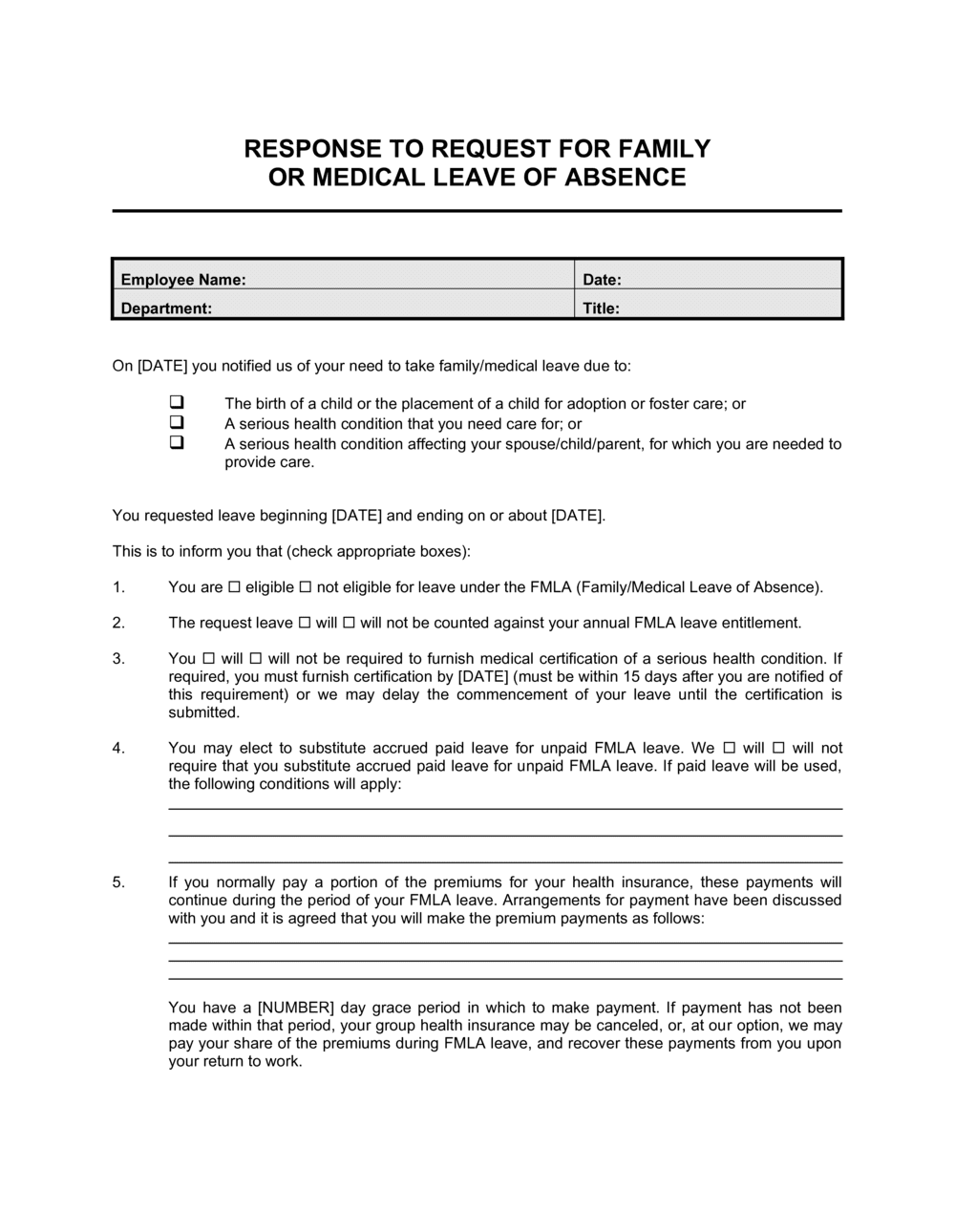
Response to Employee Request for Family or Medical Leave Template

Free Word download • Edit online • Save & share with Drive • Export to PDF

2 pages20–30 min to fillDifficulty: StandardSignature requiredLegal review recommended
Learn more ↓
FreeResponse to Employee Request for Family or Medical Leave Template

At a glance

What it is
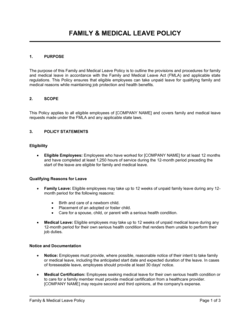
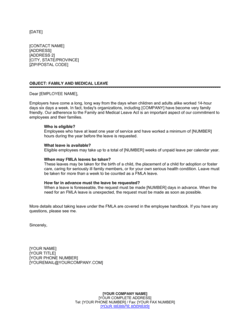
A Response To Employee Request For Family Or Medical Leave is a formal written notice an employer issues to an employee after receiving a leave request under the Family and Medical Leave Act (FMLA) or equivalent legislation. This free Word download lets you approve, deny, or conditionally approve the request while documenting the leave period, benefit continuation, return-to-work obligations, and any required certifications — all in a single letter you can edit online and export as PDF.
When you need it
Issue this letter within five business days of receiving an employee's FMLA leave request — or within two business days of acquiring knowledge that an absence may qualify for FMLA. Use it any time an employee requests leave for the birth or adoption of a child, a serious health condition of the employee or an immediate family member, or a qualifying military exigency.
What's inside
Employee and employer identification, leave approval or denial with legal basis, designated leave period and schedule, benefit continuation terms during leave, certification requirements and deadlines, return-to-work conditions, and employer and employee signature blocks.

What is a Response To Employee Request For Family Or Medical Leave?

A Response To Employee Request For Family Or Medical Leave is the formal written notice an employer issues to an employee after receiving a request for leave under the Family and Medical Leave Act (FMLA) or applicable state or provincial equivalent. Also called a Designation Notice, it is the document that formally designates the employee's upcoming absence as FMLA-qualifying — or explains why it does not qualify — and sets out the approved leave period, medical certification requirements, benefit continuation obligations, and return-to-work conditions in a single binding record. Unlike a casual email acknowledgment, a properly drafted response letter satisfies the employer's statutory notice obligations under 29 C.F.R. § 825.300 and creates the documented foundation needed to enforce the leave's terms and protect the employer's rights if the employee does not return.

Why You Need This Document

Failing to issue a timely, compliant written response to an FMLA leave request is one of the most frequently cited FMLA interference violations in DOL investigations and private litigation. Without this letter, an employer cannot designate the absence against the employee's 12-week entitlement — effectively granting unlimited protected leave by default. Missing the five-business-day deadline, omitting the fitness-for-duty certification requirement, or failing to address applicable state leave laws each independently expose the employer to back pay, front pay, liquidated damages, and attorney's fees under 29 U.S.C. § 2617. This template gives HR managers and small business owners a structured, regulation-grounded starting point that covers every required element — eligibility determination, leave designation, certification deadlines, benefit continuation terms, and return-to-work conditions — in a format that can be completed in under 30 minutes and withstands DOL scrutiny.

Which variant fits your situation?

If your situation is…Use this template
Approving a straightforward FMLA leave request with a fixed start and end dateResponse To Employee Request For Family Or Medical Leave (Approval)
Denying a leave request because the employee is ineligible or the condition does not qualifyFMLA Leave Denial Letter
Requesting additional medical certification before making a determinationRequest For Medical Certification Letter
Responding to a request for intermittent or reduced-schedule FMLA leaveIntermittent FMLA Leave Approval Letter
Notifying an employee that their FMLA entitlement has been exhaustedFMLA Exhaustion Notice
Responding to a military family leave or qualifying exigency requestMilitary Family Leave Response Letter
Granting non-FMLA medical leave as a reasonable accommodation under the ADAADA Reasonable Accommodation Leave Letter

Common mistakes to avoid

❌ Missing the five-business-day response deadline

Why it matters: The DOL treats a late designation notice as an FMLA interference violation, which can expose the employer to back pay, front pay, and attorney's fees in a private lawsuit or DOL investigation.

Fix: Log the receipt date of every leave request immediately and set a calendar alert for day four — build in a one-day buffer to review and execute the letter.

❌ Failing to designate leave as FMLA even when the absence clearly qualifies

Why it matters: Employers cannot retroactively designate leave once the employee has returned, and the undesignated absence does not count against the 12-week entitlement — effectively granting the employee additional protected leave.

Fix: Designate qualifying leave as FMLA even if the employee has not asked for it by name. If the employer has enough information that the absence likely qualifies, the designation obligation is triggered.

❌ Omitting the fitness-for-duty certification requirement from the written notice

Why it matters: If the requirement is not stated in the designation notice, the employer cannot delay reinstatement while waiting for the certification — the employee must be restored immediately upon their stated return date.

Fix: Include a specific sentence stating whether a fitness-for-duty certificate is required, the form it must take, and to whom it must be submitted before the first day back.

❌ Using the same leave file as the general personnel file

Why it matters: Medical information in a general personnel file creates HIPAA exposure, violates the ADA's confidentiality requirements for medical records, and can compromise the employer's position in litigation.

Fix: Maintain a separate, password-protected or locked confidential medical leave file for every employee — store only leave-related medical certifications and correspondence there.

The 10 key clauses, explained

Parties and Leave Request Reference

In plain language: Identifies the employer and employee by full legal name, states the date of the original leave request, and establishes the document as the employer's official response.

Sample language
This letter constitutes [EMPLOYER LEGAL NAME]'s ('Employer') official response to the family or medical leave request submitted by [EMPLOYEE FULL NAME] ('Employee') on [REQUEST DATE].

Common mistake: Referencing only the employee's first name or using a department rather than the employer's registered legal entity name — creating ambiguity about which entity bears the leave obligations.

Eligibility Determination

In plain language: States whether the employee meets the FMLA's minimum eligibility thresholds — 12 months of employment and 1,250 hours worked in the preceding 12 months — and works at a site with 50 or more employees within 75 miles.

Sample language
As of [DATE], Employee has been employed by Employer for [X] months and has worked [X] hours in the preceding 12-month period. Employee [IS / IS NOT] eligible for FMLA leave under 29 C.F.R. § 825.110.

Common mistake: Skipping the eligibility determination entirely and jumping straight to approval — which creates a false expectation of job protection if the employee later turns out to be ineligible.

Leave Designation and Qualifying Reason

In plain language: Formally designates the requested absence as FMLA leave, identifies the qualifying reason (birth, adoption, employee health, family member health, or military exigency), and cites the applicable statutory basis.

Sample language
Employer hereby designates Employee's absence beginning [START DATE] as FMLA-qualifying leave for the following reason: [QUALIFYING REASON]. This designation is made pursuant to the Family and Medical Leave Act, 29 U.S.C. § 2601 et seq.

Common mistake: Designating leave as 'personal leave' or 'medical leave' without explicitly labeling it as FMLA leave — this prevents the absence from counting against the employee's 12-week annual entitlement, creating unintended exposure.

Approved Leave Period and Schedule

In plain language: Specifies the exact start and end dates of the approved leave, the expected duration, and whether leave is continuous, intermittent, or on a reduced-schedule basis.

Sample language
Employer approves FMLA leave from [START DATE] through [END DATE], an estimated total of [X] weeks. [If intermittent: Employee is approved for intermittent leave not to exceed [X] hours per [week/month] as medically necessary.]

Common mistake: Approving an open-ended leave with no estimated end date. Without a defined period, the employer cannot enforce return-to-work obligations or properly track the 12-week entitlement.

Medical Certification Requirement

In plain language: States whether medical certification is required, identifies the applicable form, sets the 15-calendar-day deadline for submission, and explains the consequence of non-submission.

Sample language
Employee must provide completed medical certification (Form WH-380-E or equivalent) to [HR CONTACT] no later than [DATE, 15 calendar days from request]. Failure to provide certification may result in the leave being denied or delayed.

Common mistake: Giving verbal notice of the certification requirement instead of written notice — removing the employer's ability to deny or delay leave for non-submission under 29 C.F.R. § 825.305.

Benefit Continuation During Leave

In plain language: Confirms that group health insurance will be maintained on the same terms during the leave period, states the employee's obligation to continue paying their share of premiums, and identifies the payment deadline and method.

Sample language
During FMLA leave, Employer will maintain Employee's group health benefits under the same terms as if Employee had continued to work. Employee's share of premiums ($[AMOUNT] per [pay period / month]) must be remitted to [CONTACT / METHOD] by the [DAY] of each month.

Common mistake: Failing to specify the employee's premium payment deadline and method — leading to coverage lapses and potential liability when the employer terminates coverage for non-payment without adequate notice.

Substitution of Paid Leave

In plain language: States whether the employer is requiring the employee to substitute accrued paid leave (vacation, sick, or PTO) concurrently with FMLA leave, as permitted under 29 C.F.R. § 825.207.

Sample language
Pursuant to Employer's leave policy, Employee is [required / permitted] to substitute accrued [PAID LEAVE TYPE] concurrently with FMLA leave. Employee has [X] accrued hours available. Substitution does not extend the 12-week FMLA entitlement.

Common mistake: Omitting the substitution election entirely — leaving the employee uncertain whether they must use paid leave and creating disputes at the end of the leave period about remaining entitlement.

Return-to-Work Conditions

In plain language: States the expected return date, whether a fitness-for-duty certification is required before reinstatement, and the employee's right to job restoration to the same or an equivalent position.

Sample language
Employee is expected to return to work on [RETURN DATE]. Prior to reinstatement, Employee must provide a fitness-for-duty certification from their healthcare provider confirming ability to perform the essential functions of [JOB TITLE]. Upon return, Employee shall be restored to the same or an equivalent position.

Common mistake: Requiring a fitness-for-duty certification but failing to include this requirement in the designation notice — employers who do not provide written advance notice of the requirement cannot delay reinstatement pending receipt of the certification.

Consequences of Failure to Return

In plain language: Explains that if the employee does not return to work at the end of the approved leave, they may be required to repay health insurance premiums paid by the employer during leave, and that employment may be terminated.

Sample language
If Employee does not return to work at the conclusion of FMLA leave for reasons other than a continuation of a serious health condition or circumstances beyond Employee's control, Employer may recover health insurance premiums paid on Employee's behalf during leave.

Common mistake: Threatening termination as the only consequence without mentioning premium recovery — which is the more consistently enforceable remedy and the one specifically authorized by the FMLA.

Governing Law and Contact Information

In plain language: Identifies the applicable federal and state law governing the leave, provides the HR or leave administrator contact for questions, and includes signature lines for both employer and employee acknowledgment.

Sample language
This leave is governed by the Family and Medical Leave Act, 29 U.S.C. § 2601, and applicable state law. Questions should be directed to [HR CONTACT NAME], [TITLE], at [EMAIL / PHONE]. Employee's signature below acknowledges receipt of this notice, not necessarily agreement with its terms.

Common mistake: Omitting a state law reference when the employee works in a state with more generous leave entitlements (e.g., California CFRA, New York PFL) — the employer's response must address the more protective standard.

How to fill it out

  1. 1

    Identify the parties and reference the original request

    Enter the employer's full legal entity name, the employee's full legal name, and the date the original leave request was received. Confirm the date triggers your five-business-day response clock.

    💡 Log the receipt date of every leave request in your HR system the same day it arrives — a missed five-day deadline is one of the most frequently cited FMLA violations.

  2. 2

    Determine and document eligibility

    Verify that the employee has 12 months of employment, 1,250 hours worked in the past 12 months, and works at or within 75 miles of a site with 50 or more employees. Record the actual figures in the eligibility clause.

    💡 Pull the 12-month hours total from payroll records and attach a printed copy to your internal HR file — not the letter — as supporting documentation.

  3. 3

    Designate the leave and state the qualifying reason

    Select the applicable qualifying reason from the FMLA's defined categories and cite it explicitly. Do not use informal language like 'personal medical issue' — use the statutory category.

    💡 If the qualifying reason is a serious health condition, confirm it meets the FMLA's clinical threshold before designating — a designation that later has to be reversed creates confusion and potential liability.

  4. 4

    Set the approved leave period with specific dates

    Enter the exact start date, estimated end date, and whether the leave is continuous or intermittent. For intermittent leave, state the approved frequency and duration per episode.

    💡 For intermittent leave, specify the approved frequency in the letter (e.g., 'up to two days per week') rather than leaving it open-ended — this gives you a documented basis to question absences that exceed the certified pattern.

  5. 5

    Issue the medical certification requirement in writing

    State the specific form required, the 15-calendar-day submission deadline, the name and contact of the person to whom it must be submitted, and the consequence of non-submission.

    💡 Attach the blank certification form (WH-380-E for employee conditions, WH-380-F for family member conditions) to the letter so the employee cannot later claim they did not know which form to use.

  6. 6

    Confirm benefit continuation terms and premium payment obligations

    State that group health coverage will continue on the same terms, specify the employee's premium share in dollar terms, and set a clear monthly payment deadline and payment method.

    💡 Include a sentence stating the grace period (typically 30 days) before the employer may terminate coverage for non-payment — courts have found that terminating coverage without a grace-period notice is an FMLA interference violation.

  7. 7

    Address return-to-work conditions and fitness-for-duty requirements

    State the expected return date, whether a fitness-for-duty certificate is required, and the employee's right to restoration. If your policy requires fitness-for-duty certification, it must appear in this written notice.

    💡 For positions involving safety-sensitive duties, the FMLA permits employers to require a fitness-for-duty certification for each intermittent leave episode — include this if it applies.

  8. 8

    Obtain signatures and retain a copy

    Have an authorized HR representative or manager sign the letter and ask the employee to sign an acknowledgment of receipt. File the executed copy in the employee's confidential medical leave file, separate from their general personnel file.

    💡 Keep the medical leave file physically or digitally separate from the general personnel file — commingling creates HIPAA exposure and complicates e-discovery in any subsequent employment dispute.

Frequently asked questions

What is a Response To Employee Request For Family Or Medical Leave?

It is the employer's formal written notice — sometimes called a Designation Notice — issued in response to an employee's FMLA leave request. The letter confirms whether the employee is eligible, designates the absence as FMLA-qualifying (or explains why it is not), sets the approved leave period, states certification requirements, and explains benefit continuation and return-to-work conditions. Under 29 C.F.R. § 825.300, employers must provide this notice within five business days of receiving sufficient information to make the determination.

Which employers are required to respond to FMLA leave requests?

The FMLA applies to private-sector employers with 50 or more employees within a 75-mile radius for at least 20 weeks in the current or prior calendar year, all public agencies regardless of size, and all public and private elementary and secondary schools. Smaller employers are not covered by the federal FMLA but may be subject to state family leave laws with lower employee thresholds — several states extend protections to employers with as few as five employees.

How long does an employer have to respond to a family or medical leave request?

Under federal FMLA regulations, an employer must issue an eligibility notice within five business days of the employee's request or of acquiring knowledge that an absence may be FMLA-qualifying. The designation notice — confirming whether the leave counts as FMLA — must also be issued within five business days once the employer has enough information to make the determination. Missing either deadline is treated as an interference violation by the DOL.

Can an employer deny a family or medical leave request?

Yes, if the employee does not meet eligibility criteria — fewer than 12 months of employment, fewer than 1,250 hours worked, or employment at a site below the 50-employee threshold — or if the reason for leave does not qualify under the FMLA's defined categories. The denial must be communicated in writing with the specific reason. A denial of FMLA designation does not necessarily mean the employer cannot grant leave under a separate internal policy or applicable state law.

Does the employer have to maintain health insurance during FMLA leave?

Yes. The FMLA requires employers to maintain the employee's group health coverage under the same terms and at the same employer contribution level as if the employee had continued working. The employee remains responsible for their normal share of premiums. If the employee fails to pay their premium share, the employer may terminate coverage after providing at least 15 days' written notice, and may recover its premium contributions if the employee does not return from leave.

What is the difference between an FMLA eligibility notice and a designation notice?

An eligibility notice tells the employee whether they meet the FMLA's minimum eligibility criteria — 12 months of employment, 1,250 hours, and 50-employee worksite — and must be issued within five business days of the request. A designation notice is issued later, once the employer has sufficient information (including any required medical certification), and formally confirms whether the specific absence counts as FMLA leave. Both are required; this template covers the designation notice step.

Can an employer require employees to use paid leave during FMLA?

Yes. The FMLA permits employers to require employees to substitute accrued paid vacation, sick leave, or PTO concurrently with FMLA leave, provided the employer's written policy or the designation notice states this requirement clearly. Substitution does not extend the 12-week entitlement — it simply determines whether the employee receives pay during the protected absence. Some state laws limit an employer's ability to require substitution.

What happens if an employee does not return to work after FMLA leave?

If an employee fails to return for reasons other than a continuation of a serious health condition or circumstances beyond their control, the employer may recover the health insurance premiums it paid during the leave. The employer may also treat the failure to return as a resignation and terminate employment, provided the reason for non-return is not itself a qualifying condition that would entitle the employee to additional FMLA or ADA accommodation. Document the reason carefully before taking any adverse action.

Does this letter need to be signed by both the employer and the employee?

Federal FMLA regulations do not technically require the employee's signature on the designation notice itself, but obtaining a signed acknowledgment of receipt is strongly recommended. An employee signature confirms that notice was given, eliminates disputes about whether the employee knew their leave was designated as FMLA, and creates a clear record if the employer later needs to enforce premium recovery or return-to-work obligations in litigation or a DOL investigation.

How this compares to alternatives

vs Employee Leave of Absence Request Form

A leave of absence request form is the document the employee submits to initiate the leave process. The Response To Employee Request For Family Or Medical Leave is the employer's formal reply designating that absence as FMLA-qualifying and setting its terms. Both documents are needed to create a complete leave record — the request initiates the clock; the response satisfies the employer's statutory notice obligation.

vs FMLA Medical Certification Form

A medical certification form (WH-380-E or WH-380-F) is completed by the employee's or family member's healthcare provider to confirm the condition qualifies as a serious health condition. The response letter references and requests this form but does not replace it. The certification is clinical evidence; the response letter is the legal designation notice — both are required for a complete FMLA file.

vs Employee Dismissal Letter

A dismissal letter terminates the employment relationship, while an FMLA response letter preserves it by designating a protected leave period. Issuing a dismissal letter in response to an FMLA request — rather than a proper designation notice — is retaliatory and constitutes a per-se FMLA violation. The two documents serve opposite purposes and should never be confused.

vs Return To Work Letter

A return-to-work letter is issued at the end of the leave period, confirming the employee's reinstatement and any modified duties or fitness-for-duty conditions. The FMLA response letter sets the framework at the beginning of leave; the return-to-work letter closes it. Both should be retained in the employee's confidential leave file as a complete end-to-end record.

Industry-specific considerations

Healthcare

Healthcare employers must balance FMLA responses with HIPAA confidentiality obligations and are subject to stricter fitness-for-duty requirements for patient-facing roles with safety-sensitive duties.

Manufacturing

Intermittent FMLA leave creates acute operational challenges on production lines; designation notices should specify approved episode frequency precisely to distinguish protected absences from unexcused attendance violations.

Retail / Hospitality

High turnover and variable-hour scheduling complicate the 1,250-hours eligibility calculation; employers must document hours carefully to support eligibility determinations in response letters.

Professional Services

Client-facing professionals on FMLA often trigger coverage and continuity issues; the response letter should clarify return-to-work dates to enable realistic client assignment planning without constituting FMLA interference.

Jurisdictional notes

United States

The federal FMLA covers employers with 50 or more employees and provides up to 12 weeks of unpaid, job-protected leave per year. Several states — including California (CFRA), New York (NYPFL), New Jersey (NJFLA), Oregon (OFLA), and Washington (WPFML) — have enacted laws with broader coverage, higher benefit levels, or lower employer-size thresholds. Employers in these states must issue responses that address both federal FMLA and the applicable state law. The DOL's model WH-381 and WH-382 forms provide a compliant baseline but must be supplemented with state-specific notices where required.

Canada

There is no federal statute equivalent to the US FMLA in Canada. Instead, each province's Employment Standards Act provides job-protected leaves for medical, parental, and family caregiving purposes. In Ontario, employees are entitled to up to 27 weeks of critical illness leave and 28 weeks of family medical leave under the ESA. Federally regulated employers are governed by the Canada Labour Code, which provides comparable protections. Employer response letters should cite the applicable provincial ESA or the CLC and confirm benefit continuation terms under the employer's group plan.

United Kingdom

The UK does not have a single statute equivalent to the FMLA. Relevant protections are found across several pieces of legislation: Statutory Maternity Pay and Maternity Leave (up to 52 weeks), Paternity Leave (up to two weeks), Shared Parental Leave (up to 50 weeks shared between parents), and the right to time off for dependants for short-term emergencies. Employers must respond to statutory leave requests in writing and confirm the employee's rights and return date. Employees may also request flexible working arrangements, which employers must consider through a formal process.

European Union

The EU Work-Life Balance Directive (2019/1158) requires member states to provide at least four months of parental leave per parent, five days of carers' leave per year, and paternity leave of at least ten working days. Implementation varies significantly by member state: Germany provides up to three years of Elternzeit (parental leave), France offers up to 16 weeks of maternity leave at full salary, and Sweden provides up to 480 days of parental leave per child. Employer response letters must comply with the applicable national implementing legislation and any relevant collective bargaining agreements.

Template vs lawyer — what fits your deal?

PathBest forCostTime
Use the templateHR managers and small business owners responding to routine FMLA leave requests in a single US stateFree15–30 minutes per letter
Template + legal reviewEmployers in states with more protective leave laws (CA, NY, NJ, OR, WA), intermittent leave situations, or cases involving potential ADA overlap$150–$400 for an employment attorney review1–2 business days
Custom draftedContentious leave situations, key employee exception invocations, or cases where the employer intends to deny leave and faces litigation risk$500–$2,000+3–7 business days

Glossary

FMLA (Family and Medical Leave Act)
A US federal law requiring covered employers to provide eligible employees up to 12 weeks of unpaid, job-protected leave per year for qualifying family or medical reasons.
Designation Notice
The employer's written notice to an employee confirming whether an absence qualifies as FMLA leave — required within five business days of receiving enough information to make the determination.
Eligibility Notice
A written notice issued within five business days of a leave request informing the employee whether they meet FMLA eligibility requirements — specifically 12 months of employment and 1,250 hours worked.
Serious Health Condition
Under the FMLA, an illness, injury, impairment, or physical or mental condition involving inpatient care or continuing treatment by a healthcare provider that incapacitates the employee for more than three consecutive calendar days.
Intermittent Leave
FMLA leave taken in separate blocks of time or by reducing a normal weekly or daily work schedule, rather than as a single continuous period.
Medical Certification
A completed form from a qualifying healthcare provider confirming that the employee's or family member's condition meets the FMLA definition of a serious health condition.
Benefit Continuation
The employer's obligation to maintain the employee's group health insurance coverage under the same terms and conditions as if the employee had continued to work during FMLA leave.
Job Restoration
The employee's right under the FMLA to return to the same or an equivalent position — with equivalent pay, benefits, and working conditions — upon returning from protected leave.
Key Employee Exception
A narrow FMLA exception allowing an employer to deny job restoration to a salaried employee among the highest-paid 10% of its workforce if restoration would cause substantial and grievous economic injury.
Qualifying Exigency
A leave entitlement allowing an eligible employee to take up to 12 weeks of FMLA leave for specified reasons arising from a family member's active military duty, such as short-notice deployment or military events.
Light-Duty Assignment
An alternative, less physically demanding position offered to an employee who cannot return to their original role — acceptance is voluntary and does not count against FMLA leave entitlement.

Part of your Business Operating System

This document is one of 3,000+ business & legal templates included in Business in a Box.

  • Fill-in-the-blanks — ready in minutes
  • 100% customizable Word document
  • Compatible with all office suites
  • Export to PDF and share electronically

Create your document in 3 simple steps.

From template to signed document — all inside one Business Operating System.
1
Download or open template

Access over 3,000+ business and legal templates for any business task, project or initiative.

2
Edit and fill in the blanks with AI

Customize your ready-made business document template and save it in the cloud.

3
Save, Share, Send, Sign

Share your files and folders with your team. Create a space of seamless collaboration.

Save time, save money, and create top-quality documents.

★★★★★

"Fantastic value! I'm not sure how I'd do without it. It's worth its weight in gold and paid back for itself many times."

Managing Director · Mall Farm
Robert Whalley
Managing Director, Mall Farm Proprietary Limited
★★★★★

"I have been using Business in a Box for years. It has been the most useful source of templates I have encountered. I recommend it to anyone."

Business Owner · 4+ years
Dr Michael John Freestone
Business Owner
★★★★★

"It has been a life saver so many times I have lost count. Business in a Box has saved me so much time and as you know, time is money."

Owner · Upstate Web
David G. Moore Jr.
Owner, Upstate Web

Run your business with a system — not scattered tools

Stop downloading documents. Start operating with clarity. Business in a Box gives you the Business Operating System used by over 250,000 companies worldwide to structure, run, and grow their business.

Start free · No credit card required