Notice of Insurance Claim Template

Free Word download β€’ Edit online β€’ Save & share with Drive β€’ Export to PDF

1 pageβ€’15–25 min to fillβ€’Difficulty: Standard
Learn more ↓
FreeNotice of Insurance Claim Template

At a glance

What it is
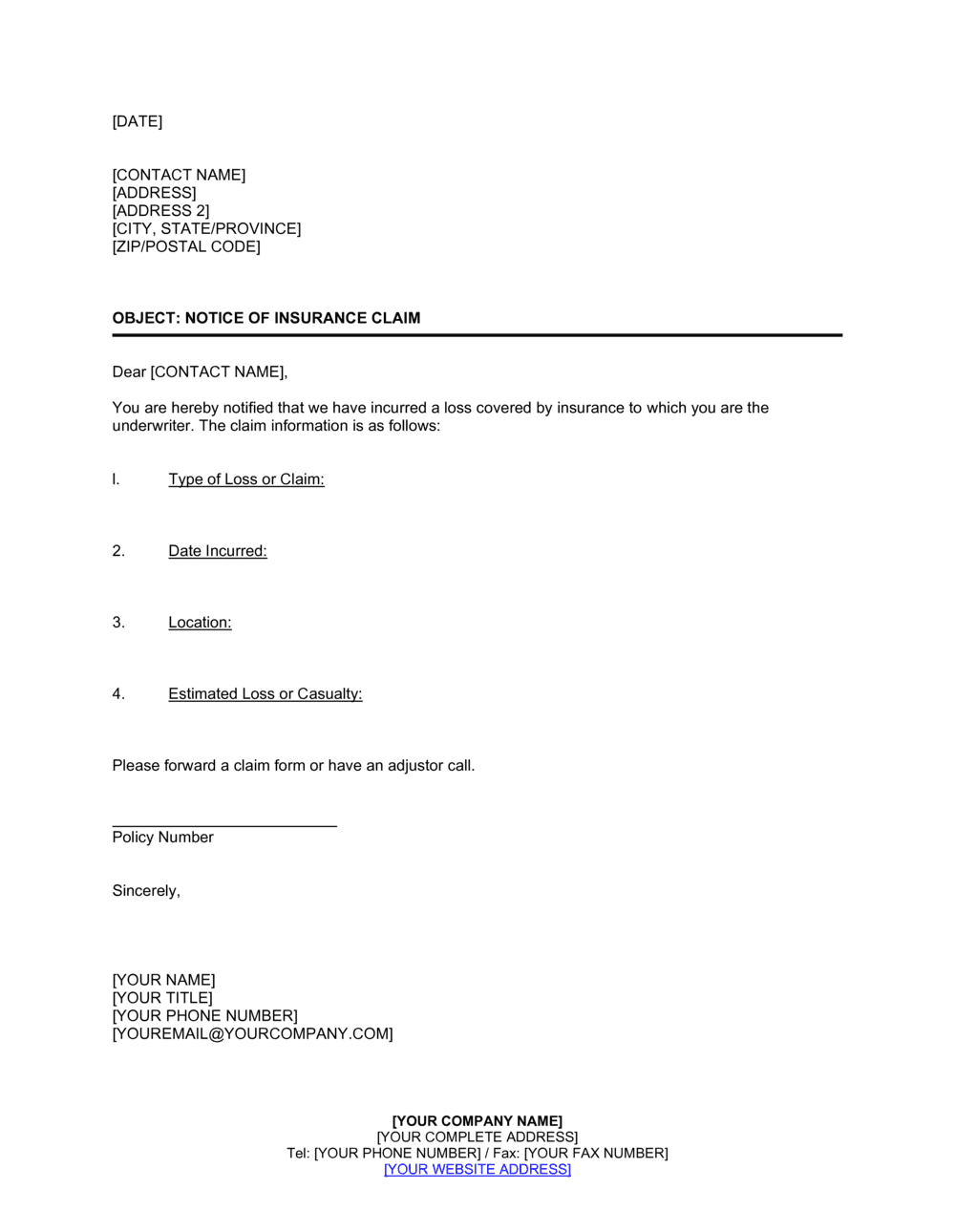
A Notice of Insurance Claim is a formal written letter sent by a policyholder to their insurance company to officially notify the insurer of a loss event and initiate the claims process. This free Word download gives you a structured, professional template you can edit online and export as PDF in minutes.
When you need it
Use it immediately after a covered loss event β€” such as property damage, theft, a liability incident, or a business interruption β€” when your policy requires prompt written notification as a condition of coverage. Delaying formal notice can jeopardize your right to recover.
What's inside
Policyholder and insurer identification, policy number, date and description of the loss event, estimated damages, supporting documentation references, and a request for claims processing instructions and adjuster assignment.

What is a Notice of Insurance Claim?

A Notice of Insurance Claim is a formal written letter sent by a policyholder to their insurance company to officially report a covered loss event and open the claims process. It identifies the policy by number, describes the incident factually, summarizes the preliminary extent of damages, references any supporting documentation, and requests adjuster assignment and processing instructions. Unlike an informal phone call, a written notice creates a dated, documented record that satisfies the prompt-notice condition found in virtually every commercial insurance policy β€” protecting the policyholder's right to recover under the coverage they have paid for.

Why You Need This Document

Failing to send a formal written notice after a covered loss is one of the most common and costly mistakes policyholders make. Most commercial insurance policies contain a prompt-notice condition β€” a requirement that the insurer be notified in writing within a defined window after the date of loss, often 30 to 90 days. Missing that window gives the insurer grounds to deny the claim entirely, regardless of whether the underlying loss is covered. A properly structured notice letter closes that risk immediately, establishes a clear timeline in the insurer's claim file, and puts the insurer on record as having received notification β€” preventing any later dispute about when or whether notice was given. This template gives you a complete, professional notice you can complete and send within 30 minutes of identifying a covered event, with every required element in place.

Which variant fits your situation?

If your situation is…Use this template
Property damage or loss at a business premisesNotice of Insurance Claim (Property)
A third-party liability incident involving a customer or visitorNotice of Insurance Claim (General Liability)
Professional error, omission, or client disputeNotice of Insurance Claim (E&O / Professional Liability)
Vehicle damage or accident involving a company vehicleNotice of Insurance Claim (Commercial Auto)
Business interruption or loss of income following a covered eventNotice of Insurance Claim (Business Interruption)
Following up because the insurer has not acknowledged the initial noticeInsurance Claim Follow-Up Letter
Disputing a claim denial or settlement offer from the insurerInsurance Claim Dispute Letter

Common mistakes to avoid

❌ Sending the notice after the policy's notification deadline

Why it matters: Most policies contain a prompt-notice condition. Filing late β€” even by a few days β€” can give the insurer grounds to deny the claim entirely or reduce the settlement.

Fix: Check your policy's notice requirement the day of the loss and send the letter within 48 hours of identifying a covered event, even if the full damage picture is not yet clear.

❌ Using speculative language about the cause of loss

Why it matters: Stating an unverified cause β€” 'the fire was probably caused by faulty wiring' β€” can be treated as an admission that complicates coverage if the actual cause turns out to be excluded.

Fix: Describe only what was directly observed. Note that the cause is under investigation and will be confirmed by a professional assessment.

❌ Omitting the policy number from the letter

Why it matters: Insurers manage thousands of policies; a letter without a policy number can sit unprocessed for days while staff search for the correct file.

Fix: Include the policy number in both the subject line and the policyholder identification paragraph so it appears twice in the document.

❌ Providing no supporting documentation with the initial notice

Why it matters: A bare-text notice with no photographs, reports, or estimates signals an unprepared claimant and invites the insurer to request multiple rounds of follow-up before assigning an adjuster.

Fix: Attach at minimum a few timestamped photographs of the damage and a copy of any incident or police report number, even if full documentation is still being compiled.

The 9 key clauses, explained

Header and date line

In plain language: Identifies the sender, the recipient insurer and their claims department address, and the date the notice is being sent.

Sample language
[POLICYHOLDER NAME] | [ADDRESS] | [DATE] | Attn: Claims Department | [INSURER NAME] | [INSURER ADDRESS]

Common mistake: Sending the notice to a general customer-service address rather than the insurer's designated claims department β€” this delays acknowledgment and can affect whether the notice is considered timely.

Subject line and policy reference

In plain language: States the purpose of the letter and the policy number so the insurer can pull the correct file immediately.

Sample language
Re: Notice of Insurance Claim β€” Policy No. [POLICY NUMBER] β€” Date of Loss: [DATE]

Common mistake: Omitting the policy number from the subject line. Without it, claims staff must search manually, adding days to processing time.

Policyholder identification

In plain language: Confirms the full legal name of the policyholder, the insured business name if different, and the contact details for the claims correspondence.

Sample language
The policyholder is [LEGAL NAME], operating as [BUSINESS NAME], located at [ADDRESS]. All correspondence regarding this claim should be directed to [CONTACT NAME] at [EMAIL] / [PHONE].

Common mistake: Using a trading name instead of the legal entity name on the policy. A mismatch between the letter and the policy record can delay the claim or trigger a coverage question.

Description of the loss event

In plain language: Provides a factual, chronological description of what happened β€” the type of incident, where it occurred, and how it was discovered.

Sample language
On [DATE OF LOSS], at approximately [TIME], [DESCRIBE INCIDENT β€” e.g., a water pipe burst in the ground-floor server room at [ADDRESS]], resulting in [DESCRIBE IMPACT β€” e.g., water damage to IT equipment and flooring].

Common mistake: Including speculative or disputed facts β€” such as assumed causes β€” in the initial description. Stick to what is directly observed; unsupported statements can be used against the claim during investigation.

Nature and estimated extent of damages

In plain language: Summarizes the categories of loss or damage and provides a preliminary dollar estimate, clearly marked as an estimate pending full assessment.

Sample language
Preliminary estimated damages include: [CATEGORY 1, e.g., IT equipment replacement β€” est. $[X]], [CATEGORY 2, e.g., structural repairs β€” est. $[X]], [CATEGORY 3, e.g., business interruption losses β€” est. $[X] per day for [X] days]. Total estimated loss: $[AMOUNT] (subject to adjuster review).

Common mistake: Providing no estimate at all, or an unsupported single lump-sum figure. Itemized categories show the insurer you have assessed the loss seriously and speed up the adjuster's initial review.

Reference to supporting documentation

In plain language: Lists the documents, photographs, police reports, or third-party assessments attached to or available for the claim.

Sample language
The following documentation is enclosed / available upon request: (a) photographs of damaged property taken on [DATE]; (b) [POLICE / INCIDENT REPORT] No. [NUMBER] filed on [DATE]; (c) [VENDOR REPAIR ESTIMATE] dated [DATE].

Common mistake: Stating 'documentation available upon request' without attaching anything. Sending at least basic evidence with the initial notice demonstrates preparation and can accelerate the adjuster assignment.

Request for claims processing instructions

In plain language: Formally asks the insurer to acknowledge receipt, assign a claims adjuster, and provide the next steps and any required forms.

Sample language
Please acknowledge receipt of this notice, assign a claims adjuster, and advise of any additional documentation or completed forms required to process this claim promptly.

Common mistake: Omitting this paragraph entirely. Without a clear request, some insurers treat the letter as informational only rather than the formal opening of a claim file.

Reservation of rights by the policyholder

In plain language: States that the policyholder reserves all rights under the policy and applicable law and does not waive any coverage by providing this notice.

Sample language
This notice is provided without waiver of, and with full reservation of, all rights and remedies available to [POLICYHOLDER NAME] under Policy No. [POLICY NUMBER] and applicable law.

Common mistake: Leaving out any reservation-of-rights language. Without it, the policyholder may inadvertently limit their options if the insurer later disputes coverage scope.

Closing and signature block

In plain language: Closes the letter professionally, identifies the signatory by name and title, and provides direct contact information for follow-up.

Sample language
We look forward to your prompt response. | Sincerely, | [SIGNATORY NAME] | [TITLE] | [COMPANY NAME] | [PHONE] | [EMAIL]

Common mistake: Signing with an illegible signature and no printed name or title. The insurer's claims file needs a named contact; an unidentifiable signature creates unnecessary back-and-forth.

How to fill it out

  1. 1

    Gather your policy documents before you start

    Locate your insurance policy, confirm the exact policy number, the insurer's claims department mailing address and email, and any notice deadline stated in the policy.

    πŸ’‘ Many policies require notice within 30, 60, or 90 days of the loss β€” check this before anything else, as a missed deadline can void your right to claim.

  2. 2

    Fill in the header, date, and subject line

    Enter today's date, the insurer's claims department address, and your policy number in the subject line. Use the format 'Re: Notice of Insurance Claim β€” Policy No. [NUMBER] β€” Date of Loss: [DATE]'.

    πŸ’‘ If you have a dedicated claims contact from a prior interaction, address the letter to them by name rather than 'Claims Department.'

  3. 3

    Confirm policyholder details match the policy exactly

    Use the legal entity name and address exactly as they appear on your policy declarations page. Note a separate operating or trading name in parentheses if needed.

    πŸ’‘ Pull up your declarations page side-by-side while completing this section to catch any discrepancies before you send.

  4. 4

    Write a factual, chronological description of the loss

    Describe the incident in the order it happened β€” date, time, location, what occurred, and how the damage was discovered. Use plain factual language and avoid speculation about causes.

    πŸ’‘ A two- to four-sentence description is sufficient for the initial notice. Save the detailed narrative for the proof-of-loss form submitted later.

  5. 5

    Itemize the estimated damages by category

    List each category of loss with a preliminary dollar estimate and label the total clearly as an estimate. Include categories even if the dollar amount is still unknown β€” mark those as 'TBD pending assessment.'

    πŸ’‘ Contact a contractor, IT vendor, or equipment supplier for a quick verbal quote before sending β€” it gives the insurer a workable starting figure.

  6. 6

    Attach or list your supporting documentation

    Include photographs, a police or incident report number, any third-party repair estimates, and a brief inventory of damaged items. List everything you are enclosing in the letter body.

    πŸ’‘ Send documentation as PDF attachments if submitting by email β€” compressed image files in a ZIP are frequently blocked by corporate mail filters.

  7. 7

    Review the reservation-of-rights clause and send

    Confirm the reservation-of-rights paragraph is present, verify the contact details in the signature block, and send by a method that creates a delivery record β€” certified mail, registered post, or email with read-receipt.

    πŸ’‘ Keep a timestamped copy of the sent letter and any delivery confirmation in a dedicated claims folder β€” you may need to prove timely notice if coverage is disputed.

Frequently asked questions

What is a notice of insurance claim?

A notice of insurance claim is a formal written letter sent by a policyholder to their insurer to officially report a covered loss event and initiate the claims process. It identifies the policy, describes what happened, summarizes the damages, and requests the insurer to assign an adjuster and provide processing instructions. Most policies require this written notice as a condition of coverage.

Why does written notice matter β€” can I just call my insurer?

A phone call to your insurer is a useful first step, but most policies require a written notice of claim to formally trigger the insurer's obligations. A written letter creates a dated, documented record that protects you if the insurer later disputes whether timely notice was given. Always follow a phone call with a written notice sent by a method that generates a delivery record.

How quickly do I need to send a notice of insurance claim?

Notice deadlines vary by policy and jurisdiction but typically range from 30 to 90 days after the date of loss. Some policies require notice "as soon as practicable," which courts have interpreted as a few days to a few weeks. Check your policy declarations and conditions page for the specific requirement. When in doubt, send the notice within 48 hours of identifying a covered loss.

What information should a notice of insurance claim include?

At minimum: the policyholder's legal name and address, the policy number, the date and description of the loss event, the location of the loss, a preliminary estimate of damages by category, a list of any supporting documentation attached, and a request for adjuster assignment and processing instructions. A reservation-of-rights paragraph protects the policyholder's options if coverage is later disputed.

What is the difference between a notice of claim and a proof of loss?

A notice of claim is the initial letter that formally alerts the insurer to a loss event and opens the claim file β€” it is sent first, often within days of the loss. A proof of loss is a more detailed sworn statement, typically submitted on the insurer's form, that itemizes the exact nature and dollar value of the claimed loss. The notice starts the process; the proof of loss substantiates it.

Can a late notice of claim be rejected by the insurer?

Yes. In many jurisdictions, failing to provide timely notice as required by the policy gives the insurer grounds to deny the claim, even if the loss itself would otherwise be fully covered. Some jurisdictions require the insurer to show actual prejudice from the late notice before denying coverage, but that protection is not universal. Sending the notice promptly is the safest approach in every case.

Do I need a lawyer to send a notice of insurance claim?

For a straightforward business property or general liability claim, a well-completed template is typically sufficient. Consider involving a public adjuster or insurance attorney if the loss exceeds $50,000, the insurer issues a reservation-of-rights letter, coverage is disputed, or the claim involves a complex multi-party liability event.

Should I send the notice by email or certified mail?

Send the notice by whichever method your policy specifies β€” some policies name a specific claims address or require certified mail. If the policy is silent, send by both email (with read-receipt requested) and certified mail to the insurer's claims department address. Keeping proof of delivery protects you against any later dispute over whether timely notice was given.

What happens after I send the notice of insurance claim?

The insurer should acknowledge receipt, assign a claims adjuster, and provide a claim reference number β€” typically within 10 to 15 business days, though timelines vary by insurer and policy type. The adjuster will contact you to schedule an inspection or request additional documentation. Keep all correspondence and document every interaction with dates and the names of insurer representatives you speak with.

How this compares to alternatives

vs Proof of Loss Form

A proof of loss is a detailed sworn statement submitted on the insurer's own form after the initial claim is opened, itemizing the exact dollar value of each loss category. A notice of insurance claim comes first β€” it opens the file and triggers adjuster assignment. The notice is a letter you draft; the proof of loss is a form the insurer provides.

vs Demand Letter

A demand letter is sent to a third party who owes you money or caused you harm, demanding payment or action. A notice of insurance claim is sent to your own insurer to initiate coverage under a policy you already hold. If a third party caused your loss, you may need both β€” a notice to your insurer and a demand letter to the responsible party.

vs Incident Report

An incident report is an internal document recording what happened at a workplace or business premises for operational and HR records. A notice of insurance claim is an external letter sent to the insurer to formally open a claim. An incident report is typically completed first and then referenced or attached to the claim notice.

vs Insurance Claim Dispute Letter

An insurance claim dispute letter is used after the insurer has denied or underpaid a claim β€” it challenges the insurer's decision and requests reconsideration or escalation. A notice of insurance claim is the first step that opens the process. The dispute letter only becomes relevant if the claim is handled unsatisfactorily after the initial notice.

Industry-specific considerations

Retail and E-commerce

Theft, shoplifting incidents, slip-and-fall liability on premises, and inventory damage from fire or water require prompt written claim notice to commercial property and general liability insurers.

Construction and Trades

Jobsite accidents, tool and equipment theft, and third-party property damage all trigger notification obligations to general liability, inland marine, and workers' compensation insurers.

Professional Services

Errors-and-omissions and professional liability claims require written notice to the insurer promptly upon becoming aware of a potential client dispute, often before a formal claim is even filed against the firm.

Property Management

Landlords and property managers must notify insurers of structural damage, tenant liability incidents, and natural-disaster losses under landlord or commercial property policies, often while simultaneously coordinating repairs.

Template vs pro β€” what fits your needs?

PathBest forCostTime
Use the templateMost small and mid-size business property, liability, or E&O claims where coverage is not disputedFree15–30 minutes
Template + professional reviewClaims above $25,000 or situations where the insurer has issued a reservation-of-rights letter$150–$400 for a public adjuster or attorney review1–2 business days
Custom draftedComplex multi-party liability claims, coverage disputes, or losses exceeding $100,000 where legal strategy matters from day one$500–$2,000+ for an insurance attorney3–7 days

Glossary

Policyholder
The individual or business entity named on the insurance policy who pays premiums and is entitled to make claims.
Policy Number
The unique identifier assigned by the insurer to a specific insurance policy, required on all claims correspondence.
Loss Event
The specific incident β€” fire, theft, flood, accident, or liability occurrence β€” that triggers the right to make an insurance claim.
Date of Loss
The calendar date on which the insured loss event occurred, which determines coverage applicability and notice deadlines.
Claims Adjuster
An insurance company representative who investigates the claim, assesses damages, and determines the settlement amount.
Prompt Notice Requirement
A standard policy condition requiring the policyholder to notify the insurer of a loss within a defined period β€” often 30 to 90 days β€” as a condition of coverage.
Proof of Loss
A formal sworn statement submitted to the insurer itemizing the nature and value of the claimed loss, typically required after the initial notice.
Subrogation
The insurer's right to pursue a third party that caused the insured loss in order to recover amounts paid out under the claim.
Reservation of Rights
A written notice from an insurer indicating it is investigating a claim while reserving the right to deny coverage based on findings β€” not an outright denial.
Coverage Period
The specific dates between which a loss event must occur to be covered under the policy terms.

Part of your Business Operating System

This document is one of 3,000+ business & legal templates included in Business in a Box.

  • Fill-in-the-blanks β€” ready in minutes
  • 100% customizable Word document
  • Compatible with all office suites
  • Export to PDF and share electronically

Create your document in 3 simple steps.

From template to signed document β€” all inside one Business Operating System.
1
Download or open template

Access over 3,000+ business and legal templates for any business task, project or initiative.

2
Edit and fill in the blanks with AI

Customize your ready-made business document template and save it in the cloud.

3
Save, Share, Send, Sign

Share your files and folders with your team. Create a space of seamless collaboration.

Save time, save money, and create top-quality documents.

β˜…β˜…β˜…β˜…β˜…

"Fantastic value! I'm not sure how I'd do without it. It's worth its weight in gold and paid back for itself many times."

Managing Director Β· Mall Farm
Robert Whalley
Managing Director, Mall Farm Proprietary Limited
β˜…β˜…β˜…β˜…β˜…

"I have been using Business in a Box for years. It has been the most useful source of templates I have encountered. I recommend it to anyone."

Business Owner Β· 4+ years
Dr Michael John Freestone
Business Owner
β˜…β˜…β˜…β˜…β˜…

"It has been a life saver so many times I have lost count. Business in a Box has saved me so much time and as you know, time is money."

Owner Β· Upstate Web
David G. Moore Jr.
Owner, Upstate Web

Run your business with a system β€” not scattered tools

Stop downloading documents. Start operating with clarity. Business in a Box gives you the Business Operating System used by over 250,000 companies worldwide to structure, run, and grow their business.

Start freeΒ Β·Β No credit card required