Sales Invoice - Excel Template

Free Excel download β€’ Use online β€’ Print or share

1 pageβ€’20–30 min to useβ€’Difficulty: Standardβ€’Signature requiredβ€’Legal review recommended
Learn more ↓
FreeXLSSales Invoice - Excel Template

At a glance

What it is
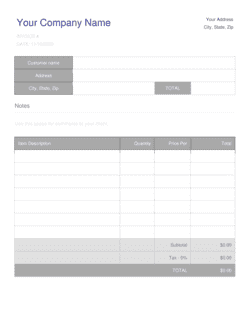
A Sales Invoice is a legally binding commercial document issued by a seller to a buyer that records the sale of goods, states the amount owed, and establishes the payment obligation. This free Excel download gives you a structured, editable template you can customize with your branding, product lines, tax rates, and payment terms, then export as PDF and send to customers in minutes.
When you need it
Issue it each time you sell physical goods or products to a business or consumer and need a formal, enforceable record of the transaction. It is required for accounts-receivable management, tax filings, audit trails, and cross-border customs documentation.
What's inside
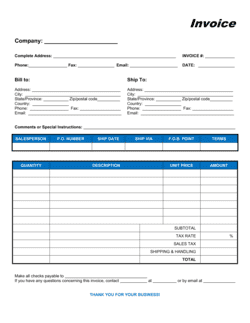
Seller and buyer identification, invoice number, issue and due dates, itemized product descriptions with quantities and unit prices, subtotal, applicable taxes, total amount due, payment terms, and governing legal terms including late-payment penalties and dispute resolution language.

What is a Sales Invoice?

A Sales Invoice is a legally binding commercial document issued by a seller to a buyer that formally records the sale of physical goods, itemizes every product with quantities and unit prices, calculates applicable taxes and the total amount owed, and establishes the payment obligation β€” including the due date, accepted payment methods, and consequences for late payment. Unlike a proforma invoice or quote, a sales invoice is issued after goods have been shipped or delivered and creates an enforceable accounts-receivable entry. It also functions as the primary documentation for sales tax or VAT compliance, customs declarations on cross-border shipments, and the audit trail required by tax authorities in every major jurisdiction.

Why You Need This Document

Issuing a professional, complete sales invoice does far more than request payment β€” it defines the legal terms under which that payment is owed. Without clearly stated FOB terms, a damaged shipment becomes a disputed liability with no clean resolution. Without a specific due date and a late-payment clause, your right to charge interest on overdue balances depends on jurisdiction-specific defaults rather than agreed terms. Without your tax ID and the correct tax amounts, corporate buyers cannot claim input tax credits and may refuse to process payment until a corrected invoice arrives. Missing or vague product descriptions trigger customs delays on international orders and make short-shipment or defect claims nearly impossible to enforce. This Excel template gives you the structure to cover all of these obligations in a single document β€” formatted for immediate use, editable for your specific products and tax rates, and exportable as a signed PDF that holds up in an audit or a collections proceeding.

Which variant fits your situation?

If your situation is…Use this template
Billing for professional services rather than physical goodsService Invoice
Cross-border product sales requiring customs documentationCommercial Invoice (International)
Issuing a preliminary price confirmation before deliveryProforma Invoice
Reversing or crediting a prior sales invoiceCredit Note
Requesting a deposit before manufacturing or shipping beginsDeposit Invoice
Recurring monthly billing for product subscriptions or standing ordersRecurring Invoice
Billing a construction or trade client for materials and labor combinedConstruction Invoice

Common mistakes to avoid

❌ Vague product descriptions on line items

Why it matters: Generic entries like 'Merchandise' or 'Products' are rejected by corporate AP systems that require specific item codes, cause customs delays on international shipments, and make defect or shortage claims impossible to trace.

Fix: Use the product name and SKU for every line item. If no SKU exists, write a description specific enough that someone who did not place the order can identify exactly what was purchased.

❌ No specific due date

Why it matters: Terms like 'due upon receipt' or 'payable promptly' are interpreted inconsistently by AP departments and cannot be automated in payment scheduling systems, consistently resulting in slower payment and weaker collection rights.

Fix: Always calculate and print a specific calendar date based on the agreed payment terms β€” 'Due: June 1, 2026 (Net 30 from May 2, 2026)' is unambiguous.

❌ Late-payment rate exceeds the statutory cap

Why it matters: Many jurisdictions impose a ceiling on contractual interest rates. A rate above the cap can void the entire late-payment clause, leaving the seller with no contractual right to charge interest at all.

Fix: Draft the clause with a fallback: '1.5% per month or the maximum rate permitted by applicable law, whichever is lower.' This protects enforceability across jurisdictions.

❌ Missing tax ID on the invoice

Why it matters: Corporate buyers, government agencies, and international customers frequently cannot legally process payment or claim input tax credits without a valid EIN, GST number, or VAT registration number on the invoice.

Fix: Add your tax ID to the seller information block in the master template so it appears automatically on every invoice you generate.

❌ No FOB or title-transfer language

Why it matters: Without defined FOB terms, responsibility for goods damaged or lost in transit is legally ambiguous. Both parties assume the other is insured, and disputes frequently escalate to costly litigation.

Fix: State FOB terms on every product invoice β€” FOB Origin or FOB Destination β€” and confirm the term matches the freight insurance policy held by the party bearing the transit risk.

❌ Sending the invoice to the wrong contact

Why it matters: An invoice routed to your sales or project contact instead of accounts payable can sit unprocessed for weeks after your due date, and the seller typically has no legal remedy until formal demand is made to the right party.

Fix: Obtain the correct AP email, any required invoice portal, and any mandatory subject-line format from every new customer before issuing the first invoice.

The 10 key clauses, explained

Seller and buyer identification

In plain language: Identifies both parties by their full legal names, registered addresses, tax IDs, and designated contacts for billing and accounts payable.

Sample language
Seller: [SELLER LEGAL NAME], [ADDRESS], [CITY, STATE, ZIP], Tax ID: [EIN/VAT NUMBER]. Bill To: [BUYER LEGAL NAME], Attn: Accounts Payable, [ADDRESS], PO Number: [PO NUMBER].

Common mistake: Using a trade name instead of the registered legal entity name β€” corporate AP systems match the invoice entity to the vendor master record, and a mismatch stalls payment or triggers a dispute.

Invoice number, issue date, and due date

In plain language: Assigns a unique identifier to the invoice, records when it was created, and states the specific calendar date by which payment is due.

Sample language
Invoice #: INV-2026-0083 | Issue Date: May 2, 2026 | Due Date: June 1, 2026 | Terms: Net 30.

Common mistake: Writing 'due upon receipt' instead of a specific due date β€” buyers interpret this inconsistently and AP systems cannot auto-schedule payment without a fixed date.

Itemized product description, quantity, and unit price

In plain language: Lists each product sold on its own row with a specific description or SKU, the number of units, the price per unit, and the calculated line total.

Sample language
Product: [PRODUCT NAME / SKU-12345] | Qty: 50 | Unit Price: $24.00 | Line Total: $1,200.00.

Common mistake: Using vague descriptions like 'Merchandise' or 'Goods' β€” customs authorities, auditors, and buyers' AP teams all require specific product descriptions to approve and classify the purchase.

Subtotal, discounts, and applicable taxes

In plain language: Calculates the sum of all line items before adjustments, deducts any agreed trade or volume discounts, and applies the correct tax rate to the post-discount subtotal.

Sample language
Subtotal: $4,200.00 | Trade Discount (5%): -$210.00 | Sales Tax (8.25%): $330.23 | Total Due: $4,320.23 USD.

Common mistake: Applying tax to the pre-discount subtotal rather than the post-discount amount, which overcharges the buyer and creates a tax filing discrepancy.

Total amount due and currency

In plain language: States the final payable amount prominently in a specified currency so there is no ambiguity about what is owed.

Sample language
TOTAL DUE: $4,320.23 USD. All amounts are stated in United States Dollars.

Common mistake: Omitting the currency code on invoices sent to international buyers β€” USD and CAD, or GBP and EUR, are easy to confuse and a currency mismatch can result in underpayment that the seller has no clean remedy for.

Payment instructions and accepted methods

In plain language: Provides the complete information the buyer needs to remit payment β€” bank wire details, ACH routing, check payable to, or a payment-portal link β€” so there is no delay caused by missing information.

Sample language
Wire Transfer: [BANK NAME] | Account: [ACCOUNT NUMBER] | Routing: [ROUTING NUMBER] | Ref: INV-2026-0083. Or pay online at: [PAYMENT PORTAL URL].

Common mistake: Including payment instructions only in the email body and not on the invoice itself β€” when the invoice is printed or forwarded, the payment details are lost.

Late payment penalty clause

In plain language: Establishes the interest rate or fixed fee that accrues on overdue balances, providing a contractual basis to charge interest without separate negotiation.

Sample language
Balances unpaid after the due date shall accrue interest at the rate of 1.5% per month (18% per annum) or the maximum rate permitted by applicable law, whichever is lower.

Common mistake: Setting a penalty rate above the statutory maximum in the buyer's jurisdiction β€” courts will void the clause entirely rather than reduce it, leaving the seller with no contractual interest remedy.

Title and risk of loss (FOB terms)

In plain language: Specifies the point at which ownership of goods and the risk of damage or loss transfers from the seller to the buyer during transit.

Sample language
Title to and risk of loss of the goods shall pass to Buyer upon delivery to the carrier at Seller's facility (FOB Origin: [SELLER CITY, STATE]).

Common mistake: Leaving FOB terms undefined β€” if goods are damaged in transit and neither party has specified who bears the risk, the dispute defaults to costly litigation rather than an insurance claim.

Returns, disputes, and claims period

In plain language: States the window within which the buyer must raise defects, shortages, or disputes, and the process for handling returns or adjustments.

Sample language
Buyer must notify Seller in writing of any claim for defective goods, shortages, or billing errors within [14] days of delivery. Claims raised after this period will not be accepted.

Common mistake: No claims period at all β€” without one, buyers in many jurisdictions can raise disputes months after delivery, well after the seller has closed the books on the transaction.

Governing law and jurisdiction

In plain language: Identifies which jurisdiction's laws govern the invoice and payment obligation, and where disputes must be resolved, providing certainty for both parties.

Sample language
This invoice and any disputes arising from it shall be governed by the laws of the State of [STATE], without regard to conflict-of-law provisions. Disputes shall be resolved in the courts of [CITY, STATE].

Common mistake: Choosing a governing law jurisdiction with no connection to where the buyer or seller operates β€” some jurisdictions refuse to enforce choice-of-law clauses that are purely opportunistic, leaving the governing law undefined.

How to fill it out

  1. 1

    Enter your seller information and logo

    Add your company's registered legal name, address, phone, email, and tax ID (EIN or VAT number) to the seller block. Upload your logo to the designated header cell.

    πŸ’‘ Save a master copy with your details pre-filled so each new invoice only requires updating the buyer information and line items.

  2. 2

    Enter the buyer's billing details and PO number

    Use the buyer's full legal entity name and official billing address. Include their purchase order number if they issued one β€” many corporate AP systems will not process an invoice without a matching PO number.

    πŸ’‘ Call the buyer's AP department before issuing the first invoice to confirm the correct entity name, billing address, and any required reference fields.

  3. 3

    Assign an invoice number and set the dates

    Use a sequential numbering system such as INV-YYYY-NNNN. Enter the issue date and calculate a specific due date based on your agreed payment terms β€” Net 30 from May 2, 2026 is June 1, 2026.

    πŸ’‘ A YYYY-NNNN numbering format keeps invoices sortable by year and prevents number collisions across fiscal periods.

  4. 4

    Fill in itemized line items with specific descriptions

    List each product on a separate row with its SKU or product name, quantity, unit price, and calculated line total. Avoid generic descriptions β€” 'Widget Model A-200, 50 units @ $24.00' is more useful than 'Goods.'

    πŸ’‘ Specific product descriptions reduce customs delays on international shipments and make it easier to resolve short-shipment or defect claims.

  5. 5

    Apply discounts and calculate taxes correctly

    Enter any agreed trade or volume discount as a line deduction from the subtotal. Apply the correct sales tax, GST, or VAT rate to the post-discount amount. The Excel template calculates the total automatically once you enter the rate.

    πŸ’‘ Confirm the correct tax rate for the buyer's ship-to location before issuing β€” rates differ by US state, Canadian province, and EU member state.

  6. 6

    Complete payment instructions and late-fee terms

    Enter your full bank wire or ACH details, check payable-to name, or payment portal URL directly on the invoice. Confirm the late-payment penalty rate does not exceed the legal maximum in the buyer's jurisdiction.

    πŸ’‘ Adding a payment link to your invoice reduces average payment time by approximately 7 days compared to bank-detail-only invoices.

  7. 7

    Specify FOB terms and the claims period

    Select FOB Origin or FOB Destination based on your shipping agreement and enter the transfer location. Set the claims window β€” typically 7 to 14 days from delivery β€” for defects, shortages, and billing errors.

    πŸ’‘ FOB Origin shifts transit risk to the buyer at pickup; FOB Destination keeps it with you until delivery β€” choose the term that matches your insurance coverage.

  8. 8

    Export as PDF, sign, and send

    Save the completed invoice as PDF. If your arrangement or jurisdiction requires seller acknowledgment, sign before sending. Email the PDF to the buyer's AP contact with the total due and due date restated in the message body.

    πŸ’‘ Keep the editable Excel source file for your records alongside the signed PDF β€” you will need it if the buyer disputes any line item.

Frequently asked questions

What is a sales invoice?

A sales invoice is a commercial document a seller issues to a buyer to formally request payment for goods sold and delivered. It identifies both parties, itemizes the products with quantities and unit prices, states the total amount due, and sets a specific payment deadline. In most jurisdictions, a properly issued sales invoice creates a legally enforceable payment obligation and serves as the primary evidence for accounts-receivable management and tax compliance.

What is the difference between a sales invoice and a commercial invoice?

A sales invoice is a general-purpose billing document used for any product sale. A commercial invoice is a specific version used in international trade that adds customs-required fields such as country of origin, harmonized tariff codes (HTS), declared value, and Incoterms. For domestic sales, a standard sales invoice is sufficient. For cross-border shipments, a commercial invoice is required by customs authorities in most countries.

Is a sales invoice legally binding?

A sales invoice is generally enforceable as evidence of a payment obligation when it references an underlying purchase order, contract, or accepted order confirmation. The invoice itself is not a contract β€” it documents a transaction that the parties already agreed to. Courts typically treat a signed or accepted invoice as prima facie evidence of the debt. Including governing-law language and a signed acknowledgment strengthens enforceability significantly.

Does a sales invoice need to be signed?

In most jurisdictions, a sales invoice does not require a signature to be valid as a billing document. However, a seller's signature or authorized stamp strengthens enforceability and is required by some buyers' AP policies, certain government procurement rules, and customs authorities for international shipments. Including a signature block costs nothing and reduces disputes over invoice authenticity.

What tax information must appear on a sales invoice?

Requirements vary by jurisdiction. In the US, invoices must show the seller's EIN and the applicable sales tax amount and rate for taxable goods. In Canada, GST/HST-registered sellers must show their GST registration number and the tax amount. In the UK and EU, VAT invoices must include the seller's VAT registration number, the VAT rate, and the VAT amount as a separate line item. Missing tax information can result in buyers being unable to claim input tax credits and can trigger tax authority inquiries.

What payment terms should I use on a sales invoice?

Net 30 is the most common standard for B2B product invoicing. Smaller suppliers often negotiate Net 15 to improve cash flow. Large corporate buyers may impose Net 45 or Net 60. Always pair the terms with a specific due date and include a late-payment penalty clause β€” typically 1.5% per month β€” to incentivize timely payment and preserve your right to charge interest without separate negotiation.

What are FOB terms and why do they matter on a sales invoice?

FOB stands for Free On Board and specifies the point at which title and risk of loss transfer from seller to buyer during shipping. FOB Origin means the buyer takes responsibility once the carrier picks up the goods at the seller's facility. FOB Destination means the seller retains responsibility until the goods arrive at the buyer's location. Leaving FOB terms undefined on a product invoice is a common and costly mistake β€” if goods are lost or damaged in transit and no FOB term is stated, both parties may dispute liability and neither may have adequate insurance coverage.

How long should I keep sales invoices?

The IRS requires businesses to retain records supporting income and deductions for at least 3 years from the filing date, and up to 7 years if there is any possibility of underreported income. In Canada, CRA requires 6 years. In the UK, HMRC requires 6 years for VAT records and 6 years for corporation tax records. For cross-border sales subject to customs audit, retain invoices for at least 5 years. Storing both the editable Excel source and the signed PDF export gives you the best audit trail.

What is the difference between a proforma invoice and a sales invoice?

A proforma invoice is a preliminary document issued before goods are shipped or delivered, used to confirm pricing and terms, request a deposit, or satisfy customs pre-clearance requirements. It does not create a formal accounts-receivable entry or a legal payment obligation. A sales invoice is issued after delivery and creates the enforceable payment demand. Use the proforma to set expectations and the sales invoice to collect.

How this compares to alternatives

vs Proforma Invoice

A proforma invoice is issued before delivery to confirm pricing, request a deposit, or satisfy customs pre-clearance. It does not create a legal payment obligation or an accounts-receivable entry. A sales invoice is issued after delivery and is the enforceable demand for payment. Use the proforma to lock in terms; use the sales invoice to collect.

vs Commercial Invoice

A commercial invoice adds fields required by customs authorities for cross-border shipments β€” harmonized tariff codes, country of origin, Incoterms, and declared value. A standard sales invoice is sufficient for domestic transactions. If you ship internationally, upgrade to a commercial invoice format to avoid customs delays and duty misclassification penalties.

vs Credit Note

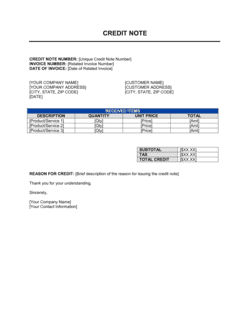
A credit note reverses or reduces a previously issued sales invoice β€” used for product returns, short shipments, billing errors, or negotiated price adjustments. It is the accounting mirror image of a sales invoice and must reference the original invoice number to be matched and processed correctly by the buyer's AP system.

vs Purchase Order

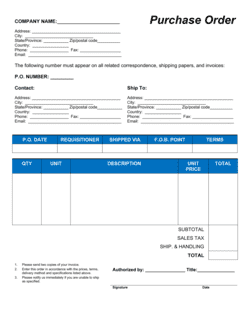
A purchase order is issued by the buyer before delivery to authorize the purchase and set agreed terms. A sales invoice is issued by the seller after delivery to demand payment. The two documents should reference each other by number β€” the sales invoice cites the PO number and the PO's terms govern any conflicts between the documents.

Industry-specific considerations

Manufacturing and wholesale

Bulk-order line items with volume pricing tiers, FOB shipping terms, and multi-currency fields for international buyers requiring HTS codes and declared customs value.

Retail and e-commerce

SKU-level descriptions, state-specific sales tax rates, shipping and handling line items, and return authorization references tied to the original invoice number.

Food and beverage

Perishable goods require tight claims periods β€” typically 24–48 hours from delivery β€” and lot numbers or batch codes on each line item for traceability and recall compliance.

Construction and building materials

Materials and delivery charges split across separate line items, progress billing tied to delivery milestones, and lien-waiver reference language on invoices for large project orders.

Jurisdictional notes

United States

Sales tax rules vary by state β€” 45 states plus Washington D.C. impose sales tax, and rates and taxable product categories differ significantly. After South Dakota v. Wayfair (2018), sellers with economic nexus in a state must collect and remit sales tax regardless of physical presence. Include the seller's EIN on every invoice and confirm the ship-to state's rate before applying tax. Late-payment interest rate caps also vary by state.

Canada

GST/HST-registered businesses must display their GST registration number and the tax amount as a separate line on invoices over CAD $30. Quebec applies QST in addition to GST. Provincial sales tax (PST) applies in British Columbia, Saskatchewan, and Manitoba as a separate levy. Invoices must be retained for 6 years under CRA requirements. French-language invoices are required for transactions with Quebec consumers under the Charter of the French Language.

United Kingdom

VAT-registered sellers must issue a full VAT invoice showing the seller's VAT registration number, the VAT rate, and the VAT amount as a distinct line item. The standard VAT rate is 20%, with reduced rates for certain goods. The Late Payment of Commercial Debts (Interest) Act 1998 entitles sellers to statutory interest of 8% above the Bank of England base rate on overdue B2B invoices, even without a contractual penalty clause. Retain VAT records for at least 6 years.

European Union

EU VAT Directive requires VAT invoices to include the seller's VAT identification number, the buyer's VAT number for B2B cross-border supplies, the applicable VAT rate and amount, and a description sufficient for customs classification. Intra-EU B2B supplies may be zero-rated if both parties are VAT-registered and the goods physically cross a member state border. GDPR applies to personal data on invoices β€” avoid including unnecessary personal information about individual buyers.

Template vs lawyer β€” what fits your deal?

PathBest forCostTime
Use the templateSmall and mid-sized businesses issuing standard domestic product invoices with straightforward payment termsFree5–10 minutes per invoice
Template + legal reviewBusinesses selling internationally, adding complex FOB or Incoterms clauses, or operating in heavily regulated industries$150–$400 (one-time review by a commercial attorney or trade compliance specialist)1–3 days
Custom draftedEnterprise sellers with ERP-integrated billing, cross-border transactions subject to multiple VAT regimes, or high-value contracts where invoice enforceability is critical$500–$2,000+ (commercial attorney or trade law specialist)3–7 days

Glossary

Sales Invoice
A commercial document issued by a seller to a buyer that records a completed or pending sale of goods and creates a legal payment obligation.
Invoice Number
A unique sequential identifier assigned to each invoice for tracking, accounting, and dispute-resolution purposes.
Net Payment Terms
The number of days after the invoice date by which the buyer must remit payment β€” e.g., Net 30 means full payment is due within 30 days.
Line Item
A single row on an invoice representing one product or SKU, including its description, quantity, unit price, and extended total.
Purchase Order (PO) Number
A reference number issued by the buyer's procurement system that authorizes the purchase and must appear on the invoice for the buyer to process payment.
Tax Identification Number (TIN/VAT Number)
A government-issued identifier for a business entity, required on invoices in most jurisdictions for tax reporting and input-tax credit claims.
Late Payment Penalty
An interest charge or fixed fee applied to balances not paid by the due date, typically expressed as a monthly percentage such as 1.5% per month.
FOB (Free On Board)
A shipping term specifying the point at which title and risk of loss transfer from seller to buyer β€” either at the seller's dock (FOB Origin) or the buyer's dock (FOB Destination).
Accounts Receivable (AR)
Money owed to a business by customers for goods or services already delivered but not yet paid for, recorded as a current asset on the balance sheet.
Credit Note
A document that reduces or cancels all or part of a previously issued invoice, used for returns, billing errors, or agreed price adjustments.
Proforma Invoice
A preliminary invoice issued before delivery to confirm pricing and terms; it is not a formal demand for payment and does not create an accounts-receivable entry.

Part of your Business Operating System

This document is one of 3,000+ business & legal templates included in Business in a Box.

  • Fill-in-the-blanks β€” ready in minutes
  • 100% customizable Word document
  • Compatible with all office suites
  • Export to PDF and share electronically

Create your document in 3 simple steps.

From template to signed document β€” all inside one Business Operating System.
1
Download or open template

Access over 3,000+ business and legal templates for any business task, project or initiative.

2
Edit and fill in the blanks with AI

Customize your ready-made business document template and save it in the cloud.

3
Save, Share, Send, Sign

Share your files and folders with your team. Create a space of seamless collaboration.

Save time, save money, and create top-quality documents.

β˜…β˜…β˜…β˜…β˜…

"Fantastic value! I'm not sure how I'd do without it. It's worth its weight in gold and paid back for itself many times."

Managing Director Β· Mall Farm
Robert Whalley
Managing Director, Mall Farm Proprietary Limited
β˜…β˜…β˜…β˜…β˜…

"I have been using Business in a Box for years. It has been the most useful source of templates I have encountered. I recommend it to anyone."

Business Owner Β· 4+ years
Dr Michael John Freestone
Business Owner
β˜…β˜…β˜…β˜…β˜…

"It has been a life saver so many times I have lost count. Business in a Box has saved me so much time and as you know, time is money."

Owner Β· Upstate Web
David G. Moore Jr.
Owner, Upstate Web

Run your business with a system β€” not scattered tools

Stop downloading documents. Start operating with clarity. Business in a Box gives you the Business Operating System used by over 250,000 companies worldwide to structure, run, and grow their business.

Free Forever PlanΒ Β·Β No credit card required