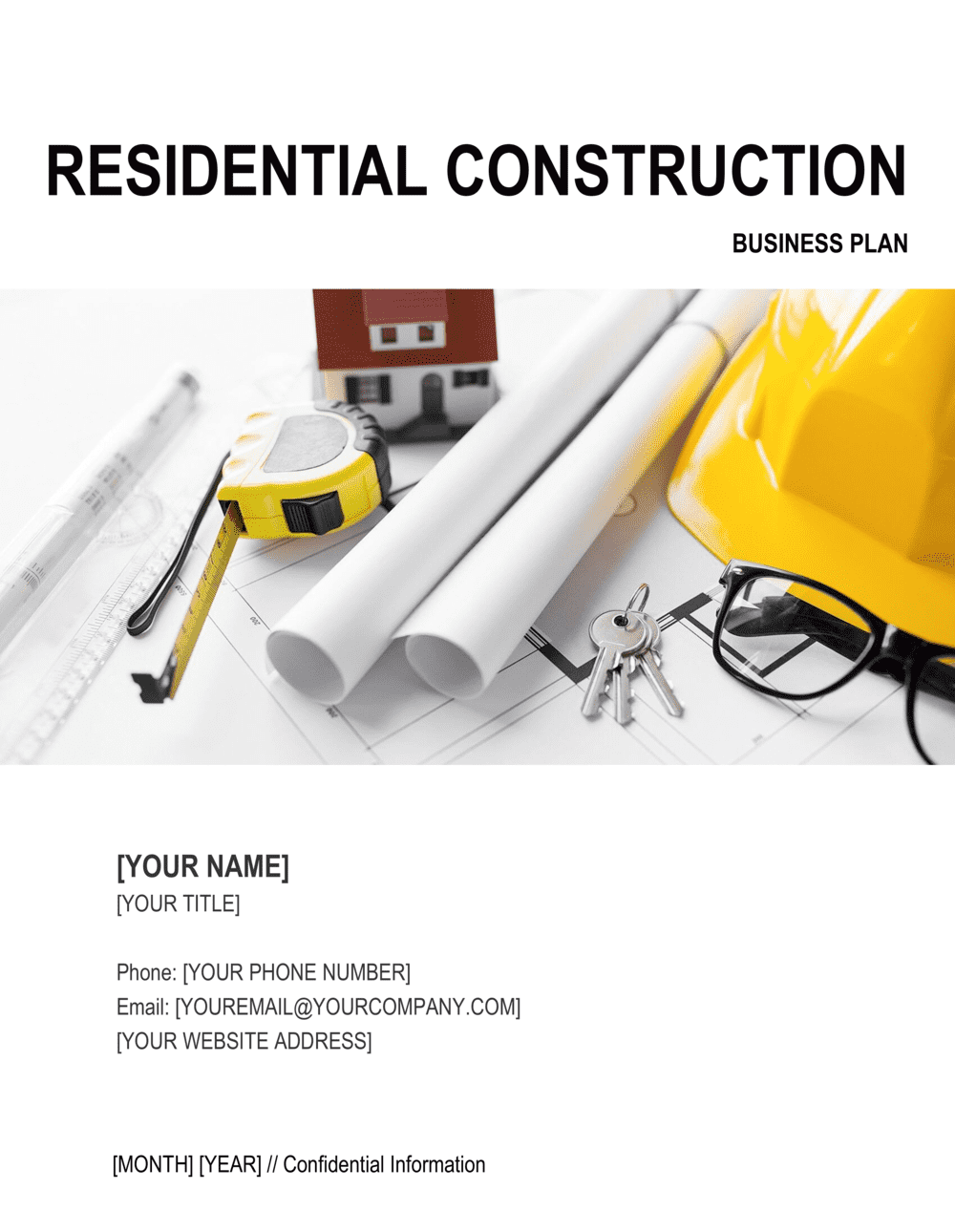
Residential Construction Business Plan Template

Free Word download β€’ Edit online β€’ Save & share with Drive β€’ Export to PDF

36 pagesβ€’2h 55m – 4h to fillβ€’Difficulty: Expert
Learn more ↓
FreeResidential Construction Business Plan Template

At a glance

What it is
A Residential Construction Business Plan is a structured operational document that defines a home-building or renovation company's strategy, target market, project pipeline, cost structure, and 3–5 year financial projections. This free Word download gives you a ready-to-edit framework you can customize for your company and export as PDF to share with lenders, investors, or partners.
When you need it
Use it when launching a new residential construction or remodeling company, applying for a construction loan or SBA financing, or formalizing growth strategy for an existing contracting business seeking bonding or new contracts.
What's inside
Executive summary, company overview, market analysis, service offerings, competitive positioning, marketing and sales strategy, operations and project management approach, management team, and financial projections including revenue by project type, cost of construction, and cash flow timing.

What is a Residential Construction Business Plan?

A Residential Construction Business Plan is a structured operational document that defines a home-building or renovation company's market position, service offerings, project management approach, management team, and 3–5 year financial projections β€” including project-level gross margins, overhead allocation, and a cash flow model that reflects the timing of construction draw-schedule receipts. Unlike a generic business plan, it addresses the industry-specific realities that lenders and surety underwriters actually evaluate: local permit market data, crew capacity constraints, subcontractor management, and the cash-flow gap that opens between subcontractor payment dates and lender draw releases. It is available as a free Word download you can edit online and export as PDF for bank submissions, bonding applications, or internal planning.

Why You Need This Document

Without a written residential construction business plan, loan applications stall at the first underwriting review, bonding capacity stays capped at levels that exclude larger contracts, and growth decisions get made on instinct rather than a financial model. Banks require a formal plan β€” including a monthly cash flow statement β€” for most construction loan applications above $150,000. Bonding companies use your plan to set the maximum contract value they will guarantee. Internally, a plan that maps crew capacity to projected project volume forces you to identify hiring bottlenecks before they become missed deadlines. This template gives you the industry-specific structure that generic business plan tools miss, so you can move from a blank page to a lender-ready document in a fraction of the time it would take to build one from scratch.

Which variant fits your situation?

If your situation is…Use this template
Launching a general contracting company from scratchResidential Construction Business Plan
Planning a commercial construction or tenant improvement businessConstruction Company Business Plan
Developing a subdivision or multi-unit residential projectReal Estate Development Business Plan
Starting a renovation or remodeling-only companyHome Renovation Business Plan
Applying specifically for an SBA 7(a) or 504 construction loanBank Loan Business Plan
Summarizing strategy on one page for an early partner or investor meetingOne-Page Business Plan
Planning a roofing, plumbing, or specialty trade businessContractor Business Plan

Common mistakes to avoid

❌ Using national housing data instead of local permit data

Why it matters: Residential construction is a hyper-local market. A lender in Phoenix knows the Maricopa County permit numbers β€” a plan citing national averages signals the owner hasn't done real market research.

Fix: Pull permit data from the U.S. Census Bureau Building Permits Survey or your county building department and cite the source and year explicitly.

❌ Ignoring cash flow timing from draw schedules

Why it matters: A project with a 22% gross margin can still produce a cash crisis if subcontractor payments fall due two weeks before the next lender draw. Lenders who see a P&L with no cash flow model will reject the plan.

Fix: Model a month-by-month cash flow for Year 1 that maps each project's draw-schedule receipts against payroll, subcontractor, and materials payment dates.

❌ Projecting revenue from more projects than crew capacity allows

Why it matters: A two-crew operation that projects 18 custom home starts in Year 1 will be immediately questioned β€” the numbers imply a hiring plan that isn't documented anywhere in the plan.

Fix: Build revenue from crew capacity up: number of crews Γ— projects per crew per year Γ— average contract value. Then document the hiring plan that supports any increase in capacity.

❌ Omitting change-order and cost-overrun management processes

Why it matters: Change orders are the leading cause of contractor margin erosion and client disputes. A plan silent on this signals the business has no control over project costs.

Fix: Include a one-paragraph description of your change-order process β€” written approval required, pricing within 48 hours, signed before work proceeds β€” in the operations section.

The 10 key sections, explained

Executive Summary

Company Overview

Market Analysis

Services and Project Types

Competitive Analysis

Marketing and Sales Strategy

Operations and Project Management

Management Team

Financial Projections

Funding Requirements and Use of Funds

How to fill it out

  1. 1

    Complete the company overview with license and insurance details

    Enter your legal entity name, state contractor license number, insurance carrier and coverage amounts, and service territory. Include your founding date and a one-sentence mission statement.

    πŸ’‘ Photocopy your license and certificate of insurance to attach as Appendix A β€” lenders expect them and it signals professionalism.

  2. 2

    Build the local market analysis from permit data

    Pull single-family permit data for your county from the U.S. Census Bureau Building Permits Survey or your local building department. Calculate your realistic share of the market based on your current crew and project capacity.

    πŸ’‘ Localize at the zip-code or county level, not the metro level β€” a bank in [CITY] knows exactly how many permits were issued last year.

  3. 3

    Define your service mix and average project economics

    List each project type you offer with average contract value, duration, direct cost percentage, and gross margin. These become the inputs for your revenue model.

    πŸ’‘ If your average custom home contract is $450,000 with a 22% gross margin, state it exactly β€” that specificity is what separates a credible plan from a speculative one.

  4. 4

    Map your three to five main competitors

    Identify local builders competing for the same customer and price band. For each, note their volume, price point, and the gap your company fills. A simple 2Γ—2 matrix (price vs. customization level) makes this scannable.

    πŸ’‘ Pull competitor Google review counts and ratings β€” a builder with 4.2 stars across 80 reviews versus your 4.8 across 35 is a real data point worth citing.

  5. 5

    Quantify your marketing channels and lead sources

    List every channel you use to find clients, the estimated cost per lead, and your close rate. Tie these numbers to the project volume in your revenue projections so the plan is internally consistent.

    πŸ’‘ If referrals from past clients drive 60% of revenue, say so β€” and explain how you systematically generate referrals (follow-up calls, warranty events, referral bonuses).

  6. 6

    Build the cash flow model with draw-schedule timing

    Model monthly cash inflows by mapping each project's draw schedule against your projected start dates. Then layer in subcontractor payment terms and materials purchase timing to identify peak cash-need months.

    πŸ’‘ Most residential builders go cash-flow negative in Month 2–3 of a custom home before the framing draw. Show the bank you know this and have a plan for it.

  7. 7

    Write the executive summary last

    Pull the single most compelling number from each section β€” market size, average margin, years of experience, funding ask β€” and compress them into one page that a lender can read in three minutes.

    πŸ’‘ State the funding ask and its specific purpose in the first paragraph of the executive summary. Lenders want to know immediately if it is a fit before reading further.

Frequently asked questions

What is a residential construction business plan?

A residential construction business plan is a structured document that defines a home-building or renovation company's strategy, target market, service offerings, project management approach, management team, and 3–5 year financial projections. It serves as both an internal operating roadmap and an external document for securing construction loans, bonding, or investment capital.

Do I need a business plan to get a construction loan?

Most banks and SBA lenders require a formal business plan for construction loan applications above $150,000–$250,000. At minimum, lenders expect a company overview, market analysis, project pipeline, and a 12-month cash flow projection that reflects draw-schedule timing. A well-prepared plan signals financial sophistication and increases approval likelihood.

What financial projections should a construction business plan include?

A complete financial section includes a project-by-project revenue model showing contract value, direct costs, and gross margin per project type; a 12-month cash flow statement with draw-schedule timing mapped against subcontractor and materials payments; an annual P&L for Years 1–3; and a funding requirements schedule showing how capital will be deployed. Overhead allocation β€” insurance, licensing, equipment, and administrative staff β€” must be separated from direct project costs.

How is a residential construction business plan different from a general business plan?

The core structure is the same, but a residential construction plan requires several industry-specific elements: a local permit-data-driven market analysis rather than a broad market size estimate, a project-level gross margin model by service type, a cash flow model that reflects draw-schedule timing, license and insurance documentation, and a subcontractor management section. Generic business plan templates miss these elements entirely.

What gross margin should I project for residential construction?

Gross margins in residential construction β€” project revenue minus direct labor, materials, and subcontractor costs β€” typically range from 15–25% for custom home builders and 20–35% for remodelers, depending on market, project type, and how tightly change orders are managed. Net margins after overhead are typically 5–12%. Projects above 25% gross margin are possible in high-demand custom markets but require detailed justification in the plan.

How long should a residential construction business plan be?

For a bank loan or bonding application, 15–25 pages plus a financial model appendix is the standard range. Internal operating plans can be shorter. A one-page summary is appropriate for an early partner conversation but insufficient for any capital raise or formal bonding application. The financial model β€” particularly the monthly cash flow β€” is the section lenders spend the most time reviewing.

What is bonding capacity and why does it matter for my business plan?

Bonding capacity is the maximum dollar value of contracts a surety company will guarantee on your behalf. Surety underwriters evaluate your business plan, financial statements, and track record to set this limit. A well- documented business plan with audited or reviewed financials, a clear project pipeline, and a credible management team directly increases the bonding capacity a surety will extend β€” which in turn determines the size of public and commercial contracts you can bid on.

Can I write this business plan myself?

Yes β€” a high-quality template handles the structure and prompts for the right data inputs. The original work is the local market research, your project-level cost data, and the cash flow model. Engage a CPA or construction-focused business advisor when the loan exceeds $500,000, when you are applying for SBA financing, or when your financial records need to be compiled or reviewed for lender submission.

How often should I update my construction business plan?

Update it annually at minimum, aligned to your fiscal year-end. Refresh the project pipeline and cash flow model each quarter if you are actively seeking bonding increases or new financing. A plan more than 18 months old will be rejected by most lenders without updated financials. After completing a significant project milestone β€” first $1M contract, first multi-family project β€” revise the track record and team sections before your next bid or financing application.

How this compares to alternatives

vs General Business Plan

A general business plan template covers universal elements β€” market analysis, marketing, financials β€” but lacks the construction-specific sections lenders and surety underwriters require: draw-schedule cash flow modeling, project-level gross margin by service type, license documentation, and subcontractor management processes. The residential construction plan includes all of these. Use the general template only for businesses outside the trades.

vs One-Page Business Plan

A one-page plan is a rapid alignment tool for internal discussions or early partner conversations. It has no financial model and lacks the market evidence, project economics, and operational detail that banks or bonding companies require. Use it to test your concept, then build the full residential construction plan before any capital raise or formal bid.

vs Real Estate Development Business Plan

A real estate development plan focuses on land acquisition, entitlement, subdivision phasing, and investor return modeling β€” it is the right document for developers building multiple units speculatively. A residential construction business plan covers the contractor's operations, project pipeline, and crew capacity. Builders who both develop and construct may need elements of both.

vs Financial Projections Template

A standalone financial projection covers the numbers but provides no market context, competitive positioning, or operational narrative β€” the story that makes the numbers credible to a lender or investor. A residential construction business plan incorporates 12-month projections as one section within a complete strategic document. Lenders rarely evaluate financial projections in isolation.

Industry-specific considerations

Custom home building

Detailed project-by-project revenue model by home size and finish level, design-build service differentiation, and lot-acquisition strategy for spec builds.

Home renovation and remodeling

Higher gross margins (20–35%) offset by shorter project cycles and higher client-acquisition frequency; referral and repeat-client metrics are critical financial drivers.

Real estate development

Land acquisition strategy, subdivision phasing, presale and absorption rate assumptions, and construction-to-perm loan structure are core to the financial model.

General contracting and trades

Subcontractor roster depth, bonding capacity growth targets, and project mix between residential and light commercial are the primary strategic levers.

Template vs pro β€” what fits your needs?

PathBest forCostTime
Use the templateGeneral contractors and remodelers applying for loans under $500K or seeking bonding increasesFree2–3 weeks (30–60 hours)
Template + professional reviewBuilders applying for SBA loans, first-time bonding applicants, or operators with complex project mixes$500–$2,000 for a CPA or construction advisor review3–5 weeks
Custom draftedDevelopers seeking equity investment, builders targeting $1M+ bonding capacity increases, or multi-family construction companies$3,000–$8,000 for a professional business plan writer with construction industry experience4–8 weeks

Glossary

Draw Schedule
A payment timeline tied to project milestones β€” such as foundation, framing, and close-out β€” at which the lender releases funds to the builder.
Spec Home
A house built on speculation without a buyer under contract, with the builder assuming market risk and selling upon or before completion.
Cost-Plus Contract
A construction agreement where the owner pays the builder's actual costs plus an agreed fee or percentage, with no fixed price ceiling.
Fixed-Price Contract
A construction agreement where the builder commits to completing work for a set total price, absorbing any cost overruns.
Bonding Capacity
The maximum dollar value of construction contracts a surety company will guarantee on a contractor's behalf, based on financials and track record.
Gross Margin per Project
Project revenue minus direct construction costs (labor, materials, subcontractors), expressed as a percentage of project revenue.
Work in Progress (WIP)
The total value of construction contracts that have been started but not yet completed and billed in full.
Subcontractor
A licensed trade specialist β€” electrician, plumber, HVAC technician β€” hired by the general contractor to complete specific scopes of work.
Change Order
A written amendment to the original construction contract that adjusts the scope, timeline, or price based on owner-requested or unforeseen changes.
Certificate of Occupancy (CO)
A document issued by the local authority confirming a completed building meets code requirements and is safe for occupancy.
Retainage
A percentage of each progress payment β€” typically 5–10% β€” withheld by the owner until the project reaches substantial completion.

Part of your Business Operating System

This document is one of 3,000+ business & legal templates included in Business in a Box.

  • Fill-in-the-blanks β€” ready in minutes
  • 100% customizable Word document
  • Compatible with all office suites
  • Export to PDF and share electronically

Create your document in 3 simple steps.

From template to signed document β€” all inside one Business Operating System.
1
Download or open template

Access over 3,000+ business and legal templates for any business task, project or initiative.

2
Edit and fill in the blanks with AI

Customize your ready-made business document template and save it in the cloud.

3
Save, Share, Send, Sign

Share your files and folders with your team. Create a space of seamless collaboration.

Save time, save money, and create top-quality documents.

β˜…β˜…β˜…β˜…β˜…

"Fantastic value! I'm not sure how I'd do without it. It's worth its weight in gold and paid back for itself many times."

Managing Director Β· Mall Farm
Robert Whalley
Managing Director, Mall Farm Proprietary Limited
β˜…β˜…β˜…β˜…β˜…

"I have been using Business in a Box for years. It has been the most useful source of templates I have encountered. I recommend it to anyone."

Business Owner Β· 4+ years
Dr Michael John Freestone
Business Owner
β˜…β˜…β˜…β˜…β˜…

"It has been a life saver so many times I have lost count. Business in a Box has saved me so much time and as you know, time is money."

Owner Β· Upstate Web
David G. Moore Jr.
Owner, Upstate Web

Run your business with a system β€” not scattered tools

Stop downloading documents. Start operating with clarity. Business in a Box gives you the Business Operating System used by over 250,000 companies worldwide to structure, run, and grow their business.

Free Forever PlanΒ Β·Β No credit card required