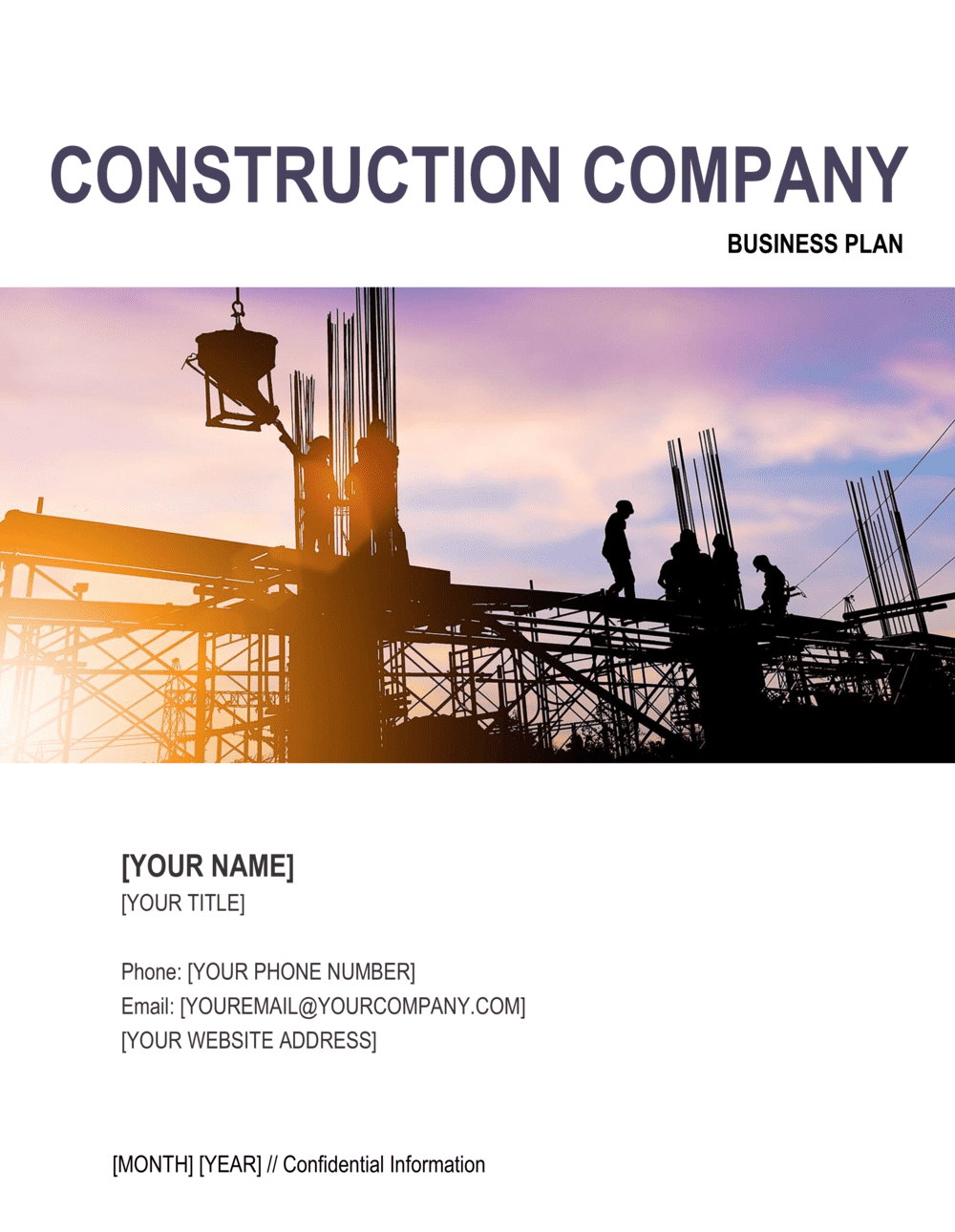
Construction Company Business Plan 3 Template

Free Word download β€’ Edit online β€’ Save & share with Drive β€’ Export to PDF

36 pagesβ€’2h 55m – 4h to fillβ€’Difficulty: Expert
Learn more ↓
FreeConstruction Company Business Plan 3 Template

At a glance

What it is
A Construction Company Business Plan is a structured document that maps a contracting or construction firm's services, target market, project pipeline, operational model, and 3–5 year financial projections into a single investor- and lender-ready package. This free Word download gives you a complete, editable starting point you can tailor to your firm's specialty β€” residential, commercial, civil, or specialty trades β€” and export as PDF to share with banks, bonding agencies, or joint-venture partners.
When you need it
Use it when applying for a construction loan or line of credit, pursuing bonding capacity increases, bidding on public or municipal contracts that require a formal business plan, or planning a new service line or geographic expansion.
What's inside
Executive summary, company overview, market and competitive analysis, services and project types, marketing and business development strategy, operations and project delivery model, management team, and full financial projections including revenue backlog, P&L, and cash flow.

What is a Construction Company Business Plan?

A Construction Company Business Plan is a structured document that defines a contracting firm's services, target market, competitive position, project delivery model, management team, and 3–5 year financial projections β€” including a project revenue schedule, cash flow statement, and WIP analysis. Unlike a generic business plan, it addresses the specific financial and operational metrics that construction lenders, surety underwriters, and bonding agents require: contractor license status, current bonding capacity, EMR, backlog, retainage exposure, and overhead rate. It functions as both an internal growth roadmap and the primary external document for securing bank financing, increasing bonding limits, or attracting joint-venture partners.

Why You Need This Document

Construction lenders and surety underwriters review dozens of firms β€” those without a formal, project-backed plan are declined in the first pass. Without a written business plan, a bonding increase request has no documented basis, a bank line-of-credit application stalls at underwriting, and bids on public or municipal contracts that require financial documentation cannot proceed. The cost of skipping it is immediate and concrete: smaller bonding limits mean smaller projects, smaller projects mean slower growth, and the gap between where your firm is and where it could bid stays closed. A well-structured construction business plan forces you to reconcile your revenue projections with your actual bonding capacity, field staffing, and cash flow cycle β€” turning assumptions that live in spreadsheets and conversations into a single, credible document that opens the doors a handshake cannot.

Which variant fits your situation?

If your situation is…Use this template
Launching a brand-new general contracting company from scratchConstruction Company Business Plan (Startup)
Expanding an existing firm into commercial constructionConstruction Company Business Plan 3
Opening a residential homebuilding or remodeling companyConstruction Company Business Plan 2
Applying for SBA financing for a construction businessBank Loan Business Plan
Planning a one-page strategic overview for internal alignmentOne-Page Business Plan
Bidding on a government infrastructure contract requiring documentationConstruction Proposal
Projecting revenue and cash flow for a construction firm onlyFinancial Projections (12 Months)

Common mistakes to avoid

❌ Using national construction market data without local context

Why it matters: Lenders and bonding underwriters operate in your region and will discount a market analysis built entirely on national statistics β€” it signals the owner hasn't done local homework.

Fix: Supplement national data with city or state permit reports, regional AGC market outlooks, and local employment figures to anchor your market sizing in the geography you actually serve.

❌ Projecting revenue growth without corresponding bonding or staffing capacity

Why it matters: A plan showing 40% revenue growth with no increase in bonding capacity or field headcount is internally inconsistent β€” underwriters will flag it immediately.

Fix: For every revenue tier in your projections, show the bonding aggregate, superintendent headcount, and working capital required to support that volume.

❌ Omitting a WIP schedule or project revenue breakdown

Why it matters: Construction revenue is project-based and lumpy β€” a single P&L without an underlying project schedule gives lenders no way to validate the revenue line.

Fix: Include a project revenue schedule as an appendix listing each active and projected contract, its value, expected start and completion, and monthly billing curve.

❌ Generic team bios without project-level credentials

Why it matters: Bonding underwriters and construction lenders evaluate the team's track record on projects of similar size and complexity β€” a list of job titles tells them nothing.

Fix: Lead each bio with the largest comparable project the individual has delivered, including contract value, project type, and client name where permissible.

❌ Skipping the safety record and EMR

Why it matters: An EMR above 1.0 disqualifies a contractor from many public bids and triggers higher insurance premiums β€” both directly affect the financial projections.

Fix: State your current EMR, your OSHA recordable incident rate, and the safety programs in place. If EMR is above 1.0, include a corrective action plan.

❌ Understating retainage impact on cash flow

Why it matters: Retainage withheld at 10% on a $2M project ties up $200K until completion β€” ignoring this routinely causes cash flow shortfalls that surprise both owners and lenders.

Fix: Model retainage receivable explicitly in your monthly cash flow, and size your line-of-credit request to cover peak retainage balances alongside normal working capital.

The 10 key sections, explained

Executive Summary

Company Overview

Market and Industry Analysis

Competitive Analysis

Services and Project Types

Business Development and Marketing Strategy

Operations and Project Delivery

Management Team

Financial Projections

Funding Requirements and Use of Funds

How to fill it out

  1. 1

    Complete the company overview with license and bonding details

    Enter your legal entity name, state contractor license number(s), current bonding capacity per project and aggregate, and geographic service area. Confirm all license numbers are active before submitting to a lender.

    πŸ’‘ Bonding underwriters verify license status independently β€” a lapsed or restricted license will stop a review immediately.

  2. 2

    Research and localize your market analysis

    Pull construction permit data, market reports, and regional GDP growth figures specific to your metro or state. Cite at least two independent sources and calculate a realistic serviceable market based on your firm's capacity.

    πŸ’‘ Your local AGC chapter or construction industry association publishes annual market outlooks β€” these carry more credibility with local lenders than national statistics.

  3. 3

    Map your competitive landscape with four or more named competitors

    List direct competitors, their estimated annual revenue, primary project types, and one key weakness. Then write a concise paragraph explaining your specific, defensible advantage.

    πŸ’‘ A simple positioning matrix comparing project size range versus delivery method makes this section scannable for time-constrained reviewers.

  4. 4

    Define your service lines and project size range

    List the scopes you self-perform, the project types you target, and your minimum and maximum project size. Include any certifications (LEED, MBE, DBE, 8(a)) that affect bid eligibility.

    πŸ’‘ Be specific about self-perform scope β€” it directly affects gross margin assumptions in your financial model.

  5. 5

    Document your business development pipeline and bid strategy

    Enter your trailing 12-month bid volume, bid-hit ratio, average project size, and primary pipeline sources. Project forward based on those actuals, not optimistic targets.

    πŸ’‘ A bid-hit ratio below 15% signals estimating or pricing problems β€” address it directly in the plan rather than hoping reviewers won't notice.

  6. 6

    Build the financial model from project revenue up

    Start with a project-by-project revenue schedule tied to your current backlog and projected pipeline. Build the P&L from contract revenue minus direct costs, then layer in overhead and G&A. Model cash flow monthly for Year 1, showing retainage timing and payroll peaks.

    πŸ’‘ Include a retainage receivable line in your cash flow β€” for most contractors, retainage represents 30–60 days of additional working capital tied up at any given time.

  7. 7

    State the funding ask with project-level justification

    Specify the instrument (line of credit, equipment loan, or bonding increase), the dollar amount, and the specific project or milestone it enables. Tie the repayment or release schedule to your cash flow projection.

    πŸ’‘ Lenders size construction lines of credit at 10–15% of projected annual revenue β€” if you're asking for significantly more, provide a detailed justification.

  8. 8

    Write the executive summary last

    Pull the firm's key differentiator, current backlog figure, gross margin, and the specific funding ask into a 1–2 page summary. It should read as a standalone document that motivates a reader to review the full plan.

    πŸ’‘ Lead with your most credible proof point β€” a completed project of comparable size, a named anchor client, or a strong EMR β€” not with a general description of your services.

Frequently asked questions

What is a construction company business plan?

A construction company business plan is a structured document that outlines a contracting firm's services, target market, competitive positioning, operational model, management team, and financial projections. It serves as both an internal growth roadmap and an external document for securing bank financing, increasing bonding capacity, or attracting joint-venture partners. Unlike a generic business plan, it includes construction-specific elements such as a project backlog schedule, WIP analysis, and EMR documentation.

Who needs a construction company business plan?

General contractors applying for a bank line of credit, specialty contractors seeking to increase bonding capacity, residential builders pursuing development loans, and civil contractors bidding on public infrastructure projects that require formal documentation all need a construction business plan. It is also used internally when a firm plans to expand into a new specialty, service area, or project size tier.

What financial projections should a construction business plan include?

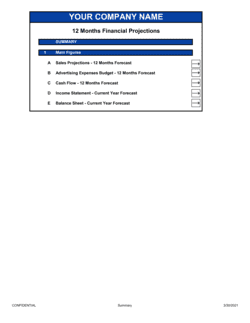
A complete financial section includes a project revenue schedule tied to current backlog and projected pipeline, a monthly P&L for Year 1 and annual P&L for Years 2–5, a cash flow statement with explicit retainage and payroll timing, a projected balance sheet, and a funding requirements schedule with use-of-funds breakdown. Lenders also expect an overhead rate calculation and gross margin by project type.

How does a construction business plan differ from a general business plan?

A construction business plan includes industry-specific sections that a generic plan omits: contractor license and bonding status, EMR and safety record, project backlog and WIP schedule, self-perform scope versus subcontracted work, and a bid-hit ratio analysis. Financial projections must account for retainage timing, equipment depreciation, and the lumpy, project-based revenue cycle that distinguishes construction from service or product businesses.

How long should a construction company business plan be?

For bank or bonding agency audiences, 20–30 pages plus a financial model appendix is standard. A plan for internal strategic planning can be shorter, but any external-facing document should include the full financial model with a project revenue schedule. Plans that are shorter than 15 pages for a capital raise typically lack the depth lenders and surety underwriters expect.

Can I write a construction business plan without a financial advisor?

For firms under $5M in annual revenue applying for standard bank financing, a well-completed template is typically sufficient. Engage a CPA or construction financial advisor when applying for bonding above $5M per project, pursuing SBA 8(a) certification, or preparing a plan for equity investors. A 2–4 hour review by a construction- experienced CPA costs $400–$1,200 and is worthwhile for any significant capital raise.

What is backlog and why does it matter in a construction business plan?

Backlog is the total value of contracted work that has been awarded but not yet completed. It is the single most important near-term revenue metric for a construction firm because it represents committed future revenue with defined delivery timelines. Lenders and bonding underwriters use backlog to assess revenue visibility, working capital requirements, and capacity utilization. A plan without a backlog schedule has no credible basis for its near-term revenue projections.

How do I show bonding capacity in a construction business plan?

State your current single-project limit and aggregate bonding capacity, name your surety company and bonding agent, and include your EMR and any completed projects of comparable size as evidence of track record. If you are requesting a bonding increase, show how the additional capacity ties to specific projects in your pipeline and explain how your financial position β€” net worth, working capital ratio, and cash flow β€” supports the higher limit.

How often should a construction company business plan be updated?

Update it annually at minimum, aligning the financial model to prior-year actuals and the coming year's project pipeline. Update it immediately when applying for new financing, requesting a bonding increase, or pursuing a new project type or geographic market. A plan built on data more than 18 months old will not reflect current market conditions and will reduce credibility with any lender or underwriter.

How this compares to alternatives

vs General Business Plan

A general business plan covers any industry with a standard structure β€” market, strategy, team, and financials. A construction-specific plan adds contractor licensing, bonding status, EMR, project backlog, WIP schedule, and retainage cash flow β€” all of which lenders and surety underwriters require. Use a general plan only if your audience has no construction industry familiarity.

vs One-Page Business Plan

A one-page plan is useful for rapid internal alignment or early-stage ideation but lacks the financial depth, backlog documentation, and bonding context that banks and surety underwriters need. Use the one-page version to test strategy internally, then build the full construction plan before any capital raise or bonding application.

vs Construction Proposal

A construction proposal is a project-specific bid document submitted to a single owner for a defined scope of work. A business plan covers the entire firm β€” its market, financial position, and multi-year strategy. The two documents serve completely different audiences and purposes, though both may be required in a public procurement process.

vs Financial Projections Template

A financial projections template covers only the numbers β€” P&L, cash flow, and balance sheet. A full business plan contextualizes those numbers with market evidence, competitive positioning, operations detail, and team credentials. Lenders and bonding underwriters require both the narrative and the model; the projections template alone is insufficient for a formal capital application.

Industry-specific considerations

Commercial Construction

Office, retail, and industrial build-outs require bonding capacity documentation, CM-at-risk delivery method descriptions, and tenant improvement pipeline analysis.

Residential Building

Spec home inventory, lot acquisition strategy, construction-to-permanent loan structures, and absorption rate projections are central to residential builder plans.

Civil and Infrastructure

DBE and 8(a) certification status, prevailing wage compliance, equipment fleet valuation, and public-sector bid pipeline tracking are specific to civil contractors.

Specialty Trades

License coverage by trade (electrical, mechanical, plumbing), self-perform margin advantage versus GC markup, and subcontractor-to-GC transition roadmap.

Template vs pro β€” what fits your needs?

PathBest forCostTime
Use the templateConstruction firms under $5M revenue applying for standard bank financing or a bonding increase up to $2M per projectFree2–4 weeks (30–60 hours)
Template + professional reviewFirms seeking bonding above $2M per project, SBA loans, or DBE/8(a) certification applications$500–$1,500 for a construction CPA or financial advisor review3–5 weeks
Custom draftedFirms pursuing bonding above $10M, equity investors, or public-sector financing programs with formal underwriting requirements$3,000–$8,000 for a construction industry business plan writer or CPA firm4–8 weeks

Glossary

Backlog
The total value of contracted work that has been awarded but not yet completed β€” a key indicator of near-term revenue visibility for construction firms.
Bonding Capacity
The maximum dollar value of surety bonds a bonding company will issue to a contractor, determining the size and number of projects they can bid.
Surety Bond
A three-party guarantee in which a bonding company promises a project owner that a contractor will fulfill its contractual obligations.
Work-in-Progress (WIP) Schedule
A report tracking contract value, costs incurred, billings to date, and estimated cost to complete for every active project β€” the primary tool for monitoring construction profitability.
Overhead Rate
Total indirect costs (office, equipment depreciation, insurance, management salaries) divided by direct labor costs, expressed as a percentage.
Change Order
A written amendment to the original construction contract authorizing a scope change, price adjustment, or schedule extension.
Prequalification
A formal vetting process in which a project owner or general contractor reviews a subcontractor's financial strength, experience, and safety record before allowing them to bid.
Experience Modification Rate (EMR)
A workers' compensation insurance multiplier reflecting a contractor's historical claims relative to industry peers β€” lower is better and affects both insurance premiums and bid eligibility.
Bid-Hit Ratio
The percentage of bids submitted that result in awarded contracts, used to evaluate business development efficiency and estimating accuracy.
Gross Margin (Construction)
Contract revenue minus direct project costs (labor, materials, subcontractors, equipment) before overhead and G&A β€” typically ranges 15–25% for general contractors.
Retainage
A percentage of each progress payment (typically 5–10%) withheld by the owner until substantial completion, representing a significant cash-flow consideration for contractors.

Part of your Business Operating System

This document is one of 3,000+ business & legal templates included in Business in a Box.

  • Fill-in-the-blanks β€” ready in minutes
  • 100% customizable Word document
  • Compatible with all office suites
  • Export to PDF and share electronically

Create your document in 3 simple steps.

From template to signed document β€” all inside one Business Operating System.
1
Download or open template

Access over 3,000+ business and legal templates for any business task, project or initiative.

2
Edit and fill in the blanks with AI

Customize your ready-made business document template and save it in the cloud.

3
Save, Share, Send, Sign

Share your files and folders with your team. Create a space of seamless collaboration.

Save time, save money, and create top-quality documents.

β˜…β˜…β˜…β˜…β˜…

"Fantastic value! I'm not sure how I'd do without it. It's worth its weight in gold and paid back for itself many times."

Managing Director Β· Mall Farm
Robert Whalley
Managing Director, Mall Farm Proprietary Limited
β˜…β˜…β˜…β˜…β˜…

"I have been using Business in a Box for years. It has been the most useful source of templates I have encountered. I recommend it to anyone."

Business Owner Β· 4+ years
Dr Michael John Freestone
Business Owner
β˜…β˜…β˜…β˜…β˜…

"It has been a life saver so many times I have lost count. Business in a Box has saved me so much time and as you know, time is money."

Owner Β· Upstate Web
David G. Moore Jr.
Owner, Upstate Web

Run your business with a system β€” not scattered tools

Stop downloading documents. Start operating with clarity. Business in a Box gives you the Business Operating System used by over 250,000 companies worldwide to structure, run, and grow their business.

Free Forever PlanΒ Β·Β No credit card required