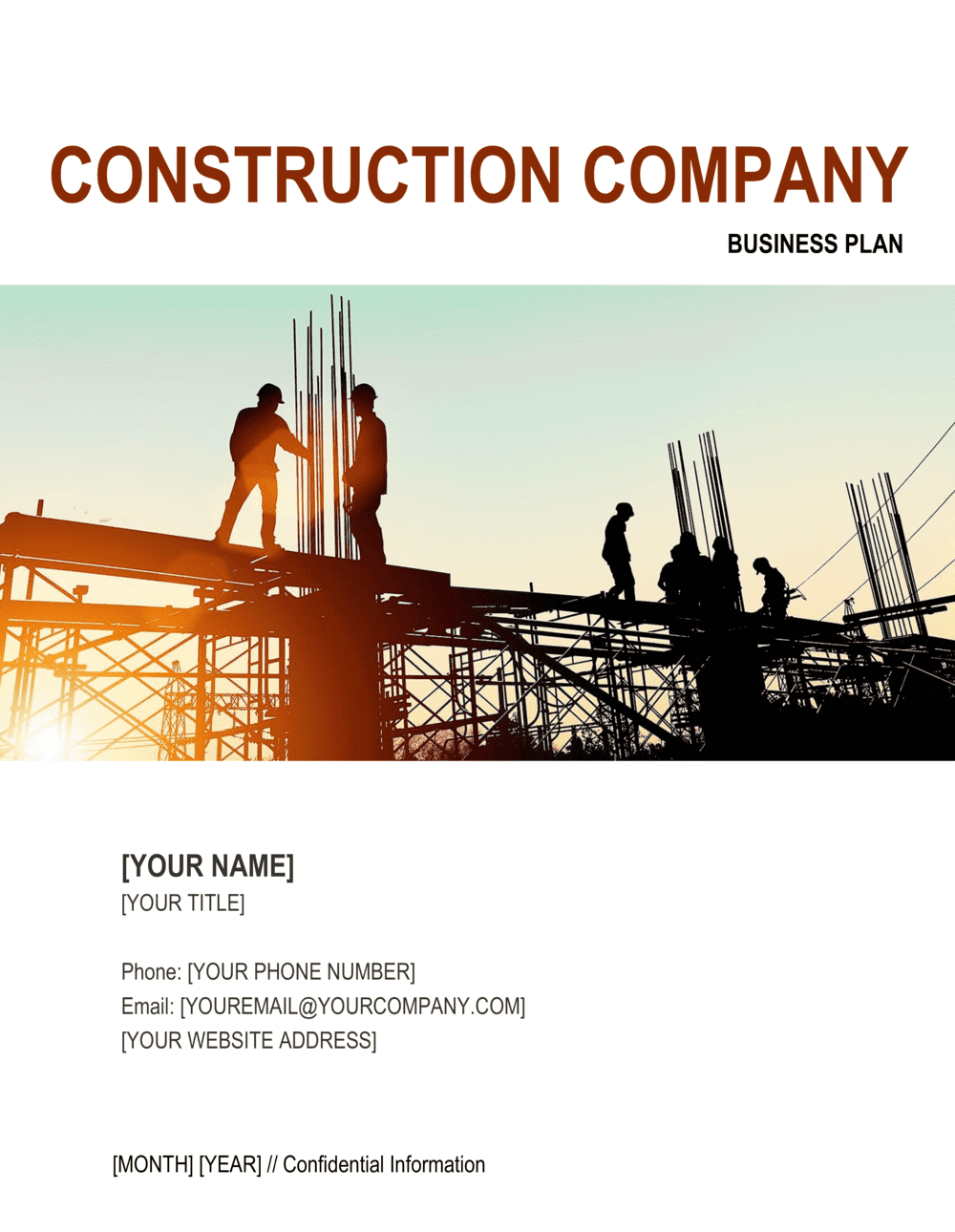
Construction Company Business Plan 2 Template

Free Word download β€’ Edit online β€’ Save & share with Drive β€’ Export to PDF

34 pagesβ€’2h 50m – 3h 50m to fillβ€’Difficulty: Expert
Learn more ↓
FreeConstruction Company Business Plan 2 Template

At a glance

What it is
A Construction Company Business Plan is a structured document that maps a contracting or construction firm's market positioning, service offerings, project pipeline strategy, operational model, subcontractor network, and 3–5 year financial projections into a single investor- and lender-ready reference. This free Word download gives you a fully structured starting point you can edit online and export as PDF to share with banks, bonding agents, or investors.
When you need it
Use it when applying for a construction loan, SBA financing, or surety bond; when seeking equity partners for a new contracting venture; or when formalizing an internal growth roadmap for an existing construction firm expanding into new project types or geographies.
What's inside
Executive summary, company overview, market and competitive analysis, services and project types, marketing and business development strategy, operations and subcontractor management, management team, and financial projections including revenue by project type, gross margin by trade, and cash flow tied to project billing milestones.

What is a Construction Company Business Plan?

A Construction Company Business Plan is a structured document that maps a contracting firm's market opportunity, service scope, project pipeline strategy, subcontractor network, management team, and 3–5 year financial projections into a single reference document for lenders, surety underwriters, equity partners, or internal leadership. Unlike a generic business plan, it incorporates construction-specific elements β€” bonding capacity, WIP scheduling, progress billing cash flow, gross margin by trade, and safety EMR β€” that lenders and bonding companies require before approving credit or bonding facilities. This free Word download gives you a fully structured, industry-specific starting point you can edit online and export as PDF.

Why You Need This Document

Without a formal business plan, a construction firm's financing and bonding applications stall at the first underwriting review, because lenders cannot assess working capital adequacy without a billing-milestone-driven cash flow model, and surety underwriters cannot evaluate bonding capacity without documented project track records and a management depth narrative. The consequences are concrete: SBA lenders decline incomplete applications, surety companies cap bonding at levels that exclude your target project size, and GC prequalification submissions require the same financial and operational detail you would put in a plan anyway. A well-built construction business plan forces you to stress-test your backlog assumptions, subcontractor capacity, and cash flow timing before you commit to contracts β€” turning operational blind spots into decisions you can act on before they become project losses.

Which variant fits your situation?

If your situation is…Use this template
Launching a brand-new general contracting businessConstruction Company Business Plan
Seeking SBA 7(a) or 504 loan for equipment and working capitalBank Loan Business Plan
Rapid internal planning or early-stage ideationOne-Page Business Plan
Planning a new residential development projectReal Estate Development Business Plan
Managing a large construction project's scope and scheduleConstruction Project Plan
Developing a targeted marketing strategy for the firmMarketing Plan
Tracking project costs and profitability in detailConstruction Budget Template

Common mistakes to avoid

❌ Projecting revenue without modeling the cash flow lag

Why it matters: Construction firms can show accounting profit while running out of cash because material and labor costs are paid weeks before owners remit progress billings. A P&L that ignores this will fail lender scrutiny and misrepresent the actual working capital need.

Fix: Build a separate monthly cash flow statement that models cost incurrence one to two months ahead of billing and receipt β€” and size the working capital line request accordingly.

❌ Listing an overly broad scope of services

Why it matters: Claiming to perform every trade and project type signals no operational focus and raises bonding risk flags. Surety underwriters and prequalification reviewers look for a track record in a defined niche, not a general willingness to take on anything.

Fix: Limit the services section to trades you self-perform and project types where you can cite at least two completed comparable projects with dollar values and references.

❌ Omitting the safety EMR and workers' compensation history

Why it matters: An EMR above 1.0 disqualifies bids with most commercial owners and many GCs. Lenders treat a high EMR as a proxy for operational risk. Leaving it out of the plan does not make the issue disappear β€” it signals you are hiding it.

Fix: State your current EMR explicitly. If it is above 1.0, include a dated safety improvement plan with specific actions and a target EMR by year-end.

❌ Using national construction market data instead of local figures

Why it matters: A local lender or surety underwriter who knows the regional market immediately discounts a plan built on national statistics β€” it signals the author does not understand their own backyard.

Fix: Pull permit data from the county or state building department, cite local AGC chapter reports, and reference specific regional projects or developers driving demand in your service area.

❌ No subcontractor management section

Why it matters: Subcontractor failures are among the top causes of project overruns and contractor defaults. A plan that describes no qualification or management process signals high execution risk to lenders and bonding companies.

Fix: Include a brief subcontractor prequalification process β€” financial review, EMR threshold, reference check β€” and a description of how subs are managed on active projects.

❌ Requesting a line of credit without a draw-and-repayment schedule

Why it matters: Lenders for construction revolving lines need to see that each draw self-liquidates within the project billing cycle. A lump-sum request with no repayment timeline looks like a term loan request in disguise.

Fix: Tie each projected draw to a specific project start date and show repayment linked to the corresponding progress billing receipt, typically within 60–90 days.

The 10 key sections, explained

Executive Summary

Company Overview

Market Analysis

Competitive Analysis

Services and Project Types

Marketing and Business Development Strategy

Operations and Subcontractor Management

Management Team

Financial Projections

Funding Requirements and Use of Funds

How to fill it out

  1. 1

    Complete the company overview with licensing and bonding details

    Enter your legal entity name, contractor license numbers for each state you operate in, current bonding capacity, general liability and workers' comp limits, and your service territory. These details are reviewed before anything else by lenders and surety underwriters.

    πŸ’‘ If your bonding capacity is below your target project size, address it in the funding section β€” underwriters want to see a plan to grow it, not silence on the gap.

  2. 2

    Build a localized market analysis

    Pull permit data from your county or state building department for the last 3 years. Identify the project types and dollar ranges that dominate local volume, then narrow your target segment to the slice where you have a documented track record.

    πŸ’‘ Citing a local data source β€” your county assessor, a regional AGC chapter report β€” is far more persuasive to a local lender than a national industry forecast.

  3. 3

    Define your service scope and project size range

    List only the trades you self-perform and the project types where you have completed at least two comparable projects. Set a minimum and maximum project size that your current bonding capacity and workforce can support.

    πŸ’‘ A tightly defined scope β€” 'commercial tenant improvement, $500K–$2.5M, in-house framing and finish' β€” wins more bids than a generic 'all construction types' positioning.

  4. 4

    Map your business development and bid pipeline

    Identify your top three bid sources, list five to ten active owner or GC relationships by name, and estimate the annual bid volume accessible through each channel. Set a target bid-hit rate and average project margin for each source.

    πŸ’‘ Track your trailing 12-month bid-hit rate by source before writing this section β€” the data will make your revenue projections credible rather than aspirational.

  5. 5

    Document your operations and safety program

    Describe your project management structure, estimating software, subcontractor prequalification criteria, and your OSHA safety program including your current EMR. Include your field supervision ratio and quality-control process.

    πŸ’‘ If your EMR is above 1.0, include a written safety improvement plan with specific targets β€” lenders and GC prequalification reviewers treat an EMR above 1.0 as a material risk factor.

  6. 6

    Build the financial model from project backlog up

    Start with your confirmed backlog and pipeline, assign revenue by month based on realistic billing milestones, then layer in direct costs by trade. Model the cash flow statement separately from the P&L to capture the timing gap between cost incurrence and owner payment.

    πŸ’‘ Show a 60-day accounts-receivable assumption in your cash flow model β€” that is the realistic payment cycle for most commercial construction invoices, and lenders will test it.

  7. 7

    State the funding ask with a draw-and-repayment schedule

    Specify the instrument, total amount, and a month-by-month draw schedule tied to project start dates. Show repayment tied to billing milestones so the lender can see the line self-liquidates.

    πŸ’‘ Lenders for construction lines of credit want to see that each draw is repaid within 90 days of issuance β€” build that cycle explicitly into your cash flow model.

  8. 8

    Write the executive summary last

    Pull your most compelling data points β€” backlog, track record project size, target margin, and specific funding milestone β€” into a 1–2 page summary. The summary should be readable in under three minutes.

    πŸ’‘ Lead the executive summary with your largest successfully completed project by dollar value β€” it anchors credibility immediately for a reader who doesn't yet know your firm.

Frequently asked questions

What is a construction company business plan?

A construction company business plan is a structured document that defines a contracting firm's market positioning, service scope, project pipeline strategy, operational model, management team, and 3–5 year financial projections. It is used to raise debt or equity financing, secure surety bonding capacity, and align internal teams around a concrete growth strategy. Unlike a generic business plan, it includes construction-specific elements such as backlog analysis, WIP scheduling, bonding capacity, and progress billing cash flow modeling.

What should a construction company business plan include?

A complete plan covers ten sections: executive summary, company overview with licensing and bonding details, market analysis using local permit data, competitive analysis, services and project types, business development strategy, operations and subcontractor management, management team profiles with project track record, financial projections (P&L, cash flow, balance sheet), and a funding requirements section with a draw-and-repayment schedule. The financial model should be built from backlog and billing milestone assumptions, not top-down revenue targets.

Do I need a business plan to get a construction loan?

Yes β€” most SBA lenders, commercial banks, and equipment finance companies require a formal business plan for construction loans above $150K. Surety underwriters for bonding capacity above $500K also expect a plan that documents financial health, project track record, and management depth. A well-structured plan with a localized market analysis and a cash flow model tied to billing milestones significantly improves approval odds.

How is a construction business plan different from a general business plan?

A construction business plan includes several industry-specific elements absent from a generic template: contractor license numbers and bonding capacity, a WIP schedule and backlog analysis, gross margin broken down by trade or project type, a cash flow model that captures the gap between cost incurrence and owner billing, a subcontractor management section, and a safety EMR disclosure. Lenders and surety underwriters familiar with construction will look for all of these and will discount a plan built on a generic business plan framework.

How long should a construction company business plan be?

For lender or surety audiences, 20–30 pages plus a financial model appendix is the accepted range. The financial model β€” monthly for Year 1, annual for Years 2–5 β€” is typically presented as a separate Excel workbook. Internal growth plans can be shorter. One-page plans work for early alignment but are insufficient for any capital raise or bonding application.

What financial projections should a construction business plan include?

At minimum: a monthly P&L for Year 1, annual P&L for Years 2–5, a monthly cash flow statement for Year 1 tied to billing milestone timing, a projected balance sheet, and a working capital analysis showing peak cash demand by month. Lenders also expect a backlog schedule, a WIP summary, and gross margin assumptions broken out by project type or trade.

How do I size my funding request in a construction business plan?

Start from your cash flow model. Identify the month of peak cash shortfall β€” typically 60–90 days into your largest concurrent projects β€” and add a 15–20% buffer for schedule delays and change order timing. For a revolving line of credit, show that each draw self-liquidates within 60–90 days of the corresponding billing. For equipment loans, tie the request to specific assets with quotes and attach them as an appendix.

Can a specialty subcontractor use this business plan template?

Yes β€” the template works for general contractors, specialty subcontractors, and design-build firms. Subcontractors should customize the services section to reflect their specific trade and self-perform scope, adjust the business development section to focus on GC relationships rather than owner relationships, and modify the financial projections to reflect their typical billing cycle, which is often 30–45 days behind the GC's owner billings.

How often should a construction company update its business plan?

Update the financial projections and backlog section at least quarterly if you are in active discussions with lenders or surety underwriters. For internal planning, a full annual review aligned to your fiscal year-end is standard, with a mid-year update to reflect actual project starts, completions, and margin variances. A plan more than 12 months old without updates is unlikely to support a new bonding or financing application.

How this compares to alternatives

vs Construction Project Plan

A construction project plan governs a single project β€” scope, schedule, milestones, resource allocation, and budget for one job. A construction company business plan governs the entire firm β€” strategy, market positioning, and multi-year financials across all projects. Both are needed; they operate at completely different levels of the business.

vs General Business Plan

A general business plan template lacks construction-specific sections for bonding capacity, WIP scheduling, progress billing cash flow, subcontractor management, and EMR disclosure. Lenders and surety underwriters familiar with the construction industry will immediately recognize a generic plan and will request the missing details β€” better to start with an industry-specific template.

vs Marketing Plan

A marketing plan covers only one component of a business plan β€” how the firm generates leads and wins new work. A business plan includes the marketing strategy but also adds financial projections, operational structure, management team, and a capital request. A standalone marketing plan is useful for a firm that already has its strategy and financing in place.

vs Financial Projections Template

A financial projections template covers the numbers in isolation β€” P&L, cash flow, and balance sheet. A business plan contextualizes those numbers with market evidence, competitive positioning, and a management narrative that explains why the projections are achievable. Lenders and investors never evaluate construction financials without the operational story behind them.

Industry-specific considerations

Commercial Construction

Ground-up office, retail, and industrial projects require bonding capacity documentation, prequalification track records, and lender-ready WIP schedules as standard components of the plan.

Residential Building

Custom home builders and production builders need lot pipeline analysis, presale absorption rates, and construction-to-permanent financing assumptions built into the financial model.

Infrastructure and Civil

Public agency clients require DBE or MBE certification status, prevailing wage compliance documentation, and bid-bond capacity at 10% of contract value β€” all of which belong in the plan.

Specialty Trades

Electrical, mechanical, and plumbing subcontractors should document journeyman-to-apprentice staffing ratios, union or open-shop status, and GC prequalification approvals as competitive differentiators.

Template vs pro β€” what fits your needs?

PathBest forCostTime
Use the templateGeneral contractors and specialty subs seeking working capital lines under $500K or initial bonding capacityFree2–4 weeks (30–60 hours)
Template + professional reviewSBA loans, bonding capacity above $1M, or first-time presentations to institutional lenders$500–$2,000 for a construction-experienced accountant or business advisor review3–5 weeks
Custom draftedCapital raises above $2M, design-build joint ventures, or regulated public-sector prequalification submissions$3,000–$8,000 for a construction industry business plan writer or CPA firm4–8 weeks

Glossary

Surety Bond
A three-party guarantee in which a bonding company assures the project owner that the contractor will complete the work and pay subcontractors and suppliers.
Backlog
The total value of contracted work that has been awarded but not yet completed β€” a key indicator of near-term revenue visibility for a construction firm.
Gross Margin by Trade
Revenue minus direct project costs (labor, materials, subcontractors) expressed as a percentage, calculated separately for each service line or trade.
Progress Billing
Invoicing the project owner for work completed to date, typically tied to defined milestones or a percentage-of-completion schedule.
Bonding Capacity
The maximum total value of construction contracts a surety company will bond at one time, based on the contractor's financial strength and track record.
Prequalification
The formal process by which a project owner or general contractor evaluates a firm's financial health, licensing, safety record, and experience before allowing them to bid.
Change Order
A written amendment to the original contract that adjusts the scope, cost, or schedule of a construction project after work has begun.
EBITDA
Earnings Before Interest, Taxes, Depreciation, and Amortization β€” used by lenders and investors to assess a construction firm's operating cash generation before capital structure effects.
WIP Schedule
Work-in-Progress schedule β€” an accounting report showing the status of all active contracts, including costs incurred, billings to date, and estimated costs to complete.
Safety EMR
Experience Modification Rate β€” a federal OSHA-derived score reflecting a contractor's workers' compensation claims history relative to industry peers; a score below 1.0 is required by most commercial clients.

Part of your Business Operating System

This document is one of 3,000+ business & legal templates included in Business in a Box.

  • Fill-in-the-blanks β€” ready in minutes
  • 100% customizable Word document
  • Compatible with all office suites
  • Export to PDF and share electronically

Create your document in 3 simple steps.

From template to signed document β€” all inside one Business Operating System.
1
Download or open template

Access over 3,000+ business and legal templates for any business task, project or initiative.

2
Edit and fill in the blanks with AI

Customize your ready-made business document template and save it in the cloud.

3
Save, Share, Send, Sign

Share your files and folders with your team. Create a space of seamless collaboration.

Save time, save money, and create top-quality documents.

β˜…β˜…β˜…β˜…β˜…

"Fantastic value! I'm not sure how I'd do without it. It's worth its weight in gold and paid back for itself many times."

Managing Director Β· Mall Farm
Robert Whalley
Managing Director, Mall Farm Proprietary Limited
β˜…β˜…β˜…β˜…β˜…

"I have been using Business in a Box for years. It has been the most useful source of templates I have encountered. I recommend it to anyone."

Business Owner Β· 4+ years
Dr Michael John Freestone
Business Owner
β˜…β˜…β˜…β˜…β˜…

"It has been a life saver so many times I have lost count. Business in a Box has saved me so much time and as you know, time is money."

Owner Β· Upstate Web
David G. Moore Jr.
Owner, Upstate Web

Run your business with a system β€” not scattered tools

Stop downloading documents. Start operating with clarity. Business in a Box gives you the Business Operating System used by over 250,000 companies worldwide to structure, run, and grow their business.

Start freeΒ Β·Β No credit card required