Refund for Returned Merchandise Template

Free Word download β€’ Edit online β€’ Save & share with Drive β€’ Export to PDF

1 pageβ€’20–30 min to fillβ€’Difficulty: Standardβ€’Signature requiredβ€’Legal review recommended
Learn more ↓
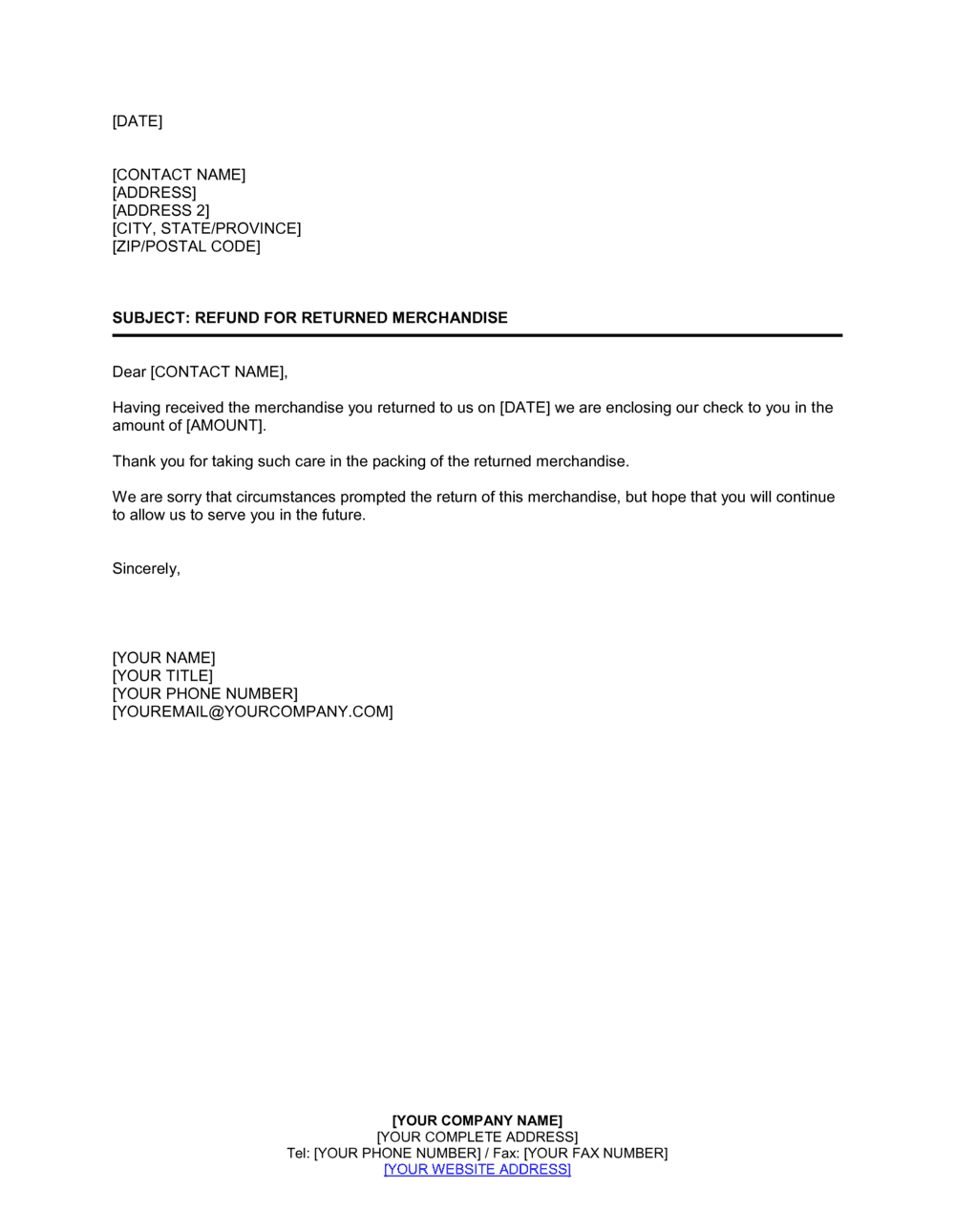
FreeRefund for Returned Merchandise Template

At a glance

What it is
A Refund For Returned Merchandise document is a legally binding agreement between a seller and a customer that formalizes the conditions under which a purchased product may be returned and a refund issued. This free Word download lets you define return eligibility, refund method, restocking fees, timelines, and liability limits in a single signed record you can export as PDF and retain for accounting and dispute purposes.
When you need it
Use it when a customer requests a refund for a returned product and you need a written record of the agreed terms β€” especially for high-value items, wholesale transactions, or disputes where the return conditions require explicit documentation.
What's inside
Party identification, product description and purchase details, return authorization and condition requirements, refund amount and method, restocking fee clause, timeline for processing, representations and warranties, limitation of liability, and governing law.

What is a Refund For Returned Merchandise?

A Refund For Returned Merchandise document is a legally binding agreement between a seller and a customer that formalizes every material term of a product return and refund transaction β€” including the merchandise description, refund amount, restocking fee, processing timeline, condition requirements, and a mutual release of claims. Unlike an informal email exchange or a verbal agreement at the returns counter, this document creates an enforceable record that both parties sign before the refund is processed, closing the transaction with legal finality. It draws on principles of the Uniform Commercial Code (US), provincial consumer protection acts (Canada), and equivalent consumer rights frameworks in the UK and EU to ensure the agreed settlement is documented in a form that holds up in a payment dispute, chargeback, or audit.

Why You Need This Document

Without a signed refund agreement, a completed return remains legally open on two fronts: the customer retains the right to dispute the refund amount or initiate a chargeback with their card issuer, and the seller has no documentary basis to defend against a second claim for the same transaction. For retail and e-commerce businesses, return fraud β€” including accepting a refund while simultaneously disputing the original charge β€” costs the industry billions of dollars annually, and a signed release-of-claims clause is the most direct contractual defense available. Beyond fraud prevention, a properly executed refund document satisfies the audit trail requirements of tax authorities in every major jurisdiction, supports accurate credit memo reconciliation in your accounting system, and demonstrates good-faith compliance with consumer protection disclosure obligations. This template gives you a professionally structured starting point you can complete in under 15 minutes β€” with every material clause in place before you issue the first dollar of the refund.

Which variant fits your situation?

If your situation is…Use this template
Issuing a store credit instead of a cash or card refundStore Credit Authorization Form
Authorizing a return before the merchandise is shipped backReturn Merchandise Authorization (RMA) Form
Documenting a partial refund for damaged or incomplete goodsPartial Refund Agreement
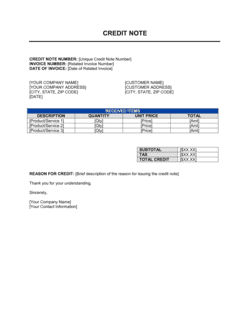
Issuing a refund to a wholesale or B2B buyerCredit Note
Refunding a customer after a service dispute rather than a product returnCustomer Complaint Resolution Letter
Reversing an invoice for goods that were never deliveredCredit Note
Processing a warranty-based return with manufacturer involvementWarranty Claim Form

Common mistakes to avoid

❌ Processing the refund before obtaining a signed agreement

Why it matters: Once the customer receives their money, they have no incentive to sign a release of claims, leaving the seller exposed to a subsequent chargeback or further legal demand for the same transaction.

Fix: Hold the refund in a processing queue and only release it after both parties have signed the agreement. Use electronic signatures to eliminate the delay without sacrificing the binding record.

❌ Applying a restocking fee to returns caused by seller error or product defect

Why it matters: Consumer protection statutes in most US states, Canadian provinces, the UK, and the EU prohibit deducting fees when the return arises from the seller's fault β€” violations trigger regulatory complaints and potential fines.

Fix: Add an explicit waiver clause stating the restocking fee does not apply when the return is due to a defect, misdescription, or fulfillment error on the seller's part.

❌ Omitting customer representations about prior chargebacks

Why it matters: Return fraud frequently involves a customer accepting a merchandise refund while simultaneously disputing the original charge with their card issuer β€” effectively collecting twice.

Fix: Include a warranty clause requiring the customer to confirm they have not initiated and will not initiate a chargeback for the same transaction. This clause becomes evidence you can submit to the card network in a dispute.

❌ Using a vague release-of-claims clause that courts may void

Why it matters: Overly broad releases β€” particularly those purporting to waive statutory consumer rights β€” are routinely struck down, leaving the seller with no release at all and potentially triggering bad-faith claims.

Fix: Limit the release to claims arising from the specific transaction identified in the agreement, and avoid language that could be read as waiving rights under consumer protection or product liability statutes.

❌ Failing to specify a return window and condition standard

Why it matters: Without a written return window, customers in many jurisdictions can claim an implied reasonable time to return β€” which courts have interpreted as 30–90 days or longer for durable goods.

Fix: State the return window in calendar days from the original purchase date and define 'acceptable condition' with enough specificity to distinguish it from 'used' or 'damaged' goods.

❌ Choosing a governing law jurisdiction with no connection to the transaction

Why it matters: Consumer protection courts routinely apply the law of the customer's home jurisdiction regardless of what the contract says, making a foreign governing-law clause useless while adding confusion.

Fix: Use the seller's home jurisdiction or the customer's state/province as the governing law β€” and confirm that the chosen jurisdiction's consumer protection requirements are reflected in the rest of the document.

The 10 key clauses, explained

Parties and Transaction Identification

In plain language: Identifies the seller and the customer as legal parties and references the original transaction β€” invoice number, purchase date, and product β€” so the refund is tied to a specific sale.

Sample language
This Refund Agreement is entered into on [DATE] between [SELLER LEGAL NAME], a [STATE/PROVINCE] [ENTITY TYPE] ('Seller'), and [CUSTOMER FULL NAME / COMPANY NAME] ('Customer'), in connection with Invoice No. [INVOICE NUMBER] dated [PURCHASE DATE].

Common mistake: Using a trade name instead of the registered legal entity name for the seller. If a dispute reaches collections or litigation, the party named must match the entity on the original sales contract.

Description of Returned Merchandise

In plain language: Describes the product being returned in enough detail β€” SKU, serial number, quantity, and original condition β€” to prevent future disputes about what was actually received back.

Sample language
Customer is returning the following merchandise: [PRODUCT NAME], SKU [SKU NUMBER], Serial No. [SERIAL NUMBER], Qty [QUANTITY], originally purchased for $[ORIGINAL PRICE] ('Merchandise').

Common mistake: Omitting serial numbers or SKUs for identical products with different configurations. A vague description makes it impossible to verify that the item refunded matches the item purchased.

Return Authorization and Condition Requirements

In plain language: States whether a formal return authorization was issued, and sets out the condition the merchandise must be in β€” unopened, undamaged, original packaging β€” for the refund to be valid.

Sample language
Return Authorization No. [RMA NUMBER] was issued on [DATE]. The Merchandise must be returned in [original / unopened / undamaged] condition with all original packaging, accessories, and documentation. Seller reserves the right to inspect the returned Merchandise within [X] business days of receipt.

Common mistake: Not defining 'acceptable condition' specifically. Without a written standard, sellers and customers dispute whether cosmetic wear, missing accessories, or opened packaging disqualifies a full refund.

Refund Amount and Calculation

In plain language: States the exact dollar amount to be refunded, how it was calculated, and whether any deductions β€” restocking fee, shipping, or partial damage β€” reduce the refund from the original purchase price.

Sample language
Seller agrees to refund Customer the amount of $[REFUND AMOUNT], calculated as the original purchase price of $[ORIGINAL PRICE] less a restocking fee of $[RESTOCKING FEE AMOUNT] ([X]%) and return shipping charges of $[SHIPPING DEDUCTION].

Common mistake: Stating only the net refund amount without itemizing the deductions. Customers who don't see the math are more likely to dispute the refund total or initiate a chargeback.

Refund Method and Timeline

In plain language: Specifies how the refund will be delivered β€” original payment method, store credit, check, or bank transfer β€” and the number of business days within which the seller will process it.

Sample language
The refund shall be issued by [original payment method / store credit / check / bank transfer] within [X] business days of Seller's receipt and acceptance of the returned Merchandise. For card refunds, processing time of [3–5] additional business days may apply.

Common mistake: Promising refund timelines without accounting for card network processing delays. Customers who expect next-day refunds file disputes when their bank statement doesn't update for five business days.

Restocking Fee Clause

In plain language: Defines the restocking fee as a percentage or flat amount, explains what it covers, and states the circumstances β€” such as unopened vs. opened goods β€” under which it applies or is waived.

Sample language
A restocking fee of [X]% of the original purchase price applies to all returned Merchandise that has been opened or removed from original packaging. No restocking fee shall apply if the return is due to a defect in the Merchandise or an error by Seller.

Common mistake: Applying a restocking fee uniformly regardless of the reason for return. In most jurisdictions, deducting a restocking fee for a defective product or seller error exposes the seller to consumer protection complaints.

Representations and Warranties by Customer

In plain language: The customer confirms they own the merchandise free of liens, have not tampered with it, and that the return is not for fraudulent purposes β€” protecting the seller from return fraud schemes.

Sample language
Customer represents and warrants that: (a) Customer is the lawful owner of the Merchandise; (b) the Merchandise has not been altered, damaged by misuse, or subjected to unauthorized repairs; and (c) Customer has not previously sought or received a refund or chargeback for the same transaction.

Common mistake: Skipping customer representations entirely. Without them, the seller has no contractual basis to recover losses if the returned item turns out to be counterfeit, swapped, or already refunded through a chargeback.

Release of Claims

In plain language: Upon receipt of the refund, the customer releases the seller from any further claims related to the original purchase, the returned product, and the refund transaction itself.

Sample language
Upon receipt of the Refund Amount, Customer hereby releases and discharges Seller from any and all claims, demands, and causes of action arising out of or relating to the purchase, use, or return of the Merchandise and the original transaction referenced herein.

Common mistake: Using overly broad release language that could be construed as waiving future product liability claims unrelated to this transaction. Courts may void a release that purports to waive rights the customer cannot legally sign away under consumer protection statutes.

Limitation of Liability

In plain language: Caps the seller's total financial exposure from this transaction at the original purchase price and excludes consequential, incidental, or punitive damages.

Sample language
Seller's total liability to Customer in connection with the Merchandise and this Agreement shall not exceed the original purchase price of $[ORIGINAL PRICE]. In no event shall Seller be liable for consequential, incidental, special, or punitive damages.

Common mistake: Omitting the limitation-of-liability clause entirely. Without it, a seller who refunds a $200 item could theoretically face liability for downstream losses the customer claims were caused by the product.

Governing Law and Dispute Resolution

In plain language: Specifies which jurisdiction's law governs the agreement and how disputes will be resolved β€” court, arbitration, or small claims β€” reducing uncertainty if the parties disagree after the fact.

Sample language
This Agreement is governed by the laws of [STATE / PROVINCE / COUNTRY]. Any dispute arising under this Agreement that cannot be resolved by good-faith negotiation shall be submitted to [binding arbitration / small claims court] in [CITY, STATE].

Common mistake: Choosing a governing law jurisdiction that has no connection to either party or the transaction. Consumer protection statutes in the customer's home jurisdiction will typically override a foreign governing law clause.

How to fill it out

  1. 1

    Enter the parties' full legal names and the transaction reference

    Use the seller's registered legal entity name β€” not a trade name β€” and the customer's full legal name or company name. Reference the specific invoice number and purchase date so the document is tied to one transaction.

    πŸ’‘ Pull the exact entity name from your business registration or tax documents to ensure it matches the name on the original sales contract.

  2. 2

    Describe the returned merchandise in detail

    Record the product name, SKU, serial number, quantity, and the original purchase price. For multiple items, list each on a separate line.

    πŸ’‘ Take a photograph of the returned item and its packaging at receipt β€” the photo timestamp provides independent evidence of condition if the customer later disputes the restocking fee.

  3. 3

    Confirm the return authorization details

    Enter the RMA number if one was issued, the date it was issued, and the condition requirements the merchandise must meet. Specify the inspection window β€” typically 3–5 business days after receipt.

    πŸ’‘ If no formal RMA process exists, note 'Return accepted by [NAME] on [DATE]' to establish a documented authorization trail.

  4. 4

    Calculate and itemize the refund amount

    State the original purchase price, any restocking fee as both a percentage and a dollar amount, return shipping deductions, and the net refund total. Show each line of the calculation.

    πŸ’‘ Round dollar amounts to two decimal places and confirm the net total matches what your accounting system will actually process β€” discrepancies create reconciliation problems.

  5. 5

    Specify the refund method and processing timeline

    Choose the refund delivery method β€” original card, store credit, check, or bank transfer β€” and enter the number of business days within which the refund will be processed after the return is accepted.

    πŸ’‘ For card refunds, add a note that card-network processing adds 3–5 business days beyond your internal processing time to manage customer expectations.

  6. 6

    Set the restocking fee terms and any waiver conditions

    State the restocking fee percentage and the conditions under which it applies or is waived β€” e.g., waived for defective items or seller errors. Consistency with your published return policy reduces consumer protection exposure.

    πŸ’‘ Cross-check the restocking fee clause against your posted return policy to avoid contradictions that a consumer protection authority could cite as a deceptive practice.

  7. 7

    Obtain signatures from both parties before the refund is processed

    Both the seller's authorized representative and the customer must sign and date the agreement before the refund is issued. For online transactions, a timestamped electronic signature satisfies this requirement in most jurisdictions.

    πŸ’‘ Process the refund only after the signed document is in your possession β€” issuing the refund first removes your leverage to obtain the customer's release-of-claims signature.

  8. 8

    File the signed agreement with the original invoice

    Retain the executed agreement alongside the original invoice, any RMA documentation, and inspection notes. Store copies for at least the duration of any applicable statute of limitations β€” typically 2–6 years depending on jurisdiction.

    πŸ’‘ Link the refund document to the credit memo in your accounting system so auditors can trace the full transaction from sale through return without requesting additional records.

Frequently asked questions

What is a refund for returned merchandise document?

A refund for returned merchandise document is a legally binding written agreement between a seller and a customer that records the conditions and terms under which a purchased product is being returned and a refund issued. It identifies the parties, describes the merchandise, states the refund amount and method, and includes a release of claims so both sides have a clear, enforceable record of the transaction's resolution.

Is a written refund agreement legally required?

No jurisdiction requires a written refund agreement for every consumer return. However, a signed document protects the seller in three specific scenarios: high-value merchandise where the refund amount is disputed, B2B transactions where restocking fees or condition deductions are involved, and any situation where a chargeback is possible. Without a signed record, the seller has no documentary defense in a payment dispute.

Can a seller charge a restocking fee?

Yes, in most jurisdictions a seller can charge a restocking fee if it is disclosed in the seller's published return policy before the purchase is made. Typical ranges are 10–25% of the purchase price. However, most consumer protection frameworks β€” including FTC guidance in the US, the Consumer Rights Act in the UK, and provincial rules in Canada β€” prohibit restocking fees when the return is caused by a product defect or seller error rather than customer preference.

What happens if the customer initiates a chargeback after signing a refund agreement?

A signed refund agreement is strong evidence that the customer authorized the resolution and received the agreed refund. You can submit the signed document to the card network as part of your chargeback representment. The agreement's warranty clause β€” in which the customer confirms they have not initiated a chargeback β€” further supports your dispute response. Card networks generally rule against chargebacks where a signed settlement exists and the refund has been confirmed as processed.

Does the customer have to sign the refund agreement?

For the agreement to be binding and to trigger the release-of-claims clause, both parties must sign. An unsigned document is merely a statement of the seller's internal processing β€” not a contract. For in-person returns, obtain a physical signature. For online or mail-order returns, an electronic signature via email confirmation or an e-signature platform is enforceable in most jurisdictions under the ESIGN Act (US), PIPEDA (Canada), and eIDAS (EU).

How long should a seller retain refund agreement records?

Retain signed refund agreements for at least as long as the applicable statute of limitations for contract claims in your jurisdiction β€” typically 2–6 years in the US depending on the state, 2 years in the UK for consumer disputes, and up to 6 years in Canada. If the original transaction is subject to tax audit requirements, retain the refund record for the same period as the underlying invoice β€” typically 5–7 years.

What is the difference between a refund agreement and a credit note?

A refund agreement is a bilateral contract signed by both the seller and the customer, documenting the agreed terms of return and issuing a release of claims. A credit note is a unilateral accounting document issued by the seller to record a reduction in the amount owed β€” it is not signed by the customer and does not create a release. For B2B transactions, both documents are typically used together: the refund agreement governs the legal terms and the credit note records the accounting entry.

Can this document be used for digital or downloadable products?

This template is designed for physical merchandise returns. Digital and downloadable products typically cannot be returned once accessed, and many jurisdictions explicitly exclude digital content from standard consumer return rights. A refund for a digital product generally requires a separate document addressing access revocation, license termination, and the specific reason for the exceptional refund β€” such as a technical failure or misdescription of the content.

What consumer protection laws affect merchandise refund agreements?

In the US, the FTC's Mail, Internet, or Telephone Order Rule governs refund obligations for remote sales, and state-level consumer protection statutes apply to in-store returns. In Canada, provincial consumer protection acts β€” notably Ontario's Consumer Protection Act β€” set minimum refund rights. The UK Consumer Rights Act 2015 provides a 30-day right to reject faulty goods for a full refund. The EU Consumer Rights Directive mandates a 14-day withdrawal right for online sales with a full refund within 14 days of return.

How this compares to alternatives

vs Credit Note

A credit note is a unilateral accounting document issued by the seller to reduce an outstanding receivable β€” it is not signed by the customer and does not include a release of claims. A refund for returned merchandise document is a bilateral contract that binds both parties and closes the legal loop. For B2B transactions, use both: the refund agreement governs the legal terms, the credit note records the accounting entry.

vs Return Merchandise Authorization Form

An RMA form pre-authorizes a return before the customer ships the goods back β€” it does not document the refund amount, method, or release of claims. A refund agreement is executed after the goods are received and inspected, and it finalizes the financial settlement. The RMA number is typically referenced inside the refund agreement.

vs Customer Complaint Resolution Letter

A complaint resolution letter is an informal correspondence document used to acknowledge a grievance and propose a remedy. It is not signed by the customer, does not create binding obligations, and does not include a release of claims. Use a refund agreement whenever a cash or credit refund is part of the resolution β€” the letter alone provides no legal protection.

vs Warranty Claim Form

A warranty claim form initiates a warranty process that may involve repair, replacement, or refund β€” it documents the defect claim and triggers the evaluation process. A refund for returned merchandise document is the final settlement step, executed once a cash refund has been agreed as the resolution. Warranty claims may ultimately resolve into a refund agreement when neither repair nor replacement is possible.

Industry-specific considerations

Retail

High return volumes mean standardized templates with pre-filled restocking fee schedules and condition checkboxes reduce per-return processing time significantly.

E-commerce

Electronic signature integration and chargeback warranty clauses are critical given the elevated fraud rate and the inability to inspect returned items before issuing a refund.

Manufacturing and Wholesale

B2B returns involve larger quantities, longer return windows negotiated in supply agreements, and restocking fees that must align with the terms of the master distribution contract.

Consumer Electronics

Serial number tracking, firmware version documentation, and inspection for data restoration are standard additions given the high per-unit value and frequent return fraud in the category.

Jurisdictional notes

United States

Federal refund obligations for remote sales are governed by the FTC's Mail, Internet, or Telephone Order Rule, which requires refunds within 7 business days for credit card transactions. State consumer protection statutes vary significantly β€” California, New York, and Massachusetts impose additional disclosure requirements for restocking fees. Sellers who post a no-refund policy must display it conspicuously; absent a posted policy, implied refund rights may apply.

Canada

Consumer protection is governed provincially; Ontario's Consumer Protection Act, Alberta's Fair Trading Act, and BC's Business Practices and Consumer Protection Act each set different minimum return and refund obligations. Quebec requires French-language versions of consumer-facing documents for provincially regulated sellers. Restocking fees are generally permissible if disclosed pre-purchase, but cannot apply to defective goods.

United Kingdom

The Consumer Rights Act 2015 gives UK consumers a statutory 30-day right to reject faulty goods for a full refund β€” contractual clauses that reduce this right are void. For distance sales, the Consumer Contracts Regulations 2013 provide a 14-day cancellation right with a refund within 14 days of return. Restocking fees for non-defective goods returned under the cancellation right are limited to direct return shipping costs.

European Union

The EU Consumer Rights Directive mandates a 14-day withdrawal right for online and distance sales, with the seller required to issue a full refund within 14 days of receiving the returned goods. Member states may extend this window β€” Germany provides up to 14 days and France up to 14 days from notification. Restocking fees are not permitted for goods returned under the withdrawal right, though sellers may deduct for diminished value caused by the customer's handling beyond what is necessary to inspect the goods.

Template vs lawyer β€” what fits your deal?

PathBest forCostTime
Use the templateSmall and mid-size retailers processing standard consumer returns with refund amounts under $2,500Free10–15 minutes per transaction
Template + legal reviewE-commerce businesses with high return volumes, B2B wholesale returns, or transactions involving restocking fees above 15%$150–$400 for a one-time legal review of your standard form1–3 days
Custom draftedHigh-value consumer electronics, regulated product categories, or businesses operating across multiple jurisdictions with conflicting consumer protection requirements$500–$2,000+1–2 weeks

Glossary

Return Authorization
A seller's formal approval for a customer to send back merchandise, typically issued as a reference number before the goods are physically returned.
Restocking Fee
A charge β€” usually 10–25% of the purchase price β€” deducted from the refund to cover the cost of inspecting, repackaging, and re-listing returned merchandise.
Refund Method
The mechanism by which the seller returns the customer's money β€” original payment method, store credit, bank transfer, or check.
Return Window
The number of days after purchase within which a customer is eligible to return merchandise, as defined by the seller's policy or contractual terms.
Condition of Goods
The required state of the returned merchandise β€” typically unused, undamaged, and in original packaging β€” that the customer must meet to qualify for a full refund.
Credit Memo
An internal accounting document issued by the seller to record a reduction in accounts receivable that corresponds to the refund amount.
Chargeback
A forced reversal of a card transaction initiated by a customer's bank when the customer disputes a charge β€” a signed refund agreement can be used as evidence to contest an unwarranted chargeback.
Limitation of Liability
A clause capping the seller's maximum financial exposure from the return transaction at the original purchase price, excluding consequential damages.
Merchantability
An implied warranty under the Uniform Commercial Code (and equivalent statutes) that goods sold are fit for their ordinary intended purpose.
Consequential Damages
Indirect losses flowing from a defective or non-conforming product β€” such as lost profits or downstream repair costs β€” that limitation-of-liability clauses typically exclude.

Part of your Business Operating System

This document is one of 3,000+ business & legal templates included in Business in a Box.

  • Fill-in-the-blanks β€” ready in minutes
  • 100% customizable Word document
  • Compatible with all office suites
  • Export to PDF and share electronically

Create your document in 3 simple steps.

From template to signed document β€” all inside one Business Operating System.
1
Download or open template

Access over 3,000+ business and legal templates for any business task, project or initiative.

2
Edit and fill in the blanks with AI

Customize your ready-made business document template and save it in the cloud.

3
Save, Share, Send, Sign

Share your files and folders with your team. Create a space of seamless collaboration.

Save time, save money, and create top-quality documents.

β˜…β˜…β˜…β˜…β˜…

"Fantastic value! I'm not sure how I'd do without it. It's worth its weight in gold and paid back for itself many times."

Managing Director Β· Mall Farm
Robert Whalley
Managing Director, Mall Farm Proprietary Limited
β˜…β˜…β˜…β˜…β˜…

"I have been using Business in a Box for years. It has been the most useful source of templates I have encountered. I recommend it to anyone."

Business Owner Β· 4+ years
Dr Michael John Freestone
Business Owner
β˜…β˜…β˜…β˜…β˜…

"It has been a life saver so many times I have lost count. Business in a Box has saved me so much time and as you know, time is money."

Owner Β· Upstate Web
David G. Moore Jr.
Owner, Upstate Web

Run your business with a system β€” not scattered tools

Stop downloading documents. Start operating with clarity. Business in a Box gives you the Business Operating System used by over 250,000 companies worldwide to structure, run, and grow their business.

Start freeΒ Β·Β No credit card required