Acknowledgment of Merchandise Returned for Repair Template

Free Word download β€’ Edit online β€’ Save & share with Drive β€’ Export to PDF

1 pageβ€’15–25 min to fillβ€’Difficulty: Standard
Learn more ↓
FreeAcknowledgment of Merchandise Returned for Repair Template

At a glance

What it is
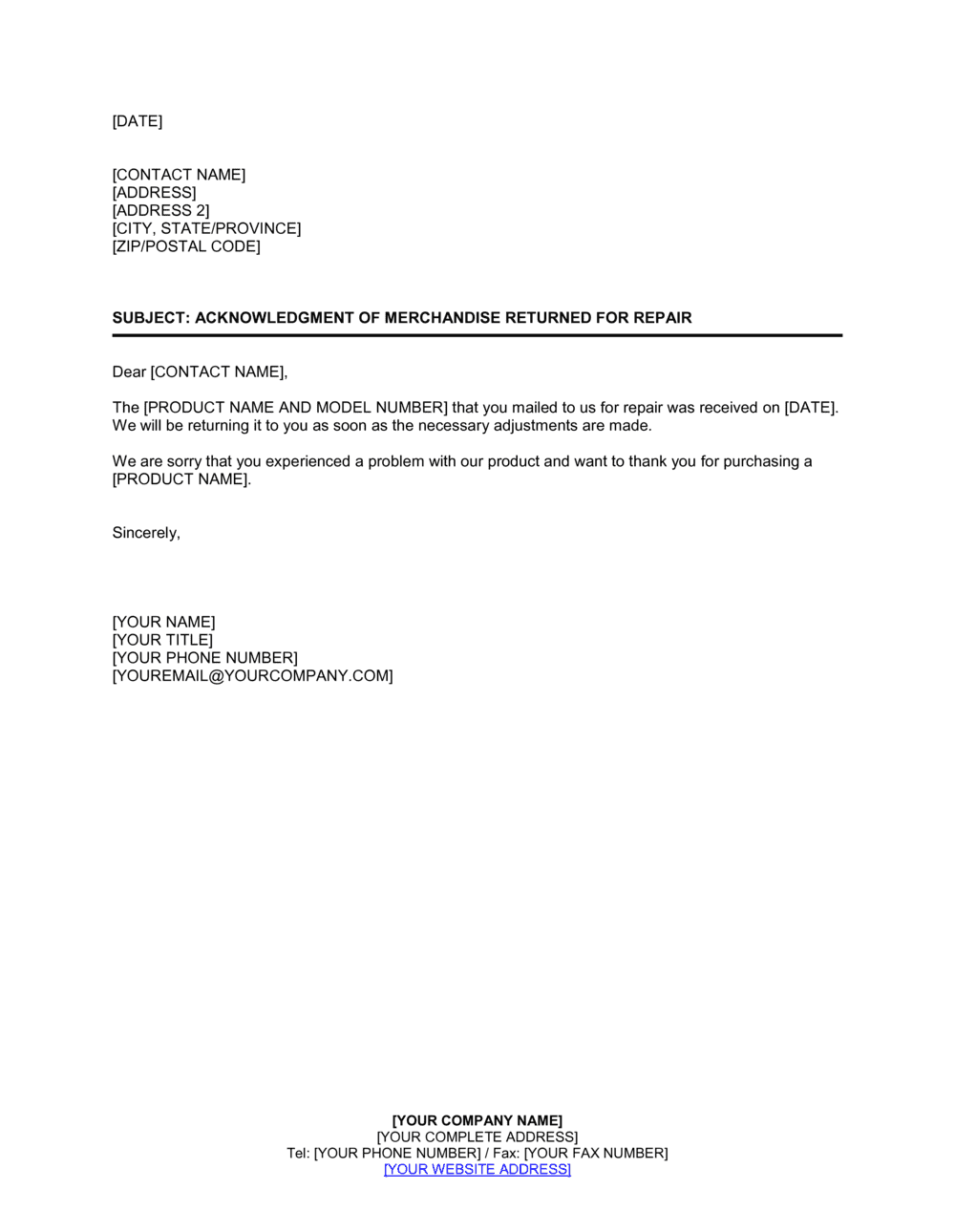
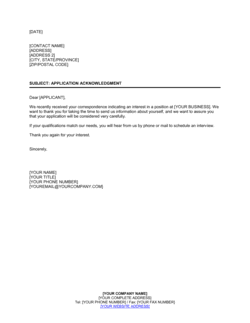
An Acknowledgment of Merchandise Returned for Repair is a formal business letter a company issues to a customer or client confirming that a product has been received for servicing or repair. This free Word download gives you a ready-to-edit template you can fill in with item details, condition notes, and an expected completion date, then send or email within minutes.
When you need it
Use it whenever a customer ships or drops off a product for repair β€” before work begins β€” to confirm receipt, document the item's condition, and set clear expectations on turnaround time and next steps.
What's inside
Sender and recipient details, date of receipt, item description and serial number, noted condition at intake, estimated repair timeline, instructions for follow-up contact, and a closing statement of commitment to service.

What is an Acknowledgment of Merchandise Returned for Repair?

An Acknowledgment of Merchandise Returned for Repair is a formal business letter a service provider sends to a customer confirming that a specific product has been received, logged, and accepted for servicing. It records the item's identifying details β€” product name, model, and serial number β€” documents its physical condition at intake, summarizes the reported fault, and sets a clear expectation for turnaround time and cost authorization. Rather than leaving the customer to wonder whether their item arrived safely or what happens next, the letter creates a shared written record that both parties can reference throughout the repair process.

Why You Need This Document

Without a written acknowledgment, the moment a customer's item arrives at your service department is invisible to them β€” and undocumented for you. When timelines run long or a customer disputes the condition of their returned item, you have no contemporaneous record to stand on. The intake condition clause alone eliminates a category of claim that routinely damages service reputations: the customer who insists a scratch was caused during repair when it arrived that way. Beyond dispute protection, a same-day acknowledgment dramatically reduces inbound status calls by giving customers an immediate confirmation with a timeline and a direct contact reference. This template gives you a professional, consistent letter you can complete in under five minutes, personalize to warranty or out-of-warranty scenarios, and send the same day every item is received.

Which variant fits your situation?

If your situation is…Use this template
Item returned under an active manufacturer's warrantyAcknowledgment of Merchandise Returned for Repair (Warranty)
Customer returning goods that cannot be repaired and will be replacedAcknowledgment of Merchandise Returned for Replacement
Customer returning goods for a full refund rather than repairMerchandise Return and Refund Acknowledgment Letter
Formal repair contract covering labor rates, parts, and liabilityRepair Services Agreement
Internal service ticket to track repair status across staffWork Order Form
Notifying the customer that the repair is complete and item is ready for pickupRepair Completion Notice Letter
Denying a repair request due to warranty exclusions or product conditionWarranty Claim Denial Letter

Common mistakes to avoid

❌ No pre-existing damage documentation

Why it matters: Without a written record of the item's condition at intake, the company has no defense if a customer claims a scratch or crack was caused during the repair.

Fix: Always describe physical condition in the intake clause and back it up with dated photographs attached to the internal work order.

❌ Omitting the cost-authorization threshold for out-of-warranty repairs

Why it matters: Customers who receive an unexpected bill they were never asked to approve will dispute the charge and damage your service reputation.

Fix: State a specific dollar threshold in the letter and commit to calling or emailing the customer for explicit approval before exceeding it.

❌ Vague or missing turnaround estimate

Why it matters: Customers without a timeline will call for status updates daily, increasing support burden and creating frustration even when the repair is progressing normally.

Fix: Always provide a specific estimate in business days with a target date, plus a caveat for parts delays β€” even an approximate answer is better than none.

❌ Sending the letter days after receiving the item

Why it matters: A delayed acknowledgment signals disorganization and leaves the customer uncertain whether their item was received safely, triggering calls and emails before any work begins.

Fix: Build a same-day or next-business-day acknowledgment SOP and use this template as the trigger document when an item is logged into the system.

The 9 key clauses, explained

Header β€” Sender and recipient details

In plain language: Identifies the service provider and the customer by name, address, and contact information, and records the date the letter is issued.

Sample language
[COMPANY NAME] | [ADDRESS] | [CITY, STATE, ZIP] | [DATE] | To: [CUSTOMER FULL NAME] | [CUSTOMER ADDRESS]

Common mistake: Using a department name instead of the company's legal name in the sender block β€” this creates ambiguity if the letter is referenced in a dispute.

Subject line

In plain language: A one-line reference that identifies the item and any RMA or work-order number so the customer can file or reference the letter easily.

Sample language
Re: Acknowledgment of Receipt β€” [PRODUCT NAME], Serial No. [SERIAL NUMBER], Work Order [WO-XXXX]

Common mistake: Omitting the item identifier from the subject line, forcing the customer to read the full body to match the letter to their return.

Receipt confirmation

In plain language: States clearly that the specific item has been received and logged by the service department on the noted date.

Sample language
We confirm receipt on [DATE] of your [PRODUCT NAME] (Model: [MODEL NUMBER], Serial: [SERIAL NUMBER]) returned to our [LOCATION / DEPARTMENT] for repair.

Common mistake: Using approximate language like 'recently received' instead of the exact date β€” a specific date establishes the start of the repair window and matters if a delivery dispute arises.

Item condition at intake

In plain language: Documents the physical and functional condition of the item as observed at intake, noting any existing damage separate from the reported fault.

Sample language
At the time of receipt, the item presented with [DESCRIBED FAULT]. Pre-existing cosmetic condition noted: [SCRATCHES / DENTS / NONE OBSERVED]. Accessories included: [LIST OR NONE].

Common mistake: Skipping pre-existing damage notes entirely β€” without them, the company may be held responsible for damage that arrived with the item.

Reported fault description

In plain language: Summarizes the specific issue the customer reported, in plain language, as the basis for the repair.

Sample language
The reported issue is: [CUSTOMER-DESCRIBED PROBLEM]. Our technicians will evaluate the unit to diagnose and address this fault.

Common mistake: Copying the customer's exact informal language verbatim without paraphrasing into neutral, professional terms β€” colloquial descriptions can create scope ambiguity.

Estimated repair timeline

In plain language: States the expected completion date or number of business days required, and flags that the estimate is subject to parts availability.

Sample language
We estimate the repair will be completed within [X] business days from the date of receipt, by approximately [TARGET DATE]. This estimate is subject to parts availability and the findings of our technical assessment.

Common mistake: Giving a single fixed date without a caveat for parts delays β€” customers treat any date in writing as a firm commitment, which leads to complaints when timelines slip.

Cost and authorization terms

In plain language: Clarifies whether the repair is covered under warranty or is billable, and states at what cost threshold the company will seek customer approval before proceeding.

Sample language
This repair is being processed as a [WARRANTY / OUT-OF-WARRANTY] service. Should our assessment determine that repair costs will exceed $[AMOUNT], we will contact you at [PHONE / EMAIL] for authorization before proceeding.

Common mistake: Omitting a cost-authorization threshold on out-of-warranty repairs β€” without it, customers dispute charges they were never explicitly asked to approve.

Contact and follow-up instructions

In plain language: Tells the customer who to contact, how, and when for status updates or questions about their repair.

Sample language
For status updates, please contact our service team at [PHONE NUMBER] or [EMAIL ADDRESS], Monday to Friday, [HOURS], referencing Work Order [WO-XXXX].

Common mistake: Providing only a general company phone number with no direct reference number β€” customers are routed through multiple departments, which damages service perception.

Closing statement and signature block

In plain language: Thanks the customer for their business, reaffirms commitment to quality service, and closes with the representative's name, title, and contact.

Sample language
Thank you for entrusting [COMPANY NAME] with your repair. We are committed to returning your item in proper working condition as promptly as possible. Sincerely, [REPRESENTATIVE NAME] | [TITLE] | [CONTACT INFORMATION]

Common mistake: Closing with a generic 'Customer Service Team' signature instead of a named individual β€” customers with follow-up questions have no one specific to contact.

How to fill it out

  1. 1

    Enter the sender and recipient details

    Fill in your company's full legal name, address, and the date the letter is issued. Add the customer's full name and mailing or email address in the recipient block.

    πŸ’‘ If you are sending the letter by email, keep the formatted header block β€” it signals professionalism and creates a clean record if the email is printed or forwarded.

  2. 2

    Add the reference line with item and work-order identifiers

    Enter the product name, model number, serial number, and your internal work-order or RMA number in the subject line so the letter is uniquely traceable.

    πŸ’‘ If your business uses a CRM or ticketing system, pull the work-order number from there rather than creating a separate sequence β€” consistency across systems prevents duplicate records.

  3. 3

    Confirm the exact receipt date

    Enter the specific calendar date the item was physically received and logged β€” not the date the customer shipped it or the date you are writing the letter.

    πŸ’‘ For mailed returns, use the date the package was opened and inspected, not the courier tracking delivery date.

  4. 4

    Document item condition and accessories at intake

    Note the item's physical condition, any pre-existing cosmetic damage, and list all accessories received. Be specific: 'hairline crack on bottom-left corner' is better than 'minor damage.'

    πŸ’‘ Photograph the item from four angles before any repair work begins and attach the photos to the internal work order β€” this protects you if condition is disputed later.

  5. 5

    Describe the reported fault in neutral language

    Summarize the issue the customer reported in clear, professional terms. Do not diagnose the problem in the letter β€” save technical findings for the repair report.

    πŸ’‘ Use language like 'the customer reports that the unit does not power on' rather than 'the battery is dead' β€” the latter implies a diagnosis before inspection is complete.

  6. 6

    Set the estimated timeline with a caveat

    Enter a realistic completion estimate in business days and calculate the approximate target date. Add the standard caveat that timelines are subject to parts availability.

    πŸ’‘ Build in a 20% buffer on your realistic internal estimate β€” promising 8 days and delivering in 7 feels better than promising 5 and delivering in 7.

  7. 7

    State warranty status and cost-authorization threshold

    Indicate clearly whether the repair is warranty-covered or billable. For out-of-warranty repairs, enter the dollar threshold above which you will seek the customer's approval before proceeding.

    πŸ’‘ Set the authorization threshold at $0 for high-value or fragile items β€” it signals diligence and prevents any cost disputes.

  8. 8

    Add contact details and sign off

    Enter the direct phone number and email address for your service department, the work-order reference number, and close with a named representative's signature block.

    πŸ’‘ Send the completed letter on the same day the item is received β€” same-day acknowledgment reduces inbound status calls by giving customers an immediate record.

Frequently asked questions

What is an acknowledgment of merchandise returned for repair?

It is a formal business letter sent to a customer confirming that a product has been received by the service department for repair. It documents the item, its condition at intake, the reported fault, an estimated completion timeline, and the applicable cost terms. It creates a shared written record for both the customer and the service provider before any repair work begins.

When should this letter be sent?

Send it on the same day the item is received and logged β€” or no later than the next business day. The letter should go out before any diagnostic or repair work begins. Same-day acknowledgment reduces inbound status inquiries and establishes the official receipt date, which anchors the repair timeline.

Is this letter legally binding?

This letter is a formal acknowledgment, not a repair contract. It does not legally obligate the company to a fixed price or completion date, but its contents β€” especially the intake condition notes and cost-authorization threshold β€” can be referenced in a dispute. For high-value repairs or commercial accounts, consider pairing it with a signed repair services agreement that sets binding terms.

What is the difference between this letter and a repair invoice?

This letter is issued at the start of the process to confirm receipt and set expectations. A repair invoice is issued at the end to request payment for completed work. They document opposite ends of the same transaction. Both should reference the same work-order number so the full service history is traceable.

Should I include a warranty disclaimer in the letter?

Yes, if the repair involves any risk to data or accessories not included with the item, a brief liability note is recommended. State clearly that the company is not responsible for pre-existing damage already noted at intake, for data loss on electronic devices, or for accessories not listed in the letter. This language reduces disputes without requiring a full legal disclaimer.

Can I use this template for both warranty and out-of-warranty repairs?

Yes. The cost and authorization clause in the template includes a field to designate the repair as warranty-covered or billable. For warranty repairs, remove the cost-authorization threshold language and note the warranty reference number instead. For out-of-warranty repairs, fill in the approval threshold and the customer's preferred contact method.

Do I need a separate form if I already have a ticketing system?

A ticketing system handles internal tracking, but it does not replace a formal written acknowledgment to the customer. Most CRM and help-desk tools generate auto-confirmation emails that lack intake condition notes, cost terms, and a named representative. This letter supplements the ticket number by giving the customer a professional, complete record they can file and reference independently.

What should I do if the item arrives damaged beyond the reported fault?

Document the additional damage in the intake condition clause before sending the letter. Then contact the customer by phone or email to notify them of the finding before issuing the written acknowledgment. Note the additional damage in the letter and confirm that it was identified at intake β€” this protects both parties if the pre-existing condition becomes part of the repair discussion.

How this compares to alternatives

vs Acknowledgment of merchandise returned for replacement

A replacement acknowledgment confirms that the returned item will be swapped for a new or refurbished unit rather than repaired. Use the repair acknowledgment when the intent is to service the original item and return it; use the replacement version when the item is being retired and a substitute will be shipped. Both letters document intake condition, but the replacement version includes shipping and delivery terms for the new unit.

vs Work order form

A work order is an internal operational document used by technicians to track repair scope, parts, labor, and assigned staff. An acknowledgment letter is an external customer-facing communication. Both reference the same repair event but serve different audiences β€” the work order drives execution while the acknowledgment manages the customer relationship.

vs Repair services agreement

A repair services agreement is a binding contract that establishes labor rates, warranty on the repair, liability limits, and payment terms before work begins. An acknowledgment letter confirms receipt and sets expectations but does not create binding price or delivery obligations. For high-value or recurring commercial repairs, use both β€” the agreement as the governing contract and the acknowledgment as the per-item intake record.

vs Customer complaint response letter

A complaint response letter addresses a customer's grievance about a product or service experience. An acknowledgment of merchandise returned for repair is proactive and operational β€” it confirms a physical event (item receipt) and sets forward-looking expectations. If the repair return arose from a complaint, send the acknowledgment first to confirm receipt, then follow up with a complaint response if additional service recovery is needed.

Industry-specific considerations

Electronics and Technology

Serial number and firmware version tracking at intake; data-loss liability disclaimers are standard for devices with internal storage.

Manufacturing and Industrial Equipment

High-value parts and long lead times make a written turnaround estimate with a parts-availability caveat essential to managing customer expectations.

Retail and Consumer Goods

High repair volume requires a standardized template to ensure every customer receives a consistent, professional acknowledgment regardless of which staff member processes the return.

Professional Services and B2B

Commercial clients often require a written acknowledgment for their own purchasing records; referencing a PO number alongside the work-order number speeds their internal processing.

Template vs pro β€” what fits your needs?

PathBest forCostTime
Use the templateAny business that receives products for repair and needs a professional, consistent customer acknowledgmentFree5 minutes per letter
Template + professional reviewCompanies adding custom liability disclaimers, data-loss waivers, or commercial account-specific terms$50–$150 (one-time legal or operations review)1–2 hours
Custom draftedHigh-volume repair businesses integrating the letter into a CRM workflow or regulated industries with mandatory written service disclosures$200–$600 (legal or operations consultant)1–3 days

Glossary

Return Merchandise Authorization (RMA)
A reference number issued by a seller authorizing a customer to send back a product for repair, replacement, or refund.
Intake Condition
A documented description of a product's physical and functional state at the moment it is received for servicing.
Estimated Turnaround Time
The anticipated number of business days or weeks from receipt to completion of the repair.
Serial Number
A unique identifier assigned by the manufacturer to a specific unit, used to track service history and verify warranty eligibility.
Warranty Period
The contracted timeframe during which the manufacturer or seller is obligated to repair or replace a defective product at no charge.
Work Order
An internal document created when a repair is accepted, detailing the issue, parts needed, assigned technician, and expected completion date.
Liability Waiver
Language in the acknowledgment that limits the service provider's responsibility for pre-existing damage or data loss during the repair process.
Chain of Custody
A documented record of every person or location that handled an item from the time it was received to the time it was returned to the owner.
Out-of-Warranty Repair
A repair performed after the manufacturer's warranty has expired, typically billed to the customer at agreed labor and parts rates.

Part of your Business Operating System

This document is one of 3,000+ business & legal templates included in Business in a Box.

  • Fill-in-the-blanks β€” ready in minutes
  • 100% customizable Word document
  • Compatible with all office suites
  • Export to PDF and share electronically

Create your document in 3 simple steps.

From template to signed document β€” all inside one Business Operating System.
1
Download or open template

Access over 3,000+ business and legal templates for any business task, project or initiative.

2
Edit and fill in the blanks with AI

Customize your ready-made business document template and save it in the cloud.

3
Save, Share, Send, Sign

Share your files and folders with your team. Create a space of seamless collaboration.

Save time, save money, and create top-quality documents.

β˜…β˜…β˜…β˜…β˜…

"Fantastic value! I'm not sure how I'd do without it. It's worth its weight in gold and paid back for itself many times."

Managing Director Β· Mall Farm
Robert Whalley
Managing Director, Mall Farm Proprietary Limited
β˜…β˜…β˜…β˜…β˜…

"I have been using Business in a Box for years. It has been the most useful source of templates I have encountered. I recommend it to anyone."

Business Owner Β· 4+ years
Dr Michael John Freestone
Business Owner
β˜…β˜…β˜…β˜…β˜…

"It has been a life saver so many times I have lost count. Business in a Box has saved me so much time and as you know, time is money."

Owner Β· Upstate Web
David G. Moore Jr.
Owner, Upstate Web

Run your business with a system β€” not scattered tools

Stop downloading documents. Start operating with clarity. Business in a Box gives you the Business Operating System used by over 250,000 companies worldwide to structure, run, and grow their business.

Start freeΒ Β·Β No credit card required