Request for Refund on Undelivered Merchandise Template

Free Word download β€’ Edit online β€’ Save & share with Drive β€’ Export to PDF

1 pageβ€’15–20 min to fillβ€’Difficulty: Standard
Learn more ↓
FreeRequest for Refund on Undelivered Merchandise Template

At a glance

What it is
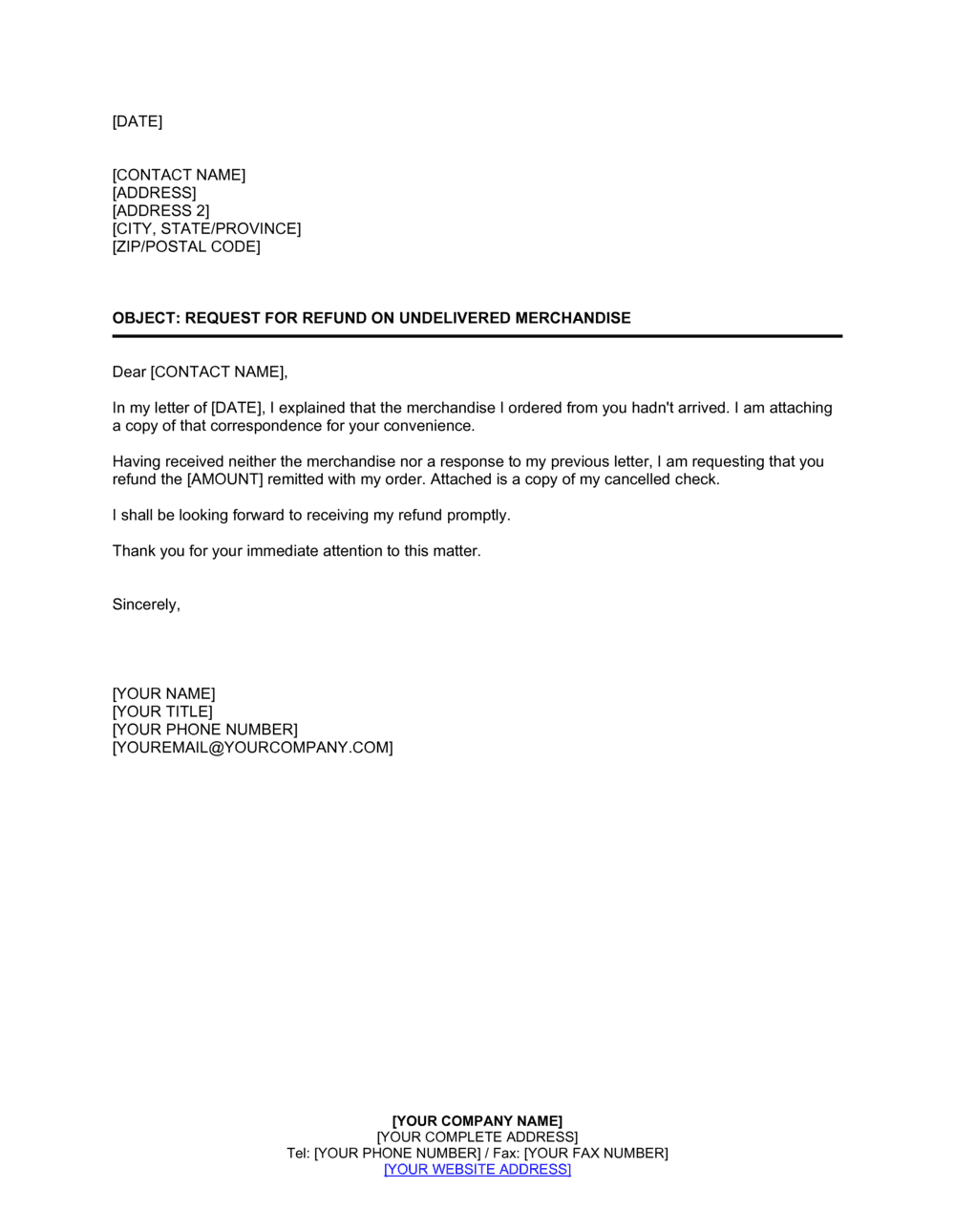
A Request For Refund On Undelivered Merchandise is a formal business letter sent by a buyer to a supplier or vendor demanding the return of payment for goods that were paid for but never received. This free Word download gives you a ready-to-edit template you can complete in minutes and send by email or post to initiate a refund or escalate an unresolved delivery dispute.
When you need it
Use it when a supplier has missed a confirmed delivery date, has not shipped the goods at all, or has failed to respond to informal follow-up. Sending a formal written letter creates a documented paper trail before escalating to a chargeback, collections claim, or legal action.
What's inside
Sender and recipient details, a clear reference to the original order and payment, a factual summary of the non-delivery, a specific refund demand with a deadline, and a statement of the buyer's intention to escalate if the demand is not met.

What is a Request For Refund On Undelivered Merchandise?

A Request For Refund On Undelivered Merchandise is a formal business letter sent by a buyer to a seller demanding the return of payment for goods that were paid for but never received. It sets out the order details, confirms that the delivery deadline has passed without fulfillment, references any prior attempts to resolve the matter informally, and gives the vendor a specific deadline to remit the refund before the buyer escalates through a chargeback, small claims court, or a collections process. Unlike an informal complaint email, this letter creates a documented, timestamped record of the demand β€” a requirement for most chargeback processes and a prerequisite for any subsequent legal action.

Why You Need This Document

When a vendor takes your money and fails to deliver, every day without a formal written demand weakens your position. Payment processors require evidence of a written refund request before accepting most chargeback claims, and chargeback windows typically close 60 to 120 days after the transaction date. A vague follow-up email rarely meets that evidentiary standard. Without a formal letter citing the order number, payment amount, delivery date, and a clear deadline, vendors have no obligation to treat your claim with urgency β€” and you have no paper trail to show a bank, a judge, or a collections agency. This template gives you a complete, professional demand letter in under 15 minutes, with every factual and legal element in the right place to support escalation if the vendor does not respond.

Which variant fits your situation?

If your situation is…Use this template
Goods were partially delivered but a portion was never receivedRequest For Partial Refund On Undelivered Merchandise
Goods were delivered but arrived damaged or defectiveRequest For Refund On Damaged Merchandise
A service was paid for but never performedRequest For Refund On Unprovided Services
A vendor owes money and the matter requires formal legal escalationDemand Letter For Payment
The buyer wants to cancel an order before shipment and recover paymentOrder Cancellation Letter
A customer is requesting a refund from a retailer rather than a B2B supplierCustomer Refund Request Letter

Common mistakes to avoid

❌ Vague or missing order references

Why it matters: A letter without a PO number, invoice number, or payment date cannot be matched to a transaction by the vendor's AP team, causing processing delays that push past your deadline.

Fix: Include the PO number, invoice number, payment date, and payment amount in both the subject line and the opening paragraph.
❌ Hedged refund language

Why it matters: Phrases like 'we would appreciate' or 'we hope you can assist' do not constitute a formal demand and may not satisfy the threshold for initiating a chargeback or filing a small claims case.

Fix: Use direct demand language: 'demands a full refund of $[AMOUNT]' β€” clear, specific, and unambiguous.

❌ No deadline stated

Why it matters: Without a specific response deadline, the vendor has no urgency to act, and you have no clear trigger date for escalation β€” leaving the matter unresolved indefinitely.

Fix: State a specific calendar date as the deadline, typically 7 to 14 business days from the letter date.

❌ Sending only by email with no follow-up confirmation

Why it matters: A vendor can claim they never received an email, and an unconfirmed send provides weak evidence if the dispute proceeds to a chargeback review or court.

Fix: Send by email and request a read receipt, then follow up with certified mail for any amount over $500 to create an unambiguous delivery record.

The 8 key clauses, explained

Header and date

In plain language: Identifies the sender, the recipient, and the date the letter is issued β€” establishing the official start of the written record.

Sample language
[SENDER NAME / COMPANY] | [ADDRESS] | [CITY, STATE, ZIP] | [DATE] | Attn: [RECIPIENT NAME / ACCOUNTS PAYABLE DEPARTMENT] | [VENDOR COMPANY NAME] | [VENDOR ADDRESS]

Common mistake: Using a trade name instead of the registered company name in the sender block β€” if the matter escalates legally, the letter must be traceable to the correct legal entity.

Subject line

In plain language: A one-line reference that identifies the letter as a refund demand and cites the order number or invoice number so the recipient routes it to the right department immediately.

Sample language
Subject: Refund Request β€” Purchase Order [PO NUMBER] / Invoice [INVOICE NUMBER] β€” Order Dated [ORDER DATE]

Common mistake: Writing a vague subject line like 'RE: Our Order' β€” without a PO or invoice number, the letter can sit unrouted in a vendor's inbox for days.

Opening statement of facts

In plain language: States clearly that the buyer placed an order, paid in full, and has not received the goods β€” giving the date of order, amount paid, and original expected delivery date.

Sample language
On [ORDER DATE], [BUYER COMPANY NAME] placed an order with [VENDOR NAME] for [DESCRIPTION OF GOODS] (Purchase Order No. [PO NUMBER]) at a total cost of $[AMOUNT], paid in full on [PAYMENT DATE] via [PAYMENT METHOD].

Common mistake: Omitting the payment method and date β€” these are the facts a vendor's accounts team needs to locate the transaction; missing them delays the response.

Non-delivery statement

In plain language: Documents that the goods have not been received as of the date of the letter, states any prior communication about the delay, and notes that no satisfactory resolution has been offered.

Sample language
As of [DATE OF LETTER], the goods have not been received. The confirmed delivery date was [ORIGINAL DELIVERY DATE]. Despite follow-up on [FOLLOW-UP DATE(S)], no delivery has been made and no satisfactory explanation or remedy has been provided.

Common mistake: Skipping mention of prior follow-up attempts β€” if the vendor disputes the claim, documented attempts to resolve the issue informally strengthen the buyer's position.

Refund demand

In plain language: States the specific dollar amount being demanded and the reason β€” non-delivery of the paid goods β€” in plain, unambiguous language.

Sample language
Accordingly, [BUYER COMPANY NAME] demands a full refund of $[AMOUNT] for the undelivered merchandise described above.

Common mistake: Writing 'we would appreciate a refund' instead of 'we demand a refund' β€” hedged language reduces the letter's force and may not satisfy the evidentiary standard for a later chargeback or court claim.

Deadline for response

In plain language: Sets a specific calendar date β€” typically 7 to 14 business days from the letter date β€” by which the vendor must remit the refund or confirm a resolution in writing.

Sample language
Please remit the full refund of $[AMOUNT] to [PAYMENT DETAILS / BANK ACCOUNT] no later than [DEADLINE DATE], which is [X] business days from the date of this letter.

Common mistake: Setting an unrealistically short deadline of 2–3 days β€” this reduces the chance of voluntary resolution and may be viewed as unreasonable if the dispute proceeds to mediation or court.

Escalation notice

In plain language: Informs the vendor that failure to meet the deadline will result in specific escalation steps β€” chargeback, small claims court, or referral to a collections agency β€” without making threats that go beyond lawful remedies.

Sample language
If we do not receive your confirmation of refund by [DEADLINE DATE], we will have no alternative but to initiate a chargeback through our payment provider and/or pursue this matter through the appropriate legal channels without further notice.

Common mistake: Threatening actions the sender cannot or will not actually take β€” such as referencing litigation when the amount is too small to pursue in court β€” undermines credibility if the matter escalates.

Closing and signature block

In plain language: A professional closing that restates the sender's expectation of prompt resolution and provides a direct contact for the vendor's response.

Sample language
We trust this matter will be resolved promptly. Please direct your response to [NAME] at [EMAIL] or [PHONE NUMBER]. Sincerely, [AUTHORIZED SIGNATORY NAME] | [TITLE] | [COMPANY NAME]

Common mistake: Signing with a first name only or no title β€” on a formal demand letter, the signatory's full name and authority to act on behalf of the company should be clear.

How to fill it out

  1. 1

    Gather your order documentation

    Locate the purchase order, invoice, payment confirmation, and any email correspondence with the vendor before you open the template. You will need exact dates, amounts, and reference numbers.

    πŸ’‘ Screenshot or PDF your payment confirmation and any vendor delivery promises β€” attach them to the letter when you send it to make the claim immediately verifiable.

  2. 2

    Complete the header with full legal names and addresses

    Enter your company's registered name and address in the sender block, and the vendor's full legal entity name and address in the recipient block. Include an attention line for accounts payable if known.

    πŸ’‘ Check the vendor's original invoice for their registered company name β€” it may differ from the trading name on their website.

  3. 3

    Fill in the subject line with your PO and invoice numbers

    Reference both the purchase order number and the vendor's invoice number in the subject line so the letter is routed to the correct person immediately upon receipt.

    πŸ’‘ If you have a vendor account number, add it to the subject line too β€” large suppliers use account numbers, not company names, to locate records.

  4. 4

    State the order facts precisely

    Enter the order date, description of goods, total amount paid, payment date, and payment method in the opening statement. Cross-reference these against your bank statement or receipt.

    πŸ’‘ Precise amounts matter β€” '$4,320.00' is harder to dispute than 'approximately $4,300.' Use the exact figure from your payment record.

  5. 5

    Document prior follow-up attempts

    In the non-delivery clause, list the dates you contacted the vendor about the missing delivery and summarize what, if any, response you received.

    πŸ’‘ Even a single unanswered email is worth mentioning β€” it shows the vendor had notice of the problem and chose not to respond.

  6. 6

    Set a specific deadline date

    Calculate a deadline of 7 to 14 business days from the date you plan to send the letter and enter it as a specific calendar date β€” not a relative phrase like 'within two weeks.'

    πŸ’‘ A 10-business-day window gives the vendor enough time to process the refund while keeping pressure on them to act promptly.

  7. 7

    Send by a traceable method and keep a copy

    Email the letter as a PDF attachment and follow up with a physical copy by certified mail if the amount is significant. Save the sent email and delivery receipt as part of your file.

    πŸ’‘ BCC your own records email address when sending so the timestamped copy is stored outside your sent folder, which can be deleted or lost.

Frequently asked questions

What is a request for refund on undelivered merchandise?

A request for refund on undelivered merchandise is a formal written letter sent by a buyer to a seller demanding the return of payment for goods that were paid for but never received. It documents the order facts, the non-delivery, prior follow-up attempts, and a specific deadline for the vendor to remit the refund β€” creating an official paper trail before escalating to a chargeback, small claims court, or collections.

When should I send a refund request letter for undelivered goods?

Send it after the confirmed delivery date has passed and at least one informal follow-up to the vendor has gone unanswered or unresolved. Waiting 5 to 10 business days past the delivery date before sending gives the vendor time to address minor delays, while still preserving your chargeback window, which most payment processors require you to initiate within 60 to 120 days of the transaction date.

Does a refund request letter need to be signed?

No signature is legally required for a refund demand letter to be effective. However, including a named signatory with their title adds authority and confirms the letter is authorized by the company. For significant amounts, having an officer or manager sign the letter is good practice.

What if the vendor ignores my refund request letter?

If the vendor does not respond by your stated deadline, escalate in the order of the remedies referenced in the letter: initiate a chargeback with your payment provider or bank, file a claim in small claims court for amounts within the local court's limit (typically $2,500–$25,000 depending on the jurisdiction), or engage a collections agency for larger commercial amounts.

Can I send this letter by email, or does it need to be mailed?

Email is acceptable and creates a timestamped record of delivery, making it the recommended primary method. For amounts over $500 or where the relationship has already broken down, follow up with a certified mail copy to establish proof of receipt that cannot be disputed. Keep the PDF attachment and the email's sent-folder timestamp as part of your file.

What documents should I attach to the refund request letter?

Attach the original purchase order or order confirmation, proof of payment (bank transfer receipt, credit card statement line, or payment processor confirmation), any prior correspondence about the missing delivery, and the vendor's invoice if one was issued. Attaching these upfront prevents the vendor from requesting documents as a delay tactic.

What is the difference between a refund request letter and a chargeback?

A refund request letter is a direct written demand to the vendor asking them to return your payment voluntarily. A chargeback is a transaction reversal initiated through your bank or payment processor that bypasses the vendor entirely. The letter typically comes first β€” it gives the vendor an opportunity to resolve the matter before you involve a third party. Many payment processors also require evidence of a written demand before accepting a chargeback claim.

How long should I give the vendor to respond?

A deadline of 7 to 14 business days is standard for commercial refund requests. Shorter deadlines β€” 2 to 3 days β€” are rarely practical for vendor AP processes and may be viewed as unreasonable. Longer than 14 business days reduces urgency unnecessarily and eats into your chargeback window if the vendor continues to stall.

How this compares to alternatives

vs Demand letter for payment

A demand letter for payment is sent by a creditor to a debtor who owes money for goods or services already delivered. A refund request for undelivered merchandise goes in the opposite direction β€” the buyer paid but received nothing and is demanding their money back. The parties and the direction of the obligation are reversed.

vs Order cancellation letter

An order cancellation letter is sent before or during the fulfillment window to cancel an order that has not yet shipped. A refund request for undelivered merchandise is sent after the delivery date has passed and the buyer has not received the goods. Use the cancellation letter proactively; use the refund request reactively when delivery has already failed.

vs Complaint letter to a vendor

A vendor complaint letter raises a general service issue β€” poor quality, billing errors, or slow communication β€” without necessarily demanding a specific monetary remedy. A refund request for undelivered merchandise has a single, specific objective: return of the purchase price. The complaint letter opens a conversation; the refund request demands a resolution.

vs Request for refund on damaged merchandise

A refund request for damaged merchandise applies when goods were received but arrived in an unusable condition, often requiring photos and inspection reports as supporting evidence. The undelivered merchandise version applies when no goods arrived at all, making the evidentiary focus the payment record and delivery confirmation rather than the condition of goods.

Industry-specific considerations

Retail and wholesale

Retailers use this letter to recover prepaid stock from suppliers who missed shipment windows, particularly during peak seasons where undelivered inventory directly impacts sales.

Construction and trades

Contractors send refund requests when materials prepaid for a project β€” lumber, fixtures, or equipment β€” are never delivered by the supplier, causing costly project delays.

Professional services

Agencies and consulting firms use the letter to reclaim prepaid subscriptions, software licenses, or event registrations that were paid for but never fulfilled by the vendor.

Manufacturing

Manufacturers send formal refund demands when component parts or raw materials paid for under a purchase order fail to arrive, disrupting production schedules and triggering downstream costs.

Template vs pro β€” what fits your needs?

PathBest forCostTime
Use the templateAny buyer recovering a prepaid amount from a vendor where goods were not deliveredFree10–15 minutes
Template + professional reviewRefund claims above $5,000 or disputes involving a long-term supplier relationship worth preserving$100–$300 for a brief legal or business advisor review1–2 days
Custom draftedHigh-value disputes, international vendor relationships, or matters requiring a solicitor's letterhead to compel a response$300–$8002–5 days

Glossary

Undelivered Merchandise
Goods that were paid for by the buyer but never physically received, regardless of whether the seller claims to have shipped them.
Purchase Order (PO)
A buyer-issued document authorizing the purchase of specific goods at an agreed price, quantity, and delivery date β€” the primary reference document for a refund claim.
Proof of Payment
Documentation β€” such as a bank transfer confirmation, receipt, or credit card statement β€” confirming that the buyer remitted the agreed amount to the seller.
Delivery Confirmation
A carrier-issued record showing that goods were physically delivered to the buyer's address, typically including a timestamp and recipient signature.
Chargeback
A reversal of a credit card or payment transaction initiated by the buyer's bank when a seller fails to deliver goods or services as agreed.
Demand Deadline
The specific calendar date stated in a refund request by which the seller must respond or remit the refund, after which the buyer may escalate.
Escalation
The process of advancing an unresolved dispute to a higher authority β€” such as a bank chargeback, small claims court, or a collections agency.
Remittance
The act of sending a payment β€” used in refund letters to mean the seller returning the buyer's money within the stated deadline.

Part of your Business Operating System

This document is one of 3,000+ business & legal templates included in Business in a Box.

  • Fill-in-the-blanks β€” ready in minutes
  • 100% customizable Word document
  • Compatible with all office suites
  • Export to PDF and share electronically

Create your document in 3 simple steps.

From template to signed document β€” all inside one Business Operating System.
1
Download or open template

Access over 3,000+ business and legal templates for any business task, project or initiative.

2
Edit and fill in the blanks with AI

Customize your ready-made business document template and save it in the cloud.

3
Save, Share, Send, Sign

Share your files and folders with your team. Create a space of seamless collaboration.

Save time, save money, and create top-quality documents.

β˜…β˜…β˜…β˜…β˜…

"Fantastic value! I'm not sure how I'd do without it. It's worth its weight in gold and paid back for itself many times."

Managing Director Β· Mall Farm
Robert Whalley
Managing Director, Mall Farm Proprietary Limited
β˜…β˜…β˜…β˜…β˜…

"I have been using Business in a Box for years. It has been the most useful source of templates I have encountered. I recommend it to anyone."

Business Owner Β· 4+ years
Dr Michael John Freestone
Business Owner
β˜…β˜…β˜…β˜…β˜…

"It has been a life saver so many times I have lost count. Business in a Box has saved me so much time and as you know, time is money."

Owner Β· Upstate Web
David G. Moore Jr.
Owner, Upstate Web

Run your business with a system β€” not scattered tools

Stop downloading documents. Start operating with clarity. Business in a Box gives you the Business Operating System used by over 250,000 companies worldwide to structure, run, and grow their business.

Start freeΒ Β·Β No credit card required