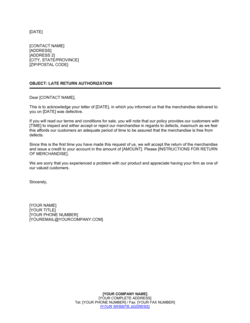
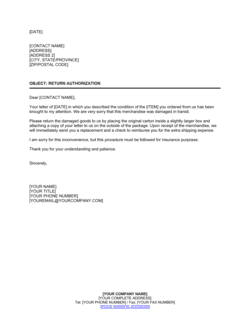
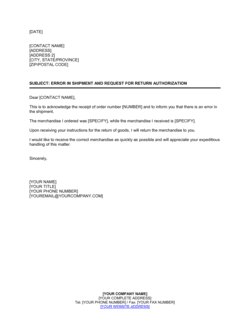
Return Authorization Template

Free Word download β€’ Edit online β€’ Save & share with Drive β€’ Export to PDF

1 pageβ€’15–25 min to fillβ€’Difficulty: Standard
Learn more ↓
FreeReturn Authorization Template

At a glance

What it is
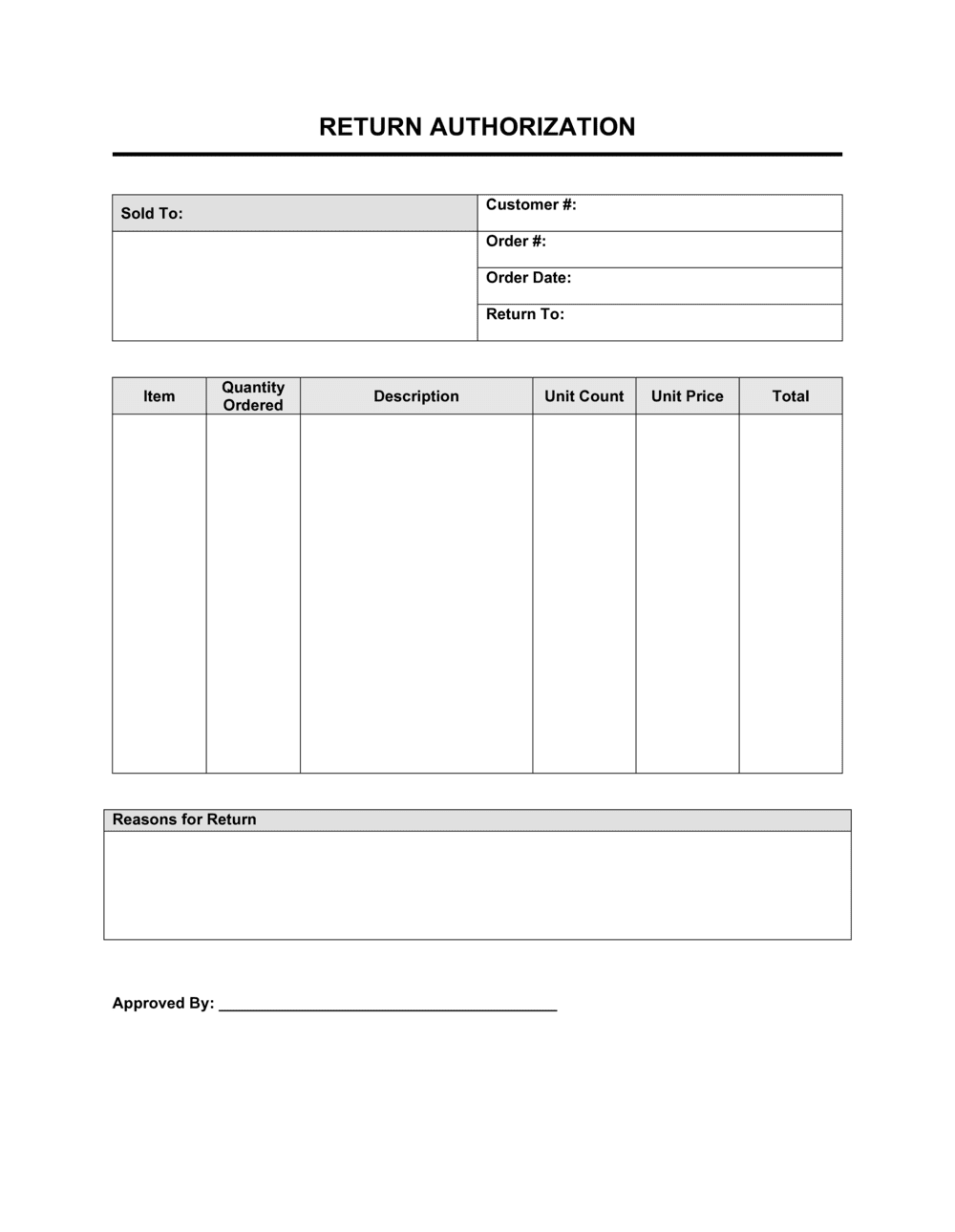
A Return Authorization (RMA) is a structured form a seller issues to a buyer granting permission to return goods. This free Word download captures the original order reference, items being returned, return reason, shipping instructions, and the approved disposition β€” refund, replacement, or credit β€” in a single printable document you can edit online and export as PDF.
When you need it
Issue one whenever a customer or business buyer requests to return a product, before the goods leave their location. Requiring a valid RMA number prevents unauthorized returns and keeps your receiving and accounting teams aligned from the moment goods arrive back at your warehouse.
What's inside
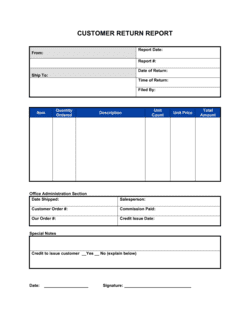
Seller and buyer contact details, original order and RMA numbers, itemized return lines with quantities and SKUs, return reason codes, approved disposition, return shipping carrier instructions, and an authorization signature block for the issuing staff member.

What is a Return Authorization?

A Return Authorization (RMA) is a structured form a seller issues to a buyer granting formal permission to return goods before they are shipped back. It captures the original order reference, identifies the specific items and quantities being returned, records the return reason, states the approved disposition β€” refund, replacement, or store credit β€” and provides clear shipping instructions including the unique RMA number that ties the physical return to its open record. Without this document in place, returns arrive unannounced, get routed to the wrong department, and create reconciliation problems that ripple through inventory, finance, and customer service simultaneously.

Why You Need This Document

Processing returns without a formal authorization form is one of the fastest ways to lose money on transactions that were already closed. Goods arrive at the receiving dock with no reference number, no stated disposition, and no way to verify whether the return was ever actually approved β€” and your team either rejects a legitimate return or honors one it shouldn't. A completed RMA locks in the approved disposition before the buyer ships, giving your finance team a committed refund amount to accrue and your warehouse team a scheduled inbound to prepare for. It also creates the paper trail you need to calculate restocking fees accurately, run return-reason analysis across SKUs, and respond to chargebacks with documented evidence of your return process. This template gives you a complete, print-ready form you can issue in under five minutes and adapt to any product category or return scenario.

Which variant fits your situation?

If your situation is…Use this template
Consumer retail return with a refund to the original payment methodReturn Authorization (Refund)
Defective product under active warranty requiring replacementWarranty Claim Form
B2B buyer returning excess inventory for store creditReturn Authorization (Credit Memo)
International shipment return requiring customs documentationCommercial Invoice (Return Shipment)
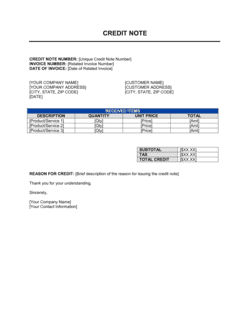
Customer disputing a charge before returning goodsCredit Note
Buyer rejecting goods at point of delivery without prior authorizationDelivery Receipt / Proof of Delivery
Issuing a formal refund after the returned goods are received and inspectedRefund Receipt

Common mistakes to avoid

❌ No expiry date on the RMA

Why it matters: Buyers treat an open-ended RMA as a standing permission to return goods at any time, creating surprise inventory and cash-flow impacts months after the original sale.

Fix: Set a 30-day expiry on every RMA and note that returns arriving after the expiry date require a new authorization before they will be processed.

❌ Omitting the RMA number from shipping instructions

Why it matters: Unlabeled returns arrive at the receiving dock with no routing information β€” they get quarantined, lost, or processed against the wrong order, delaying refunds and inflating discrepancy reports.

Fix: Include explicit instructions on the form requiring the RMA number on the outer carton, and repeat this in the email you send the buyer.

❌ Leaving the disposition field blank until goods arrive

Why it matters: Buyers who do not know their expected outcome before shipping are more likely to dispute the final amount, escalate to a chargeback, or delay returning goods entirely.

Fix: Confirm and document the approved disposition at the time of issuing the RMA, subject to a receiving inspection β€” state any conditions clearly on the form.

❌ Authorizing returns without checking the original order

Why it matters: Issuing an RMA for items not on the original invoice, or for quantities beyond what was shipped, creates write-off exposure your accounting team will catch only at reconciliation.

Fix: Always cross-reference the RMA line items against the original invoice before issuing β€” take 90 seconds to open the order record and confirm SKUs and quantities match.

The 9 key fields, explained

RMA number and issue date

Seller contact information

Buyer contact information

Original order reference

Itemized return lines

Return reason

Approved disposition

Return shipping instructions

Authorization signature

How to fill it out

  1. 1

    Assign an RMA number and set an expiry date

    Generate a sequential RMA number (e.g., RMA-2026-0088) and set an expiry date 30 days from the issue date. Record both at the top of the form.

    πŸ’‘ Keep a running RMA log in a spreadsheet or your order management system so numbers are never duplicated and open returns can be tracked at a glance.

  2. 2

    Enter buyer and seller contact details

    Fill in your returns department address β€” not your billing address β€” and the buyer's name, phone, and email. Confirm the return ship-from address if it differs from the buyer's billing record.

    πŸ’‘ Ask the buyer to confirm the ship-from address by email before issuing the RMA β€” misrouted returns are the single most common cause of delayed processing.

  3. 3

    Reference the original order

    Enter the invoice number, PO number, and order date from the original transaction. Cross-reference against your order management system to confirm the items are still within the return window.

    πŸ’‘ If the return window has passed, note the exception approval and the name of the manager who authorized it on the form.

  4. 4

    Itemize the goods being returned

    List each item on a separate line with SKU, description, quantity returned, and unit price. Only authorize the specific SKUs and quantities the buyer has confirmed are being returned.

    πŸ’‘ Match quantities against the original invoice β€” if the buyer is returning more units than they ordered, flag the discrepancy before issuing the RMA.

  5. 5

    Select the return reason code

    Choose the closest reason code from your standard list (e.g., DEF, WRONG-ITEM, OVERSHIPMENT, BUYER-REMORSE) and add a free-text note if the situation requires it.

    πŸ’‘ Consistent reason codes let you run monthly return analysis to catch product quality trends before they escalate into wider issues.

  6. 6

    Confirm and record the approved disposition

    State clearly whether the buyer will receive a full refund, partial refund, replacement, or store credit β€” and the expected timeline. Get internal sign-off before communicating this to the buyer.

    πŸ’‘ For high-value returns, require a receiving inspection note before committing to the final refund amount β€” physical condition of returned goods is not always what the buyer described.

  7. 7

    Attach return shipping instructions and authorize

    Specify the carrier, provide a prepaid label if applicable, and instruct the buyer to write the RMA number on all cartons. Sign and date the form before sending.

    πŸ’‘ Send the completed RMA as a PDF attachment β€” not in the body of an email β€” so the buyer can print it and attach it to the shipment without reformatting.

Frequently asked questions

What is a return authorization?

A return authorization (RMA) is a document a seller issues to a buyer granting formal permission to return goods. It assigns a unique RMA number for tracking, specifies which items may be returned, states the reason and approved disposition β€” refund, replacement, or credit β€” and provides return shipping instructions. Requiring an RMA before goods ship back prevents unauthorized returns and keeps receiving, inventory, and accounting records accurate.

When should I issue a return authorization?

Issue an RMA as soon as a return request is approved and before the buyer ships the goods. Sending it after the items are already in transit means the return arrives without a valid RMA number, causing receiving delays and potentially triggering a chargeback dispute. A same-day turnaround on approved requests is the standard expectation in most B2B and e-commerce environments.

What is an RMA number and why does it matter?

An RMA number is the unique identifier assigned to each approved return. It links the physical shipment arriving at your warehouse to the open authorization record in your system, enabling your receiving team to verify quantities, your finance team to process the correct refund amount, and your inventory team to update stock levels accurately. Without it, returns must be manually matched to orders β€” a process that introduces errors and delays.

Does a return authorization need to be signed?

No legal requirement mandates a signature, but having an authorized staff member sign the form before it is issued serves two purposes. It creates an internal approval trail confirming the disposition was sanctioned, and it gives the buyer confidence the form is official rather than auto-generated without review. For high-value or exception returns, a manager's signature is strongly recommended.

What should the disposition field include?

The disposition should state the specific outcome β€” full refund, partial refund with a restocking fee amount, like-for-like replacement, or store credit β€” the dollar amount where applicable, the payment method for refunds, and the expected processing timeline after the returned goods are received and inspected. Vague dispositions like 'refund TBD' are a common source of customer disputes.

What is a restocking fee and when should I charge one?

A restocking fee is a percentage or flat charge deducted from the refund to cover the cost of inspecting, repackaging, and returning an item to saleable inventory. It is most appropriate for buyer's remorse returns where the item is in resaleable condition and the return cost is not the seller's fault. Typical rates range from 10–25% of the item price. Restocking fees should be disclosed in your return policy before a purchase is made to avoid disputes.

How long should an RMA be valid?

A 30-day window from the issue date is the most common standard. This gives the buyer reasonable time to package and ship the goods while limiting your exposure to returns arriving outside your planning horizon. For B2B accounts or high-value equipment, 60 days is sometimes granted. Always print the expiry date on the form and state that returns arriving after it require a new authorization.

How is a return authorization different from a credit note?

A return authorization is issued before the goods are returned β€” it grants permission and sets the terms. A credit note is issued after the goods are received and inspected, reducing the buyer's account balance or triggering a refund payment. They document the same transaction at different stages: the RMA opens the return; the credit note closes it from an accounting perspective.

How this compares to alternatives

vs Credit Note

A return authorization is issued before goods are sent back β€” it approves the return and sets the terms. A credit note is the accounting document issued after the returned goods are received and verified, formally reducing the buyer's balance. The RMA initiates the process; the credit note closes it. Both should reference the same RMA number for easy reconciliation.

vs Refund Receipt

A refund receipt confirms that money has been returned to the buyer after the return is processed. A return authorization comes earlier in the workflow β€” it grants permission to return and states the expected disposition before any funds move. You typically need both: the RMA to authorize the return, and the refund receipt to confirm the transaction is closed.

vs Purchase Order

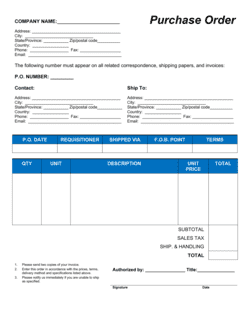
A purchase order documents the buyer's original intent to acquire goods. A return authorization reverses part of that transaction. They should be linked by order reference number so your procurement and accounts-payable teams can reconcile the net quantity and value of goods actually retained.

vs Delivery Receipt

A delivery receipt confirms goods were received in good condition at the point of original delivery. A return authorization is used when those goods are later found to be defective, incorrect, or unwanted. A signed delivery receipt limits the buyer's ability to claim the damage occurred in transit on the original shipment, which affects how the return is classified and who bears the cost.

Industry-specific considerations

E-commerce and retail

High return volumes require automated RMA numbering, prepaid label generation, and reason-code reporting to manage refund costs and identify product quality trends.

Manufacturing and wholesale

B2B return authorizations typically cover partial-order returns, overship corrections, and warranty replacements β€” often tied to a PO and requiring credit memo issuance.

Electronics and technology

Defective-unit returns require serial number capture, technical fault description, and a clear distinction between warranty replacement and out-of-warranty paid repair.

Healthcare and medical devices

Regulatory requirements may mandate lot number and expiry date tracking on returned goods, and certain device returns require quarantine and destruction rather than restocking.

Template vs pro β€” what fits your needs?

PathBest forCostTime
Use the templateAny seller processing standard product returns β€” retail, wholesale, or B2BFree5 minutes per authorization
Template + professional reviewBusinesses adding restocking fee schedules, custom reason codes, or multi-warehouse routing logic$0–$100 (operations or accounting review)1–2 hours
Custom draftedHigh-volume operations integrating RMA issuance into an ERP or order management system$500–$3,000 (developer or systems consultant)1–4 weeks

Glossary

RMA Number
A unique reference code assigned to each approved return, used to track the shipment through receiving, inspection, and disposition.
Disposition
The seller's decision on what happens after the return is received β€” typically a full refund, store credit, or product replacement.
Return Reason Code
A standardized short code or category β€” such as 'defective', 'wrong item shipped', or 'buyer's remorse' β€” that classifies why the return is being made.
Restocking Fee
A charge deducted from the refund amount to cover the cost of inspecting, repackaging, and returning an item to saleable inventory.
Return Window
The number of days after purchase or delivery within which a return request is eligible for authorization β€” commonly 30, 60, or 90 days.
Credit Memo
An accounting document issued to reduce the buyer's outstanding balance or provide store credit, used instead of a cash refund.
Proof of Purchase
Evidence of the original transaction β€” invoice number, order confirmation, or receipt β€” required to validate a return request.
Inspection Note
A record completed by the receiving team documenting the condition of returned goods, used to determine whether the approved disposition can be honored.
Prepaid Return Label
A shipping label generated and paid for by the seller, provided to the buyer so the return shipment cost is covered by the seller.
Carrier Tracking Number
The reference code issued by the shipping carrier that lets both parties monitor the return shipment's transit status in real time.

Part of your Business Operating System

This document is one of 3,000+ business & legal templates included in Business in a Box.

  • Fill-in-the-blanks β€” ready in minutes
  • 100% customizable Word document
  • Compatible with all office suites
  • Export to PDF and share electronically

Create your document in 3 simple steps.

From template to signed document β€” all inside one Business Operating System.
1
Download or open template

Access over 3,000+ business and legal templates for any business task, project or initiative.

2
Edit and fill in the blanks with AI

Customize your ready-made business document template and save it in the cloud.

3
Save, Share, Send, Sign

Share your files and folders with your team. Create a space of seamless collaboration.

Save time, save money, and create top-quality documents.

β˜…β˜…β˜…β˜…β˜…

"Fantastic value! I'm not sure how I'd do without it. It's worth its weight in gold and paid back for itself many times."

Managing Director Β· Mall Farm
Robert Whalley
Managing Director, Mall Farm Proprietary Limited
β˜…β˜…β˜…β˜…β˜…

"I have been using Business in a Box for years. It has been the most useful source of templates I have encountered. I recommend it to anyone."

Business Owner Β· 4+ years
Dr Michael John Freestone
Business Owner
β˜…β˜…β˜…β˜…β˜…

"It has been a life saver so many times I have lost count. Business in a Box has saved me so much time and as you know, time is money."

Owner Β· Upstate Web
David G. Moore Jr.
Owner, Upstate Web

Run your business with a system β€” not scattered tools

Stop downloading documents. Start operating with clarity. Business in a Box gives you the Business Operating System used by over 250,000 companies worldwide to structure, run, and grow their business.

Free Forever PlanΒ Β·Β No credit card required