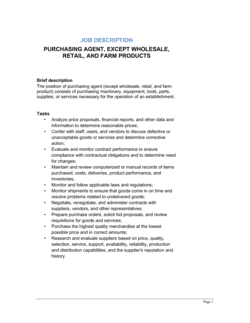
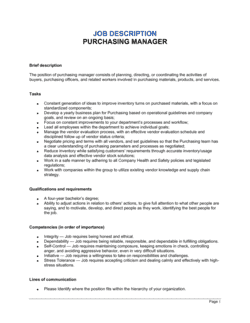
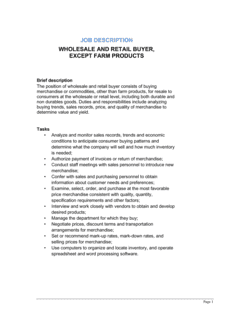
Purchasing Agent & Buyer — Farm Products Job Description Template

Word (DOC/DOCX)•2 pages•20–30 min to fill•Difficulty: Standard•Signature required•Legal review recommended
Learn more ↓

The full editable document opens in Business in a Box.

At a glance

What it is
A Purchasing Agent & Buyer Farm Products Job Description is a binding employment document that defines the duties, qualifications, authority limits, compliance obligations, and performance expectations for a professional responsible for sourcing and procuring agricultural commodities and farm products on behalf of an organization. This Word template is fully editable online and can be exported as PDF for offer packages, HR files, and regulatory compliance records.
When you need it
Use it when hiring, promoting, or restructuring a procurement role that involves purchasing raw agricultural goods — grains, produce, livestock, dairy, or specialty crops — from farms, co-operatives, or commodity markets. It is also required when regulatory bodies, auditors, or certification programs ask for documented role definitions covering food safety and traceability obligations.
What's inside
Role summary and reporting structure, core purchasing and sourcing duties, supplier evaluation and relationship management responsibilities, regulatory and food-safety compliance obligations, budget and spend authority limits, required qualifications and certifications, and performance metrics. Each clause is drafted to be enforceable as part of an employment agreement or attached as a Schedule to one.

Which variant fits your situation?

If your situation is…Use this template
Hiring a senior buyer managing multi-million-dollar commodity spendSenior Agricultural Procurement Manager Job Description
Defining a junior or entry-level purchasing assistant roleProcurement Assistant Job Description
Formalizing a contract or freelance commodity sourcing roleIndependent Contractor Agreement
Creating a full employment agreement to accompany the job descriptionEmployment Contract
Documenting a food safety officer role within the procurement teamFood Safety Manager Job Description
Defining a livestock-specific buyer role at a meat processing facilityLivestock Buyer Job Description
Posting a general supply chain or logistics manager roleSupply Chain Manager Job Description

What is a Purchasing Agent & Buyer Farm Products Job Description?

A Purchasing Agent & Buyer Farm Products Job Description is a formal employment document that defines the authorized duties, spend authority, regulatory compliance obligations, supplier management responsibilities, and performance standards for a professional hired to source and procure agricultural commodities — including grains, produce, livestock, dairy, and specialty crops — on behalf of a food manufacturer, retailer, distributor, or agribusiness operation. When incorporated into an employment agreement or signed as a standalone exhibit, it creates an enforceable record of role expectations that governs the employment relationship, satisfies food safety audit requirements, and protects the organization against unauthorized purchasing decisions or undisclosed conflicts of interest. This Word template is fully editable and export-ready as PDF for HR files, offer packages, and regulatory documentation.

Why You Need This Document

Without a documented job description, a purchasing agent's authority is undefined — leaving the organization exposed to unauthorized forward contracts, undisclosed supplier relationships, and food safety traceability gaps that regulators and auditors can cite as systematic failures. Companies subject to FSMA, GFSI certification schemes, or CFIA oversight are routinely required to produce documented role definitions as evidence that procurement functions are controlled and accountable. A buyer who lacks written performance criteria cannot be fairly evaluated, disciplined, or terminated for performance reasons without significant employment law risk. This template closes all four gaps in a single document: it defines what the buyer is authorized to do, what regulatory frameworks they must follow, how their performance will be measured, and what confidentiality and conflict-of-interest obligations bind them from day one.

Common mistakes to avoid

❌ Using a generic purchasing job description not tailored to agricultural commodities

Why it matters: A non-agricultural template omits seasonal sourcing cycles, basis pricing, COOL labeling obligations, and farm supplier qualification requirements — leaving critical duties legally undocumented.

Fix: Replace all generic procurement language with commodity-specific duties, specifying the actual crops, livestock, or produce categories the buyer will source and the relevant regulatory frameworks.

❌ Setting a single flat spend limit without distinguishing contract types

Why it matters: A buyer authorized to execute $500K spot purchases under a single threshold could commit the company to a $500K per-month 12-month forward contract — a $6M exposure — without additional approval.

Fix: Define separate authorization levels for spot purchases, seasonal contracts, multi-year forward contracts, and any derivative or hedging instruments, each with its own escalation path.

❌ Omitting conflicts-of-interest disclosure requirements

Why it matters: Agricultural purchasing is a high-risk function for undisclosed supplier relationships and kickback arrangements. Without a documented disclosure obligation, the company has no contractual basis to discipline or terminate a buyer found to have an undisclosed supplier interest.

Fix: Include an explicit conflicts-of-interest clause requiring immediate written disclosure to HR or compliance of any financial interest in, or personal relationship with, current or prospective suppliers.

❌ Failing to reference specific regulatory frameworks by name

Why it matters: Vague language like 'ensure regulatory compliance' creates no enforceable obligation and provides no guidance to the buyer on which specific rules govern their purchasing decisions.

Fix: Name the applicable statutes and standards — FSMA, COOL, CFIA Safe Food for Canadians Regulations, EU 178/2002 — relevant to the commodities and geographies the buyer covers.

❌ Storing purchase records in email or personal drives rather than a centralized system

Why it matters: When a buyer leaves or a regulatory audit is triggered, records stored informally become inaccessible, creating compliance violations and exposing the company to penalties under food safety traceability requirements.

Fix: Specify in the record-keeping clause the exact system — ERP, document management platform, or shared drive — where all records must be stored, with a minimum retention period.

❌ Signing the job description after the employee's start date

Why it matters: Confidentiality obligations and conflicts-of-interest restrictions signed post-start may be unenforceable without fresh consideration in common-law jurisdictions, leaving the company exposed from day one of the hire.

Fix: Execute the job description as part of the offer package before the employee's first day, or provide documented additional consideration — a signing bonus or salary increment — if execution is unavoidably delayed.

The 10 key clauses, explained

Role Summary and Reporting Structure

In plain language: States the position title, the organizational unit it belongs to, who the buyer reports to, and the scope of the role in one authoritative paragraph.

Sample language
The Purchasing Agent & Buyer, Farm Products ('Buyer') reports to the [DIRECTOR OF PROCUREMENT / VP SUPPLY CHAIN] and is responsible for sourcing, negotiating, and contracting the purchase of farm and agricultural products required by [COMPANY NAME] to meet production and inventory targets.

Common mistake: Listing multiple dotted-line reporting relationships without clarifying which manager has primary authority over performance reviews and spend approvals — this leads to conflicting directives and accountability gaps.

Core Purchasing and Sourcing Duties

In plain language: Enumerates the day-to-day responsibilities — identifying supply sources, issuing purchase orders, negotiating price and terms, and managing delivery scheduling.

Sample language
Buyer shall: (a) identify and evaluate sources of supply for [COMMODITY TYPES]; (b) negotiate purchase price, delivery schedule, and payment terms with approved suppliers; (c) issue purchase orders within authorized spend limits; and (d) monitor crop conditions, market prices, and seasonal availability to optimize procurement timing.

Common mistake: Using a generic purchasing duties list not tailored to agricultural commodities — omitting seasonal sourcing cycles, basis pricing, and harvest-window scheduling that are essential to the role.

Supplier Qualification and Approved Supplier List Maintenance

In plain language: Defines the buyer's obligation to assess, onboard, and maintain suppliers according to the organization's food safety and quality standards.

Sample language
Buyer shall maintain and update the Approved Supplier List (ASL) in accordance with [COMPANY NAME]'s Supplier Qualification Procedure [DOCUMENT NUMBER]. Buyer shall ensure all active farm suppliers hold current [GAP / GFSI / ORGANIC] certifications as required and that audit records are renewed at least every [12/24] months.

Common mistake: Delegating ASL maintenance without specifying the frequency of re-qualification reviews — allowing lapsed certifications to go undetected until a customer or regulatory audit exposes them.

Regulatory and Food Safety Compliance Obligations

In plain language: Places responsibility on the buyer for ensuring that purchase decisions and supplier documentation meet applicable food safety laws, traceability requirements, and country-of-origin labeling rules.

Sample language
Buyer shall ensure all purchased farm products comply with applicable requirements under [FSMA / COOL / CFIA / applicable EU regulation], maintain complete traceability records from point of origin through receipt, and promptly escalate any supplier non-conformance to the Quality Assurance Manager.

Common mistake: Referencing only federal regulations and omitting state, provincial, or local requirements — particularly important for produce buyers operating across multiple jurisdictions.

Budget Authority and Spend Limits

In plain language: Specifies the maximum value of a single purchase order or contract the buyer may execute without additional approval, and the process for exceeding those limits.

Sample language
Buyer is authorized to execute individual purchase contracts up to $[AMOUNT] without additional approval. Contracts exceeding $[AMOUNT] require countersignature from [TITLE]. Any multi-year forward contract or hedge position requires approval from the [CFO / RISK COMMITTEE] prior to execution.

Common mistake: Setting a single flat spend limit without distinguishing between spot purchases and forward contracts — a buyer who can commit the company to a 12-month forward contract at a low dollar threshold creates outsized price and cash-flow risk.

Market Analysis and Price Risk Management

In plain language: Outlines the buyer's responsibility to monitor commodity markets, maintain price benchmarks, and use approved hedging or forward-contracting tools to manage input cost risk.

Sample language
Buyer shall track daily cash and futures prices for [COMMODITIES] on [EXCHANGE(S)], maintain a monthly benchmark comparison against actual purchase prices, and recommend forward-contracting or spot-purchase strategies to [SUPERVISOR TITLE] based on market outlook and inventory position.

Common mistake: Assigning price risk management duties without specifying the approved instruments — buyers who execute unauthorized hedge positions using options or swaps can expose the company to significant financial liability.

Quality Specifications and Receiving Standards

In plain language: Defines the buyer's role in establishing and enforcing quality specifications for purchased commodities and coordinating with the receiving or quality team on inspection and rejection procedures.

Sample language
Buyer shall maintain written quality specifications for each commodity purchased, including grade, moisture content, foreign material tolerances, and pesticide residue limits in accordance with [INTERNAL SPEC NUMBER / USDA GRADE STANDARDS]. Buyer shall coordinate with Quality Assurance to resolve supplier non-conformances within [X] business days of receipt.

Common mistake: Delegating quality spec maintenance entirely to QA without involving the buyer — leading to specs that do not reflect market availability or seasonal grade variation, resulting in unnecessary rejections and supply disruptions.

Record-Keeping and Documentation Obligations

In plain language: Requires the buyer to maintain complete, organized records of all purchase contracts, invoices, delivery receipts, supplier certifications, and inspection reports for regulatory and audit purposes.

Sample language
Buyer shall maintain all purchase records — including contracts, purchase orders, bills of lading, inspection certificates, and supplier qualification documents — in [ERP SYSTEM / DOCUMENT MANAGEMENT SYSTEM] for a minimum of [5/7] years or as required by applicable law, whichever is longer.

Common mistake: Storing records only in email threads or personal drives rather than a centralized system — records become inaccessible during turnover, audits, or legal disputes.

Confidentiality and Conflicts of Interest

In plain language: Prohibits the buyer from disclosing pricing, supplier, or strategic sourcing information and requires disclosure of any financial relationship with current or prospective suppliers.

Sample language
Buyer shall not disclose pricing, supplier identities, or procurement strategies to any third party without prior written authorization. Buyer shall immediately disclose to [HR / COMPLIANCE OFFICER] any direct or indirect financial interest in, or personal relationship with, any current or prospective supplier of [COMPANY NAME].

Common mistake: Omitting the conflicts-of-interest disclosure requirement entirely — agricultural purchasing is a high-risk function for undisclosed supplier relationships, kickbacks, and preferential pricing arrangements.

Performance Standards and Review Criteria

In plain language: Establishes the measurable KPIs against which the buyer's performance will be evaluated — cost savings, on-time delivery rate, supplier scorecard results, and compliance metrics.

Sample language
Buyer's performance shall be evaluated annually against the following KPIs: (a) purchase price variance vs. benchmark (target: [X]% or better); (b) on-time delivery rate (target: [X]%); (c) supplier non-conformance rate (target: less than [X]% of shipments); and (d) ASL currency rate (target: 100% of active suppliers re-qualified within required cycle).

Common mistake: Setting performance criteria for cost savings alone without balancing quality, compliance, and supply continuity metrics — incentivizing buyers to chase price at the expense of food safety and reliability.

How to fill it out

  1. 1

    Enter the company name, location, and department

    Replace all [COMPANY NAME] placeholders with the organization's full legal name. Add the physical location or locations the buyer will serve and the department or business unit they will join.

    💡 Use the same legal entity name that appears on employment contracts and payroll records to ensure the job description can be incorporated by reference into the offer package without amendment.

  2. 2

    Define the reporting structure and backup authority

    Name the specific title — not an individual's name — that the buyer reports to, and identify any dotted-line relationships. Designate who holds approval authority in the manager's absence.

    💡 Title-based reporting lines remain valid through personnel changes; name-based lines require amendment every time there is turnover above the buyer.

  3. 3

    List the specific commodities and sourcing channels

    Replace the generic [COMMODITY TYPES] placeholder with the actual product categories — for example, corn, soybeans, fresh-cut vegetables, organic dairy, or live cattle. Specify whether sourcing is from farms directly, co-operatives, brokers, or commodity exchanges.

    💡 The more specific the commodity list, the easier it is to write targeted interview questions, set defensible salary bands, and evaluate candidates with relevant experience.

  4. 4

    Set spend authority thresholds and approval escalation levels

    Enter numeric dollar limits for single purchase orders, multi-year forward contracts, and any hedging instruments. Match these thresholds to the organization's existing procurement policy and financial controls.

    💡 If no documented procurement policy exists, this step is the prompt to create one — spend limits written only in job descriptions are unenforceable if a separate policy document does not authorize them.

  5. 5

    Specify applicable regulatory frameworks

    Identify the food safety, labeling, and traceability regulations that apply to your commodities and geographies — FSMA for US food companies, CFIA for Canadian operations, EU regulation 178/2002 for European supply chains. Remove frameworks that do not apply.

    💡 Over-referencing regulations you are not subject to creates compliance obligations you do not have — keep only the frameworks that apply to your specific operation.

  6. 6

    Define quality specifications and rejection thresholds

    Insert references to your internal spec numbers or USDA/CFIA grade standards for each commodity. Specify moisture, grade, foreign material, and pesticide residue limits relevant to your products.

    💡 Attach the actual quality specifications as a Schedule rather than embedding all parameters in the body — this allows specs to be updated without amending the job description.

  7. 7

    Insert performance KPIs with numeric targets

    Fill in the target percentages or values for purchase price variance, on-time delivery, non-conformance rate, and supplier re-qualification rate. Align these numbers with your department's current baseline performance.

    💡 Set targets that are aspirationally achievable in Year 1 — KPIs set too far above current performance are ignored; KPIs set below current performance create no incentive to improve.

  8. 8

    Have both parties sign before the employee's start date

    Obtain signatures from the hiring manager or authorized HR representative and the incoming employee before day one. File the signed original in the employee's HR record and provide them with a copy.

    💡 In common-law jurisdictions, restrictions signed after the start date — including confidentiality and conflicts-of-interest obligations — may require fresh consideration to be enforceable. Execute before day one.

Frequently asked questions

What does a purchasing agent and buyer of farm products do?

A purchasing agent and buyer of farm products is responsible for sourcing, negotiating, and contracting the purchase of agricultural commodities — such as grain, produce, dairy, or livestock — on behalf of a food manufacturer, retailer, distributor, or processor. They monitor commodity markets, maintain relationships with farm suppliers and co-operatives, manage delivery scheduling, enforce quality specifications, and ensure all purchases comply with applicable food safety and traceability regulations.

Why does a purchasing agent need a formal job description?

A formal job description defines the buyer's authorized duties, spend limits, and compliance obligations in writing — creating an enforceable record that protects both the employer and the employee. Without one, spend authority is ambiguous, regulatory obligations are unclear, and performance expectations are impossible to enforce. For companies subject to food safety audits under FSMA or GFSI standards, documented role definitions are typically a mandatory audit requirement.

Is a job description a legally binding document?

A job description is generally binding when it is incorporated into an employment agreement by reference and signed by both parties. Standing alone, a job description is typically considered a strong statement of expectations rather than a contract, but courts and tribunals regularly use signed job descriptions as evidence of agreed duties, authority limits, and performance standards in employment disputes. Including a signature block and incorporating the document into the offer package strengthens its enforceability.

What qualifications should a farm products buyer have?

Most organizations require a bachelor's degree in agriculture, supply chain management, food science, or business, combined with 2–5 years of commodity purchasing experience. Familiarity with USDA grade standards, futures market mechanics, basis pricing, and food safety regulations is typically essential. Some roles require specific certifications such as a Certified Professional in Supply Management (CPSM) designation or completion of a GFSI-recognized food safety training program.

What regulations apply to purchasing agents buying farm products in the US?

In the US, farm product buyers typically operate under the Food Safety Modernization Act (FSMA) for food safety and supplier verification requirements, Country of Origin Labeling (COOL) rules for certain commodities, USDA Agricultural Marketing Act grade standards, and state agricultural department regulations that vary by commodity and location. Buyers sourcing produce are also subject to the Produce Safety Rule under FSMA. Applicable rules depend on the specific commodities purchased and the end use of the products.

How should spend authority limits be structured for an agricultural buyer?

Spend authority should be tiered by contract type rather than set as a single flat limit. A typical structure authorizes the buyer to execute spot purchases up to a defined dollar amount (e.g., $50,000–$250,000) without additional approval, while requiring supervisor countersignature for seasonal supply contracts and finance or risk committee approval for multi-year forward contracts or any derivative positions. Limits should align with the organization's existing procurement policy and financial controls framework.

What is the difference between a purchasing agent and a commodity buyer?

The terms overlap significantly in practice, but a purchasing agent typically focuses on transactional procurement — issuing purchase orders, managing supplier relationships, and handling day-to-day buying operations. A commodity buyer more specifically focuses on market-facing activities — monitoring futures prices, managing basis risk, executing forward contracts, and timing purchases to optimize cost. Larger agribusinesses distinguish the roles; smaller operations often combine both functions in a single position.

Should a job description be updated when duties change?

Yes. A job description that no longer reflects actual duties creates risks on both sides — the employer cannot hold the employee to undocumented responsibilities, and the employee may claim constructive dismissal if duties are changed materially without amendment and consent. Best practice is to review job descriptions annually, update them before any formal role restructuring, and have the employee acknowledge significant changes in writing.

Can this job description be used as a standalone document or does it need an employment contract?

This job description is designed to be used alongside a formal employment agreement — either incorporated by reference as a Schedule or attached as an exhibit. The employment contract establishes the binding legal relationship, compensation terms, and termination provisions; the job description defines duties, authority, and performance standards. Using the job description without a governing employment agreement leaves compensation, termination, IP, and confidentiality obligations legally undocumented.

How this compares to alternatives

vs Employment Contract

An employment contract establishes the binding legal relationship — compensation, term, termination, IP, and severance. A job description defines duties, authority limits, and performance standards within that relationship. The two documents work together: the job description is typically attached as a Schedule to the employment contract. Using a job description without a governing employment contract leaves compensation and termination terms legally undocumented.

vs Offer Letter

An offer letter confirms the role title, compensation, and start date to secure candidate acceptance. It is not a detailed operational document. A job description provides the authoritative record of duties, regulatory obligations, spend authority, and performance criteria that the offer letter does not cover. For regulatory compliance and audit purposes, a signed job description is the required document — an offer letter is insufficient.

vs Supply Chain Manager Job Description

A supply chain manager job description covers end-to-end logistics, inventory planning, transportation, and distribution across all product categories. A farm products buyer job description focuses specifically on commodity sourcing, agricultural market analysis, farm supplier qualification, and food safety compliance for raw agricultural inputs. The two roles may coexist in a larger organization, with the buyer reporting to the supply chain manager.

vs Independent Contractor Agreement

An independent contractor agreement engages a self-employed individual for a defined project or period without employment entitlements — no benefits, no tax withholding, no overtime. A job description is an employment document for a direct hire. Using a job description framework to engage a contractor blurs the employee/contractor classification line and can trigger misclassification liability under the FLSA, CRA, or HMRC rules.

Industry-specific considerations

Food Manufacturing

FSMA preventive control supplier verification, allergen documentation, and specification-controlled raw material procurement are core buyer obligations in food manufacturing environments.

Retail and Grocery Distribution

Fresh produce and dairy buyers must manage short shelf-life scheduling, COOL labeling documentation, and retailer-specific private-label quality standards across hundreds of SKUs.

Agriculture and Agribusiness

Grain elevator and co-operative buyers operate against harvest-window timing, basis pricing mechanics, and forward contract management as primary performance drivers.

Professional Services

Consulting firms and staffing agencies placing agricultural procurement professionals use standardized job descriptions to match candidates to client role specifications and ensure compliance obligations are clearly communicated.

Jurisdictional notes

United States

US farm product buyers operate under FSMA supplier verification requirements, USDA commodity grade standards, and Country of Origin Labeling rules under the Agricultural Marketing Act. State agricultural departments impose additional requirements — California, for example, has its own Produce Safety regulations that exceed federal FSMA minimums. Spend authority clauses must align with the organization's existing procurement policy to be enforceable under state contract law.

Canada

Canadian agricultural buyers are governed by the Safe Food for Canadians Act and CFIA regulations, which require documented supplier verification and traceability records from farm to processor. Provincial employment standards legislation in Ontario, Alberta, British Columbia, and Quebec sets mandatory minimum terms that the accompanying employment agreement must meet. Job descriptions signed after the start date require fresh consideration under common-law principles applicable in all provinces except Quebec, which is governed by the Civil Code.

United Kingdom

UK farm product buyers operate under the Food Safety Act 1990 and retained EU food law, including traceability obligations under EC 178/2002 as retained in UK law post-Brexit. The Groceries Supply Code of Practice (GSCOP) governs buyer conduct with direct suppliers for retailers above the turnover threshold. Employers must provide a written statement of employment particulars on or before day one, and the job description should be incorporated into that statement to be enforceable.

European Union

EU farm product buyers are subject to General Food Law Regulation 178/2002, which mandates full one-step-forward, one-step-back traceability for all food and feed. The Unfair Trading Practices Directive (EU 2019/633) restricts certain buyer practices in agricultural supply chains — including late payment, last-minute order cancellations, and unilateral contract changes — and must be reflected in the buyer's documented authority and conduct standards. GDPR applies to supplier contact data maintained by the buyer.

Template vs lawyer — what fits your deal?

PathBest forCostTime
Use the templateAgribusinesses and food companies hiring a standard buyer role for domestic operations with existing procurement policiesIncluded with Business in a Box30–60 minutes
Template + legal reviewCompanies subject to FSMA, GFSI, or CFIA audit requirements, or where the buyer has significant forward-contract authority$300–$700 (employment lawyer or HR specialist review)2–5 business days
Custom draftedMulti-jurisdiction agribusiness operations, C-suite procurement roles, or organizations facing active food safety regulatory scrutiny$1,000–$3,500+1–3 weeks

Glossary

Purchasing Agent
An employee authorized to negotiate and execute purchase contracts for goods or services on behalf of an organization, within defined spend limits.
Commodity Buyer
A specialized purchasing professional who sources bulk agricultural or raw material goods — such as grain, cotton, or livestock — at market or negotiated prices.
Spend Authority
The maximum dollar value of a purchase or contract a buyer is permitted to approve without escalating to a supervisor or committee.
FSMA (Food Safety Modernization Act)
US federal legislation requiring food companies to implement preventive controls across the supply chain, including documentation of supplier qualifications.
GFSI (Global Food Safety Initiative)
A benchmarking organization whose recognized standards — SQF, BRC, FSSC 22000 — are widely required by retailers and food manufacturers as a condition of supplier approval.
Approved Supplier List (ASL)
A maintained register of vendors that have passed the organization's qualification criteria, including food safety audits, insurance, and traceability documentation.
Traceability
The ability to track a food product's origin, handling, and movement through the supply chain from farm to point of sale — required by major food safety regulations.
Forward Contract
An agreement to purchase a specified quantity of a commodity at a fixed price on a future delivery date, used to manage price risk in agricultural procurement.
Basis Price
The difference between the local cash price and the futures contract price for a commodity, used to calculate the actual purchase price for farm products.
Co-operative (Co-op)
A farmer-owned marketing and supply organization through which members collectively sell or purchase agricultural products, often a primary sourcing channel for farm product buyers.
Country of Origin Labeling (COOL)
A US federal requirement that certain agricultural products sold at retail carry a label identifying the country in which they were produced, relevant to a buyer's documentation obligations.

Part of your Business Operating System

This document is one of 3,000+ business & legal templates included in Business in a Box.

  • Fill-in-the-blanks — ready in minutes
  • 100% customizable Word document
  • Compatible with all office suites
  • Export to PDF and share electronically

Browse related collections

Create your document in 3 simple steps.

From template to signed document — all inside one Business Operating System.

1
Download or open template

Access over 3,000+ business and legal templates for any business task, project or initiative.

2
Edit and fill in the blanks with AI

Customize your ready-made business document template and save it in the cloud.

3
Share with your team

Share your files and folders with your team. Create a space of seamless collaboration.

Save time, save money, and create top-quality documents.

★★★★★

"Fantastic value! I'm not sure how I'd do without it. It's worth its weight in gold and paid back for itself many times."

Managing Director · Mall Farm
Robert Whalley
Managing Director, Mall Farm Proprietary Limited
★★★★★

"I have been using Business in a Box for years. It has been the most useful source of templates I have encountered. I recommend it to anyone."

Business Owner · 4+ years
Dr Michael John Freestone
Business Owner
★★★★★

"It has been a life saver so many times I have lost count. Business in a Box has saved me so much time and as you know, time is money."

Owner · Upstate Web
David G. Moore Jr.
Owner, Upstate Web

Run your business with a system — not scattered tools

Stop downloading documents. Start operating with clarity. Business in a Box gives you the Business Operating System used by over 250,000 companies worldwide to structure, run, and grow their business.

Start free · No credit card required