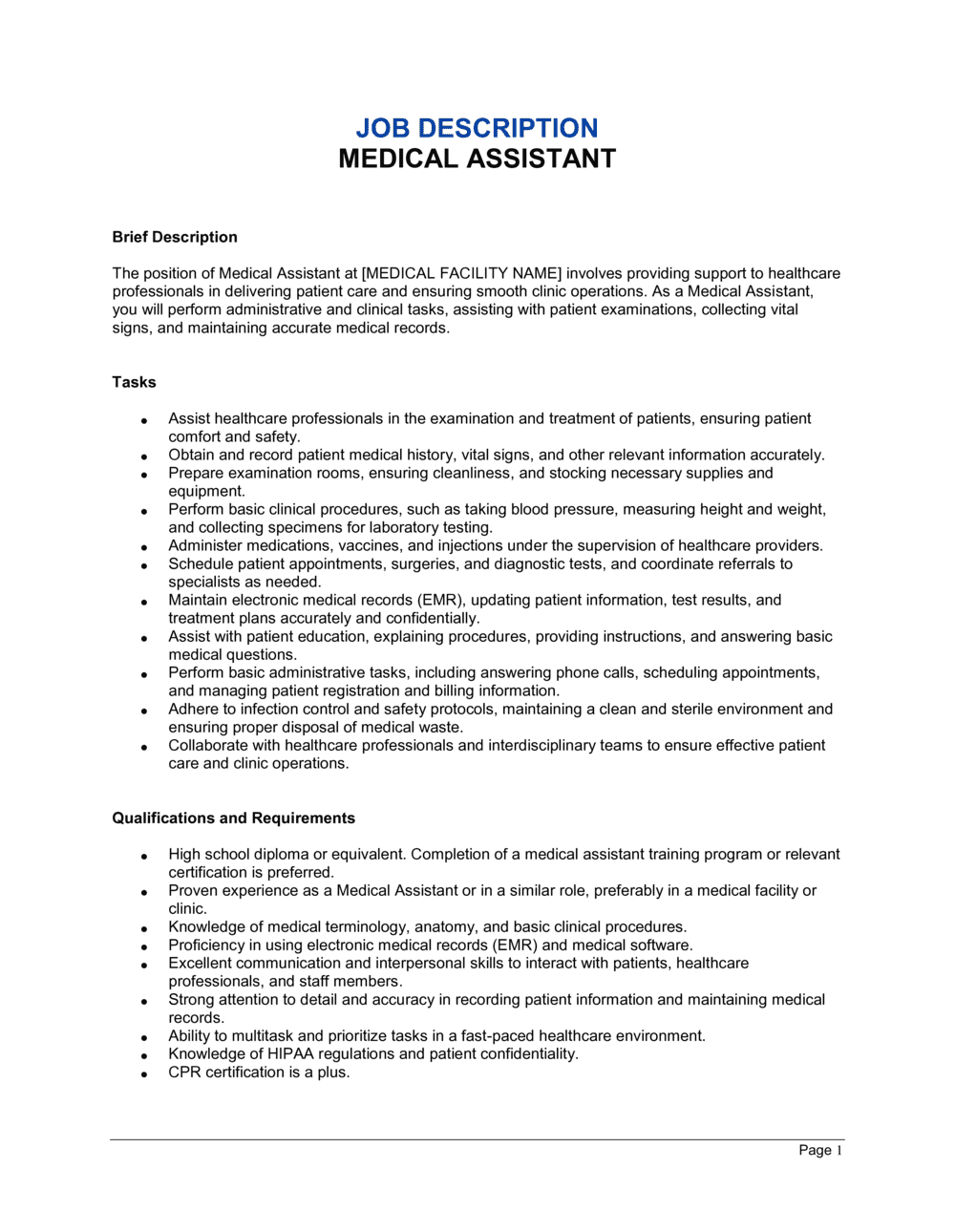
Medical Assistant Job Description Template

Free Word download • Edit online • Save & share with Drive • Export to PDF

2 pages20–30 min to fillDifficulty: StandardSignature requiredLegal review recommended
Learn more ↓
FreeMedical Assistant Job Description Template

At a glance

What it is
A Medical Assistant Job Description is a formal binding document that defines the duties, qualifications, compliance obligations, and compensation terms for a medical assistant role within a healthcare organization. This free Word download gives you a structured, legally considered starting point you can edit online and export as PDF for internal records, job postings, or as an attachment to an employment contract.
When you need it
Use it when hiring a new medical assistant, reclassifying an existing position, or updating role definitions to reflect changes in scope, certification requirements, or regulatory obligations such as HIPAA. It also serves as the authoritative reference document for performance reviews and disciplinary action.
What's inside
Position summary, reporting structure, clinical and administrative duties, required and preferred qualifications, certification requirements, HIPAA and compliance obligations, physical demands, compensation and benefits overview, and acknowledgment signature block.

What is a Medical Assistant Job Description?

A Medical Assistant Job Description is a formal binding document that defines the duties, required qualifications, compliance obligations, physical demands, and compensation terms for a medical assistant position within a healthcare organization. It functions as the authoritative internal record of what the role requires — establishing the essential functions used in ADA accommodation analysis, the HIPAA obligations the employee is put on written notice of, and the scope-of-practice boundaries that limit clinical task assignments to what the employee's credential and state law authorize. Unlike a job posting written to attract candidates, a job description is signed by both employer and employee and retained in the personnel file as a legal reference document throughout the employment relationship.

Why You Need This Document

Without a current, signed medical assistant job description, you lose the legal and operational foundation for virtually every employment decision that follows. Performance reviews become subjective because there are no documented essential functions to evaluate against. ADA accommodation requests cannot be properly assessed without defined physical demands. HIPAA compliance audits look for role-specific written acknowledgment of PHI obligations — a generic confidentiality policy does not satisfy that standard. Perhaps most immediately, listing clinical tasks that exceed your employee's state-authorized scope of practice exposes your practice to unauthorized-practice-of-medicine liability and patient safety risk. A properly completed job description, signed before day one, closes all of these gaps at once — and this template gives you the structure to do it in under 30 minutes.

Which variant fits your situation?

If your situation is…Use this template
Hiring a certified medical assistant (CMA) with phlebotomy dutiesCertified Medical Assistant Job Description
Filling an administrative-only front-desk medical assistant roleAdministrative Medical Assistant Job Description
Hiring for a pediatric or specialty clinic environmentSpecialty Medical Assistant Job Description
Formalizing the full employment relationship beyond the job descriptionEmployment Contract
Posting the role publicly on a job boardJob Posting Template
Onboarding the hired candidate with a formal offerJob Offer Letter
Documenting performance expectations after hireEmployee Performance Review Template

Common mistakes to avoid

❌ Listing tasks beyond the employee's state-authorized scope of practice

Why it matters: If a medical assistant performs a task listed in their job description but prohibited by state law, the employer bears liability for unauthorized practice of medicine — including licensing sanctions and patient injury claims.

Fix: Cross-reference every clinical task against the applicable state medical board's scope-of-practice guidelines for the credential level before finalizing the document.

❌ Classifying the role as FLSA exempt

Why it matters: Medical assistants almost always fall under the FLSA non-exempt category, meaning they are entitled to overtime pay for hours over 40 per week. Misclassification creates retroactive back-pay liability plus Department of Labor penalties.

Fix: Mark the role as non-exempt in the compensation clause and confirm the classification with your employment counsel or HR advisor if any doubt exists.

❌ Using a generic HIPAA line instead of role-specific obligations

Why it matters: A general 'maintain patient confidentiality' sentence does not put the employee on notice of their federal statutory obligations under HIPAA. In a breach investigation, regulators look for documented, role-specific training and acknowledgment.

Fix: Name HIPAA explicitly, describe the categories of PHI the employee will access, and reference your breach-reporting procedure and Privacy Officer contact.

❌ Omitting the physical demands section

Why it matters: Without documented physical requirements, an employer cannot lawfully assess whether a proposed ADA accommodation is reasonable or would eliminate an essential function — leaving the organization exposed in accommodation disputes.

Fix: Include specific, measurable physical demands (lifting weight, standing hours, exposure categories) and label them as essential functions.

❌ Collecting the acknowledgment signature after the employee's start date

Why it matters: A signature obtained after work begins provides weaker legal footing in termination or discipline disputes because the employee can argue they were not informed of the requirements before accepting the position.

Fix: Make signed acknowledgment a condition of the job offer, collected on or before day one alongside the employment contract.

❌ Setting experience requirements without documented business justification

Why it matters: Qualification thresholds that disproportionately exclude a protected class — such as requiring five years' experience for an entry-level role — can constitute disparate-impact discrimination under Title VII if no business necessity exists.

Fix: Document the operational reason for each experience or credential requirement, distinguish required from preferred qualifications, and review thresholds with HR or counsel before posting.

The 9 key clauses, explained

Position Summary

In plain language: Describes the overall purpose of the role, who it serves, and where it fits in the organization in two to four sentences.

Sample language
The Medical Assistant at [CLINIC NAME] supports the clinical and administrative operations of the [DEPARTMENT/SPECIALTY] team under the supervision of [SUPERVISING PHYSICIAN/MANAGER TITLE]. This role is responsible for delivering high-quality patient care support and ensuring efficient daily clinic operations.

Common mistake: Writing a position summary that is identical across every clinical role. A generic summary makes it harder to use the document for performance management or termination defense because it doesn't capture what this specific role is accountable for.

Reporting Structure

In plain language: Names the direct supervisor title and any secondary reporting relationships, clarifying the chain of command the employee operates within.

Sample language
This position reports directly to [CLINIC MANAGER / LEAD PHYSICIAN] and coordinates daily activities with [NURSE PRACTITIONER / FRONT DESK SUPERVISOR] as applicable.

Common mistake: Listing a person's name rather than their title. If the named individual leaves, the reporting structure appears invalid and the document must be amended.

Clinical Duties

In plain language: Enumerates patient-facing clinical tasks the medical assistant is authorized and expected to perform, tied to their credential level and the clinic's scope.

Sample language
Clinical responsibilities include: (a) taking and recording vital signs; (b) preparing patients for examinations; (c) administering injections and medications as directed by the supervising physician; (d) performing phlebotomy and specimen collection; (e) assisting with minor surgical procedures; and (f) operating and maintaining clinical equipment.

Common mistake: Including tasks that exceed the employee's credential level or state-authorized scope of practice. If a non-credentialed MA is listed as authorized to administer IV medication, the employer faces liability if that task is performed.

Administrative Duties

In plain language: Lists the non-clinical, office-based tasks the medical assistant is expected to perform, including scheduling, EHR documentation, and billing support.

Sample language
Administrative responsibilities include: (a) scheduling patient appointments; (b) verifying insurance eligibility; (c) entering patient data into [EHR PLATFORM NAME]; (d) processing prior authorization requests; and (e) managing patient correspondence and follow-up calls.

Common mistake: Omitting administrative duties entirely for clinical MA roles. Courts and HR tribunals look at all regular tasks when determining job classification, overtime exemption status, and reasonable accommodation obligations.

Required Qualifications and Certifications

In plain language: States the minimum education, certification, and experience an applicant must hold to be considered for the role.

Sample language
Minimum qualifications: (a) High school diploma or GED; (b) completion of an accredited Medical Assistant program; (c) current CMA (AAMA), RMA (AMT), or equivalent certification; (d) current CPR/BLS certification; (e) minimum [X] years of clinical experience in a [SPECIALTY] setting.

Common mistake: Setting qualification thresholds that screen out protected classes without a documented business necessity. Requirements like '5 years' experience' for an entry-level role can trigger disparate-impact claims under Title VII if not justified.

HIPAA and Confidentiality Obligations

In plain language: Puts the employee on written notice of their legal obligation to protect patient information and the consequences of unauthorized disclosure.

Sample language
Employee acknowledges that all patient information encountered in the course of employment constitutes Protected Health Information (PHI) under HIPAA and agrees to: (a) access PHI only to the extent necessary to perform assigned duties; (b) not disclose PHI to any unauthorized party; and (c) immediately report any suspected breach to [PRIVACY OFFICER / COMPLIANCE MANAGER].

Common mistake: Embedding a vague 'maintain confidentiality' line instead of explicitly referencing HIPAA. A general clause does not put the employee on notice of their federal statutory obligations and weakens the employer's enforcement position after a breach.

Physical Demands and Work Environment

In plain language: Describes the physical requirements of the role — standing, lifting, exposure to biohazards — which are legally required under the ADA to define essential functions.

Sample language
This role requires: (a) standing and walking for extended periods of up to [X] hours per shift; (b) lifting and moving patients or equipment up to [X] lbs; (c) exposure to blood-borne pathogens and infectious materials requiring PPE; and (d) use of standard clinical and office equipment.

Common mistake: Omitting physical demands entirely. Without documented physical requirements, an employer cannot objectively assess whether a reasonable accommodation is feasible when an employee requests one under the ADA or analogous provincial law.

Compensation, Hours, and Classification

In plain language: States the pay rate or salary range, FLSA classification (exempt or non-exempt), scheduled hours, and whether the role is full-time, part-time, or per diem.

Sample language
Compensation: $[X.XX]–$[X.XX] per hour / annual salary of $[X] depending on experience. Classification: Non-Exempt (FLSA). Schedule: Full-time, [X] hours per week, [SHIFT DETAILS]. Overtime is compensated at 1.5× the regular rate for hours exceeding 40 per week.

Common mistake: Classifying a medical assistant as exempt from overtime. Medical assistants almost universally meet the FLSA non-exempt threshold and must receive overtime pay. Misclassification results in back-pay liability and penalties.

Acknowledgment and Signature Block

In plain language: A signed and dated confirmation by the employee that they have received, read, and understood the job description and agree it accurately reflects their role.

Sample language
I, [EMPLOYEE FULL NAME], acknowledge that I have received and reviewed this Job Description and understand its contents. I agree that this document accurately describes the essential functions and requirements of my position. Signature: _______________ Date: _______________

Common mistake: Treating the acknowledgment as optional or collecting it after the employee's start date. An undated or post-start acknowledgment provides weak documentation support in a termination dispute or ADA accommodation dispute.

How to fill it out

  1. 1

    Enter the organization and position details

    Replace all placeholder brackets with your clinic's legal name, the specific job title (e.g., 'Certified Medical Assistant — Cardiology'), and the department. Use the registered legal entity name, not a trade name.

    💡 If you operate multiple locations, add the specific facility name in the position title to distinguish the role for HR records and payroll.

  2. 2

    Define the reporting structure by title, not name

    Enter the direct supervisor's title — not their personal name — in the reporting clause. Add any secondary reporting relationships for cross-functional coordination.

    💡 Use org-chart titles that match your HRIS system to ensure the document stays accurate through personnel changes without requiring amendment.

  3. 3

    List clinical duties within authorized scope of practice

    Enumerate every clinical task the employee will perform, then cross-check each task against your state's or province's scope-of-practice rules for the employee's credential level before finalizing.

    💡 Your state medical board's website publishes the authorized scope for each credential type. Bookmark it — scope rules change when legislatures update medical practice acts.

  4. 4

    Add administrative duties specific to your EHR and workflow

    List the EHR platform by name (e.g., Epic, Athenahealth, eClinicalWorks), along with any billing, scheduling, or prior-authorization tasks that are part of the daily workflow.

    💡 Specific platform names make it easier to set training milestones and assess competency during the probationary period.

  5. 5

    Set minimum qualifications with documented business necessity

    For each required credential or experience threshold, note internally why it is necessary for this specific role. This documentation supports the requirement if a candidate later challenges it as discriminatory.

    💡 Separate 'required' from 'preferred' qualifications clearly — conflating them can expose you to claims from qualified applicants who meet the required bar but not the preferred one.

  6. 6

    Complete the HIPAA and confidentiality section

    Reference HIPAA by name and describe the specific categories of PHI the employee will encounter. Add your organization's internal breach-reporting procedure and the name or title of the Privacy Officer.

    💡 If your organization has a separate HIPAA training acknowledgment, cross-reference it here so the job description and training records form a unified compliance file.

  7. 7

    Document physical demands with specific measurements

    Enter concrete numbers for lifting limits, standing duration, and shift length. Vague language like 'occasional lifting' is insufficient for ADA essential-functions analysis.

    💡 Use the physical demands assessment language your occupational health vendor provides — it aligns with ADA guidelines and supports return-to-work evaluations.

  8. 8

    Collect the signed acknowledgment before the start date

    Present the completed job description to the employee before or on day one, collect their dated signature, and file the original in their personnel record. Provide them a copy.

    💡 Pair this with your employment contract signing to create a single documented onboarding record that establishes terms before work begins.

Frequently asked questions

What is a medical assistant job description?

A medical assistant job description is a formal document that defines the duties, required qualifications, compliance obligations, physical demands, and compensation terms for a medical assistant position. It serves as the binding reference for hiring, onboarding, performance management, and disciplinary action. Unlike a job posting, which is written to attract candidates, a job description is an internal operational and legal document that both parties sign and retain on file.

What duties should a medical assistant job description include?

A complete description covers both clinical duties — taking vital signs, preparing patients, collecting specimens, administering injections, and assisting with procedures — and administrative duties such as scheduling, EHR documentation, insurance verification, and prior authorizations. The exact clinical tasks must be calibrated to the employee's credential level and the scope of practice authorized in your state or province. Omitting either category creates gaps in performance management and ADA essential-functions documentation.

Does a medical assistant job description need to be signed?

Yes. A signed acknowledgment from the employee — collected before or on day one — creates a documented record that the employee received, read, and understood the role's requirements. This is critical for HIPAA compliance documentation, ADA accommodation disputes, and any termination or discipline proceeding. Unsigned job descriptions are difficult to enforce and provide weak evidentiary support in employment disputes.

What certifications should I require for a medical assistant role?

The most widely recognized credentials are the CMA (Certified Medical Assistant) from the AAMA and the RMA (Registered Medical Assistant) from AMT. CPR/BLS certification is standard across virtually all clinical settings. Specialty roles — phlebotomy, EKG, or surgical assisting — may require additional credentials. Some states require specific certifications for certain tasks; confirm requirements with your state medical board before finalizing the qualifications clause.

Is a medical assistant an exempt or non-exempt employee under the FLSA?

Medical assistants are almost universally classified as non-exempt under the FLSA, meaning they are entitled to overtime pay at 1.5× their regular rate for hours worked beyond 40 per week. The learned professional exemption — which applies to nurses with advanced degrees — typically does not apply to medical assistants. Misclassifying the role as exempt creates retroactive back-pay liability and Department of Labor penalties.

Does the job description need to reference HIPAA?

Yes. A medical assistant job description should explicitly reference HIPAA and the employee's obligation to protect PHI, limit access to the minimum necessary, and report suspected breaches. A generic confidentiality clause is insufficient for HIPAA compliance documentation purposes. Regulators and auditors expect role-specific written acknowledgment that the employee was informed of their PHI obligations before beginning work.

Can I use the same job description for multiple locations or specialties?

A standardized template can cover shared core duties, but clinical tasks, physical demands, and equipment references should be tailored by location and specialty. A dermatology MA and an urgent care MA have materially different scope-of-practice tasks. Using an identical document for both creates risk in performance reviews and ADA accommodation analysis if the essential functions differ between sites.

How often should a medical assistant job description be updated?

Review and update the job description whenever the role's duties change materially, when state scope-of-practice laws are amended, when EHR platforms or clinical workflows change, or at least annually during the performance review cycle. An outdated job description that no longer reflects actual duties weakens performance management documentation and can undermine ADA essential-functions analysis.

What is the difference between a job description and a job posting?

A job posting is a marketing document written to attract qualified candidates — it is typically shorter, benefits-forward, and written in an engaging tone. A job description is a legal and operational document that defines duties, qualifications, compliance obligations, physical demands, classification, and compensation in binding detail. The job description is what the employee signs; the job posting is what candidates respond to. Both should be derived from the same underlying role definition.

How this compares to alternatives

vs Employment Contract

An employment contract governs the full legal relationship — compensation, IP assignment, non-compete, confidentiality, and termination terms. A job description defines the specific duties, qualifications, and compliance obligations of a single role. The two documents are complementary: the job description should be incorporated as a schedule or exhibit to the employment contract, with both signed before day one.

vs Job Offer Letter

An offer letter summarizes compensation and start date to secure the candidate's acceptance — it is not a comprehensive operational document. A job description provides the binding duty and compliance framework the employer will use for performance management, ADA analysis, and termination support. The offer letter triggers acceptance; the job description governs ongoing employment.

vs Job Posting Template

A job posting is a candidate-facing marketing document written to attract applicants — shorter, benefits-forward, and written in an engaging tone. A job description is an internal legal document both parties sign. The posting is derived from the job description but omits compliance obligations, physical demands, and FLSA classification details that are not relevant to recruitment.

vs Employee Performance Review Template

A performance review evaluates how well an employee has met the expectations of their role over a defined period. A job description is the foundational document that defines those expectations. Without a current, signed job description, a performance review lacks the objective standards needed to support ratings, corrective action plans, or termination for cause.

Industry-specific considerations

Primary Care and Family Medicine

High patient volume requires MA duties to cover rooming, vital signs, immunizations, and EHR documentation within tight per-visit time windows.

Urgent Care and Emergency Clinics

Expanded scope often includes triage support, splinting, wound care, and point-of-care testing, requiring precise scope-of-practice language in the duties clause.

Specialty Practices (Cardiology, Dermatology, Orthopedics)

Specialty-specific equipment operation and procedure assistance require credential and training requirements tailored to the specialty's clinical standards.

Telehealth and Virtual Care Platforms

Remote intake workflows, virtual rooming protocols, and EHR-based patient communication dominate the administrative duties section, with limited clinical tasks.

Jurisdictional notes

United States

Medical assistant scope of practice is defined at the state level — not federally. Some states (e.g., California) prohibit MAs from performing tasks that are routine in others (e.g., administering IV medications). HIPAA applies federally to all covered entities. FLSA non-exempt classification is standard for MAs; confirm with your state's Department of Labor whether additional state overtime protections apply, as several states set lower weekly thresholds than the federal 40-hour standard.

Canada

Medical assistant scope of practice varies significantly by province. In Ontario and British Columbia, clinical tasks such as phlebotomy and injections must be performed under direct physician supervision and require documented competency. Employment Standards Acts in each province govern minimum notice, overtime thresholds, and termination obligations — at-will termination does not exist in Canada. Quebec requires job descriptions to be available in French for provincially regulated employers.

United Kingdom

The Medical Assistant role in the UK is typically unregulated at the national level, but NHS and CQC-registered providers must maintain up-to-date job descriptions as part of their governance obligations. Employers must provide a written statement of employment particulars on or before day one under the Employment Rights Act 1996. Data protection obligations under UK GDPR govern patient information handling and should be referenced explicitly in the confidentiality clause.

European Union

Scope of practice for clinical support staff varies by member state — Germany, France, and the Netherlands each have distinct rules governing which tasks require medical or nursing supervision. GDPR applies to all patient data handling and must be referenced in the confidentiality section alongside any national health data regulations. The EU Transparent and Predictable Working Conditions Directive requires written terms to be provided within seven days of the employment start date.

Template vs lawyer — what fits your deal?

PathBest forCostTime
Use the templateSingle-location clinics and small practices hiring standard CMA or RMA roles in straightforward US states or Canadian provincesFree20–30 minutes
Template + legal reviewMulti-location practices, specialty clinics with expanded scope-of-practice tasks, or employers in states with restrictive scope or labor laws (CA, NY, WA)$200–$500 for an employment attorney review1–3 days
Custom draftedHospital systems, telehealth platforms operating across multiple states, or practices subject to CMS or Joint Commission accreditation requirements$800–$2,500 for a healthcare employment attorney1–2 weeks

Glossary

CMA (Certified Medical Assistant)
A medical assistant who has passed the AAMA certification examination, demonstrating competency in both clinical and administrative healthcare tasks.
RMA (Registered Medical Assistant)
A credential awarded by the American Medical Technologists (AMT) to medical assistants who pass a qualifying examination and meet education or experience requirements.
HIPAA
The Health Insurance Portability and Accountability Act — US federal law requiring healthcare workers to protect the privacy and security of patients' protected health information.
Scope of Practice
The defined range of tasks and procedures a medical assistant is legally permitted to perform, which varies by state or province and credential level.
PHI (Protected Health Information)
Any individually identifiable health information held or transmitted by a covered entity, protected under HIPAA from unauthorized disclosure.
At-Will Employment
An employment arrangement in most US states allowing either the employer or employee to end the relationship at any time for any lawful reason, without advance notice.
EHR (Electronic Health Record)
A digital system used to document, store, and retrieve patient medical records; medical assistants are typically required to enter and retrieve data from EHR platforms.
Essential Functions
The core duties of a position that an employee must be able to perform with or without reasonable accommodation, as defined under the Americans with Disabilities Act.
Reasonable Accommodation
A modification to a job, work environment, or the way tasks are performed that enables a qualified employee with a disability to perform essential job functions.
Acknowledgment Clause
A signed statement by the employee confirming they have received, read, and understood the job description and its obligations — creating a documented record.

Part of your Business Operating System

This document is one of 3,000+ business & legal templates included in Business in a Box.

  • Fill-in-the-blanks — ready in minutes
  • 100% customizable Word document
  • Compatible with all office suites
  • Export to PDF and share electronically

Create your document in 3 simple steps.

From template to signed document — all inside one Business Operating System.
1
Download or open template

Access over 3,000+ business and legal templates for any business task, project or initiative.

2
Edit and fill in the blanks with AI

Customize your ready-made business document template and save it in the cloud.

3
Save, Share, Send, Sign

Share your files and folders with your team. Create a space of seamless collaboration.

Save time, save money, and create top-quality documents.

★★★★★

"Fantastic value! I'm not sure how I'd do without it. It's worth its weight in gold and paid back for itself many times."

Managing Director · Mall Farm
Robert Whalley
Managing Director, Mall Farm Proprietary Limited
★★★★★

"I have been using Business in a Box for years. It has been the most useful source of templates I have encountered. I recommend it to anyone."

Business Owner · 4+ years
Dr Michael John Freestone
Business Owner
★★★★★

"It has been a life saver so many times I have lost count. Business in a Box has saved me so much time and as you know, time is money."

Owner · Upstate Web
David G. Moore Jr.
Owner, Upstate Web

Run your business with a system — not scattered tools

Stop downloading documents. Start operating with clarity. Business in a Box gives you the Business Operating System used by over 250,000 companies worldwide to structure, run, and grow their business.

Free Forever Plan · No credit card required