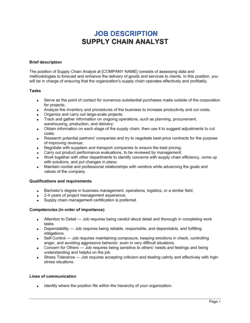
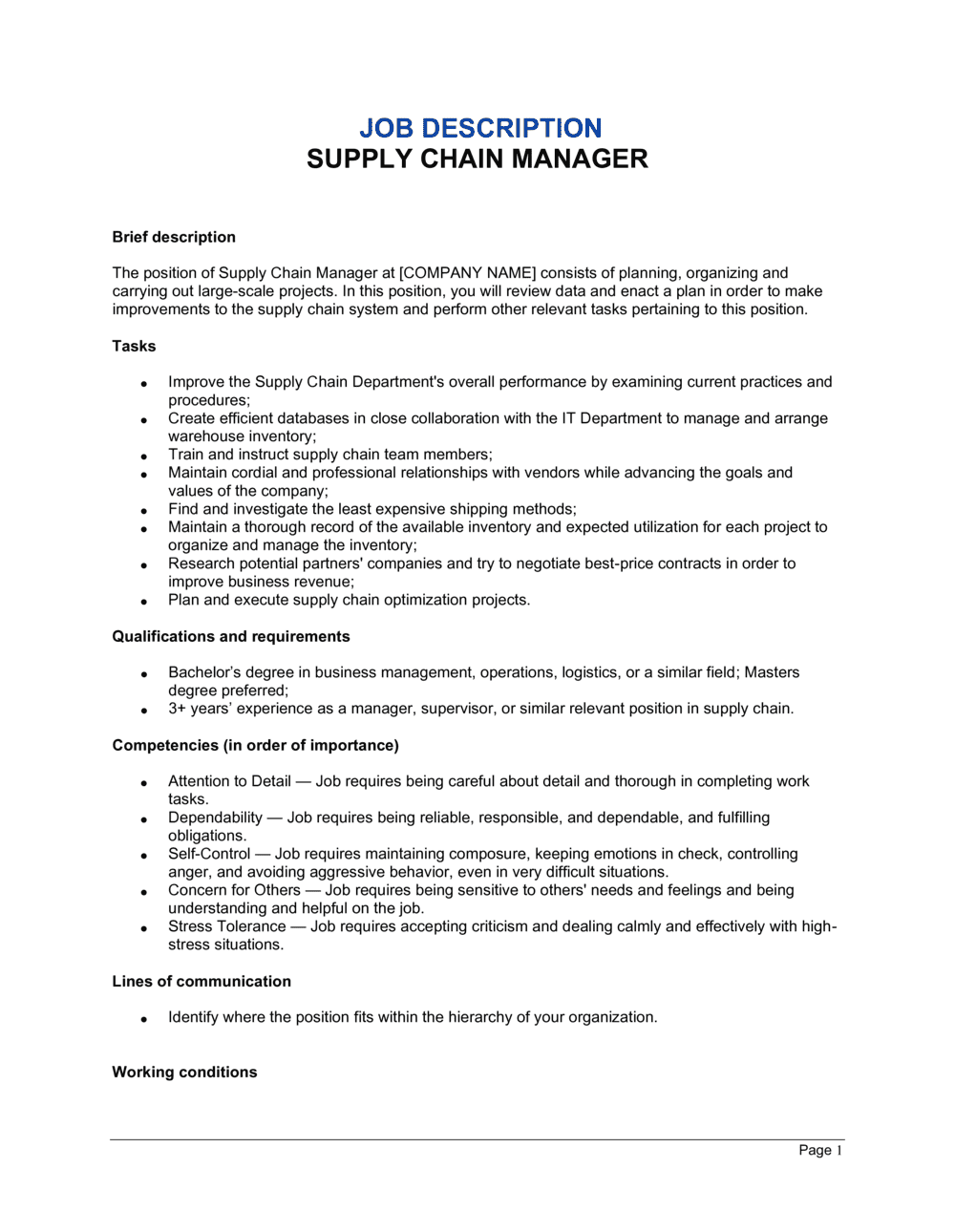
Supply Chain Manager Job Description Template

Free Word download β€’ Edit online β€’ Save & share with Drive β€’ Export to PDF

2 pagesβ€’20–30 min to fillβ€’Difficulty: Standardβ€’Signature requiredβ€’Legal review recommended
Learn more ↓
FreeSupply Chain Manager Job Description Template

At a glance

What it is
A Supply Chain Manager Job Description is a formal document that defines the scope, duties, qualifications, reporting structure, and compensation expectations for a supply chain management role within an organization. This free Word download gives you a professionally structured template you can edit online and export as PDF to post publicly, include in offer packages, or attach to an employment contract.
When you need it
Use it when opening or backfilling a supply chain manager position, restructuring your operations team, or standardizing role definitions across multiple facilities or business units. It is also required when submitting job postings to recruitment agencies or integrating the position into a formal workforce plan.
What's inside
Role title and reporting line, position summary, core duties and responsibilities, required and preferred qualifications, key performance indicators, compensation range, work environment requirements, and equal employment opportunity statement.

What is a Supply Chain Manager Job Description?

A Supply Chain Manager Job Description is a formal document that defines the scope, reporting structure, core duties, qualifications, performance standards, and compensation expectations for a supply chain management position within an organization. It functions simultaneously as a recruitment tool β€” posted to attract qualified candidates β€” and as a binding reference document signed by the hired employee and filed alongside the employment contract. A well-constructed job description establishes clear, measurable expectations before day one, giving both employer and employee a shared understanding of what success looks like in the role and how it will be evaluated.

Why You Need This Document

Hiring a supply chain manager without a clearly documented job description creates four concrete problems. First, without defined KPIs and duties, performance reviews become subjective, making it legally difficult to support a termination decision if the hire underperforms. Second, vague or inflated qualification requirements reduce your candidate pool unnecessarily and may expose the organization to disparate-impact claims under applicable employment discrimination law. Third, in an increasing number of US states and under the incoming EU Pay Transparency Directive, publishing a job posting without a salary range is a regulatory violation β€” not merely a best practice gap. Fourth, an unsigned job description cannot be used as evidence of agreed duties if a dispute arises. This template gives you a professionally structured, jurisdiction-aware starting point that covers every required element β€” from EEO statement to signature block β€” so you can post with confidence, hire with clarity, and manage performance against documented standards from the first day of employment.

Which variant fits your situation?

If your situation is…Use this template
Hiring a senior leader overseeing global procurement and logisticsVP of Supply Chain Job Description
Recruiting a hands-on coordinator focused on order tracking and vendor communicationSupply Chain Coordinator Job Description
Filling a specialist role focused exclusively on inbound procurementProcurement Manager Job Description
Hiring for a distribution center or third-party logistics operationLogistics Manager Job Description
Defining a warehouse operations role within the supply chain functionWarehouse Manager Job Description
Recruiting a temporary or contract supply chain resource for a projectIndependent Contractor Agreement
Attaching the job description to a binding offer of employmentEmployment Agreement

Common mistakes to avoid

❌ Setting artificially high education requirements

Why it matters: Requiring a master's degree or specific credential when the role does not genuinely need it shrinks the candidate pool and can expose the employer to disparate-impact discrimination claims under Title VII or equivalent statutes.

Fix: Benchmark requirements against the last three successful hires in comparable roles and against competitor postings. Remove any credential requirement that cannot be justified by actual job duties.

❌ Omitting measurable KPIs from the document

Why it matters: Without defined performance benchmarks, annual reviews become subjective and any termination for underperformance becomes legally difficult to document and defend.

Fix: Add 4–6 specific, measurable KPIs tied to core duties β€” on-time delivery rate, inventory accuracy, supplier scorecard results β€” and mirror these in the performance review template.

❌ Not obtaining an employee signature on the job description

Why it matters: An unsigned job description leaves the employer unable to prove the employee knew what was expected, weakening performance improvement plans and termination documentation.

Fix: Include a signature block and obtain the employee's signed acknowledgment at or before the start date. File the signed copy with the employment contract.

❌ Publishing a salary range that violates pay-transparency laws

Why it matters: California, New York, Colorado, Washington, and other jurisdictions require salary ranges in job postings. Non-compliance triggers regulatory penalties and signals poor HR governance to candidates.

Fix: Confirm pay-transparency requirements for every state or country where the posting will be visible β€” not just where the employer is headquartered β€” and include the required range before publishing.

❌ Treating preferred qualifications as hidden required criteria during screening

Why it matters: Filtering out all candidates who lack preferred attributes defeats the two-tier qualification structure, reduces diversity, and may result in screening out qualified candidates who could outperform peers with the preferred credential.

Fix: Train screeners explicitly on the difference between required and preferred criteria. Use preferred qualifications only as tiebreakers among candidates who meet all required thresholds.

❌ Using an outdated EEO statement

Why it matters: Protected categories under federal, state, and local law have expanded in recent years. An EEO statement that omits gender identity, sexual orientation, or other recognized categories creates compliance exposure and reputational risk.

Fix: Review and update your EEO statement at least annually against current EEOC guidance and applicable state and local human rights legislation.

The 10 key clauses, explained

Role title and reporting structure

In plain language: States the official job title, the department it sits in, and the direct supervisor. Also specifies the number and nature of direct reports, if any.

Sample language
Job Title: Supply Chain Manager | Department: Operations | Reports To: VP of Operations | Direct Reports: [NUMBER] supply chain coordinators and [NUMBER] logistics analysts.

Common mistake: Using an informal working title instead of the official HR-registered job title. Mismatches between job postings and payroll records create classification disputes and complicate background checks.

Position summary

In plain language: A 3–5 sentence paragraph describing what the role does, the business function it serves, and the organizational impact it is expected to have.

Sample language
The Supply Chain Manager is responsible for overseeing end-to-end supply chain operations at [COMPANY NAME], including procurement, inventory management, demand planning, and logistics. This role ensures the uninterrupted flow of materials and finished goods to meet customer delivery commitments while achieving cost and quality targets.

Common mistake: Writing a position summary that duplicates the duties list rather than providing a strategic framing of why the role exists. Candidates and hiring managers both use the summary to assess role fit at a glance.

Core duties and responsibilities

In plain language: A structured list of the primary tasks the role is accountable for, written in action-verb format and organized by function or priority.

Sample language
Manage relationships with [NUMBER] tier-1 suppliers, negotiating contracts and monitoring delivery performance against agreed SLAs. Oversee inventory planning processes to maintain [TARGET] days of supply across [NUMBER] SKUs. Lead weekly S&OP (sales and operations planning) meetings with cross-functional stakeholders.

Common mistake: Listing over 20 bullet-point duties without grouping them by function. An undifferentiated wall of tasks makes it impossible for candidates to understand what the role actually prioritizes.

Required qualifications

In plain language: The minimum education, years of experience, technical skills, and certifications a candidate must hold to be considered for the role.

Sample language
Bachelor's degree in Supply Chain Management, Business, Engineering, or a related field. Minimum [X] years of progressive supply chain experience, including at least [X] years in a management role. Proficiency in ERP systems (SAP, Oracle, or equivalent). APICS CPIM or CSCP certification required.

Common mistake: Setting education requirements higher than the role actually demands β€” for example, requiring a master's degree for a coordinator-level role. This reduces the candidate pool and may expose the employer to disparate-impact discrimination claims.

Preferred qualifications

In plain language: Additional skills, experiences, or credentials that differentiate stronger candidates but do not disqualify applicants who lack them.

Sample language
Experience managing supply chains in [INDUSTRY]. Familiarity with lean manufacturing or Six Sigma methodologies. Working knowledge of customs regulations and international trade compliance. Experience with demand-sensing or AI-powered planning tools.

Common mistake: Treating preferred qualifications as hidden requirements during screening. Filtering out candidates who lack preferred attributes defeats the purpose of the two-tier qualification structure and narrows diversity.

Key performance indicators (KPIs)

In plain language: Quantitative metrics the role holder will be measured against, tied directly to the core responsibilities of the position.

Sample language
On-time, in-full (OTIF) delivery rate: target [X]%. Inventory carrying cost as a percentage of revenue: target [X]%. Supplier on-time delivery: target [X]%. Days inventory outstanding (DIO): target [X] days.

Common mistake: Including no KPIs at all, or stating only vague outcomes like 'improve supply chain performance.' Without measurable benchmarks, performance reviews become subjective and termination-for-cause decisions become legally difficult to defend.

Compensation and benefits

In plain language: States the base salary range, bonus eligibility, and a reference to the company benefits program, without binding the employer to specific plan terms.

Sample language
Base Salary: $[MINIMUM] – $[MAXIMUM] per year, commensurate with experience. Eligible for an annual discretionary performance bonus of up to [X]% of base salary. Benefits: medical, dental, vision, 401(k) with [X]% employer match, and [X] days PTO, subject to plan terms in effect from time to time.

Common mistake: Specifying exact benefit plan details β€” coverage levels, deductible amounts, or match percentages β€” in the job description. When plans change annually, the published description creates an expectation the employer may no longer be able to honor.

Work environment and physical requirements

In plain language: Describes the physical setting (office, warehouse, hybrid, remote), travel expectations, and any physical demands relevant to the role.

Sample language
This role is based at [LOCATION]. Regular visits to [WAREHOUSE / DISTRIBUTION CENTER / SUPPLIER SITES] are required, averaging [X]% travel. The role may require standing for extended periods in a warehouse environment and the ability to lift up to [X] lbs.

Common mistake: Omitting physical requirements entirely for roles that include warehouse or site visits. If a physical requirement is job-essential and undisclosed, accommodation disputes are harder to resolve and ADA compliance becomes more complex.

Equal employment opportunity statement

In plain language: A standard declaration that the company does not discriminate on the basis of protected characteristics and, where applicable, is an affirmative action employer.

Sample language
[COMPANY NAME] is an Equal Opportunity Employer. All qualified applicants will receive consideration for employment without regard to race, color, religion, sex, sexual orientation, gender identity, national origin, disability, or veteran status.

Common mistake: Using an outdated EEO statement that omits protected categories added by recent legislation or executive orders β€” such as gender identity and sexual orientation β€” exposing the employer to compliance risk.

Acknowledgment and signature block

In plain language: A section for the hiring manager and the hired employee to sign and date, confirming receipt, review, and agreement to the role as described.

Sample language
I have read and understood the responsibilities and requirements of this position. Employee Signature: _______________ Date: ________ | Hiring Manager Signature: _______________ Date: ________

Common mistake: Treating the job description as an internal-only document and never obtaining an employee signature. Without a signed acknowledgment, employees can claim they were unaware of specific duties, complicating performance management and termination documentation.

How to fill it out

  1. 1

    Enter the official role title and reporting line

    Use the HR-registered job title and confirm the reporting hierarchy with your organizational chart. List all direct reports by title, not name.

    πŸ’‘ Verify the title matches the payroll system before posting. A mismatch between posted title and employment records creates classification headaches during onboarding.

  2. 2

    Write the position summary

    Draft 3–5 sentences that describe why the role exists, the business function it serves, and the scope of its authority. Focus on organizational impact, not task enumeration.

    πŸ’‘ Write the summary last β€” after drafting duties and KPIs β€” so it accurately reflects the full scope rather than a vague aspiration.

  3. 3

    List core duties grouped by function

    Organize responsibilities into 4–6 functional clusters (procurement, inventory, logistics, team management, reporting). Use action verbs and aim for 10–15 bullets total.

    πŸ’‘ Limit each bullet to one distinct responsibility. Combined bullets β€” 'manage vendors and negotiate contracts and track performance' β€” make scope ambiguous and KPI-setting impossible.

  4. 4

    Define required and preferred qualifications separately

    Set required qualifications at the true minimum for competent performance. Add preferred qualifications for attributes that would accelerate onboarding or strengthen the team without being eliminatory.

    πŸ’‘ Audit your required qualifications against your last three successful hires in similar roles. If none of them held a requirement you're listing, it may not be genuinely required.

  5. 5

    Set measurable KPIs for the role

    Identify 4–6 metrics the role will be formally evaluated against. Use existing operational benchmarks as starting targets, then refine with the hiring manager.

    πŸ’‘ KPIs in the job description should match the KPIs in the performance review template. Misalignment between the two documents is a common source of termination disputes.

  6. 6

    Enter the compensation range and benefits reference

    State the salary band minimum and maximum. Reference benefits by category only β€” do not list specific plan details. Mark bonus as discretionary unless it is guaranteed.

    πŸ’‘ Comply with applicable pay-transparency laws before publishing. As of 2025, California, New York, Colorado, Washington, and several other states require salary ranges in job postings.

  7. 7

    Add the work environment and EEO statement

    Describe the physical setting, travel percentage, and any physical demands. Append your current EEO statement β€” confirm it includes all federally and state-required protected categories.

    πŸ’‘ Review your EEO statement annually. Protected categories have expanded in several jurisdictions in recent years, and an outdated statement creates compliance exposure.

  8. 8

    Obtain signatures before or at the offer stage

    Have the hiring manager sign before the role is posted to confirm internal approval. Have the employee sign at or before the start date to acknowledge duties and performance expectations.

    πŸ’‘ Store the signed job description alongside the executed employment contract in the employee's HR file. It forms part of the foundational documentation for any future performance or termination action.

Frequently asked questions

What is a supply chain manager job description?

A supply chain manager job description is a formal document that defines the duties, reporting structure, qualifications, KPIs, and compensation expectations for a supply chain management role. It serves as both a recruiting tool β€” posted publicly to attract candidates β€” and a binding reference document attached to the employment offer and signed by the hired employee. A well-drafted description sets clear performance expectations from day one and supports objective performance reviews.

What should a supply chain manager job description include?

A complete supply chain manager job description covers ten elements: the official role title and reporting line, a position summary, core duties grouped by function, required qualifications, preferred qualifications, measurable KPIs, compensation range, benefits reference, work environment and travel requirements, an EEO statement, and a signature block. Missing any of these β€” especially KPIs and the signature block β€” creates gaps that surface during performance management or legal disputes.

Is a job description a legally binding document?

A job description is generally not a standalone employment contract, but it can carry legal weight when signed by the employee and incorporated by reference into an employment agreement. Courts in several jurisdictions have treated signed job descriptions as evidence of agreed-upon duties and performance standards. Unsigned descriptions carry less legal weight but still form part of the employer's documentation in wrongful termination or discrimination disputes. Always have the employee sign and date it.

What qualifications should a supply chain manager have?

Required qualifications typically include a bachelor's degree in supply chain management, business, or engineering; 5–8 years of progressive supply chain experience with at least 2–3 years in a management role; proficiency in an ERP system such as SAP or Oracle; and an APICS CPIM or CSCP certification for mid-to-large organizations. Preferred qualifications often include lean or Six Sigma experience, international trade compliance knowledge, and familiarity with AI-powered demand planning tools.

What KPIs should be included for a supply chain manager role?

The most commonly used KPIs for a supply chain manager are on-time, in-full (OTIF) delivery rate, inventory carrying cost as a percentage of revenue, days inventory outstanding (DIO), supplier on-time delivery rate, purchase order cycle time, and freight cost per unit shipped. Select 4–6 metrics that correspond directly to the role's core duties and set baseline targets from historical operational data before the hire begins.

Do I need to include a salary range in a supply chain manager job posting?

Pay-transparency laws in California, New York, Colorado, Washington, and several other US states require employers to include salary ranges in job postings, including remote postings visible to residents of those states. Even where not legally required, publishing a compensation band reduces unqualified applications and shortens the offer negotiation cycle. Always confirm the current requirements in each jurisdiction where the posting will be visible before publishing.

How is a supply chain manager job description different from an employment contract?

A job description defines the scope, duties, and performance expectations of a role. An employment contract is the legally binding agreement governing compensation, IP assignment, confidentiality, non-compete restrictions, termination notice, and severance. The job description is typically attached as a schedule to the employment contract and incorporated by reference. Using a job description as a substitute for an employment contract leaves significant legal gaps around restrictive covenants and termination terms.

Can I use the same job description for multiple locations or facilities?

A single base template can be used across locations, but it must be reviewed and adjusted for each jurisdiction's specific legal requirements β€” including pay-transparency laws, physical requirements disclosures, and EEO statement language. Roles at different facilities may also have materially different KPIs, reporting structures, or scope; using an identical description for structurally different roles creates performance management inconsistencies and potential pay-equity issues.

How often should a supply chain manager job description be updated?

Review and update the job description whenever the role's scope changes materially β€” such as when the organization restructures, adds a new distribution channel, or changes ERP systems. At minimum, review it annually as part of the performance cycle. An outdated description that no longer reflects actual duties creates friction in performance reviews, complicates promotion decisions, and weakens documentation if a performance-based termination is challenged.

How this compares to alternatives

vs Employment Contract

An employment contract is the binding legal agreement governing compensation, IP rights, confidentiality, non-compete restrictions, and termination terms. A job description defines scope and duties but does not replace contractual protections. The two documents work together β€” the job description is typically attached as a schedule to the employment contract and signed alongside it.

vs Offer Letter

An offer letter confirms the role, start date, and compensation to secure a candidate's acceptance before onboarding. A job description provides the operational detail β€” duties, KPIs, qualifications, and performance standards β€” that the offer letter omits. Candidates should receive both before signing, and both should be filed in the employee record.

vs Procurement Manager Job Description

A procurement manager job description focuses narrowly on sourcing, vendor selection, contract negotiation, and purchasing processes. A supply chain manager job description spans the full end-to-end supply chain β€” procurement, inventory, logistics, demand planning, and S&OP. Use the procurement variant when the role has no logistics or inventory accountability.

vs Warehouse Manager Job Description

A warehouse manager job description defines operational accountability for a specific distribution facility β€” inbound receiving, storage, pick-pack, and outbound shipping. A supply chain manager oversees the strategic and cross-functional layer above individual facilities, including supplier relationships, demand planning, and network-level logistics decisions. The two roles often coexist, with the warehouse manager reporting to the supply chain manager.

Industry-specific considerations

Manufacturing

Emphasis on raw material procurement, production scheduling integration, supplier quality management, and capacity planning tied to plant output targets.

Retail and e-commerce

Focus on demand forecasting accuracy, omnichannel fulfillment, returns management, and carrier performance against last-mile delivery SLAs.

Food and beverage

Cold-chain integrity, perishable inventory management, food safety compliance documentation, and supplier certification requirements drive role-specific KPIs.

Healthcare and medical devices

FDA traceability requirements, lot control, consignment inventory management at hospital sites, and compliance with ISO 13485 or equivalent standards shape qualification requirements.

Technology and electronics

Component shortage management, contract manufacturing oversight, global logistics coordination across multiple time zones, and export control compliance.

Professional services and consulting

Procurement of third-party vendors, subcontractor management, and project-based resource supply coordination rather than physical goods logistics.

Jurisdictional notes

United States

Pay-transparency laws in California, Colorado, New York, Washington, and other states require salary ranges in job postings, including remote postings visible to residents of those states. FLSA classification (exempt vs. non-exempt) must be confirmed before posting β€” supply chain managers typically qualify as exempt under the executive or administrative exemption but the duties test must be satisfied. EEO statements must reflect current EEOC guidance, including gender identity and sexual orientation as protected categories.

Canada

Canadian Human Rights Act and provincial human rights codes prohibit discrimination on protected grounds in job postings and screening. Several provinces, including Ontario and British Columbia, have introduced or are considering pay-transparency requirements. Quebec postings must be available in French for provincially regulated employers. The job description should avoid language that could be construed as requiring characteristics protected under applicable human rights legislation.

United Kingdom

The Equality Act 2010 prohibits discriminatory requirements in job descriptions β€” qualifications must be objectively justifiable as occupational requirements. IR35 rules are relevant if the supply chain manager role may be engaged through a personal service company rather than direct employment. The job description should be reviewed against the employer's gender pay gap reporting obligations where the organization employs 250 or more people.

European Union

The EU Pay Transparency Directive (2023/970) requires member states to implement salary disclosure obligations in job postings by June 2026. GDPR applies to the collection and processing of candidate personal data during the recruitment process β€” include a data processing notice or link in any application flow. Works council consultation may be required before posting or restructuring roles in Germany, France, and the Netherlands.

Template vs lawyer β€” what fits your deal?

PathBest forCostTime
Use the templateHR teams and hiring managers creating standard domestic supply chain manager postings with straightforward scopeFree30–60 minutes
Template + legal reviewMulti-state or multi-country postings, roles with equity, or organizations in regulated industries requiring compliance-specific language$200–$500 (HR consultant or employment lawyer review)1–3 days
Custom draftedExecutive-level supply chain hires with equity, restrictive covenants, or complex cross-border employment arrangements$500–$2,000+1–2 weeks

Glossary

Job Description
A formal document outlining the duties, qualifications, reporting structure, and compensation expectations for a specific role within an organization.
KPI (Key Performance Indicator)
A measurable metric used to evaluate whether a role holder is meeting defined performance standards β€” for example, on-time delivery rate or inventory accuracy.
Reporting Line
The direct supervisory relationship defining who the role holder reports to and, where applicable, who reports to them.
At-Will Employment
An employment arrangement β€” common in most US states β€” where either party may end the relationship at any time for any lawful reason without advance notice.
FLSA Classification
The determination under the US Fair Labor Standards Act of whether a role is exempt or non-exempt from overtime pay requirements.
EEO Statement
An Equal Employment Opportunity statement affirming that the employer does not discriminate on the basis of protected characteristics such as race, gender, age, or disability.
Scope of Role
The defined boundary of a position's authority, accountability, and decision-making power within the organizational structure.
Competency Framework
A structured set of skills, behaviors, and knowledge areas used to evaluate candidates against a defined performance standard for the role.
Span of Control
The number of direct reports a manager is accountable for supervising, which determines the role's organizational weight and compensation band.
Preferred vs. Required Qualifications
Required qualifications are minimum thresholds a candidate must meet; preferred qualifications are additional attributes that differentiate stronger candidates but are not eliminatory.
Compensation Band
The defined salary range for a role, typically expressed as a minimum, midpoint, and maximum, used to guide offers and manage internal pay equity.

Part of your Business Operating System

This document is one of 3,000+ business & legal templates included in Business in a Box.

  • Fill-in-the-blanks β€” ready in minutes
  • 100% customizable Word document
  • Compatible with all office suites
  • Export to PDF and share electronically

Create your document in 3 simple steps.

From template to signed document β€” all inside one Business Operating System.
1
Download or open template

Access over 3,000+ business and legal templates for any business task, project or initiative.

2
Edit and fill in the blanks with AI

Customize your ready-made business document template and save it in the cloud.

3
Save, Share, Send, Sign

Share your files and folders with your team. Create a space of seamless collaboration.

Save time, save money, and create top-quality documents.

β˜…β˜…β˜…β˜…β˜…

"Fantastic value! I'm not sure how I'd do without it. It's worth its weight in gold and paid back for itself many times."

Managing Director Β· Mall Farm
Robert Whalley
Managing Director, Mall Farm Proprietary Limited
β˜…β˜…β˜…β˜…β˜…

"I have been using Business in a Box for years. It has been the most useful source of templates I have encountered. I recommend it to anyone."

Business Owner Β· 4+ years
Dr Michael John Freestone
Business Owner
β˜…β˜…β˜…β˜…β˜…

"It has been a life saver so many times I have lost count. Business in a Box has saved me so much time and as you know, time is money."

Owner Β· Upstate Web
David G. Moore Jr.
Owner, Upstate Web

Run your business with a system β€” not scattered tools

Stop downloading documents. Start operating with clarity. Business in a Box gives you the Business Operating System used by over 250,000 companies worldwide to structure, run, and grow their business.

Free Forever PlanΒ Β·Β No credit card required