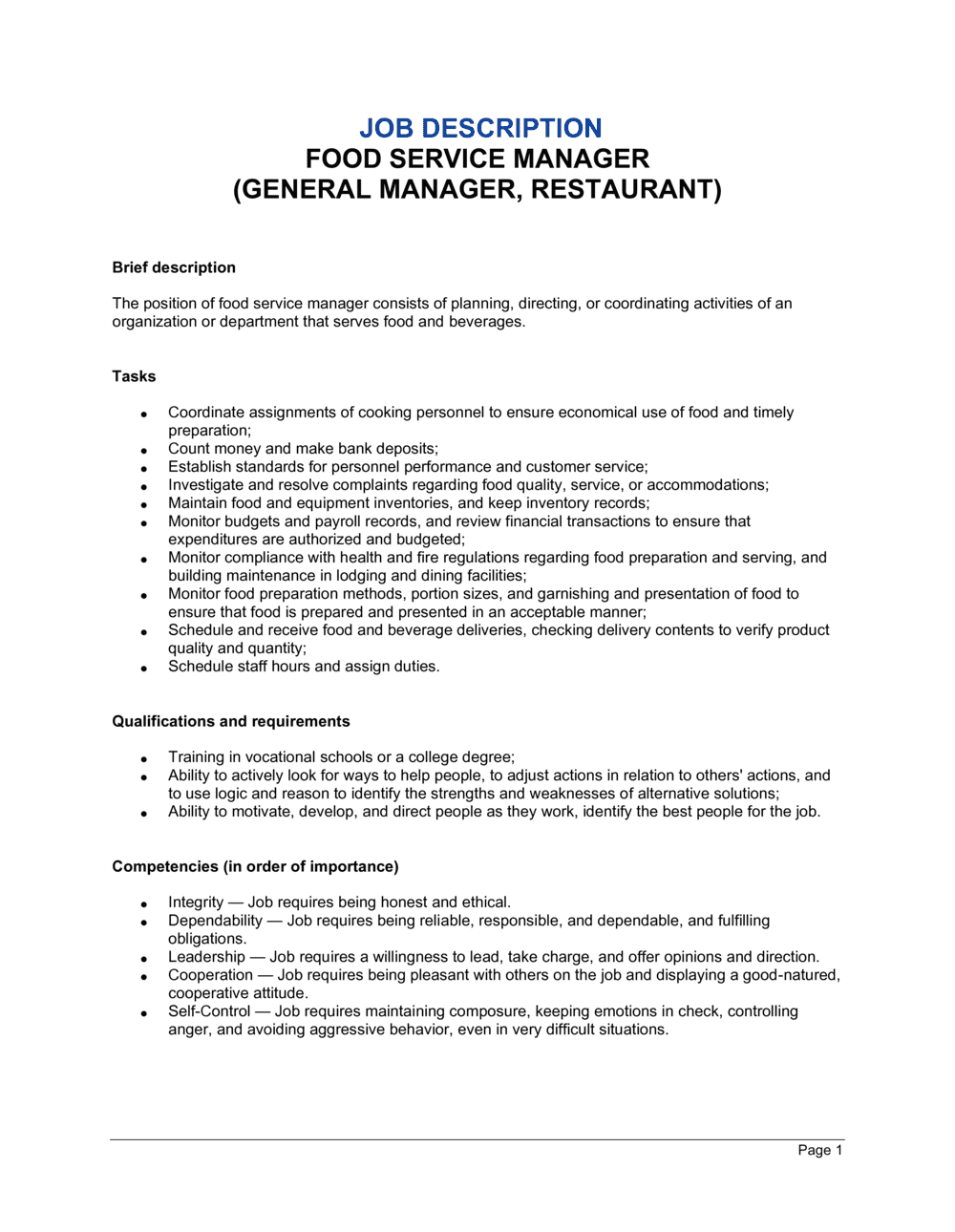
Food Service Manager (General Manager, Restaurant) Job Description Template

Free Word download • Edit online • Save & share with Drive • Export to PDF

2 pages20–30 min to fillDifficulty: StandardSignature requiredLegal review recommended
Learn more ↓
FreeFood Service Manager (General Manager, Restaurant) Job Description Template

At a glance

What it is
A Food Service Manager (General Manager Restaurant) Job Description is a binding employment document that defines the full scope of a restaurant general manager's role — duties, authority, qualifications, reporting structure, and performance expectations. This free Word download gives hospitality employers a professionally structured, legally defensible starting point they can edit online and export as PDF for offer packages and personnel files.
When you need it
Use it when hiring or replacing a general manager for a restaurant, food service operation, catering company, or multi-unit hospitality group. It is also appropriate when formalizing an existing manager's role after a promotion or operational restructure.
What's inside
Position summary, reporting structure, core responsibilities across front-of-house and back-of-house operations, staff management duties, financial accountability, compliance obligations, required qualifications and certifications, and compensation and benefits overview.

What is a Food Service Manager (General Manager Restaurant) Job Description?

A Food Service Manager Job Description is a formal employment document that defines the full scope of a restaurant general manager's role — covering position title, reporting structure, operational duties, financial accountability, staff management authority, regulatory compliance obligations, required certifications, physical requirements, and compensation terms. Unlike a casual offer letter, a properly drafted GM job description creates a documented, mutually acknowledged standard of performance that governs the employment relationship from day one. It functions simultaneously as a hiring tool, a performance management benchmark, and a legally defensible record of what both parties agreed the role required.

Why You Need This Document

Hiring a restaurant general manager without a comprehensive, signed job description exposes your business to four compounding risks. First, without specific financial benchmarks — food cost targets, labor cost thresholds, spending authority limits — you have no enforceable standard for a performance improvement plan or termination when a GM underperforms financially. Second, omitting the at-will disclaimer in a US jurisdiction converts a detailed duty list into an implied employment contract, a mistake courts have ruled against employers in wrongful termination cases. Third, failing to document physical requirements and schedule expectations removes the paper trail needed when an accommodation request or scheduling dispute arises. Fourth, vague or unsigned job descriptions leave the employer unable to define the "cause" standard if a termination is challenged. This template gives restaurant owners, franchise operators, and hospitality HR teams a professionally structured, jurisdiction-aware starting point that closes all four gaps — in the time it takes to fill in the blanks.

Which variant fits your situation?

If your situation is…Use this template
Hiring a GM for a single independent full-service restaurantFood Service Manager Job Description
Hiring a front-of-house manager who reports to the GMRestaurant Floor Manager Job Description
Defining the role of an executive chef with P&L responsibilityExecutive Chef Job Description
Hiring a catering manager for event-based food serviceCatering Manager Job Description
Hiring a district or area manager overseeing multiple locationsArea Manager Job Description
Documenting the full employment relationship beyond the job descriptionEmployment Contract
Hiring a bar manager with beverage P&L responsibilityBar Manager Job Description

Common mistakes to avoid

❌ Omitting the at-will disclaimer in US jurisdictions

Why it matters: Detailed job descriptions with specific performance standards have been found by courts to create implied employment contracts, exposing employers to wrongful termination claims when a GM is let go without cause.

Fix: Add a clear at-will disclaimer in the final section: 'This job description does not constitute an employment contract. Employment is at-will and may be terminated by either party at any time for any lawful reason.'

❌ No specific financial performance benchmarks

Why it matters: A GM held accountable for financial results needs defined targets. Without them, performance improvement plans and terminations for financial underperformance are nearly impossible to defend.

Fix: Enter specific food cost percentage targets, labor cost percentage targets, and revenue benchmarks aligned to the actual operating budget before presenting the offer.

❌ Skipping physical requirements and schedule expectations

Why it matters: Omitting physical demands removes the employer's ADA and human rights code documentation trail when an accommodation request is made, and creates disputes when the GM objects to weekend or holiday availability requirements.

Fix: Document specific physical demands (lifting weight, standing duration, heat exposure) and state schedule expectations including nights, weekends, and holidays using 'with or without reasonable accommodation' language.

❌ Granting termination authority without a compliance caveat

Why it matters: An uncaveated statement that the GM may 'hire and terminate staff' signals to the GM that they have unlimited discretion, increasing the risk of discriminatory or procedurally deficient terminations the employer must defend.

Fix: Add language tying termination authority to company policy and applicable employment law: 'consistent with [COMPANY] HR policy and applicable federal, state, and local employment law.'

❌ Listing qualifications that are applied inconsistently

Why it matters: Requiring a four-year degree for one candidate and waiving it for another of a different protected class is a textbook disparate-treatment discrimination claim waiting to be filed.

Fix: Review every qualification listed against your actual hiring history. Only include requirements you apply uniformly — if you routinely waive a degree requirement for experienced candidates, list 'degree or equivalent experience.'

❌ Signing the job description after the employee's start date

Why it matters: In common-law jurisdictions, post-start-date signatures lack fresh consideration, potentially voiding any restrictive provisions included in or referenced by the description.

Fix: Execute the signed job description on or before day one. If timing requires a post-start signature, document a specific benefit — a signing bonus, additional PTO, or a pay increase — as fresh consideration.

The 10 key clauses, explained

Position title and reporting structure

In plain language: States the official job title, the location or locations covered, and the direct reporting line — both who the GM reports to and which positions report to the GM.

Sample language
Position: General Manager — [RESTAURANT NAME]. Reports to: [OWNER / REGIONAL DIRECTOR / VP OPERATIONS]. Direct reports include: [KITCHEN MANAGER], [FRONT-OF-HOUSE SUPERVISOR], and all hourly staff at [LOCATION ADDRESS].

Common mistake: Listing a reporting line to a generic title like 'management' rather than a specific role. Ambiguous reporting structures create authority disputes and undermine the GM's ability to make operational decisions.

Position summary and authority scope

In plain language: A 3–5 sentence overview of the role's purpose — the outcomes the GM owns and the level of decision-making authority granted, including hiring, termination, and budget authority.

Sample language
The General Manager is accountable for the overall operation of [RESTAURANT NAME], including financial performance, team management, guest experience, and regulatory compliance. The GM has authority to hire and terminate hourly employees, approve schedules, and authorize expenditures up to $[AMOUNT] without additional approval.

Common mistake: Omitting dollar-threshold authority limits. Without a defined spending limit, finance and ownership have no clear control point, leading to unauthorized purchases and budget overruns.

Core operational duties

In plain language: Itemizes the day-to-day management responsibilities across front-of-house and back-of-house operations — opening and closing procedures, floor presence, shift management, and service standards.

Sample language
Duties include overseeing all daily operations including opening and closing procedures, monitoring service quality during peak periods, conducting pre-shift briefings, resolving guest complaints at point of contact, and ensuring facility cleanliness meets [HEALTH DEPARTMENT / BRAND] standards.

Common mistake: Writing duties as outcomes ('ensure guest satisfaction') without defining the specific behaviors or processes required. Outcome-only descriptions make performance management subjective and difficult to document for disciplinary purposes.

Financial management and P&L accountability

In plain language: Defines the GM's responsibility for revenue targets, cost controls (food cost, labor cost, waste), cash handling, and reporting cadence to ownership or corporate.

Sample language
The GM is responsible for achieving a weekly food cost below [X]% of net sales and a labor cost below [X]% of net sales. The GM will prepare and submit a weekly P&L variance report to [OWNER / REGIONAL DIRECTOR] by [DAY] each week and is accountable for all cash handling procedures and end-of-shift reconciliation.

Common mistake: Not specifying target cost percentages. A job description that says 'manage food and labor costs' without benchmarks gives the GM no measurable standard and makes performance reviews contentious.

Staff hiring, training, and performance management

In plain language: Covers the GM's authority and responsibility for recruiting, onboarding, scheduling, coaching, disciplining, and terminating hourly and supervisory staff in compliance with employment law.

Sample language
The GM is responsible for all hourly staffing decisions including recruitment, selection, onboarding, scheduling, performance counseling, and termination consistent with [COMPANY] policy and applicable employment law. The GM will conduct quarterly performance reviews for all direct reports using the company-approved evaluation form.

Common mistake: Granting termination authority without referencing compliance with company policy and employment law. An uncaveated termination clause creates employer liability if the GM terminates an employee without following proper procedure.

Food safety and regulatory compliance

In plain language: States the GM's responsibility for maintaining compliance with local health codes, HACCP protocols, food handler certification requirements, alcohol licensing conditions (if applicable), and any brand standards audits.

Sample language
The GM ensures all food handling, storage, and preparation practices comply with [STATE/PROVINCE] food safety regulations and HACCP standards. The GM maintains a current [ServSafe / equivalent] certification and ensures all food handlers hold valid food handler cards. The GM is the primary contact for health department inspections.

Common mistake: Listing compliance as a general responsibility without naming the specific regulatory framework. Vague compliance language does not put the employee on notice of the specific standards they are accountable for meeting.

Guest experience and service standards

In plain language: Defines measurable expectations for guest satisfaction, complaint resolution authority, review monitoring, and the GM's personal floor presence obligations.

Sample language
The GM maintains a minimum average guest satisfaction score of [X/5] on [PLATFORM] and responds to all negative reviews within [48] hours per company policy. The GM is expected to be present on the floor during peak service periods no fewer than [X] shifts per week.

Common mistake: Setting guest satisfaction standards without specifying the platform or measurement method. 'Maintain high guest satisfaction' is unenforceable without a defined metric and tracking source.

Required qualifications and certifications

In plain language: Lists the minimum education, experience, licenses, and certifications required to be eligible for the role — including food safety certifications, alcohol server certifications, and any state-specific manager licenses.

Sample language
Minimum qualifications: [X] years of restaurant management experience, including at least [X] years as a general manager or equivalent; current [ServSafe Manager / equivalent] certification; [TIPS / Smart Serve / equivalent] alcohol service certification where required by law; valid driver's license (if required for the role).

Common mistake: Setting qualification requirements so high that they exclude otherwise qualified candidates, or so low that they invite underqualified applicants and trigger discrimination claims if requirements are applied inconsistently.

Physical requirements and working conditions

In plain language: Documents the physical demands of the role — standing, lifting, heat exposure — and the expected schedule including evenings, weekends, and holidays. This section has ADA and human rights code significance.

Sample language
The GM must be able to stand and walk for up to [8] hours per shift, lift up to [50 lbs], and work in a commercial kitchen environment with exposure to heat, noise, and wet floors. The role requires availability to work evenings, weekends, and holidays as business needs require.

Common mistake: Skipping physical requirements entirely to avoid the awkwardness of the conversation. Omitting them removes the employer's ADA/accommodation documentation trail and creates inconsistency when accommodation requests arise later.

Compensation, benefits, and at-will acknowledgment

In plain language: States the base salary or hourly rate, bonus or incentive structure, benefits eligibility, and — in US contexts — the at-will employment acknowledgment that the job description does not constitute a contract of employment.

Sample language
Compensation: $[X] per year / $[X] per hour. Bonus eligibility: up to [X]% of base salary based on P&L performance targets. Benefits: as outlined in the current employee handbook. This job description does not constitute an employment contract and employment is at-will unless otherwise stated in a separate written agreement.

Common mistake: Omitting the at-will disclaimer in US job descriptions. Courts have found that specific performance standards and detailed duty lists in job descriptions create implied-contract claims when no disclaimer is present.

How to fill it out

  1. 1

    Enter the restaurant name, location, and entity details

    Add the full legal entity name of the employer (not just the brand name), the specific location address, and the date the description takes effect. This ties the document to the right legal employer.

    💡 If the GM will oversee multiple locations, list each address or define the territory explicitly — authority over unnamed locations is frequently disputed.

  2. 2

    Define the reporting structure precisely

    Identify the specific title the GM reports to (e.g., Owner, Regional Director of Operations) and list the direct report positions by title. Avoid generic labels like 'senior management.'

    💡 If the GM will rotate between a dotted-line and solid-line reporting relationship (common in franchise structures), document both in this section.

  3. 3

    Set financial targets and authority thresholds

    Enter specific food cost and labor cost percentage targets, the discretionary spending limit the GM can approve without escalation, and the reporting cadence for P&L variance reports.

    💡 Align these numbers with your actual operating budget before finalizing — targets that differ from the financial model create an immediate credibility problem with the incoming GM.

  4. 4

    List all required certifications and licenses

    Identify the specific food safety certification required in your state, province, or country (ServSafe, CIFS, Level 2 Award in Food Safety) and any alcohol server certifications mandated by local law. Check current requirements with your local health department.

    💡 Certification requirements vary by municipality even within the same state — verify the specific requirement for your city or county, not just the state standard.

  5. 5

    Document physical requirements and schedule expectations

    Describe the physical demands of the role (standing, lifting, heat exposure) and state the expected schedule including nights, weekends, and holidays. Accuracy here protects you if an accommodation request arises later.

    💡 Use 'must be able to perform with or without reasonable accommodation' language to align with ADA requirements and equivalent statutes.

  6. 6

    Confirm the compensation and bonus structure

    Enter base salary, bonus eligibility percentage, and the P&L metrics that trigger bonus payment. Add benefits eligibility by referencing the employee handbook rather than detailing specific plan terms.

    💡 Mark bonuses as discretionary unless you intend them to be guaranteed — a consistently paid bonus can become a contractual entitlement in several jurisdictions.

  7. 7

    Add the at-will disclaimer (US employers)

    Include a clear statement that the job description does not constitute an employment contract and that employment is at-will. Place it in the compensation section or as a standalone final clause.

    💡 Have the GM sign and date the job description at hire and retain the signed copy in the personnel file — this creates the documentation trail needed if an implied-contract claim arises.

  8. 8

    Have both parties sign before the start date

    Both the employer representative and the incoming GM should sign the job description before the first day of work. File the signed copy in the personnel record and provide a copy to the employee.

    💡 In Canada and the UK, signing after the start date can undermine the enforceability of restrictive provisions — execute before day one or provide documented fresh consideration.

Frequently asked questions

What is a food service manager job description?

A food service manager job description is a formal employment document that defines the full scope of a restaurant general manager's role — including duties, authority, qualifications, reporting structure, financial accountability, compliance obligations, and performance expectations. It serves as both a hiring tool and a legally defensible record of what the employer and employee agreed the role entailed, which is critical for performance management and termination decisions.

Is a job description a legally binding document?

In most US jurisdictions, a job description is not itself an employment contract, provided it contains a clear at-will disclaimer. Without that disclaimer, courts have found detailed job descriptions — particularly those with specific performance standards and progressive discipline references — to constitute implied employment contracts. In Canada and the UK, a job description incorporated by reference into an employment contract carries binding weight. Always include an at-will or non-contract disclaimer for US contexts and consult an employment lawyer for cross-border roles.

What certifications should a restaurant general manager have?

Most US states require a food protection manager certification — typically ServSafe or an equivalent accredited by the American National Standards Institute (ANSI). Alcohol service certification (TIPS, TABC, or state-equivalent) is required in jurisdictions where the restaurant holds a liquor license. In Canada, the Canadian Institute of Food Safety (CIFS) Food Handler Certificate is widely recognized; provincial requirements vary. In the UK, a Level 3 Award in Food Safety in Catering is the standard for supervisory roles. Confirm current requirements with your local health authority before finalizing the job description.

What financial responsibilities should a restaurant GM's job description include?

A complete financial accountability section covers revenue targets, food cost percentage targets (typically 28–35% for full-service, 25–30% for fast casual), labor cost percentage targets (typically 30–35% of revenue), cash handling and reconciliation procedures, weekly P&L reporting to ownership, and the dollar threshold below which the GM can authorize expenditures without additional approval. Specifying these benchmarks in the job description creates the measurable standards needed for performance management and bonus calculations.

Do I need an employment contract in addition to a job description?

Yes, for any GM role with meaningful financial exposure, a separate employment contract is strongly recommended. The job description defines the role; the employment contract governs the legal relationship — confidentiality, IP assignment, non-compete, non-solicitation, termination notice, severance, and governing law. Relying solely on a job description leaves the employer without enforceable restrictive covenants and creates ambiguity on termination obligations.

What ADA requirements affect a food service manager job description?

The Americans with Disabilities Act requires employers to distinguish between essential functions and marginal tasks in job descriptions. Physical requirements (lifting, standing, heat exposure) must be listed accurately and apply only to genuinely essential functions. Using 'with or without reasonable accommodation' language signals that the employer will engage in the interactive process when needed. Overstating physical demands to screen out candidates is an ADA violation; understating them removes the documentation trail when an accommodation request arises.

How detailed should the duties section be?

Detailed enough to define the GM's accountability clearly, but not so granular that any operational change requires a document amendment. Best practice is to list 8–12 core duty categories (operations, financial management, staffing, compliance, guest experience) with a brief description of each, plus a catch-all clause such as 'and other duties as reasonably assigned.' Over-specifying makes the description a constraint rather than a governance tool.

Can a job description be used to support a termination for cause?

Yes — a signed, specific job description is one of the most useful documents in a termination-for-cause proceeding. It establishes what the employee agreed to do, against which documented performance failures can be measured. Courts and labor arbitrators routinely review job descriptions to assess whether a performance standard existed and whether the employee had notice of it. A vague or unsigned job description undermines the employer's position significantly.

What schedule and availability language should a restaurant GM job description include?

State explicitly that the role requires evening, weekend, and holiday availability and that specific shift requirements will vary based on business needs. Include a minimum floor presence expectation (e.g., present during peak service periods on no fewer than five shifts per week). Vague availability language leads to disputes when the GM declines to cover weekend shifts or objects to a schedule change.

How this compares to alternatives

vs Employment Contract

A job description defines the role — duties, qualifications, and performance expectations. An employment contract governs the legal relationship — confidentiality, non-compete, termination notice, severance, and IP assignment. The job description is often attached as a schedule to the employment contract. Both documents serve different purposes and neither fully replaces the other for a senior hire like a restaurant GM.

vs Offer Letter

An offer letter confirms the candidate's acceptance of the role with basic terms — salary, start date, and position title. A job description is the operational and accountability document that governs what the GM is expected to do. The offer letter triggers acceptance; the job description defines the ongoing standard of performance the GM is held to.

vs Performance Review Form

A job description establishes the duties and standards the GM is hired to meet. A performance review form measures actual performance against those standards over a defined period. The review form has no grounding without a specific, signed job description to anchor the evaluation criteria — both documents work together as a performance management system.

vs Restaurant Manager Job Description (Shift/Floor Manager)

A shift or floor manager job description covers a narrower operational scope — service standards, floor coverage, and team leadership during a single shift. A general manager job description covers the full business — P&L accountability, hiring authority, compliance ownership, and strategic decisions. The two documents define different authority levels and should not be used interchangeably.

Industry-specific considerations

Full-Service Restaurants

GM scope covers both front-of-house and back-of-house operations, liquor license compliance, table-turn management, and tipped-employee payroll rules.

Quick Service and Fast Casual

High-volume throughput targets, drive-through speed-of-service metrics, franchise brand standard audits, and hourly workforce scheduling compliance are primary accountability areas.

Hotel and Resort Food and Beverage

GM role interfaces with property-wide hotel operations, banquet and catering management, multiple outlet oversight, and union collective agreements in many properties.

Contract and Institutional Food Service

GM accountability includes client contract compliance, cost-plus or fixed-price management, and adherence to institutional dietary and allergen standards at healthcare or education sites.

Jurisdictional notes

United States

At-will employment is the default in 49 states, making an at-will disclaimer in the job description critical to avoiding implied-contract claims. The FLSA requires GM roles to meet the executive exemption test (primary duty of management, supervision of two or more employees, authority to hire/fire) to be classified as exempt from overtime — misclassification exposes employers to significant back-pay liability. Food protection manager certification requirements vary by state and municipality; confirm with the local health authority. The ADA requires that essential functions be identified and physical requirements accurately documented.

Canada

At-will employment does not exist in Canada — all provinces mandate notice or pay in lieu of notice for termination. A job description incorporated into or attached to an employment contract carries contractual weight. Ontario's Employment Standards Act and equivalent provincial statutes set minimum notice, overtime, and scheduling requirements that must align with the duties and hours described in the job description. Quebec employers must provide documentation in French. Food handler certification requirements are set provincially and vary significantly.

United Kingdom

UK employers must provide a written statement of employment particulars — which typically incorporates the job description — on or before day one. The Equality Act 2010 requires that physical requirements and working conditions be genuinely necessary for the role to avoid indirect discrimination claims. Food hygiene regulations require that food business operators ensure managers have adequate food safety training — typically a Level 3 Award in Food Safety in Catering for supervisory roles. Working time regulations limit average weekly hours to 48 unless an opt-out agreement is signed.

European Union

The EU Transparent and Predictable Working Conditions Directive requires employers to provide written terms of employment within 7 days of hire, which typically incorporates job description elements. EU member states impose varying food safety training requirements under Regulation (EC) No 852/2004, with national competent authorities setting specific certification standards. Working time directives limit average weekly hours to 48 across member states, with specific rest period requirements affecting the schedule expectations stated in the job description. Non-discrimination directives require that qualifications and physical requirements be strictly justified by the genuine needs of the role.

Template vs lawyer — what fits your deal?

PathBest forCostTime
Use the templateIndependent restaurant owners and small hospitality groups hiring a GM in a single domestic jurisdictionFree30–45 minutes
Template + legal reviewMulti-unit operators, franchise locations requiring brand-specific compliance language, or employers in jurisdictions with complex food safety or employment law$300–$6001–3 days
Custom draftedLarge hospitality groups, unionized operations, multi-jurisdiction employment, or roles with significant non-compete or IP requirements$1,000–$3,000+1–2 weeks

Glossary

Job Description
A formal written document outlining a position's duties, required qualifications, reporting relationships, and performance expectations — used in hiring, performance management, and legal compliance.
General Manager (GM)
The senior on-site leader of a restaurant or food service operation, accountable for revenue, costs, staffing, customer experience, and regulatory compliance.
Food Handler Certification
A government-issued credential confirming that an individual has passed a food safety training program meeting local health department standards — required for managers in most North American jurisdictions.
ServSafe
A nationally recognized food safety certification program administered by the National Restaurant Association, commonly required for restaurant managers in the United States.
Cost of Goods Sold (COGS)
The direct cost of food and beverage ingredients consumed to generate revenue — typically expressed as a percentage of total sales and a key GM performance metric.
Labor Cost Percentage
Total labor expense (wages, benefits, payroll taxes) divided by total revenue, expressed as a percentage — a primary financial control metric for restaurant managers.
HACCP
Hazard Analysis and Critical Control Points — a systematic food safety framework identifying and controlling biological, chemical, and physical hazards in food production, required under most food service regulations.
Reporting Structure
The documented hierarchy defining who a position reports to, who reports to the position, and the span of managerial control.
At-Will Employment
An employment arrangement terminable by either party at any time for any lawful reason — the default standard in most US states, which affects how duties and termination clauses are worded in the job description.
Essential Functions
The core duties a position must perform to fulfill its purpose — a legally significant designation under the ADA and equivalent disability statutes, requiring that job descriptions distinguish essential from marginal tasks.
Span of Control
The number of direct reports a manager is responsible for supervising — typically 8–15 hourly employees plus 2–4 supervisors for a full-service restaurant GM.

Part of your Business Operating System

This document is one of 3,000+ business & legal templates included in Business in a Box.

  • Fill-in-the-blanks — ready in minutes
  • 100% customizable Word document
  • Compatible with all office suites
  • Export to PDF and share electronically

Create your document in 3 simple steps.

From template to signed document — all inside one Business Operating System.
1
Download or open template

Access over 3,000+ business and legal templates for any business task, project or initiative.

2
Edit and fill in the blanks with AI

Customize your ready-made business document template and save it in the cloud.

3
Save, Share, Send, Sign

Share your files and folders with your team. Create a space of seamless collaboration.

Save time, save money, and create top-quality documents.

★★★★★

"Fantastic value! I'm not sure how I'd do without it. It's worth its weight in gold and paid back for itself many times."

Managing Director · Mall Farm
Robert Whalley
Managing Director, Mall Farm Proprietary Limited
★★★★★

"I have been using Business in a Box for years. It has been the most useful source of templates I have encountered. I recommend it to anyone."

Business Owner · 4+ years
Dr Michael John Freestone
Business Owner
★★★★★

"It has been a life saver so many times I have lost count. Business in a Box has saved me so much time and as you know, time is money."

Owner · Upstate Web
David G. Moore Jr.
Owner, Upstate Web

Run your business with a system — not scattered tools

Stop downloading documents. Start operating with clarity. Business in a Box gives you the Business Operating System used by over 250,000 companies worldwide to structure, run, and grow their business.

Free Forever Plan · No credit card required