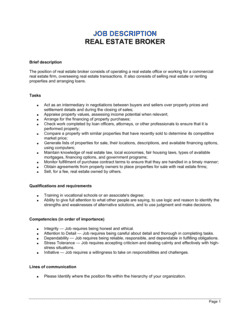
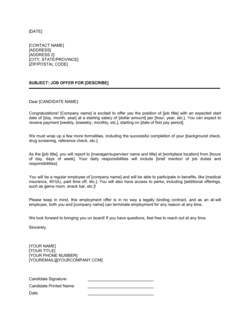
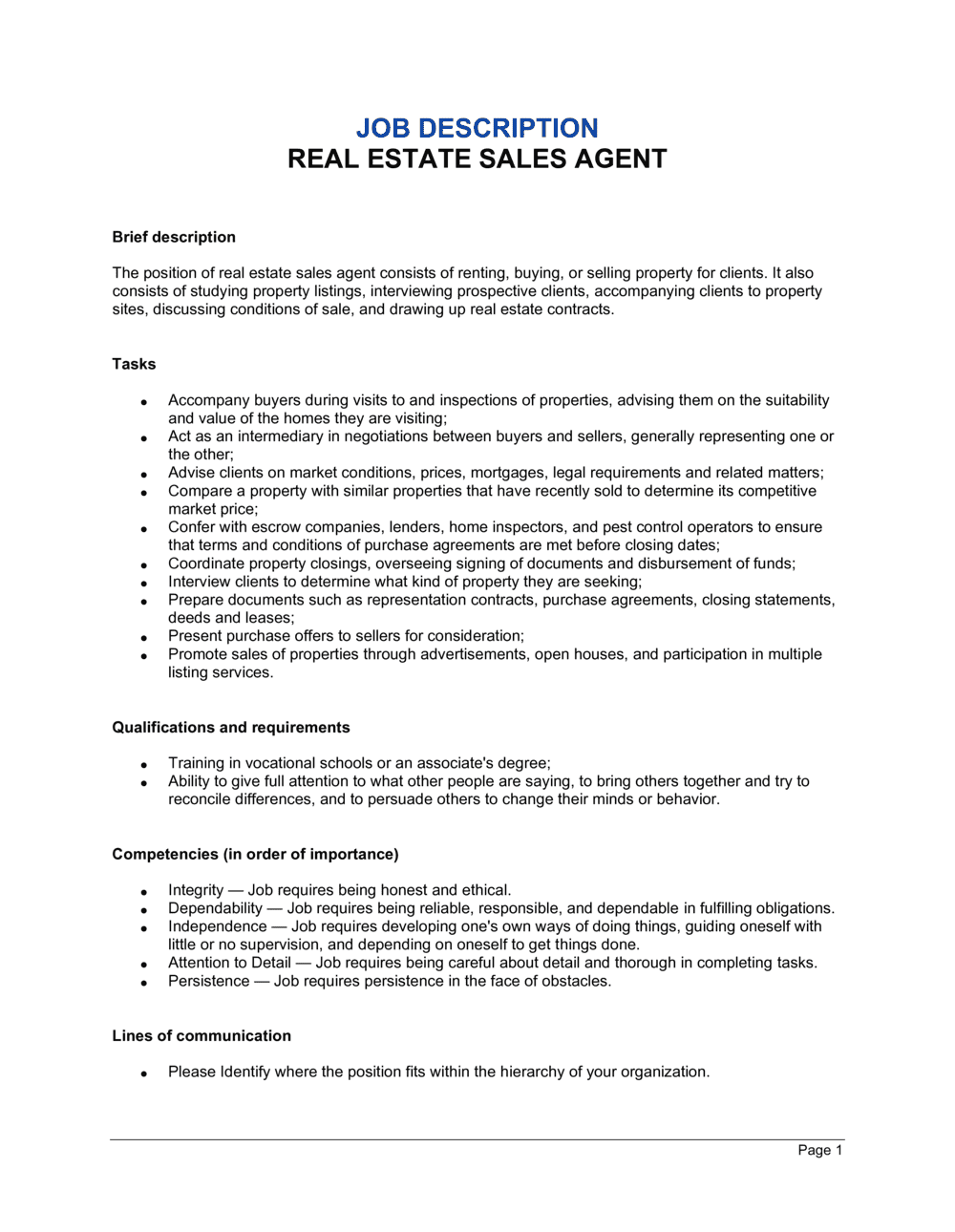
Real Estate Sales Agent Job Description Template

Free Word download • Edit online • Save & share with Drive • Export to PDF

2 pages20–30 min to fillDifficulty: StandardSignature requiredLegal review recommended
Learn more ↓
FreeReal Estate Sales Agent Job Description Template

At a glance

What it is
A Real Estate Sales Agent Job Description is a binding document used by brokerages and real estate firms to define the role, responsibilities, licensing requirements, compensation structure, and performance expectations of a sales agent. This free Word download is fully editable online and can be exported as PDF, giving brokers a professional, legally grounded starting point for onboarding new agents or formalizing existing arrangements.
When you need it
Use it when hiring a new residential or commercial sales agent, converting an informal arrangement into a documented role, or updating agent agreements to reflect changes in commission splits, licensing obligations, or regulatory requirements.
What's inside
Role title and reporting structure, primary duties and sales responsibilities, licensing and continuing-education requirements, commission structure and payment terms, performance expectations, confidentiality obligations, independent contractor or employment classification, and termination conditions.

What is a Real Estate Sales Agent Job Description?

A Real Estate Sales Agent Job Description is a formal binding document that defines the role, duties, licensing obligations, commission structure, and performance expectations of a licensed sales agent working under a sponsoring broker. It functions simultaneously as an HR-facing role definition and a legally enforceable agreement covering independent contractor classification, confidentiality, non-solicitation, and termination mechanics. Because real estate agents operate at the intersection of licensing law, contract law, and labor law, this document carries greater legal weight than a standard job description and must be drafted with care.

Why You Need This Document

Without a signed, comprehensive job description in place before an agent begins licensed activity, a brokerage faces four serious exposures at once. First, an undocumented commission structure becomes a credibility contest the moment a high-value deal closes and the agent disputes their split. Second, without a confidentiality and non-solicitation clause, a departing agent walks out the door with the brokerage's client list and pending listings — and faces no enforceable restriction on contacting them. Third, if the employment classification is not stated and substantiated in writing, the IRS and state labor agencies have no basis to treat the arrangement as an independent contractor relationship, creating back-tax liability that can reach two or more years of unpaid payroll taxes. Fourth, pending transactions at the time of departure become litigation fodder without a clear tail-commission clause. This template gives brokerages a complete, professionally structured starting point that closes all four gaps in under 30 minutes.

Which variant fits your situation?

If your situation is…Use this template
Engaging an agent as an independent contractor rather than an employeeReal Estate Independent Contractor Agreement
Hiring a buyer's agent focused exclusively on representing purchasersBuyer's Agent Job Description
Defining a listing agent role for residential property salesReal Estate Listing Agent Job Description
Onboarding a commercial real estate agent with different licensing requirementsCommercial Real Estate Agent Job Description
Formalizing a property manager's duties alongside sales responsibilitiesProperty Manager Job Description
Documenting a team lead or senior agent supervising junior agentsReal Estate Team Leader Job Description
Hiring an assistant or administrative support for a sales teamReal Estate Administrative Assistant Job Description

Common mistakes to avoid

❌ Misclassifying the agent's employment status

Why it matters: Treating an agent as an independent contractor while exercising employee-level control over their schedule and methods creates IRS misclassification liability, back taxes, and state labor penalties that can exceed two years of payroll taxes plus interest.

Fix: Audit the actual working arrangement against the IRS 20-factor test and your state's ABC test before choosing a classification. If controls are significant, classify as W-2 and structure accordingly.

❌ No provision for license lapse or revocation

Why it matters: If an agent's license lapses mid-transaction and the brokerage unknowingly allows them to continue, the brokerage violates state licensing law and may face regulatory action, fines, or loss of its own broker license.

Fix: Include a clause requiring immediate suspension of all licensed activity upon license lapse and automatic termination if the license is not reinstated within 30 days.

❌ Stating commissions are earned at contract execution rather than closing

Why it matters: Real estate transactions fall through — if commissions vest at contract signing, the brokerage owes the agent money on deals that never funded, creating cash flow exposure and potential disputes.

Fix: State explicitly that commissions are earned and payable only upon successful closing and receipt of gross commission by the brokerage.

❌ Omitting a tail commission clause for transactions pending at termination

Why it matters: The most common post-departure dispute in real estate is whether a departed agent is owed commission on a deal they originated that closes after their last day. Silence on this point leads to litigation.

Fix: Define a clear rule — for example, the agent earns commission on transactions under signed purchase agreement at the termination date, provided the deal closes within 60 days, subject to the standard split.

❌ Drafting a non-solicitation clause covering all past clients

Why it matters: Courts regularly void non-solicitation clauses that restrict agents from contacting clients they personally originated before joining the brokerage, finding them an unreasonable restraint on trade.

Fix: Limit the non-solicitation to clients the brokerage introduced to the agent during the engagement. Document which clients were brokerage-originated at the time of onboarding.

❌ No E&O insurance requirement stated in the document

Why it matters: If an agent causes an errors-and-omissions claim and carries no coverage, the brokerage's own E&O policy becomes the first line of defense — increasing the brokerage's premiums and exposure.

Fix: Require agents to maintain individual E&O coverage at a stated minimum (typically $250,000–$1,000,000 per occurrence) and to provide proof of coverage at signing and each renewal.

The 10 key clauses, explained

Job Title, Classification, and Reporting Structure

In plain language: Identifies the role as Real Estate Sales Agent, states whether the agent is classified as an independent contractor or W-2 employee, and names the supervising broker.

Sample language
Position: Real Estate Sales Agent. Classification: Independent Contractor / Employee (select one). Reports to: [SUPERVISING BROKER NAME], Licensed Broker, [BROKERAGE LEGAL NAME].

Common mistake: Labeling an agent as an independent contractor while imposing employee-level controls over schedule and methods — this misclassification exposes the brokerage to IRS back-tax liability and state labor penalties.

Duties and Sales Responsibilities

In plain language: Lists the core functions the agent is expected to perform, including prospecting, listing, showing property, negotiating offers, and managing transactions to close.

Sample language
Agent shall: (a) prospect for buyers and sellers through [METHODS]; (b) list residential properties in the MLS within [X] hours of executed listing agreement; (c) represent clients in purchase and sale negotiations; (d) coordinate inspections, appraisals, and closings; and (e) comply with all applicable MLS rules and brokerage policies.

Common mistake: Omitting MLS compliance and brokerage policy obligations from the duties clause — leaving no documented basis for termination if an agent violates MLS rules or fair housing laws.

Licensing and Continuing Education Requirements

In plain language: States the minimum license level required (salesperson license, not broker), the jurisdiction of licensure, E&O insurance requirements, and mandatory CE obligations.

Sample language
Agent must maintain an active real estate salesperson license issued by [STATE / PROVINCE] at all times during engagement. Agent shall complete [X] hours of CE by [RENEWAL DATE] and provide proof of renewal to the Broker. Agent shall maintain E&O insurance with minimum coverage of $[AMOUNT] per occurrence.

Common mistake: Not specifying what happens if the agent's license lapses — failing to address this means the brokerage may unknowingly continue paying a commission to an unlicensed agent, which is illegal in every US state.

Commission Structure and Payment Terms

In plain language: Defines the commission split percentage, when commissions are earned (at closing), how and when the brokerage disburses the agent's share, and any desk fees or transaction fees deducted.

Sample language
Agent shall receive [X]% of gross commission income earned on transactions closed during the term. Commissions are earned upon closing and disbursed within [5] business days of receipt by Broker. A transaction fee of $[AMOUNT] per closed deal shall be deducted prior to disbursement.

Common mistake: Stating that commissions are earned at contract execution rather than at closing — if a deal falls through, the brokerage may owe the agent a commission on a transaction that never funded.

Performance Expectations and Minimum Production

In plain language: Sets measurable activity or production targets — minimum closed transactions per quarter, minimum listing volume, or minimum GCI — that define satisfactory performance.

Sample language
Agent is expected to close a minimum of [X] transactions per calendar quarter and maintain a minimum gross commission income of $[AMOUNT] annually. Failure to meet minimum production for [2] consecutive quarters may result in review or termination of this Agreement.

Common mistake: Setting no minimum production requirements at all — this makes it difficult to exit a non-performing agent arrangement without dispute, especially for independent contractors who claim continued engagement.

Independent Contractor Obligations and Expense Responsibility

In plain language: Clarifies that as an independent contractor, the agent is responsible for their own taxes, business expenses, marketing costs, and professional dues — the brokerage does not withhold income tax or pay employment taxes.

Sample language
As an independent contractor, Agent is solely responsible for all federal, state, and local taxes on commissions earned. Agent shall bear costs of personal marketing materials, MLS dues, lockbox fees, and professional association memberships unless otherwise agreed in writing.

Common mistake: Providing regular expense reimbursements, set hours, or mandatory training attendance for someone classified as an independent contractor — each control factor increases misclassification risk under the IRS 20-factor test.

Confidentiality and Client Data

In plain language: Prohibits the agent from disclosing or misusing the brokerage's client lists, transaction data, pricing strategies, or proprietary systems during and after the engagement.

Sample language
Agent shall not, during or after the term, disclose or use any Confidential Information of the Brokerage, including client lists, transaction records, commission rates, or marketing systems, without prior written consent of Broker. 'Confidential Information' excludes information independently obtained by Agent or available in the public domain.

Common mistake: Failing to define 'Confidential Information' specifically — an overly broad definition covering all real estate knowledge is unenforceable, while an overly narrow one may not protect the brokerage's actual client database.

Non-Solicitation

In plain language: Restricts a departing agent from soliciting the brokerage's active clients, pending listings, or other agents for a defined period after the engagement ends.

Sample language
For [12] months following termination, Agent shall not directly or indirectly solicit any client, customer, or active listing of the Brokerage, nor recruit any agent or employee of the Brokerage to leave or reduce their association with the Brokerage.

Common mistake: Applying a non-solicitation clause to all former clients regardless of who originated the relationship — courts frequently strike down restrictions on clients the agent personally brought to the brokerage before joining.

Termination and License Transfer

In plain language: States the notice period required for voluntary departure, the conditions that permit immediate termination for cause, and the mechanics for transferring the agent's license to a new sponsoring broker.

Sample language
Either party may terminate this Agreement with [30] days' written notice. Broker may terminate immediately for Cause, including license revocation, fraud, or material breach of this Agreement. Upon termination, Agent shall cooperate in transferring sponsorship of the license to a designated successor broker within [5] business days.

Common mistake: No provision for pending transactions at termination — leaving unresolved whether the departing agent is owed commission on deals that close after their last day.

Governing Law and Dispute Resolution

In plain language: Identifies the jurisdiction whose real estate licensing law and general contract law governs the agreement, and specifies whether disputes go to arbitration, mediation, or court.

Sample language
This Agreement is governed by the laws of [STATE / PROVINCE]. Any dispute shall first be submitted to non-binding mediation before [MEDIATION SERVICE] in [CITY]. If unresolved within [30] days, either party may pursue binding arbitration under [AAA] rules.

Common mistake: Selecting a governing jurisdiction different from the state where the agent holds their license — several state real estate commissions require disputes involving licensees to be resolved under local law regardless of what the contract says.

How to fill it out

  1. 1

    Identify the brokerage legal entity and sponsoring broker

    Enter the brokerage's full registered legal name, state of incorporation, and the name and license number of the supervising broker who will hold the agent's license. This is required by most state real estate commissions.

    💡 Use the exact legal name from your broker's license certificate — trade names alone are insufficient for regulatory compliance.

  2. 2

    Select and state the employment classification

    Decide whether the agent will be classified as an independent contractor (1099) or W-2 employee based on your brokerage's operating model and state labor law. Mark this clearly in the classification field and ensure the rest of the document's controls are consistent with the chosen classification.

    💡 If you require set hours, mandatory meetings, or provide equipment, independent contractor status is difficult to defend — consult a labor attorney before deciding.

  3. 3

    Define duties and MLS obligations specifically

    List the core sales responsibilities — prospecting methods, listing timelines, showing requirements, and transaction management expectations. Include explicit references to MLS rules and fair housing compliance.

    💡 Tie duties to specific timelines (e.g., 'list in MLS within 24 hours') to make performance management objective rather than subjective.

  4. 4

    Set the commission split and any deductions

    Enter the commission split percentage, confirm that commissions are earned at closing, and list any deductions (desk fee, transaction fee, E&O charge) applied before disbursement.

    💡 Specify the disbursement timeline in business days — 'within 5 business days of brokerage receipt' is enforceable; 'promptly' is not.

  5. 5

    State licensing and E&O insurance requirements

    Enter the state or province of licensure, the license renewal date, the CE hours required, and the minimum E&O coverage amount. Include what happens if the license lapses — typically immediate suspension of activity and commission accrual.

    💡 Set a calendar reminder to audit agent license renewal dates 90 days before expiry — a lapsed license creates regulatory exposure for the brokerage, not just the agent.

  6. 6

    Calibrate non-solicitation scope to the agent's role

    Limit the non-solicitation clause to clients the brokerage introduced to the agent, not clients the agent brought with them. Set a duration of 6–12 months and a clear geographic scope tied to the brokerage's operating area.

    💡 Non-solicitation of fellow agents within the brokerage is harder to enforce than client non-solicitation — consider whether you need it and whether your state permits it.

  7. 7

    Address pending transactions at termination

    Add a clause specifying whether the agent earns commission on transactions that were under contract at the time of termination but close afterward, and who manages those files during transition.

    💡 A clear 'tail commission' provision prevents the most common post-termination dispute in real estate brokerage arrangements.

  8. 8

    Execute before the agent begins any licensed activity

    Both the supervising broker and the agent must sign the agreement before the agent represents any buyer or seller. In most states, an agent cannot legally conduct licensed activities until formally affiliated with a sponsoring broker.

    💡 Retain a countersigned copy in the agent's personnel file and submit the affiliation paperwork to the state real estate commission on the same day.

Frequently asked questions

What is a real estate sales agent job description?

A real estate sales agent job description is a formal document that defines the duties, licensing requirements, commission structure, performance expectations, and legal obligations of a sales agent working under a licensed sponsoring broker. It functions as both an HR reference document and a binding contractual agreement governing the working relationship between the agent and the brokerage.

Is a real estate sales agent job description legally binding?

Yes, when signed by both the sponsoring broker and the agent, a real estate sales agent job description generally functions as a binding contract. It creates enforceable obligations regarding commission splits, confidentiality, non-solicitation, and termination. Courts have upheld provisions in these documents — including non-solicitation clauses and commission structures — when they are clearly drafted and properly executed.

Should a real estate agent be classified as an employee or independent contractor?

Most real estate brokerages in the US classify sales agents as independent contractors under IRS Revenue Ruling 87-41 and state real estate licensing statutes that explicitly authorize independent contractor arrangements. However, classification depends on the actual working relationship — if the brokerage controls work methods, sets hours, or provides tools and training, the IRS and state labor agencies may reclassify the agent as a W-2 employee regardless of what the contract says. Consult a labor attorney before choosing a classification.

What commission split is standard for a real estate sales agent?

Commission splits vary widely by brokerage model. Traditional brokerages typically offer 50/50 to 70/30 (agent/broker) splits. High-production agents at competitive brokerages may negotiate 80/20 or higher. Flat-fee and 100% commission brokerages charge a desk fee or transaction fee in lieu of a percentage split. The split should be clearly stated in the job description along with any fees deducted before disbursement.

What happens to an agent's pending transactions when they leave a brokerage?

This depends on what the job description and affiliation agreement say. A well-drafted document includes a 'tail commission' clause specifying that the agent earns their split on transactions that were under signed purchase agreement at the termination date and close within a defined window — typically 30–90 days. Without this clause, the brokerage and departing agent face ambiguity that frequently leads to disputes or litigation.

Does a real estate agent job description need to include E&O insurance requirements?

Yes — specifying E&O insurance requirements in the job description protects the brokerage from being the sole insurer when an agent's error or omission generates a claim. Most state real estate commissions do not mandate agent-level E&O coverage, so without a contractual requirement, agents may carry none. A minimum of $250,000 per occurrence is a common threshold in brokerage affiliation documents.

Are non-solicitation clauses enforceable for real estate agents?

Non-solicitation clauses are generally enforceable in most US states and Canadian provinces when limited to clients the brokerage originated during the engagement, reasonable in duration (typically 6–12 months), and narrowly scoped to the brokerage's operating territory. Courts tend to strike down clauses that cover clients the agent brought to the brokerage independently or that extend to geographic areas where the brokerage does not actively operate.

What is the difference between a real estate sales agent job description and an independent contractor agreement?

A job description defines the role, duties, licensing requirements, and performance expectations — it reads as the employment-facing document. An independent contractor agreement is the legal contract governing the business relationship, covering tax classification, liability, IP, commission structure, and termination in full legal detail. In practice, many brokerages combine both into a single signed document. For independent contractor arrangements, both a detailed job description and a standalone ICA are best practice.

How often should a real estate sales agent job description be updated?

Review the document annually or whenever commission structures change, state licensing requirements are amended, or the brokerage's policies are updated. Significant changes — such as a shift from independent contractor to W-2 status, or a change in commission split — require a new signed agreement, not just a policy memo. Keeping stale job descriptions in force creates contradictions between the written document and actual practice that courts resolve against the party that drafted it.

How this compares to alternatives

vs Independent Contractor Agreement

An independent contractor agreement is the formal legal contract governing the business relationship — classification, liability, IP, and termination. A job description defines the role and day-to-day expectations. Real estate brokerages should use both: the ICA as the governing contract and the job description as the operational supplement. Using the job description alone as the only signed document leaves key legal protections unaddressed.

vs Employment Contract

An employment contract is used when the agent is classified as a W-2 employee, providing statutory benefits, tax withholding, and employment law protections. A real estate sales agent job description is most commonly paired with an independent contractor classification. Using an employment contract for agents provides greater legal clarity but increases payroll costs and regulatory obligations for the brokerage.

vs Property Manager Job Description

A property manager job description covers leasing, tenant relations, maintenance coordination, and asset management — ongoing operational duties rather than transactional sales. A sales agent job description focuses on listing, showing, and closing transactions. The two roles require different license types in most jurisdictions and should be documented separately.

vs Offer Letter

An offer letter confirms compensation and role to secure a candidate's acceptance but is not a comprehensive governing document. It typically lacks commission structure details, licensing obligations, non-solicitation terms, and termination mechanics. Relying on an offer letter alone for a real estate agent engagement leaves the brokerage without enforceable restrictions on departure and creates ambiguity on commission disputes.

Industry-specific considerations

Residential Real Estate

Commission split structures, MLS membership requirements, open-house duties, and buyer/seller representation obligations are the core focus in residential sales brokerage.

Commercial Real Estate

Longer deal cycles, co-brokerage arrangements, tenant-representation splits, and separate licensing requirements in some states distinguish commercial agent job descriptions from residential ones.

Property Development and New Builds

Sales agents for new developments often work on-site with fixed compensation structures that blend base salary, commission per unit sold, and incentive bonuses tied to project milestones.

Property Management and Leasing

When sales agents also handle leasing activity, the job description must address the separate licensing requirements, leasing commission structures, and tenant screening duties that differ from transaction sales.

Jurisdictional notes

United States

Real estate agent licensing is regulated at the state level — there is no federal real estate license. Each state's Real Estate Commission sets education requirements, exam criteria, and renewal obligations. California, New York, and Florida impose among the strictest licensing and supervision requirements. Independent contractor status for agents is explicitly recognized by IRS Revenue Ruling 87-41 and most state real estate licensing statutes, but the actual working arrangement must be consistent with contractor classification to withstand scrutiny.

Canada

Real estate licensing in Canada is provincially regulated. In Ontario, agents are licensed through RECO under the Trust in Real Estate Services Act (TRESA) as of 2023. British Columbia licenses agents through the BC Financial Services Authority. Quebec regulates agents under the Real Estate Brokerage Act, and contracts for Quebec agents must be available in French. Minimum education and continuing education requirements vary by province and are generally more prescriptive than US state requirements.

United Kingdom

Real estate agents in the UK are not currently subject to mandatory statutory licensing, though the Property Agents Working Group has recommended a licensing regime. Agents must comply with the Estate Agents Act 1979, the Consumer Protection from Unfair Trading Regulations 2008, and AML obligations under the Money Laundering Regulations 2017. Self-employed agent arrangements are common, but HMRC applies the IR35 rules where an agent works predominantly for one brokerage — employment classification must be assessed carefully.

European Union

Real estate agent regulation varies significantly across EU member states. Germany requires a trade license (Gewerbeerlaubnis) under §34c GewO; France requires a professional card (carte professionnelle) issued by the Chambre de Commerce. Spain and Italy also impose licensing requirements. GDPR applies to all client data handled by agents operating in the EU, and job descriptions should reference data protection obligations explicitly. Post-employment non-compete and non-solicitation clauses may require financial compensation to the agent to be enforceable in several member states.

Template vs lawyer — what fits your deal?

PathBest forCostTime
Use the templateSmall residential brokerages hiring standard independent contractor agents in a single stateFree20–30 minutes
Template + legal reviewBrokerages in California, New York, or other states with complex agent classification rules, or those adding equity or profit-sharing arrangements$300–$7502–4 days
Custom draftedMulti-state brokerages, franchise operations, commercial real estate firms, or arrangements that blend W-2 and 1099 classifications$1,000–$3,500+1–3 weeks

Glossary

Sponsoring Broker
The licensed broker legally responsible for supervising a sales agent's real estate activities and holding the agent's license on behalf of the brokerage.
Commission Split
The agreed percentage division of earned commission between the agent and the brokerage, typically expressed as agent share/broker share (e.g., 70/30).
Independent Contractor Status
A classification under IRS guidelines and state law where the agent controls their own work methods and schedule, with taxes paid by the individual rather than withheld by the brokerage.
MLS (Multiple Listing Service)
A cooperative database used by licensed agents and brokers to share property listings and access buyer and seller information within a region.
Fiduciary Duty
The legal obligation of a real estate agent to act in the best interests of their client — including duties of loyalty, disclosure, confidentiality, obedience, and reasonable care.
Continuing Education (CE)
Mandatory coursework required by state or provincial licensing authorities to maintain an active real estate license, typically 12–30 credit hours per renewal cycle.
Dual Agency
A situation where the same agent or brokerage represents both the buyer and the seller in a single transaction — restricted or prohibited in some jurisdictions.
Earnest Money
A deposit made by a buyer to demonstrate serious intent to purchase, held in escrow by the brokerage and credited toward the purchase price at closing.
At-Will Employment
An employment arrangement where either party may end the relationship at any time for any lawful reason — applicable to W-2 agent relationships in most US states, not to independent contractors.
Non-Solicitation Clause
A post-termination restriction preventing a departing agent from soliciting the brokerage's clients, listings, or other agents for a defined period after leaving.
E&O Insurance (Errors and Omissions)
Professional liability insurance covering claims arising from an agent's mistakes, omissions, or negligence in the course of a real estate transaction.

Part of your Business Operating System

This document is one of 3,000+ business & legal templates included in Business in a Box.

  • Fill-in-the-blanks — ready in minutes
  • 100% customizable Word document
  • Compatible with all office suites
  • Export to PDF and share electronically

Create your document in 3 simple steps.

From template to signed document — all inside one Business Operating System.
1
Download or open template

Access over 3,000+ business and legal templates for any business task, project or initiative.

2
Edit and fill in the blanks with AI

Customize your ready-made business document template and save it in the cloud.

3
Save, Share, Send, Sign

Share your files and folders with your team. Create a space of seamless collaboration.

Save time, save money, and create top-quality documents.

★★★★★

"Fantastic value! I'm not sure how I'd do without it. It's worth its weight in gold and paid back for itself many times."

Managing Director · Mall Farm
Robert Whalley
Managing Director, Mall Farm Proprietary Limited
★★★★★

"I have been using Business in a Box for years. It has been the most useful source of templates I have encountered. I recommend it to anyone."

Business Owner · 4+ years
Dr Michael John Freestone
Business Owner
★★★★★

"It has been a life saver so many times I have lost count. Business in a Box has saved me so much time and as you know, time is money."

Owner · Upstate Web
David G. Moore Jr.
Owner, Upstate Web

Run your business with a system — not scattered tools

Stop downloading documents. Start operating with clarity. Business in a Box gives you the Business Operating System used by over 250,000 companies worldwide to structure, run, and grow their business.

Start free · No credit card required